2736
Neural Semi-Markov Conditional Random Fields for
Robust Character-Based Part-of-Speech Tagging
Apostolos Kemos2∗ Heike Adel1,3∗
1 Center for Information and Language Processing (CIS), LMU Munich, Germany 2Department of Computer Engineering and Informatics, University of Patras, Greece
3 Bosch Center for Artificial Intelligence (BCAI), Renningen, Germany
[email protected] [email protected] [email protected]
Hinrich Sch ¨utze1
Abstract
Character-level models of tokens have been shown to be effective at dealing with within-token noise and out-of-vocabulary words. However, they often still rely on correct token boundaries. In this paper, we propose to elim-inate the need for tokenizers with an end-to-end character-level semi-Markov conditional random field. It uses neural networks for its
character and segment representations. We
demonstrate its effectiveness in multilingual settings and when token boundaries are noisy: It matches state-of-the-art part-of-speech tag-gers for various languages and significantly outperforms them on a noisy English version
of a benchmark dataset. Our code and the
noisy dataset are publicly available athttp:
//cistern.cis.lmu.de/semiCRF.
1 Introduction
Recently, character-based neural networks (NNs) gained popularity for different tasks, ranging from text classification (Zhang et al., 2015) and
language modeling (Kim et al., 2016) to
ma-chine translation (Luong and Manning, 2016). Character-level models are attractive since they can effectively model morphological variants of words and build representations even for unknown words, suffering less from out-of-vocabulary problems (Pinter et al.,2017).
However, most character-level models still rely on tokenization and use characters only for cre-ating more robust token representations (Santos
and Zadrozny,2014;Lample et al.,2016;Ma and
Hovy,2016;Plank et al.,2016). This leads to high
performance on well-formatted text or text with misspellings (Yu et al., 2017; Sakaguchi et al.,
2017) but ties the performance to the quality of the tokenizer. While humans are very robust to
* Work was done at Center for Information and Lan-guage Processing, LMU Munich.
noise caused by insertion of spaces (e.g., “car ni-val”) or deletion of spaces (“deeplearning”), this can cause severe underperformance of machine learning models. Similar challenges arise for lan-guages with difficult tokenization, such as Chinese or Vietnamese. For text with difficult or noisy to-kenization, more robust models are needed.
In order to address this challenge, we propose a model that does not require any tokenization. It is based on semi-Markov conditional random fields (semi-CRFs) (Sarawagi and Cohen,2005) which jointly learn to segment (tokenize) and label the input (e.g., characters). To represent the character segments, we compare different NN approaches.
In our experiments, we address part-of-speech
(POS) tagging. However, our model is
gener-ally applicable to other sequence-tagging tasks as well since it does not require any task-specific hand-crafted features. Our model achieves state-of-the-art results on the Universal Dependencies dataset (Nivre et al., 2015). To demonstrate its effectiveness, we evaluate it not only on English but also on languages with inherently difficult to-kenization, namely Chinese, Japanese and Viet-namese. We further analyze the robustness of our model against difficult tokenization by randomly corrupting the tokenization of the English dataset. Our model significantly outperforms state-of-the-art token-based models in this analysis.
Our contributions are: 1) We present a truly end-to-end character-level sequence tagger that does not rely on any tokenization and achieves state-of-the-art results across languages. 2) We show its robustness against noise caused by cor-rupted tokenization, further establishing the im-portance of character-level models as a promis-ing research direction. 3) For future research, our code and the noisy version of the dataset are
publicly available at http://cistern.cis.
2 Model
This section describes our model which is also de-picted in Figure1.
2.1 Character-based Input Representation
The input to our model is the raw character se-quence. We convert each character to a one-hot representation. Out-of-vocabulary characters are represented with a zero vector. Our vocabulary does not include the space character since there is no part-of-speech label for it. Instead, our model represents space as two “space features” (lowest level in Figure1): two binary dimensions indicate whether the previous or next character is a space. Then, a linear transformation is applied to the ex-tended one-hot encoding to produce a character
embedding. The character embeddings are fed
into a bidirectonal LSTM (biLSTM) (Hochreiter
and Schmidhuber, 1997) that computes
context-aware representations. These representations form the input to the segment-level feature extractor.
2.2 Semi-Markov CRF
Our model partitions a sequence of charactersx= {x1, . . . , xT} of length T, into (token-like) seg-ments s ={s1, . . . , s|s| } withsj = haj, dj, yji whereajis the starting position of thejthsegment,
dj is its length and yj is its label. Thus, it as-signs the same label yj to the whole segmentsj. The sum of the lengths of the segments equals the number of non-space characters:P|s|
j=1dj =T.1
The semi-CRF defines the conditional distribu-tion of the input segmentadistribu-tions as:
p(s|x)=Z(1x)exp(P|s|
j=1F(sj, x)+A(yj−1, yj))
Z(x)=P
s0∈Sexp(P |s0|
j=1F(s0j, x)+A(yj0−1, yj0))
whereF(sj, x)is the score for segmentsj (includ-ing its labelyj), andA(yt−1, yt) is the transition score of the labels of two adjacent segments. Thus, p(s|x) jointly models the segmentation and label assignment. For the normalization termZ(x), we sum over the set of all possible segmentationsS.
The scoreF(sj, x)is computed as:
F(sj, x) =w>yjf(sj, x) +byj
where W = (w1, . . . ,w|Y|)> ∈ R|Y|×D and
1For efficiency, we define a maximum segment lengthL:
dj < L,1≤j≤ |s|. Lis a hyperparameter. We choose it based on the observed segment lengths in the training set.
T h e f o x
... 1-ho t ve ct or sp ac e fe at ur e ... ... ... ... ... em be dd in g bi L S T M gr C on v <1,3,DET> <4,3,NN> ou tp ut ch ar ac te r-ba se d in pu t r ep re se nt at io n se m i-C R F
zk zk+1
zk zk
d-1 d-1 d
d
WL WR
θL θR
θ
[image:2.595.329.503.61.298.2]M
Figure 1: Overview of our model. Illustration of gating
for grConv taken from (Zhuo et al.,2016).
b = (b1, . . . , b|Y|)> ∈ R|Y| are trained
parame-ters, f(sj, x) ∈ RD is the feature representation
of the labeled segment sj, |Y| is the number of output classes andDis the length of the segment representation.
For training and decoding, we use the semi-Markov analogies of the forward and Viterbi algo-rithm, respectively (Sarawagi and Cohen, 2005). In order to avoid numerical instability, all compu-tations are performed in log-space.
2.2.1 Segment-level Features
Sarawagi and Cohen(2005) andYang and Cardie
(2012) compute segment-level features by hand-crafted rules. Recent work learns the features au-tomatically with NNs (Kong et al., 2015; Zhuo
et al., 2016). This avoids the manual design of
new features for new languages/tasks. We adopt
Gated Recursive Convolutional Neural Networks
(grConv) (Cho et al., 2014; Zhuo et al., 2016) since they allow to hierarchically combine features for segments. We argue that this is especially use-ful for compositionality in language. An example is the word “airport” which can be composed of the segments “air” and “port”.
GrConv constructs features by recursively com-bining adjacent segment representations in a pyra-mid shape way (see Figure 1). The dth level of
char-acter representations from our biLSTM. The rep-resentation zk(d) ∈ RD, stored in the kth node of
layerd, is computed as follows:
zk(d)=θL◦z(d −1)
k +θR◦z
(d−1)
k+1 +θM ◦zˆk (d)
withzˆk(d)=g(WLz
(d−1)
k +WRz
(d−1)
k+1 +bw)
whereWL, WR ∈RD×D andbw ∈RD are
glob-ally shared parameters,θL,θM andθRare gates,g is a non-linearity and◦denotes element-wise mul-tiplication. The gates are illustrated in the blue box of Figure1and described in (Zhuo et al.,2016).
3 Experiments and Analysis
Our implementation is in PyTorch (Paszke et al.,
2017). Hyperparameters are tuned on the devel-opment set. We use mini-batch gradient descent
with a batch size of 20 and Adam (Kingma and
Ba, 2014) as the optimizer. The learning rate is 1e-3, the coefficients for computing running av-erages of the gradient and its square are 0.9 and 0.999, respectively. A term of 1e-8 is added to the denominator for numerical stability. We use character embeddings of size 60 and three stacked biLSTM layers with 100 hidden units for each di-rection. For the semi-CRF, we set the maximum
segment length to L = 23 as tokens of bigger
length are rarely seen in the training sets. To avoid overfitting, we apply dropout with a probability of 0.25 on each layer including the input. For input dropout, we randomly replace a character embed-ding with a zero vector, similar to Gillick et al.
(2016). This avoids overfitting to local character patterns. Moreover, we employ early stopping on the development set with a minimum of 20 train-ing epochs. We run our experiments on a gpu which speeds up the training compared to multiple cpu cores considerably. We assume that it espe-cially benefits from parallelizing the computation of each level of the grConv pyramid.
3.1 Multilingual Experiments on Clean Data
Data and Evaluation. To compare our model to state-of-the-art character-based POS taggers, we evaluate its accuracy on the English part of the Universal Dependencies (UD) v1.2 dataset (Nivre
et al., 2015). For multilingual experiments, we
use the English (EN), Chinese (ZH), Japanese (JA) and Vietnamese (VI) part of UD v2.02(Nivre and
2UD v1.2 does not provide data for JA, VI, ZH.
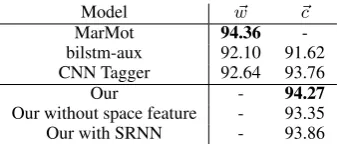
Model w~ ~c
MarMot 94.36 -bilstm-aux 92.10 91.62 CNN Tagger 92.64 93.76 Our - 94.27
[image:3.595.332.501.61.133.2]Our without space feature - 93.35 Our with SRNN - 93.86
Table 1: POS tag accuracy on UD v1.2 (EN). ’-’ denotes that the model does not use this input.
ˇ
Zeljko Agic,2017), using the splits, training and
evaluation rules from the CoNNL 2017 shared task
(Zeman et al., 2017). In particular, we calculate
joint tokenization and UPOS (universal POS) F1
scores.
Baselines for UD v1.2. We compare our model to two character-based models that are state of the art on UD v1.2: bilstm-aux(Plank et al., 2016) andCNN Tagger(Yu et al.,2017). We also com-pare to a state-of-the-art word-based CRF model MarMot3(M¨uller and Sch¨utze,2015).
Results on English (UD v1.2). Table 1 pro-vides our results on UD v1.2, categorizing the models into token-level (w~) and character-only models (~c). While most pure character-level mod-els cannot ensure consistent labmod-els for each charac-ter of a token, our semi-CRF outputs correct seg-ments in most cases (tokenization F1 is 98.69%,
see Table4), and ensures a single label for all char-acters of a segment. Our model achieves the best results among all character-level models and com-parable results to the word-level model MarMot.
In addition, we assess the impact of two compo-nents of our model: the space feature (see Section
2.1) and grConv (see Section2.2.1). Table1shows that the performance of our model decreases when ablating the space feature, confirming that infor-mation about spaces plays a valuable role for
En-glish. To evaluate the effectiveness of grConv
for segment representations, we replace it with a
Segmental Recurrent Neural Network (SRNN)
(Kong et al., 2015).4 SRNN uses dynamic
pro-gramming and biLSTMs to create segment repre-sentations. Its performance is slightly worse com-pared to grConv (last row of Table1). We attribute
3http://cistern.cis.lmu.de/marmot/ 4
UDPipe 1.2 Stanford FBAML TRL IMS Our Tokens POS Tokens POS Tokens POS Tokens POS Tokens POS Tokens POS EN 99.03 93.50 98.67 95.11 98.98 94.09 94.31 82.41 98.67 93.29 98.79 93.45
[image:4.595.78.527.61.134.2]JA 90.97 88.19 89.68 88.14 93.32 91.04 98.59 98.45 91.68 89.07 93.86 91.34 VI 84.26 75.29 82.47 75.28 83.80 75.84 85.41 74.53 86.67 77.88 88.06 77.67 ZH 89.55 83.47 88.91 85.26 94.57 88.36 83.64 71.31 92.81 86.33 93.82 88.15 Avg 90.95 85.11 89.93 85.95 92.67 87.33 90.49 81.68 92.46 86.64 93.66 87.65
Table 2: Tokenization and joint token-POSF1on UD v2.0. Best scores are in bold, second-best are underlined.
this to the different way of feature creation: While grConv hierarchically combines context-enhanced n-grams, SRNN constructs segments in a sequen-tial order. The latter may be less suited for com-positional segments like “airport”.
Baselines for UD v2.0. We compare to the top performing models for EN, JA, VI, ZH from the CoNLL 2017 shared task: UDPipe 1.2 (Straka
and Strakov´a,2017), Stanford (Dozat et al.,2017),
FBAML (Qian and Liu, 2017), TRL (Kanayama
et al.,2017), and IMS (Bj¨orkelund et al.,2017).
Multilingual Results (UD v2.0). Table2 pro-vides our results. While for each language another shared task system performs best, our system per-forms consistently well across languages (best or second-best except for EN), leading to the best av-erage scores for both tokenization and POS tag-ging. Moreover, it matches the state of the art for Chinese (ZH) and Vietnamese (VI), two languages with very different characteristics in tokenization.
3.2 Analysis on Noisy Data
To further investigate the robustness of our model, we conduct experiments with different levels of corrupted tokenization in English. We argue that this could also give us insights into why it per-forms well on languages with difficult tokeniza-tion, e.g., on Chinese which omits spaces between tokens, or on Vietnamese which has spaces inside tokens, after each syllable. Note that we do not ap-ply input dropout for these experiments, since the corrupt tokenization already acts as a regularizer.
Data. We are not aware of a POS tagging dataset with corrupted tokenization. Thus, we cre-ate one based on UD v1.2 (EN). For each token, we either delete the space after it with probabil-ityP = pdor insert a space between two charac-ters withP =pi:”The fox chased the rabbit”→
”The f ox cha sed therabbit”. We varypdandpi to construct three datasets with different noise lev-els (LOW, MID, HIGH, see Table3). We note that there are more sophisticated ways of creating “er-rors” in text. An example isKasewa et al.(2018)
who generate grammatical errors. We leave the investigation of other methods for generating tok-enization errors to future work.
level pd # deletions pi # insertions LOW 0.1 15198 0.05 26497 MID 0.3 39361 0.11 40474 HIGH 0.6 65387 0.33 68209
Table 3: Noisy dataset statistics (three different noise levels).
Labeling. As mentioned before, we either delete the space after a token with probabilitypd or insert a space between two of its characters with probabilitypi. We assign the label from the orig-inal token to every sub-token created by space in-sertion. For space deletions, we randomly choose one of the two original labels for training and eval-uate against the union of them. Figure2shows an example.
The fox chased the rabbit DET NOUN VERB DET NOUN
The f ox cha sed therabbit DET NOUN NOUN VERB VERB {DET|NOUN}
Figure 2: Example of label assignment.
Baseline. We compare our joint model to a tra-ditional pipeline of tokenizer (UDpipe 1.0)5 and token-level POS tagger (MarMot).6 We re-train MarMot on the corrupted datasets.
Evaluation. We evaluate the models on the noisy datasets using two different metrics: (i) to-kenization and joint token-POSF1 as in Table2,
and (ii) a relaxed variant of POS tag accuracies. With the latter, we can assess the performance of MarMot without penalizing it for potential errors of UDpipe. For calculating the relaxed accuracy, we count the POS tag of a gold token as correct if MarMot predicts the tag for any subpart of it.
5
http://lindat.mff.cuni.cz/services/udpipe/
6In contrast to Table1where we use gold tokens for
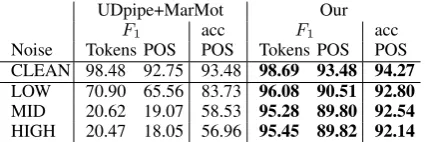
UDpipe+MarMot Our
F1 acc F1 acc
Noise Tokens POS POS Tokens POS POS CLEAN 98.48 92.75 93.48 98.69 93.48 94.27
LOW 70.90 65.56 83.73 96.08 90.51 92.80
MID 20.62 19.07 58.53 95.28 89.80 92.54
[image:5.595.76.289.62.133.2]HIGH 20.47 18.05 56.96 95.45 89.82 92.14
Table 4: TokenizationF1, joint token-POSF1and
(re-laxed) POS tag accuracies on noisy version of UD v1.2.
We provide more details on the relaxed evaluation (description, examples and implementation) in our code repository. Note that we apply the relaxed evaluation only to UDpipe+MarMot but not to our model. The output of our model is directly evalu-ated against the gold labels of the clean corpus.
Results. The performance of our model de-creases only slightly when increasing the noise level while the performance of UDpipe+MarMot drops significantly (Table 4). This confirms that our model is robust against noise from tokeniza-tion. Note that most other character-based models would suffer from the same performance drop as MarMot since they rely on tokenized inputs.
Discussion.The results in Table4show that our model can reliably recover token boundaries, even in noisy scenarios. This also explains its strong performance across languages: It can handle dif-ferent languages, independent of whether the lan-guage merges tokens without whitespaces (e.g., Chinese) or separates tokens with whitespaces into syllables (e.g., Vietnamese).
4 Related Work
Character-based POS Tagging. Most work uses characters only to build more robust token rep-resentations but still relies on external tokenizers
(Santos and Zadrozny,2014;Lample et al.,2016;
Plank et al., 2016; Dozat et al., 2017;Liu et al.,
2017). In contrast, our model jointly learns seg-mentation and POS tagging. Gillick et al. (2016) do not rely on tokenization either but in contrast to their greedy decoder, our model optimizes the whole output sequence and is able to revise lo-cal decisions (Lafferty et al.,2001). For process-ing characters, LSTMs (Lample et al.,2016;Plank
et al.,2016;Dozat et al.,2017) or CNNs (Ma and
Hovy,2016;Yu et al.,2017) are used. Our model
combines biLSTMs and grConv to model both the context of characters (LSTM) and the composi-tionality of language (grConv).
Joint Segmentation and POS Tagging. The
top performing models of EN, JA, VI and ZH use a pipeline of tokenizer and word-based POS tag-ger but do not treat both tasks jointly (Bj¨orkelund
et al.,2017;Dozat et al.,2017;Kanayama et al.,
2017;Qian and Liu, 2017). Especially for
Chi-nese, there is a lot of work on joint word segmen-tation and POS tagging, e.g., (Zhang and Clark,
2008;Sun,2011;Hatori et al.,2012;Zheng et al.,
2013;Kong et al.,2015;Cai and Zhao,2016;Chen
et al.,2017;Shao et al.,2017), of which some use
CRFs to predict one POS tag per character. How-ever, this is hard to transfer to languages like En-glish and Vietnamese where single characters are less informative and tokens are much longer, re-sulting in a larger combinatory label space. Thus, we choose a semi-Markov formalization to di-rectly model segments.
Semi-Markov CRFs for Sequence Tagging.
Zhuo et al. (2016) and Ye and Ling (2018)
ap-ply semi-CRFs to word-level inputs for named en-tity recognition. In contrast, we model character-based POS tagging. Thus, the expected length of our character segments is considerably larger than the expected length of word-based segments for
NER.Kong et al.(2015) build SRNNs that we use
as a baseline. In contrast to their 0-order model, we train a 1-order semi-CRF to model dependen-cies between segment labels.
5 Conclusion
We presented an end-to-end model for character-based part-of-speech tagging that uses semi-Markov conditional random fields to jointly
seg-ment and label a sequence of characters.
In-put representations and segment representations are trained parameters learned in end-to-end train-ing by the neural network part of the model. The model achieves state-of-the-art results on two benchmark datasets across several typologically diverse languages. By corrupting the tokeniza-tion of the dataset, we show the robustness of our model, explaining its good performance on lan-guages with difficult tokenization.
Acknowledgments
References
Anders Bj¨orkelund, Agnieszka Falenska, Xiang Yu, and Jonas Kuhn. 2017. IMS at the CoNLL 2017 UD shared task: CRFs and perceptrons meet
neu-ral networks. In Proceedings of the CoNLL 2017
Shared Task: Multilingual Parsing from Raw Text to Universal Dependencies, pages 40–51, Vancouver, Canada. Association for Computational Linguistics.
Deng Cai and Hai Zhao. 2016. Neural word
segmen-tation learning for chinese. In Proceedings of the
54th Annual Meeting of the Association for Compu-tational Linguistics (Volume 1: Long Papers), pages 409–420, Berlin, Germany. Association for Compu-tational Linguistics.
Xinchi Chen, Xipeng Qiu, and Xuanjing Huang. 2017. A feature-enriched neural model for joint chinese word segmentation and part-of-speech tagging. In
Proceedings of the 26th International Joint Con-ference on Artificial Intelligence, pages 3960–3966, Melbourne, Australia. AAAI Press.
Kyunghyun Cho, Bart van Merrienboer, Dzmitry Bah-danau, and Yoshua Bengio. 2014. On the properties of neural machine translation: Encoder–decoder
ap-proaches. InProceedings of SSST-8, Eighth
Work-shop on Syntax, Semantics and Structure in Statisti-cal Translation, pages 103–111, Doha, Qatar. Asso-ciation for Computational Linguistics.
Timothy Dozat, Peng Qi, and Christopher D Manning.
2017. Stanford’s graph-based neural dependency
parser at the CoNLL 2017 shared task. In
Proceed-ings of the CoNLL 2017 Shared Task: Multilingual Parsing from Raw Text to Universal Dependencies, pages 20–30, Vancouver, Canada. Association for Computational Linguistics.
Dan Gillick, Cliff Brunk, Oriol Vinyals, and Amarnag Subramanya. 2016. Multilingual language
process-ing from bytes. InProceedings of the 2016
Confer-ence of the North American Chapter of the Associ-ation for ComputAssoci-ational Linguistics: Human Lan-guage Technologies, pages 1296–1306, San Diego, California. Association for Computational Linguis-tics.
Jun Hatori, Takuya Matsuzaki, Yusuke Miyao, and Jun’ichi Tsujii. 2012. Incremental joint approach to word segmentation, pos tagging, and dependency
parsing in chinese. InProceedings of the 50th
An-nual Meeting of the Association for Computational Linguistics (Volume 1: Long Papers), pages 1045– 1053, Jeju Island, Korea. Association for Computa-tional Linguistics.
Sepp Hochreiter and J¨urgen Schmidhuber. 1997.
Long short-term memory. Neural computation,
9(8):1735–1780.
Hiroshi Kanayama, Masayasu Muraoka, and
Kat-sumasa Yoshikawa. 2017. A semi-universal
pipelined approach to the conll 2017 ud shared task. In Proceedings of the CoNLL 2017 Shared Task:
Multilingual Parsing from Raw Text to Universal Dependencies, pages 265–273, Vancouver, Canada. Association for Computational Linguistics.
Sudhanshu Kasewa, Pontus Stenetorp, and Sebastian
Riedel. 2018. Wronging a right: Generating
bet-ter errors to improve grammatical error detection. In Proceedings of the 2018 Conference on Em-pirical Methods in Natural Language Processing, pages 4977–4983, Brussels, Belgium. Association for Computational Linguistics.
Yoon Kim, Yacine Jernite, David Sontag, and Alexan-der M Rush. 2016. Character-aware neural language
models. In AAAI Conference on Artificial
Intelli-gence, pages 2741–2749. AAAI Press.
Diederik P Kingma and Jimmy Ba. 2014. Adam: A
method for stochastic optimization. InInternational
Conference on Learning Representations.
Lingpeng Kong, Chris Dyer, and Noah A Smith.
2015. Segmental recurrent neural networks. arXiv
preprint arXiv:1511.06018.
John D. Lafferty, Andrew McCallum, and Fernando
C. N. Pereira. 2001. Conditional random fields:
Probabilistic models for segmenting and labeling
se-quence data. In International Conference on
Ma-chine Learning, pages 282–289. Morgan Kaufmann Publishers Inc.
Guillaume Lample, Miguel Ballesteros, Sandeep Sub-ramanian, Kazuya Kawakami, and Chris Dyer. 2016. Neural architectures for named entity recognition. InProceedings of the 2016 Conference of the North American Chapter of the Association for Computa-tional Linguistics: Human Language Technologies, pages 260–270, San Diego, California. Association for Computational Linguistics.
Liyuan Liu, Jingbo Shang, Frank Xu, Xiang Ren, Huan Gui, Jian Peng, and Jiawei Han. 2017. Empower sequence labeling with task-aware neural language
model. arXiv preprint arXiv:1709.04109.
Minh-Thang Luong and Christopher D. Manning. 2016. Achieving open vocabulary neural machine translation with hybrid word-character models. In
Proceedings of the 54th Annual Meeting of the As-sociation for Computational Linguistics (Volume 1: Long Papers), pages 1054–1063, Berlin, Germany. Association for Computational Linguistics.
Xuezhe Ma and Eduard Hovy. 2016. End-to-end
sequence labeling via bi-directional
LSTM-CNNs-CRF. InProceedings of the 54th Annual Meeting of
the Association for Computational Linguistics (Vol-ume 1: Long Papers), pages 1064–1074, Berlin, Germany. Association for Computational Linguis-tics.
Thomas M¨uller and Hinrich Sch¨utze. 2015. Robust
American Chapter of the Association for Computa-tional Linguistics: Human Language Technologies, pages 526–536, Denver, Colorado. Association for Computational Linguistics.
Joakim Nivre and Lars Ahrenberg ˇZeljko Agic. 2017.
Universal dependencies 2.0 CoNLL 2017 shared task development and test data. lindat/clarin digital library at the institute of formal and applied linguis-tics, charles university.
Joakim Nivre et al. 2015. Universal dependencies 1.2. LINDAT/CLARIN digital library at the Institute of Formal and Applied Linguistics (
’UFAL), Faculty of Mathematics and Physics, Charles University.
Adam Paszke, Sam Gross, Soumith Chintala, Gre-gory Chanan, Edward Yang, Zachary DeVito, Zem-ing Lin, Alban Desmaison, Luca Antiga, and Adam Lerer. 2017. Automatic differentiation in pytorch. In The future of gradient-based machine learning software and techniques, NIPS 2017.
Yuval Pinter, Robert Guthrie, and Jacob Eisenstein. 2017. Mimicking word embeddings using subword
rnns. arXiv preprint arXiv:1707.06961.
Barbara Plank, Anders Søgaard, and Yoav Goldberg.
2016. Multilingual part-of-speech tagging with
bidirectional long short-term memory models and
auxiliary loss. In Proceedings of the 54th
An-nual Meeting of the Association for Computational Linguistics (Volume 2: Short Papers), pages 412– 418, Berlin, Germany. Association for Computa-tional Linguistics.
Xian Qian and Yang Liu. 2017. A non-DNN
fea-ture engineering approach to dependency parsing –
FBAML at CoNLL 2017 shared task. In
Proceed-ings of the CoNLL 2017 Shared Task: Multilingual Parsing from Raw Text to Universal Dependencies, pages 143–151, Vancouver, Canada. Association for Computational Linguistics.
Keisuke Sakaguchi, Kevin Duh, Matt Post, and
Ben-jamin Van Durme. 2017. Robsut wrod reocginiton
via semi-character recurrent neural network. In Pro-ceedings of the Thirty-First AAAI Conference on Ar-tificial Intelligence, February 4-9, 2017, San Fran-cisco, California, USA., pages 3281–3287. AAAI Press.
C´ıcero N. dos Santos and Bianca Zadrozny. 2014. Learning character-level representations for
part-of-speech tagging. InInternational Conference on
Ma-chine Learning, pages 1818–1826.
Sunita Sarawagi and William W Cohen. 2005. Semi-markov conditional random fields for information
extraction. InAdvances in Neural Information
Pro-cessing Systems, pages 1185–1192.
Yan Shao, Christian Hardmeier, J¨org Tiedemann, and Joakim Nivre. 2017. Character-based joint segmen-tation and pos tagging for chinese using
bidirec-tional rnn-crf. InProceedings of the Eighth
Interna-tional Joint Conference on Natural Language Pro-cessing (Volume 1: Long Papers), pages 173–183, Taipei, Taiwan. Asian Federation of Natural Lan-guage Processing.
Milan Straka and Jana Strakov´a. 2017. Tokenizing,
pos tagging, lemmatizing and parsing UD 2.0 with
UDPipe. InProceedings of the CoNLL 2017 Shared
Task: Multilingual Parsing from Raw Text to Univer-sal Dependencies, pages 88–99, Vancouver, Canada. Association for Computational Linguistics.
Weiwei Sun. 2011. A stacked sub-word model for joint chinese word segmentation and part-of-speech
tag-ging. In Proceedings of the 49th Annual Meeting
of the Association for Computational Linguistics: Human Language Technologies, pages 1385–1394, Portland, Oregon, USA. Association for Computa-tional Linguistics.
Bishan Yang and Claire Cardie. 2012. Extracting opin-ion expressopin-ions with semi-markov conditopin-ional
ran-dom fields. InProceedings of the 2012 Joint
Con-ference on Empirical Methods in Natural Language Processing and Computational Natural Language Learning, pages 1335–1345, Jeju Island, Korea. As-sociation for Computational Linguistics.
Zhi-Xiu Ye and Zhen-Hua Ling. 2018. Hybrid
semi-markov crf for neural sequence labeling. In
Pro-ceedings of the 56th Annual Meeting of the Asso-ciation for Computational Linguistics (Volume 2: Short Papers), Melbourne, Australia. Association for Computational Linguistics.
Xiang Yu, Agnieszka Falenska, and Ngoc Thang Vu. 2017. A general-purpose tagger with convolutional
neural networks. InProceedings of the First
Work-shop on Subword and Character Level Models in
NLP, pages 124–129, Copenhagen, Denmark.
As-sociation for Computational Linguistics.
Daniel Zeman, Martin Popel, Milan Straka, Jan Ha-jic, Joakim Nivre, Filip Ginter, Juhani Luotolahti, Sampo Pyysalo, Slav Petrov, Martin Potthast, et al. 2017. Conll 2017 shared task: multilingual parsing
from raw text to universal dependencies.
Proceed-ings of the CoNLL 2017 Shared Task: Multilingual Parsing from Raw Text to Universal Dependencies, pages 1–19.
Xiang Zhang, Junbo Zhao, and Yann LeCun. 2015. Character-level convolutional networks for text
clas-sification. InAdvances in Neural Information
Pro-cessing Systems, pages 649–657.
Yue Zhang and Stephen Clark. 2008. Joint word seg-mentation and POS tagging using a single
percep-tron. InProceedings of ACL-08: HLT, pages 888–
Xiaoqing Zheng, Hanyang Chen, and Tianyu Xu. 2013. Deep learning for Chinese word segmentation and
POS tagging. In Proceedings of the 2013
Confer-ence on Empirical Methods in Natural Language Processing, pages 647–657, Seattle, Washington, USA. Association for Computational Linguistics.
Jingwei Zhuo, Yong Cao, Jun Zhu, Bo Zhang, and Za-iqing Nie. 2016. Segment-level sequence modeling using gated recursive semi-markov conditional
ran-dom fields. InProceedings of the 54th Annual