ISSN: 2231-5381 http://www.ijettjournal.org Page 3994
Utilizationof Hypo Sludge by Eco-Efficient Development
of Rigid Pavement in Rural Roads
Prof. Jayeshkumar Pitroda1, Dr. L.B.Zala2, Dr.F.S.Umrigar3 1
Assistant Professor & Research Scholar, Civil Engg Department, B.V.M. Engineering College, Vallabh Vidhyanagar
2
Head & professor, Civil Engineering Department, B.V.M. Engineering College, Vallabh Vidhyanagar.
3
Principal, B.V.M. Engineering College, Vallabh Vidhyanagar – Gujarat – India.
Abstract— The paperproducing industry generates various wastes coming out from the various processes. From the preliminary waste named as hypo sludge, due to its low calcium is taken out to replace the cement in concrete. Major initiatives are needed in India to use these large volumes in construction industry especially in
rigid pavement construction and other
infrastructure projects. Moreover Use of Hypo Sludge in construction of rigid pavement will
improve transportation functionality and
ecological sustainability and results in improved traffic safety and reduced life-cycle cost. Use of Hypo Sludge in construction of rigid pavement will benefit urban growth, public health and surrounding communities by encouraging smart growth by integrating and guiding future growth. It is also needed to reduce the cost of concrete pavement for rural development in India. So our study is concerned with eco-efficient utilization of Hypo sludge as partial replacement of cement in concrete for development of low cost rigid pavement of rural road infrastructure.The Hypo sludge was replaced within the range of 10-40% by weight of cement. In the present study, 5 different mixes of Hypo Sludge are tested for parameters like: compressive strength, flexural strength and cost.
Keywords : Hypo sludge, Eco-efficient, Concrete, Rigid Pavement, Rural Development, Low Cost Roads
I INTRODUCTION
Rural Infrastructure is the key to inclusive growth by connecting the rural hinterlands and enabling the roll out of many additional socio-economic sciences.With a growing rural road network of the country and with ambitious rural road development plans, there is a great need for the roads sector to build a sustainable and
environment- friendly road infrastructure for low volume rural roads.
It has been observed that it would be economical to use industrial wastes in the construction of low volume rural roads.
Paper mill sludgeisamajor economicandenvironmental problemfor the paper andboard industry. Thematerial isaby-product of
thede-inkingandre-pulpingofpaper.Themilliontonnesquantityof paper mill sludge produced in the world. Themain recyclinganddisposalroutesfor paper sludgeare land-spreadingasagriculturalfertiliser, producingpaper sludge ash,ordisposaltolandfill. Infunctionalterms,papersludgeconsistsofcellulosefib res,calciumcarbonateand chinaclay and residual chemicalsboundupwithwater. Thematerial isviscous,sticky andhardtodry. To produce low cost concrete by blending various ratios of cement with hypo sludge and to reduce disposal and pollution problems due to hypo sludge it is most essential to develop profitable building materials from hypo sludge. To make good quality paper limited number of times recycled Paper fibres can be used which produces a large amount of solid waste. The innovative use of hypo sludge in concrete formulations as a supplementary cementitious material was tested as an alternative to conventional concrete
II EXPERIMENTAL WORK
a) Chemical Properties of Ordinary Portland
Cement (OPC) and Hypo sludge:
It is Chemical Properties of Ordinary Portland Cement (OPC) and Hypo sludgeas listed in Table 1:
TABLE 1
CHEMICAL PROPERTIES OF ORDINARY PORTLAND CEMENT (OPC) AND HYPO
ISSN: 2231-5381 http://www.ijettjournal.org Page 3995
Source: Geo Test House, Vadodara, Gujarat, Indiab) Characterization of cement:
The most common cement used is an Ordinary Portland Cement (OPC). The Ordinary Portland Cement of 53 grades is conforming to IS:8112-1989 is being used. Specific gravity, consistency tests, setting time tests, compressive strengths, etc. are conducted on cement. The results are tabulated in table 2.
TABLE 2
PROPERTIES OF ORDINARY PORTLAND CEMENT (OPC)
Sr.No. Physical properties of
cement
Result
Requirements as per IS:8112-1989
1 Specific
gravity 3.15
3.10-3.15
2 Standard consistency (%)
28%
30-35
3 Initial setting time (hours, min)
35 min
30 minimum
4 Final setting time (hours, min)
178 min
600 maximum
5 Compressive strength- 7 days
38.49 N/mm2
43 N/mm2
6 Compressive strength- 28 days
52.31 N/mm2
53 N/mm2
c) Cement Hypo Sludge Mix Proportions:
A mix M25 grade was designed as per IS 10262:2009 and the same was used to prepare the
test samples. The design mix proportion is shown in Table 3.
TABLE 3
CONCRETE DESIGN MIX PROPORTIONS Sr.
No
Types of Concrete
Concrete Design Mix Proportion (By Weight) in kg
Cement Replacement
By Hypo Sludge W/C
Ratio
C F. A. C. A.
1 A1 0.50 372.00 558.60 1251.90 -
2 C1 0.50 334.80 558.60 1251.90 37.20
3 C2 0.50 297.60 558.60 1251.90 74.40
4 C3 0.50 260.40 558.60 1251.90 111.60
5 C4 0.50 223.20 558.60 1251.90 148.80
W/C = Water/Cement, C= Cement, F. A. = Fine Aggregate, C. A. = Coarse Aggregate
IIIEXPERIMENTALRESULTS
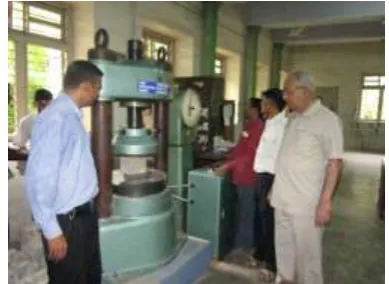
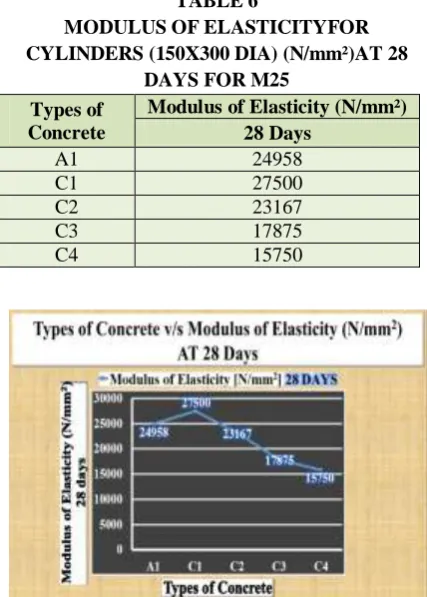
Above 5 different concrete samples were used to find the important properties like compressive strength, flexural strength and modulus of elasticity.To make the study from an economic point of view cost of each mix was also worked out from the present market rates. The results for these properties are given in Table 4, 5&6. Figure 1, 3 & 5 shows setup for testing of hardened concrete.
Figure 1: Setup of Compressive Strength Test
TABLE 4
AVERAGECOMPRESSIVE STRENGTHFOR CUBES (150X150X150) (N/mm²)AT 7, 14, 28
DAYS FOR M25
Types of Concrete
Average Compressive Strength (N/mm²)
7 Days 14 Days 28 Days
A1 28.76 32.00 38.52
C1 29.24 33.63 39.70
C2 22.96 23.35 25.78
C3 20.92 22.96 23.26
Chemical Properties Ordinary Portland Cement
(OPC)
Hypo Sludge
Percent by mass
Silicon Dioxide (SiO2) 21.77% 5.28% Calcium Oxide (CaO) 57.02% 47.84% Magnesium Oxide
(MgO) 2.71%
6.41%
Sulphur Trioxide (SO3) 2.41% 0.19% Aluminium Oxide
(Al2O3)
2.59% 0.09%
ISSN: 2231-5381 http://www.ijettjournal.org Page 3996
C4 19.47 21.04 22.96
Figure: 2Types of Concrete v/s Average Compressive Strength (N/mm²)At 7, 14, 28 Days
for M25
Figure 3: Setup of Flexural Strength Test
TABLE 5
AVERAGEFLEXURAL STRENGTH FOR BEAMS(100X100X500) (N/mm²)AT 28AND 90
DAYS FOR M25
Types of Concrete
Average FlexuralStrength (N/mm²)
28 Days 90 Days
A1 4.71 5.26
C1 4.49 4.94
C2 2.93 3.31
C3 2.74 3.27
C4 2.62 2.93
Figure: 4 Types of Concrete v/s AverageFlexural Strength(N/mm²)At 28&90 Daysfor M25
Figure 5: Setup of Modulus of ElasticityTest
TABLE 6
MODULUS OF ELASTICITYFOR CYLINDERS (150X300 DIA) (N/mm²)AT 28
DAYS FOR M25 Types of
Concrete
Modulus of Elasticity (N/mm²) 28 Days
A1 24958
C1 27500
C2 23167
C3 17875
C4 15750
Figure: 6 Types of Concrete v/s AverageModulus of Elasticity (150X300 dia.) (N/mm²) At 28 Days
for M25
DESIGN OF A CEMENT CONCRETE PAVEMENT FOR RURAL ROAD (IRC: SP: 20-2002 / IRC: SP: 62-2004)
ISSN: 2231-5381 http://www.ijettjournal.org Page 3997
buses, animal drawn vehicles, motorizedtwo-wheelers and cycles. The soil has a soaked CBR value of 2%.
Table 7: Design of CC Pavement For Rural Roads Design Parameters: Sample C1
Trial Thickness for Slab, h= 150mm
Check for Temperature Stresses:
Assuming a contraction joint spacing of 3.75 and 3.75m width.
1. Temperature Stress (σte):
The temperature differential (∆t) for Gujarat for a slab thickness of 150mm is 12.5˚C.
The Radius of Relative Stiffness, l = √𝟒 𝟏𝟐 (𝟏− µ𝑬 𝒉𝟑𝟐) 𝒌
Hence, l = 748.56mm.
L/l = 3750 / 748.56= 5.0
W/l = 3750 / 748.56= 5.0
Both values are same, if not then adopt greater one.
Bradbury‟s Coefficient, C = 0.720 (from figure 1, pg. 9, IRC: SP: 62-2004)
[Value of C can be ascertained directly from Bradbury‟s chart against values of L/l and W/l]
Temperature Stress in edge region, σte =
𝑬 𝜶 ∆𝒕
𝟐 𝑪
Hence, σte= 1.24 N/mm2.
2. Edge Load Stress (σle):
From Page: 12, IRC: SP: 62-2004,
Edge Load Stress:
σle = 0.529 P / h2 (1 + 0.54µ) [4 log10 (l/b) + log10 (b) – 0.4048]
where;
b= Radius of equivalent distribution of pressure, b = a (if (a/h >= 1.724);
(b) =√1.6 𝑎2+ ℎ2 - 0.675 h if (a/h < 1.724),
a/h< 1.724, 0.922< 1.724
For slab thickness of 150mm; Edge Load Stress, σle, is 3.63 N/mm2 (3.63MPa).
Total Stress = Edge Load Stress + Temperature Stress= 3.63 + 1.24= 4.87 N/mm2, which is less than the allowable flexural strength of 4.94N/mm2.
Hence, assumed thickness of slab = 150mm, is OK. [As per Temperature Stress Criteria]
Check for Corner Stresses (σlc):
From Fig. 5 (Page 12), Corner Load Stress for
wheel load of 30kN,
for k = 25.2 (N/mm2/mm)*10-3 = 0.0252 N/mm2/mm = 0.03 N/mm2/mm (Approx.) and slab thickness of 150mm is 3.2N/mm2 (3.2MPa).
[Temperature Stress in the corner region is negligible, as the corners are relatively free to warp, hence it can be ignored.]
Hence, σlc= 3.2 N/mm2, which is less than the
allowable flexural strength of 4.94 N/mm2.
So, the slab thickness of 150mm is Safe.
The calculations presented above are sample calculations (C1). Similar calculations are done using various values of flexural strengths of concrete.
IVECONOMIC ANALYSIS
TABLE- 8 COST OF MATERIALS Sr.
No.
Materials Rate
(Rs/Kg)
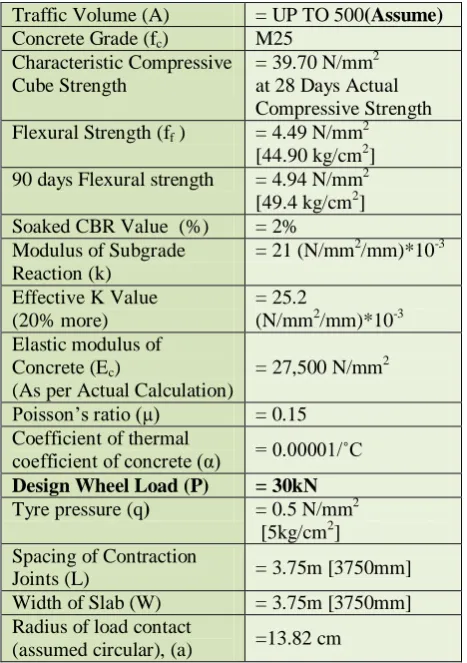
Traffic Volume (A) = UP TO 500(Assume)
Concrete Grade (fc) M25 Characteristic Compressive Cube Strength
= 39.70 N/mm2 at 28 Days Actual Compressive Strength Flexural Strength (ff ) = 4.49 N/mm2
[44.90 kg/cm2] 90 days Flexural strength = 4.94 N/mm2
[49.4 kg/cm2] Soaked CBR Value (%) = 2% Modulus of Subgrade
Reaction (k)
= 21 (N/mm2/mm)*10-3
Effective K Value (20% more)
= 25.2
(N/mm2/mm)*10-3 Elastic modulus of
Concrete (Ec)
(As per Actual Calculation)
= 27,500 N/mm2
Poisson‟s ratio (µ) = 0.15 Coefficient of thermal
coefficient of concrete (α) = 0.00001/˚C
Design Wheel Load (P) = 30kN
Tyre pressure (q) = 0.5 N/mm2 [5kg/cm2] Spacing of Contraction
Joints (L) = 3.75m [3750mm] Width of Slab (W) = 3.75m [3750mm] Radius of load contact
ISSN: 2231-5381 http://www.ijettjournal.org Page 3998
1 Cement (OPC 53 grade) 6.402 Hypo Sludge 0.60
3 Fine aggregate 0.60
4 Coarse aggregate 0.65
5 Grit 0.65
TABLE-9
MATERIALS FOR DESIGNED M25 CONCRETE
Types of Concrete
% Reduction in cement
Materials
Total Cost [Rs./m3]
% Change
in Cost Cement
[kg/m3]
Fine aggregate
[kg/m3]
Coarse aggregate
[kg/m3]
Grit [kg/m3]
Hypo Sludge [kg/m3]
A1 0 479.0 485.75 718.22 478.81 0.0 4135.12 0
C1 10 431.1 485.75 718.22 478.81 47.9 3857.30 (-) 6.71 C2 20 383.2 485.75 718.22 478.81 95.8 3579.48 (-) 13.43 C3 30 335.3 485.75 718.22 478.81 143.7 3301.66 (-) 20.15 C4 40 287.4 485.75 718.22 478.81 191.6 3023.84 (-) 26.87
TABLE 10
RELATIVE COST OF SLAB FOR M25
Figure: 7 Types of Concrete v/s Cost of 1m x 1m Slab (Rs.)
CONCLUSIONS
Based on limited experimental investigations concerning the compressive strength, flexural strength & modulus of elasticity test of concrete (M25 Grade) for rigid pavement, the following observations are made in the ray of the objectives of the study
(a) Effective utilization of Hypo Sludgein concrete can save the Paper industry‟s disposal costsand storage problems; and also produces a „greener‟ concrete for low cost rural roads. (b) This research study concludes that Hypo
Sludgecan be an innovative Supplementary Cementitious Material useful for construction of rigid pavement in development of low cost rural roads.
(c) For a CBR value of 2% and Wheel Load (P) of 30KN; Cost of rigid pavement decreases from Rs. 785.67 to Rs. 580.12. (73.83% Relative Cost)
ACKNOWLEDGMENT
The Authors thankfully acknowledge Dr. C. L. Patel, Chairman, Charutar Vidya Mandal, Er.V.M.Patel, Hon.Jt. Secretary, Charutar Vidya Mandal, Prof. J. J. Bhavsar, Associate Professor
and P.G. Coordinator(Construction Engineering and Management), B.V.M. Engineering College, Mr.Yatinbhai Desai, Jay Maharaj construction, Vallabh Vidyanagar, Gujarat, India for their motivations, infrastructural support and cooperationto carry out this research.
REFERENCES
[1] Ashoke K. Sarker, “Use of Non-Conventional Materials for the Construction of Low-Volume Roads”, Workshop on Non-Conventional Materials/ Technologies, Central Road Research Institute, New Delhi 110 016, India,pp:27-38, February 2012. [2] Binod Kumar, G.K. Tike, P.K. Nanda,
“Prospects & New Approaches of Using Industrial wastes in Building Materials”,
Journal of Materials in Civil Engineering, Vol. 19 (10), pp: 906-911, October 2007 [3] Darsh Belani, Prof. Jayeshkumar Pitroda
(2013), “Harmonising Environment and
Ecological Sustainability by Utilization of Fly Ash in Rigid Pavement” International Journal Global Research Analysis, (GRA), Volume:
Types of Concrete
Slab Thickness
(cm)
Cost of 1m x 1m Slab (Rs.)
Relative Cost (%)
A1 19 785.67 100.00
C1 15 580.12 73.83
C2 19 680.10 86.56
C3 19 627.32 79.84
ISSN: 2231-5381 http://www.ijettjournal.org Page 3999
2, Issue : 2, ISSN No 2277 – 8160, pp-97-99,Feb 2013.
[4] Darsh Belani,Prof. Jayeshkumar Pitroda(2013), “Fly Ash (F-Class): Opportunities for Sustainable Development of Low Cost Rural Roads”International Journal of Engineering Trends and Technology (IJETT), ISSN: 2231-5381, Volume-4, Issue-5, pp:1614-1619, May 2013.
[5] Darsh Belani,Prof. Jayeshkumar Pitroda(2013), “Value Addition to Fly Ash
Utilization by Eco-Efficient Development of Rigid Pavement in Rural Roads” International Journal of Advanced Engineering Research and Studies, Technical Journals Online (IJAERS), E-ISSN 2249–8974, Volume-II, Issue-III, pp:75-78, April-June, 2013.
[6] Dr Praveen Kumar, Dr G D Ransinchungh R.N., Aditya Kumar Anupam, “Waste Materials- An Alternative to Conventional Materials in Rural Road Construction”, Workshop on Non-Conventional Materials/ Technologies, Central Road Research Institute, New Delhi 110 016, India,pp:16-26, February 2012.
[7] Guru vittal u. k., scientist satanderkumar scientist, deepchandra, head sr div. dr. p. k. sikadar, Director Central Road Research Institute New Delhi. “Utilization of fly ash in road construction". CE and CR Pp 60-63. April 99 Rigid Pavement Division, Maharashtra Engineer's Research Institute Nashik "Study of fly ash samples from Eklahre Thermal Power Station".
[8] Mr.NageshTatobaSuryawanshi, Mr. Samitinjay S. Bansode, Dr. Pravin D. Nemade ,“Use of Eco-Friendly Material like Fly Ash in Rigid Pavement Construction & It's Cost Benefit Analysis”, International Journal of Emerging Technology and Advanced Engineering Volume 2, Issue 12, December 2012.
[9] Prof. B. B. Pandey, “Low Cost Concrete Roads for Villages”, Workshop on Non-Conventional Materials/ Technologies, Central Road Research Institute, New Delhi 110 016, India,pp: 39-4, February 2012.. [10]Prof. J R Pitroda, Dr L B Zala, Dr F S
Umrigar (2012), “Hypo Sludge Management:
Opportunities For Developing Low Cost Concrete With Glass Fibres” International Journal Global Research Analysis, (GRA), Volume: 1, Issue: 7, ISSN No 2277 – 8160, pp-56-58, Dec 2012.
[11]Pavement Engineering and materials for Rigid Pavements, Central Road Research institute, Annual Report 2009-10
[12]R. Srinivasan, K. Sathiya And M. Palanisamy “Experimental Investigation In Developing
Low Cost Concrete From Paper Industry Waste”,Tamilnadu College of Engineering,
Karumathan Patti, India.
[13]R. Gracia, R. Vigil de la Villa, I. Vegas, M. Frias,and M.I. Sanchez de Rojas, “The pozzolanic properties of paper sludge waste”, Construction and Building Materials, 22(7), July 2008.
[14]R.S. Gallardo, Mary Ann Q Adajar, “Structural performance of concrete with paper sludge as fine aggregates partial replacement enhanced with admixtures,” Symposium on Infrastructure Development and the Environment, University of the Philippines, December 2006.
[15]Sumit A Balwaik, S P Raut “Utilization of Waste Paper Pulp by Partial Replacement of Cement in Concrete” International Journal of Engineering Research and Applications, (IJERA) ISSN: 2248-9622,YCCE, Nagpur-10, Maharashtra, India.
[16]Seehra s. s. and Satanderkumar," Technoeconomic aspects of rigid pavements" International seminar on Civil Engineering Practices in 21st century Roorkey, India 1996. [17]Shetty, M.S. “Concrete technology”,
S.Chand& Company Ltd.
[18]Tarun R. Naik, Bruce W. Ramme, Rudolph N. Kraus, Rafat Siddique, “Long-term performance of high-volume fly ash concrete pavements”, ACI Materials Journal, Vol. 100 (2), pp: 150-155, March/April 2003.
[19]UjjwalBhattacharjee, Tara Chandra Kandpal , “Potential of fly ash utilization in India”
Centre for Energy Studies, Indian Institute of Technology Delhi, HauzKhas, New Delhi 110 016, India
[20]U.S. Department of Transportation, Federal Highway Administration, “User Guidelines for Waste and By-product Materials in Pavement Construction, Coal Fly Ash”, Publication Number: FHWA-RD-97-148. [21]V. Mohan Malhotra, “High-performance
HVFA concrete: A solution to the infrastructural needs of India”, Indian Concrete Journal, Vol. 76 (2), pp: 103-107, February 2002.
[22]Vimal Kumar, “Overview of Fly Ash for Use in Rural Development”, Workshop on Non-Conventional Materials/ Technologies, Central Road Research Institute, New Delhi 110 016, India,pp:1-15, February 2012. [23]Vegas, J. Urreta, M. Frias, and R. Garcia,
ISSN: 2231-5381 http://www.ijettjournal.org Page 4000
AUTHORS BIOGRAPHYProf. Jayeshkumar R. Pitroda was born in 1977 in Vadodara City. He received his Bachelor of Engineering degree in Civil Engineering from the Birla Vishvakarma Mahavidyalaya, Sardar Patel University in 2000. In 2009 he received his Master's Degree in Construction Engineering and Management from Birla Vishvakarma Mahavidyalaya, Sardar Patel University. He joined Birla Vishvakarma Mahavidyalaya Engineering College as a faculty where he is Assistant Professor of Civil Engineering Department with a total experience of 12 years in the field of Research, Designing and education. He is guiding M.E. (Construction Engineering & Management) Thesis work in the field of Civil/ Construction Engineering. He has papers published in National Conferences and International Journals.
Dr.L.B.Zala completed his B.E. (Civil) Engineering from BVM Engineering College, S.P. University in 1984, M.E. (Civil) Transportation Engineering from University of Roorkee (now IIT, Roorkee) in 1994. Dr. Zala joined BVM Engineering College as Assistant Lecturer in August 1986. He completed his Ph.D in Civil Engineering from S.P. University in 2009. He is working as Head Civil Engineering at BVM Engineering College. He is guiding M.E. / M. Tech & Ph.D Dissertation work in field of Civil/Transportation Engineering.