CONTRIBUTORS:
JOHN W. BUTLER
VINTON G. CERF
EARL W. COMSTOCK
MARK N. COOPER
MICHAEL J. COPPS
ROBERT E. KAHN
MARK A. LEMLEY
LAWRENCE LESSIG
RICHARD S. WHITT
TIMOTHY WU
EDITED BY MARK
N. COOPER
PRESERVING
INTERNET
FREEDOM
IN THE
BROADBAND
ERA
OPEN ARCHITECTURE
COMMUNICATIONS POLICY
AS
CENTER FOR
INTERNET
AND SOCIETY
AS
AS
COMMUNICATIONS POLICY
P
RESERVINGI
NTERNETF
REEDOMIN THE
B
ROADBANDE
RAE
DITORCENTER FOR INTERNET AND SOCIETY
STANFORD LAW SCHOOL
2004
Licensed under the Creative Commons Attribution-NonCommercial-ShareAlike License. To view a copy of this license, visit http:// creativecommons.org/licenses/by-nc-sa/1.0/ or send a letter to Creative Commons, 559 Nathan Abbott Way, Stanford, California 94305, USA.
ISBN 0-9727460-8-0
different Journals that use different footnoting conventions. The original footnotes are preserved. Because there are many citations common to the articles, however, one bibliography was compiled. The Bibliography accepts the shortened law review style that predominated in the articles. To ensure ease of identification and location of sources, the bibliography uses an alphabetical rule -- Author’s last name, then first name followed by the Title. Occasionally, a single article was cited using different footnoting conventions. Each citation is included in the bibliography.
The following publications have graciously granted permission to reprint excerpts from previously published works:
Earl W. Comstock and John W. Butler, Access Denied: The FCC’s Failure
to Implement Open Access as Required by the Communications Act, 8 JOURNALOF COMMUNICATIONS LAWAND POLICY, Winter: 2000.
Mark N. Cooper, Open Communications Platforms: Cornerstone Of
Innovation And Democratic Discourse In The Internet Age, 2 JOURNALOF
TELECOMMUNICATIONSAND HIGH TECHNOLOGY LAW, 1: 2003.
Mark A. Lemley and Lawrence Lessig, The End of End-to-End:
Preserving the Architecture of the Internet in the Broadband Era, 48 UCLA LAW. REVIEW, April: 2001.
Timothy Wu, Network Neutrality, Broadband Discrimination, 2 JOURNAL
OF TELECOMMUNICATIONSAND HIGH TECHNOLOGY LAW, 1: 2003.
Timothy Wu, Broadband Policy: A User ’s Guide, JOURNAL OF
I. INTRODUCTION ... 1
THE FUTUREOFTHE INTERNETINTHE BROADBAND AGE... 1 Mark N. Cooper OPENING REMARKS... 5 Michael J. Copps MODERATOR’S REMARKS ... 9 Mark N. Cooper
PART I:
THE INTERACTION BETWEEN TECHNOLOGY AND
POLICY IN THE CREATION OF THE INTERNET
II. WHAT IS THE INTERNET? ... 17
Robert E. Kahn and Vinton G. Cerf
III. THE END OF END-TO-END ... 41 Mark A. Lemley and Lawrence Lessig
PART II:
EMPIRICAL STUDIES, THE ROLE OF OPEN
ARCHITECTURE IN STIMULATING INNOVATION
IV. MAKING THE NETWORK CONNECTION ... 95
Mark N. Cooper
V. ANTICOMPETITIVE PROBLEMS OF CLOSED
COMMUNICATIONS FACILITIES ... 155
DISCRIMINATION ... 197
Timothy Wu
PART III:
POLICY AND LEGAL FRAMEWORK FOR
PRESERVING OPEN ARCHITECTURE
VII. BROADBAND POLICY ... 233 BROADBAND POLICY, A USER’S GUIDE... 233
Timothy Wu
EX PARTE SUBMISSIONIN CS DOCKET NO. 02-52 ... 258 Timothy Wu and Lawrence Lessig
VIII. ACCESS DENIED ... 283 Earl W. Comstock and John W. Butler
IX. A HORIZONTAL LEAP FORWARD ... 345 LETTERTO EVANSAND POWELL... 345 Vinton G. Cerf
FORMULATINGA NEW PUBLIC POLICY FRAMEWORK
BASEDONTHE NETWORK LAYERS MODEL... 353
Richard S. Whitt
I. INTRODUCTION
THE FUTURE OF THE INTERNET IN THE BROADBAND AGE The papers in this volume are collected from speakers at a forum
held on Capitol Hill entitled Broadband Technology Forum: The Future
Of The Internet In The Broadband Age.1 All of the speakers are active in
the public policy debates, regulatory proceedings and court cases that have been defining the contours of the next generation of the Internet. The purpose of the forum was to engage staffers from Congressional offices and federal agencies in a dialogue over the importance of preserving the vibrant nature of the Internet.
With that purpose in mind, this volume blends new papers and comments with several that are half a decade old (ancient by Internet standards). Taken together they seek to provide a comprehensive basis for understanding the interaction of technology and public policy in the development of the Internet. Written at different times and for different purposes over the past five years, the papers are powerful testimony to the proposition that open architecture is critical to the success of the Internet. The end-to-end principle of the Internet and the open communications networks in which it was incubated are critical building blocks of a dynamic, innovative information economy.
The papers address three aspects of the environment in which the Internet was created and flourished – technology, economy and law – three of the critical modalities of regulation, as Lawrence Lessig called them in CODEAND OTHER LAWSOF CYBERSPACE.2
PART I: TECHNOLOGY AND POLICY IN THE CREATION OF THE INTERNET
Chapter II is a paper by Robert E. Kahn and Vinton G. Cerf, What
Is the Internet (and What Makes It Work)?, INTERNET POLICY INSTITUTE (1999,
revised 2004). It provides a brief discussion of the architecture of the Internet through the chronology of the development of its fundamental
technologies. Both of the authors were at the center of the creation of the seminal technologies. They are keenly aware of the role of institutions and public policies in the creation of the Internet.
Chapter III is a paper by Mark A. Lemley and Lawrence Lessig, The End of End-to-End: Preserving the Architecture of the Internet in the Broadband Era, 48 UCLA LAW REVIEW (April: 2001). The paper presents
a discussion of the design principle of the Internet. Not only does it explain how the design principle operates to promote innovation, but it directly refutes many of the economic arguments made by those who would abandon, or allow the network facility owners to abandon, the end-to-end principle and open communications networks.
PART II: EMPIRICAL STUDIES: THE ROLE OF OPEN ARCHITECTURE IN
STIMULATING INNOVATION
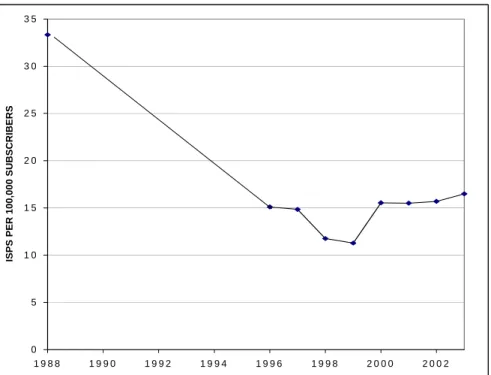
Part II presents empirical studies of the dynamic environment created by open architecture in digital networks and the negative impact on innovation of closure and discrimination in communications networks. Chapter IV presents a paper prepared for the forum by Mark N. Cooper that takes a broad view of the impact of the Internet. It attempts to use network theory and recent analyses of technological change to reinforce the long-standing claim that the open architecture of the Internet represents a fundamental change and improvement in the innovation environment. It concludes with an examination of the role of Internet Service Providers in the spread of the Internet.
Chapter V is excerpted from a paper by Mark N. Cooper, Open
Communications Platforms: Cornerstone Of Innovation And Democratic Discourse In The Internet Age,” 2 JOURNALOF TELECOMMUNICATIONSAND
HIGH TECHNOLOGY LAW (1: 2003). It demonstrates the increased possibility
of anticompetitive practices by firms that dominate key points of the digital communications platform. It links the potential harm back to the network theory by presenting a case study of the elimination of Internet Service Providers.
Chapter VI is excerpted from a paper by Timothy Wu, Network
Neutrality, Broadband Discrimination,” 2 JOURNALOF TELECOMMUNICATIONS AND HIGH TECHNOLOGY LAW (1: 2003). It attempts to precisely define the
characteristics of the Internet that should be preserved. In contrast to chapters IV and V, which emphasize the commercial relationships between
network owners and Internet Service Providers (ISPs), Wu provides a detailed study of the customer contract provisions that threaten or infringe on the freedom for consumers to use the Internet and applications.
PART III: POLICY AND LEGAL FRAMEWORK FOR PRESERVING OPEN
ARCHITECTURE
Part III maps out the current terrain of law and regulatory policy. The papers share the objective of preserving open architecture. They would travel somewhat different routes to achieve that goal.
Chapter VII is composed of two papers. It opens with a paper by
Timothy Wu, Broadband Policy: A User ’s Guide, Journal OF
TELECOMMUNICATIONSAND HIGH TECHNOLOGY LAW, forthcoming. It reviews
several aspects of the current policy debate and offers a recommendation of nondiscrimination. The chapter then presents a formal proposal for network neutrality that was presented to the Federal Communications
Commission (FCC) in an ex parte filed at the FCC by Wu and Lawrence
Lessig.
Chapter VIII combines two documents by Earl W. Comstock and
John W. Butler, Access Denied: The FCC’s Failure to Implement Open
Access as Required by the Communications Act,” 8 JOURNAL OF
COMMUNICATIONS LAWAND POLICY, (Winter: 2000), and the legal brief filed
on behalf of Earthlink in the second case heard by the Ninth Circuit
involving broadband (Brand X v. FCC). Comstock and Butler show why
the FCC has had so much trouble convincing the Ninth Circuit Court of Appeals that its approach to deregulating advanced telecommunications networks fits under the statute. Twice the Court found that the obligations of nondiscrimination and interconnection of Title II of the Communications Act apply to cable modem service. The detailed recounting of the history and purpose of the Computer Inquiries that runs through the legal arguments is a strong reminder that the FCC adopted the correct policy over 35 years ago when it recognized the fundamental importance of nondiscriminatory access to the essential telecommunications function of the network on which applications and services ride.
Chapter IX begins with a letter from Vinton G. Cerf to the head of the Secretary of Commerce and the Chairman of the Federal Communications Commission raising concerns about the apparent public policy shift away from open communications networks. The chapter then
moves to a paper by Richard Whitt of MCI that formed the basis for Vinton Cerf’s comments to the forum. The paper picks up and develops the distinction between transmission and applications as it is being discussed in regard to contemporary digital networks. Whitt attempts to synthesize the emerging thinking about reforming regulation of communications by moving from the old vertical view, in which industries are regulated because of their underlying technologies or the services they provide, to a horizontal view, in which similar functionalities are treated similarly across networks, regardless of which technology is used.
The remainder of this chapter is composed of the opening remarks at the forum. FCC Commissioner Michael Copps established the policy context for the forum by summarizing a speech he had made in October 2003 that asked a critical question “The Beginning of the End of the Internet?”3 His subtitle identified the critical issues as “Discrimination,
OPENING REMARKS OF COMMISSIONER MICHAEL J.COPPS
Good morning. Thank you for having me here, thank you all for coming. I’ve got to say that I feel more than a little intimidated being on the same program with Vint Cerf and Larry Lessig. They are the digital revolution’s dream team, pioneer thinkers and doers whose fame and contributions will long outlive what some little regulatory agency does over in Greater Southwest. Let me also thank my friend Mark Cooper for his unflagging efforts on behalf of the public interest, his leadership at the Consumer Federation of America, his work for the Center for Internet and Society at Stanford Law School, and for organizing this very timely forum today.
We all take pride in the dynamic forum that the Internet has become. From right to left, Republicans and Democrats, rural and urban, we view the Internet as a place of freedom where technology and business innovation flourish. End-to-end openness has always been at the heart of what the Internet community and its creators celebrate. The Internet has become a fountain of innovation; a well of opportunity for consumers and entrepreneurs. It may just be the most democratic public forum that has ever existed.
But this Internet may not be the one we know in the future. There are threats to it out there and I think we had better begin to understand them before they derail the promise of this technology, not after the damage has been inflicted. Entrenched interests are already jockeying to constrain the openness that has been the Internet’s defining hallmark and they are lobbying the FCC to aid and abet them. They claim all they are advocating is a “deregulated” environment where the “market can reign supreme.” But in reality they are seeking government help to allow a few companies to turn the Internet from a place of competition and innovation into an oligopoly. Power over the Internet would then reside with the network owners, who could use chokepoint power to constrain consumer choices, limit sources of news, information and entertainment, undermine competitors and quash disruptive new technologies. They may talk in terms of Schumpeter and creative destruction, but in reality what they are asking is for the Commission to pick winners and to choose existing technologies and businesses over new technologies and entrepreneurs. They can talk “competition” all they want, but the race to combine distribution
and content spells economic constraint here as clearly as it did when John D. Rockefeller married distribution to his product.
We cannot afford to buy into this vision. If we do, we’ll wind up looking back, shaking our heads and wondering whatever happened to that open, dynamic and liberating Internet that we once knew. “What promise it held,” we’ll say. If that happens, history won’t forgive us. Nor should it.
So it’s time to take stock. What is the future of the broadband Internet? What regulation, deregulation, unregulation, whatever, made it so that this dynamic and open platform developed as it did? And as the Internet matures from its dial-up infancy to its broadband adolescence— how do we keep it this way?
These are the questions that should be our starting point. To answer them, begin with a little history. Not so long ago, one company ran the whole show in the wireline world. When innovators showed up with new ideas and technologies, Ma Bell just shooed them away. And the FCC was totally complicit in this! Keeping those new and novel ideas at bay would keep the network stable, keep economies of scale in place and ensure quality service. Or so they thought. But this kind of government protectionism only ensured that the network was closed to new innovation and consumer benefits.
Thankfully the FCC changed course. More than thirty-five years ago, the Commission decided to let consumers attach devices like the Carterfone to the end of the network. And you know what? The doomsday loss of quality and control didn’t come to pass. Instead, a right to attachment came into being. It brought consumers the basic freedom to attach any device to the network as long as it causes no network harm. And look at its benefits—fax machines and computer modems are direct descendants of this principle.
In the years after the Carterfone decision the FCC reaffirmed its policy of openness and competition in the Computer Inquiry cases. And Internet pioneers like Vint Cerf built the network on the now famous end-to-end principle. This combination of policy and principle charged the nation’s entrepreneurial batteries. It has empowered consumers to go where they want and do what they want on the Internet. We must not allow these core tenets of non-discrimination to wither and die.
Consider what might happen if your broadband Internet provider could discriminate. It might, for example, choose to prevent you from
using a spam-jamming service that blocks its own spam, or a filtering technology to keep your kids from cruising the back alleys of the Internet. Maybe it’s not weird fantasy that someday somebody might want to decide which news sources or political sites you could visit. We ought to at least be thinking about this now and maybe even taking steps to ensure that it
doesn’t happen. Where are the boundaries between legitimate bandwidth
management and denial of access? The lines are blurry.
I was pleased to read a recent speech by Chairman Powell setting out some key principles of Internet freedom—the freedom to access content, use applications, attach personal devices and obtain service plan information.4 It is, I hope, a sign that a deeper discussion may finally be
starting and that we may be developing consensus around the idea that there just may be some problems here after all. I saw his comments as a call to action for the broadband industry. Perhaps this will serve a good purpose, but with so much at stake we have to ask ourselves if this is action enough to get the job done. People like Vint Cerf and Larry Lessig have devoted too much time and talent to maximizing this paradigm-busting technology to see it subordinated to some empty and outdated debate about regulation versus deregulation. Let’s get serious! And the reason to get serious now is because consumers and innovators have precious little recourse once discrimination occurs—if they even know it is happening.
Until that happy day when we have a robust and competitive market for access, and when there are no longer any dangerous bottleneck facilities on a network, I believe the FCC needs to be on the job ensuring that conduits are accessible, neutral and open, just as they are in the dial-up world. We are not picking winners and losers when the government makes sure the roads of the Internet are open to all.
In the past, too few people outside of Washington have been able to tune into these issues. They have been classic, inside-the-Beltway games. But last spring in the media debate we woke a sleeping giant. The brazenness of what the FCC decided on media concentration and the stealth process it used to get there aroused the ire of millions of Americans. In previously unheard of numbers they made it known that they were not interested in surrendering content control over music, entertainment and information; gatekeeper control over the civil dialogue of our country; and veto power over the majority of what we watch, hear and read to an ever-smaller number of corporate giants. They got mad. They’ll get mad again if we let their Internet go down the same road.
So let’s not let the same regulatory tunnel vision drive Internet policy that has driven telecom and media policy in this Commission. The time is right for those of us who have concerns—be we businesses, innovators, technologists, content providers, regulators, legislators, consumers, citizens all—to seize the opportunity we have now to think and talk and maybe do something about the Internet in the broadband age. We need to make sure that it continues to foster freedom and innovation, that the openness that is its hallmark has a future every bit as bright as its past. I think we’re going to learn a lot about all this today, and because I’d much rather listen and learn, I’m going to get out of the way now and turn the floor over to probably the two best people in all of America to help us sort through all of this—Vint Cerf and Larry Lessig. Thank you.
MODERATOR’S REMARKS
Chairman Michael Powell made it clear that his approach to preserving the freedom of the Internet is entirely a voluntary enterprise. He would impose no mandate on the network owners to ensure these freedoms. Are the four freedoms he mentioned enough and will a voluntary approach work to restore innovation to this information space? Those are a few of the critical questions and these are just the latest exchanges in a debate that stretches back several decades, a debate that was started in some sense by Vinton Cerf. Janet Abbate writes in her book entitled Inventing the Internet:
In the course of trying to resolve some dilemmas they encountered in these other networking projects, researchers Robert Kahn and Vinton Cerf began to consider how to interconnect dissimilar networks. The Internet architecture that Cerf and Kahn proposed was eventually used not only to build the Internet itself but also as a model for other networks. According to Cerf in a 1990 interview “We wanted to have a common protocol and a common address space so that you couldn’t tell, to first order, that you were actually talking through all different kinds of networks.”5
If there is a message you should take away from Vint Cerf’s history it is not only that architecture is the critically important characteristic of the Internet, but that architecture does not just happen, you have to fight for it. Cerf was not only one of the inventors of Internet architecture, he has remained one of its most dedicated and ardent defenders.
That is the lesson I took in the late 1980s when another challenge to the open architecture of the Internet was mounted. In January of 1990, I wrote a paper for the Consumer Federation of America and the American Association of Retired Persons in which we embraced the architecture of the Internet, stating “[t]he fact that a great deal of the necessary intelligence is currently located on the periphery of the information age network has led to a pragmatic, decentralized pattern of development.”6 Give individuals
maximum flexibility in the choice of equipment and services, allowing them to develop applications at the periphery of the network, and the resulting decentralized decisions will select the most cost-effective technologies for specific applications.
A decade later at the end of the 1990s, yet another threat to the
architecture of the Internet arose. Larry Lessig’s first book, Code and
Other Laws of Cyberspace, sounded a clarion call.
We are enabling commerce in a way we did not before; we are contemplating the regulation of encryption; we are facilitating identity and content control. We are remaking the values of the Net. We can no more stand neutral on the question of whether the Net should enable centralized control of speech than Americans could stand neutral on the question of slavery in 1861.7
Code is law; architecture is policy.
After a decade of phenomenal success, this policy debate involved a whole new sector of the economy. The practical implications were clear to Earl Comstock, representing Internet Service Providers and other clients engaged in the competitive provision of communications services. In a
2000 law review article entitled “Access Denied”8 he and his co-author
John Butler wrote
The Commission is on the wrong course. It must return to a path within the authority of the Communications Act before its present “parallel universe” policy becomes so embedded in the Internet access marketplace that it causes irreparable harm to competition, consumers, thousands of independent ISPs and the structure of the global Internet itself.
He predicted that “the Commission’s choice so far… cannot ultimately be upheld by the courts.”9 Thus far, he is correct on both counts.
Denied access, the ranks of the ISPs have been devastated and the Ninth Circuit has twice ruled against the FCC. Earl Comstock is in that case. CFA is in that case. Even if Professor Lessig is not formally in the case, his spirit is in the Courtroom. The Ninth gets it. Listen to their words:
Among its broad reforms, the Telecommunications Act of 1996 enacted a competitive principle embodied in the dual duties of nondiscrimination and interconnection… The Internet’s protocols themselves manifest a related principle called “end-to-end”: control lies at the ends of the network
where the users are, leaving a simple network that is neutral with respect to the data it transmits, like any common carrier. On this role of the Internet, the codes of the legislator and
the programmer agree.10
Tim Wu has studied the actual terms written into contracts in a
paper entitled “Network Neutrality: Broadband Discrimination.”11 Giving
real world examples, he and Lessig proposed a network neutrality regime to the FCC based on the premise that
[t]he question an innovator, or venture capitalist, asks when deciding whether to develop some new Internet applications is not just whether discrimination is occurring today, but whether restrictions might be imposed when the innovation is deployed. If the innovation is likely to excite an incentive to discriminate, and such discrimination could occur, then the mere potential imposes a burden on innovation today.”12
Andrew McLaughlin represents just such a young, innovative company – Google – that recognizes how important an open Internet is. We could have invited any of a dozen companies, but Google is unique in one sense. The application on which the company is built has a special role to play in the future of the Internet (you can always tell which applications are critical by observing which companies Microsoft decides to imitate).13 Searchability and access are critical characteristics for the
continuing success of the Internet.
As Commissioner Copps reminds us, and much to the consternation of the cable industry and the majority at the Federal Communications Commission , the public debate will not go away. The Ninth Circuit Appeals Court has twice rejected the view that the advanced telecommunications networks are not subject to the obligations of nondiscriminatory interconnection and carriage to which telecommunications services have
been subject for almost a century, once in the case of Portland v. AT&T
and once in the case of Brand X v. FCC.14
Although one of the concurrences in the Ninth Circuit decision worried that the ruling would end the policy debate, in fact, quite the opposite is the case.15 A Declaratory Ruling by the FCC in the Cable Modem
proceeding was a pre-emptive strike against the public policy that the Commission had embraced for 35 years and the Telecommunications Act
of 1996 had adopted.16 The Declaratory Order that the Ninth Circuit
overturned was an attempt to end the debate. But for the Court ruling, the FCC would have quickly eliminated all requirements for nondiscrimination and interconnection on the two dominant advanced telecommunications
networks.17 By emphatically turning down the FCC’s request for rehearing
– pointing out that not one judge supported a rehearing – the court ensures that the public policy discussion will be with us for some time to come.
Some argue that the Supreme Court will not take Brand X v. FCC
because the statutory construction is so clear, the legal/administrative avenues for deciding the policy issue have not been exhausted (the FCC could conduct a forbearance proceeding under Section 10 of the Act), and there are no compelling constitutional questions (notwithstanding the cable operators’ vacuous First Amendment claims). If the Supreme Court grants cert, it will hear a great deal about public policy, but it is likely to decide the issue on statutory grounds. If it upholds the Appeals Court decision, the issue will be thrown back to the agency, which has failed to resolve it
in repeated tries over eight years.18 If the Supreme Court reverses, the
Congress is likely to become engaged.
Many in Washington are aware that there is a lot of talk about rewriting the Telecommunications Act of 1996. The Ninth Circuit may accelerate things, but whenever the rewrite comes, it is unthinkable and would be irresponsible for Congress to set the environment for the digital information age without addressing this issue.
Thus, a full appreciation of why the open architecture of the Internet and the communications network interacted to create a dynamic environment for innovation remains vital to the continuing public policy
debate. Being trained as a historian, Commissioner Copps will appreciate
the irony of the current situation. George Santayana’s adage “Those who do not understand the past are destined to repeat it,” is usually invoked as a caution not to repeat mistakes; but when it comes to the architecture of the Internet, our plea is to study its history in order to repeats its past success.
ENDNOTES
1 Cosponsored by the Consumer Federation of America and the Center for Internet
and Society, Stanford Law School, March 26, 2004.
2 Lawrence Lessig, Code and Other Laws of Cyberspace (1999), at Chpater 7. See
also, Mark Cooper, Inequality in Digital Society: Why the Digital Divide Deserves All the Attention it Gets, 20 CARDOZO ARTS & ENTERTAINMENT LAW J. (2002), which expands
the modalities of regulation into realms of social order..
3 Michael J. Copps, THE BEGINNINGOFTHE ENDOFTHE INTERNET? DISCRIMINATION,
CLOSED NETWORKS, AND THE FUTURE OF CYBERSPACE, New America Foundation,
Washington, D.C., October 9, 2003.
4 Michael Powell, Preserving Internet Freedom: Guiding Principles for the Industry,
the DIGITAL BROADBAND MIGRATION: TOWARDA REGULATORY REGIMEFORTHE INTERNET
AGE, University of Colorado School of Law, February 8, 2004.
5 Janet Abbate, INVENTINGTHE INTERNET (1999).
6 Mark Cooper, EXPANDING THE INFORMATION AGE FORTHE 1990S: A PRAGMATIC
CONSUMER VIEW (Washington, DC: American Association of Retired Persons and
Consumer Federation of America, January 11, 1990).
7 Lessig, supra note 2, at 205.
8 Earl Comstock and John Butler, Access Denied: The FCC’s Failure to Implement
Open Access as Required by the Communications Act, J. OF COMM. L. & POL. (Winter
2000), at 6.
9Id., at 21.
10AT&T Corp. v. City of Portland, 216 F.3d 871 (9th Cir. 2000).
11 Tim Wu, Network Neutrality & Broadband Discrimination, 2COL. J. TELECOMM.
& HIGH TECH. L. 5 (2003).
12 Tim Wu, and Lawrence Lessig, Ex Parte Submission in CS Docket No. 02-52,
August 22, 2003, at 7-8.
13 Cooper, Mark, Antitrust as Consumer Protection in the New Economy: Lessons
from the Microsoft Case, 52 HASTINGS L.J. (2001).
14Brand X v. FCC, U.S. Court of Appeals for the Ninth Circuit, No. 02-70518,
October 2003.
15Id. Concurrence of Judge O’Scannalin.
16 Federal Communications Commission, Declaratory Ruling and Notice of
Proposed Rulemaking, INTHE MATTEROF INQUIRY CONCERNING HIGH-SPEED ACCESSTO THE INTERNET OVER CABLEAND OTHER FACILITIES, INTERNET OVER CABLE DECLARATORY
RULING, APPROPRIATE REGULATORY TREATMENTFOR BROADBAND ACCESSTOTHE INTERN T
OVER CABLE FACILITIES, GN Docket No. 00-185, CS Docket No. 02-52, March 15, 2002.
17 Federal Communications Commission, Notice of Proposed Rulemaking, INTHE
MATTEROF APPROPRIATE FRAMEWORK FOR BROADBAND ACCESS TO THE INTERNET OVER
WIRELINE FACILITIES, UNIVERSAL SERVICE OBLIGATIONSOF BROADBAND PROVIDERS, COMPUTER
III FURTHER REMAND PROCEEDING: BELL OPERATING COMPANY PROVISION OF ENHANCED
SERVICES; 1998 BIENNIAL REGULATORY REVIEW – REVIEW OF COMPUTER III AND ONA
18 These include the FEDERAL-STATE JOINT BOARDON UNIVERSAL SERVICE, CC Docket
No. 96-45, Report to Congress, 13 FCC Rcd 1105, 11516 (1998); Inquiry Concerning the Deployment of Advanced Telecommunications Capability to ALL AMERICANSINA
REASONABLEAND TIMELY FASHION, AND POSSIBLE STEPSTO ACCELERATE SUCH DEPLOYMENT
PURSUANTTO SECTION 706 OFTHE TELECOMMUNICATIONS ACTOF 1996, CC Docket No.
98-146, 15 FCC Rcd 20913, 20918 (2000); INQUIRY CONCERNING HIGH-SPEED ACCESSTOTHE
INTERNET OVER CABLEAND OTHER FACILITIES, GN Docket No. 00-185, Notice of Inquiry,
15 FCC Rcd 19287 (2000), the Declaratory Order, and the Notice of Proposed Rulemaking, supra note 16, INRE APPROPRIATE FRAMEWORKFOR BROADBAND ACCESSTO THE INTERNETOVER WIRELINE FACILITIES, CC Docket Nos. 02-33, 95-20 and 98-10.
THE INTERACTION BETWEEN TECHNOLOGY AND
POLICY IN THE CREATION OF THE INTERNET
II. WHAT IS THE INTERNET
(AND WHAT MAKES IT WORK)?
December, 1999 Revised May 2004
PREFACE
This paper was originally prepared by the authors at the request of the Internet Policy Institute (IPI), a non-profit organization based in Washington, D.C., for inclusion in their series of Internet related papers. It is a condensation of a longer paper in preparation by the authors on the same subject. Many topics of potential interest were not included in this condensed version because of size and subject matter constraints. Nevertheless, the reader should get a basic idea of the Internet, how it came to be, and perhaps even how to begin thinking about it from an architectural perspective. This will be especially important to policymakers who need to distinguish the Internet as a global information system apart from its underlying communications infrastructure.
INTRODUCTION
As we enter a new millennium, the Internet is revolutionizing our society, our economy and our technological systems. No one knows for certain how far, or in what direction, the Internet will evolve. But no one should underestimate its importance.
Over the past century and a half, important technological developments have created a global environment that is drawing the people of the world closer and closer together. During the industrial revolution, we learned to put motors to work to magnify human and animal muscle power. In the new Information Age, we are learning to magnify brainpower
by putting the power of computation wherever we need it, and to provide information services on a global basis. Computer resources are infinitely flexible tools; networked together, they allow us to generate, exchange, share and manipulate information in an uncountable number of ways. The Internet, as an integrating force, has melded the technology of communications and computing to provide instant connectivity and global information services to all its users at very low cost.
Ten years ago, most of the world knew little or nothing about the Internet. It was the private enclave of computer scientists and researchers who used it to interact with colleagues in their respective disciplines. Today, the Internet’s magnitude is thousands of times what it was only a decade ago. It is estimated that about 250 million host computers on the Internet today serve about 800 million users in over 200 countries and territories. Today’s telephone system is much larger still: about 3 billion people around the world now talk on 2.3 billion telephones (about half of which are actually radio-based mobile phones). Although the Internet has grown rapidly, mobile telephony continues to outpace the spread of Internet access. Ironically, the rapid evolution of mobile telephone technology will likely meld the two systems as mobile phones become Internet-enabled. It might be reasonable to anticipate that by the end of the decade, many billions of devices will be interlinked through the Internet, including most mobile telephones and personal digital assistants.
THE EVOLUTION OF THE INTERNET
The underpinnings of the Internet are formed by the global interconnection of hundreds of millions of otherwise independent computers, communications entities and information systems. What makes this interconnection possible is the use of a set of communication standards, procedures and formats in common among the networks and the various devices and computational facilities connected to them. The procedures by which computers communicate with each other are called “protocols.” While this infrastructure is steadily evolving to include new capabilities, the protocols initially used by the Internet are called the “TCP/IP” protocols, named after the two protocols that formed the principal basis for Internet operation.
On top of this infrastructure is an emerging set of architectural concepts and data structures for interconnecting heterogeneous information
systems that renders the Internet a truly global information system. In essence, the Internet is an architecture, although many people confuse that with its implementation. When the Internet is looked at as an architecture, it manifests two different abstractions. One abstraction deals with communications connectivity, packet delivery and a variety of end-to-end communication services. The other abstraction deals with the Internet as an information system, independent of its underlying communications infrastructure, which allows creation, storage and access to a wide range of information resources, including digital objects and related services at various levels of abstraction.
Interconnecting computers is an inherently digital problem. Computers process and exchange digital information, meaning that they use a discrete mathematical “binary” or “two-valued” language of 1s and 0s. For communication purposes, such information is mapped into continuous electrical or optical waveforms. The use of digital signaling allows accurate regeneration and reliable recovery of the underlying bits. We use the terms computer, computer resources and computation to mean not only traditional computers, but also devices that can be controlled digitally over a network, information resources such as mobile programs, and other computational capabilities.
The telephone network started out with operators who manually connected telephones to each other through “patch panels” that accepted patch cords from each telephone line and electrically connected them to one another through the panel, which operated, in effect, like a switch. The result was called circuit switching, since at its conclusion, an electrical circuit was made between the calling telephone and the called telephone. Conventional circuit switching, which was developed to handle telephone calls, was inappropriate for connecting computers because it made limited use of the telecommunication facilities and took too long to set up connections. Although reliable enough for voice communication, the circuit-switched voice network had difficulty delivering digital information without errors.
For digital communications, packet switching is a better choice, because it is far better suited to the typically “bursty” communication style of computers. Computers that communicate typically send out brief but intense bursts of data, and then remain silent for a while before sending out the next burst. These bursts are communicated as packets, which are very much like electronic postcards. The “postcards” are relayed from
computer to computer until they reach their destination. The special computers that perform this forwarding function are called variously “packet switches” or “routers” and form the equivalent of many bucket brigades spanning continents and oceans, moving buckets of electronic postcards from one computer to another. Together these routers and the communication links between them form the underpinnings of the Internet. Without packet switching, the Internet would not exist as we now know it. Going back to the postcard analogy, postcards can get lost. They can be delivered out of order, and they can be delayed by varying amounts. The same is true of Internet packets, which, on the Internet, can even be duplicated. The Internet Protocol is the postcard layer of the Internet. The next higher layer of protocol, TCP, takes care of re-sending the “postcards” to recover packets that might have been lost, and putting packets back in order if they have become disordered in transit.
Of course, packet switching is about a billion times faster than the postal service or a bucket brigade would be. It also has to operate over many different communications systems, or substrata. The authors designed the basic architecture to be so simple and undemanding that it could work with most communication services. Many organizations, including commercial ones, carried out research using the TCP/IP protocols in the 1970s. Email was steadily used over the nascent Internet during that time and to the present. It was not until 1994 that the general public began to be aware of the Internet by way of the World Wide Web application, particularly after Netscape Communications was formed and released its browser and associated server software.
Thus, the evolution of the Internet was based on two technologies and a research dream. The technologies were packet switching and computer technology, which, in turn, drew upon the underlying technologies of digital communications and semiconductors. The research dream was to share information and computational resources. But that is simply the technical side of the story. Equally important were the other dimensions that enabled the Internet to come into existence and flourish. This aspect of the story starts with cooperation and far-sightedness in the U.S. government, which is often derided for lack of foresight but is a real hero in this story.
It leads on to the enthusiasm of private sector interests to build upon the government-funded efforts to expand the Internet and make it available to the general public. Perhaps most important, it is fueled by the development of the personal computer industry and significant changes in
the telecommunications industry in the 1980s, not the least of which was the decision to open the long distance market to competition. The role of workstations, the Unix operating system and local area networking (especially the Ethernet) are themes contributing to the spread of Internet technology in the 1980s into the research and academic community from which the Internet industry eventually emerged.
Many individuals have been involved in the development and evolution of the Internet. Their work covers a span of almost four decades if one goes back to the early writings on the subject of computer networking by Leonard Kleinrock,1 Joseph Licklider,2 Paul Baran,3 Larry Roberts,4
and Donald Davies.5 The ARPANET, described below, was the first
wide-area computer network. The NSFNET, which followed more than a decade later under the leadership of Erich Bloch, Gordon Bell, Bill Wulf and Steve Wolff, brought computer networking into the mainstream of the research and education communities. It is not our intent here to attempt to attribute credit to all those whose contributions were central to this story, although we mention a few of the key players. A readable summary on the history of the Internet, written by many of the key players, may be found on the website of the Internet Society.6
FROM ONE NETWORK TO MANY: THE ROLE OF DARPA Modern computer networking technologies emerged in the early 1970s. In 1969, The U.S. Department of Defense Advanced Research Projects Agency (variously called ARPA and DARPA), commissioned a wide-area computer network called the ARPANET. This network, initiated under the leadership of Charles Herzfeld, Robert Taylor and Larry Roberts at ARPA, made use of new “packet switching” concepts for interconnecting computers and linked computers at universities and other research institutions in the United States and in selected NATO countries. At that time, the ARPANET was essentially the only wide-area computer network in existence, with a base of several dozen organizations, perhaps twice that number of computers and numerous researchers at those sites. The program was led at DARPA by Larry Roberts. The packet switches were built by Bolt Beranek and Newman (BBN), a DARPA contractor. Others directly involved in the ARPANET activity included the authors, Len Kleinrock, Frank Heart, Howard Frank, Steve Crocker, Jon Postel and many, many others.
Back then, the methods of internetworking (that is interconnecting computer networks) were primitive or non-existent. Two organizations could interwork technically by agreeing to use common equipment, but not every organization was interested in this approach. Absent that, there was jury-rigging, special case development and not much else. Each of these networks stood on its own with essentially no interaction between them – a far cry from today’s Internet.
In the early 1970s, ARPA began to explore two alternative applications of packet switching technology based on the use of synchronous satellites (SATNET) and ground-based packet radio (PRNET). The decision by Kahn to link these two networks and the ARPANET as separate and independent networks resulted in the creation of the Internet program and the subsequent collaboration with Cerf. These two systems differed in significant ways from the ARPANET so as to take advantage of the broadcast and wireless aspects of radio communications. The original SATNET strategy was to embed the SATNET software into an ARPANET packet switch and interwork the two networks through memory-to-memory transfers within the packet switch. This approach would make SATNET an “embedded” network within the ARPANET; users of the network would not even need to know of its existence. The technical team at BBN, having built the ARPANET switches and now building the SATNET software, could easily produce the necessary patches to glue the programs together in the same machine. Indeed, this is what they were under contract with DARPA to provide. By embedding each new network into the ARPANET, a seamless internetworked capability was possible, but with no realistic possibility of unleashing the entrepreneurial networking spirit that has manifest itself in modern day Internet developments. A new approach was in order.
The PRNET program had not yet gotten underway so there was ample opportunity to change the approach there. In addition, up until then, the SATNET program was only an equipment development activity. No commitments had been obtained for the use of actual satellites or ground stations to access them. Indeed, since there was not yet a domestic satellite industry in the U.S., the only two viable alternatives were the use of Intelsat or U.S. military satellites. The time for a change in strategy, if it was to be made, was then.
THE INTERNET ARCHITECTURE
The authors created an architecture for interconnecting independent networks that could be federated into a seamless whole without changing any of the underlying networks. This was the genesis of the Internet as we know it today.
In order to work properly, the architecture required a global addressing mechanism (or Internet address) to enable computers on any network to reference and communicate with computers on any other network in the federation. Internet addresses fill essentially the same role
as telephone numbers did in early telephone networks.7 The design of the
Internet assumed first that the individual networks could not be changed to accommodate new architectural requirements; but this was largely a pragmatic assumption to facilitate progress. The networks also had varying degrees of reliability and speed. Host computers would have to be able to put disordered packets back into the correct order and discard duplicate packets that had been generated along the way. This was a major change from the virtual circuit-like service provided by ARPANET and by then contemporary commercial data networking services such as Tymnet and Telenet. In these networks, the underlying network took responsibility for keeping all information in order and for resending any data that might have been lost. The Internet design made the computers responsible for tending to these network problems.
A key architectural construct was the introduction of gateways (now called routers) between networks to handle disparities such as different data rates, packet sizes, error conditions, and interface specifications. The gateways would also check the Internet destination addresses of each packet to determine the gateway to which it should be forwarded. These functions would be combined with certain end-to-end functions to produce reliable
communication from source to destination.8
DARPA contracted with Professor Cerf’s group at Stanford to carry out the initial detailed design of the TCP software and, shortly thereafter, with BBN and University College London to build independent implementations of the TCP protocol (as it was then called – it was later split into TCP and IP) for different machines. BBN also had a contract to build a prototype version of the gateway. These three sites collaborated in the development and testing of the initial protocols on different machines. Cerf provided the day-to-day leadership in the initial TCP software design
and testing. BBN deployed the gateways between the ARPANET and the PRNET and also with SATNET. Under Kahn’s overall leadership at DARPA, the initial feasibility of the Internet Architecture was demonstrated during this period.
The TCP/IP protocol suite was developed and refined over a period of four more years and, in 1980, it was adopted as a standard by the U.S. Department of Defense. On January 1, 1983 the ARPANET converted to TCP/IP as its standard host protocol. Gateways (or routers) were used to pass packets to and from host computers on “local area networks.” Refinement and extension of these protocols and many others associated with them continues to this day by way of the Internet Engineering Task Force.9
GOVERNMENT’S HISTORIC ROLE
Other political and social dimensions that enabled the Internet to come into existence and flourish are just as important as the technology upon which it is based. The federal government played a large role in creating the Internet, as did the private sector interests that made it available to the general public. The development of the personal computer industry and significant changes in the telecommunications industry also contributed to the Internet’s growth in the 1980s. In particular, the development of workstations, the Unix operating system, and local area networking (especially the Ethernet) contributed to the spread of the Internet within the research community from which the Internet industry eventually emerged.
THE NATIONAL SCIENCE FOUNDATION AND OTHERS
In the late 1970s, the National Science Foundation (NSF) became interested in the impact of the ARPANET on computer science and engineering. NSF funded the Computer Science Network, a logical design for interconnecting universities that were already on the ARPANET and those that were not. Telenet was used for sites not connected directly to the ARPANET and a gateway was provided to link the two. Independent of NSF, another initiative called BITNET (“Because it’s there” Net)10 provided
campus computers with email connections to the growing ARPANET. Finally, AT&T Bell Laboratories’ development of the Unix operating system
led to the creation of a grass-roots network called USENET,11 which rapidly
became home to thousands of “newsgroups” where Internet users discussed everything from aerobics to politics and zoology.
In the mid 1980s, NSF decided to build a network called NSFNET to provide better computer connections for the science and education communities. NSF made a critical decision to use TCP/IP for the NSFNET although in some government circles favoring the alternative OSI protocols, this decision was strongly criticized. NSF stuck to its decision. The NSFNET made possible the involvement of a large segment of the education and research community in the use of high-speed networks. A consortium consisting of MERIT (a University of Michigan non-profit network services organization), IBM and MCI Communications won a 1987 NSF competition for the contract to build the network. Within two years, the newly expanded NSFNET, operating at a backbone speed of over a million bits per second, had become the primary backbone component of the Internet, augmenting the ARPANET until ARPANET was decommissioned in 1990. At about the same time, other parts of the U.S. government had moved ahead to build and deploy networks of their own, including NASA and the Department of Energy. While these groups originally adopted independent approaches for their networks, they eventually decided to support the use of TCP/IP.
The developers of the NSFNET, led by Steve Wolff who had direct responsibility for the NSFNET program, also decided to create intermediate level networks to serve research and education institutions and, more importantly, to allow networks that were not commissioned by the U.S. government to connect to the NSFNET. Nearly a dozen intermediate level networks were created, most with NSF support. This strategy reduced the overall load on the backbone network operators and spawned a new industry: Internet Service Provision. Nearly a dozen intermediate level
networks were created, most with NSF support,12 some, such as UUNET,
with private sector13 and Defense support, and some without any
government support. The NSF contribution to the evolution of the Internet was essential in two respects. It opened the Internet to many new users and, drawing on the properties of TCP/IP, structured it so as to allow many more network service providers to participate.
For a long time, the federal government did not allow organizations to connect to the Internet to carry out commercial activities. By 1988, it was becoming apparent, however, that the Internet’s growth and use in the
business sector might be seriously inhibited by this restriction. That year,
the Corporation for National Research Initiatives (CNRI)14 requested
permission from the Federal Networking Council to interconnect the commercial MCI Mail electronic mail system to the Internet as part of a general electronic mail interconnection experiment. Permission was given and the interconnection was completed by CNRI, under Cerf’s direction, in the summer of 1989. Shortly thereafter, two of the then non-profit Internet
Service Providers (UUNET15 and NYSERNET) produced new for-profit
companies (UUNET and PSINET,16 respectively). In 1991, they were
interconnected with each other and CERFNET.17 Commercial pressure to
alleviate restrictions on interconnections with the NSFNET began to mount. In response, Congress passed legislation allowing NSF to open the NSFNET to commercial usage. Shortly thereafter, NSF determined that its support for NSFNET might not be required in the longer term and, in April 1995, NSF ceased its support for the NSFNET. By that time, many commercial networks were in operation and provided alternatives to NSFNET for national level network services. The NSFNET was operated by the non-profit Advanced Networks and Services (ANS) under contract to NSF and it sold its networking assets to America OnLine (AOL).18 Today,
there are thousands of Internet Service Providers (ISPs) around the world. A DEFINITION FOR THE INTERNET
The authors feel strongly that efforts should be made at top policy levels to define the Internet. It is tempting to view it merely as a collection of networks and computers. However, as indicated earlier, the authors designed the Internet as an architecture that provided for both communications capabilities and information services. Governments are passing legislation pertaining to the Internet without ever specifying to what the law applies and to what it does not apply. In U.S. telecommunications law, distinctions are made between cable, satellite broadcast and common carrier services. These and many other distinctions all blur in the backdrop of the Internet. Should broadcast stations be viewed as Internet Service Providers when their programming is made available in the Internet environment? Is use of cellular telephones considered part of the Internet and if so under what conditions? This area is badly in need of clarification.
The authors believe the best definition currently in existence is that approved by the Federal Networking Council (FNC) in 1995.
RESOLUTION:
The Federal Networking Council (FNC) agrees that the following language reflects our definition of the term “Internet.”
“Internet” refers to the global information system that – (i) is logically linked together by a globally unique address space based on the Internet Protocol (IP) or its subsequent extensions/follow-ons;
(ii) is able to support communications using the Transmission Control Protocol/Internet Protocol (TCP/IP) suite or its subsequent extensions/follow-ons, and/or other IP-compatible protocols; and
(iii) provides, uses or makes accessible, either publicly or privately, high level services layered on the communications and related infrastructure described herein.19
Of particular note is that it defines the Internet as a global information system, and included in the definition is not only the underlying communications technology, but also higher-level protocols and end-user applications, the associated data structures and the means by which the information may be processed, manifested, or otherwise used. In many ways, this definition supports the characterization of the Internet as an “information superhighway.” Like the federal highway system, whose underpinnings include not only concrete lanes and on/off ramps, but also a supporting infrastructure both physical and informational, including signs, maps, regulations, and such related services and products as filling stations and gasoline, the Internet has its own layers of ingress and egress, and its own multi-tiered levels of service.
The FNC definition makes it clear that the Internet is a dynamic organism that can be looked at in myriad ways. It is a framework for
numerous services and a medium for creativity and innovation. Most importantly, it can be expected to evolve.
WHO RUNS THE INTERNET THE DOMAIN NAME SYSTEM
The Internet evolved as an experimental system during the 1970s and early 1980s. It then flourished after the TCP/IP protocols were made mandatory on the ARPANET in January 1983; these protocols thus became the standard for many other networks as well. Indeed, the Internet grew so rapidly that the existing mechanisms for associating the names of host computers (e.g. UCLA, USC-ISI) to Internet addresses (known as IP addresses) were about to be stretched beyond acceptable engineering limits. Most of the applications in the Internet referred to the target computers by name. These names had to be translated into Internet addresses before the lower level protocols could be activated to support the application. For a time, a group at SRI International in Menlo Park, California called the Network Information Center (NIC) maintained a simple, machine-readable list of names and associated Internet addresses which was made available on the net. Hosts on the Internet would simply copy this list, usually daily, so as to maintain a local copy of the table. This list was called the “host.txt” file (since it was simply a text file). The list served the function in the Internet that directory services (e.g. 411 or 703-555-1212) do in the U.S. telephone system - the translation of a name into an address.
As the Internet grew, it became harder and harder for the NIC to keep the list current. Anticipating that this problem would only get worse as the network expanded, researchers at USC Information Sciences Institute launched an effort to design a more distributed way of providing this same
information. The end result was the Domain Name System (DNS)20 which
allowed hundreds of thousands of “name servers” to maintain small portions of a global database of information associating IP addresses with the names of computers on the Internet.
The naming structure was hierarchical in character. For example, all host computers associated with educational institutions would have names like “stanford.edu” or “ucla.edu”. Specific hosts would have names like “cs.ucla.edu” to refer to a computer in the computer science department of UCLA, for example. A special set of computers called “root servers”
maintained information about the names and addresses of other servers that contained more detailed name and address associations. The designers of the DNS developed seven generic “top level” domains, as follows:
Education - EDU Government - GOV Military - MIL International - INT Network - NET
(non-profit) Organization - ORG Commercial - COM
Under this system, for example, the host name “UCLA” became “UCLA.EDU” because it was operated by an educational institution, while the host computer for “BBN” became “BBN.COM” because it was a commercial organization. Top level domain names also were adopted for
every country.21 United Kingdom names would end in “.UK” while the
ending “.FR” was adopted for the names of France.
In addition to the top level domains listed above, .ARPA, originally created in the 1970s to map Arpanet names into “internet names,” was used to hold infrastructure information. The so-called “inverse IP address” tables, IN-ADDR, are in .ARPA as are the inverse telephone number tables, E164.ARPA, used to map telephone numbers into Internet destinations, in accordance with the ENUM standard.
The Domain Name System was and continues to be a major element of the Internet architecture, which contributes to its scalability. It also contributes to controversy over trademarks and general rules for the creation and use of domain names, creation of new top-level domains and the like. At the same time, other resolution schemes exist as well. One of the authors (Kahn) has been involved in the development of a different kind of standard
identification and resolution scheme22 that, for example, is being used as
the base technology in the publishing industry to identify digital objects on the Internet by adapting various identification schemes. For example, International Standard Book Numbers can be used as part of the identifiers. The identifiers then resolve to state information about the referenced books, such as location information (which can include multiple sites) on the
Internet that is used to access the books or to order them. These developments are taking place in parallel with the more traditional means of managing Internet resources. They offer an alternative to the existing Domain Name System with enhanced functionality.
To add to the list, Instant Messaging has become a popular application on the Internet and as each participant goes online, his or her instant messaging identifier is associated with the IP address through which the particular participant is connected to the Internet. Thus, these instant messaging identifiers are bound to IP addresses directly and not through the DNS.
The growth of Web servers and users of the Web has been remarkable, but some people are confused about the relationship between the World Wide Web and the Internet. The Internet is the global information system that includes communication capabilities and many high level applications. The Web is one such application. The existing connectivity of the Internet made it possible for users and servers all over the world to participate in this activity.
Electronic mail is another important application. As of today, an estimated 750 million personal computers are in use. It is estimated that on the order of 250 million servers are on the Internet. While it is not known exactly how much web content is online, estimates range from 750 to 7,500 terabytes. Much of the content is in databases and is not visible unless the database is queried and a web page is produced in real time in response. One of the popular web search services, Google, reports that it indexes 4.29 billion pages of material. The number of users online is estimated to be on the order of 700 million to as many as 1 billion. Virtually every user of the net has access to electronic mail and web browsing capability. Email remains a critically important application for most users of the Internet, and these two functions largely dominate the use of the Internet for most users.
THE INTERNET STANDARDS PROCESS
Internet standards were once the output of research activity sponsored by DARPA. The principal investigators on the internetting research effort essentially determined what technical features of the TCP/ IP protocols would become common. The initial work in this area started with the joint effort of the two authors, continued in Cerf’s group at Stanford,
and soon thereafter was joined by engineers and scientists at BBN and University College London. This informal arrangement has changed with time and details can be found elsewhere.23 At present, the standards efforts
for the Internet are carried out primarily under the auspices of the Internet Society. The Internet Engineering Task Force (IETF) operates under the leadership of its Internet Engineering Steering Group, which is populated by appointees approved by the Internet Architecture Board, which is, itself, now part of the Internet Society. The IETF comprises over one hundred working groups categorized and managed by Area Directors specializing in specific categories.
There are other bodies with considerable interest in Internet standards or in standards that must interwork with the Internet. Examples include the International Telecommunications Union Telecommunications standards group, the European Telecommunication Standards Institute, the International Institute of Electrical and Electronic Engineers (IEEE) local area network standards group, the Organization for International Standardization, the American National Standards Institute, the World Wide Web Consortium, and many others.
As Internet access and services are provided by existing media such as telephone, cable and broadcast, interactions with standards bodies and legal structures formed to deal with these media will become an increasingly complex matter. The intertwining of interests is simultaneously fascinating and complicated, and has increased the need for thoughtful cooperation among many interested parties.
MANAGINGTHE INTERNET
Perhaps the least understood aspect of the Internet is its management. In recent years, this subject has become the subject of intense commercial and international interest, involving multiple governments and commercial organizations, and, recently, congressional hearings. At issue is how the Internet will be managed in the future, and, in the process, what oversight mechanisms will insure that the public interest is adequately served.
In the 1970s, managing the Internet was easy. Since few people knew about the Internet, decisions about almost everything of real policy concern were made in the offices of DARPA. It became clear in the late 1970s, however, that more community involvement in the decision-making
processes was essential. In 1979, DARPA formed the Internet Configuration Control Board (ICCB) to insure that knowledgeable members of the technical community discussed critical issues, educated people outside of DARPA about the issues, and helped others to implement the TCP/IP protocols and gateway functions. At the time, there were no companies that offered turnkey solutions to getting on the Internet. It would be another five years or so before companies like Cisco Systems were formed, and while there were no PCs yet, the only workstations available were specially built and their software was not generally configured for use with external networks; they were certainly considered expensive at the time.
In 1983, the small group of roughly twelve ICCB members was reconstituted (with some substitutions) as the Internet Activities Board and about ten “Task Forces” were established under it to address issues in specific technical areas. The attendees at Internet Working Group meetings were invited to become members of as many of the task forces as they wished.
The management of the Domain Name System offers a kind of microcosm of issues now frequently associated with overall management of the Internet’s operation and evolution. Someone had to take responsibility for overseeing the system’s general operation. In particular, top-level domain names had to be selected, along with persons or organizations to manage each of them. Rules for the allocation of Internet addresses had to be established. DARPA had previously asked the late Jon Postel of the USC Information Sciences Institute to take on numerous functions related to administration of names, addresses and protocol related matters. With time, Postel assumed further responsibilities in this general area on his own, and DARPA, which was supporting the effort, gave its tacit approval. This activity was generally referred to as the Internet Assigned Numbers Authority (IANA).24 In time, Postel became the arbitrator of all controversial
matters concerning names and addresses, which he remained until his untimely death in October 1998.
It is helpful to consider separately the problem of managing the domain name space and the Internet address space. These two vital elements of the Internet architecture have rather different characteristics that color the management problems they generate. Domain names have semantics that numbers may not imply; and thus a means of determining who can use which names is needed. As a result, speculators on Internet names often claim large numbers of them without intent to use them other than to resell
them later. Alternate dispute resolution mechanisms,25 if widely adopted,
could significantly change the landscape here. Some of these problems have been mitigated through so-called anti-cybersquatting legislation in the U.S. and elsewhere.
The rapid growth of the Internet has triggered the design of a new and larger address space (the so-called IP version 6 address space; today’s
Internet uses IP version 4).26 Although this address and packet format has
been standardized for about 10 years, significant movement towards implementing the new version has only begun in the last year or two. The effort is particularly advanced in Asia and the Pacific Rim, notably in Japan and China. There is also increasing momentum in Europe and in the U.S. The Defense Department has adopted a target of 2008 to have full IPv6 implementation completed. Despite concerns to the contrary, the IPv4 address space will not be depleted for some time. Network Address Translation devices allow multiple computers to share a single IP address as if they were part of a single, multiprocessor computer. These NAT mechanisms interfere, however, with end-to-end protocol designs and in particular with security. Further, the use of Dynamic Host Configuration Protocol to dynamically assign IP addresses has also cut down on demand for dedicated IP addresses. Nevertheless, there is growing recognition in the Internet technical community that expansion of the address space is needed, as is the development of transition schemes that allow concurrent use of and possible interoperation between IPv4 and IPv6 while migrating to IPv6.
In 1998, the Internet Corporation for Assigned Names and Numbers27 was formed