Munich Personal RePEc Archive
Technical Progress and Long-Run
Growth
Chilosi, Alberto and Gomulka, Stanislaw
December 1969
Online at
https://mpra.ub.uni-muenchen.de/17464/
by Alberto Chilosi
Congo State UniversityStanislaw Gomulka
London School of EconomicsRivista di Polirica Economica
SELECTED PAPER FROM No.3, 1969
Technical Progress
and Long-Run Growth(')
1. - Foreword.
In this art.icle the types of technical progress currently referred to in the theory of economic growth will be passed in review and their relations studied in detail. First the reciprocal relations of Hicks' and Harrod's classifications will be thoroughly examined. Secondly the various types of factor augmenting technical progress will be considered. Then Professor Kalecki's new classification of technical progress, as presented in his recent Theory of Growth of a Socialist Economy (1) w.i11 be taken into consideration; its over-lapping with Harrod's classification will be shown. Light will also be shed on the dependence of the long-run rate of growth, in the pre-sence of a constant rate of saving, on the type of technical progress taking place in the economy. both in the most general case and in that of an aggregate C.E.S. (Constant Elasticity of Substitution) production function; what happens in this respect in the case when technical progress is Harrod neutral is well known, the same cannot be said of the case when technical progress is not Harrod neutral.
(*) This "'OIk is based on a report submitted to Prof. Kalecki's seminar on the theory of economic gWWl}l in Warsaw, FebrualY 1968. It ~ppcared in Italian, in the June J969 issue of our jouroa\.
The paper constitutes a kind of sunrey of the theory of teclmical progress in
which the arguments which wcre of most interest to seminar panicipants and where the authors were able to bring some personal <.:ontributions are most exten-sively treated. We apologize to the more specialized readers {or haviJ'lg been a bit too long aod detailed, particularly in the first paragraphs, in order to make the paper comprehensible to a larger audience.
4
-The study wlll be carried out in the framework of the neoclassi-cal aggregate model of economic growth. First we assume «
malle-able» capital, then we assume investment vintages, in order to make a comparison between the treatment of embodied and disem-bodied technical progress in \·vestern vintage models and in Kalecki's recent model of economic growth.
2. - Definitions and Assumptions. Hicks' and Harrod's Classifications.
For the present the investigation will be carried out in the framework of the neoclassical monosectoraJ model with malleable capital, which is characterized by the possibility to transform the existing capital stock in such a way as to adapt it instantaneously and without cost to changes in the relative factor endowments and to technical progress; consequently at a given moment a sUlgle production technique is used by the economic system as a whole_ In view of the monosectoral nature of the model, all the magnitudes can be measured in physical units of the single good produced. Questions related to depreciation will not be considered; capital is supposed to last for ever.
The model is based on an aggregate production function:
y ~ F (K, L, l) [1]
whereY stands for income,Lfor labour,K for capital and t for time; the state of technique depends exclusively on the latter variable. The production function is strictly convex, continuous, differentiable at each point and homogeneous of the first degree with respect to
K
and L. It is further assumed to possess those properties that make it «well behaved », i.e.:Lim
t'
(k) ::::: 0;k_ 00
Lim
r
(k)=
rf.J,k __ O [2]
where k
==:
K/L is the capital/labour ratio and 1(1<)=
F(K!L, 1, t)(2).(2) See F. H. HMJN and R. C. O. M,ITTHE'WS: The Theory of Economic Growlh: A Survey, «Economic Journal., Dec. 1964, n. 788. The meaning of these properties
5
-In our model the distinctive character of technical progress is provided by the fact that, as time passes, ever lower quantities of factors are needed to obtain a given quantity of product, or, alter-natively, the quantity of product obtainable from given amounts of factors increases.
Given these assumptions, therefore, technical progress consists in a shift towards the origin of the coordinates (or towards the abscissae, according to the point of view) of the isoquants corres-ponding to given quantities of product.
Owing to constant returns to scale, for a given t we have:
[3J
where FK and FL are respectively the marginal productivities of
capital and of labour. Dividing both sides of [3] by Y we get:
U+Q=l
[4]
where U and Q are respectively the partial elasticities of income with respect to capital and to labour; we shall from now on refer to them simply as factor elasticities or factor shares.
Let
[5J
be the marginal rate of substitution. As is clear from [3] the fact that technical progress determines an increase in the quantity of product obtainable from given amounts of factors implies the in-crease over time of at least one of the marginal productivities. In the most general case, given the constancy of the amounts of factors available, the marginal rate of substitution will vary. If S increases through time there will be technical progress that is labour-using and capital-saving according to Hicks' classification. In the opposite case there will be capital-using and labour-saving technical progress. If,on the other hand, S remains unchanged, we have Hicks' neutral technical progress. Therefore, given the constancy of the amounts of the factors used, or, what amounts to the same thing [1] being linearly homogeneous, given the constancy of the ratio between the
6
-[6]
S
k
amounts of the factors used (Le. of k), capital-using technical pro-gress increases U (and reduces Q), while labour-using technical progress increases Q (and reduces U) and neutral technical progress leaves U and Q unvaried. As the terms relating to the bias of tech-nical progress will recur frequently in the present work, from now on we shall use the following symbols to save space: P+ for capital-using technical progress, P- for capital-saving technical progress and po for neutral technical progress.
The above mentioned classification was formulated by Hicks in his Teory of Wages (3) to characterize the influence of technical progress on the distribution of income in a competitive economy. Later a different classification was proposed by Harrod. In the framework of the present model, Harrod's classification may be formulated as follows. If,given the constancy of m
=
KjY, the mar-ginal productivity of capital increases (so that U increases and Qdecreases), we have capital-using technical progress (P+), if it de-creases (and therefore U decreases) we have capital saving tech-nical progress (P-), if it remains unchanged (so that both U and Q
remain unchanged) we have neutral technical progress (PO). In the case of k remaining constant, the change in the factor elasticities depends exclusively on the action of technical progress (i.e. on the passing of time); if k changes (as happens in the case of m remaining constant, given the very nature of technical progress), the behaviour of factor elasticities depends on the combined action of two phenomena: a) technical progress and b) the substitution of one factor for another. Hicks' classification formalizes the first kind of action; on the other hand we may examine the effect that substitution has on the relative shares by resorting to the concept of elasticity of substitution. The latter, which we shall denote with <1, is defined, at a given point of the production function and at a given moment, as follows (4):
<1=Lim~;
~S
=Lim~
6. k_ 0 k S 6. k_ 0 I1S
(3) See J. R. HICKS: The Theory of Wages, London 1932, p. 121 ff.
[7J
..
7
-Since the marginal rate of substitution is generally a function ofK and of t, namely S = S(k, t), we may also write
l/cr
=
~
(~)
.
s
ak,
tFurther reference wiH be made to [7J in Appendix II. Two interrelated effects of technical progress can be distin-guished: the first refers to its action on the marginal producti-vities of the factors at the various points of the production function, the second to its action on the elasticity of substitution at the various points of the production function (we have excluded a third possible effect, that of a change occurring in returns to scale, as we have assumed the linear homogeneity of the production function). As has been seen, the first effect is inherent in the very nature of technical progress; given the combination of factors, an increase in the marginal productivity of at least one factor derives directly from the definition of technical progress. However these two pheno-mena are closely interrelated; how the marginal productivities of the factors increase in relation to the various productive combina-tions depends strictly on the changes in the configuration of the isoquants, which are in turn responsible for changes in the elasticity of substitution. Incompatibility might therefore be supposed to exist between determinate biases of technical progress and determinate values of the elasticity of substitution. That this incompatibility does not exist is clearly demonstrated in Appendix I where, assuming a C.E.S. production function, the possibility is shown of having all three types of technical progress, according to both Harrod's defi-nition and Hicks'. irrespective of the value of cr,
3. - Detailed Comparison of Hicks' and Harrod's Classifications.
Let the curves shown in Fig. 1 be the isoquant corresponding to the production of a unit of income in two successive intervals of time. To see what the bias of technical progress is according to Hicks the two points A and B will be considered; to see what it is according to Harrod points A and C will be considered. In the latter case the result will be the same if one goes first from point
8
-of this path the factor elasticities change in relation to the bias -of technical progress as formalized by Hicks. In the second part instead the change depends on the value of the elasticity of substi-tution in section
Be.
L/Y
/
/
/
/
/ /
.If
/
/ /
/
/ / / / /
Fig. 1
I
I
I
I
Ie
I
I
I
I
I
I
KjV
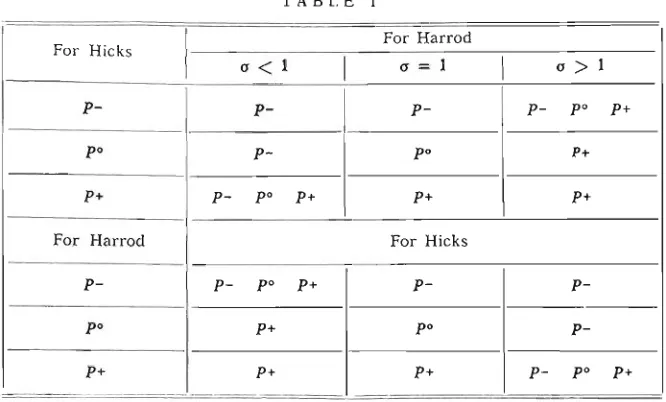
The value of the factor elasticities at point C, and therefore the bias of technical progress according to Harrod, will depend on the algebraic sum of the changes undergone by the factor elasticities in the two steps. These premises having been made, it is not difficult, by simple reasoning, to find the relationship between Hicks' classification and Harrod's, and vice versa, in relation to the value assumed by (j(5). This relationship, the formal demonstration
9
-of which will be found in Appendix II, is illustrated in the following table (6) (7):
TABl.E 1
I
For Harrod For Hicks
a
<
1I
a := 1I
a> 1p- p- p- p- po p+
po p- po P+
P+ p- po p+ p+ p+
For Harrod For Hicks
p- p- po p+ p-
p-po p+ po
p-p+ p+ p+ p- po p+
change occurs in the amounts of the factors employed in production.Ifthe elasticity of substitution is higher than one the share of the factor that grows the most increases. On the other hand, if the elasticity of substitution is lower than one, it is the share of the factor that grows the least that increases.
(6) We give an example of the way the reasoning has to be conducted to arrive at the relations expounded in the table:
Suppose technical progress is Hicks capital saving and a
<
1: moving to the new isoquant by comtantk gives a higher labour share. Then moving along the isoquant to get (he same capital-output ratio as at the start gives a still higher labour share. Technical progress is therefore Harrod capital saving. The same conclusion can be renched if a=1.If0>
I, on the other hand, in the first step the labour share increases, then decreases. The effect of technical progress and the substitution effect will be conlrasting :)nd we cannot predict a priori which will be stronger. Technical progress will be nccordingly capital saving, neutral or capital l!sing for Harrod, in relation to the ~elntive strength of the two effects. In the same way all the other relations in Table 1 can be found. [image:9.468.58.391.117.318.2]1 0
-4. - The Long-run Path of Growth as Related to the' Bias of Technical Progress According to Hicks' and Harrod's Classifications.
Differentiating [1
J
with respect to time we have:•
.
..
Y
=
FKK+
FLL+
FtDividing both sides of [8J by Y we get:
r
=
Uh+
Qn+
y,[8]
[9]
where r is the rate of growth of income, h the rate of growth of capital. n the rate of growth of labour, and y can be indicated as the rate of technical progress in Hicks' sense (8). From [9J it can be seen that the factor elasticities are the weights that determine the relative contributions made by the rates of growth of the factors to the rate of growth of income. The change of these elasticities through time is therefore of crucial importance for the determi-nation of the path of growth.
At a given moment of time the values of U and Q depend on the capital-labour ratio and on the shape of the production function. But dynamically. through time, these values depend - as shown by equations [2.3] and [2.4
J
obta'ined in Appendix II - on the three following elements:a) the rate of growth of the capital-labour ratio, k/k
=
h- n;b) the elasticity of substitution, a(t);
c) the intensity of the bias of technical progress, where the latter is defined as the growth rate of 5, given a constant k (9).
a) and b) have to be considered together: their joint effect may be termed effect of substitution.
c) on the other hand has a character of its own. The best thing is to consider it by resorting to Hicks' classification.
(8) See MEADE: op. cit., Chapter Ii.
1 1
-Let us now take into consideration equation [2.4], contained in Appendix II:
UjV=(l-U)
[0-:-1
- - -k 1k S
(::)J.
[10]In this equation the effect of substitution is indicated by the first component of the expression between square brackets. Ifthe capital· labour ratio changes, this effect differs from zero only in the
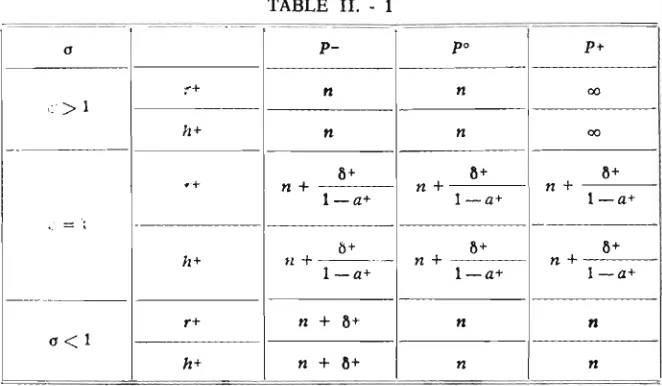
ca~e of 0 7 1. The sign and the absolute value of the second component depend, on the other hand. on the bias of technical progress (according to Hicks) and (';]. its intensity. With [10] we have succeeded in showing clearly how the effect of substitution and the intensity of the bias of technical progress act on the growth process through their effects on factor elasticities. What still has to be clarified in [9] is what the value of y depends on. Differentia-ting both sides of [3] with respect to time and assuming the con-stancy of K and L,we get:
y= 1
Y ay =
Vb
+
Qc,at
[11]where b
=
_1_ aFK and c=
_1_ aFLare functions of k and t.
F
Kat
F
Lat
On the other hand it follows from the definition of S that
_1
s
(~)=C-b.
at
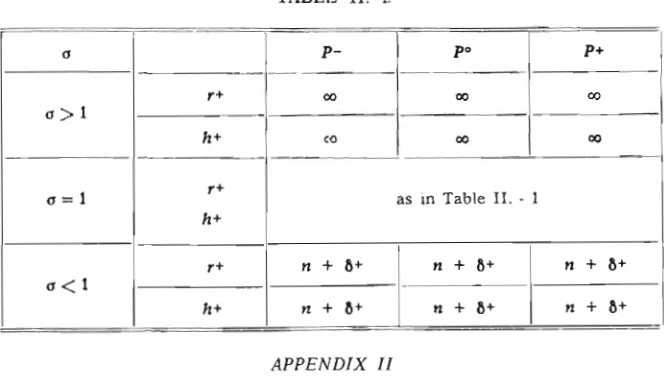
[12]Given a certain initial value of k and m, the value of n (which given the assumption of full employment is determined exogenously) and a given value of the rate of saving 5, the path of growth will be determined by the dynamics of V and of the two variables band c. If the impact of the bias of technical progress on the value cf TJ
1 2
-grows as time passes (0). We shall denote the long-run values of the variables (i.e. when t - (0) by placing the sign
+
above on the right. Thus if a>
1, U+=
1,Q+=
O. In the long run, therefore, the rate of growth of income tends to be equal to h+
b. The rate of growth of capital being lower than the rate of growth of income, the former increases in time, bringing about an unlimited increase in the rate of growth. Since, by hypothesis, K/Y _ s is constant, the rate of growth of h is equal to r - h and therefore, at the limit, for t=
+
00 it is equal to b;. As a result ifb+>
0, r+=
+
00 and h+=
+
00.The same will happen in the case of 0 = 1, given biasP+. 2) 0
<
1 and Por po (i.e. c :::::,. b).If
it is assumed that 0+<
1,then U+ = 1 and Q+ = Q. As a result r+
=
11.+
c+=
h+. The same is obtained in the case of 0=
1 and bias P-.3) 0
=
1 and PO. [6J shows that U (and therefore also Q) is then independent of changes in the capital/labour ratio. Since hereb
=
c, according to [11J
y=
b=
c and thereforer
=
Uh+
Qn+
b, [13J
for any time t and in particular for t
=
+
00. I t can easily be shown that r+ = h+.Let us in fact assume tha t in [13] we have r>
h. Then K/Y;=:: m decreases and h = s/m increases (we always assume t11' s is constant). Given the constancy of U, Q, 11. and c, therefore, rincreases too. But rincreases less than hinasmuch as r
=
Uh+
con-stant, where U<
1. Hence(11. - r) decreases, tending towards zero.If
r=
11., m is constant and we have golden age growth. The follo\'J-ing result can therefore be reached:r+
=
11.+=
c/Q+
11.=
a+
11. [14Jwhere a is the rate of growth of labour productivity, taking into account that in [13] U
=
1 - Q. The same holds if one starts from(10) It should be taken into account that in the long run always h
>
nandk
therefore -
>
O. This may be deduced from [9], taking into account [3], andk - .
h
from the fact that, given the assumed constancy of 5,
should also be recalled). h
1 3
-an initial situation in which r
<
h. From this it can be concluded that, in the case considered, the golden age rate of growth, r+=
=
c/Q+
n, is stable (11).If the effect of technical progress and the effect of substitution are contrasting, i.e. in the case of (J
<
1 and P+, and (J>
1 and P-,it is not possible to determine a priori the trend of the long-run rates of growth of income and of capital. All growth paths are pos-sible, among others those of types 1), 2) and 3).
On the other hand, if one considers Harrod's classification, it is possible to identify a priori the long run path of growth only if tecnical progress is neutral. In discussing this case the following relation obtained in Appendix II will be helpful:
[15]
u
u
(J - 1
m
1(au)
(J
m
+
u
---at
m·The first component of the right-hand side of [15] is the quantitative expression of what may be indicated as the effect of substitution in Harrod's sense; the second component may be indi-cated in turn as the measure of the intensity of technical progress, also in Harrod's sense. Consequently, if Harrod's P- is accompanied by (J
>
1, the effect of technical progress and the effect ofsubsti-tution are constrasting, provided
m/m
>
O. As can be seen in Table I, in this case Harrod's P- technical progress is also Hicks' P-. The same happens, mutatis mutandis, in the case of P+ and (J<
1. Thusthe long-run rates of growth of income and of capital are not deter-minable a priori inasmuch as they depend on the concrete values of
(J(t) and on the intensity of bias P-, or P+.
On the other hand, in the case of Harrod's P+ accompanied by
(J
>
1 and P- accompanied by (J<
1, it might appear at first sightthat the economy tends in the long run to set on growth paths 1) and 2) respectively. This is not certain, however, except in the case in which the rate of capital growth always exceeds the rate of income growth. The fact is that for h
>
r (and therefore in [15]m/m
>
0) the effect of substitut,ion acts in conformity with the corresponding bias of technical progress, while, for h>
r it acts in the opposi.te-
14-sense. In these cases, in effect, non-neutral technical progress in Harrod's sense may correspond to any bias in Hicks' sense, even that which, accompanied by a corresponding value of the elasticity of substitution, makes the path of long-run growth unidentifiable a priori.
In the case of Harrod's po accompanied by (J
=
1, technicalprogress is neutral also ~n Hicks' sense (see Table I); the path of long-run growth is therefore characterized by a golden age rate of growth equal to a
+
n.Let us further suppose that (J::I:- 1.Then Harrod's po corresponds
to Hicks' p. if (J
>
1 and to P" if (J<
1. In both cases, if capitalgrows at the same rate as income, factor elasticities do not change and we have a golden age rate of growth. On the other hand, if capital grows at a higher (lower) rate than income, the rate of capi-tal growth decreases (increases). So that in this case there are good reasons to suppose that the path of long-run growth is of type c). In our model this will always be the case, as we have assumed the pro-perties of the production function corresponding to equations [2]: the necessity of convergence towards the golden age path is in fact linked to the assumption of these two properties (12).
We have anyhow reached the conclusion that in the case of a contrasting action of technical progress according to Hicks and of the effect of substitution, a golden age path of growth is possible. On the other hand, according to a widely shared opinion, if tech-nical progress is not Harrod's po golden age growth is not possible. A distinctive feature of the golden age is in fact the equality of the rates of growth of income and capital and, as a consequence, the constancy of the capital/output ratio corresponding to a constant level of the aggregate rate of saving and a constant level of factor elasticities. But in the case of Harrod's non-neutral technical pro-gress if, by hypothesis, m is constant, the factor elasticities change. Further (as follows from [9]), in the presence of a constant value of s the value of the difference r - h must also in general change and therefore, contrary to the hypothesis, the capital/output ratio must change too (13). It should however be noted that a state of
(12) See A. CHlLOSI, op. cit.
(13) See HAHN and MATTHEWS, op. cit., p. 829. On the same page the authors write: «Labour-saving bias in technical progress ... tends on most assumptions to
-
1~-growth characterized by the constancy' of m and of5 in the presence
of Harrod's non-neutral technical progress appears possible from [9] if, during the growth process, the changes in U and in Q are exactly compensated by corresponding changes in y so as not to have any influence on the rate of growth.
5. - Factor-Augmenting Types of Technical Progress.
Only in the case of Harrod's po at each point of the production function there can be an infinity of logarithmically parallel golden ages, characterized by the same growth rate of income, capital, and efficiency labour (for an explanation of this expression see below. pp. 17-18). This is due to the fact that only in this case (as we shall show in par. 6) does the rate of growth of labour productivity in correspondence to a constant value of the capital/output ratio not depend on the level of this ratio. In this case the production function can be be written as follows:
Y
=
F (K, AL), [16Jwhere A is an increasing function of time (14). It follows directly from this equation that technical progress of this kind has the same productjve effects as an increase in employment proceeding at the same rate at which A grows (15). That is why this kind of technical progress is called labour- augmenting. In referring to it we shall, for the sake of brevity, use the sign Pl!'.
If we take a to denote the rate of growth of AU), we get from [16J
r
=
Uh+
Q(a+
n). [17JThe identity of the productive effect of technical progress and of the growth of labour is clearly shown in [17J (note that both a andn are exogenous variables). From [12
J
it follows that in the casetends to deceleration ...» (our italics). We hope to have made it clear which as-sumptions determine the accuracy of these conclusions.
(14) See H. UZAWA: Neutral Inventions and the Stability of Growth Equilibrium,
• Review of Economic Studies ", February 1961.
1 6
-of golden age growth, in which h
=
r, a=
r - n; namely a is equal to the rate of growth of labour productivity.If the production function is of the Cobb-Douglas type (namely if ()
=
1), it then follows from [16] that the value of Q does not depend on the level of k and does not change when changes occur in the value of the capital/labour ratio.Since, by hypothesis, a is in [17] a function of time only, like A in [16], the value of y (see [9]), which in this case is equal to aQ, is independent of the value of k. On the other hand, if the production function is not of the Cobb-Douglas type, Q depends on the level of k and, in the case of Harrod's po, therefore, the value ofy changes at the various levels of k as a consequence of the changes in Q (it must be always taken into account that y
=
aQand that a does not depend on the level of k).The concept of capital-augmenting technical progress, briefly PCA , can be introduced in the same way. The rate of this progress,
equal to y/U, has the same effect, as regards the rate of growth of income, as an increase in capital stock taking place at the same rate. The PCA bias may be defined (analogously to Harrod's
definition of the PLA bias) as requiring the constancy of the mar-ginal productivity of labour, given the constancy of its average productivity (16). In this case r = n and, the factor elasticities remaining constant, the average productivity of capital (i.e. the reci-procal of the capital/output ratio) must grow at the same rate as its marginal productiViity, i.e. at the ylU rate. But this kind of neu-trality of PCA technical progress is only apparent. In the Pr.A case in
effect the economy tends, if the rate of investment is constant, to bring about a state of balanced growth in which factor elasticities do not change. In the PCA case this is only possible when the elasticitv of substitution is one, namely in the case of a production function of the Cobb-Douglas type. In fact, if income increases at a constant rate resulting from the sum of a constant rate of technical progress ylO
=
d and of a constant rate of labour growth. n, capital grows at the same rate as income. As has been seen, this is the funda-mental characteristic of the golden age. But in this case the rate of(16) For this def.nition see H~HN and MATTHEWS, ap. cit., p. 830; E. S. PHELPS:
17
-growth of capital evidently cannot be equal to the rate of -growth of labour. Hence the average productivity of labour cannot be constant. Therefore if we have PCA> U and Q can be constant only
if the elasticity of substitution is equal to one. Then neither tech-nical progress nor substitution tend to change the values of factor elasticities, which therefore remain constant.
The PCA bias is then alternatively Harrod's p., po or
r
accord-ing to whether the elasticity of substitution is lower than, equal to, or higher than one. We can use fig. 1 to show this.
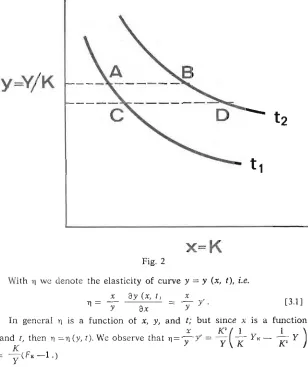
Passing from point A to point D the factor elasticities do not change. To see what the bias of technical progress is for Harrod, we pass from point D to point C.
If
in the interval CD (J = 1, thefactor elasticities do not change in passing fromD to C and we have Harrod's neutral technical progress.
If
(J>
1, in passing from D toC V increases and we have Harrod's P+, if (J
<
1, U decreases andwe have Harrod's P-. The same holds for Hicks' classification, pass-ing from point D to point B.
Thus, just as technical progress of type PLA can be inserted into
the production function by means of a multiplicative factor of physical labour, increasing function of time, PCA technical progress
can be inserted into the production function by means of a multi-plicative factor of capital, increasing function of time (17). In both cases we can choose the productive effect of a certain dated quan-tity of capital or labour as an unit for measuring capital or labuur, respectively, in efficiency units (18). In the case of Pu, the rate of growth of income and capital in the golden age is equal to the rate
(.17) The importance of this kind of technological progress lies in the fact that it (and it alone) allows the aggregation of the capital stock in efficiency units and the construction of a global production function for the economy as a whole also in the case in which capital is not asswned to be «malleable ». See in this respect R. M. SOLOW: Technical Progress, Capital Formation and Economic Growth,
«American Economic Review» (Papers and Proceedings), May 1963, p. 56 ff. and also F. M. FISHER: Embodied Technical Change and the Existence of an Aggregate Capital Stock, «Review of Economic Studies» October 1965; ID.: Embodied Techno-logy and the Aggregation of Fixed and Movable Capital Goods, «Review of Econo-mic Studies» October 1968. The relations between capital augmenting and Hicks and Harrod neutral and biased technical progress are stated by JOSSA: Teoria economica del prfJr;resso tecnico, Milano, Giutfre, 1966, p. 259 ff.
1 3
-of growth -of labour in efficiency units. In the case -of PCA , on the
other hand, the rate of growth of income is given by
) =
U (~+
h)+
Qn, [18Jwhere ~ is the rate of growth of the capital-augmenting factor, i.e. the rate at which the average and marginal productivities of capital increase, given the constancy of the average (and at the same time the marginal) productivity of labour.
In the particular case of Hicks' PO, there is no change in the shape of the isoquant, but only an increase at the same rate of the productive effects of both factors. Technical progress can then be characterized merely by an increase in the level of output corres-ponding to the different isoquants of the production function; the latter may therefore be written as multiplied by an increasing func-tion of time (19):
Y
=
F(K, L) C(t). [19JIn this case technical progress can be said to be product aug-menting.
Differentiating [19], the rate of growth of income comes to be expressed as follows:
r
=
Uh+
Qn+
y [20Jwhere y, the rate of growth of C, does not depend on the level of k and is only a function of time.
The following production function includes the various possible cases of factor-augmenting technical progress:
Y
=
F [B(t) K, AU) LJ [21JIn view of the linear homogeneity of [21], the btter may also be written
Y ='B(t) F ( K,
;~;~
L ) . [22J19
-Or, in the case ofA(t) and B(t) growing at constant rates, given initial conditionA(O)
=
B(O)=
1:Y
=
elll F (K, e(a-W L). [23JFactor augmenting technical progress (briefly PFA) is therefore
a combination of Hicks' po at rate ~ and of Harrod's po at rate
ex- ~ (20).It,is therefore clear that the PFA type of technical progress,
in its various possible specifications, is of a rather special kind (21).
It should be observed, for example, that if technical progress is of the PFA type and cr = 1, technical progress must respond to Hicks'
cri terion of neutrali ty, although, in the case of cr
=
1, technical pro-gress generally can very well be non-neutral in Hicks' sense. This because, in case cr=
1, the production function is of the Cobb-Douglas type and if, for instance, there is PCA technical progress,this progress is alsoPLAand Hicks' PO, and vice versa.
It should be noted that if one wishes to consider the bias of factor-augmenting technical progress according to Hicks' classifica-tion, this bias is seen to be determined by the value of Harrod's neutral element(i.e. if(l : ; ~) and by the value of cr. If(l
>
~ we shallfind that for cr
>
0 technical progress will be Hicks' P- and for cr<
0 P+ (see Table I). The reverse will be true in the case of~
>
(l (22).The bias according to Harrod may be determined analogously i.e. by considering Hicks' neutral component and the value of cr.
(20) See VA~EK: Towards a More General Theory, op. cil.; M. J. BECKMAl'lN:
EinkommerLSverleilung und Wachs/urn bei nichlneulra'e.rn /eclmischen Forschri/ls,
" Jahrbiicher fiir Narionalokonomie und Statistik», 1965, p. 811 ff. (These two papers
are concerned with [he determination of the long-lUll path of growth in the case of factor- augmenting technical progress); SAro and BECKl\1At.~;, op. cit., p. 57.
(21) PHELPS (Axioms, op cil., p. 6 ff.) shows that technical progress can be described as factor augmenting if, and only if, «at time I the rate of change of the capital-output ratio necessary to keep shares constant is independent of the capital-output ratio». Another descl'iption of factor-augmenting technical progress is provided by SATO andBECKl\i1ANN(op. cil., p. 63). They show that technical progress can be described as factor augmenting if the elasticity of substitution remains constant when factor shares are constant.
-
20-Differentiating [21] we get the following expression for the rate of growth:
r = U (~
+
h)+
Q (a+
n)In this case we have
y=U~+Qa.
[24]
[25]
Comparing [25] with [11] one might be inclined to conclude that the former is a particular case of the latter that occurs when b and c of [11] (which correspond to ~ and a of [25]) are only functions of time and do not in any way depend on the value of
m and k. However it is not so. In can be shown in fact that in the case of factor-augmenting technical progress band c take the follow-ing form (23):
b= - -
aF
K 1=
0-
Q (~- a); [26]at
F
K 0aF
L 1a
U(0 -
a). [27]c=
- -+
at
F
L (JSubstituting [26] and [27] in [11] we obtain [25] (24).
6. - KaIecki's Classification of Technical Progress; Its Relation with Harrod's Classification.
So far we have considered classifications and characterizations of determinate types of technical progress that have been worked out and used in the West, usually to study the impact of technical change and growth on the relative shares of factors in the framework of a competitive economy. Owing to their technological basis, however, these classifications are of general value since they can be used in any growth model, irrespective of its institutional
specifi-(23) See PHELPS, Axioms, cit., pp. 10-11; B. JOSSA: Anali.,i econornica del progresso
tecnico, Milano 1966, pp. 120-17.5.
-
21-cations. Professor Kalecki, on the other hand, has recently formu-lated a new classification of technical progress that is strictly reformu-lated to the planner's decisional process in a socialist economy. The planner has to decide the level of the share of accumulation in the national income and the level of the capital coefficient to be chosen for the new investment projects. These decisions will be influenced by various considerations, which are related to the implications of the choices to be made. The study of the logic of these choices is the object of KaJecki's recent book, Outline of the Theory of Growth of a Socialist Ern'1nmy.
Of particular importance among the implications of the planner's decisions are those related to the effects of the bias of technical progress and of the level of the capital coefficient on the rate of growth of labour productivity. In short, the planner will choose a higher aggregate rate of saving and a higher capital coefficient for future investments when the rate of growth of labour producti-vity is a positive function of the level of the capital coefficient. And conversely in the opposite case.
Kalecki consequently divides technical progress into « encourag-ing capital intensity», «discouragencourag-ing capital intensity» and neutral, according to whether the rate of growth of labour productivity at a constant level of the capital coefficient is positively related, inversely related, or unrelated to the level of the capital coefficient (25).
We shall now show that Kalecki's classification of technical progress, although different in its formulation, corresponds exactly to Harrod's classification (26). For the sake of brevity we shall use the same symbols for Kalecki's classification as for Hicks' and Harrod's, namely P+, P- and po respectively for the three types of technical progress mentioned above.
Kalecki considers an economy with vintage capital; this is an aspect of his model we shall return to later. For the time being it will be sufficient to point out that in a model of this kind the concepts of production function and technical progress, in the:· sense used so far, apply only to the ex ante production function.
(25) KALECKI, op cit., p. 70 ff.
2 2
-The character of the model insofar as it concerns ex post substituta-bility, however, is of no importance as far as the nature of the classification of the bias of technical progress is concerned. Kalecki's classification can therefore be examined wi thin the limits of the model in the framework of which we have worked so far. Alterna-tively, if the reader prefers, what we are going to say can be applied to the ex ante production function and [1] may now be considered to represent this function. In his book, however, Kalccki does nol work explicitly with the production function, but instead starts from the assumption that a relation exists between labour producti-vity,W _ YIL, and the level of the capital coefficient, In
.:=:
KfY.Kalecki describes this relationship graphically by means of the isoquant (which he calls curve of production) corresponding to the production of a unit of income (27). Since the «curve of pro· duction» is assumed to be fall ing and convex everywhere, the relationship between labour productivity and the capital coefficient is one to one and can be expressed in the form of a function. This relationship can therefore be written~
w
=
f
(m, t). [28]It follows from [28]. moreover, that the implicitly assumed production function connecting income with factor endowments is homogeneous of first degree. Only in this case, in fact, is the productivity of labour a function of the capital coefficient, irrespect· ive of the scale of production.
[28) can be obtained from [1] as follows:
Given the linear homogeneity of [1] we have:
Y
=
LF (KfL, 1; t)=
LF (mw, 1; t) [29]Of, dividing by L:
tv = F(mw, 1; t). [30]
In view of the assumed one to one character of the relationship connecting w withIn, [30] can be solved in such a way as to obtain
w as an explicit function of m, as expressed in (28).
-
23-At the starting point t
=
0 we know the graph representing w(m)=
f
(m, 0), i.e. the relationship existing between labour pro-ductivity and the capital coefficient.Kalecki assumes that, for any given value of m, we know the value of the rate of growth of labour productivity that occurs when
m is maintained at a constant level. In other words we know the function
0.0 (m, t)
=
1 8ww
at
[31]Kalecki's classification of the bias of technical progress is based on 80.°
the nature of the dependence of0.0 on n1; when 8m __a.om
>
0tech-nical progress is P+, when uOm
<
0 it is P- and when aOm=
0 it is neutral. Integrating [31] we are able to put the productivity of'.,,'-r·.J" tV in .~n explicit relation with m and t, given the values of
wo(m) and of aO:
w
=
f
(m, t)=
WO(m) exp[tao
(m, t') dt'. [32]Let us now calculate the rate of growth of labour productivity,
w/w
=
a. This rate may differ from 0.0 as m is not necessarily constant in time. Considering [28J we have:w
=
fmm
+
ft.From [32] we know that fm = WOIll
~
+
'\-iJf'a
om dt' and thereforeWO
u
=
(~o
WOrn+
f~a"m
dt' )m
+
0.0=
q : -+
0.0, [33]where q/m stands for the expression between the brackets (28). In view of the definition of wand In, moreover, we know that a
=
=
r - nandm/m
=
h - r. By substituting these expressions in [38] we can obtain a general expression for the rate of growth,1 8w·
(28) Since w/w
=
u.= -
- -
m + 0.0, it follows from the comparisonw 8m
m 8w
with [33] that q = - - - , namely that q is the elasticity of labour productivity
w 8m
-
24-placing at the same time in relief the influence of the bias of tech-nical progress in Kalecki's sense on the value of this rate:
r
=
--=-q-- h+ __
1__l+q l+q n
+
1+
q [34JInaddition to this expression for r we also have the preceding one, consisting of [9J, already known to us. Both these relations must be satisfied simultaneously, irrespective of the magnitude of the rate of growth of labour and of the rate of growth of capital. For this to occur, the coefficients by which hand u are multiplied and the last component of the right-hand sides of the two equations must be equal. It ensues that
u=
q1
+
q rnFK • [35J[35
J
gives the key enabling us to relate Kalecki's classifica-tion to Harrod's. According to Kalecki, technical progress is P+ whenaOm
>
O. From the definition of q we know that in this case, giventhe value ofm, the expression q(m, t)increases in time. The quotient
1 q then increases at the same rate and so, as follows from [35J,
+
qdoes the marginal productivity of capital: technical progress is then P+ also in Harrod's sense. In the case of aOm
<
0, the expressionq(m, t) decreases as time passes and consequently 1 q and FK
+q
decrease too. Agreement exists between Kalecki's classification and Harrod's also in this case. Finally, if aOm
=
0, with m constant, alsoq(m, t) is constant and therefore we have from [35J that FK is
constant, too. Technical progress is then neutral both for Harrod and for Kalecki.
With the help of [35J it is easy to verify that the equivalence is satisfied also in the opposite case, starting from Harrod's instead from Kalecki's classification.
i'
I
j
J
-
25-to depart from this unrealistic assumption was Leif Johansen 111 1959 (29).
Whereas in the original neo-classical model with mallectble capital technical progress acts indifferently on the whole production apparatus irrespective of the date of construction, in Johansen's model technical progress is embodied in the successive vintages of capital goods. Once a determinate vintage of capital goods has been installed, its productive capacities do not change up to the moment of its scrapping. On the other hand technical progress can be considered to be partly embodied and partly disembodied; Jo-hansen's original model has since been altered, so as to take this possibility into account (30). Kalecki's model is also of vintage type and is characterized by the presence of two types of technical pro-gress that correspond to a considerable extent to the division made, in certain western models with investment vintages, between embo-died and disemboembo-died technical progress. In Kalecki's treatment there are, however, some interesting peculiarities to which, among other things, the next two paragraphs will be devoted.
7. - Technical Progress in Vintage Models.
Each part of the capital stock of the whole economy (machinery, equipement, plants etc.) can be ranged according to the time of its construction. In the period from v to v
+
dva quantity Iv dv of new capital goods is produced in the old plants. At moment t,wheret :::::". v, LVl workers are employed with these capital goods. Let us
continue to assume, as we have done so far, that there is no period of gestation in production and that capital can last indefinitely without becoming worn out. We shall also continue to assume that only one good is produced; the model continues to be mono-sectoral. This good, however, though its qualities remain unaltered if it is used for consumption purposes, changes its productive qualities as
lime passes if it is used as a capital guud.
(29)L.JOHANSEN: Substitution versus Fixed Production Coefficients in the Theory of Economic Growth: A Synthesis, «Econometrica", April 1959.
-
26-All the innovations at the current time t can be divided into the following groups:
1) A group that we shall denote with v*. The innovations belonging to this group are absorbed exclusively by the most recent vintage, i.e. by vintage v
=
t. These innovations have all the effects we have so far connected with technical progress; namely they bring about an increase in the output that can be obtained from a given amount of factors.2) A group we shall denote with
t.
To this group belong the innovations contemporarily absorbed by all the vintages. Here the economic effects of the innovations are not related to the formation of a vintage that embodies them, but are spread uniformily over the whole productive apparatus, inclusive of the most recent vintage, which also absorbs the innovations of type v'.Whereas the latter logically include improvements of a techno-logical as well as organizational nature, the innovations of type t
refer mainly to organizational improvements in the economy as d
whole.
In the following pages we shall limit ourselves to examining the working of vintage models in a state of steady growth and with labour augmenting technical progress.
The v' innovations present at moment v insure efficiency labour at moment v being equal, in vintage v, to AvLvl, where Av is a
func-tion of v increasing at rate a. Moreover, if the existence of disem-bodied technical progress is also assumed, t innovations bring the quantity of labour in efficiency units, combined with investment vintage v, at moment t ~ v, to the level
where Bl is a function of current time t, increasing at rate y.
Assu-ming that both kinds of technical progress jointly augment efficiency labour, the income produced by vintage v at time t is
YVl
=
F(Iv,eIXv+yl LvI), where t ~ v andBoAo=
1 . [36JIn the above equation, however, Lvt cannot be arbitrary for
-
27-Ifthe latter assumption is made, theex post fixity of coefficients can be specified in one of the following two ways (31): 1) by assum-ing the ex post constancy of the capital/labour ratio, measuring labour in efficiency units; 2) by assuming this ratio to be constant, but measuring labour in physical terms. The difference between these two interpretations of the fixity of the capital/labour ratio is that the first implies that employment in physical terms must de-crease in the old vintages at rate y i.e. the rate at which disem-bodied technical progress proceeds, and that the income produced by the various vintages of the capital stock does not change through time from the moment of their installation. If the second interpre-tation is adopted, on the other hand, employment in physical terms remains unchanged in the old vintages, while labour in efficiency units grows at rate y, and consequently the income produced by each vintage of the capital stock increases. Thus Yvt increases at
rate
u = ~l y, [37]
where ~ is the elasticity of output with respect to efficiency labour in the ex ante production function. (In golden age growth ~ will have the same value for all vintages). It should be noted that, once the investments corresponding to vintage v have been completed, an increase in employment in efficiency units generates an increase in income only if it occurs as a consequence of technical progress. As this does not seem very logical, the first interpretation is to be preferred.
Ifthe possibility of ex post changes in production coefficients is assumed, several solutions are possible. The ex post flexibility of coefficients may be assumed following the original ex ante pro-duction function (32). In this case [36] and [37] are applicable. Or, more reaHstically, a particular(ex post) utilization function, differ-ent from the ex ante production function at the time of the
con-(31) See SESHINSKI, cit.. p. 240.
-
28-struction of the plants may be assumed. In particular it may be supposed:
a) that output increases proportionally to employment (this may be measured in efficiency units) until a certain capital/efficiency labour ratio is reached beyond which an increase in employment can no longer cause an increase in output (linear utilization func-tion) (33);
b) that the productivity of efficiency labour decreases as the quantity employed with a given vintage increases; this utilization function, a particular case of which occurs when it is identical with the original ex ante production function, need not necessarily be equal to it.
On the other hand there is no reason why, unlike the ex ante
production function, the utilization function should not, for instance, provide increasing returns to scale (34).
In the case of both a posteriori substitutability and fixed pro-duction coefficients, the problem exists, in the models we are con-sidering, of the efficient distribution of the available IC'.bour among the various vintages and of the choice of the optimal capital/labour ratio in the new vintage by a given level of the rate of saving; this is a problem that occurs specifically with regard to the optimal combination of capital intensity in the new vintage and intensity of renewal of the old vjntages. If,as we are supposing, the economy is in a state of steady growth, this problem is assumed to have already been solved, either by the market mechanism of a perfectly competitive economy or, alternatively, by the«benevolent planner ». As a result the capital/efficiency-labour ratio of successive vintages at the time of their construction is identical for all of them and the economic life of all vintages is constant (35).
In any case the increase of income in the period from t to
t
+
dt is equal to the difference between the production of the new(33) This assumption is mace by C. J. Buss' On Putty-Clay «Review of Econo-mic Studies», April 1968, p. 106.
(34) Ibidem, pp. 106-107.
(35) This has been shown in all models WIth embodied technical progress wntten after Johansen's original work. In the latter, in fact, the problem of obsolescence and of the determination of the economic life of capital goods in relation to the efficient distribution of the available labour force among the various vintages of
-
29-vintage, Ytt dt, and that of the vintage that is being scrapped Y,t-TIL
(here T is the life of capital goods, which is a constant in a golden age), plus the sum of the increases in income that may occur as a result of an increase of efficiency labour combined with the other vintages (these increases can even be negative if employment in efficiency units decreases, as in most cases it should). Each of these increases is proportional to Yvt with the coefficient of
propor-tionality uv • If all the uv's are identical ar,d equal to u, the sum of
the single increases of the various vintages is proportionate to the sum of the single Yvt's, i.e. to Y twith the coefficient of propor· tionalityu. We therefore have:
[38J
As always r denotes the rate of growth of income. Fur gruwLh to take place along a steady path, investments Iv mus'!: grow at the rate r, i.e. Iv
=
10erv.The rate of growth of labour is n. Taking [36]into account we have
[39] - F (/0 er(t-T), e(a:+n+y)(t-T)+£T Lo),
where E denotes the rate of growth of labour in the successive
vin-tages after the time of their installation (37). This dIfference grows at a constant rate only when
r=a+n+y.
[40]In fact the difference Yl,l - Yt-T,t
=
[F (/0, Lo) - F (Io e-rT, LoeT(c r»)] ert increases at rate r as the expression in square brackets
does not depend on current time t. As a result, in this case, we have both sides in [39] growing at the same rate r = (y.
+
~+
y, constant through time.(36) This equation is equivalent to the one found in KALECKI, ap. cit., p. 23. (37) E is usally null or negative according to the assumptions made in the
-
30-8. - The Treatment of Innovations in Kalecki's Model.
Kalecki too divides the innovations absorbed by the economic system in two groups:
1) Groupv', which includes innovations both of technological and organizational nature absorbed by the latest vintage v = t. If
the capital coefficient is constant, their absorption brings about an increase of labour productivity in the new vintage as compared with the preceding ones (38).
2) Group (, which comprises mainly innovations of an organ-izational nature, absorbed by vintages v
<
t, namely by those vin-tages already existing at time t (39).It is easy to see that this division is not exclusive; there may well be innovations that are contemporarily of type v' and type ['. On the contrary, in models of the kind considered in the preced-ing paragraph, the sets v* and t* are mutually exclusive; a glance at their definition is sufficient to prove this. This is a first difference between the two divisions.
The second difference is that it seems logical that innovations of more various kind can be included in the sum of sets v' and t'
than in the sum v*
+
t*; all the innovations that can be included in the first subdivision can be included in the second, but the contrary is not true.In addition to this difference in the division of innovations there are differences in Kalecki's model with regard to the effect of each group on the growth of the economy (principally as a con-sequence of the difference mentioned above). Given the constancy of the capital coefficient mv
=
lv/Lv,
the absorption of innovationsof type v' leads to an increase in labour productivity in vintage v
=
t as compared with all the pre-existing vintages, at a rate that generally depends (as we have seen in par. 6) on the level of m. As we have shown in par. 6, the classification of technical prugress for(38) KALECKI, op. cit., p. 33.
(39) Ibidem, pp. 22-23. This seems the kind of technological pr0C:iCS.s :nenlioned by N. KALDOR and J. A. MIRRLEES in: A New Model of Economic Growth, «Review
of Economic Studies ", 1961-62 (Vo\. X;X.IV), p. 176: «it is probable that in addition to
3 1
-this group of innovations corresponds exactly to Harrod's. Assuming technical progress to be neutral, and considering for the time being only innovations of type v', the flow of income produced by vintage v at time t will be equal to
[41J
In models of the kind considered in the preceding paragraph the quantity of labour in efficiency units employeJ with vintage v
=
t is Lv'=
e("+Y)vLv,
whereas in Kalecki's model L*=
e"VLv.
Therefore in models of the first kind the sum a -+- y corresponds to a in Kalecki's model.
For vintage v
=
t the effect of the absorption of innovations of type v' is exactly the same as the aggregate effect of the absorp-tion of the innovaabsorp-tions v· andt.
The innovations t' (as well as the innovations v' at the time of the «birth)} of these vintages, i.e. at time v) have an additional effect on the production of vintages v
<
t. Kalecki assumes that, in the case of labour Lvt increasing at a constant rate 13, which can alsobe negative or null, income Yvt increases at a constant rate u,
inde-pendently of the bias of technical progress (40).
From this point of view the productive effect of the absorption of innovations t' corresponds to that resulting from the absorption of type
t
innovations in the preceding paragraph, in the particular case for which [37J holds; in both cases production increLlses in the lifetime of vintage v at a constant rate u.The consideration of the absorption of innovations t' calls for a change in equation [41].It is possible to check that Kalecki's above-mentioned assumptions are always respected, regardless of the bias of technical progress, when
[42J
In effect, since we have Ut
=
Lvv
e~(t-v), and F is supposed to be homogeneous of the first degree, we get from [42J that[431
-
32-that is YVt increases at rateu. From [41] it would appear that through
time the technical progress linked to the absorption of innovations t augments both factors of production in eachv
<
t vintage: labourLvt
at rate f.L - ~ and capital Iv at rate u.This is not however a necessary condition for steady growth to be possible (41). If,for instance, the quantity of capital in efficiency units increases at the constant rate 1'1 and the quantity of labour in efficiency units at the constant rate~
+
1'2 in vintage v,income YVt .increases at rate
u
=
(l - !J.)1'1+
f.L (1'2+
~), [44]which is constant if the elasticity f.L is assumed to be constant through time and returns to scale are constant in the utilization functrion. Parameters 1'1 and )'2 are arbitrary constants. It may
happen, in particular, that 1'1 =
a
and ':'2 y. We then haveu
=
!J.(I'+
~) [45] namely, in the case ~=
0, a relation formally identical to equa-tion [37].In any case, if production in the old plants increases at the cons1!ant rate u and employment at the constant rate E, the possibi-lity of having steady growth exists. In fact [39] takes the following form:
[46] - euT F (10 &it-T), Lo e(a+n)(t-T)+€T);
and it is easy to ascertain that this difference increases at a constant rate when r
=
a+
n.We may therefore come to the following conclusions: a) The distinction made by Kalecki between technical pi'ogi'ess that acts on the ex ante production function and technical progress that acts on the existing vintages of the capital stock makes the condition for the existence of steady growth, in so far as it concerns the
(41) The working of his model in a state af steady growth and the 'lS~llnq)tjons
-
33-latter type of technical progress, that labour productivity and empluyment mu~t be able to increase at constant rates in the exist-ing vintages of the capital stock. b) In all vintage models, whatever their specific characteristics may be, the rate of steady growth (in whichIn
=
constant,S=
constant and r=
constant) in the economy as a whole is equa.l to the sum of the rates' of growth of employment and of labour productivity in the new vintage.9. - Te'chnical Progress, Steady Growth and Long-run Growth in Vin-tage Models.
In most cases there will be the possibility of steady growth only if technical progress shifting the ex ante production fl nf't;OT"\ is Harrod's and Kalecki's neutral; the reasons for this are of the same kind as we have taken into consideration for models with malleable capital. On the other hand, even if technical progress absorbed by the old vintages of the capital stock is not labour augmenting, there may be steady growth, as we have seen in the preceding paragraph. Moreover the possibility exists of having steady growth also with non-neutral technical progress in the ex ante production function, in the partiollar case described at the end of paragraph 4 (42).
So far as concerns the relationship between the bias of tech-nical progress and long-run growth in the case of vintage models, it is most probably of the same type as in models with malleable capital. What has been said in the preceeding paragraphs for the case of malleable capital may be extended to the new vintage of vintage models. As, in the long run, the path of growth along which the economic system proceeds is traced by the successive new vin-tages, while the old vintages gradually disappear or lose their relative importance, as compared with the bulk of the more recent
-
34-ones, the relationship between types of technical progress (with regard to the new vintage) and the path of economic growth must logically be the same in models with vintage capital as in those with malleable capital. However an accurate treatment of this prob-lem in a vintage model involves far from negligible mathematical difficulties; and does not seem to lead to the discovery of new results, interesting enough to justify the task of overcoming these difficulties (43).
10. - The Level of Technology as an Endogenous Variable.
Since the present paper has in some respects the character of a survey it will not be amiss, before concluding, to mention briefly some interesting new developments in the theory of technical pro-gress.
Until now the level of technology has been treated as exoge-nous; technical progress was as «manna falling from heaven» (44). In some recent models, however, the level of technology is treated as an endogenous magnitude. The best known of these models is Arrow's (45). In its original version, fixed coefficients of production were assumed, both ex ante and ex postfor each vintage of the capital stock, as well as labour augmenting technical pro-gress (46). If,instead, ex antesubstitutability is assumed, the model takes the following form (47):
(43) A demonstration of the theorem of convergence is presented by SHESHlNSKJ in the framework of his version of the vintage model. KALECKJ (op. cit., chapters VIII and IX) describes the process of convergence towards steady growth; in his book, however, the process of convergence takes place with the choice of a constant value of the capital/output ratio in the new vintage of investment goods and with the progressive adjustment of the rate of investment to this value, contrary to how the process of convergence towards steady growth is usually described.
(44) HAHN and MATIEWS, op. cit., p. 836.
(45) K. J. ARRow; The Economic Implications of Learning by Doing, «ReVIew of Economic Studies», June 1962. Kaldor's technical progress function is also based on similar ideas. For this interpretation see HAHN and MATIHEWS, op. cit., p. 847 ff. (46) In a model with fixed production coefficients, labour-augmenting technical progress is characterized by the fact that, as time passes, the capital/labour ratio increases while the capital/output ratio remains unchanged.
-
3S-The ex ante production function is of the [ 16
J
type withAequal tocu,
where C is the amount of capital up to time t and u is a posi-tive constant less than one.Vintage v produces an income
[47J
where
Lv.
is employment with vintagevat time tand Iv = Cv is grossinvestment at time v, namely
G(v)
=
Cv=
jV1(t')dt'- < t )
[48]
To obtain the income produced by the economy as a whole at time t it is necessary to add up the partial incomes ¥v. produced by the different vintages, from v
=
t - T(t) to v=
t, where T(t) is the lifetime of capital goods. In the same way we have to proceed for labour. With regard to the ex ante production function, F (x, y), where x=
lv, Y=
CvuLv
t , homogeneity of the first degree (F (A x,A
y)
=
AF (x,y»,
and strict convexity (Fx , Fy>
0; Fa, Fyy<
0) areassumed as usual. Given these assumptions it is possible to find the value of the long-run rate of growth of labour productivity. In the case of steady growth (Y, I and G growing at an identical and constant rate r, with labour L growing at a constant rate n) we have
u
a
=
n,l - u [49]
the rate of growth of labour productivity a is namely proportional to the rate of growth of labournwith a coefficient of proportionality that depends on the value of u, the so-called « learning by doing» parameter.
Another way of rendering the level of technology an endogenous magnitude is that followed by Phelps (48). The latter distinguishes one « technological» sector from the whole of the economic system,
-
36-to which 36-to attribute the « production» of technological and organ-izational innovations. This sector employs R(t) workers and has an M(t) capital stock. The larger Rand M are the more will be the reo searches carried out, the quantity of which will be indicated by E(t) And the more research work is done, the larger will be the quantity of innovations that may be expected and consequently the larger the growth of the level of technology A. Thus two production func-tions exist in the model, the usual production function for goods and services produced outside the technological sector:
""
Y
=
F (K, AN) [50Jand a new function referring to the increase in the level of techno-logy:
A
= H (E (M, R, L), A), [51Jwhere L
=
R+
N is employment in the economy as a whole. Given the assumptions of linear homogeneity and of convexity of F, H and E, it is possible to determine the value of the golden age rate of growth of labour productivity and a variant of the Golden Rule of Accumulation (49).11. - Conclusions.
We should like to close with the following remarks:
1) Growth is very often studied by comparing various possible logarithmically parallel golden ages (comparative dynamics). Are· suIt of this method that has aroused some interest is the by now well-known « Golden Rule of Accumulation» (50). The peculiar na·
(49) On the Golden Rule see the note below.