AUTONOMOUS ROBOT HOME SECURITY
SURVEILLANCE USING
ATMega 2560 MICROCONTROLLER
1C.YAASHUWANTH
1
Department of Information Technology Venkateswara Engineering College
E-mail: [email protected]
ABSTRACT
The primary concern of every household when they leave their home is safety of the home as well as its protection. This paper deals with creating a solution for such a situation in the form of a small robot that can take care of the security in the home. The system uses several sensors that are mounted on it as well as in the home so that it can detect any breach in security or any abnormal situation in the household and inform the owners immediately as well as raise an alarm so that those nearby can take effective actions. The system can be used in cost efficient manner and can handle multiple operations. The main feature of the system is when it detects obstacles it avoids the obstacle, after avoiding the obstacle it again finds the black line path and returns to the original path. The robot uses an ATMega2560 as its microcontroller since it provides higher transmission rate and higher clock speed with more memory in terms of RAM and Flash. This enables the system to respond faster when compared to using other microcontrollers.
Keywords: Sensors, ATMega2560, Robot, Security, Microcontrollers)
1. INTRODUCTION
A large number of break and enter crimes are easily preventable. By introducing a number of simple and inexpensive changes to the home, people can play an active role in reducing the chances of this happening in their home. By securing your home you significantly lower the risk of you and your family becoming victims of crime. Burglary can have a serious impact on families and individuals in a number of different ways. Many people often feel violated and have difficulty overcoming such experiences. Jimin Cheon et.al[6] proposed A single-chip CMOS smoke and temperature sensor for use as an intelligent fire detector. The proposed smoke sensor measures smoke density based on the light-scattering method. The author also integrated temperature sensor is with the smoke sensor not only to sense heat from a fire but also to compensate for the temperature dependency of the smoke sensor. Hou-Tsan Lee et.al[4] developed a self patrolling robot which will transmit the images to the server using Wifi and this vehicle can also be remote controlled by the user. The Lin Jiang et.al, Lipu et.al [7],[8] are developed models to efficiently detect fire.
2. STATE OF ART
integrating intelligent control method and mobile robot developing platform, a lot of assistant robots and service systems are developed such as human-machine interaction, mobile navigation system, image processing, object recognition, voice recognition, teleoperation, remote sensing, map building and localization, etc. Through artificial intelligence techniques, applications of advanced robot systems can be achieved. Yen-Sheng Chen and Jih-Gau Juang[14] presented intelligent strategies for a wheeled mobile robot to avoid obstacle and move to target location. The obstacle detection for the wheeled mobile robot was carried out by ultrasonic sensors. The authors also presented a study of two models short-distance obstacle avoidance model in which the wheeled mobile robot utilizes signals of the ultrasonic sensors to avoid obstacle. and target-driven obstacle avoidance model. In which fuzzy theory with sensor signals is used to control the speed of the wheeled mobile robot and make it move to target location. Divakar et.al, Xue-Song Wang et.al [3],[13] in their papers implemented various ways through which their wireless robots or other devices can avoid various obstacles through ultra sonic sensors. Real-time obstacle avoidance for redundant robot is always of consequence in the field of robot research. Xuan-Thu Le[12] et.al in their paper described the obstacle avoidance architecture to walk safely around in factory and home environment, and presented methods for path planning and obstacle avoidance for the humanoid robot.
Home security and control is one of the basic needs of mankind from early days. But today it has to be updated with the rapidly changing technology to ensure vast coverage, remote control, reliability, and real time operation. Deploying wireless technologies for security and control in home automation systems offers attractive benefits along with user friendly interface. Arbab Waheed
Ahmad et. al [1] implemented novel security and
control system for home automation . The proposed system consists of a control console interfaced with different sensors using ZigBee. Suspected activities are conveyed to remote user through SMS (Short Message Service) or Call using GSM (Global System for Mobile communication) technology. Upon reply, the remote user can control his premises again through GSM-ZigBee combination. Ahmad Zaki bin Hj Shukor and Muhammad Herman bin Jamaluddin[2] discussed a method for implementing Global System for Mobile
communications (GSM) control of a Light Emitting Diode (LED) Messaging Display for advertising purposes. The remote way of monitoring and control of mobile robot using a mobile phone was implemented by the Mufioz, N.D et.al[10] using general packet radio service technology. Xinyu Wu et al[11] developed a system for home surveillance Robot. The robot detects abnormal human behaviours by tracking the upper body of a person. For audio surveillance, Mel frequency cepstral coefficients (MFCC) are used to extract features from audio information. Those features are input to a support vector machine classifier for analysis. When any abnormal audio information is detected, a camera on the robot will be triggered to further confirm the occurrence of the abnormal event. From the above literature the authors felt there is a need for efficient automated mobile robot for home surveillance.
The main objectives of the proposed system are The system must be built in a cost efficient manner so that it can be used in place of the current systems which are very costly, The system will send a message and wait for the users response for a set period of time after which it will keep calling the user till the user acknowledges the emergency. The robot can handle multiple operations such as locomotion as well as sensing the environment at the same time which helps it to perform better in real time scenario.
3. PROPOSED SYSTEM
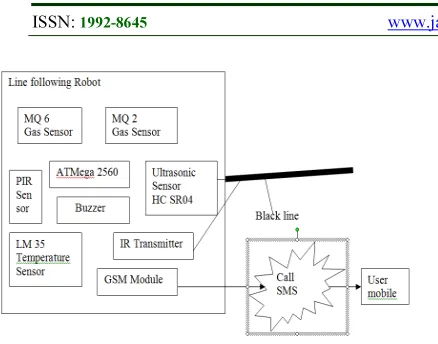
Figure. 1 Block Diagram for Proposed System
Advantages of proposed system are The proposed system incorporates many of the features and makes it into a single holistic device, the system is a mobile robot which is capable of moving around and is not fixed at any physical location, The system uses sensors to help it detect any breach of security or threat to the household. The system detects the following types of abnormalities such as Fire breakout, Gas (Natural and LPG) detection, Smoke sensor and Human Presence using PIR Module, The system uses DC motors (or servos for precision control) to move around the house (using line following capabilities). The ON and OFF of the DC motors depends on the direction it has to move which is the complete responsibility of the controller. The system weaves around any obstacles that it may face in the house hold when it is going around the house and In the event of any abnormality, the system will message the 5 pre-programmed numbers as well as call the primary number and plays the recorded voice message indicating abnormalities. The user after receiving the call and hearing the pre recorded message should acknowledge the robot in the form of SMS If the call is not attended the robot will keep calling the user until it receives an acknowledgement from the authorized user.
3.1 Implementation Using ATMega 2560
The system uses an ATMega2560 microcontroller board. The board consists of 54 digital input/output pins and 16 analog inputs. The system uses several sensors to detect the abnormalities, IR sensor to sense black line, ultrasonic sensor for distance avoidance and GSM modem for communication with user.
The work can be divided into four parts. They are Sensor detection, Locomotion (locomotion line following), Obstacles avoidance and Communication with the user. In terms of functionality the system offers intimation regarding gas leakage, detection of smoke caused by electrical shortage or any other kind and fire breakouts. It also informs the user if there is any human presence in the house. The system communicates with the user with the help of GSM Communication While sensing the environment for detecting gas leakage the MQ6 looks out for LPG, iso-butane, propane, LNG, while avoiding the noise of alcohol and cooking fumes and cigarette smoke. The MQ2 looks out for methane, alcohol, Hydrogen, and smoke thus enabling it as a smoke sensor. For detection of fire breakouts temperature changes is measured using LM35. The main functional requirement for the temperature sensor is the accuracy which the LM35 provides in terms of ±0.25˚Cat room temperature and ±0.75˚C over a full −55 to +150˚C temperature range.
For moving around the house the locomotion uses DC motors along with L293D H-bridge motor driver. The Device is a monolithic integrated high voltage, high current four channel driver designed to accept standard DTL or TTL logic levels and drive inductive loads (such as relays solenoids, DC and stepping motors) and switching power transistors. In order to move in a set path the system uses IR LEDs to detect a black line on white surface. The system must be able to interpret the incoming signals and move the robot accordingly. The circuit diagram is shown in the Figure.2.
For communicating with the user the system uses a SIM900 module which is a time tried and tested module in providing reliable communication over the GSM network 5 with the help of an activated SIM card which is inserted into the system. The numbers to contact are pre-programmed into the system and only the administrator has the privileges to modify this detail.
3.1.1. Sensor detection
The Robot has various sensors to detect abnormalities such as temperature ,gas etc, it also contains PIR sensor to detect human interference While sensing the environment for detecting gas leakage the MQ6 looks out for LPG, iso-butane, propane, LNG, while avoiding the noise of alcohol and cooking fumes and cigarette smoke. The MQ2 looks out for methane, alcohol, Hydrogen, and smoke thus enabling it as a smoke sensor. For detection of fire breakouts temperature changes is measured using LM35. The main functional requirement for the temperature sensor is the accuracy which the LM35 provides in terms of ±0.25˚Cat room temperature and ±0.75˚C over a full −55 to +150˚C temperature range.
Figure.3 Temperature and Gas detected
3.1.2. Locomotion (line following)
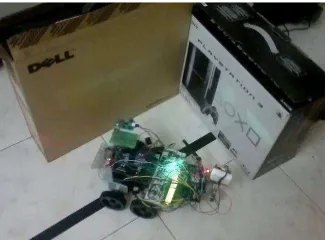
The Line-Following module is basically a set of IR transmitters and receiver LEDs. The module consists of Op Amps which help in getting a digital output from the LEDs. The LEDs are calibrated such that it sends a LOW signal when it cannot detect any IR light which is in the case of a BLACK LINE. Thus it is coded accordingly so as to move the robot based on the position of the BLACK LINE detected. The locomotion uses PID Control Design. Figure. 4,
Fig.4 Shows the robot following the line
A proportional-integral-derivative controller (PID controller) is a generic control loop feedback mechanism (controller) widely used in industrial control systems. A PID controller calculates an "error" value as the difference between a measured process variable and a desired set point. The controller attempts to minimize the error by adjusting the process control inputs.
The PID controller calculation (algorithm) involves three separate constant parameters, and is accordingly sometimes called three-term control: the proportional, the integral and derivative values, denoted P, I, and D. Heuristically, these values can be interpreted in terms of time: P depends on the present error, I on the accumulation of past errors, and D is a prediction of future errors, based on current rate of change.
The values used are as follows:
Motor speed = KP * error + KD * (error - last Error);
where KP = 0.2 and KD = 0.5 and KI = 0
3.1.3. Obstacle avoidance
The HC-SR04 is the Ultrasonic Distance Sensor that is being used in this system. Ultrasonic ranging module HC - SR04 provides 2cm - 400cm non-contact measurement function, the ranging accuracy can reach to 3mm. The modules includes ultrasonic transmitters, receiver and control circuit. The basic principle of work:
(1) Using IO trigger for at least 10us high level signal,
(2) The Module automatically sends eight 40 kHz and detect whether there is a pulse
(3) IF the signal back, through high level, time of high output IO duration is the time
from sending ultrasonic to returning. Test distance = (high level time × velocity of sound (340M/S) / 2
The Figure. 5, Figure.6 shows how the obstacle is avoided by the robot.
[image:5.595.88.252.233.353.2]Figure. 5 Obstacle Detection
Figure 6 Finding the line once again
3.1.4. GSM communication
The GSM Module which we are using is the ICOMSAT v1.1 which uses the SIM900 controller. Quad-band GSM/GPRS module. It is controlled via AT commands (GSM 07.07 ,07.05 and SIMCOM enhanced AT Commands), and fully compatible with Arduino / Iteaduino and Mega.
The robot calls the user if there are any abnormalities detected in the house the user receives the call and hears the pre recorded voice message indicating abnormalities and send acknowledgement to the robot in the form of SMS. If the user fails to notice the call, the robot will be continually calling user mobile until user attends the call and an acknowledgement is sent in the form of short message service (SMS) in the Figure.7,8
[image:5.595.309.474.285.398.2]Figure. 7 User receiving the call
Figure 8 Acknowledgement Received by Robot
4. CONCLUSION
The proposed robot has been implemented successfully implemented. In the future Version 2.0 we’ll have wheels with encoders to calculate the distance travelled and compass modules in order to keep track of which direction the robot is moving. This will enable us to achieve higher success rate for obstacle avoidance. Another scope for improvement is adding additional proximity sensors so as to determine obstacles which are smaller than the robots
REFERENCES
[1] Ahmad, A.W., Jan, N., Iqbal, S. and Lee, C “Implementation of ZigBee-GSM based Home Security Monitoring and Remote Control system”, Proceedings of 54th IEEE International Symposium on Circuits and Systems Aug 7-10, 2011, pp 1-4. .
[image:5.595.87.259.385.511.2]International Conference on Space Science and Communication, pp 11- 14, Oct 2009
[3] Divakar.S “Multi-colored line following and obstacle avoiding helicopter” ,Proceedings of 3rd IEEE International Conference on Electronics Computer Technology, April 8-10, 2011, pp 135-139.
[4] Hou-Tsan Lee, Wei-Chuan Lin, Ching-Hsiang Huang and Yu-Jhih Huang “ Wireless Indoor Surveillance Robot”, Proceedings of SICE Annual Conference, Sep 13- 18, 2011, pp 2164-2169.
[5] Ismail A. H., Ramli H. R., Ahmad M. H. and Marhaban M. H.” Vision-based System for Line Following Mobile Robot” IEEE Symposium on Industrial Electronics and Applications,, Oct 4-6, 2009, pp 642-645. [6] Jimin Cheon, “A Single-Chip CMOS Smoke
and Temperature Sensor for an Intelligent Fire Detector,” IEEE Sensors Journal, . Vol 9,2009 pp 914-921
[7] Lin Jiang, Jian Xun Jin and Yan Xia Wang( “Multi-Sensor Fireproof Alarm System”, Proceedings of IEEE International Conference on Applied Superconductivity and Electromagnetic Devices , ,Dec 14-16, 2011, pp 248-251.
[8] Lipu, M.S.H. Karim, T.F., Rahman, M.L. and Sultana, F. “Wireless Security Control System & Sensor Network for Smoke & Fire Detection”; Proceedings IEEE International Conference on Advanced Management Science, ,July 9-11 2010, pp 153-157. [9] Konaka.E., Suzuki.T and Okuma.S “line
following control of two wheeled vehicle by symbolic controller”, Proceedings of 40th IEEE International Conference on Decision and Control, Dec 4-7, 2001, pp-514-515.
[10]Mufioz, N.D.,Eusse, J.F. and Cruz, E.J . “Robot Teleoperation System Based on GPRS” Proceedings of 4th conference on Electronics, Robotics and Automotive Mechanics, sep 25-28, 2007, pp 74-79.
[11]Xinyu Wu, Haitao Gong, Pei Chen, Zhong Zhi and Yangsheng Xu “Intelligent household surveillance robot”, Proceedings of IEEE International Conference on Robotics and Biomimetics, Dec 19-23, 2009, pp 1734-1739 . [12]Xuan-Thu Le, Woo-Song Lee,Dong-Won Ha, Byung-Chang Kim, Uhn-Joo Na, Won-Il Kim and Sung-Hyun Han “A Study on Obstacle Avoidance and Walking Humanoid Robots”, Proceedings of IEEE International Conference on Control Automation and Systems, Oct 17-20, 2007, pp 2309-2312.