606
CHDS: A FAST SEARCH ALGORITHM FOR MOTION
ESTIMATION IN VIDEO CODING STANDARDS
1R. VANI, 2M. SANGEETHA and 3P. DAVIS
1
Assistant Professor, Department of ECE, Meenakshi College of Engineering, Anna University,
Tamil Nadu, India
2
Professor and Head, Department of ECE , Karpaga Vinayaga College of Engineering and Technology,
Anna University ,Tamil Nadu, India
3
PG Student, Department of ECE, Karpaga Vinayaga College of Engineering and Technology, Anna
University, Tamil Nadu, India
E-mail: [email protected], [email protected]
3
ABSTRACT
In this paper, we propose a new hybrid Cross Hexagon Diamond Search algorithm (CHDS) using cross-shaped search pattern as the initial step and asymmetric hexagon-cross-shaped patterns and small diamond pattern as the subsequent steps for fast block motion estimation. In block motion estimation, search pattern with different shape or size and the center biased motion vector distribution characteristics has a great impact on search speed and distortion performance. The previously developed fast search algorithms focus on improvement of either coarse search or inner search. The Proposed CHDS algorithm reduces the number of search points by exploiting the distortion information in the neighbouring search points. Simulations are done using MATLAB and our experimental results indicate that the proposed CHDS algorithm reduces an average of 39.78% of time for motion estimation compared to New Hexagon Search (NHEXS), 10.86% of time for motion estimation compared to Hexagon Search (HS) and 38.64% of time for motion estimation compared to Diamond Search (DS).
Keywords: Motion Estimation, Block Matching, Motion Vector, Search Algorithm.
1. INTRODUCTION
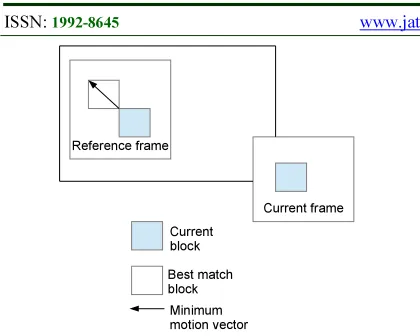
Video coding technology is a research focus of digital video media. In real time processing, to enable the transmission and storage, the video bit stream must be drastically reduced. There is a lot of redundant information in a digital video, and this redundancy is explored by the inter frame prediction operation in video coding standards. Motion Estimation (ME) is the main operation of the inter frame prediction [5, 12]. It is a process of estimating the pixels of the current frame from a reference frame. ME algorithms are used to compute the displacement between current frame and reference frame. The intensity value of a pixel in the current frame and in reference frame has some correlation with its neighborhood which will determine the best matching position of pixels intensity values in the reference frame. The difference in positions of current frame and the reference frame is calculated so as to find the best match. This difference is defined as the
displacement vector and it is known as the Motion Vector (MV) [2, 8] as shown in Figure 1. The similarity criterion is used to compare the candidate blocks with each original block and in our work we use Mean Absolute Difference (MAD) as the criteria given by the mathematical expression in (1).
( )
15 15
( , ) ( ) ,( )
0 0
1
( , , , )
256
j ix i y j x u i y v j
i j
MAD x y u v
A
B
= =
+ + + + + +
= =
=
∑∑
−
(1)
607
Current frame Reference frame
Best match block Current block
[image:2.595.86.296.104.272.2]Minimum motion vector
Figure 1: Motion Estimation and Motion Vector
Block-matching algorithms are used widely due to its simplicity and it is easy to be applied. In block based ME approach, the current frame is divided into non overlapping Blocks. H.264/AVC is a Video Codec standard for video compression and has a wide range of application from low bit rate (internet streaming) to High Definition Television (HDTV) broadcast. In H.264, the seven possible modes of a block are 16×16, 16×8, 8×16, 8×8, 8×4, 4×8, 4×4 as shown in Figure 2. These are called macro blocks and for each such current frame, one best MV is calculated in the reference frame. Here, an inherent assumption is made that the entire block undergoes translational motion. The algorithms that use block based ME technique are known as block matching ME algorithms. Since ME process consumes up to 60–80% of computational power of the encoder process, still researches are carried out for an efficient and fast motion estimation algorithms which becomes significant [6].
Figure 2: Variable Block Size
The video coding standards like MPEG2, H.264/AVC [20] and the emerging High Efficiency Video Coding Standard (HEVC) [7] do not restrict
how the ME is done. Based on this fact, there is a vast space to explore a new algorithm as a solution for the ME. These solutions are evaluated according based on complexity and objective quality of the digital video. In the literature, a number of fast ME algorithms have been proposed. These algorithms include fixed set of search patterns such as Three Step Search (3SS) proposed by Koga et al [17], New Three Step Search (NTSS) proposed by Li Ren-xiang et al [16], Four Step Search (4SS) proposed by L.M. Po et al [18], Diamond Search (DS) [19] and Hexagon Search (HS) [2, 3]. The drawback is that these algorithms suffer from the local minima problem and have less adaptability and search efficiency to track large motions. Hybrid algorithms which combine various search patterns are used to avoid being trapped in local minima. The existing algorithms are focused on reduction of the number of search points which has great impact on reduction of motion estimation time which is the main objective to be dealt in Video Coding. Our research work focuses on further improvement in the existing algorithms and at the same time reducing the number of search points when compared to the existing algorithms in the literature. It uses the aspect of combining several search patterns to achieve the objective of the work. In this paper, a novel fast block matching hybrid algorithm called new cross hexagon diamond search algorithm (CHDS) is proposed. It uses cross-shaped search pattern as the initial steps and large hexagon-shaped patterns and small diamond patterns as the subsequent steps for fast block motion estimation. It results in higher motion estimation speed and also reduces the number of search points. This paper is organized as follows. Section 2 explains about the existing Motion estimation algorithms. Section 3 briefly discusses about the proposed CHDS algorithm. Section 4 shows the experimental results in a variety of video sequences to verify the efficiency of the proposed algorithm followed by the concluding remarks in Section 5.
2. EXISTING MOTION ESTIMATION
ALGORITHMS
[image:2.595.104.278.528.687.2][image:3.595.311.500.99.324.2]
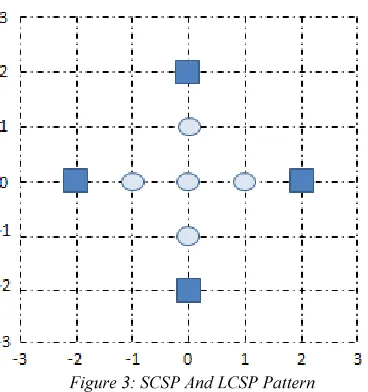
608 compensation. The Small Cross Search Pattern (SCSP) and Large Cross Search Pattern (LCSP) are used as initiative steps in the algorithm as proposed by Kamel Belloulata et al [6]. The SCSP and LCSP are illustrated in Figure 3.
Figure 3: SCSP And LCSP Pattern
The New diamond search algorithm (DS) has been proposed by S. Zhu and K. K. Ma in 2000. The DS algorithm utilizes two different types of fixed search patterns. The first pattern called large diamond search pattern (LDSP) and the second pattern called small diamond search pattern (SDSP) shown in Figure 4. The LDSP consisting of nine checking points from which eight points surround the center one to compose a diamond shape. The SDSP consisting of five checking points and it forms a smaller diamond shape [9, 11, 13, 15]. The advantages of DS can be summarized as: in large motion content, optimal minimum can be got using fewer points. It is faster than the traditional method of 4SS for small motion contents. In terms of search mode, it is highly sensitive in all directions. It is harder to fall into the local minimum, when compared to other methods.
[image:3.595.98.282.185.381.2]Zhu et al. [5] investigated the research and proposed a Hexagon based search algorithm that achieves better speed improvement up than DS algorithm with similar distortion performance. The HS can find the same motion vector in the motion field with fewer search points than the DS algorithm [1, 4, 13].
Figure 4 : Large And Small Diamond Search Pattern
Figure 5 : Large And Small Hexagon Search Pattern
3. PROPOSED ALGORITHM
[image:3.595.323.501.353.532.2]
609 3.1:Algorithm Development
The algorithm is designed using three patterns: Symmetric Cross, Asymmetric hexagon and Small Diamond Pattern. Figure 8 shows the search pattern of the proposed algorithm. The Cross search pattern is of pixel distance± 2 from the center point. Asymmetric hexagon with distance of ±1 and ±2 from center is used for both Horizontal and Vertical hexagon patterns. Small diamond search is the final step which uses pixel distance ±1 from the center. The initial point is assumed to be at the location (0, 0). The steps for the proposed algorithm are given below:
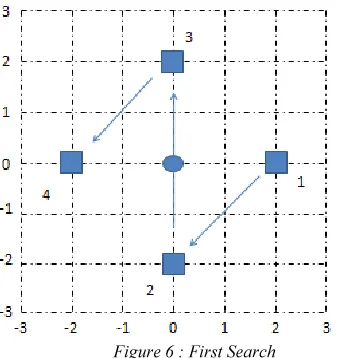
Step 1: The Symmetrical Cross search pattern as shown in Figure 6 is initialized. Calculate the MAD for all five points and search point with minimum cost is obtained. If the minimum cost is found to be at center point, then go to step 3.
Step 2: If the minimum cost is in horizontal direction of the search points in the cross search pattern (along X-axis), then perform asymmetric horizontal hexagon search, with minimum cost from step 1 as center point as shown in Figure 7a. Else perform asymmetric vertical hexagon search (along Y axis) as shown in Figure 7b.
[image:4.595.294.520.357.708.2]Step 3: Switch from the coarse search to the fine resolution inner search to find out absolute motion vector. With minimum cost from previous search as center, a small diamond pattern with pixel distance ±1 as shown in Figure 8 is formed and search for minimum cost. The resultant search point is the final solution for motion vector.
Figure 6 : First Search
The search starts from the central point (0, 0) and continues according to the distance parameters. The first search is performed using cross search pattern with 5 search points having distance ± 2 from the center point. Initially search starts from the center
point; Figure 6 shows the first search and its search directions. The second search has 7 search points with two reuse points. Second search uses both horizontal and vertical hexagon patterns. The hexagon pattern used is asymmetric with distance of ± 1 and ±2 from the center point. The decision to use horizontal or vertical hexagon is made such that, if the minimum cost point from first search is along the horizontal points (x-axis) of the cross search, then horizontal hexagon is used and if the minimum cost point from first search is along the vertical points (y-axis) of the cross search, then vertical hexagon is used. Thus the proposed algorithm concentrates for motion of video sequence both on horizontal and vertical directions. The final search is done using small diamond search pattern with search distance ±1 from the center. The small diamond search has 5 search points and this is the final search to find the motion vector for the given current block.
(a)
(b)
[image:4.595.92.264.494.673.2]
610 The Proposed CHDS algorithm adopts the following Pseudocode to find the minimum cost:
[image:5.595.87.293.144.568.2]
Figure 8 : Search Pattern for Proposed Algorithm
3.2:Analysis of Algorithm
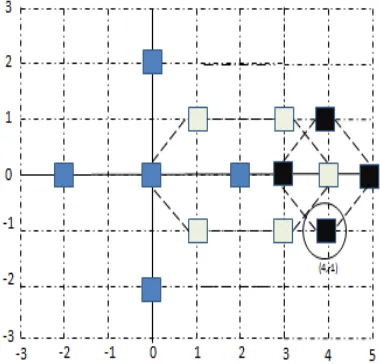
Let us assume that the best match block of the current block is at the position (4,-1) as shown in Figure 9. The cross search pattern consists of five search points. Minimum block distortion (MBD) point is the most matching point having minimum MAD with reference block in the current search. Initially we start the search at the location (0, 0). If the MBD point is at one of the four corners of the cross, that is at the location (2, 0), the algorithm searches for the five new non-overlapping search points around it to form a hexagon along horizontal axis. The minimum MBD is found at location (4, 0) from second search, and then the algorithm
[image:5.595.311.501.243.425.2]searches for four search points around it to form a small diamond pattern. Thus by exploiting the continuity, the search point with minimum MBD is located at (4,-1) by using 14 points for computation. For the same assumption, the HS algorithm proposed by Ce Zhu et al[9] requires 17 search points; NHEXS algorithm proposed by Kamel Belloulata et al [6] requires 22 search points. Thereby, the number of search points has been reduced in the proposed algorithm.
Figure 9 : Proposed Algorithm Search Path
4. EXPERIMENTAL RESULTS
The algorithms are simulated using MATLAB 7.10.0.499 (R2010a). The algorithm is applied to the first 30 frames of sequences “Foreman” with a resolution of 352x288, “Mobile” with a resolution of 352 x 288, “BQMALL” with a resolution of 832x480 and “MOBISODE” with a resolution of 832x480. These sequences vary in motion content as well as frame size. Simulations are carried out on Windows 8.1 OS platform with Intel I3-2310M @ 2.10 GHz CPU and 4GB RAM.
The experimental setup is as follows: the block size of 16 x16, the maximum displacement in the search area is ± 2 pixels in both horizontal and vertical directions and MAD as distortion measurement. To evaluate the performance of the new CHDS algorithm featured with inner search, we compare it against the existing methods. To obtain the realistic results of motion estimation for different video sequences, the comparison of the proposed CHDS algorithm is done against the algorithms: NHEXS proposed by Kamel Belloulata et al [6], HS proposed by Ce Zhu et al [9], the DS proposed by S. Zhu and K. K. Ma [19] in terms of number of search points, average computational Perform initial Cross Search
Centre Point <= Minimum point of Cross Pattern
points <=7 i <= 0 Repeat
MAD(i) <= Execute Vertical Hexagon Pattern points
i++
while (i < points && Centre Point along Y-axis)
Repeat
MAD(i)<=Execute Horizontal Hexagon Pattern points
i++
while (i < points && Centre Point along X-axis)
Minimum cost <= minimum (MAD(i)) Centre Point <= Minimum point of Hexagon Pattern
Perform Diamond Search
611 time savings for motion estimation and Peak Signal to Noise Ratio (PSNR). The existing and the proposed algorithms are real time simulated for a block size of 16x16 using MATLAB and the results are tabulated as follows.
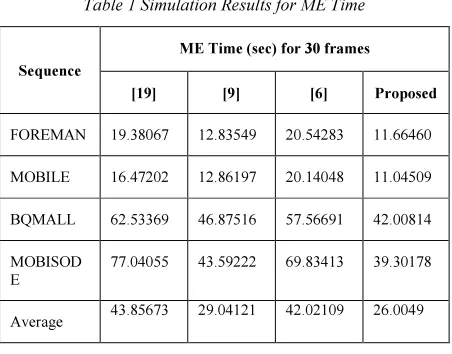
Table 1 show the simulation results of ME time for different search patterns such as the DS, HS, NHEXS and proposed CHDS algorithm. It can be clearly seen that the average ME Time of our proposed algorithm shows that there is an appreciable decrease of 10-40% of ME Time compared to other existing search algorithms.
The ∆ME Time and ∆PSNR denotes the CPU time reduction in ME process and improvement of PSNR of the encoded image respectively [10]. They are defined as in equations (2), (3) and (4):
proposed original
METime
MET
MET
∆
=
−
(2)
(
)
%
proposed original100
original
MET
MET
METime
MET
−
∆
=
×
(3)
proposed original
PSNR
PSNR
PSNR
∆
=
−
[image:6.595.77.303.447.624.2](4)
Table 1 Simulation Results for ME Time
Sequence
ME Time (sec) for 30 frames
[19] [9] [6] Proposed
FOREMAN 19.38067 12.83549 20.54283 11.66460
MOBILE 16.47202 12.86197 20.14048 11.04509
BQMALL 62.53369 46.87516 57.56691 42.00814
MOBISOD E
77.04055 43.59222 69.83413 39.30178
Average 43.85673 29.04121 42.02109 26.0049
where MET proposed and PSNRproposed denotes the
ME time and PSNR of the proposed algorithm and METoriginal,PSNRoriginal represents the ME time and
PSNR of DS, NHEXS and HS.
Table 2 shows the improvement in PSNR and average reduction of ME Time for proposed algorithm when compared to existing search patterns. The proposed CHDS algorithm saves 38.64%, 10.86% and 39.78% of total ME time
compared to Diamond, Hexagon and New-Cross Hexagon search pattern respectively.
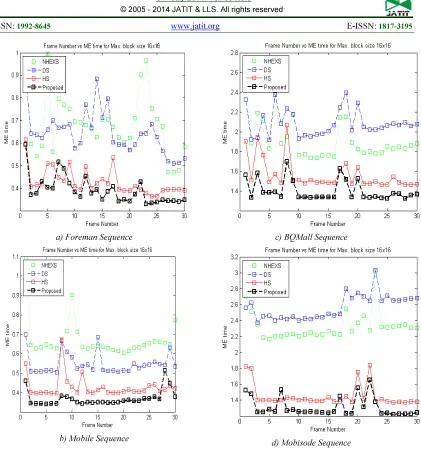
The comparison is shown in Figure 10 for thirty frames of different video sequences. When compared to the existing algorithms, the proposed scheme can reduce the ME time of the encoded image, as the frame number increases. The limiation of the work is further improvement in ME time could be achieved with hardware resource utilization.
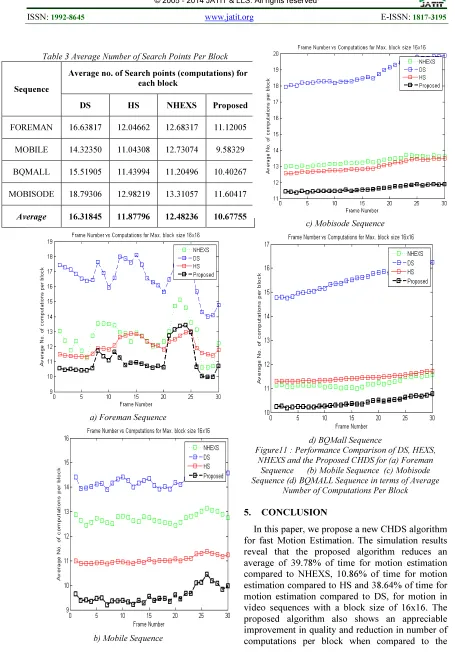
Table 3 shows that the proposed CHDS algorithm consumes the smallest number of search points compared to other algorithms. The average search points per block with the observations are CHDS<<HS<<NHEXS<<DS.
612
a) Foreman Sequence
b) Mobile Sequence
c) BQMall Sequence
[image:7.595.95.516.89.538.2]d) Mobisode Sequence
Figure 10 : Performance Comparison of DS, HEXS, NHEXS and the Proposed CHDS for a) Foreman Sequence b) Mobile Sequence c) Mobisode Sequence d) BQMALL Sequence in terms of Time Reduction in ME Process
Table 2 Simulation Results Showing PSNR Improvement and Average Reduction of ME Time
Sequence
∆PSNR (dB) ∆ME Time (sec)
Proposed vs DS
Proposed VS HS
Proposed vs NHEXS
Proposed vs DS
Proposed vs HS
Proposed vs NHEXS
FOREMAN 2.06100 0.28172 3.66466 -7.71606 -1.17089 -8.87822
MOBILE 2.64899 -0.77990 4.48102 -5.42693 -1.81688 -9.09539
BQMALL 1.12293 0.81034 1.50547 -20.52555 -4.86702 -15.55878
MOBISODE 3.48379 1.60837 2.71776 -37.73877 -4.29045 -30.53235
[image:7.595.84.516.577.757.2][image:8.595.61.516.98.757.2]
613
Table 3 Average Number of Search Points Per Block
Sequence
Average no. of Search points (computations) for each block
DS HS NHEXS Proposed
FOREMAN 16.63817 12.04662 12.68317 11.12005
MOBILE 14.32350 11.04308 12.73074 9.58329
BQMALL 15.51905 11.43994 11.20496 10.40267
MOBISODE 18.79306 12.98219 13.31057 11.60417
Average 16.31845 11.87796 12.48236 10.67755
a) Foreman Sequence
b) Mobile Sequence
c) Mobisode Sequence
d) BQMall Sequence
Figure11 : Performance Comparison of DS, HEXS, NHEXS and the Proposed CHDS for (a) Foreman
Sequence (b) Mobile Sequence (c) Mobisode Sequence (d) BQMALL Sequence in terms of Average
Number of Computations Per Block
5. CONCLUSION
614 previous algorithms. The experimental results have demonstrated that the proposed CHDS algorithm outperforms tshe previous algorithms and it works well in different formats of video sequences with various motion activities.
REFRENCES:
[1] Ce Zhu, Xiao Lin, Lappui Chau, and Lai-Man Po , “Enhanced Hexagonal Search for Fast Block Motion Estimation”, IEEE Transactions on Circuits and Systems for Video Technology, Vol. 14, No. 10, 2004, pp. 1210-1214.
[2] Obianuju Ndili and Tokunbo Ogunfunmi, “Algorithm and Architecture Co-Design of Hardware-Oriented, Modified Diamond Search for Fast Motion Estimation in H.264/AVC” , IEEE Transactions on Circuits and Systems for Video Technology, Vol. 21, No. 9, 2011, pp. 1214-1227.
[3] Kamel Belloulataa, Shiping Zhub, Jun Tianb and Xiaodong Shen, “A Novel Cross-Hexagon Search Algorithm for Fast Block Motion Estimation”, 7th International Workshop on Systems, Signal Processing and their Applications (WOSSPA), 2011, pp-1-4.
[4] Akash Ambulkar, Shailesh Wankhede, Sujit Kautkar, Mukesh Angrakh, and Vidya N. More, “Enhanced Directional Hexagonal Search Algorithm”, 2012 IEEE International Conference on Circuits and Systems (ICCAS), October 3-4, 2012, pp.143 – 146.
[5] Ziyin Li and Qi Yang, “A Fast Adaptive Motion Estimation Algorithm”, International Conference on Computer Science and Electronics Engineering, 2012, pp. 656-660. [6] Kamel Belloulata, Shiping Zhu, and
ZaikuoWang , “ A Fast Fractal Video Coding Algorithm Using Cross-Hexagon Search for Block Motion Estimation” , International Scholarly Research Network Signal Processing , 2011, pp 1-10.
[7] G. J. Sullivan, J.-R. Ohm, W.-J. Han, T. Wiegand, “Overview of the High Efficiency Video Coding (HEVC) Standard,” IEEE Transactions on circuits and systems for video Technology, Vol. 22, No. 12, 2012, pp. 1649-1668.
[8] Ali, M. Muzammil and G. Raja, “Performance Analysis of Motion Estimation Algorithms based on Motion Activity in Video Sequences”, Pakistan Journal of Science, Vol. 64, No. 1, 2012, pp 39-45.
[9] Ce Zhu, Xiao Lin, Lap-Pui Chau, Keng-Pang Lim, Hock-Ann Ang and Choo-Yin Ong , “A Novel Hexagon-based Search Algorithm for Fast Block Motion Estimation”, Proceedings of the IEEE International Conference on Acoustics, Speech, and Signal Processing, Vol. 03 , 2001, pp. 1593-1596.
[10]Zhaoqing Pan Sam Kwong, “A Direction-Based Unsymmetrical-Cross Multi-Hexagon-Grid Search Algorithm for H.264/AVC Motion Estimation”, Journal of Signal Processing System , 2013, pp 59-72.
[11]S. Rukmani Devi, P. Rangarajan, and J. Raja Paul Perinbam , “VLSI Implementation of High Performance Optimized Architecture for Video Coding Standards” , Acta Polytechnica Hungarica, Vol. 10, No. 6, 2013 pp 237- 249. [12]Gustavo Sanchez, Felipe Sampaio, Marcelo
Porto, Sergio Bampi, and Luciano Agostini, “DMPDS: A FastMotion Estimation Algorithm Targeting High Resolution Videos and its FPGA”, International Journal of Reconfigurable Computing, 2012, pp- 1-12. [13]Chih-Ming Kung, Wan-Shu Cheng, and
Jyh-Horng Jeng , “Application of Genetic Algorithm to Hexagon-Based Motion Estimation”, Scientific World Journal, 2014, pp. 1-12. [14]Jaeho Lee, Seongwan Kim, Kyungmin Lim, Jae
Hyun Kim and Sangyoun Lee , “Fast intermode decision algorithm based on general and local residual complexity in H.264/ AVC”, EURASIP Journal on Image and Video Processing, 2013, pp. 1-11.
615 [16]Li Ren-xiang, Zeng Bing, and Liou M. L, “A
new three-step search algorithm for block motion estimation,” IEEE transactions on Circuits and Systems for Video Technology, vol. 4, 1994, pp. 438-442.
[17]T.Koga, K. Iinuma, A. Hirano, Y. Iijima, and T. Ishiguro, “Motion compensated interframe coding for video conferencing,” Proceedings of National Telecommunication Conference, 1981, pp. G5.3.1–G5.3.5.
[18]L.M. Po and W.C. Ma, “A novel four-step search algorithm for fast block motion estimation”, IEEE Transactions of Circuitsand System forVideo Technology, Vol. 6, No. 3, 1996, pp. 313–317.
[19]S. Zhu and K. K. Ma, “A new diamond search algorithm for fast block matching motion estimation,” IEEE Transactions of Image Processing, Vol. 9, No.2, 2000, pp. 287–290. [20]T. Wiegand, G. J. Sullivan, G. Bjøntegaard, and
A. Luthra, “Overview of the H.264/AVC video coding standard,” IEEE Transactions of Circuits and System for Video Technology, Vol. 13, No. 7, 2003, pp. 560–576.