UGC Approved Sr. No.49366, MAR–APR, 2018, VOL- 5/44
Copyright © 2018, Scholarly Research Journal for Interdisciplinary Studies
A STUDY OF EMOTIONAL INTELLIGENCE AND SELF-ESTEEM AMONG ADOLESCENT
Satish Kumar Kalhotra, Ph. D.
Associate Professor, Department of Education, Rajiv Gandhi University, Itanagar. E-Mail : [email protected]
The present study was made an attempt to find out find significant interaction between emotional intelligence and sex with self-esteem as dependent variable among adolescents.The researcher employed 250 samples stratified random sampling was used for selecting 250 samples for the present study. Self Esteem Inventory by Dr. Stanley Cooper smith and Emotional Intelligence Inventoryby Dr.S.K MANGAL was used for collecting the data. The findings reveal that there is no significant interaction between emotional intelligence and sex among adolescent students with self esteem as the dependent variable.
Keywords: Adolescence, Personality, Self-Esteem and Emotional intelligence
Introduction
‘’Adolescence is the turbulent time changed with conflict and moods swings,’’ with this perspective it is not hard to recognize that personality plays a big part in the overall development of adolescents. It is important to understand that almost all the theorists believe that adolescence is characterized as time of storm and stress. It certainly may have its ups and downs, but much of this normal reaction to the entire physical, emotional and social change taking place.
In the field of learning, personality factors are significantly influentional. Educational pattern of today is undergoing complete transformation technologically as well as methodologically. Nothing is more imp in educating students than to make them imbibe the right attitude towards teaching .This can be done when we explore into their energies and sentiments which govern their behavior.
Personality is linked with self –esteem of an individual .Self-realization is an important aspect of personality. Self- realization is important for gaining the achievement in one’s life. Self-esteem is the major contributor of personality make-up and it is a path to creative, fully functioning healthy individual and possibly the most essential ingredient for human happiness.
Copyright © 2018, Scholarly Research Journal for Interdisciplinary Studies Self-Esteem
In psychology, the self-esteem is used to describe a person’s over all sense of self worth or personal value. Self-esteem is often seen as personality traits, which means that it tends to stable and enduring. Self esteem can be involve a variety of belief about the self, such as the appraisal one’s own appearance, beliefs, emotions and behavior.
Self esteem refer to positive or negative orientation towards oneself and it evaluates an individual in different roles and domains of life (Rogers,1981).It is an overall evaluation of one’s worth or values and important component of psychological health(Rosenberb,1989,Robson 1988)and it is also related to various psycho-social support including life events(Miller, Kreitman et al,1989,Brown,Andrews et al 1989),and social support(Brown, Bifulco and Andrews,1990;Brown,Bifulco et al 1986).In other words, it implies a realistic assessment of one’s abilities and potentials or one’s own positive impression.
Emotional intelligence
The term emotional intelligence was introduced in 1990 by two American university professors Dr.John Mayer and Dr.Peter Salavey in their attempt to develop a scientific measures for knowing the differences in peple’s ability in the areas of emotion. However emotional intelligence goes to another American Psychologist Daniel Goleman (1998).
Emotional intelligence is being able to monitor one’s own and other’s feeling and emotions to discriminate among them, and to use this to guide one’s thinking and actions. Again Salovey and Mayer(1993) wrote that emotionally intelligent person is skilled in four areas; identifying, using, understanding and regulating components, kowing one’s emotions(self awareness) managing them, motivating self, recognizing emotion in other’s(empathy and handling relationship).
The social scientists and other educational psychologists are beginning to uncover the study of emotional intelligence to phenomenon.
Emotional intelligence refers to the ability to perceive, control and evaluate emotions. Some researchers suggest that emotional intelligence can be learned and strengthened, while others claims it is an inborn characistic.
Objective of the study
The main objectives of the study are
Copyright © 2018, Scholarly Research Journal for Interdisciplinary Studies 2. To find significant difference in self -esteem among adolescents.
3. To find significant interaction between emotional intelligence and sex with self-esteem as dependent variable among adolescents.
Hypotheses of the study
The following hypotheses have been formulated for the present investigation:
1. There will be no significance difference in self-esteem among adolescents having good and poor emotional intelligence
2. There will be no significant sex difference in self-esteem among adolescents.
3. There will be no significant interaction between emotional intelligence and sex with self esteem as dependent variable.
Significance of the study
The personality of the individual is a product of learning. It is essential that he/she should have an all round development.
Self-Esteem means feeling good about one. Self esteem is the belief that we all have, potential to do something good in whatever condition we are placed .When we build-up self-esteem ,we do not require any certificate from others as how good we are.
Survey of related literature Studies of Emotional intelligence
Bhatia(2010) in her study “emotional intelligence in teacher training programme” found that there is an increased awareness about the importance of emotional intelligence .Despite this, the teacher are unable to adopt it for leading a more successful life .In this fast changing and stressful situation that students and teacher in schools are facing .It has become absolutely essential for them to find tune their emotional skills. The teacher training curriculum hence must have a module on emotional intelligence for teachers to do.
Akomolafe (2011), made an attempt to study the interactive and relative effect of Emotional Intelligence and locus of control on burnout among the secondary school teachers and has suggested that secondary school teachers should be managed by capable and qualified counselors for desired result to be achieved.
Copyright © 2018, Scholarly Research Journal for Interdisciplinary Studies
Nicholls et al.(2012), purposed to find the ability of subjects studying accounting at a Canadian University to purposely alter their results on two of the most frequently used emotional intelligence tests(Emotional Quotient Inventory and the Mayer-Salovery-Carsuso Emotional Intelligence Test).They found that subjects can purposely change their emotional intelligence scores to fit the job description and also concluded that neither instrument was clearly better than the other was in the hiring process and both required revision as potential applicants were able purposely to alter their scores.
Studies conducted on self-esteem
Jasrotia(2010) conducted Study, “A study of self Esteem and academic Achievement of B.Ed students”. The findings were (a) There are significant difference in self esteem among B.Ed ,students having high and low level of Academic Achievement so, it is said that there is no main difference among High and low Academic Achievers.(b)There B.Ed students having high level of Academic Achievement are better in self esteem than one’s having low Level of Academic Achievement So,it is said that there is no main difference Among high and low academic achievers.(c) There is are insignificant sex Difference in self esteem among B.Ed.students.
Jamwal(2011) “A study on locus of control and self esteem among Secondary school students”. The finding were (a) There are no significant Differences in self esteem among internal and external secondary school Students.(b)There are no significant sex differences in self esteem among secondary school students.(c) There variables of locus of control and sex independent of each other with self esteem independent variable among secondary school students.
Plan and procedure
This study was conducted in June, two weeks after the school midterm examination ended. A set of questionnaire and emotional ability test instrument were distributed to 205 students. The students were briefed about the aims of the study, and were assured about the confidential treatment of their answer sheets were collected at the end of the class.
Tools used
In the present study, the instruments employed for the collection of data are a) Self Esteem Inventory by Dr. Stanley Coopersmith
Copyright © 2018, Scholarly Research Journal for Interdisciplinary Studies Selection of the sample
In the present study, the researcher employing stratified random sampling. He chose sample from private and Govt. schools of Jammu district, the size of the sample was 250. The private schools from where certain number of boys and girls were randomly selected..
Administration of the tools
The investigator visited the various schools of Jammu District personally for the collection of data. On the first day, he approached to the concerned teachers and Headmasters. The problem was explained to them. They were told about the purpose of investigation. After the permission was granted, the tools were administrated in the classroom with the help of class teachers. The subjects were instructed that these tests were meant for the research work and their responses will be kept confidential. They were requested to be frank, honest and sincere in answering test items.
The investigator studied all the instructions from manual of the test for the scoring of answer sheets. Thus the responses obtained by students on answer sheets were scored with the help of scoring keys of the test.
The collected data need to be categorized in the light of objectives of study Therefore data collected from secondary students of Jammu city into two categories of emotional intelligence and low emotional intelligence i.e high emotional and low emotional intelligence groups on the basis of scores.
For this purpose Mean and S.D of Emotional Intelligence scores are calculated employing raw score method.
ANALYSIS AND INTERPRETATION OF DATA
Table - 1 showing the values of Mean and S.D of Emotional Intelligence scores.
Variable Mean S.D M+1/2 S.D M-1/2 S.D
Emotional intelligence
66 9.7 70.85 61.51
(a) The students scoring M+ 1/2x S.Dor more were labeled as high E.I. In the present study the subjects scoring 70.85 and above were labeled as high emotionally intelligence group.
Copyright © 2018, Scholarly Research Journal for Interdisciplinary Studies
The details of the Categorization data given in Table - 2 showing the number of students falling in High and Low emotional Intelligence group.
Variable M S.D High Emotional
Intelligence
Low Emotional Intelligence
Emotional Intelligence
66 9.7 Boys Girls Boys Girls
53 18 51 49
It is of prime importance in any research problem to analyze and interpret the available data. The tabulated data as such has no meaning. The raw scores collected with the help of tools do not represent the true picture of the problem. In order to get some useful information, some statistical techniques are applied to drive fruitful information thereof.
"Analysis is an important phase of classification and summarization of data".
Keeping the objectives of the study in view, the researcher applied the following statistical techniques:
IV. 1 (b) Two-Way Analysis of Variance
In the present investigation, the researcher was concerned with differences in the emotional intelligence as well as interaction studying relationship between Emotional Intelligence and Self-Esteem among adolescents . Thus the investigator employed Two- Way Analysis of Variance.
Table-1: Treatment Combinations of Two-Way ANOVA (2x2 Factorial Experiment) with self esteem as the dependent variable.
Treatment Emotional Intelligence Sex
A1B1 Good Emotional Intelligence Boys
A1B2 Good Emotional Intelligence Girls
A2B1 Poor Emotional Intelligence Boys
A2B2 Poor Emotional Intelligence Girls
IV.1.5 Computation of two way anova(2x2 factorial experiment).
Table - 2 Scores of self esteem of boys and girls of adolescent student EMOTIONAL INTELLIGENCE (A)
Good emotional
intelligence(A1) Poor emotional intelligence(A2)
52 44 40 60
68 48 56 68
Copyright © 2018, Scholarly Research Journal for Interdisciplinary Studies SEX(B)
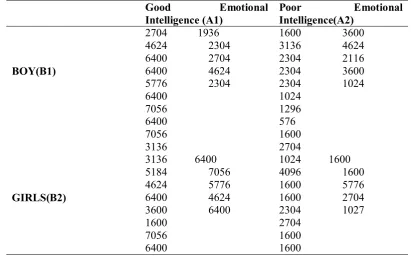
Table -3 Squared value of the self esteem scores are given in the Table - 2
Good Emotional
Intelligence (A1)
Poor Emotional
Intelligence(A2)
BOY(B1)
2704 1936 1600 3600
4624 2304 3136 4624
6400 2704 2304 2116
6400 4624 2304 3600
5776 2304 2304 1024
6400 1024
7056 1296
6400 576
7056 1600
3136 2704
GIRLS(B2)
3136 6400 1024 1600
5184 7056 4096 1600
4624 5776 1600 5776
6400 4624 1600 2704
3600 6400 2304 1027
1600 2704
7056 1600
6400 1600
BOYS (B1)
80 68 48 60
76 48 48 32
80 32
84 36
80 24
84 40
56 52
∑A1 B 1=1000
N A1B1=15
∑A2B1=690
N A2 B₁ =15
56 80 32 40
72 80 64 40
68 84 40 76 64 76 40 52 80 68 48 32
60 52
40 40
84 40
80 44
72 68
∑A1 B2=1069
NA1B₂ =15
∑A2B2=708
NA2B₂ =15
∑A1=2064
NA1=30
∑A2=1398
NA2=30 ∑XT=3462
Copyright © 2018, Scholarly Research Journal for Interdisciplinary Studies
5184 1936
6400 4624
[image:8.595.95.524.52.341.2]∑X²T=219268
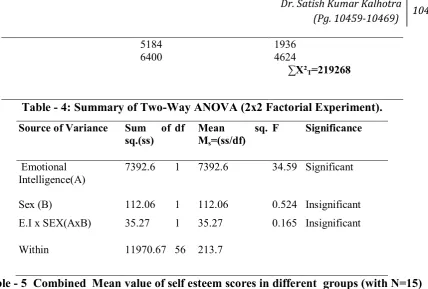
Table - 4: Summary of Two-Way ANOVA (2x2 Factorial Experiment).
Source of Variance Sum of
sq.(ss)
df Mean sq.
Ms=(ss/df)
F Significance
Emotional Intelligence(A)
7392.6 1 7392.6 34.59 Significant
Sex (B) 112.06 1 112.06 0.524 Insignificant E.I x SEX(AxB) 35.27 1 35.27 0.165 Insignificant
Within 11970.67 56 213.7
Table - 5 Combined Mean value of self esteem scores in different groups (with N=15) in each cell.
Group Good emotional
intelligence
Poor emotional
intelligence
Boys 66.7 46
Girls 70.93 47.2
Combined mean 68.8 46.6
INTERPRETATION OF DATA
Perusal of Table - 4 reveals that the value of F for the main effect of emotional intelligence with self esteem as the dependent variable is 34.5 is significant at o.o1 level of significance for df 1 and 56.Tus ,there is significant difference in self esteem among high and low level of emotional intelligence of adolescents students.
Table - 5 shows that the mean value of high emotional intelligence is 68.8 of adolescents students which is higher than the low emotional intelligence of adolescents students which is 47.2 .So it can be said ,that emotional intelligence of adolescents students having more self esteem than the low emotional intelligence of adolescents students.
Hence, the hypothesis that there will be no significant difference in self esteem among adolescents school students having high and low emotional intelligence is rejected.
Copyright © 2018, Scholarly Research Journal for Interdisciplinary Studies
Review of Table - 4 further shows that the value of F for interaction between emotional intelligence sex with self esteem as the dependent variable is 0.165 which is also insignificant for df 1 and 56.
Therefore it can be said that the variables of emotional intelligence and sex are independent of each other with self esteem as the dependent variable among adolescents students.
Hence ,the hypothesis that there will be no significant interaction between emotional intelligence and sex with self esteem as dependent variable among adolescents students is accepted.
RESULTS
In order to accomplish the objective of the study , Two-way Analysis of Variance (2x2 Factorial Experiment) has been employed . The result are given in the following table.
Sources of Variance
Sum of
squares
Degree of freedom
Mean square
F- ratio Significance
(A) Emotional intelligence
7392.6 1 7392.6 34.59 Significant at 0.05 level
(B) Sex 112.06 1 112.06 0.524 NS
Emotional intelligence x Sex
35.27 1 35.27 0.165 NS
Within 11970.67 56 213.7
CONCLUSIONS OF THE STUDY
On the basis of analysis of data following conclusions are drawn:
1) There is significant differences in self -esteem among adolescent students having high and low emotional intelligence.
2) There is no significant sex differences in self esteem among adolescent students. 3) There is no significant interaction between emotional intelligence and sex among
Copyright © 2018, Scholarly Research Journal for Interdisciplinary Studies Educational implications of the study
The present investigation was carried out to self esteem and emotional Intelligence among adolescent students .
1) The classroom environment should be congenial so that students are able to develop emotional intelligence which will help them to adjust for better learning and overcome inferiority complex in weak students.
2) Every student would be given “Guidance and counseling” sessions so that useful steps should be taken up.
3) The teacher would considered the level of students and then discuss the topic with students by categorizing his class into average and above average.
4) Not only teachers but parents would spend couple of time with their children to develop good emotional intelligence.
BIBLIOGRAPHY
Akomolafe, (2011). Interactive and relative effect of Emotional Intelligence and locus of control on burnout Retrived from http://www.ijaiem.org/vol2 (7)/1JAIEM-2013-07-25-090 pdf.
Bala, Rajni (2008) “A study on emotional intelligence and job satisfaction among the secondary school teachers.”(unpublished master’ dissertation) Department of the education, university, Jammu.
Bansai. Reena (2006) “ Achievement of senior secondary students in relation to their intelligence, emotional intelligence and spiritual intelligence”(unpublishedmaster’s dissertation) Department of education.
Bar on R (1996). The emotional quotient inventory(EQ-1).A test of EMOTIONAL Intelligence Toronto.
Goleman, D (1995) Emotional Intelligence: Why it can matter more than I.Q, New York Bantam Book.
Goleman, “D”(1998) Working with Emotional Intelligence, New York Bantam Book.
Gupta ,N. and N. Shukla (2009). “ A Comparative Study of Self Esteem and Emotional Intelligence of Physically Attractive and Physically Unattractive Adolescents Girls” (unpublished master’s disseration), Department of Education, University of Jammu, Jammu
Harishwar Sharma (2003-04), “A study of Scientific and Creativity In Relation to Emotional ,Interest in science and socio –Demographic Variables.”( unpublished master dissertation of Education) Punjab University Chandigarh.
Jamwal, Bharti (2011). “ A Study on Locus of Control and Self Esteem among secondary school students.” (unpublished master’ dissertation) . Department of Education , University of Jammu, Jammu.
Jasrotia, Poonam(2010). “A study of Self Esteem and Academic Achievement of B.Ed. students.” UNPUBLISHED M.Ed. DISSERTATION Department of Education, University of Jammu ,Jammu
Copyright © 2018, Scholarly Research Journal for Interdisciplinary Studies
Kour ,Manpreet (2009) . “ Self Esteem of teachers Trainees in Relation to Locus of Control and Gender”. (unpublished master’s dissertation). Department of Education ,Panjab University ,Chandigarh.
Manahas(2004) Ph.D Thesis on cognitive and non cognitive correlated of emotional intelligence of Adolescents.
Mayer,J.D and Salovey ,P.(1995) Emotional Intelligence and the construction and regulation of feeling .Applied and preventive psychology.
Mayer, J.D and Salovey Pooja ,priya pihu(1993) The Intelligence 174, 433-442.
Naderi ,Babibullah et. al.(2009). “ Self Esteem Gender and Academic Achievement of Undergraduate Students”, American Jounral Of Scientific Research ,Vol. X, No.3,pp.26-37. Nanda, A.K .(2004) .“ A study of Self Esteem of Academic Achievement” .Indian Journal Of
Psychometry And Education ,Vol.35. No.2, pp. 118-122.
Obieke.A. (2012). Relationship between emotional intelligence and academic achievement among senior secondary school students.Retrieved from http://www.ijaiem.org/vol2 (7)/1JAIEM-2013-07-25-090 pdf.
Robin, R.W. , J .L. Tracy and K . Trensniewski (2001). “ Personality Correlated of Self Esteem”, Journal Of Research In Psychiatry , Vol.XXXX.No.35.pp .463-468.
Verma, Lokesh K. and N..R Sharma(2008). “ ADVANCED STATISTICS IN EDUCATION AND PSYCHOLOGY JAMMU” Narendra Publishing House .