672
A METHOD FOR SOLVING THE SHORTEST PATH ON
CURVED SURFACE BASED ON PSO-SA ALGORITHM
SHIGANG WANG, FENGJUAN WANG, XIANFENG DU
School of Mechanical Engineering, Qiqihar University, Qiqihar 161006, Heilongjiang, China
ABSTRACT
Through the method of analyzing the intrinsic relationship of the nodal point series of the path on curved surface, circle arc approach method is put forward corresponding to the shortest path to solve the curved surface problem by local tuning. Particle swarm optimization has made faster development due to its easy understanding and implement. Particle swarm algorithm has strong local search ability and can make the search process avoid falling into local optimal solution. Therefore, simulated annealing particle swarm algorithm is introduced in the path optimization in this paper. Random search algorithm is put forward to calculate the shortest path on curved surface and then the parameter space is processed. In the end of this paper, there will be an numerical simulation example being presented.
Keywords: Particle Swarm Algorithm, Simulated Annealing, Arc Approach Method, Iterative Search, Shortest Path on Curved Surface Problem.
1. INTRODUCTION
In the theoretical and practical fields, it is of great concern to get the shortest path between two points on the curved surface. Whether the good path can be obtained or not will have great impact on the cost of the project and the expense of the later operation in the course of large-scale engineering, such as highway, electric power, communication lines, water, oil pipeline construction, etc.
In recent years, many new kinds of heuristic probability search algorithm have been carried out which have been achieved a great success in function optimization, parameter estimation, combinatorial optimization, etc [1]. However, few people try to use search algorithm to solve problems in the curve optimization aspects. Also some people optimize the shortest path by genetic algorithm [2]. Although reproduction, crossover and mutation function and group optimization way can avoid falling into local optimal solution, this method may affect the efficiency because of its involving trial coding, decoding process. It is not beneficial to advocate this method for its differential and vector product problems, large amounts of calculation, calculation process trial in the course of calculation.
So far, the method of iteration, which is used to calculate the shortest path between two fixed points on the curved surface, refers to the iterative search through the gradual thinning space from a single initial point start. But through this method, it is probably that global optimal value can not be
obtained [3, 4, 5]. For the first time, this paper aims to solve it through the way of combing particle swarm optimization algorithm with simulated annealing algorithm. During this course, we can use optimization model of the SPCS problem, the transforming relation between old coordinate system and new coordinate system, approximation of initial path to get the optimal solution. The improved scheme needs to adjust less parameter for the calculating process is very concise and easy to implement.
2. OPTIMIZATION MODEL OF THE SPCS
PROBLEM
Suppose a given surface∑.
z= f x y( , ) ( , )x y ∈D (1)
Where D is a convex set.
Seeking the shortest path between two fixed points A x y z0( 0, 0, 0) and A x y zn( n, n, n) on curved surface, the projection of path on the XOY plane is curveL, as shown in Figure 1. Namely seeking the minimum of objective functionG L( ).
minG( ) ds τ
673
Figure 1: The Path Between Two Fixed Points Along Curved Surface
As z is the single-valued function of x and y in equation (1), x and y are transformed into state space. This paper takes the state space as search space, and the optimized objection as the projection curve L on XOY plane.
: x= (t) [0,1] y= (t)
L θ t
ψ
∈
(3)
The transformed objective function is
1 3
2 2 2
minG(L)= ( )+t (t)+[ z (t)+ z (t)] dt= f(t)dt
x y
τ θ ψ θ ψ τ
∂ ∂
′ ′
∂ ∂
∫
∫
(4)
L can be approximately presented by nodal
serial in segment. Each node forms the space =(x ,y )
i i i
S , x and y compose the two-dimensional Euclidean state space including N node series.
Solution space, namely path set, is an injection. The injection curve of N node segment series is curve L corresponding state space. The shortest path is
solved by the use of circle arc approach method. Get the parameter x x x( 0, 1,...,xn) with x , 0 x , n
which is on the curved surface.
0( 0, , )0 0
A x y z ,A x y z1( , , )1 1 1 , … , A x y zn( n, , )n n The length of this path is approximately equal to [6]
1
2 2 2 2
-1 -1 -1
i=0
( ) [(x - ) +(y -y ) +(z -z ) ]
n
i i i i i i
G L =
∑
x (5)The target of path optimization is to take curved surface ∑ as searching space and taking G L as ( ) objective function.
3. PROCESSING OF THE PARAMETER
SPACE
3.1 Transformation of Parameter Space
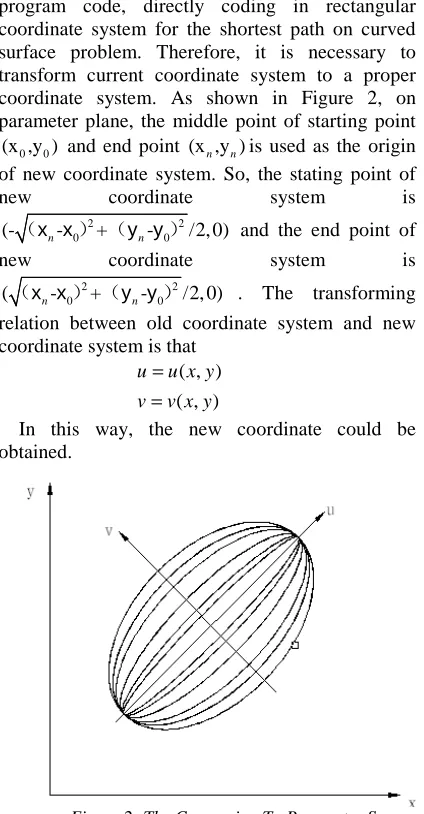
It will increase the space and time complexity of program code, directly coding in rectangular coordinate system for the shortest path on curved surface problem. Therefore, it is necessary to transform current coordinate system to a proper coordinate system. As shown in Figure 2, on parameter plane, the middle point of starting point
0 0
(x ,y ) and end point (x ,y )n n is used as the origin of new coordinate system. So, the stating point of new coordinate system is
2 2
0 0
(-(x xn- ) (+ y yn- )/2, 0) and the end point of new coordinate system is
2 2
0 0
((x xn- ) (+ y yn- )/2, 0) . The transforming relation between old coordinate system and new coordinate system is that
u=u x y( , ) v=v x y( , )
In this way, the new coordinate could be obtained.
Figure 2: The Conversion To Parameter Space
3.2 Approximation of Initial Path
There must be many paths between two points on the curved surface. In order to have an easy convergence, circle arc approach method is used. Firstly let's suppose that the parameter sphere is 8, species individual count N is 40, starting point is
' 1
(x , 0), end point is (xn', 0) , the semi-major axis of auxiliary elliptic equation is that ' '
1 / 2
n
a= x −x ,
/
b=sphere N ,forming N paths. At last, the
[image:2.612.314.526.160.567.2]674
4. PARTICLE SWARM ALGORITHM
BASED ON SIMULATED ANNEALING
4.1 Basic Particle Swarm Algorithm
POS [7] is initialized to be a group of random
particles (random solutions), then get the optimal solution by iteration. In each iteration, particles updated themselves by tracking two extreme values to find the optimal solution which is called the individual extreme value pbest. Another extreme value is the current optimal solution of the entire population which is called global extreme value
gbest. It also use the whole population but only one
portion as the neighbors of the particles. Then all neighbors of extreme value was the local extremum. When finding the optimal value, the velocity and position of each particle was updated according to the following formula
1 1 K
2
w* *rand*( - ) *rand*(pg _plus - )
K K K
k K
V V C pbest X
C X
+ = +
+
(6)
1 1
K K K
X + =X +V +
(7)
Where V is the particle velocity vector, K XK
is the current position of the particle, pbestk is the
position of the optimal solution,C , 1 C are the 2
population learning factor, pg_plus is the individual which is chosen by roulette rules.
In Particle Swarm Optimization algorithm, particle velocity is limited to a little range [8], but the new location would still become so bad possibly, which will cause slow convergence. So the updated position needed to be limited.
4.2 Improved Particle Swarm Optimization
The point of departure for the simulated annealing algorithm [9] [10] applied to the optimization problem is based on the similarity of the physical annealing process of solid material and general optimization problem. The basic idea of the algorithm is that starting from a given solution, randomly generating another solution from the neighborhood, accepting a new solution by a certain probability, accepting the objective function deteriorating in a limited range allowed by criteria. Specific contents are modified as follows.
Accept the objective function deteriorating in a limited range allowed by criteria, but don’t make a choice according to probability, directly according to E<e, which is the deteriorating range allowed by objective function. The specific algorithm is shown as follows.
Step 1: Initialize each particle. Set the number of
particles is N , randomly generate N
initial solutions and N initial velocities;
Step 2: Generate the new location of particles
according to the current position and velocity;
Step 3: Calculate the fitness value of the new
location of each particle;
Step 4: If the particle's fitness value is better than
the original individual extreme, set the current value as pbest;
Step 5: Find the global extremum according to
each particles individual extreme;
Step 6: Update their own velocity by formula (1); Step 7: Update their own location by formula (2); Step 8: Calculate the length of the path generated
by the new location, if the new length is less than the former length, change the new path to the old path.
Step 9: Return Step 2, calculate the next population
until the repeat number is greater than the alternation number N .
5. ALGORITHM TESTING
Set the special surface.
2 2 2 2
2 2 2 2
2 2 2 2
=10sin + / + +
15sin -2 + -5 / -2 + -5
-15sin +3 + -5 / ( +3) +( -5)
z x y x y
x y x y
x y x y
( ) ( ) ( ) ( )
( ) ( )
as an example.
Calculate the shortest path between two fixed points A(-8.0, -7.3) and B(6.0, 5.2) in the process of circle arc approach, give an auxiliary parameter, coordinates of basic points are set according to the auxiliary elliptic equation and species individual countN. All the parameters in this simulation are set as follows: N =40, ω =1.05, C1=C2 =2
,
number of node in each path is 8 (including the starting point and end point), iteration number
500
M = . In the end, the shortest length of optimized path is 26.9678.
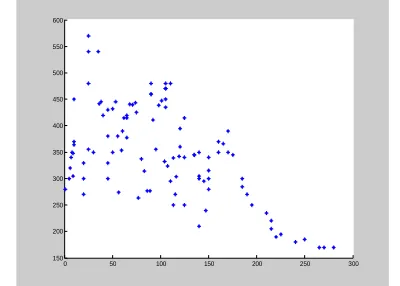
Convergence curves in this simulation are shown in Figure 3.
[image:3.612.317.517.573.716.2]0 50 100 150 200 250 300 150 200 250 300 350 400 450 500 550 600
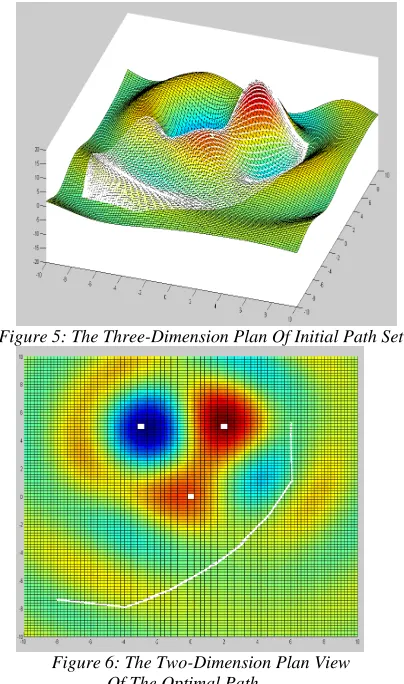
675 Figure 4&5 showed the initial path set. Figure 6&7 showed the optimal path with circle arc approach method.
[image:4.612.312.522.71.282.2]Figure 4: The Two-Dimension Plan Of Initial Path Set
Figure 5: The Three-Dimension Plan Of Initial Path Set
Figure 6: The Two-Dimension Plan View Of The Optimal Path
Figure 7: The Three-Dimension Plan View Of The Optimal Path
[image:4.612.101.292.128.296.2]The node sequence of optimal path after calculating is shown in Table 1.
Table 1: Table Of Nodes Sequence
X Y Z
-8.000 -7.301 -1.784
-3.920 -7.843 1.401
-1.315 -6.735 1.177
0.941 -5.237 -1.286
… … …
2.941 -3.451 0.377
4.685 -1.378 0.072
6.079 1.085 -1.057
6.000 5.200 -2.275
6. CONCLUSION
Through the numerical simulation example which has been showed, the proposed algorithm can achieve a better path. Because of the good convergence of the algorithm, this algorithm can be used in free surface on solving the shortest path. In the later period of the calculation, its fine ability can not be exceeded by artificial methods. If it is used to solve practical problems in highway, electric power, communication lines, water, oil pipeline construction, it will have an immediately good effect on solving the problem and save a lot of cost.
[image:4.612.312.521.324.487.2] [image:4.612.94.296.325.667.2]676 only these examples showed in this paper. As a general method to solve curve optimization problems, it has a broad prospect of application.
ACKNOWLEDGEMENTS
This work was supported by the Natural Science Foundation of Heilongjiang Province, China (Grant No. E201106).
REFERENCES:
[1] Zhu Guangyu, Zhang Weibo, “Drilling path optimization by the particle swarm optimization algorithm with global convergence characteristics”, International Journal of Production Research, Vol. 46, No. 8, 2008, pp.
2299-2311.
[2] Lee, Moon-Kyu, Kwon, Ki-Bum, “Cutting path optimization in CNC cutting processes using a two-step genetic algorithm”, International
Journal of Production Research, Vol. 44, No.
24, 2006, pp. 5307-5326.
[3] Zhang Xiang, Bernd Kuhlenkotter, Klaus Kneupner, “An efficient method for solving the Signorini problem in the simulation of free-form surfaces produced by belt grinding”,
International Journal of Machine Tools & Manufacture, Vol. 45, No. 6, 2005, pp.
641-648.
[4] A.W. Mohemmed, N.C. Sahoo, T.K. Geok, “A new particle swarm optimization based algorithm for solving shortest-paths tree problems”, IEEE Congress on Evolutionary
Computation, IEEE Conference Publishing
Services , September 25-28, 2007, pp. 3221-3225.
[5] Ishida, T. Dept, Kyoto Univ, “Moving-target search: a real-time search for changing goals”,
Pattern Analysis and Machine Intelligence,
Vol. 17, No. 6, 1995, pp. 609-619.
[6] Huang Zhangcan, Chen Siduo, Kang Lishan, et al, “Solving the Shortest Path on Curved Surface Based on Simulated Annealing Algorithm”, Journal of Wuhan University
(Natural Science Edition), Vol. 46, No. 3,
2000, pp. 273-276.
[7] Kennedy J, Eberhart R. C, “Particle swarm optimization”, Proceedings of the 1999
Congress on Evolutionary Computation, IEEE
Conference Publishing Services, July 6-9, 1999, pp. 1945-1950.
[8] Tsai S J, Sun T Y, “An improved objective particle swarm optimizer for multi-objective Problems”, Expert Systems with
Applications, Vol. 37, No. 8, 2010, pp.
5872-5886.
[9] S. Kirkpatrick, C.D.Gelatt, M.P.Vecchi, “Optimization by Simulated Annealing”,
Science, Vol. 220, No. 5498, 1983, pp.
671-680.
[10] Corona A., Marches M., Martini C., et al, “Minimizing Multimodal Functions for Continuous Variables with the Simulated Annealing Algorithm”, ACM Transactions on
Mathematical Software, Vol. 13, No. 3, 1987,