2017 International Conference on Computer Science and Application Engineering (CSAE 2017) ISBN: 978-1-60595-505-6
The Key Technology Research and Application of Re-configurable
Real-time Data Process System
Huifen Duan*, Feng Sun and Junlei Bao
China Satellite Maritime Tracking and Control Department, 214431 Jiangyin, China
ABSTRACT
In aerospace launching mission, the requirements of the tracking and control system are frequently changing, which cause the high costs of software maintenance and low software reliability. To solve this problem, we research some key technologies in designing a reconfigurable real-time data process system. According to the characteristics of the tracking and control information, an information description model, a processing method model and a processing tree model are presented. Based on these models, re-configurable real-time data processing system architecture and resource configuration methods are proposed. The proposed methods improve the data processing system’s rapid adaption ability to new mission and new processing requirements.
INTRODUCTION
With the development of aerospace industry of China, the aerospace launching missions have become more and more frequent. The types of these missions are quite different, some missions are launched in parallel, and the experimental state is frequently changing. In the experimental mission, different kinds of measuring and controlling equipment are used to collect experimental information in real time, the information is then transmitted to the command and display system. The command and display system should provide different kinds of correct mearing information to commanders and technicians in time, to help them in checking the parameters of the aircrafts and decision making. To meet the requirements of diversity and changeability of the aerospace launching mission, a reconfigurable real-time data process architecture is proposed.
RECONFIGURABLE MODEL DESIGN Data Description Model
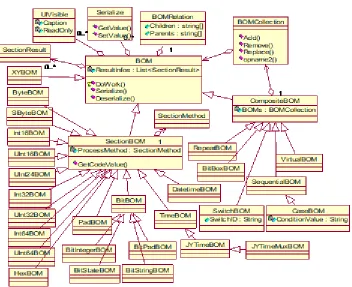
model is a layer derived tree structure, in line with the characteristics of hierarchical definition. The topmost layer is the BOM abstract class, which is the base class for all BOM classes, and the other BOM classes are derived directly or indirectly from the BOM base class. The BOM classes fall into two broad categories: Section BOM and CompositeBOM. The class hierarchy of the BOM model is shown in Figure 1. The abstraction description of the data model has expressed a strong ability, good versatility, flexible and extensible advantages [1] in solving the problem description of complex data, and it has been used in space mission data processing software, Figure 2 shows the commonly used data derived model.
SectionBOM
BOM
CompositeBOM 0..*
0..*
TimeBOM BitBOM Int32BOM SequentialBOM SwitchBOM
BitIntergerBOM BitStateBOM CaseBOM
…
…
[image:2.612.189.421.199.316.2]…
Figure 1. BOM model class diagram.
[image:2.612.137.489.358.645.2]Data Processing Method Model
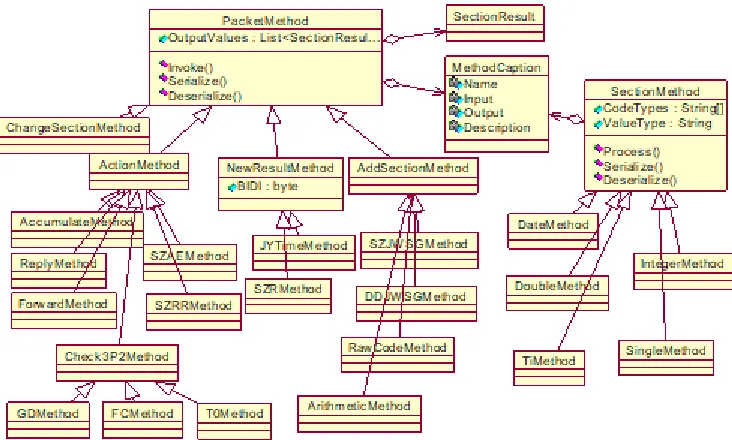
[image:3.612.132.498.256.476.2]Based on the created BOM, the structure analysis of data stream is realized, and the data stream is transformed into effective data source field. These valid data source field by dimension conversion, calculation formula and other methods eventually transformed into physical quantity effectively, and to carry out comprehensive treatment of physical treatment out of the final result, based on the data processing method of formal description. Through adding field processing method for processing field attributes specified in parsing after the source encoding structure of field data, a sequence of data processing can be generated via the data processing method of dynamic scheduling, dynamic loading method. Figure 3 shows the commonly used processing methods, and model classes.
Figure 3. Data processing method model class diagrams.
PROCESS RECONFIGURATION
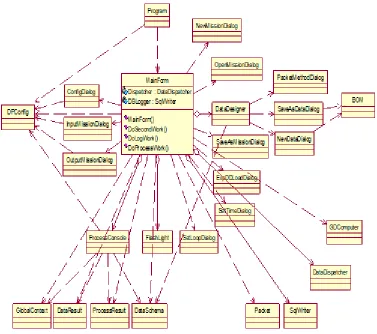
Figure 4. Processing flow class diagram.
METHOD APPLICATIONS
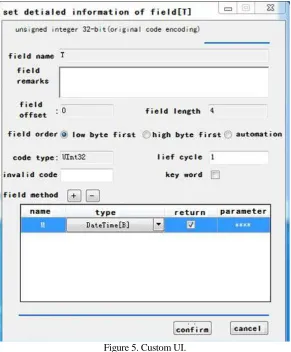
To verify the architecture and method proposed in last sections, a real-time data process system for aerospace launching mission tracking and control is implemented in the WINDOWS using Microsoft's Visual 2010 development platform and C# language. The user interface of the software in the custom state is shown in Figure 5.
Figure 5. Custom UI.
Initiating UI
Load Base files
Edit(create)
Source file
New Source file customizing state
Create real-time data receive
Socket
Start data receive thread
Start timer Ready state
Receiving data
Judging kind of data stream
Matching source file Execute state
Processing on matched source file Source
[image:5.612.106.487.436.655.2]files
CONCLUSIONS
Based on the space measurement and control task, according to the characteristics of information control, an information description based field data model is proposed, including bit data model, time data model, combination data model, processing method model based on results of the flow of information. On the basis of these models, the framework of three custom states is designed, including the designing state, ready state and executing state. The designing state is designed mainly to complete the process of generating custom state tree, the ready state’s job is to complete the main data communication interface, create thread processing, the running state’s job is to accomplish real-time data receiving and processing. Through the above design, the application software has the ability to deal with the data frame, and can meet the expansion requirements of the data frame types, parameters, processing methods and changes in processing results. The developed application system has effectively improved the adaptability of data processing.
REFERENCES
1. Wei Jidong, Wang Zhaoshun, Dai Guilan, Dai Jun. 2010. “Data-frame Parsing and Processing Based
on Tree-structured,” J. Journal of Chinese Computer Systems, 31(12): 2352-2354.
2. Wang Guangqi, Zhang Yu, Yu Ge. 2008. “e-ScopeWork: a Flexible Workflow System Based on
Web Service,” J. Journal of Northeastern University (Natural Science), 28(2): 180-183.
3. Wei Xing. 2007. “Research on Software Object Framework of Tracking & Telemetry Real Time Data Processing,” [D]. Chongqing: Chongqing University, 2007. 10.
4. Feng Xinyang, Cui Kai, Shen Jianjing. 2009. “Research and implementation of plug-in oriented application frame work,” J. Computer Engineering and Applications 2009, 45(10): 89-91.