ISSN: 1992-8645 www.jatit.org E-ISSN: 1817-3195
234
APPLICABILITY OF AN ADAPTIVE HANDOVER
MECHANISMON PRACTICAL 4G NETWORKS
1
BHASKAR S, 2DR G A E SATISH KUMAR, 2DR P RAMANA REDDY 1
Associate Prof, Department of ECE, SJCIT, Chickballapur, India 2
Professor, Department of ECE, Vardhaman College of Engg. (Autonomous), Hyderabad, India 3
Professor, Department of ECE, JNTUA College of Engg, Anantapur, India E-mail: [email protected], [email protected] , [email protected]
ABSTRACT
The fourth generation 4 and beyond networks define the future of mobile communication. Handover management in 4 networks based on the IPv6 core is a problem that exists. The co-channel interference in wireless channels effect network and handover performance. In this paper the proposed Noise Resilient Reduced Registration Time Care-of Mobile IP protocol is modelled considering practical network conditions. A threshold based handover decision making algorithm is incorporated in the proposed protocol. The results presented in this paper clearly put forth the effects of the co-channel interference on handover management and network performance in the presence of multiple users. The comparative study prove that the proposed protocol is robust and minimizes network performance degradation considering practical conditions.
Keywords: Mobile Internet Protocol, Ipv6, Handover Latency, Mobility Management, Received Signal Strength, Mobile Ipv6 (Mipv6), Co-Channel Interference, Handover Request Rate.
1. INTRODUCTION
The adoption of 4G and future networks in mobile communications is widely acclaimed. A recent worldwide market report (Signals and Systems Telecom 2014) provides insights of the research significance in developing such future technologies. Enhancing transmission speed, capacity and improving network performance can be considered as the goals of 4 and future networks. Efficient handover management techniques is essential to achieve these goals in 4 networks. Handover management techniques enable to maintain seamless continuity without compromising the Quality of Service . The network bandwidth available to the service providers is limited. With the limited bandwidth constraint and the ever increasing user demands the service providers reuse the frequency within the available network. The frequency reuse induce co-channel interference (YoungBo et al 2009, Hao et al 2014). The effect spectral efficiency and degrade link performance in 4Gand future networks (Soret et al 2013, Wang et al 2009). The problems arising from are practical and inevitable characteristics of 4 networks. The link degradation due to effects the the performance of handover algorithms. Designing of handover
algorithms considering practical network conditions is a problem that exists in 4 networks.
4 networks are heterogeneous in nature integrating varied technologies over the Internet Protocol Version 6 6 core(Prakash et al 2010, Prakash et al 2011 ).For handover management on the 6 the Internet Engineering Task Force initially introduced 6 protocol (Johnson et al 2004). A user node in the wireless 4Gnetwork is addressed by the Home Address in the home network or a Care of Address when in other visited networks. The handover operation is initiated when moves from the to a visited network or when moves from one visited network to another. To acquire the the user node sends a router solicitation message addressed to the foreign agent of the visited network. To verify the identity of U the FA sends a binding update (BU) message to the correspondent node ( ).
The confirms the identity of the user and
sends the binding acknowledgement ( )
message to the . Post the receipt of the
messege data transmission to the user is
resumed on the new . The existing handoff
ISSN: 1992-8645 www.jatit.org E-ISSN: 1817-3195
235 Atiquzzaman 2005, Costa et al 2002 ) like channel fading, signal degradations, interference in the overlapping regions of the network. In our previous work Bhaskar et al 2015, the drawbacks and short comings of the existing handoff protocols are clearly discussed and to overcome the drawbacks a Noise Resilient Reduced Registration Time Care-of Mobile _ : protocol is proposed. The _ : is an extension of the : (Bhaskar et al 2013) protocol. In our previous work the _ : protocol is designed considering the channel fading effects and the region of uncertainty/overlap region of phantom introduced by Hao et al 2014. The modelling and the simulation presented in the previous work did not consider the effects that exist in practical scenarios. Researchers YoungBo et al (2009), Hao et al (2014), Stuber (1994), Pratesi et al (1997) and Das et al (2005) have presented the effects of CCI on handover performance. Based on the literature it is evident that effects handover operations and effects network performance. Limited work is conducted to study the effect of considering 4 networks integrated over the 6 core.
In this paper the authors have incorporated the effects of in modelling the _ : handover management protocol. The handover decision making algorithm of the _ : protocol depends on the received signal strength observed by the user nodes . The induces additionnal inteference. The additional inteference induced is modelled. The degrades the wireless links of the network which induce handover failure probabilities. The handover failure probabilities are modelled based on the handover request rates. The effects of on handover management and network performance are studied in the simulation study considering multiple users and the robustness is proved through comparisons.
The outline of this paper is as follows. A brief of the related works discussing the effects of on handover performance is presented in section two. In section three the modified _ : protocol is presented. The performance evaluation and comparisons are presented through a simulation study in section 4. The conclusion are discussed in the last sections of the paper.
2. RELATED WORK
The initial attempts to study the effects of on handover performance was presented by Stuber (1994). The importance of the auto correlation function in the analysis of handovers is discussed
by Stuber (1994). Daset al (2005) have presented the performance degradation of hard and soft handover mechanisms in code division multiple access cellular networks. The effects of is considered in modelling the system presented by Das et al (2005). The major drawback of the model proposed by Das et al (2005), is that the authors consider a perfect inner loop power control mechanism which is not the case in practical scenarios. Pratesi, M. et al (1997) have extended the work presented by Das et al (2005) by considering multiple base station scenarios. The corporation of the effects is considered by Pratesi, M. et al (1997) based on the cross correlated shadow observed dependent on the angle of arrival of the user nodes. A cell multi-sector analytical model considering is presented Young Bo Cho et al (2009). Young Bo Cho et al (2009) have accurately described the modelling of the received and sent signal strength measurements. A similar signal strength measurement model is incorporated in the _ : protocol. Young Bo Cho et al (2009) a signal strength based handover decision algorithm is also discussed. Hao Song et al (2014) have proposed a handover mechanism considering the Long-Term Evolution networks for railway systems. Based on the predicted received signal quality handover decision making is achieved by Hao Song et al (2014).
The observed at the physical layer are network characteristics that cannot be ignored in the design of robust handover management protocols. In this paper the effects of is considered in the modelling of the _ : protocol. The major drawbacks of the related works presented so far is that the performance and its applicability over the IPv6 core is not discussed or proved.
3. PROPOSED HANDOFF MECHANISM
3.1 Channel Modelling with CCI
Let ! ∪ #$$ % ∪ & ∪ #'( ∪ )* represent a 4 network on the 6 core having a wireless coverage of + square meters. The network defined constitutes of , user nodes -. .. ), number of correspondent nodes-. .. , home agent &, number of wireless access points -. .. #'(, number of access routers -. .. #
$ $ %.
Every indivudial access point 0 ∈ -. .. #2'(is connected to the 6 based wired backbone 4 network through an access router 0 ∈ #'( -. .. #
2
ISSN: 1992-8645 www.jatit.org E-ISSN: 1817-3195
236 network follow the uniform mobility model prsented by YoungBo Cho et al (2009) with a maximum speed represented as 3 4/6. In this paper the authors study the effects of on the _ : protocol presented in the previous work.
When the 7 user node travelling at a speed of38 4/6 , moves from the#''(in the home network to#9'( in another network and handover occurance is induced. The 7 user node initiates an handover request on the basis of the received signal strength indicator from #''( and#9'( measured at regular intervalsΔ;. If <;is the sampling rate, then the received signal strength ( ) at the = time instance measured is > = <⁄ ;. The measurement interval based on the sampling rate is Δ; <⁄;.
To model the observed in the 4 network based on presented by YoungBo Cho et al (2009)let us consider that = represents antenna loss, = represents fast fading, the shadow and path loss is represented as = , , = . At the = time instance let @ > , AB > represent the positin vectors of the 7 user node with respect to the #''(. Then the pilot signal strength measured from the C #'( at the = time instance is defined as
BD = ,B = E B = E B = E B = , (1)
The path loss is defined as ,B = FGH IFJK logIO @ > H AB > OPP, where the
values of FGand FJare constants and are established on the basis of the enviromental considions considered. The antenna loss B = based on the 3GPP standard by 3GPP Technical Specification Group (2003) is defined as
B = H4-QR12I U|μ , DPX E Y (1)
where μ is bandwith , Dis maximum attenuation, U isn the angle between the C #'( and the user node and Y represents antenna gain.
In Eq. (1) B = represents a Gaussian noice process with a zero mean and can be expressed as Z[\] ^ , a autocorrelation function given as Z[\] ^ _`[\J]a K b._c |de|fgfh ai . The fast fading B = can be elimnated by adopting the averaging window <jk_l IΔjk_lmG P K n.bc ofgfpq_ris.
Let us consider thatA ⟺ .b
c fg
fpqrirepresents the effective window size of the avereging filter, then
the avereging window at the = time instance can be represented as<jk_l = _vuo
pq_ra wx.Q = y 0
Considering the , 1, the processed pilot signal strength {B)|G = from the C #'( and can be defined as
{B)|G = <jk_l = ∗ BD = wx.Q =
y 0. (2)
CCI is generally observed when the number of user nodes are greater than unity i.e. , ~ 1. Let ^D,(represent the cross corelation between the 4 | 4 ∈ , user node and Q | Q ∈ , user node acessing data from the same #'( on the same frequency. The cross correlation ^D,(is defined as
^D,( λGcosIUD,(P E λJ, < @ 4 ‚ Q, (3) where λG, λJrepresent constants and UD,(represents the angle between the 4 and Q user node considering the #'(as the vertex. YoungBo Cho et al (2009) consider the processed pilot strength {B)ƒG = considering , y 2 user nodes can be derived.
At the time instance = the cumilitive or the processed pilot signal strength from the C #'( and the , H 1 number of interfering signals of the other user nodes is defined as
{B = 10 7 „ …_10I{]e†‡ Kˆ.GPa
E ‰Š 10I{]e‹‡ Kˆ.GP )mG
8|G
Υ
(4)
The first term in Eq. (5) i.e. _10I{]e†‡ Kˆ.GParepresents the desired signal free of
inteference and the second term i.e. _∑)mG8|G10I{]e‹‡ Kˆ.GPa represents the component.
Based on the above equation it can be observed that the {Bvaries in the presence of intefeering users i.e. as the user nodes increase the increases. In the _ : on the basis of the {Bthe handover decisions are achieved.
3.2 Threshold Based Handover Decision Making
The _ : discussed in this paper adopts a threshold based decision making algorithm. As stated earlier the user nodes )measure the
received signal strength {Bfrom the #'( at
regular intervals. If the signal strength
ISSN: 1992-8645 www.jatit.org E-ISSN: 1817-3195
237
threshold • then an handover operation is
[image:4.612.95.299.79.272.2]initiated.
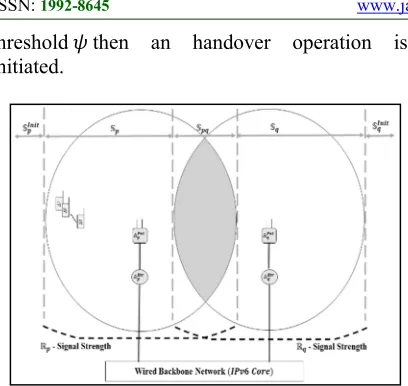
Figure. 1. Handover Decision Making System Architecture
Let us consider a sample 4 network integrated over a 6 core shown in Fig 1. The network consists of two wireless networks maintained by #B'( and#9'( . The routers i.e. #B$ %and #9$ %provide the connectivity to the wired backbone network. The signal strength observed by the user nodes is represented as {B, {9(represented a a black dotted line). Considering the network covers and area •⟺ H∞, ∞ . Let us consider that )are present in the network. The signal strength measured by the )nodes at the = time instance in the network is defined as{ = {C = H {’ = . Based on the signal strength observed by the
)nodes the network is considered to constitute of three sectors. Sector •B
⟺
R•B,∞P
where the signal strength from #B'(is i.e.{Bis dominant. Sector •9⟺
IH∞,H•9Xwhere the signal strength from #9'(is i.e.{9is dominant. The intersecting sector •B9 ⟺ I•B, H•9P is called as the region of uncertainity or also overlap region of phantomby Hao Song et al (2014). In the overlapping region it can be observed that the signal strength {B, {9deteriorates which induces handover failures due to loss of and messege loss. Coupled with the and the deteriotating signals additional handover failure occurances are observed.If the user nodes )move from #''(towards#9'(handover operations are initiated at every user node,if the difference in the measured signal strength falls belowH•9. Similarily handover operations are initiated when the measured signal strength is above E•Bwhen the user nodes ) move from #9'(towards#B'(.A user node 8at time instance = is assigned to the#''( in the section •Bif = ∈ •Bor if =“ ∈ •B for some =“” = and { =““ ∈ •B9for the time instance=′” =′′– =. Let { _>
9arepresent a
sequence of ’ measured signal strength values of
!{ = *in time =seconds and is defined as
{ _>9a ⟺ I { = H ’ E 1 , { = H ’ E 2 , { = H ’ E 3 … … . { = P , (6)
where 1 – ’ – = E 1.
The sequence { _>
9acan also be presented as a tuple
of cardinality = as™ ⟺š•CQ-›, •C, •’Q-›, •’, •C’œ. Let us consider a tuple •B9% of cardinality@. The tuple •B9% consists of @ repetitions of the symbol •B9 based on the node mobility. It is assumed that the travesal of the7 user node 8in the network begins from •B•(ž or •9•(žat time= 0. On the basis of its speed 3 and time instance = y 1 the user node 8is present in either one of the three sections•B , •B9or•’.
Based on our previous work the mean number of handover occurances Ÿ of the user node 8 travelling at a speed of 3 4/6 and based on its travesal trajectory is computed using
Ÿ Š _ℙB9 = E ℙ9B = a
>
>|G
, (7)
where = denotes the total number of sampling intervals, ℙB9 = is the probablity that 7 is assigned to #9'( from #B'( and ℙB = denotes the probablity that 8 is assigned to#CQ›from #9'(.
Let us assume an handover occurance = time instance is initiated by the user node 7between the #''(to #9'( . The signal strength measured is computed using
; = = E ¢
ISSN: 1992-8645 www.jatit.org E-ISSN: 1817-3195
238
where the parameters =
_max _{B = , {9 = aa,
¢B = _1 ]> . Min!0, { = *aand ¢9 =
_1 ©> . Min!0, H{ = *a. In the computation of
¢B = and ¢9 = , 1ªdenotes the indicator function on the set «, B = and 9 = represent = time instance when the user node 8 is assigned a home address or care of address from the #''( or #9'( .
When the user node 8moves from sector •Binto the sector of uncertainity •B9and handover request is sent to the #''(. As shown in Fig. 1 the signal strength {B = , {9 = from #''( and #9'(degrades in the sector •B9. In _ : where the handover operation is initiated when the measured { = is below a thresholdH•9. The signal degradation or interference of the 8experienced in the region•B9on the basis of {B = , {9 = is computed as
= ⟺ B = E 9 = , (6)
where B = H¢ž = is the channel inteference observed due to the degrading signals from #''(, and 9 = H¢9 = represents the inteference observed due to the degrading signals from #9'(. Considering X = ¢ž = E ¢9 = the signal inteference can be presented as = ⟺ HX = .
The mean noise induced in the channel due to the degraged signals is computed using -=® ⟺
! = *. The presence of the remaining user nodes i.e. )m8 ) ∩ 8 causes as they operate on the same frequency. Considering the the cumilitive inteference observed is defined as
° ⟺ _4±0G²³²´! = *a E ‰Š 10I{]e‹‡ K ˆ.GP )mG
8|G
Π, (7)
where the first term4±0G²³²´! = *represents maximum value of -=®observed in the time period .
The signal fading and the cause degradation of the signal received by the user nodes. The cumilitive inteference computed result in transmission errors of the and messeges. The loss in and messeges result in increase in handover latencies observed by the user nodes.
The results presented in the sucesseding sections of the paper prove the fact.
3.3 Effect of CCI on Handover Probabilities
Let B = and 9 = represent circumstances or events that occur at the time = when the 8is attached with #''(±Qµ#9'(. The handover decision is executed by transmitting messeged in the _ : when the received signal strength falls below the threshold • . Let
B
¶ = represent the circumstance at time = let when
the B = from #''(is below the threshold • i.e.
B
¶ = ⟺ š
B = ” • œ. Similarily the
circumstance 9¶ = is defined as 9¶ = ⟺ š 9 = ” • œ.The handover operation · executed
at time = by transmitting the messege to the #'( can be defined as
· = ⟺ B = ∩ B¶ = ⊔ 9 =
∩ 9¶ = .
(11)
To simplify Eq. 11 the handover operation Ycan be given as
· = ⟺ ·B = ⊔ ·9 = , (12)
where ·B = , ·9 = represents the assignment of the 8through the messege to #''(and #9'(.
The fading channels introduce the ping pong effects by Shun-Ren Yang and Yung-Chun Lin et al (2008), Maturino-Lozoya, H and Munoz-Rodriguez et al (2000) and Das S et al (2005) especially in the overlapping sections of the network i.e. •B9. These effects induce a number of unsucessfull handovers and were considered in our earlier work to model the handover probablity. The experienced by the 8induces handover failures.The is induced due to the ongoing transactions (between between the user nodes and the corresponding #'() and the handover requests generated by the user nodes
to the #'(.
ISSN: 1992-8645 www.jatit.org E-ISSN: 1817-3195
239 with the #'(. The handover request rates induced by the ¹ nodes is denoted byº». The handover failure probablity in the section•B9can be computed using
¼½
…_I¾º2E ¾º»P
)
a
, •
‰∑ I¾º2E ¾º»P8
7
)
8|ˆ Œ
,
DisplayText cannot span more than one line!
where ¾ ¿G
g.
In the section•B9handover requests can be sent by to #''(and #9'( . The sucessful handover probablity considering #''( is defined as ¼B⟺ ℙ!·B = *. The sucessfull handover probablity considering #9'( is ¼9⟺ ℙ!·9 = *.
The handover probablity in the section•B9at time = is defined as
¼ = ¼B = E ¼9 = E ¼½ , (9)
The computation of the sucessfull handover probablites is discussed in out previous work. From Eq. 14 it is clear that as the handover failures increases the handover latencies increase. The experienced by the usernodes in the 4G network increase the handover failure rates thereby enhancing handover latencies.
4 Performance Evaluation
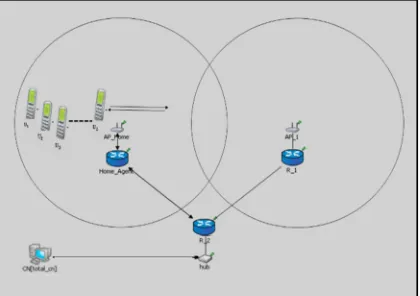
To evaluate the performance of the _ : protocol the authors have considered the OMNET++ simulator by OMNET++ Discrete Event Simulation System. The adoption of the MiXiMs. Valentin et.al (2008) framework on the OMNET++ simulator is consider to simulate the channel fading and conditions. The experimental test bed considered with the overlapping region of two networks is shown in Fig 2. The test bed considers two access routers #\ÀDÁ$ % and #G$ %. The routers #\ÀDÁ$ % and #G$ % are
connected to router _2 which provides the connectivity to the back bone network through the xÂA. All the components of the test bed operate on 6 adresses.The routers #\ÀDÁ$ % and #G$ % provide connectivity to access points #\ÀDÁB( and #G'(. The #\ÀDÁB( and #G'(considered in the test bed operate on the IEEE 802.11 standard
[image:6.612.91.216.159.257.2]ata frequency of 2.4 GHz. The in the teat bed is used to host a ping application and addresses all the user nodes )in the network. To understand the effects of on handovers we need to model the scenarios for varied handover request rates i.e. º». To induce we need to simulate cases wherein the user nodes )simultaneously perform the similar required tasks like sending handover requests, data requests etc. Varied number of user nodes are considered to acheive the desired handover request rates. Considering 1,5, 15 and 20 user nodes varied values of º»are acheived. The simulation time, number of user nodes and the corresponding º»simulated is summarised in Table 1. The mobility speed i.e. 3 of all the user nodes is considered to be 10 4/6 . Randomwaypoint mobility of the nodes is considered in the experimental study. The performance of the _ : protocol is compared with the state of art : protocol.
Figure. 2 Experimental Testbed Considered On The OMNET++ Simulator
Table 1: Simulation Configurationsconsidered For Performance Evaluation
NUMBER OF
USER NODES )
HANDOVER REQUEST RATEº» (Requests/Sec)
SIMULATION TIME(s)
1 1 79.99
5 2.29 79.99
15 2.72 79.99
[image:6.612.315.525.343.491.2]ISSN: 1992-8645 www.jatit.org E-ISSN: 1817-3195
240 4.1 Effect of ÃÃÄ on Handover Latency
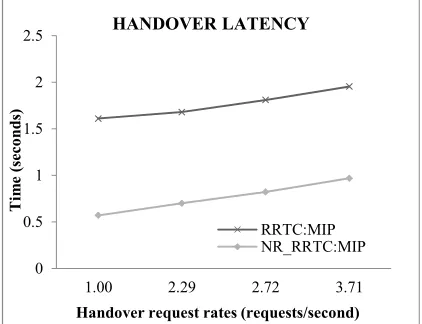
To study the effects of on the handover latencies, varied rates of º»are considered. In the sumulation study all the ) (for , 1,5,15 and 20 ) are initially attached to the #\ÀDÁB( represented by AP_Home in Fig.2. When the signal strength { in the over intersecting sector of the network falls below the threshold • then the ) initiates the handover by sending messege to #GB( (represented as AP_1 in Fig.2.). The #GB( receives the and assigns a new to the ) thereby completing the registration. The time delay observed from the instance the is transmitted to obtaining the is termed as the registration latency. Post the registration data, transmission (from the Ping application at the ) to the ) is resumed through #GB( . The total delay observed by the ), starting form the RS messege transmission to receiving the data on the new is called the handover latency. The registration latency and the handover latencies observed at each of the user nodes in the simulation study varied due to the mobility patterns and . It was observed that as the handover request rates º»increase, the handover latencies increase considering both the protocols _ : and : . This observation proves the concept presented in Eq 13 and Eq 14 of this paper. The increase in º»increases the handover drop probablity ¼½. As the drop probablities increase the handover latency increases as seen in Fig 3. Note the average value is represented in the Fig.3. Tredlines were added to understand the nature of the graph the tredline
analysis for _ : and :
observed are as follows
¹ $_$$Æ : Ç•' I0.276 K lnIº»PP
E 0.5457 ,
¹$$Æ : Ç•' I0.23731 K lnIº»PP
E 1.575 ,
(15)
Where ¹ $_$$Æ : Ç•'and ¹$$Æ : Ç•'represent the handover latency corresponding to the handover request rate º». The logrithmic nature of the handover latencies observed confirms the correctness of Eq. 5. In Eq.5 the inteference due to is shown. Higher inteference is observed as the handover request rates increase. From the Fig.3
[image:7.612.312.523.235.397.2]it is evident that the _ : protocol exhibits lower handover latencies by about 56.6% when compared to the : due to the { signal based handover decision algorithm. Based on the results it can also be stated that in dense 4 networks as the handover drop probablity ¼½ increases due to the the handover latencies increase. Incorporating effecient handover management protocols based on robust decision making algorithms can reduce the effect of in such networks.
Fig. 3. Average Handover Latency Observed Considering Varied Handover Request Rates
4.2 Effect of ÉÉÊ on network performance
To study the effects of on network performance the authors have considered a ping application hosted at the addressing all the user nodes )in the network. The ping application in the simulation study considers a payload of 56 bytes. Uniform simulation duration is considerd and the packet trransmissions through the network is monitored. The drop rate observed at the application layer is shown in Fig.4 of this paper. The average drop rate of 7.69% is observed considering the : protocol when compared to a low average drop rate of 2.96% considering the _ : protocol. As the handover request rates increase the drop rates increases due to the increase in handover periods as during these periods no application layer data is transmitted to the )in the network. The ping pong effects induced due to to the fading effects is not
considered in the : protocol which
further contribute to increased packet drop rates.
0 0.5 1 1.5 2 2.5
1.00 2.29 2.72 3.71
T
im
e
(
se
c
o
n
d
s)
Handover request rates (requests/second) HANDOVER LATENCY
ISSN: 1992-8645 www.jatit.org E-ISSN: 1817-3195
[image:8.612.325.515.65.295.2]241 Figure. 4. Application layer drop rates considering
varied handover request rates
In each simulation considered one handover per user node per simulation is considered i.e. from #\ÀDÁB( to #GB( . Hence data analysis at the #GB( is
critical to clearly understand the effect of on handover operations and network performance. The 802.11 MAC frames transacted (i.e. sent and received) at #GB( are observed and collisions at the wireless layer are noted. The collisions observed are shown in Fig. 5. It is observed as the handover request rates increase the number of packets lost due to collisions increase. The packet collisions observed in the _ : protocol are less when compared to the
: protocol.
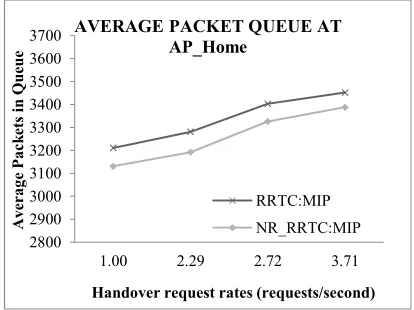
The network performance can also be analyzed based on the packet buffer / queue sizes in the maintained in the network. Lower number of packets in the queues denote better performance. The packet queues maintained at the #GB( are noted and the results obtained is shown in Fig. 6 of the paper. The average packet queue lengths maintained at #\ÀDÁB( considering varied handover request rates in shown in Fig. 7. The packets in the queue increase as the number of users in the network increase. At #GB( the packet queues
considering the _ : and :
protocol is almost of similar lengths for lower handover request rates i.e. º» – 2.29 . At higher handover request rates the reduction in queue lengths in the _ : protocol is clearly seen by the divergent nature of the graph. At #\ÀDÁB( , (to which all the )in the network are
initially connected) the queue length reduction of 2.33% is observed considering the _ : protocol when compared with the : protocol. Base on application layer drop rates , packet collosions and queue length
results obtained, better performance of the _ : protocol in comparison to
[image:8.612.322.526.342.492.2]: protocol is confirmed.
Figure. 5. Packet Collisions At MAC Layer Of AP_1 Considering Varied Handover Request Rates
Figure. 6. Average Packet Queue Lengths At AP_1 Considering Varied Handover Request Rates
Figure. 7. Average Packet Queue Lengths At AP_Home Considering Varied Handover Request Rates 0 2 4 6 8 10
1.00 2.29 2.72 3.71
D r o p R a te %
Handover request rates (requests/second) APPLICATION LAYER DROP RATE
RRTC:MIP NR_RRTC:MIP 720 770 820 870
1.00 2.29 2.72 3.71
P a c k e ts C o ll o ss io n s / L o st
Handover request rates (requests/second) PACKETS COLLISSIONS / LOST
AT AP_1 RRTC:MIP NR_RRTC:MIP 2700 2900 3100 3300 3500 3700
1.00 2.29 2.72 3.71
A v e r a g e P a c k e ts i n Q u e u e
Handover request rates (requests/second) AVERAGE PACKET QUEUE
LENGTH AT AP_1
RRTC:MIP NR_RRTC:MIP 2800 2900 3000 3100 3200 3300 3400 3500 3600 3700
1.00 2.29 2.72 3.71
A v e r a g e P a c k e ts i n Q u e u e
Handover request rates (requests/second) AVERAGE PACKET QUEUE AT
AP_Home
RRTC:MIP
[image:8.612.320.527.536.691.2]ISSN: 1992-8645 www.jatit.org E-ISSN: 1817-3195
242 4.3 Effect of CCI on user nodes considering
NR_RRTC: MIP protocol
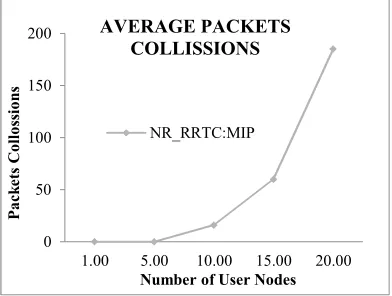
[image:9.612.101.297.320.468.2]The primarily effects the )in the network. To further study the effects of in the _ : protocol the number of user nodes in the network are increased. The wireless layer of the user nodes are monitored and the number of packet collisions at each user node is noted. The average number of collisions is computed and the results obtained is shown in Fig. 8. From the figure it is clear that when the number of user nodes are less (i.e. )– 5 the effects of on the user node performance is negligible. When the number of user nodes in the network increase, performance of the )in the network deteriorates primarily due to which induces collissions.
Figure. 8. Average Packet Collisions Observed At The Wireless MAC Layer Of The User Nodes.
5. CONCLUSION
The signifance of 4 and future networks is discussed. Handover management is critical to acheive good network performance and provide seamless connectivity to the user nodes. The observed at the physical layer effect the handover mechanisms. Limited work is carried out for developement of handover mechanisms considering the 6 based networks and . In this paper the _ : protocol for handover management is presented. The and it seffects on the measured signal strength is discussed. A threshold based decision making
algorith is considered in
the _ : protocol. The computation of handover sucess and failure probablities are presented. A simulation study to demonstrate the effects of on handover and network
performance is shown on the OMNET++ simulator. The simulation study considers multiple user scenaios used to modell varied handover request rates. The results prove the robustness of the _ : protocol in comparison to the state of art existig algorithms.
REFRENCES:
[1] A Kopke, M Swigulski, K Wessel, D Willkomm, P T Klein Haneveld, T E V Parker, O W Visser, H S Lichte, and S. Valentin. 2008. Simulating wireless and mobile networks in OMNeT++ the MiXiM vision. In Proceedings of the 1st international conference on Simulation tools and techniques for communications, networks and systems & workshops. ICST, Brussels, Belgium, Belgium. Article 71. 1-8.
[2] Bhaskar S, G A E Satish Kumar, P Ramanareddy and Kashyap Dhruve 2013 A Seamless Adaptive Mobility Management Scheme for 4-G Network. International Journal of Computer Science and Network Security. 13: 39-45
[3] Bhaskar Subbe Gowda, SATISH KUMAR Gandluru Arthur Edwin and RAMANA REDDY Patil 2015. Design and Analysis of an Adaptive Handover Protocol for 4G Networks. Journal of shanghai Jiaotong University (Science). Springer 20: 209-217.
[4] Das S, MacDonald W M and Viswanathan H 2005 Sensitivity analysis of handoff algorithms on CDMA forward link. IEEE Transactions on Vehicular Technology. IEEE 54: 272-285. [5] Hao Song, Xuming Fang and Li Yan 2014
Handover Scheme for 5G C/U Plane Split Heterogeneous Network in High-Speed Railway. IEEE Transactions on Vehicular Technology. IEEE 63: 4633-4646.
[6] Johnson D, Perkins C, and Arkko J 2004 Mobility support in IPv6. Network Working Group RFC 3775. The Internet Society. 1-165. [7] Maturino-Lozoya H, Munoz-Rodriguez D,
Jaimes-Romera F and Tawfik H 2000 Handoff algorithms based on fuzzy classifiers. IEEE Transactions on Vehicular Technology. IEEE 49: 2286-2294.
[8] OMNET++ Descrete Event Simulation System. [Online] http://www.omnetpp.org/.
[9] Prakash S, C B Akki and KashyapDhruve 2010 Handoff Management Architecture for 4G Networks over MIPv6. International Journal of
0 50 100 150 200
1.00 5.00 10.00 15.00 20.00
P
a
c
k
e
ts
C
o
ll
o
ss
io
n
s
Number of User Nodes
AVERAGE PACKETS COLLISSIONS
ISSN: 1992-8645 www.jatit.org E-ISSN: 1817-3195
243 Computer Science and Network Security. 10: 267-274.
[10] Prakash S, Kashyap Dhruve and C B Akki 2011. Unified Billing-Realization of convergent architecture for charging and billing in 4G networks. International Journal on Information Technology. ACEE 01: 26-32.
[11] Pratesi M, Ruggieri M, Graziosi F and Santucci F 1997 Performance of signal strength handover algorithms with interference and correlated shadowings. IEEE Vehicular Technology Conference, 1997. IEEE 2: 530-534
[12] Shaojian Fu and Atiquzzaman M 2005 Handover latency comparison of SIGMA, FMIPv6, HMIPv6, FHMIPv6. Global Telecommunications Conference, 2005. IEEE 6: 3809-3813
[13] Shun-Ren Yang, Yung-Chun Lin and Yi-Bing Lin 2008 Performance of Mobile Telecommunications Network With Overlapping Location Area Configuration. IEEE Transactions on Vehicular Technology. IEEE 57: 1285-1292
[14] Signals and Systems Telecom 2014 The Wireless Network Infrastructure Bible: 2014 – 2020 – Macrocell RAN, Small Cells, RRH, DAS, Cloud RAN, Carrier WiFi, Mobile Core & Backhaul. Signals and Systems Telecom. 1-391.
[15] Soret B, Hua Wang, Pedersen K I and Rosa C 2013 Multicell cooperation for LTE-advanced heterogeneous network scenarios. IEEE Wireless Communications. IEEE 20: 27-34 [16] Stuber G L 1994 Cochannel interference
modelling for signal strength based handoff analysis. Electronics Letters. IEEE 30: 1914-1915.
[17] Wang M M, Borran J, TingfanJi, Richardson T and Min Dong 2009 Interference management and handoff techniques. IEEE Vehicular Technology Magazine. IEEE 4: 64-75
[18] X P Costa, R Schmitz, H Hartenstein and M Liebsch 2002 A MIPv6, FMIPv6 and HMIPv6 handover latency study: Analytic approach. Proceedings of the IST Mobile and Wireless Telecommunications Summit 2002. 100-105 [19] YoungBo Cho, Eunsung Oh and Daesik Hong
2009 A New Modeling Scenario and Analysis of Handoff Algorithms in Multisector Systems with Cochannel Interference. IEEE Transactions on Vehicular Technology. IEEE 58: 1407-1414