REDUCING STUDENT’S LEARNING DURATION ON
ENGINEERING FINAL PROJECT BY IMPLEMENTING
FINK’S TAXONOMY ON E-LEARNING
1SRI SUNING KUSUMAWARDANI, 2LUKITO EDI NUGROHO, 3ADHI SUSANTO, 4AMITYA
KUMARA, 5HUTOMO SURYO WASISTO, 6ULISES CORTÉS
1,2,3
Department of Electrical Engineering and Information Technology, Faculty of Engineering, Universitas Gadjah Mada (UGM), Yogyakarta, Indonesia
4
Faculty of Psychology, Universitas Gadjah Mada (UGM), Yogyakarta, Indonesia 5
Institute of Semiconductor Technology (IHT), Technische Universität Braunschweig, Braunschweig, Germany
6
Department of Software (LSI), Universitat Politècnica de Catalunya (UPC), Catalonia, Spain
E-mail: [email protected], [email protected], [email protected], [email protected], 5
[email protected], [email protected]
ABSTRACT
In this work, a developed e-learning system for the final project of engineering undergraduate students is evaluated as a miniature of engineering education in one of the Indonesian universities (i.e., Universitas Gadjah Mada). Several challenges faced during the system realization have been accommodated by involving the use of both learning materials and experiences. For its problem-solving approach, Fink’s taxonomy has been combined in a system with semantic technology, based on the ontology method. Therefore, the results of ontology design can then be integrated to the learning management system (LMS) of Moodle, which allows semantic resource queries. By means of the e-learning experimental results with six components of Fink’s taxonomy as the measurement aspects, it is obviously shown that the e-learning system has significantly influenced the application, learning how to learn, integration, and foundational knowledge aspects. Moreover, it provides a strong indication that the realized system can assist engineering undergraduate students to reduce the required duration of their final projects.
Keywords: Project Based Learning, Significant Learning, Engineering Education,Evaluation E-Learning, Final Project
1.
INTRODUCTIONIn recent years, final project course has been found as a reflection of the end product for the engineering education in universities (i.e., engineering faculties) because of its special characteristics [1]. Final project course used as a tool to study a certain subject in more depth, practice skills and knowledge on the faced research problems, and prepare for the graduation. Therefore, its value on the education credit system is normally much higher than those of other regular courses. According to [2], final project course is defined as inquiry-based learning process focusing on the question/complex problems, which are solved through a collaborative process of certain-period investigation and learning stimulation.
In today's learning theory, the purpose of learning is not only to provide its materials, but also to involve its significant experience [3]. This approach known as Fink’s taxonomy or significant learning taxonomy. From various e-learning products that have produced, specifically designed application for engineering education still lacks because of its challenging realization processes (i.e., logical thinking development, self-management, and independent learning) [4]. Therefore, to solve these issues, it is necessary to establish learning objectives that consider both learning materials and experiences.
In engineering education field, four typical learning characteristics are required to build an effective learning process, which are as follows:
2) Learning or a process activity (i.e., a decision-making process, iterative, problem-solving, project-based learning, and engineering design),
3) Basic knowledge (i.e., mathematics, basic, and engineering sciences),
4) Outcome (design and result of application basic knowledge to change a resource optimally based on the purpose, technical specification, creativity and a product artifact, public knowledge, new technology, and transformation of people).
Therefore, realizing e-learning support in engineering education field by keeping all those characteristic requirements is very challenging. The largest challenge is the mindset formation in problem-solving, which plays a key role to produce the already set outcomes. In this condition, method to create the mindsets is engineering design [5].
The existing e-learning products only provide the content of learning materials that have not been able to overcome their challenges and characteristics [6]. Consequently, in this case of engineering education field, the semantic technology has been selected as problem-solving approach because it can precede information and knowledge simultaneously. Hence, it has the same understanding as human beings. Furthermore, it enables the creation of a more powerful engine for searching and making conclusions. Referring to learning design based on significant learning taxonomy and engineering design will raise a question on how e-learning architecture based on semantic web can support significant learning experiences in engineering education field. In this case, the final project course is considered as the engineering education miniature. Thus, at last, e-learning platform, named SHINTA, has been implemented in our institution (i.e., Gadjah Mada University) as a supporting system for engineering education of undergraduate students.
2.
STATE OF THE ARTThere are few contributions from the existing literatures on e-learning implications in terms of the pedagogical aspects. Reference [7] had conducted a study on the environmental aspects of e-learning by mapping the learning environment of an e-learning system. The purpose of this research was to bring a new concept and formulate a vision and subsequent research ideas of an e-learning environment. Furthermore, the research product was a formulation of an adaptation process for e-learning environment into the current system (i.e., General
Networked Training and Learning Environment (GENTLE)). In that research, web-based technology and pedagogical aspects were used in the system and referred to the learning environment models, respectively. From another research in Thailand, the development of an e-learning system utilizing ontology was conducted and evaluated with the aim of investigating the role of the users and their activities to the learning environment [8]. That research had specified the reusable structures of e-Learning process and standardized the Thai educational metadata, where semantic web technology and pedagogical aspects also employed and referred to Thailand Student Learning Style (visually oriented), respectively.
Based on the problem and related work, we will investigate an e-Learning that can reduce the duration of the final project.
3. METHOD
3.1 E-LEARNING SHINTA
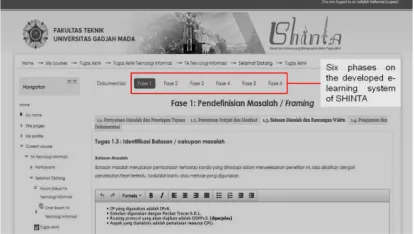
[image:2.595.305.512.510.627.2]For this research, we used e-Learning domain ontology for engineering activities which integrated to Moodle platform. We named the integration result as SHINTA. SHINTA has been created by integrating Fink’s Taxonomy, engineering design, and web semantic to assist undergraduate students performing their final project courses. Figure 1 shows the configuration of the main page of the developed e-learning system.
Figure 1: Developed E-Learning System of SHINTA Showing Six Subsequent Phases Created Based on The
Engineering Design Concept
each phase, the supervisor may provide feedback and comments on the tasks that have been presented by the students. Their explanations described as follows:
1) Framing.
2) Conceptual design. 3) Preliminary design. 4) Detailed design.
5) Analysis/Implementation. 6) Communication result.
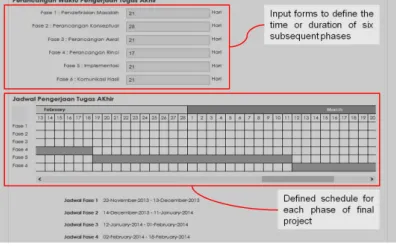
[image:3.595.88.286.366.489.2]Another beneficial feature of SHINTA e-learning system is its provided timeline for the student final projects. To keep the time in a tight schedule, the students need to plan and define the duration of each phase of their final project at the beginning of their researches (Figure 2). The students can monitor the deadline of each phase from their timeline. Thus, they will be more discipline in doing their final project.
Figure 2: Timeline of Each Phase on SHINTA
3.2 Evaluation of The Implementation
After programming and building the system, a human-system interaction research had been conducted to test the developed e-learning platform in terms of its function and effect. The participants of this research were eight engineering students from Department of Electrical Engineering and Information Technology, Gadjah Mada University in Indonesia, who took the final project course within a certain period (i.e., one year). Those students divided into two groups (i.e., the control and experimental groups). The first and second groups consisted of four students in each group, who were performing their final projects without and with SHINTA e-learning system, respectively. In this case, the same supervisor has been set to provide feedback of their reports.
The process steps grouped into eight sessions to finish the student final project. Correspondingly,
the classified two groups have to follow the different steps, which described as syllabi shown in Table 1. It can be obviously seen from the fifth session that the experimental group needs to fill student self-assessment, whereas, the control group is not necessary to perform that task. There are six aspects used to assess the performances of both control and experimental groups (i.e., application, human dimension, caring, learning how to learn, integration and foundational knowledge). Before and after final project (i.e., namely pre and post), the students had filled student self-assessment with same asked questions. Therefore, the difference values could be clearly seen in each aspect. Moreover, to investigate the speed of the activity, an additional aspect of the period of the final project also measured, which was calculated from the beginning of the final project proposal to the end of the research report.
Table 1: The Differences Between Control and Experimental Groups
Session Control group Experimental
group First −Filling student
self-assessment
−Discussing
proposal research
−Discussing with
lecturer (face to face) about problem,
objective, output, and problem limitation of research
−Filling student
self-assessment
−Discussing
proposal research
−Filling 1 st
phase (framing): defining problem, objective, output, and problem limitation of research
−Feedback from
supervisor and online discussion Second −Discussing with
lecturer (face to face) about theory analysis, question of research, and requirement analysis
−Filling 2 nd
phase (conceptual design): theory analysis, question of research, and requirement analysis
−Feedback from
supervisor and online discussion Third −Discussing with
lecturer (face to face) about preliminary design based on their research.
−Filling 3 rd
phase (preliminary design): each student designing this phase based on their research
−Feedback from
supervisor and online discussion Fourth −Discussing with −Filling 4
th
[image:3.595.303.516.370.741.2]lecturer (face to face) about detailed design based on their research.
(detailed design): each student designing this phase based on their research
−Feedback from
supervisor and online discussion Fifth −Continuing to
write the
document of the final project (include all things discussed with their supervisor).
−Filling student
self-assessment
−Continuing to
write the
document of the final project
Sixth −Discussing with
lecturer (face to face) about research analysis
−Filling 5 th
phase (research
analysis): each student designing this phase based on their research
−Feedback from
their supervisor
and online
discussion Seventh −Result
communication and presentation
−Documenting
hard files of the final project
−Filling 6 th
phase: result
communication and presentation
−Feedback from
supervisor and online discussion
−Documenting the
final project. Last −Filling student
self-assessment
−Filling student
self-assessment
4. RESULT
From the analyzed results concerning mean and standard deviation for both groups, their values can then be collected in Table 2(a). The six components of Fink’s taxonomy used as the main monitored aspects. Overall, the mean values of the experimental group were greater than those of the control group. However, for the investigated period of the final project, the mean of the group experiencing SHINTA e-learning system was slightly lower than that of the control group (Table 2(b)).
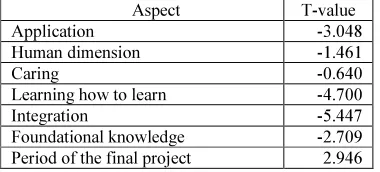
Nevertheless, to assure their validities, each measured value needed to be compared to distinguish the significant difference between those two groups. Therefore, in this case, T-test with confidence level of 0.05 was employed to test their significances. The critical value for alpha of 0.05 is ±2.353. The values located outside the critical area boundary are considered to be significant. All
analyzed aspects and their T-values listed in Table 3.
Table 2(a): Mean and Standard Deviation for Both Assessed Groups Before (Pre) and After (Post) Final
Project Termination
Category
Control Group (n = 4)
Experimental Group (n = 4)
Mean Std Mean Std
Pre
Application 72.500 2.313 77.188 7.373 Human
Dimension 78.125 4.732 80.625 8.260 Caring 76.875 1.250 81.500 1.000 Learning
How to Learn 71.250 7.500 77.500 5.000 Integration 60.000 0.000 57.500 6.455 Foundational
Knowledge 60.000 0.000 56.668 16.329
Post
Application 77.292 4.555 93.638 8.111 Human
Dimension 83.750 6.292 96.250 3.227 Caring 81.875 5.907 91.500 7.000 Learning
How to Learn 78.750 8.539 96.250 4.787 Integration 80.500 1.000 97.000 2.000 Foundational
Knowledge 80.500 1.000 97.665 2.262
Table 2(b):Mean and Standard Deviation for Both Groups in Terms of The Assessment Period
Category
Control Group (n = 4)
Experimental Group (n = 4)
Mean Std Mean Std
Period of the final project
[image:4.595.82.521.90.596.2]172.571 20.297 117.000 14.989
Table 3: T-value for each aspect based on Fink’s taxonomy
Aspect T-value
Application -3.048
Human dimension -1.461
Caring -0.640
Learning how to learn -4.700
Integration -5.447
Foundational knowledge -2.709
Period of the final project 2.946
Moreover, the explanations of each assessed category described as follows:
• For the aspect of application, the calculated
[image:4.595.88.315.107.523.2] [image:4.595.313.503.560.646.2]in the application aspect (proven from the significantly different values of two groups).
• Meanwhile, in human dimension aspect
investigation, the T-value between two groups is -1.461. As this value is inside the critical level boundary (insignificant), the method used on the experimental group has not offered significant improvement in human dimension aspect.
• Similar to the human dimension aspect, the
T-value of the caring aspect is also inside the critical level boundary (0.640). Thus, the experimental group is not significantly affected by the used method for caring aspect.
• However, for the aspect of learning how to
learn, its T-value is -4.700 which is in the outside critical level boundary. Thus, it can be concluded that the value between control and experimental groups is significantly different. In other word, there is a significant improvement because of the method implemented on the experimental group.
• Next, for the integration category, there is a
significant difference between the control group and experimental group. It is proven from its T-value, which located outside the critical level boundary (-5.447). Moreover, the significance (2-tailed) value of 0.012 is found from its characteristic, which is less than the significance level (< 0.05). Thus, the confidence level of this aspect can reach up to 98.8%, which is very high.
• The significant effect, which is occurring in
application, learning how to learn, and integration aspects are also experienced by the foundational knowledge aspect. Owing its T-value of -2.709, which is outside the critical level boundary, this aspect has significant improvement because of the method used in the experimental group.
• For the last investigated aspect (period of the
final project), it has been measured that the T-value is 2.946 (outside critical level boundary). Therefore, this aspect values are significantly different for two groups. From the obtained data, the required periods of final projects for students in the experimental group are shorter than those in the control group (the students with SHINTA e-learning system can finish the final project in more effective way). Furthermore, this aspect can also be viewed from its efficiency, which can be calculated by the difference of the obtained mean values. In this case, the efficiency for the final project period 32.2 %.
5. DISCUSSION
The original finding of this research is six phases on the e-Learning SHINTA. The first phase is framing, where the students should define their research problem, purposes, output, advantage, limitation, and timeline. The second phase is the conceptual design, where the students can explore the theory analysis, raised research questions and requirement analysis. The third phase is the preliminary design, where the students may create the design outline based on their researches. The fourth phase is the detailed design, where the students can put the detailed information on the previously designed outlines and be ready to do their research implementation. The fifth phase is research analysis, where the students have to analyze their experimental research results based on their research. The sixth phase is result communication, where the students can present their research analysis to supervisor and subsequently receive the feedback.
From the evaluations of the experimental results done by investigating their mean, standard deviation, and t-values for all aspects, it has been found that there are significant differences between control and experimental group on four aspects (i.e., application, learning how to learn, integration, foundational knowledge, and period of final project). Meanwhile, the aspects of human dimension and caring do not give significant influences to the experimental group.
These different phenomena can be attributed to several factors. In case of human dimension aspect, this study is investigating on how students interact with themselves and others. Therefore, the developed shinta e-learning system cannot affect directly on the student manners. As a result, it is reasonable when the final result of human dimension aspect in the experimental group (shinta users) is the same as that of in the control group (non-shinta users). Similar to human dimension aspect, the introduction of new e-learning system has not influenced the caring aspect. As a personal behavior, the students will have more energy and power to learn subjects when they care for them. However, the change of this human behavior type cannot be forced by the shinta e-learning system.
their purposes. Meanwhile, in learning how to learn aspect, they may design their future learning in a more efficient way. Furthermore, as viewed from the integration and foundational knowledge aspects, the students can integrate some necessary information and choose the foundational knowledge needed in their learning processes, respectively. As a result, regardless of some required improvements of the e-learning system (e.g., compatibility with other university systems and international language for foreign students), the currently developed shinta platform can be considered as one of the effective tools to further support and enhance engineering education in the university level, especially in Indonesia.
6. CONCLUSION
An engineering education based e-learning platform of SHINTA has been developed and evaluated by integrating Fink’s Taxonomy, engineering design, and web semantic for assisting engineering undergraduate students to finish their final project courses. Its implemented methods have successfully improved the student performances on four aspects (i.e., application, learning how to learn, integration, and foundational knowledge). Moreover, this developed system proved can shorten the required time from average 172 days to 112 days for the students to accomplish their final project mission. After several feasible improvements of the system development, this platform has potential to be further utilized not only for engineering Indonesian students, but also other foreign students with different major fields of study.
REFERENCES:
[1] Berndtsson, M., Hansson, J., Olsson, B., Lundell, B, “Planning and Implementing your Final Year Project — with Success!: A Guide for Students in Computer Science and Information Systems”, Springer, X, 152 p, 2002.
[2] Educational Technology Division, Ministry of Education, Project-Based Learning Handbook: Educating the Millennial Learner, Kuala Lumpur, Malaysia, 2006.
[3] Fink, L., “Creating Significant Learning Experiences : An Integrated Approach to Designing College Course”, San Fransisco, CA: Jossey-Bass, 2003.
[4] Welsh, E.T., Wanberg, C.R., Brown, K.G., Simmering, M.J, “E-learning: emerging uses,
empirical results and future directions”,
International Journal of Training and
Development, 7(4), 2003, 245–258, doi:
10.1046/j.1360-3736.2003.00184.x.
[5] Dym, C., Agogino, A., Frey, D., Eris, O., and Leifer, L., “Engineering Design: Thinking, Teaching, and Learning”, Journal of
Engineering Education, 2005.
[6] Ruiz, J.G., Mintzer, M.J., Leipzig, R.M, “The Impact of E-Learning in Medical Education”,
Academic Medicine, 81(3), 2006, 207 - 212.
[7] Dietinger, T., “Aspects of E-Learning Environtments”, Dissertation for the Award of
the Academic Degree, Graz University of
Technology, Austria. Austria, 2003.
[8] Snae, C. and Brueckner, M., “Ontology-Driven E-Learning System Based on Roles and Activities for Thai Learning Environment”,
Interdisciplinary Journal of Knowlegde and
Learning objects, 2007.
[9] Errington, J.J., “Continuity and Change in Indonesian Language Development”, The
Journal of Asian Studies, 45(02), 1986,