572
MICROCONTROLLER BASED WALKING ROBOT WITH
MULTI-DEGREES OF FREEDOM MOVEMENT
1HASRUL CHE SHAMSUDIN, 1MOKHTAR HASHIM, 1ERNA NOORYANTI AZMI,
2
ANTON SATRIA PRABUWONO
1Electrical Engineering Department, Politeknik Sultan Haji Ahmad Shah,
Semambu, 25350 Kuantan, Pahang Darul Makmur
2Faculty of Information Science and Technology, Universiti Kebangsaan Malaysia,
43600 UKM Bangi, Selangor Darul Ehsan
E-mail: [email protected] , [email protected]
,
1[email protected] ,ABSTRACT
In designing a walking robot, a power supply issue must be considered which is the required power to generate movement of the joint using a servomotor and the required of a suitable algorithm to enable the robot to move. In addition, the use of suitable devices to allow users to move the robot also should be considered. The objectives of this study is to develop the walking robot using minimum number of servomotor. The minimum number of servomotor allows the walking robot to minimize the power consumption while construct a program that can produce coordination of multi-degree of freedom for the movement of the robot. The project also tried to use PS2 joystick to allow users to control the robot forward or backwards and turn the robot to the left or right. The parameters studied include determination of the minimum voltage amount required to sustain the burden of the output which are servomotors used. Besides that, servomotor rotation angle at each joint in order to move the robot's feet and the use “USART” protocol to allow the microcontroller to communicate with a PS2 joystick driver circuit. It is found that four servomotors are sufficient to produce the basic walking robot and two voltage regulators are needed to control the load where one voltage regulator capable of supplying enough current to drive two servomotors for each leg.
Keywords: Biped Robot, USART Protocol, Microcontroller, Servomotor
1. INTRODUCTION
Robot has the ability to perform repetitive, boring and dangerous tasks. Many large and fixed robots had been used in industries to replace human workers to increase production and so on. Robot that can move freely is needed to enable multitasking when navigating the working area. Some problem faces by mobile robot are power supply and control system must be with the robot. Mobile robot reliable path planning also required to enables the robot to move and become a major challenge in this field of study. Additionally, human movement like robot is needed to enable the robot to works in the human environment. Therefore, legged robots should be used instead of conventional wheeled robot. Legged robot should be able to change form while navigate like human escort the body to go through small area. Legged robot is usually less efficient in electricity
consumption compared to wheeled robots.
However, the study of legged robot can offer
significant benefits, especially if remaining
obstacles can be overcome.
573 needs because the biped robot only have simple walking sequence when there are signal from the user to move forward, backward, right or left. The objective of this study is to determine the least number of servomotor to allow the robot walks to
minimize the power consumption. Simple
programming will be develop that can produce coordination of multi – degree of freedom for the movement of the robot. The program also enable the microcontroller used to communicate with PS2 joystick which allows users to control the robot forward or backward and turn the robot to the left or right. Parameters of the study divided into three main sections. Firstly, the physical design of the robot legs that allow the robot to move forward, backward, right or left. Robot walks with simple movement which achieved by simple programming based on tuning the angle of each servomotor manually for robot direction without using any sensors and modern controller algorithm. Four servomotors used where two servomotors for each leg to minimize the power consumption. PS2 joystick is used to transmit wireless signals to the microcontroller using USART protocol.
This paper describes the developments taken in implementing a reliable hardware base. This section presents the motivation behind building biped robots, reviews the history of the biped project, and explains the specific aims of this research. Section 2 then reviews some of the current ideas and techniques used in designing and constructing biped robots. Section 3 describes the development of the hardware platform and highlights the software developments, covering the topics of mechanical design, controller circuit including power supply issue, USART protocol and software design. Section 4 examines the results obtained from the research. Section 5 provides a review of the tasks completed and offers suggestions to possible future work.
2. RELATED WORK
There are different types of mobile robots which can be divided into several categories consists of wheeled robot, crawling robot and legged robot. Legged type robot is a robot with its own advantage over other types of mobile robot where legged robot can be used in variety environments. Legged robot has jointed configuration that consists of some degree of freedom. So that it is difficult to develop legged robots that can be used for practical applications. Legged robot can be divided into biped robot and multi-leg robot which is odd number of legs or even number of legs robots.
Less study was done related with odd legged robot movement compare to even legged robot due to several factors. Even legged robot movement is easier to develop by observing the movement of insects while there are no sample can be used for odd legged robots development. Insect movement can be used as a model for legged robots since insect movement can be concluded will produce very stable gait. Insect movement cannot be equated with odd legged robot because there are no insect which move stable with odd legs [5]. Related studies about hexapod robot gait had been
discussed through biological observation.
Reference [6] explains that the hexapod robot still can move even though one leg does not function because the balance of the robot can still be maintained due to static stability. However, to maximize the static stability, the study for five legs gait is required. They introduce method for five legged robot to consider a case when one of the hexapod robot leg malfunction. To maintain
stability during movement, hexapod robot
configuration change into the pentagonal shape is proposed in the study.
Nowadays, studies had been carried out for five legged robot are not only based on the hexapod robot with one leg malfunction but also from nature based such as idea from starfish [7]. Reference [8] focused Brittle Star to develop flexible myriapod robot. They develop a five legged robot that can move forward. In addition, the synchronized motion is also very important for multi-leg robots. This study proposes synchronous movement method that utilized the idea of autonomous distributed systems. There are also other studies that discuss the methods used to develop a multi-leg robot such as Reinforcement Learning of Walking Behavior [9] for a four legged robot and Distributed Reinforcement Learning [10] for a hexapod robot to walk. Most of the proposed methods use the degree of freedom tuning as the main parameter for robot to move.
574 [11] focuses on the passive dynamic walking to enable a biped robot on level ground to walk efficiently with simple mechanism. They propose the level-ground walking by controls the robot torso during the leg swinging process. Leg swinging is controlled depending on the current robot stance. This study also analyses the stability of the biped robot to demonstrate the effectiveness of the proposed method. A study from [12] addresses the problem of energy-optimal gait generation for biped robots. They study a complete gait cycle comprising single support, double support and the transition phase. The energy optimal gaits for each phases is compared to normal human gait. A study about feedback controller for asymptotically stability was done by [13]. Several strategies had been explored to achieve the stability which are imposing a stability condition during the search of a periodic gait by optimization, uses an event-based controller to modify the eigenvalues of the (linearized) Poincare map and the effect of output selection on the zero dynamics. There are paper about optimization of dynamic gait for small bipedal robots [14] which discusses the parameters that effect dynamic gait and how these effects will be implemented in a servo skeleton robot.
Most of this studies use more than six servomotors to develop walking robot. Actual study is now taking place on the biped robot with smaller number of servomotors to achieve the stated objectives.
3. SYSTEM DESIGN
A. Mechanical Design
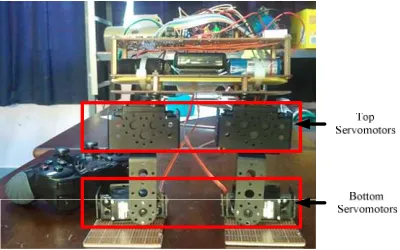
Walking is the main task to be performed by this robot. After getting the signal from the user, the robot will walk forward, backward, left or right. In other words, developed robot leg design should have features that enable the robot walk in four directions without falling. The design used in the robot leg is generated based on the concept of sumo wrestlers and the mechanical model of the robot consists of four servomotors as shown in Figure 1.
To move the robot, four servomotors will rotate independently to different angle where each leg has two DOF as shown in Figure 2. To enable the robot walk, one servomotor at the bottom will rotate so that the robot will be stiff a little. Then, both of the servomotors at the top will rotate simultaneously at a certain angle to move the robot body.
Figure 1: (L) Sumo Wrestler (R) Robot Mechanical Model
Figure 2: Robot Fabricated Model
B. Actuators
[image:3.612.318.518.225.350.2]575
Figure 3: Cytron C36R Servomotor
C. Microcontroller
Figure 4: PIC16F628A Control Circuit
The PIC16F628A circuit used to control the robot operation. Information from the button of the PS2 joystick will be processed by the microcontroller to determine whether the robot will move forward, back, right or left as shown in Figure 4. Two sources used to supply the control circuit and four servomotors (not shown). For the load, two LM7805 IC regulator is used where one regulator only can support two servomotors. Using three or more servomotors causes no rotation will be produced.
D. PS2 Joystick
[image:4.612.95.300.255.420.2]PS2 joystick will be used to control four servomotor walking robot through SKPS driver as shown in Figure 5. There are 16 buttons that can be used as input button to send signal to microcontroller. Beside that, there are two motors in the PS2 joystick that could be used as the alarm or indicator for the user. Nevertheless, only four buttons are used in this project. SKPS driver communicate with microcontroller using USART communication through transmit and receive pin.
Figure 5: Wired PS2 Joystick
E. Software Framework
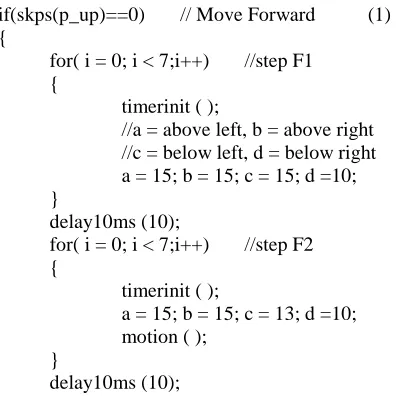
A brief overview of the software function and the system architecture is shown in Figure 6 to clarify the cyclic phase rotation for robot movement. From the flowchart, the calling sequence and the relationship between the functions are visualized. The flowchart for forward movement started with initializes the register involved in reading the PS2 joystick buttons and controls the rotation of the servomotors. Then, the servomotors will be calibrated to the initialize angle so that the robot will stand upright. If the UP button is pressed, the robot will start to move forward until the UP button is released. After the forward movement is completed, the robot return to the stand upright position and ready to move in other directions if there are signal received from the user. TIMER1, TIMER2 and INTERUPT functions had been used to control the angle of servomotors using PWM signal. The PWM signal will be send to four pins which connected to servomotors depend on desired angle. To enable robot walk for a single step, ten PWM values will be set in sequence. The following psuedocode is a sample to set the pulse value to each pin.
if(skps(p_up)==0) // Move Forward (1) {
for( i = 0; i < 7;i++) //step F1 {
timerinit ( );
//a = above left, b = above right //c = below left, d = below right a = 15; b = 15; c = 15; d =10; }
delay10ms (10);
for( i = 0; i < 7;i++) //step F2 {
timerinit ( );
a = 15; b = 15; c = 13; d =10; motion ( );
}
[image:4.612.328.526.529.735.2]576
Figure 6: Flowchart for the Forward Movement Process
4. RESULTS
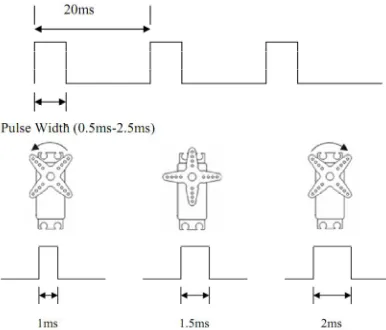
This section discusses the resulting angles to allow the robot walk forward when the UP button on the PS2 is pressed as shown in Table 1. The movement is basiccally by rotate the servomotors which act as a leg joint. The angle is determined by the duration of pulse that is applied the signal wire of servomotor. The servo expects to see a pulse every 20 ms. The length of the pulse will determine the servomotor angle. For example, 1.5 ms pulse turns the servomotor to 90 degree position (neutral position). Another correspondence pulse width and the servomotor angle is shown in Figure 7. When the button is pressed once, the robot will move forward only for a single step. Ongoing movement can be accomplished by continuously press the button.
[image:5.612.322.515.381.546.2]577
Table 1: Walking Forward Analysis
Sequence Values
Above Left Servomotor
Above Right Servomotor
Below Left Servomotor
Below Right Servomotor
1 1.5 ms 1.5 ms 1.5 ms 1 ms
2 1.5 ms 1.5 ms 1.3 ms 1 ms
3 1.9 ms 1.9 ms 1.3 ms 1ms
4 1.9 ms 1.9 ms 1.3 ms 1.5 ms
5 1.9 ms 1.9 ms 1.5 ms 1.5 ms
6 1.9 ms 1.9 ms 20 ms 1.5 ms
7 1.9 ms 1.9 ms 20 ms 1.7 ms
8 1.1 ms 1.1 ms 20 ms 1.7 ms
9 1.1 ms 1.1 ms 1.5 ms 1.7 ms
10 1.1 ms 1.1 ms 1.5 ms 1.5 ms
5. CONCLUSION
From this study, a walking robot that achieved the stated objectives had been developed. This robot is able to produce the basic walking movements using four servomotors. The issue of power consumption had been solved using the techniques of current division at the IC regulators. This robot is also able to communicate with users via a signal sent through a wireless PS2 joystick. The biped robot enable to walk in four directions using a simple algorithm when the user push the PS2 joystick button. However, the robot tends to go to the right direction while walking forward since the right side of the robot is heavier and there is no feedback from sensor used. Users need to manually adjust the robot direction while the robot walking. For future works, some improvements can be made by adding several funtions to the robot due to the available buttons on the PS2 joystick. Besides that, the use of microcontroller with bigger program memory is suggested since the current program was about sufficient to the memory in PIC16F628A. Sensors application also essential to enables the robot to functions more intelligent.
ACKNOWLEDGMENT
The authors would like to thanks Universiti Kebangsaan Malaysia for providing financial support under grant no. PTS-2011-504.
REFERENCES:
[1] Sung-Nam O., Sung-Ui L., and Kab-Il K., “Design of a Biped Robot Using DSP and FPGA”, International Journal of Control,
Automation, and System, Vol. 1, No. 2, 2003,
pp. 252-256.
[2] H. Wongsuwarn, and D. Laowattana, “Neuro-Fuzzy Algorithm for a Biped Robotic System”,
World Academy of Science, Engineering and Technology, Vol. 15, 2006, pp. 138-144.
[3] M. C. Lam, A. S. Prabuwono, H. Arshad, C. S. Chan, “A Real-Time Vision-Based Framework for Human-Robot Interaction”, IVIC 2011, 7066
Lecture Notes in Computer Science (Part 1),
2011, pp. 257-267.
[4] T. Ishida, and Y. Kuroki, “Sensor System of a small Biped Entertainment Robot”, Advanced
Robotics, © VSP and Robotics Society of Japan,
Vol. 18, No. 10, 2004, pp. 1039-1052.
[5] Inagaki K., “Gait Study for Hexapod Walking with Disable Leg”, International Conference on
Intelligent Robot and Systems, Vol. 1, 1997, pp.
408-413.
[6] Inagaki K., and Kobayashi H., “Adaptive Wave Gait for Hexapod Synchronized Walking”,
Proceedings IEEE International Conference on Robotics and Automation, Vol. 2, 1994, pp.
1326-1331.
[7] A. R. A Besari, R. Zamri, A. S. Prabuwono, and S. Kuswadi, “The Study on Optimal Gait for
Five-Legged Robot with Reinforcement
Learning”, Intelligent Robotics and
Applications, Vol. 5928, 2009, pp. 1170-1175.
[8] Maikoto T., Koji Y., and Satoshi E., “Studies on Forward Motion of Five Legs Robot”, Journal Code: L0318B 2005, 2P1-S-065, 2005.
[9] Kimura H., Yamashita T., and Kobayashi S., “Reinforcement Learning of Walking Behavior
for a Four-Leg Robot”, Proceedings of the 40th
IEEE Conference on Decision and Control,
578 [10] Y. Zennir, P. Couturier, and B. M. Temps,
“Distributed Reinforcement Learning of a
Six-Legged Robot to Walk”, Proceedings of the 4th
International Conference on Control and Automation, 2003, pp. 896-900.
[11] T. Narukawa, M. Takahashi, K. Yoshida, “Stability Analysis of a Simple Active Biped Robot with a Torso on Level Ground Based on Passive Walking Mechanisms”, (Humanoid
Robots: Human-Like Machine edited, Book by: Matthias Hackel), Journal Code:
978-3-902613-07-3, 2007, pp. 642.
[12] L. Roussel, C. Canudas-de-Wit, and A. Goswami, “Generation of Energy Optimal Complete Gait cycles for Biped Robots”,
Proceedings of the IEEE International
Conference on Robotics and Automation, Vol.
3, 1998, pp. 2036-2041.
[13] Chevallereau C., Grizzle J. W., and Ching-Long S., “Asymptotically Stable Walking of a Five-Link Underactuated 3D Bipedal Robot”, IEEE
Transactions on Robotics, Vol. 25, Issue 1,
2009, pp. 37-50.
[14] P. Gibbons, M. Mason, A. Vicente, G. Bugmann, and P. Culverhouse, “Optimisation of Dynamic Gait for Small Bipedal Robots”,