TACIT KNOWLEDGE ELICITATION THROUGH CONCEPT
LATTICE
1K.KALAISELVI, 2ARAVIND GOVINDARAM, 3G.V.UMA
1
Teaching Assistant, Anna University, Department of Mathematics
2
Research Scholar, Anna University, Department of Information Science and Technology
3
Professor, Anna University, Department of Information Science and Technology
E-mail: [email protected], [email protected], [email protected]
ABSTRACT
The main objective of this proposed work is to prove that knowledge dissemination can be better done through concept lattice. The database management system learning content is stored in the formal concept analysis (FCA). The formal concept analysis helps to construct the concepts together through which the information drawn quickly. The concepts are built in the form of concept lattice. The subject matter experts (SME) can append the learning content using the incremental method on formal concept analysis. The proposed work helps to impart the knowledge to the learners in quick time. The learner’s knowledge can be observed and evaluated using the Bloom’s taxonomy parameters. The proposed system helps in the reusability of information.
Keywords: Concept Lattice, Formal Concept Analysis, Concept Analysis, Knowledge Extraction, Knowledge
Transfer
1.
INTRODUCTIONKnowledge management aims to explore organizations information for greater productivity, new value and increased competiveness (N.J.Davies & R. Weeks, 1999). Concept lattice is the core of formal concept analysis which gains knowledge and keeps updated information in the knowledge-based systems. The FCA is basically used to extract all concepts from a given formal context. The data structure for description of the concepts and their partial order relations is concept lattice (Chunzhi XIE et al, 2011).
Concept lattices have proven useful in many
applications viz., knowledge representation
(kalfoglou et al, 2004), information retrieval (carpineto & Romano, 2004), software engineering (smelting & Tip, 1998), concept lattices have applications in gene-expression analysis (Choi et al, 2007).
A formal concept analysis describes the relations between objects and their attributes. Concept lattice theory focuses how to construct efficient concept lattices. The application of concept lattice focuses on how to apply the concept into the fields such as data mining, knowledge discovery and decision support (Chunzhi XIE et al, 2011).
This proposed work explains how to find the relationship among the concepts, using the Formal concept analysis. The concept lattice helps to find the relationship among the concepts at each and every level, using the incremental approach. The similarity in the concept relationships can be rectified, using the sprouts algorithm (Vicky Choi 2006).
2.
RELATED WORKKrohn (1999) explains how to support the acquisition of new knowledge, and to enhance the interaction between knowledge workers. It explains how the sharing of retrieval terms with members of the communities of practice is facilitated. The concept lattice uncovers relational and contextual information and facilitates the sharing of the retrieved vocabulary to support the acquisition of new knowledge and to enhance the interaction within the Communities of Practice (CoP)
Stumme (1998) explains how the concept lattice aims to support specifications of less rigorous relations, or associations, which might be more intuitive to the knowledge workers, and lead to more interesting links via associations.
keeps it up to date in the knowledge based system. Mutated concepts from the process reflect fundamental changes, which can be helpful in decision making. Evolution - based concept lattice (ECL) achieves efficiency of prediction. Based on the suitable context provided, knowledge based system, and web like system is to provide
computer-aided decision support Enhanced
retrieval process is done through concept lattice. In the proposed work, provides the increased transparency of knowledge discovery process and documented at different stages. The model is designed for knowledge elicitation. It explains how knowledge structure is grown as new attributes or observations are made. In this approach, knowledge structure is fixed with the same set of attributes. The FCA exemplified the percentage of tacit knowledge shared and codified among the learners.
New concept in the concept lattice diagram is appended after the verification of similarities in the concept. In concept lattice diagram, comparing all the seven levels the common attributes found are definition, illustration and do it yourself. The objects and attributes are fixed in all the learning content stored. If needed, the attributes are added to the concept lattice. Knowledge structure need to be reorganized based on the stored learning content. In the proposed work, concept lattice is bottom up approach and levels are created based on the number of attributes combined.
3.
FORMAL CONCEPT ANALYSIS (FCA)The formal concept analysis aims to extract all concepts from a given formal context; it finds all the relations and represents them graphically. It describes the relations between objects and their attributes. The FCA (Ganter and Wille 1999) studies the hierarchical structures represented by a binary relation over the couple of sets O (objects) and A (attributes). The FCA can be implemented to find the relationship between the documents and retrieval terms, done by the communities of people. In the FCA framework, the binary relation is given by the object-to-attribute matrix of its incidence relation I, called (formal) context. The FCA can be applied in the fields of data mining, text mining,
machine learning, knowledge management,
semantic web software development and biology.
A formal context is defined (Bernhard and Rudolf 1999) as a triple k = (O, A, I) where ‘O’ and ‘A’ are sets (objects and attributes respectively),
and I is an incidence relation, that is
I
⊆
O
×
A
.Based on the above definition, considering the DBMS course content, and the FCA framework, the objects are denoted as O1 through O9 and attributes from a through i. The set of objects O and the attributes A are denoted as
O = {O1, O2, O3, O4, O5, O6, O7, O8, O9} and A = {a, b, c, d, e, f, g, h, i}
3.1 Construction of FCA for the DBMS Course
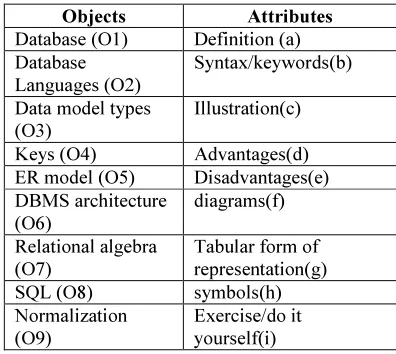
Consider the data base management systems’ course learning content stored in the k-base. The learning content is organized with the objects referred to as database, database languages, data model types, keys, ER model, DBMS architecture, Relational algebra, SQL, and Normalization. The attributes defined for the respective objects are
definition, syntax/keywords, illustration,
[image:2.595.315.513.443.620.2]advantages, disadvantages, diagrams, tabular form of representation, symbols, exercises/do it yourself. The binary relation R between O and A, is shown in Table 1 below. ‘1’ in the table indicates that the (row, column) pair is present, and ‘0’ in the table indicates the absence of concepts (row, column) in the relation. The objects and attributes are assigned as following in the FCA framework.
Table 1: Formal Concept Analysis Notations for The Binary Relation
Objects Attributes
Database (O1) Definition (a)
Database Languages (O2)
Syntax/keywords(b)
Data model types (O3)
Illustration(c)
Keys (O4) Advantages(d)
ER model (O5) Disadvantages(e)
DBMS architecture (O6)
diagrams(f)
Relational algebra (O7)
Tabular form of representation(g)
SQL (O8) symbols(h)
Normalization (O9)
Exercise/do it yourself(i)
This provides the relationship among the different objects based on the different set of attributes. This helps to get a better knowledge about the learning content for the knowledge seekers
Table 2: Binary Relation With The Ninth Concept Normalization
Objects \Attributes
Database (O1)
1 0 1 0 0 0 0 0 0
Database Languages
(O2)
1 1 1 0 0 0 1 0 1
Data model types (O3)
1 0 1 1 1 0 1 0 1
Keys (O4) 1 1 1 0 0 0 0 1 1
ER model (O5)
1 0 1 1 1 1 0 1 1
DBMS architecture
(O6)
1 0 0 1 1 1 0 0 0
Relational algebra (O7)
1 1 1 0 0 0 1 1 1
SQL (O8) 1 1 1 0 0 0 1 0 1
Normalization (O9)
1 0 1 1 1 0 0 1
3.2 Appending Concepts Using the Incremental Approach
In the theory of formal concept analysis there are limitations, where the elements in the objects and attributes set are fixed. The relation R between the object and attributes are fixed. In order to construct the concept lattice, R is processed between O and A. If the new concept has been introduced, then a new row can be appended in the FCA framework.
An iterative approach using the incremental algorithm is incorporated to build the lattices. In order to overcome the limitations in the formal concept analysis, in which R is fixed and processed, is considered as a stream relation. Using this incremental approach, each row can be added according to the concept added at that moment. The lattice diagram is changed according to the addition of rows in the FCA framework. This approach is possible because the lattice possesses the monotonicity property; that is no concept is removed from the lattice. This approach is introduced by Robert et al(1995)
Using the incremental approach in the formal concept analysis, the concepts can be appended in the learning content created by the subject matter experts. In future, if the concepts are to be included in the DBMS course content, then it can be appended using the incremental approach without any major changes in the concept lattice structure.
4.
CONSTRUCTION OF THE CONCEPTLATTICE USING THE FCA
There are many ways to compute and construct the concept lattice from the binary table. It is grouped under two categories, namely, procedures to extract only the set of concepts (Noris 1978 and Ganter 1984), and concepts are considered together to construct the entire lattice (Bordat 1986; Godin et al 1995 and Nourine and Raynaud 1999). The resultant ordered set of all formal concepts together, forms the complete lattice referred to as the concept lattice.
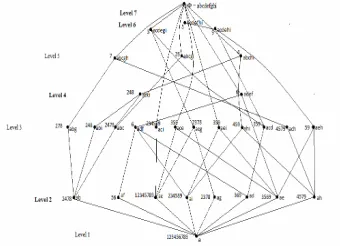
In the proposed work, the procedure is followed to extract the set of concepts and to find the relationship among the concepts found at each level. The concept lattice diagram is drawn, based on the combination of attributes found in the database management systems course content FCA framework. The diagram consists of seven levels; each level explains about the combination of attributes, based on their objects.
4.1 Levels of the Concept Lattice for the DBMS Course
At level 1, it explains the relationship between all the objects with one attribute, say the definition. In the level 2, it explains the relationship that exists between all the nine objects with the two different combination attributes. At level 3, it explains the
three different attributes grouped together
associated with the nine objects.
At level 4, a combination of the four attributes is grouped with the nine objects in the database management systems course content. At level 5, a combination of five attributes is associated with the nine objects. In the level 6, six attributes are associated with the nine objects. Finally at the level 7, it is grouped with seven attributes and nine objects. At the top of the node, it is referred to as
[image:3.595.319.489.576.699.2]the empty set assigned with the null value ‘ϕ’.
4.2 Appending the Attributes to the Universal Set
Let the attribute A be expanded incrementally to build a concept lattice as the universal attribute. Consider a knowledge structure for the DBMS course to cover the possible concepts. The closure
axiom defined as
A
⊆
γ
(
A
)
is applied tothe entire universal attribute A, and for any relation R, the set containing all the attributes must be closed.
The set ‘universe’ attribute is started with the introduction of one concept, in order to overcome the changing covering concepts. Let us consider the first row in the DBMS course content FCA
framework as
O
×
A
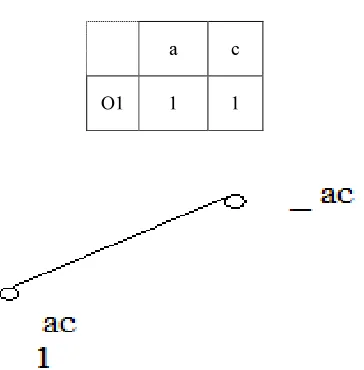
. The concept latticediagram is given below along with the FCA for the first row. The value of ‘1’ represents the presence of the attribute corresponding to the object. The
[image:4.595.324.492.307.473.2]value for _ac is assigned as a null value that is ‘ϕ’.
Table 3: Formal Concept Analysis for the DBMS Course Content with Single Row
Figure 2: Concept Lattice after Adding the first row in the DBMS Course Content
After adding the second row O2 the attributes corresponding to O2 are ‘abcgi’. The value of ‘1’ in the FCA framework of DBMS course content implies the presence of the attribute with respect to the object in the row. The value of ‘0’ implies the absence of the attribute with respect to the object in the row. The value of _ abcgi is assigned with a null value ‘ϕ’.
In the concept lattice, after adding the second row that is in this frame work the second row is referred to as the database languages. The figure implies the relationship between the objects
databases (O1) and database languages (O2) by having common attributes as ‘a’ and ‘c’, that is,
definition and illustration. The additional
information found in the database languages is syntax/keyword, tabular form of representation and exercise/do it yourself; i.e. the attribute ‘bgi’. Thus, the procedure follows with the introduction of new objects in to the DBMS course content of the FCA framework.
Corresponding to the FCA framework the concept lattice diagram is changed. The common attributes among the objects are identified and similarities are eliminated appropriately.
Table 4: Formal Concept Analysis for the DBMS Course Content with Two Rows
a b C g i
O1 1 0 1 0 0
O2 1 1 1 1 1
Figure 3: Concept Lattice after Adding the Second Row in the DBMS Course Content
5.
INTRODUCTION OF A NEW CONCEPTIN THE KNOWLEDGE STRUCTURE
Over a period of time, there is a necessity to update the learning content which is stored in the knowledge base. The subject matter experts (SME)
make a new observation On , where n is a new
observation made in the learning content of the particular course, say the database management systems. The SME decides whether the new
observation can be updated in the
k-base or not. The new observations are decided,
based on the condition for each
x
∈
A
whether Oncontains
x
. If the condition is true and valid, thenOn is inserted into the knowledge structure.
While inserting a new observation, it is verified whether it is new or a similar one, based on the
condition
O
.
α
=
O
.
α
j
n for some
O
j alreadypresent in the knowledge structure. This implies that the resultant knowledge structure does not have
a c
[image:4.595.95.277.389.574.2]any redundancy in the diagram, after the insertion of a new attribute in the diagram.
5.1 Elimination of Similarity Measures in the Concepts Relationship
Three procedures are involved in the efficient processing of a concept to be placed in the concept lattice, which is adapted from Vicky Choi. The following are the list of procedures to be followed to get efficient information retrieval.
1. To compute child (obj(X), X) in
(
∑
)
∈obj(X)
a
nbr
(
a
)
O
time it is referredto as Sprout (Vicky choi). This is expressed in the Lemma (Vicky Choi) as For (obj(X), X) ∈ B, it takes
O
(
∑
a∈obj(X)nbr
(
a
)
)
tocompute child (obj(X), X) where obj(X) is the objects, and ‘a’ is the attribute in the objects, and nbr is the neighbor list of each attribute in the concept lattice
With respect to the DBMS course content, the obj(X) is the objects available in the entire course content. The attribute ‘a’ is the attributes in the course content(X). The ‘nbr’ is the neighbor list for each attribute present in the concept lattice diagram of DBMS
course content. Each object a ∈ obj(X) is
scanned through the entire concept lattice, and each attribute i in its neighbor list nbr
(a), append ‘a’ to the set Ei
2. For s ∈ AttrChild(X), test if XS is closed
based on the proposition if and only if, if
there exists T∈ AttrChild(X), T ≠ S,
such that Obj (XS)
⊂
Obj (XT).Furthermore,
∀
T ∈ AttrChild(X) with obj(XS)
⊂
obj (XT), there existsS
′
∈AttrChild(XT) such that S ⊆ S′,
)
S
XT
(
obj
)
XS
(
obj
⊂
′
andS
XT
XS
⊂
′
. Hence, the sprout algorithmis quick.
3. Testing the existence of C by testing the
existence of obj(X) or X
Let C= (obj(X), X) be uniquely determined by its extent obj(X) or its intent X. Therefore, either to store the object sets or attribute sets generated so far in a number of trials and then, test the existence of C by testing the existence of obj(X) or X
The Sprout algorithm (Vicky choi) is given below. 1. for each i
∈
K, set Ci = φ2. for a
∈
C do 3. for i∈
nbr(a)/{s} do 4. Append a to Ci;5. end for 6. end for
The following takes O(∑ a
∈
c | nbr(a)|)time.7. Initialize a local tries TC over objects;
8. for i
∈
K do9. if Ci does not exist in TC then
10. insert Ci into TC;
11. Si = content(i);
12. else
13. Merge Si with content (i);
14. end if 15. end for
[image:5.595.307.500.95.477.2]16. Output all the pairs in TC:{ obj(XSj),Xsj):1 ≤ j ≤ t }
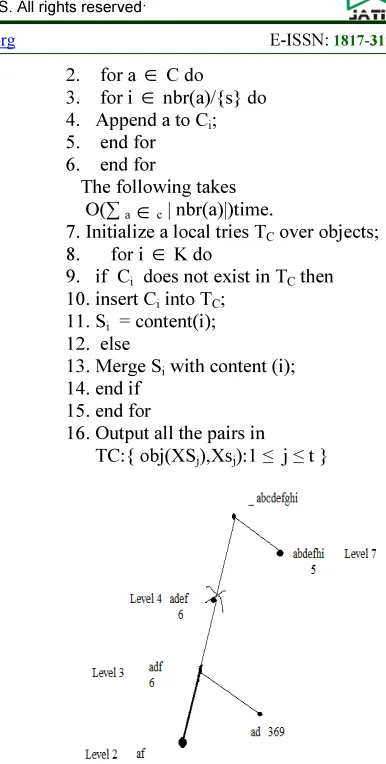
Figure 4: Elimination Of The Redundant Atribute In The Concept Lattice
Let us consider levels 7, 4, 3 and 2, in the concept lattice diagram, which is represented below. The redundant attributes found in the diagram are ‘adf’ at level 3 and ‘adef’ at level 4. The sub levels present at level 3 include the attributes of definition, advantages and diagrams. The attributes found in the level 3 cannot be deleted, and hence, using sprout the ‘adef’ which is found at level 4 includes the attributes definition, advantages, disadvantages and diagrams can be eliminated from the diagram. Thus, the similarities are removed from the entire concept lattice diagram, as the concepts are appended in the future.
5.2 Knowledge Acquisition from K-Store
performance acquired by the knowledge seekers can be evaluated, based on Bloom’s taxonomy.
The questionnaires are prepared by the SME and the queries are answered by the knowledge seekers. The knowledge acquired by the knowledge seekers is recorded. With respect to the scores acquired by the knowledge seekers the knowledge level can be measured.
The sample questionnaire is prepared, based on Bloom’s taxonomy is given below. The general list of questions is provided to evaluate the learner’s knowledge are:
1. Define the term concepts O1, O2,
O3….O9.
2. List the main concept found in any of the
specific concept O1/O2/…/O9.
3. Comparative study of all the observations.
4. Identify the important notion in the
specific concept.
5. Discuss any of the observations with
illustrations.
6. In what innovative way can the
concepts/observations be implemented in real time applications?
7. Relate the concepts to the current trend
technology.
8. Examine the observations and find the
relationship among them,
9. Based on the existing learning content
provided, construct an innovative learning content for the same learning material? 10. Analyze the concept with illustrations/real
time applications.
The above questions will help to assess the students’ performance, to be evaluated by the SME’s and marked on the score board. The groups are created with 25 students in a group, and the total is strength of 250 students.
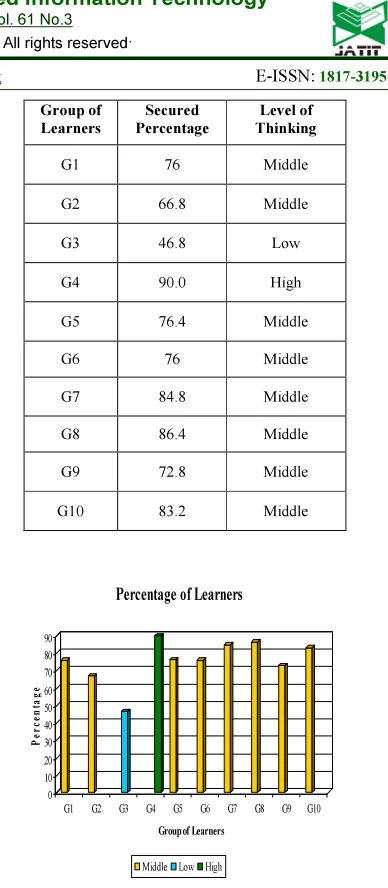
Based on the percentage, the level of thinking is identified with the range of values as low level thinking below 50%, middle level thinking between 51% and 89%, and high level thinking from 90% to 100%.
[image:6.595.314.508.77.521.2]The below table provides details about the marks secured by the learners in the different groups according to the level of thinking. The knowledge gained by the learners can be assessed using Blooms’ taxonomy parameters, categorized into low level thinking and high level thinking. Based on these parameters the marks are given.
Table 5 : Percentage of the Learners Based on their Thinking Level
Group of Learners
Secured Percentage
Level of Thinking
G1 76 Middle
G2 66.8 Middle
G3 46.8 Low
G4 90.0 High
G5 76.4 Middle
G6 76 Middle
G7 84.8 Middle
G8 86.4 Middle
G9 72.8 Middle
G10 83.2 Middle
0 10 20 30 40 50 60 70 80 90
P
e
r
c
e
n
ta
g
e
G1 G2 G3 G4 G5 G6 G7 G8 G9 G10
Group of Learners Percentage of Learners
Middle Low High
Figure 6: Performance of the Student’s Level of Thinking
6.
CONCLUSIONThe proposed research work helps to provide the learning content to knowledge seekers, based on their knowledge level selection. The K-create process can be done through the formal concept analysis structure. The relation between the concepts can be viewed in the diagram. Further, the concepts can be appended in future.
[image:6.595.328.482.375.517.2]The technique of concept lattice helps the learners and the SME to share and transfer the knowledge. Thus, knowledge sharing is done among the learners. The proposed work is applicable in the field of education, business strategy, and information technology.
REFERENCES:
[1] Abraham Silberschatz, Henry Korth and
Sudarshan S, “Database System Concepts”, McGraw-Hill, New York, Fifth edition,
[2] Ben Tagger, “An Enquiry into extraction of the
implicit knowledge”, IMR Assignment 3, pp
1-7, 2005.
[3] Christopher M.Taylor.,“A mathematical model
for knowledge acquisition, A Thesis-M.Sc (computer science) report”, August 2002.
[4] Chunzhi XIE, Yajun DU. and Zhisheng GAO,
“Algorithm for Construction of Evolution-Based Concept Lattices with Application to
Public Sentiment Prediction”, Journal of
Information and Computational Science, Vol. 8, No. 16, pp. 4201- 4208, 2011.
[5] Eric C. O. and Charles C. O, “The Underlying
Issues in Knowledge Elicitation”,
Interdisciplinary Journal of Information, Knowledge and Management, Vol. 1, 2006.
[6] Frank Nyame-Asiamah, “Exploiting Implicit
Knowledge through Knowledge Management
Technologies”, Learning Forum London
Conference, pp. 01-13, 2009.
[7] Ganter, B. and Wille, R, “Formal Concept
Analysis: Mathematical foundations”,
Springer-Verlag, 1999.
[8] Hua MAO, “An approach to access to a
concept lattice via the Idea of Lattice Theory”, U.P.B. Sci. Bull. Series A, Vol. 73, No.2, 2011.
[9] Jennifer Rowley, “Is higher education ready for
knowledge management?”, The International
Journal of Educational Management, Vol. 14, No. 7, pp. 325-333, 2000.
[10]Jillinda, J. K., Karen, M. V. and Sandra, L. J, “Applying Corporate Knowledge Management
Practices in Higher Education”, Educause
Quarterly, No. 4, pp. 28-33, 2000.
[11]Keiichi Nakata., Angi Voss., Marcus Juhnke.,
and Thomas Kreifelts, “Collaborative concept
extraction from documents”, Proceedings of
the 2nd International Conference on Practical Aspects of Knowledge management (PAKM98), October 1998.
[12]Krohn, U., Davies, N. J. and Weeks, R,
“Concept lattices for knowledge management”, BT Technology, Vol. 17, No.4, 1999.
[13]Nourine, L, Raynaud,O, “A fast algorithm for
building lattices”, Information processing
letters 71,pp. 199-204, 1999.
[14]Patrick Cohendet, and Frieder Meyer –
Krahmer, “The Theoretical and policy implication of Knowledge Codification”, Research policy Vol.30, pp.1563-1591, 2001.
[15]Patrick Njiwoua, and Engelbert Mephu Nguifo,
“A parallel algorithm to build Concept Lattice”, proceedings of 4th Groningen International Information Technology Conference for studies, pp.103-107, 1997.
[16]Paul Fergus, Anirach Mingkhwan, Madjid
Merabti and Martin Hanneghan, “Capturing
Tacit Knowledge in P2P Networks”,
Proceedings of Mendeley, ISBN: 1-9025-6009-4, pp 159-165, 2003.
[17]Robert Godin, Rokia Missaoui., and Hassan
Alaoui, “Incremental concept formation
algorithms based on Galois (concept) lattices”, Computational Intelligence, Vol.11, No.2, pp.246-267, 1995.
[18]Ron Sanchez, “Tacit Knowledge versus
Explicit Knowledge”, Approaches to
Knowledge Management Practice, No. 2004-01, IVS/CBS Working Papers, 2004.
[19]Rosina Weber, David W. Aha., and Irma
Becerra-Fernandez, “Intelligent Lesson
Learned system”, Special Issue on Expert
Systems / AI and KM fothe Expert Systems with Application Journal , 2001.
[20]Sergei O. Kuznetsov and Sergei A. Ob’Edkov,
“Comparing performance of algorithms for
generating concept lattices”, International
workshop on concept lattices based KDD, 2001 ICCS’01.
[21]Stumme, G. and Wille, R, “Conceptual
knowledge discovery in databases using formal
concept analysis methods”, Lecture Notes in
Computer Science, Vol. 1510, pp. 450-458, 1998.
[22]Valtchev.P., Missaoui. R, “Building concept
incremental methods”, Lecture Notes in Artificial Intelligence. Volume 2120, Berlin Heidelberg New York, Springer, Verlag, pp. 290-303, 2001.
[23]Vicky Choi, “Faster Algorithms for
Constructing a Concept (Galois) Lattice, 2006 arxiv:cs/0602069v2[CS:DM]
[24]Wille, R, “Why can concept lattices support
knowledge discovery in databases?”,
International workshop on concept lattices-based KDD, pp.7-20.
[25]Yang Xu, Jun Lio, Xiaomei Zhong and Shuwei