
Technology (IJRASET)
©IJRASET 2014: All Rights are Reserved
518
Nature Inspired Energy Efficient Wireless
Sensor Networks Using Dynamic
Sleep-Active Algorithm
Rajesh SL#1, Dr.Somashekhar C Desai*2
#1
Department of Computer Science and Engineering, SJJT UNIVERSITY, Rajasthan *2
V.P Dr. P.G Halakatti College of Engineering. and Technology, Bijapur, Karnataka
Abstract— Wireless communication is the demand of the current technology with fast computational techniques where
different type of sensor nodes or motes are deployed densely within the phenomenon or very close to it, structuring in a Wireless Sensor Networks, usually termed WSN, consisting hundreds of thousands of sensor motes, which can communicate among themselves using radio signals. But the life time of the WSN is entirely depends on the total energy consumed by n number of motes participating in the target application. Therefore, the primary objective is to increase the life time of the WSN, by designing energy efficient protocols and algorithms. Our research is motivated by the nature of Polar Bear’s adaptation seasonally, especially in winter, to reduce energy consumption they will go to sleep. Hence sensor motes are characterized by two operational states, as ‘active’ and ‘sleep’. Existing approaches to reduce the energy consumption is based on the Medium Access Layer MAC protocols resulting in static active-sleep mechanisms not supporting the dynamic nature of network traffic and its varying load degrades the performance of the networking system by consuming more energy. We developed a NIEESA algorithm, a novel approach to Sensor Network Motes, based on Energy consumption algorithm, which is computationally efficient to extend network lifetime by reducing the redundant transmission, in order to save energy consumption in idle states, low powered operation is used in Wireless Sensor Networks (WSNs), where each mote dynamically switches between sleeping mode and active mode.
Keywords—Wireless Sensor Networks, Nature Inspired, Energy Efficient, Sleep-Active
I. INTRODUCTION
This Wireless Sensor Networks (WSNs) are the integral part of today’s applications, ranging under general headings: Environmental monitoring, Military applications, Robotics & Commercial or Human centric applications including health care monitoring systems, home or factory Automation, Logistics and so on. Advances in wireless sensor networks have led to the design of many new protocols especially for wireless sensor networks with the consideration on energy awareness. Our research focuses on the energy constraints in wireless networking consisting of small sensor nodes or motes.The most Wireless sensors network motes are battery powered, equipped with computing devices which limits the energy capacity, so it is necessary for them to use efficiently their battery resources. Present power-saving protocols may achieve power saving by putting sensor motes to sleep periodically. The mechanism of Regular sleep/active fails to adjust a sensor mote's sleep duration based on its traffic load, thus causing either lower power efficiency or higher latency. The model proposed is based on the nature inspired energy efficient technique of the Polar Bears which survive for more than 6 months without food in winter. In order to save energy consumption in idle states, low powered operation is used in Wireless Sensor Networks (WSNs), where each mote dynamically switches between sleeping mode and active mode.
II. WIRELESSCOMMUNICATIONTECHNOLOGYENERGYRESEARCHCHALLENGE
Today’s appealing field of research is Wireless Sensor Networks (WSN), because of its wide range of applications in different fields, WSN consists of a large number of randomly deployed sensor motes and perform the basic functions of sensing, computations and communications. In last few years WSNs has become an explorative Research area and WSN is a prime requisite to provide, robust service in hostile environments. As already seen power consumption is a challenge in sensor networks, which revolve around the limited power resources. Depending on the size of the sensor motes the design of the battery size limits the life time of the network. A new set of hardware and software design issues are carefully considered to evolve energy efficient, policies (data compression, radio transmission,) application specific policies (turnoff a subset of motes to conserve energy in simultaneous operations.
The model proposed is based on the nature of the Polar Bear. The polar bear is found in polar areas where for six months there will be full sunshine and for another six months there will be no sunshine. During sunshine, the polar bear will wander for food and easily it will get food and will survive. But when there is no sunshine and there is only ice everywhere it won’t be getting any food so it tries to save its energy consumption for surviving for next six months, by taking rest only rather wandering in search of food. In same manner, in the case of Wireless Sensor Networks, when they are not having any devices to detect nearby in the cluster in their neighborhood, they will be going under idle state and thus saving their energy consumption in order to work for much more time. Since long there are many protocols developed to conserve the energy in a sensor mote, which inspired us to extend the life time of sensor mote to the next higher level by implementing NIEESA (Nature Inspired Energy Efficient Sleep Active) protocol.
IV.EXISTING ENERGY CONSERVATION PROTOCOLS
To conserve energy in WSN Medium Access Control (MAC) protocols plays an important role. Ample energy saving protocols is implemented but the following are of our research interest, motivated us to develop NIEESA (Nature Inspired Energy Efficient Sleep Active ) protocol. SMAC adopts static sleep scheduling for preserving the energy. SMAC divides the time into frames. Every frame is divided into an active and a sleep period. BMAC (Berkley Media Access Control) is a Wireless Sensor Networks MAC layer protocol in which, an adaptive preamble (a preamble is the sequence of bits which does not contain any relevant information and is used to tell receiver that some motes wants to communicate) sampling scheme is used. Here we see the technique of fixed time intervals for sampling the medium. BMAC+ is an extension of BMAC protocol. This protocol is designed in such a way that it reduces the energy waste due to long preamble of BMAC earlier. The BMAC+ ‘s new idea is by replacing the wake up preamble with small numbers of blocks containing some information
V. PROPOSED NIEESA (NATURE INSPIRED ENERGY EFFICIENT SLEEP ACTIVE)
PROTOCOL
Energy conservation concept for our research on wireless sensor networks was inspired by the nature of Napping in polar bears which helps them to conserve energy. Polar Bears nap just about anywhere and anytime, and especially after feeding on a seal. Existence of a polar bear is centric on hunting and conserving energy. It is observed that idle energy plays an important role for saving energy in. Most existing radios used in WSNs support different modes: transmit or receive mode, idle mode, and sleep mode. The radio is not communicating in the idle mode but the radio circuitry is still turned on, which is resulting in energy consumption, slightly less than that in the transmitting or receiving states. Hence, a better way is to shut down the radio as much as possible in the idle mode. We design a low power listening mode by reducing the duty cycle as compared with the slotted listening mode. NIEESA introduces a shortened preamble approach thus saving idle energy that takes the advantage of low power listening such as low power communication decoupling of transmitter receiver sleep schedules including simplicity. NIEESA introduces a series of short preamble packets, each packet containing the destination address and remaining number of preambles. A motes sends these series of preambles at fixed intervals, as this interval is long enough to get a response from receiver. If any preamble is received by a receiver, then it at once sends acknowledgement to sender during fixed interval between preamble packets. As soon as sender receives an acknowledgement, sending of further preambles are stopped by the sender, and data packet is sent immediately. Hence reduces both latency per hop and energy at both receiver and sender sides.
VI.SIMULATORSENERGYCONSERVATIONMODEL
We design a low duty cycled sleep/active scheduling in wireless sensor networks, which exploits the idle channel listening, here we consider the effect of synchronization error in the design of sleep/active scheduling algorithm through the simulators support. Energy conservation Model cam be developed by using simulators, as not all the simulators support for the energy consumption of a sensor mote, we have the following latest simulators available which will help and compare our research results.
NS2 Simulator: Simulate an energy source and keep track of energy consumptions of various devices in the mote. Current version focuses on radio energy consumption. Energy modeling is a key element in wireless network simulation.
GloMoSim/QualNet simulator: GloMoSim and QualNet In QualNet the energy consumption model for communication is implemented in the physical layer. The simulator currently includes six deferent physical layer models: 802.11a, 802.11b, abstract, GSM, FCSC prototype, and link16. TOSSIM: TinyOS based SIMulator for sensor networks scalable to thousands of network motes. OMNeT++ : supports Simulations on operating systems: Windows XP, 7, and 8 ,Mac OS X 10.7,10.8 and 10.9. And the Simulation IDE can be used on the platforms: Linux x86 32/64-bit, Windows XP, 7, and 8, Mac OS X 10.7,10.8.
Technology (IJRASET)
©IJRASET 2014: All Rights are Reserved
520
VII. NATURE INSPIRED SLEEP –ACTIVE LOW DUTY CYCLED WIRELESS SENSOR
NETWORKS
We now design an Energy efficient MAC Protocol to address the issue, in a survey on Wireless Sensor Networks, most of all sources of energy waste at medium access communication are: collision - which requires re-transmission of collided packets,
overhearing - where a motes receives a message meant for another motes, control packet overhead - where energy is consumed in exchange of control packets used for control data transmission and finally idle listening - which means that motes is listening to idle channel and then over-emitting by sending packets when the destination motes is not yet ready. Idle listening is a major cause of energy waste among all reasons mentioned above. So it is important to design a suitable MAC protocol which can reduce or prevent above energy wastes. There are four techniques to avoid idle listening - static sleep scheduling, dynamic sleep scheduling, preamble sampling, and off-line scheduling. Based on these techniques, we introduce our protocol NIEESA (Nature Inspired Energy Efficient Sleep Active) protocol.
VIII. DUTY-CYCLING MAC PROTOCOL
To save energy in WSNs, it has been observed that idle energy plays an important role. Existing radios (i.e., CC2420) used in WSNs support different modes, such as transmit/receive mode, idle mode, and sleep mode. In the idle mode, the radio is not communicating but the radio Circuitry is still turned on, resulting in energy consumption which is only slightly less than that in the transmitting or receiving states.
TABLE 8.1:ENERGY CONSUMPTION OF DIFFERENT COMPONENTS IN TELOSB
Module Power Remark
Processor/memory mode 1.8 mA Active
Processor/memory mode 5.1 μA Sleep
Radio RX mode 18.8 mA receiving
Radio TX mode 17.4 mA transmission
Radio Idle mode 21 μA Radio Sleep mode 1 μA
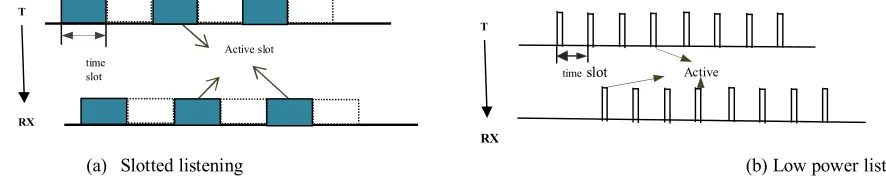
Thus, a better way is to shut down the radio as much as possible in the idle mode. The typical energy consumption parameters for a Telosb are shown in Table 8.1. If the time is arranged into consecutive and equal time slots, then two modes for low duty cycle operation can be identified: slotted listening mode and low power listening (LPL) mode. In the slotted listening mode, as shown in Fig 8.1(a), a mote is wholly wake in select slots and asleep in the remaining slots when there is no data transmission or reception. In the low power listening (LPL) mode, as shown in Fig 8.1(b), a mote will be fractionally wake in every slot.
(a) Slotted listening (b) Low power listening Fig 81: Duty-cycled operation in WSNs
Here we define duty cycle as the percentage of time a mote is active in the whole operational time. In most of the cases the duty cycle in the LPL mode is lower than that in the slotted listening mode. Hence, saving idle energy consumption is necessary. Thus the adaptive duty cycling is proposed to save energy consumption and to prolong the sustainable workable time per mote. The duty cycle setting can be based on the residual energy, mote location, or the rechargeable energy on each mote, independently.
Active slot
RX T
time
slot time slot Active
RX
[image:4.612.73.516.540.630.2]IX.IMPLEMENTATION NIEESA (NATURE INSPIRED ENERGY EFFICIENT SLEEP ACTIVE) PROTOCOL
It is necessary to introduce active scheduling scheme in which a mote sleeps in more slots in idle state to support low power duty cycling, but maintains network connectivity. Towards energy saving goal, existing neighbour discovery mechanisms fall into three categories: on-demand active-up, scheduled neighbour discovery, and asynchronous neighbour discovery. Thus an excellent idle energy savings, scalability, and easiness in implementation, is achieved by the forum-based active scheduling, If nj and nk are two neighbours, shown in Figure 9.1, a difference is observed with the departure times, when the latency
[image:5.612.153.452.188.252.2]between two neighbours is varying, for neighbour discovery.
Fig 9.1: Varying neighbour discovery latency in heterogeneous LPL mode
X. RESULTS AND DISCUSSION
Protocols based on preamble sampling consume lesser energy than protocols based on static or dynamic sleep schedule. This paper presents the advantages and disadvantages of these protocols when traffic is high and also when it is low. Such analysis may be used to configure the network as per user requirements. Towards the goal of energy saving, we have developed a NIEESA protocol with set of solutions, which concludes our contributions as follows. cyclic forum system pair: cfs-pair: We developed the cyclic forum system pair (or cfs-pair), which guarantees that two adjacent nodes which adopt heterogeneous cyclic forums from such a pair as their active schedules, can hear each other at least once within one super cycle length (i.e., the larger cycle length in the cfs-pair). We also developed a fast algorithm for constructing cfs-pairs. Given a pair of cycle lengths (n and m, n ≤ m), we show that the cfs-pair is an optimal design in terms of energy saving ratio. Our fast construction scheme significantly improves the speed of finding an optimal forum, in contrast to previous exhaustive methods. We also analyze the
performance of cfs-pair in terms of expected delay (
<
EDelay<
) forum ratio, and energy saving ratio. grid forumsystem pair: gfs-pair: An another design developed for heterogonous forum system pair, is called the grid forum system pair
(or gfs-pair) in which each forum system of the pair is a grid forum system. We prove that any two grid forum systems can form a gfs-pair. We also show that for a gfs-pair with √n × √n grid and √m × √ m grid, the average discovery delay is bounded within
( )(√ )
√
<
EDelay<
( )(√ )
√ while the forum ratios are √
and √ respectively.
XI.PERFORMANCE
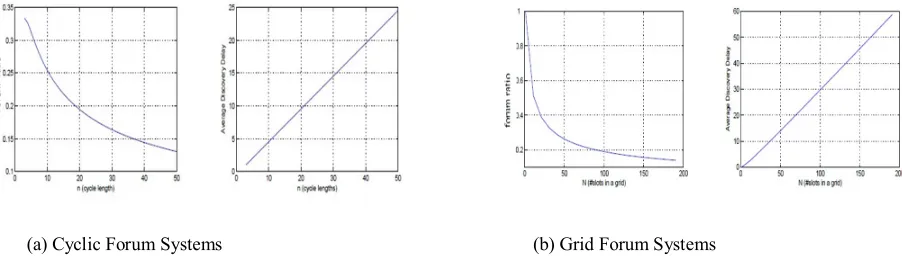
We first evaluated the forum ratio and average neighbor discovery delay by numerical analysis. The performance of a cyclic forum system is shown in Figure 11.1 there is a trade-off between forum ratio and average discovery delay since they have reverse changing trends under increasing cycle lengths
(a) Cyclic Forum Systems (b) Grid Forum Systems Fig 11.1: Forum Ratio and Average Discovery Delay
[image:5.612.86.537.552.681.2]Technology (IJRASET)
522
[image:6.612.116.503.95.208.2]corresponding cyclic forum system
Fig 11.2: Impact of Traffic Load: Energy Consumption Ratio
Figure 11.2 shows how the energy consumption ratios of nodes adopting different cyclic forum
systems increase under increasing traffic load between two neighboring nodes. The rationale is that higher traffic loads will cause a node to increase its active time ratio in our implementation. When the traffic load is low, the impact is insignificant because a node will maintain its current active schedule, without adding more active slots into its communication schedule for transmitting or for receiving packets.
XII.CONCLUSION
The performance ofNIEESA (Nature Inspired Energy Efficient Sleep Active) protocol, a cfs-pair and a gfs-pair were analysed in terms of average delay, forum ratio, and energy saving ratio. We show that the average delay between two nodes that active via heterogeneous forums from a cfs-pair is bounded between (n−1) / 2 2 and (m−1) /2 and the forum ratios of the two forum systems in the pair are optimal, respectively, given their cycle lengths n and m. For a gfs-pair with √n ×√n grid and √m ×√m
grid, the average discovery delay is bounded within ( )(√ )
√
<
EDelay<
( )(√ )
√ while the forum ratios are (2√ −1)/n and (2√m−1)/m respectively. To summarize, the Research contributions to implement NIEESA (Nature Inspired Energy Efficient Sleep Active) protocol, we developed set of asynchronous forum-based active scheduling schemes in duty cycled WSNs including cfs-pair, and gfs-pair, , and show that they provide a better trade-off between energy consumption and average delay, and better energy efficiency for neighbour discovery in unreliable environments, compared with existing protocols.
REFERENCES
[1] Chih-Min Chao1 and Yi-Wei Lee), “A Forum-Based Energy-Saving MAC Protocol Design for Wireless Sensor Networks” Vehicular Technology, IEEE Transactions”, Vol 59 , Issue: 2, pp. 813 – 822, 2010
[2] Mohammad A. Matin,"Wireless Sensor Networks - Technology and Protocols", book Published under CC BY 3.0 licenses , ISBN 978-953-51-0735-4, 2012
[3] Daniele Puccinelli and Martin Haenggi, Wireless Sensor Networks Applications and Challenges of Ubiquitous Sensing IEEE Circuits and systems Magazine, pp. 20-29, 2011.
[4] Akira Mutazono,“Energy Efficient Sleep Scheduling in Wireless Sensor Networks Inspired by Satellite Behavior of Frogs” Annual IEEE International Conference on Pervasive Computing and Communications, PerCom, 2010
[5] Paul Honeine et.al (), “W S N in Biomedical, Body Area Networks”, 7th International WorkshopSystems, Signal Processing and their Applications (WOSSPA), ISBN:978-1-4577-0689-9, pp. 388 – 391, 2011.
[6] Anamika Chauhan et.al “Early Detection of Forest Fire using WSN”, International Journal of Engineering Research and Applications (IJERA) ISSN: 2248-9622, Vol. 3, Issue 4, pp. 163-168, 2013.
[7] Mohamed Hefeeda and Majid Bagheri), “Forest Fire Modeling and Early Detection Using Wireless Sensor Networks” Ad Hoc & Sensor Wireless Networks Vol. 7, pp. 169–224, 2008.
[8] E. Egea Lopez et.al , Wireless Sensor Network Simulation Tools, Summer Simulation Multi conference – SPECTS, 2-9, 2010.
[9] M. Thangaraj and S.Anuradha, Energy Model Prototyping in Various Simulators of WSN, IOSR Journal of Computer Engineering (IOSR-JCE) Vol6, Issue 2 pp., 48-57, 2014.
[10] P.Kavitha,“On Demand Sleep active Energy Efficient protocol in Wireless Sensor Networks”, International Journal of Communications and Engineering, Volume 06– No.6, Issue: 02, pp. 148-153, 2012.
[11] Arul XavierV, “Delay-Efficient Approaches For Sleep Scheduling In Wireless Sensor Networks” International Journal of scientific & technology Research, Vol 2,issue1, pp. 45-48, 2013
[12] Mutazono and Sugano M , ‘’Energy Efficient Sleep Scheduling in Wireless Sensor Networks Inspired by Satellite Behavior of Frogs”, Global COE (Centers of Excellence) Program, of the Ministry of Education, Culture, Sports, Science and Technology, Japan, pp. 450 – 455, 2010.
[13] S. S. Iyengaret.al, “Biologically Inspired Cooperative Routing for Wireless Mobile ensor Networks”, IEEE Systems Journal, Vol. 1, No. 1, pp. 29 – 37, 2007.
[14] Liang and Lei Zhang, “A Biologically-Inspired Sensor Activeup Control Method for Wireless Sensor Networks”, Hong Kong RGC General Research Grant (PolyU 5102/07E), pp.1-27, 2006.
[image:6.612.66.552.450.738.2]Coverage optimization”, Journal of Information & Computational Science , Vol. 8: No.14, pp. 3181–3188, 2011.
[16] Somnath Ghosh et.al, “Performance of a Wireless Sensor Network MAC Protocol with a Global Sleep Schedule” International Journal of Multimedia and Ubiquitous Engineering, Vol. 4, No. 2, pp. 99-114, 2009.
[17] Maryam El Azhari et.al, “Energy Efficient Routing Algorithm in Wireless Sensor Networks”, Computer Engineering and Intelligent Systems, Vol 4, No. 5, pp. 60-69, 2013.
[18] Muhammad Hamad Alizai et.al, “Modeling Execution Time and Energy Consumption in Sensor Mote Simulation”, PIK– prasisder.Informationsverarbeitung und kommunikation, Vol.32, No.2, pp. 127-132, 2009.
[19] Hady S. AbdelSalam and Olariu, “BEES: BioinspirEd backbonE Selection in Wireless Sensor Networks”,IEEE Transactions on parallel and Distributed systems, Vol. 23, No.1, pp. 44-51,2012.

![[(1R) 3 Benzoyl 1,7,7 trimethylbicyclo[2 2 1]heptan 2 onato κ2O,O′]chlorido(η6 p cymene)ruthenium(II)](data:image/gif;base64,R0lGODlhAQABAIAAAP///wAAACH5BAEAAAAALAAAAAABAAEAAAICRAEAOw==)