An Efficient Technique for Resource Allocation &
Deallocation in Cloud Environment Using Multiple
Requests of Clients
Rekha
1, Vinod Saroha
2, Dr. Sanjeev Rana
31
M.Tech CSE, 4th Sem., 2Asstt Professor, Department of CSE & IT, BPSMV 3
Professor, CSE, MMU, Mullana
.
Abstract: The users of cloud computing services can store and access data and applications with the help of internet technology at any time anywhere. Users of cloud computing need not to install any special hardware and software for accessing cloud technologies. The cloud computing environment provides varied kind of services. One such service is sharing of resources. Today there are large numbers of clients that need the access of cloud resources, therefore proper scheduling, planning and allocation of resources and services should be done. This scheduling, planning and allocation should be done while taking into consideration both the resource availability and the project time. This paper provides a new and efficient technique for multiple resource allocation and deallocation in cloud environment.
Keywords: Cloud Resources, Virtualization, Resource Scheduling.
I. INTRODUCTION
Cloud computing [1] is a technology that uses the internet and central remote servers to maintain data and applications. Cloud computing is a comprehensive solution that delivers Information Technology as a service. Cloud computing is an emerging discipline for providing different types of resources to different types of users. It found its application in almost the fields of real life. With cloud computing one can access applications and other resources anytime and from anywhere.
[image:2.612.190.414.512.635.2]Due to scarcity of resources on cloud environment its proper scheduling and allocation is compulsory. Also resources can be allocated statically as well as dynamically therefore proper allocation and de-allocation is an important task for cloud computing. One of the methods statically allocates the resources and other dynamically allocates the resources. With static resource allocation the cloud user has to make prior request for the resources. With dynamic resource allocation the cloud resources are requested by the cloud user on the fly or as and when the application needs.
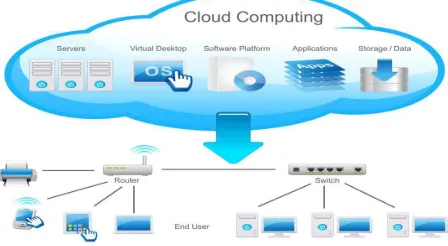
Figure 1 below shows the basic cloud computing environment.
Figure 1: Basic Cloud Computing Environment.
The cloud makes it possible for users to access information from anywhere anytime. It removes the need for users to be in the same
location as the hardware that stores data. Cloud computing comprises of 2 components ―the front end and the back end. The front
One of the main services of cloud environment is resource allocation. Resource allocation [3] is process of assigning the available resources in an economic way and efficient and effective way Resource allocation is the scheduling of the available resources and available activities required by those activities while taking into consideration both the resource availability and the project time. This paper provides a new and efficient technique for multiple resource allocation and deallocation in cloud environment. A client can send multiple requests at a time & whenever tasks are completed the client can deallocate the requests from cloud servers.
II. RESOURCESCHEDULING&ALLOCATION
In cloud computing environments, there are two players: cloud servers and cloud clients/users. On one hand, servers or providers hold massive computing resources in their large datacenters and rent resources out to users on a per-usage basis. On the other hand, there are multiple clients or users who have applications with fluctuating loads and lease resources from providers to run their applications. In most cases, the interaction between providers and users occur as shown in Figure 1 below [4].
Request Response
[image:3.612.162.439.234.356.2]Internet Service Provider
Figure 2: Cloud Server & Cloud Client Interaction
First, a user sends a request for resources to a provider. When the provider receives the request, it looks for resources to satisfy the request and assigns the resources to the requesting user, typically as a form of virtual machines (VMs). Then the user uses the assigned resources to run applications and pays for the resources that are used. When the user is done with the resources, they are returned to the provider [5, 6].
One interesting aspect of the cloud computing environment is that these players are often different parties with their own interests. Typically, the goal of providers is to generate as much revenue as possible with minimum investment. To that end, they might want to squeeze their computing resources; for example, by hosting as many VMs as possible on each machine. In other words, providers want to maximize resource utilization.
[image:3.612.179.433.574.716.2]Energy efficient Cloud resources allocation consists in identifying and assigning resources to each incoming user request in such a way, that the user requirements are met, that the least possible number of resources is used and that data center energy efficiency is optimized.
Figure 3 shows the resource scheduling, allocation and deallocation for multiple clients requests for cloud computing [5].
Figure 3: Resource Scheduling, Allocation & Deallocation in Cloud Computing Cloud
Client
Cloud Server
A. Resource Scheduling
Once the resource containers are given to the user, the application makes a scheduling decision. In many cases, the application consists of multiple jobs from various clients to which the allocated resources are given. The job scheduler is responsible for assigning preferred resources to a particular job so that the overall computing resources are utilized effectively. The application also has to make sure each job is given adequate amount of resources, or its fair share. Such a scheduling decision becomes more complex if the environment is heterogeneous [6].
B. Resource Allocation
Resource allocation [7][8] involves deciding what, how many, where, and when to make the resource available to the user. Typically, users decide the type and amount of the resource containers to request then providers place the requested resource containers onto nodes in their datacenters. To run the application efficiently, the type of resource container need to be well matched to the workload characteristics, and the amount should be sufficient to meet the constraints (e.g., job completion time deadline). In an elastic environment like the Cloud where users can request or return resources dynamically, it is also important to consider when to make such adjustments.
C. Resource Deallocation
Resource deallocation is the process of releasing all or some specific resources previously allocated to clients. When the client stops the task then the service allocated to the client is released & same can be reallocated to another client in the waiting. The client can deallocate all or some specific resources according to requirements. After deallocation the client can further allocate the resources if required.
III. PROPOSEDMODEL
Resource Allocation Strategy (RAS) [9] is about integrating cloud provider activities for utilizing and allocating scarce resources within the limit of cloud environment so as to meet the needs of the cloud application. It requires the type and amount of resources needed by each application in order to complete a user job. The order and time of allocation of resources are also an input for an optimal RAS. Resource allocation is process of assigning the available resources in an economic, efficient and effective way. Due to dynamic nature of users and numbers of requests [10], it is not possible for cloud server to satisfy some requests due to scarce number of resources. Therefore resource scheduling and monitoring in an important task for cloud computing. Also client can send multiple requests for cloud resources at the same time. Hence we need an efficient resource allocation system that suits cloud environments by satisfying multiple requests from the clients without any delay.
In this work we focused on the concept of effective multiple resource allocation & de-allocation in a cloud environment. When the multiple requests from the client arrive, it performs the requests to the priority cloud under its requirements in terms of memory & processor capabilities. As the particular cloud will get the requests, it will search for the number of requested processors for each request. If the numbers of processors are available with the current cloud, the resources will be allocated to that particular client. But if the sufficient numbers of processors are not available then the search will be performed for the next particular cloud to perform the resource allocation.
The resources allocated to the client are released as soon as client’s tasks are completed. The client can de-allocate all or some specific resources according to requirements. After de-allocation the client can further allocate the resources. Therefore the present work provides efficient allocation, de-allocation and reallocation of cloud services.
IV. PROPOSEDALGORITHM
The proposed algorithm is explained below
A. Initialize the cloud with multiple servers supporting multiple CPUs.
B. Initialize clients with specific group viz. standard group – supporting maximum 3 requests, Professional group - supporting maximum 5 requests and Enterprise Group - supporting maximum 7 requests
C. Send multiple requests to the cloud depending upon client group.
D. The scheduler schedules the requests depending upon the current status of each server. The server that satisfies the client’s requests is selected and allocated for the desired resources.
F. If no server is capable of satisfying the client’s request then display message “out of server”.
G. When client is done then ask for deallocation of requests. A client can deallocate all or some specific resources depending upon need.
H. After deallocation again update the utilization and remaining capacity of the server that satisfy the requests.
In this work we focused on the concept of effective multiple resource allocation & de-allocation in a cloud environment. When the multiple requests from the client arrive, it performs the requests to the priority cloud under its requirements in terms of memory & processor capabilities. As the particular cloud will get the requests, it will search for the number of requested processors for each request. If the numbers of processors are available with the current cloud, the resources will be allocated to that particular client. But if the sufficient numbers of processors are not available then the search will be performed for the next particular cloud to perform the resource allocation. The resources allocated to the client are released as soon as client’s tasks are completed. The client can de-allocate all or some specific resources according to requirements. After de-allocation the client can further de-allocate the resources. Therefore the present work provides efficient allocation, de-allocation and reallocation of cloud services.
[image:5.612.163.410.279.454.2]V. IMPLEMENTATIONRESULTS
Figure 5.1 shows the main menu of our implementation.
Figure 5.1: Main menu of implementation
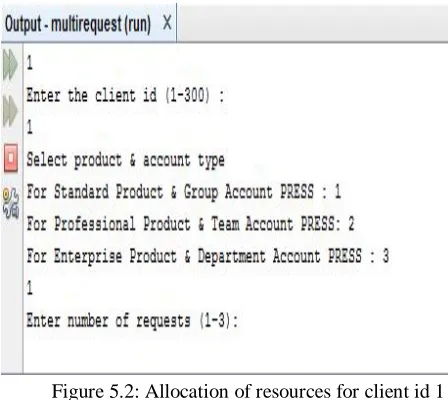
[image:5.612.182.406.495.695.2]When user select option 1 i.e., allocation of resources then it ask for client id and account type for the client as shown in figure 5.2.
Figure 5.2: Allocation of resources for client id 1
Figure 5.3: Effect after multiple resource allocation
In main menu options now select the option 2 for deallocation of resources. It will ask for client id and numbers of CPUs to be deallocated for multiple requests. If client id is not correct or numbers CPUs to be deallocated are more than the allocation then appropriate error message is displayed. If everything is OK then deallocation is performed.
V. ANALYSIS OF RESULTS
We compare result of proposed algorithm with the work of other previous researchers. The metric used for comparison is the number of requests performed by the users at a time & number of servers started with respect to number of virtual machines requested.
A. The number of requests in our proposed work is depending upon type of customer/client. If Client is from group account type
then he can perform maximum three requests at a time. If Client is from team account type then he can perform maximum five requests at a time. If Client’s is from department account type then he can perform maximum seven requests at a time. On the other hand in previous resource allocation algorithms a client can send one request at a time. Further request is only entertain after deallocation of first request.
B. The number of servers started (active servers) in our proposed algorithm are less as compared to previous resource allocation algorithms. In our algorithm as soon as deallocation of some requests are performed then allocation process started from first server again. If required numbers of processors are available then allocation is performed on it. While in previous work allocation is always performed from the current active server. As the processors of deallocated servers are reused instantly by new clients therefore number of active servers reduces which saves energy.
VI. CONCLUSION
of assigning the available resources in an economic way and efficient and effective way Resource allocation is the scheduling of the available resources and available activities required by those activities while taking into consideration both the resource availability and the project time. This paper provides a new and efficient technique for multiple resource allocation and deallocation in cloud environment.
REFERENCES
[1] Rajkumar Buyya, Christian Vecchiola, Thamarai Selvi, “Mastering Cloud Computing”, Tata MCgraw Hill Education, 2013.
[2] Ricardo Puttini, Thomas Erl, Zaigham Mahmood, “Cloud Computing Concepts, Technology & Architecture”, Prentice Hall, 2013.
[3] B. Rajasekar, S. K. Manigandan, “An Efficient Resource Allocation Strategies in Cloud Computing”, International Journal of Innovative Research in Computer
and Communication Engineering Vol. 3, Issue 2, February 2015.
[4] Riddhi Patel, Hitul Patel, Sanjay Patel, “Efficient Resource Allocation in Cloud Computing”, International Journal For Technological Research In Engineering
Volume 2, Issue 7, March-2015
[5] Q. Zhang, L. Cheng, and R. Boutaba, “Cloud computing: state-of-the-art and research challenges,” Journal of Internet Services and Applications, vol. 1, no. 1,
pp. 7–18, Apr. 2010
[6] D. Warneke, O. Kao, “Exploiting Dynamic Resource Allocation for Efficient Parallel Data Processing in the Cloud”, IEEE Transactions on Parallel and
Distributed Systems, Vol. 22, No. 6, pp 985 - 997, June 2011, DOI: http://doi.ieee computersociety.org/10.1109/TPDS.2011.65
[7] V. Vinothina, R. Sridaran, Padmavathi Ganapathi, “Resource Allocation Strategies in Cloud Computing”, International Journal of Advanced Computer Science
and Applications [IJACSA], Vol. 3, No.6, 2012. ISSN: 2158-107X (Print), DOI: 10.14569/issn.2156-5570
[8] Sowmya Koneru, V N Rajesh Uddandi, Satheesh Kavuri, ”Resource Allocation Method using Scheduling methods for Parallel Data Processing in Cloud”,
International Journal of Computer Science and Information Technologies[IJCSIT], Vol. 3(4), 2012, pp 4625 - 4628 4625, ISSN: 0975-9646.
[9] Mohd Hairy Mohamaddiah, Azizol Abdullah, Shamala Subramaniam, and Masnida Hussin, “A Survey on Resource Allocation and Monitoring in Cloud
Computing”, International Journal of Machine Learning and Computing, Vol. 4, No. 1, February 2014.
[10] Pratik P. Pandya, Hitesh A. Bheda, “Dynamic Resource Allocation Techniques in Cloud Computing”, International Journal of Advance Research in Computer
![Figure 3 shows the resource scheduling, allocation and deallocation for multiple clients requests for cloud computing [5]](https://thumb-us.123doks.com/thumbv2/123dok_us/8308451.857124/3.612.179.433.574.716/figure-resource-scheduling-allocation-deallocation-multiple-requests-computing.webp)