Non-split and Inverse Non-split Domination Numbers
in the Join and Corona of Graphs
Esamel M. Paluga
Department of MathematicsCaraga State University Ampayon, Butuan City, Philippines
Rolando N. Paluga
Department of MathematicsCaraga State University Ampayon, Butuan City, Philippines
ABSTRACT
A dominating set D of a graph G = (V, E) is non-split dominating set ifhV \Diis connected. The non-split domination number of G is the minimum cardinality of a non-split dominating set inG. LetDbe a minimum dominating set inG. If a subsetD0 ofV \ D is dominating inG, then D0 is called an inverse dominating set with respect to D. Furthermore, if
V \D0
is connected, then D0 is called an inverse non-split dominating set. The inverse non-split domination number ofG
is the minimum cardinality of an inverse non-split dominating set inG. In this paper, characterization of non-split dominating sets in the join and corona of two graphs are presented. Furthermore, explicit formulas for determining the split and inverse non-split domination numbers of these graphs are also determined.
General Terms:
Graph Theory, Domination
Keywords:
non-split domination, inverse non-split domination, join, coron-aifx
1. INTRODUCTION
Given a connected graphG= (V(G), E(G))andD⊆V(G), we sayDisdominating setinGif for allx∈V(G)\D, there existsy ∈ D such thatdG(x, y) = 1. The domination num-ber ofG, denoted byγ(G), is the minimum cardinality of all dominating sets inG. IfD is dominating andhV(G)\Di is connected, then we say thatD isnon-split dominating set(or ns-dominating)inG. The non-split dominating number ofG, de-noted byγns(G), is the minimum cardinality of all non-split dominating sets inG. LetD be a minimum dominating set in
G. If there exists D0 ⊆ V(G)\D such thatD0 is non-split dominating set, then we say thatD
0
is aninverse non-split dom-inating set(or ins-dominating) inG. The minimum cardinality of all inverse non-split dominating sets inGis the inverse non-split domination number ofGand is denoted byγns0 (G). To illustrate these concepts, consider the following examples:
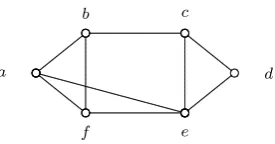
EXAMPLE 1.1. Consider the graph in Figure 1 . Let
D = {a, d,}, thenhV(G)\Diis connected. Note thatDis
minimum. Hence,γns(G) = 2. Moreover, ifD 0
={c, f}, then
D0 ⊆ V(G)\Dand V(G)\D0is connected. SinceD0 is minimum, it follows thatγns0 (G) = 2.
Thejoinof any graphsGand H, denoted by G+H, is the graph withV(G+H) = V(G)∪V(H)andE(G+H) =
E(G)∪E(H)∪ {uv:u∈V(G)andv∈V(H)}. Thecorona
Figure1: A graphGwithγns(G) = 2andγ 0
[image:1.595.361.499.256.328.2]ns(G) = 2 ... ... ... . .... .. ... ... .. ... ... . . .. . ... . . .. . . . ... . ... .. ... ... .... ... ... ...... ... . .... .. ... .. ... ... . . .. . ... . . .. . . . . . . . . . . . . . . . . . . . . . . . . . . . . . . . . . . . . . . . . . . . . . . . . . . . . . . . . . . . . . . . . . . . . . . . . . .. . .... .. ... ... .. ... ... . . ... . . .. . . . . . . . . . . . . . . . . . . . . . . . . . . . . . . . . . . . . . . . . . . . . . . . . . . . . . . . . . . . . . . . . . . . . . . . . . . . . . . . . . . . . . . . . . . . . . . . . . . . . . . . . . . . . . . . . . . . . . . .. ...... .... ... .. ... ... . . .. . ... . . .. . . . . . . . . . . . . . . . . . . . . . . . . . . . . . . . . . . . . . . . . . . . . . . . . . . . . . . . . . . . . . . . . . . . . . . . . . .. . ... ... ... .. ... ... . . ... . . .. . . . . .... .. ... ... .. ... ... . . .. . ... . . .. . . . . . . . . . . . . . . . . . . . . . . . . . . . . . . . . . . . . . . . . . . . . . . . . . . . . . . . . . . . . . . . . . . . . . . . . . . . . . . . . . . . . . . . . . . . . . . . . . . . . . . . . . . . . . . . . . . . . . . . . . . . . . . . . . . . . . . . . . . . . . . . . . . . . . . . . . . . . . . . . . . . . . . . . . . . . . . . . . . . . . . . . . . . .. . .... .. ... ... .. ... ... . . .. . ... . . .. . . . . .... .. ... ... .. ... ... . . .. . ... . . .. . . . ... ... ... ... ... ... ... ... .... . ... ... ... ... ... ... . ... ... ... .. ... ... . . ... . . .. . . . ... ... ... ... ... ... ... ... .... . .... .. ... .. ... ... . . .. . ... . . .. . . . . .... .. ... ... .. ... ... . . .. . ... . . .. . . . a b c d e f
ofGandH, denoted byG◦His defined as the graph obtained by taking one copy ofG(which haspvertices) andpcopies of
H, and then joining the ith vertex ofGto every vertex in the ith copy ofH. We denote the copy ofH with respect to vertex
a∈V(G)byHa. Apathwith verticesx
0, x1, . . . , xnwill be
denoted by[x0, x1, . . . , xn]. ThedistancedG= (u, v)between verticesuandvis the lenght of a shortest path connectinguand
v. Anextreme vertexinGis a vertex that is adjacent to all other vertices ofG. The setext(G)consists of all the extreme vertices ofG.
Throughout this paper,G = (V(G), E(G))is a simple undi-rected and connected graph. The order of G denoted by
|G|, is the cardinality ofV(G). For other graph theoretic terms which are assumed here, readers are advised to refer to [5]. The following are needed in the development of this paper.
2. NON-SPLIT DOMINATION IN THE JOIN AND
CORONA OF GRAPHS
This section characterizes all non-split dominating sets in the join and corona of two graphsGandH. As a consequence, the explicit formulas for the non-split dominating numbers of these graphs are presented. The following results are necessary in the development of succeding results
REMARK 2.1. For any connected graphG,γns(G)≥1. LEMMA 2.2. [7] LetGbe a connected graph. Then
γ(G)≤ |G|
2
.
THEOREM 2.3. Let G and Hbe connected graphs. Then
D⊆V(G+H)is ns-dominating inG+Hif and only one of the following conditions holds:
(i) D∩V(G)6=∅, V(G)andD∩V(H)6=∅, V(H);
(ii) Dis dominating inH;
(iii) Dis dominating inG;
(iv) V(G)⊆D, andhV(H)\Diis connected;
PROOF. IfV(G)∩D6=∅, V(G)andV(H)∩D6=∅, V(H), then we are done. SupposeV(G)∩D=∅. ThenD ⊆V(H). Letx ∈ V(H)\D. Thenx ∈ V(G+H)\D. SinceD is dominating inG+H,∃y∈Dsuch thatdG+H(x, y) = 1. Since
V(G)∩D=∅,y∈V(H). This implies thaty∈V(H)∩D. Consequently,V(H)∩Dis dominating inH. Thus,(ii)holds. The case(iii)is proved similarly.
Suppose V(G) ∩ D = V(G). If V(H) ∩D = ∅, then
hV(H)\Di=H is connected. SupposeV(H)∩D 6=∅. Let
x, y,∈ V(H)\D. SinceV(H)\D = V(G+H)\D, and
hV(G+H)\Di is connected, hV(H)\Di is connected, proving(iv). The case(v)is proved similarly.
Suppose thatD∩V G) = ∅and x ∈ V(H)\D ⊆ V(G+
H)\D. SinceD is dominating inG+H,∃y ∈D such that
dG+H(x, y) = 1. Now,D∩V(G) =∅soy∈V(H)∩Dand
dH(x, y) = 1. Thus,V(H)∩Dis dominating inH. The proof for case (v) is similarly done.
For the converse, assume(i)holds. Letx∈V(G+H)\D. Let
y∈D∩V(G),z∈D∩V(H),q∈V(G)\Dandr∈V(H)\D.
Eitherx∈ V(G)\D orx ∈ V(H)\D. Ifx ∈ V(G)\D, thendG+H(x, z) = 1. Ifx∈V(H)\D, thendG+H(w, y) =
1. Hence,D is dominating inG+H. Furthermore, letu, v ∈
V(G+H)\D. Ifu, v,∈V(G)\D, then[u, r, v]is a path with
vertices inV(G+H)\D. Ifu, v,∈V(H)\D, then[u, q, v]is a pathG+Hconnectinguandv. Lastly, ifu∈V(G)\Dandv∈ V(H)\Dthen[x, y]is a path inG+H. Thus,hV(G+H)\Di
is connected. Hence,Dis ns-dominating inG+H.
Next, we assume that(ii)holds. Letx∈V(G+H)\D. Since
D∩V(G) = V(G),V(G+H)\D = V(H)\D. Conse-quently,dG+H(x, y) = 1 where y∈D∩V(G). This implies thatDis dominating inG+H. Furthermore, sincehV(H)\Di
is connected,hV(G+H)\Diis connected. Accordingly,Dis ns-dominating inG+H.
To prove that the result holds assuming(iii)is similar to(ii). Netx, assumeiv holds. Letx ∈ V(G+H)\D. Then either
x∈V(G)orx∈ V(H)\D. Ifx ∈V(G), then for ally ∈ V(H)\D,dG+H(x, y) = 1. Ifx ∈ V(H)\D, then since
V(H)∩D is dominating inH,∃w ∈ V(H)∩D such that
dH(x, y) = 1. It follows that∃w∈Dsuch thatdG+H(x, y) =
1. Thus,Dis dominating inG+H. Moreover, letu, v∈V(G+
H)\D. Ifu, v∈V(G), then there exists a path inGconnecting
uandvsinceGis connected. Ifu, v∈V(H)\D, then for each
w ∈ V(G),[u, w, v]is a path inG+H connectinguandv.
Ifu∈V(G)andv ∈V(H)\D, then[u, v]is a path inG+
H connecting uandv. Thus,hV(G+H)\Di is connected. Hence,Dis ns-dominating inG+H.
Lastly, assume that(v)holds. The proof is similar to(iv).
COROLLARY 2.4. LetGandHbe connected graphs. Then
γns(G+H) =
1 if either γ(G) = 1 or γ(H) = 1,
2 otherwise.
PROOF. Suppose γ(G) = 1. Then ∃x ∈ V(G) such thatD={x}is dominating inG. By Theorem 2.3(iv),Dis ns-dominating inG+H. Thus,γns(G+H)≤1. Combining this with Remark 1.1,γns(G+H) = 1. The case whereγ(H) = 1 can be shown similarly using Theorem 2.3(v).
Now supposeγ(G) ≥2andγ(H)≥ 2. LetD ={a, b}such thata∈V(G)andb∈V(H). ThenD∩V(G)6=∅, V(G)and
D∩V(H)6=∅, V(H). By Theorem 2.3(i),Dis ns-dominating inG+H. Thus,γns(G+H)≤2. Supposeγns(G+H) = 1. Then∃D0 ⊆ V(G+H)such thatD0 = {y}for somey ∈ V(G+H). Ify ∈ V(G), thenD0must be dominating in G, contradicting the fact thatγ(G)≥2. A similar argument can be used to show thaty ∈ V(H) cannot hold. Thus, |D0| ≥ 2
. Accordingly,γns(G+H) = 2.
THEOREM 2.5. Let Gand H be connected graphs. Then
D ⊆ V(G◦H) is ns-dominating inG◦H if and only one of the following conditions holds:
(i) There exists v ∈ V(G) such that hV(G◦H)\Di is a connected subgraph ofHv;
(ii) For each v∈V(G), V(Hv)∩D is dominating in Hv andD⊆ ∪w∈V(G)V(Hw);
(iii) V(G)∩Dis ns-dominating inGandV(Hv)⊆D when-everv∈V(G)∩DandV(Hv)∩Dis dominating inHv wheneverv∈V(G)\D.
PROOF. Assume thatDis ns-dominating inG◦H. Suppose
V(G)∩D =V(G), i.e.,V(G)⊆ D. IfV(G◦H)\D =∅, then(i)follows vacuously. SupposeV(G◦H)\D6=∅. SinceD
is ns-dominating inG◦H,hV(G◦H)\Diis connected. Since
V(G)⊆D,V(G◦H)\D⊆ ∪a∈V(G)V(Ha). Thus,V(G◦H)\
D⊆V(Hv)for somev∈V(G). That is,hV(G◦H)\Di ≤
Hv. Hence,(i)holds.
SupposeV(G)∩D =∅. Letv ∈ V(G),B = V(Hv)∩D, andx∈V(Hv)\B. It follows thatx∈V(G◦H)\D. Since
Dis dominating inG◦H,∃y∈Dsuch thatdG◦H(x, y) = 1. Sincex∈V(Hv)andd
G◦H(x, y) = 1,y∈V(Hv)ory=v. If
y=v, theny∈V(G)∩D, a contradiction. Thus,y∈V(Hv)∩
D=B. Accordingly,B =V(Hv)∩Dis dominating inHv. SinceV(G)∩D=∅,D⊆ ∪v∈V(G)V(Hv). Hence,(ii)holds. SupposeV(G)∩D 6= ∅andV(G)∩D 6= V(G). LetA =
V(G)∩Dandx∈V(G)\A, i.e.,x∈V(G)\D. It follows that
x∈V(G◦H)\D. SinceDis dominating inG◦H,∃y∈Dsuch thatdG◦H(x, y) = 1. Supposey /∈ V(G). Then∃v ∈ V(G) such thaty ∈ V(Hv). Sincevis a cutvertex, d
G◦H(x, y) =
dG◦H(x, v) +dG◦H(v, y)≥1 + 1 = 2. This is a contradiction. Consequently,y∈V(G). Note thatdG(x, y) = 1. Hence,Ais dominating inG.
Letx, y ∈ V(G)\A = V(G)\D. SincehV(G◦H)\Di
is connected and x, y ∈ V(G ◦ H) \ D, there exists a geodesic path P = [u1, u2, . . . , un] where u1 = x and
un = y. Suppose ∃i with 1 < i < n such that
ui ∈/ V(G). Then∃w∈V(G)such thatui ∈V(Hw). Since
P is geodesic,ui−1 =w. Note thatun ∈/ V(Hw). Now,wis the only vertex that can be used to traverse fromuigoing toun. This contradicts the fact thatP is a path. Thusui∈V(G),∀i. Accordingly,hV(G)\Aiis connected.
Hence,A=V(G)∩Dis ns-dominating inG.
Let v ∈ V(G) ∩ D. Suppose V(Hv) \ D 6= ∅. Let u ∈ V(Hv) \ D. Since V(G) ∩ D 6= V(G),
∃z ∈ V(G) \ D. Since hV(G◦H)\Di is con-nected, there exists a u − z path with vertices from
V(G◦H)\D. However, any u− z path must have v as a vertex. This is not possible. Hence,V(Hv)\D=∅. In effect,
V(Hv)⊆D.
Suppose v ∈ V(G) \ D. Let x ∈ V(Hv) \[V(Hv) ∩
D]. = V(Hv) \ D. This implies that x ∈ V(G ◦H) \
D. Since D is dominating in G◦H, ∃y ∈ D such that
dG◦H(x, y) = 1. Consequently, y = v or y ∈ V(Hv). Since y ∈ D and v ∈ V(G) \ D, y 6= v. In effect,
y∈V(Hv). Now,d
G◦H(x, y) = 1implies thatdHv(x, y) = 1. Hence,V(Hv)∩Dis dominating inHv.
Therefore,(iii)holds.
For the converse, suppose(i)holds. Letx ∈ V(G◦H)\D. SinceV(G◦H)\D⊆V(Hv),x∈V(Hv)andV(G)⊆D. Thus,v∈ DanddG◦H(x, v) = 1. Hence,Dis dominating in
G◦H. Accordingly,Dis ns-dominating inG◦H.
Suppose(ii)holds. Letx∈V(G◦H)\D. Supposex∈V(G). SinceV(Hx)∩Dis dominating inHx,V(Hx)∩D 6=∅. Let
u∈V(Hx)∩D. Thend
∪v∈V(G)(V(Hv),V(G)∩D=∅. Consequently,V(G◦H)\D =[∪v∈V(G)(V(Hv)\D]∪V(G).
Letp, q∈V(G◦H)\D,p6=q. Ifp, q∈V(Hv)\Dfor some
v∈V(G), then[p, v, q]is a path with vertices inV(G◦H)\D. Ifp, q ∈ V(G), then there is ap−qpathP inGsinceGis connected. Note thatPis also a path inV(G◦H)\D. Suppose
p∈V(G)andq∈V(Hv)\Dfor somev∈V(G). Ifp=v, then we can choose the path[p, q]with vertices inV(G◦H)\D. Supposep 6= v. Since Gis connected, there is a pathP1 =
[u1, u2, . . . , un]such thatui∈V(G),∀i= 1,2, . . . , nwhere
u1=pandun=v. Thus the pathP2= [u1, u2, . . . , un, q]is a
p−qpath with vertices inV(G◦H)\D. Supposep∈V(Hv)\
Dand q ∈ V(Hw)\D for somev, w ∈ V(G). SinceGis connected, there is a path[u1, u2, . . . , un]with vertices inV(G) such thatu1 =vandun=w. Then[p, u1, u2, . . . , un, w]is a path with vertices inV(G◦H)\D. Hence,hV(G◦H)\Diis connected. Accordingly,Dis ns-dominating inG◦H. Suppose(iii)holds. Letx∈V(G◦H)\D. Supposex∈V(G), i.e.,x∈V(G)\D =V(G)\(V(G)∩D). SinceV(G)∩D
is dominating inG,∃y∈V(G)∩Dsuch thatdG(x, t) = 1. It follows thatdG◦H(x, y) = 1. Supposex∈V(Hv)for somev∈
V(G), i.e.,x∈V(Hv)\D. Note thatd
G◦H(x, v) = 1. Ifv∈
D, then we are done. Supposev /∈D, i.e.,v∈V(G)\D. In this case,V(Hv)∩Dis dominating inHv. That is∃w∈V(Hv)∩
Dsuch thatdHz(x, w) = 1. It follows thatdG◦H(x, w) = 1. Hence,Dis dominating inG◦H.
Letx, y∈V(G◦H)\D. Supposex, y∈V(G). Thenx, y∈ V(G)\D. SinceV(G)∩Dis ns-dominating inG,hV(G)\Di
is connected. In effect, there is ax-ypathP with vertices in
V(G)\D)⊆V(G◦H)\D.
Supposex ∈ V(G)and y ∈ V(Hv) for some v ∈ V(G), i.e., x ∈ V(G) \D and y ∈ V(Hv) \ D. If x = v, then we can take the path [x, y]. Suppose x 6= v. If v ∈ V(G)∩D, thenV(Hv) ⊆ D. This contradicts the fact that
V(Hv) \D 6= ∅ . Thus, v ∈ V(G)\D. Consequently,
V(Hv)\D is dominating inHv, i.e.,V(Hv)∩D 6= ∅. Let
x ∈ V(Hv)∩D. Sincex, v ∈ V(G)\D andhV(G)\Di is connected, there exists anx−vpath[u1, u2, . . . , un]with vertices inV(G)\D such thatu1 = xandun = v. Thus,
[u1, u2, . . . , un, y]is anx−ypath with vertices inV(G◦H)\D.
Supposex, y ∈ V(Hv), x 6= yfor some v ∈ V(G). Then
x, y∈V(Hv)\D. Ifv∈D, thenV(Hv)⊆D. This contradicts the fact thatV(Hv)\D6=∅. Thus,v /∈D, i.e.,v∈V(G)\D.
Now,[x, v, y]is a path with vertices inV(G◦H)\D.
Supposex∈V(Hv)andy∈V(Hw)for somev, w∈V(G),
v6=w. Thenx∈V(Hv)\Dandy∈V(Hw)\D. Ifv∈Dor
w ∈ D, thenV(Hv) ⊆ D and V(Hw) ⊆ D. This is a contradiction sinceV(Hv)\D 6= ∅and V(Hw)\D 6= ∅. Thus,v, w /∈D, i.e.,v, w /∈V(G)\D⊆V(G◦H)\D. Since,
hV(G)\Diis connected, there is a path[u1, u2, . . . , un]with vertices inV(G)\D, andu1 =vandun =w. Consequently,
[x, u1, u2, . . . , un, y]is a path with vertices inV(G◦H)\D.
Hence,hV(G◦H)\Di is connected. Accordingly, D is ns-dominating inG◦H.
COROLLARY 2.6. LetGandHbe connected graphs. Then
γns(G◦H) =
1 if |G|= 1
|G| ·γ(H) otherwise.
PROOF. The case where|G|= 1follows from Corollary 2.2. Suppose|G|=m≥2. For eachv∈V(G), letHvbe a copy ofHcorresponding to vertexv. Further, for eachv∈V(G), let
Dvbe a minimum dominating set inHv. Then by Theorem 2.5
(ii),D=∪v∈V(G)Dvis ns-dominating in(G◦H). Thus,
γns(G◦H)≤ |D| =
∪v∈V(G)Dv
= Σv∈V(G)|Dv|
= Σv∈V(G)γ(H) =|G| ·γ(H)
Suppose∃D∗
such thatD∗
satisfies(i)of Theorem 2.5. Then by Theorem 2.5,D∗=∪
j6=iV(Hvj)∪ {V(Hvi)\D∗}. Now,
|D∗| = |∪j6=iV(Hvj)∪ {V(Hvi)\D∗}|
= X
j6=i
|Hvj|+|V(Hvi)\D∗| ≥(m−1)|H|
By Lemma 2.2,γ(H)≤ |H2|, i.e.,2γ(H)≤ |H|. Hence,
|D∗| ≥ (m−1)(2γ(H) +r) +t
= (m−1)γ(H) + (m−1)γ(H)
≥ (m−1)γ(H) +γ(H) =|G| ·γ(H).
SupposeD∗
satisfies(ii)of Theorem 2.5. Then
|D∗| = X
v∈V(G
|V(Hv∩D| ≥ X v∈V(G)
γ(Hv)
= X
v∈V(G
γ(H) =|G| ·γ(H).
Next, suppose D∗ satisfies (iii) of Theorem 2.5. Let
A = {v1, v2, . . . , vr}, where 1 ≤ r ≤ m. Then D∗ =
S
vi∈AV(H vi)S
vj∈V(G)\A(D
∗∩V(Hvj)). Now
|D∗| = r|H|+ (m−r)γ(H)≥r(2γ(H)) + (m−r)γ(H)
= γ(H)(m+r)> mγ(H) =|D|.
Therefore,D is a minimum ns-dominating set inG◦H, i.e.,
γns(G+H) = 2.
3. INVERSE NON-SPLIT DOMINATION IN JOIN
AND CORONA OF GRAPHS
REMARK 3.1. For any graphG,γ0ns(G)≥1, if it exists. THEOREM 3.2. LetGandHbe connected graphs. Then
γ(G+H) =
1 if ext(G)6=∅or ext(H)6=∅
2 ifext(G) =∅and ext(H) =∅.
PROOF. Suppose ext(G) =6 ∅. Let D = {a}, where
a∈ext(G)andx∈V(G+H)\D. Ifx∈V(G)\D, then
dG(x, a) = 1sincea∈ext(G). It follows thatdG+H(x, a) =
1. Ifx∈V(H)\D, thendG+H(x, a) = 1. Thus,Dis domi-nating inG+H. Hence,γ(G+H) = 1. The proof is similar for theext(H)6=∅.
Suppose now that Supposeext(G) = ∅andext(H) =∅. Let
D={a, b}, wherea∈V(G)andb∈V(H). Letx∈V(G+
H)\D. Ifx∈V(G)\D. Ifx∈V(G), thendG+H(x, b) = 1. If
x∈V(H),dG+H(x, a) = 1. Thus,Dis dominating inG+H, implying thatγ(G+H)≤2. Supposeγ(G+H) = 1. LetD=
{t}be dominating inG+H. Ift∈V(G), thendG+H(t, y) = 1 for ally ∈ V(G), makingtan extreme vertex inG. This is a contradiction. The case wheret∈V(H)yields a similar result. Consequently,γ(G+H)6= 1.
Accordingly,γ(G+H) = 2.
THEOREM 3.3. Let G be a nontrivial graph. Then
γns0 (G+K1) =γ(G).
PROOF. By Theorem 3.2, γ(G + K1) = 1. Suppose
ext(G) = ∅. Let D = {a}wherea ∈ V(K1)and D 0
be a minimum dominating set inG. ThenD0 ⊆ V(G+K1)\D. Moreover, D0 is a dominating set in G + K1 and
V(G+K1)\D
0
is connected. Thus,D0 is ins-dominating set inG+K1. Hence,γ
0
ns(G+K1)≤
D
0 γ(G).
t∈ V(G). ThendG+K1(t, x) = 1∀x ∈V(G). This implies thatt∈ext(G), acontradiction. Thus,t=a. SinceD00is domi-nating inG+HandD00 ⊆V(G+K1)\D0,D
0
0is dominating inG. Thus,
γns0 (G+K1) =
D
0 0
≥
D
0 =γ(G)
Hence,γns0 (G+K1) =γ(G).
THEOREM 3.4. Let G and H be nontrivial connected graphs. Then
γns0 (G+H) =
1 if |ext(G)| + |ext(H)| ≥2 2 if |ext(G)| + |ext(H)|= 0,1.
PROOF. Suppose|ext(G)|+|ext(H)|= 0, i.e.,|ext(G)|=
∅and|ext(H)|=∅. By Theorem 3.2,γ(G+H) = 2. As shown in the Theorem,D ={a, b}wherea∈V(G)andb∈V(H), is a minimum dominating set inG+H. Since|ext(G)| = ∅
and|ext(H)| = ∅, |V(G)| ≥ 2and|V(H)| ≥ 2. LetD0 =
a0, b0 wherea0 ∈V(G)\ {a}andb0 ∈V(H)\ {b}. That is
D0 ⊆V(G)\D. Letx∈V(G+H)\D0. Ifx∈V(G)\D0, then
dG+H(x, b
0
) = 1. Ifx∈ V(H)\D0, thendG+H(x, a 0
) = 1. Thus,D0is dominating inG+H.
Letu, v ∈ V(G+H)\D0 withu6= v. LetP be defined as follows:
P=
[u, a, v] if u, v∈V(H)\b0
[u, b, v] ifu, v∈V(G)\
a0
[u, v] ifotherwise
Thus,V(G+H)\D0is connected.
Hence, D0 is ins-dominating set in G + H. Accordingly,
γ0ns(G+H)≤2
Supposeγns0 (G+H) = 1. Then there is a dominating setD1and an ins-dominating setD01with respect toD1such that|D1|= 2 andD
0 1
= 1. LetD
0
1 = {t}. Ift ∈V(G), thendG(x, t) =
dG+H(x, t) = 1and sot∈ext(G), a contradiction. The same argument holds ift∈ext(H)Hence,γns0 (G+H) = 2. Suppose|ext(G)| + |ext(H)| = 1. Assume without loss of generality thatext(G) = {a}andext(H) = ∅. By Theo-rem 3.2,γ(G+H) = 1. Clearly,D={a}is a minimum domi-nating set inG+H. LetD0 ={b, c}, whereb∈V(G)\{a}and
c∈V(H), i.e.,D0 ⊆V(G+H)\D. Now,D0 is dominating inG+H.
Letu, v ∈ V(G+H)\D0 withu6= v. LetP be defined as follows:
P=
([u, a, v] if u, v∈V(H)\ {c}
[u, c, v] ifu, v∈V(G)\ {b}
[u, v] ifotherwise
Thus,V(G+H)\D0is connected.
Hence, D0 is ins-dominating set in G + H. Accordingly,
γ0ns(G+H)≤2.
Supposeγ0ns(G+H) = 1. LetD00 ={t}be an ins-dominating set inG+H with respect to some dominating setD0. Since
D00 is dominating inG+H,dG(t, x) = 1 ∀x ∈ V(G). It follows thatt∈ext(G), sot=a. LetD0={p}. Since,D0is dominating in G + H, p ∈ ext(G) ∪ ext(H) =
ext(G). Thus, p = a. This contradicts the fact that D00 ⊆ V(G + H) \ D0. Hence,
γ0ns(G+H) = 2.
Suppose |ext(G)| + |ext(H)| ≥ 2. By Theorem 3.2,
γ(G+H) = 1. Consider the following cases:
Case 1.ext(G) = ∅. Then|ext(H)| ≥ 2. Leta, b∈ ext(G),
a 6= b. Following the proof of Theorem,D = {a}is a min-imum dominating set in G+H. Let D0 = {b}. Clearly,
D0 ⊆ V(G+H)\D. Moreover,D0 is a dominating set in
G+H. Furthermore,V(G+H)\D0 is connected. Thus,
D0is an ins-dominating set inG+Hwith respect toD. Hence,
γns0 (G+H)≤1. By Lemma,γ 0
ns(G+H) = 1.
Case 2.ext(H) =∅. Proof of this is similar to Case 1. Case 3.ext(G) 6=∅andext(H) 6= ∅. LetD = {a}, where
a∈ext(G). ThenDis a dominating set inG+H. LetD0 =
{b}, whereb ∈ ext(H). Clearly, D0 ⊆ V(G+H)\Dand
D0 is dominating inG+H. Moreover,V(G+H)\D0is connected. Thus,D0 is an ins-dominating set inG+H with respect toD. Hence,γns0 (G+H)≤1. Accordingly,γ0ns(G+
H) = 1.
The next two results will be useful in the succeeding theorems.
THEOREM 3.5. [4] LetGbe a connected graph of orderm
and letH be any graph of ordern. ThenC∩V(G◦H)is a dominating set inG◦H if and only ifV(v+Hv)∩C is a dominating set ofv+Hvfor everyv∈V(G).
COROLLARY 3.6. [4] . LetGbe a connected graph of order
mand letHbe any graph of ordern. Thenγ(G◦H) =m. LEMMA 3.7. LetGandH be connected graphs andDbe a minimum dominating set inG◦H. Ifγ(H) ≥ 2, thenD =
V(G).
PROOF. Supposeγ(H)≥2. By Theorem 3.5,D∩(V(a+
Ha))is dominating inHa,∀a ∈V(G). Suppose∃t ∈V(G) such that|D∩(V(t+Ht)| ≥2. Then by Corollary 3.6,
|G| = |D|= X
a∈V(G)
|D∩V(a+Ha)|
= X
a6=t
|D∩V(a+Ha)|+D∩V(t+Ht)
≥ X
a6=t
1 + 2 = (|G| −1) + 2 =|G|+ 1.
This is a contradiction. Thus,|D∩(V(a+Ha)|= 1.
Suppose ∃a ∈ V(G) such that |D∩(V(Ha)| 6= ∅. Then
|D∩(V(Ha)| = 1. Since D is dominating in G◦H and
a∈V(G),D∩(V(Ha)is dominating inHa. Consequently,
γ(H) =γ(Ha)≤ |D∩(V(Ha)|= 1
This is a contradiction. Hence, D ∩ (V(Ha) = ∅,
∀a ∈ V(G). Accordingly,D ⊆ V(G). Since,D∩(V(a+
Ha)6=∅,∀a∈V(G),a∈D,∀a∈V(G). That is,V(G)⊆D. Therefore,D=V(G).
LEMMA 3.8. LetGandH be connected graphs such that
γ(H) = 1. ThenDis a minimum dominating set inG◦Hif and only if one of the following conditions hold:
(i) D=V(G);
(ii) D= (V(G)\A)∪ {ta:a∈A}for someA⊆V(G)and
ta∈ext(Ha)
PROOF. IfD = V(G), then we are done. Suppose D 6=
V(G). LetA =V(G)\D. SinceD is dominating inG◦H,
V(Ha)∩Dis dominating inHa∀a∈A. Now,γ(H) = 1so
|V(Ha)∩D|= 1. It follows thatV(Ha)∩D={t
a},∀a∈A. Thus,D= (V(G)\A)∪ {ta:a∈A}.
Conversely, ifD = V(G), thenDis a min dominating set in
G◦H. Suppose(ii)holds. Then
Letx∈V(G◦H)\D. Ifx∈V(Ha)for somea∈V(G)\A, thendG◦H(a, x) = 1. Ifx∈A, thendG◦H(x, tx) = 1. Thus,
Dis a minimum dominating set inG◦H.
THEOREM 3.9. LetGandHbe connected graphs. Then
γns0 (G◦H) =|G|γ(H)
PROOF. LetD = V(G). ThenD is a minimum dominat-ing set inG◦H. For each a ∈ V(G), Let Da be a min-imum dominating set in Ha. Let D0 = ∪
a∈V(G)Da. Then
D0 ⊆ V(G◦H)\ ⊆D. By Lemma 3.8,D0 is dominating in
G◦H.
Letu, v ∈ V(G◦H \D0. Ifu, v ∈ V(Ha)\D
a for some
a∈V(G), then[u, a, v]is a path with vertices inV(G◦H)\
D. Ifu ∈V(G)andv ∈ V(Hu)\D
u, then we consider the path[u, v]. If Ifu, v∈V(G), then there is a path with vertices inV(G◦H)\DsinceGis connected. If Ifu ∈ V(G)and Ifv ∈ V(Hw)for some w ∈ V(G), then consider the path
[u1, u2, . . . , u, v], whereu1=u,un=wand[u1, u2, . . . , un]
is au−vpath inG. Ifu∈V(Ha)\D
aandv∈V(Hb)\Db, then consider the path[u1, u2, . . . , un, v]whereu1 =u,u2 =
a,un = band[u2, u3, . . . , un]is ana−bpath inG. Thus,
V(G◦H)\D0is connected.
Hence,D0is an ins-dominating set inG◦H. Accordingly,
γns0 (G◦H) ≤
D
0 =
∪a∈V(G)Da
= X
a∈V(G)
|Da|
= X
a∈V(G)
γ(H)
= |G|γ(H).
LetDbe a minimum dominating set inG◦HandD0be a min-imum dominating set in(G◦H) and D0 be a minimum ins-dominating set in(G◦H)with respectD. Supposeγ(H)≥2. Then by Lemma 3.7,D = V(G). Since D0 is dominating in
G◦HandD0⊆V(G◦H)\D.D0∩V(Ha)is dominating in
Ha,∀a∈V(G). Thus,
γns0 (G◦H) = D
0 =
∪a∈V(G) D 0
∩V(Ha)
≥ X
a∈V(G)
γ(Ha) = X
a∈V(G)
γ(H) =|G|γ(H).
Thus,
γns0 (G◦H) =
∪a∈V(G)(D 0
∩(V(Ha)∪ {a}
= X
a∈V(G)
D
0
∩(V(Ha)∪ {a}
≥ X
a∈V(G)
1 =|G|=|G|γ(H).
Suppose γ(H) = 1. Since D0 is dominating in G ◦ H,
D0∩(V(Ha)∪ {a} 6=∅. Thus,γ0
ns(G◦H) =|G|γ(H).
4. CONCLUSION
The last few decades have seen how graph theory were useful in the area of computer science, particularly in de-veloping algorithms and in computer communications net-work. In [2], Balasundaram mentioned the role of dominat-ing sets in clusterdominat-ing problem in ad hoc network topolo-gies. An important use of dominating sets and its in-verse in information retreival system was cited in [1]. The author stated that the presence of a secondary set of nodes to pass on the information is essential since it serves as back up in case the primary set of nodes fails . The concept of inverse non-split dominating set was first introduced by Bibi, et. al. in the same paper. Interesting results on inverse nonsplit domination number on special classes of graphs were given . Relationships with associated domination invariants were also investigated. This present work invetigated intensively the abovementioned parameters in some graphs resulting from bi-nary operations, such as the join and corona of graphs, which were not tackled by Bibi, et. al. Important results on character-ization of non-split and inverse non-split dominating sets were presented here and corresponding formulas for computing the non-split and inverse non-split dominating numbers were also explicitly given.
5. REFERENCES
[1] B. Balasundaram, S. Butenko.Graph domination, coloring and cliques in telecommunications. Handbook of Optimiza-tion in TelecommunicaOptimiza-tions, pages 865-890. Springer, 2006. [2] K. Ameenal Bibi., K. Selvakumar.The inverse split and non-split domination in graphs. International Journal of Com-puter Applications, (0975 -8887), No. 7, Vol 8, 2010. [3] G.J. Chang.Algorithm Aspects of Domination in Graphs. [4] C.E. Go, S.R. Canoy, Jr.Domination in the corona and join
of graphs. International Mathematical Forum, Vol. 6, 2011, no. 16, 763 - 771.
[5] F. Harary, Graph Theory. Addison-Wesley, Reading MA (1969).
[6] V.R. Kulli, B. Janakiram.The split domination number of a graph. Graph Theory Notes of New York. New York Academy of Sciences. XXXII, pp.16-19.
[7] V.R. Kulli, B. Janakiram.The non-split domination number of a graph. The Journal of Pure and Applied Math, 31(5), pp.545-550, 2000.