Proceedings of the Third Conference on Machine Translation (WMT), Volume 2: Shared Task Papers, pages 340–344
An Empirical Study of Machine Translation for the Shared Task of
WMT18
Chao Bei, Hao Zong, Yiming Wang, Baoyong Fan, Shiqi Li, Conghu Yuan
Global Tone Communication Technology Co., Ltd.
{beichao,zonghao, wangyiming, fanbaoyong, lishqi, yuanconghu}@gtcom.com.cn
Abstract
This paper describes the Global Tone Commu-nication Co., Ltd.’s submission of the WMT18 shared news translation task. We participated in the English-to-Chinese direction and get the best BLEU (43.8) scores among all the partic-ipants. The submitted system focus on data clearing and techniques to build a competitive model for this task. Unlike other participants, the submitted system are mainly relied on the data filtering to obtain the best BLEU score. We do data filtering not only for provided tences but also for the back translated sen-tences. The techniques we apply for data filter-ing include filterfilter-ing by rules, language mod-els and translation modmod-els. We also conduct several experiments to validate the effective-ness of training techniques. According to our experiments, the Annealing Adam optimizing function and ensemble decoding are the most effective techniques for the model training.
1 Introduction
We participated in the WMT shared news trans-lation task and focus on the English-to-Chinese direction. Our neural machine translation sys-tem is developed as transformer (Vaswani et al.,
2017a) architecture and the toolkit we used is Mar-ian (Junczys-Dowmunt et al.,2018). Since BLEU (Papineni et al., 2002) is the main ranking index for all submitted systems, we apply BLEU as the evaluation matrix for our translation system. We aim to verify whether the techniques we applied in the Encoder Decoder architecture of recurrent neural network(RNN) and attention mechanism (Bahdanau et al.,2014) are also positive for trans-former architecture (Vaswani et al.,2017b) and the effectiveness of the data filtering.
For data preprocessing, the basic methods in-clude Chinese word segmentation, tokenization, byte pair encoding(BPE) (Sennrich et al.,2015b).
Besides, human rules and translation model are also involved for cleaning parallel data, as well as using language model for cleaning monolin-gual data. As to the techniques on model training, Annealing Adam (Denkowski and Neubig,2017), back-translation (Sennrich et al.,2015a) and right-to-left reranking (Sennrich et al., 2016) which have proven to be effective in the Encoder Decoder model with RNN layer and attention mechanism are applied to verify whether these techniques in transformer architecture are also effective.
When comparing our baseline model, we show the increase in 5.57 BLEU scores of English to Chinese direction for news. And comparing the best score in last year, transformer architec-ture is more powerful than RNN with attention mechanism with 3.65 BLEU score improvement. However, not all the techniques we applied to RNN with attention mechanism are equally ef-fective against transformer architecture, especially reranking by right-to-left model.
This paper is arranged as follows. We firstly de-scribe the task and provided data information, then introduce the method of data filtering, including rules, language model and translation model. Af-ter that, we describe the techniques on transformer architecture and show the conducted experiments in detail, including data preprocessing, postpro-cessing and model architecture. At last, we anal-yse the results of experiments and draw the con-clusion.
2 Task Description
The task focuses on bilingual text translation in news domain and the provided data is show in Table 1, including parallel data and monolingual data. The parallel data is mainly from News Com-mentary v13 (Tiedemann,2012), UN Parallel Cor-pus V1.0 (Ziemski et al.,2016) and CWMT
Direction parallel data monolingual data en-zh 22,587,593 9,061,023
Table 1: The number of provided data including par-allel data and monolingual data.
pus, and monolingual we used is XMU corpus from CWMT Corpus. To compare with others in last year, WMT17 test set in English to Chinese di-rection is used as the development set to compare with the best score in last year.
3 Data Filtering
This section introduces the methods we used for data filtering in the news task. For this task, be-cause we found that it is very difficult to make a significant improvement for training technique in a short time. Therefore, we pay more attention on the data filtering than exploring different training techniques. In this task we do the data filtering for both of the provided parallel sentences and the generated sentence from back translation.
3.1 Data Filtering through Rules
According to our observations the provided data has two types of noise: misalignment and trans-lation error. One of the misalignment noise we found in the parallel corpus is that the transla-tion only translates half or even a very small part of the source text. The translation error behaves like one punctuation repeated many times. Ob-viously language model cannot solve the problem of alignment or translation error from parallel sen-tences. It only evaluates the quality of the mono-lingual sentences. Thus, we clean up sentences with these problems with calculating the number of punctuation in both source sentence and target sentence. The parallel sentences where the differ-ence between the number of punctuation of source and target sentences that exceeds the threshold A are removed. Besides, the sentences which con-tain punctuation more than threshold B will be removed because these sentences may appear as the table of contents or other sentences with some punctuation error. Here threshold A is named rela-tive punctuation frequency threshold and threshold B is named absolute punctuation frequency thresh-old.
3.2 Data Filtering through Language Model It has been proved that back translation (Sennrich et al., 2015a) is an effective way to improve the translation quality, especially in low-resource con-dition. In this task we firstly train an initial transla-tion model(from Chinese to English) using trans-former architecture, then we use this model to translate the provided monolingual Chinese data onto English and then get the generated synthetic data. To filter the generated synthetic data, we or-ganize the filtering procedure as follows:
• Train two language models with Chinese and English monolingual data extracted from pro-vided parallel corpus. To train the models we utilized the Marian toolkit, the model type of Marian is lm-transformer whose architecture is based on transformer.
• Calculate the cross entropy of each sentence with the trained language model in Chinese.
• Analyse the cross entropy, according to our observation, we removed the sentences with cross entropy higher than -30.971481 or lower than -299.529816. After this operation the number of remaining parallel sentences is 6,280,000 out of 9,061,023.
• Remove the duplicated sentences in the maining 6,280,000. This operation further re-duced the remaining sentences to 5,891,328.
• Remove the sentences that contain HTML tag such as “hpih/pi”,”hstrongih/strongi”, the remaining sentences then reduced to 4,981,288.
• Calculate the cross entropy of each trans-lated English sentence with the trained En-glish language model.
• Remove the sentences with cross entropy lower than -396.643829, the remaining paral-lel sentences further reduced from 4,981,288 to 4,975,094.
3.3 Data Filtering Through Translation Model
Beside the generated synthetic data, we also sup-pose the provided parallel corpus is not clean enough to directly put into the training proce-dure. Since the language model cannot evalu-ate the quality of translation for parallel sentences which means that tow irrelevant or bad-translated sentences can’t be distinguished through language model. Therefore, we use the rescorer tool of Mar-ian to evaluate the parallel sentences in loss. In this case, we trained a translation model with the pro-vided paralleled data, then we assume the transla-tion model is generally correct and fix all the pa-rameters in the model to calculate the cross en-tropy loss of each pair of provided parallel sen-tences. We remove the provided parallel sentences with cross entropy loss lower than -165.529449. This operation accompanies by the filter rules make the number of parallel sentences reduces from 22,587,593 to 17,969,826.
4 Optimizing transformer
The intuition for optimizing transformer is to try those optimizing methods which have proven to be effective in RNN architecture. According to our previous experiments right-to-left reranking, back translation synthetic data, Annealing Adam and ensemble decoding are the most effective ap-proaches to improve the translation performance.
Right-to-left reranking means training a right-to-left model in target side. It can rerank the n-best translations and the expected averaged probabili-ties will be more robust for general evaluation. In this task, we reverse the target sentences and train the rights-to-left model.
Back translation is trying to improve the trans-lation quality through data aspect. It is a simple but effective approach especially in low-resource condition. In this task, we have nearly 20 million parallel sentences from English to Chinese, but we are still trying to translate the Chinese monolin-gual data to construct the back translation data.
Annealing Adam is an optimizing function which is significantly faster than stochastic gradi-ent descgradi-ent with Annealing. Besides, it can also obtain a better performance in most cases. In this task we set the baseline with Annealing Adam op-timizing function.
Ensemble decoding is trying to combine differ-ent models together to explore a better translation
balance between different translation preference. The most common solution is to average the pa-rameters of the latest server saved models during the training procedure. We can also combine mod-els with different parameter initialization or even models with different hyper parameters. Normally to do ensemble decoding requires many different trained models. Therefore, it needs a lot of time and hardware resources which is the main reason that we only participate in one direction of the whole evaluation task. Unlike some other partici-pants, we take a greedy ensemble strategy to com-bine our trained models instead of directly ensem-ble decoding them all. The greedy ensemensem-ble strat-egy firstly choose one model with the best single model BLEU score as the base model, and choose one model from the rest models again as the en-semble result to get a better BLEU score, then re-peatedly choose one of the rest model to obtain a better BLEU until the BLEU doesn’t increase.
5 Experiment
This section describes the all experiments we con-ducted and illustrate how we get the evaluation step by step.
5.1 Data pre-processing
In the news translation task we only focus on En-glish to Chinese direction. Both of the paral-lel data and monolingual data are fully filtered at first. After that, we normalized the punctuation of English texts by normalize-punctuation.perl in Moses toolkit(Koehn et al.,2007) and normalized the punctuation of Chinese texts by converting the double byte character(DBC) to single byte charac-ter(SBC). We applied Jieba(Sun,2012) as our Chi-nese word segmentation tool for segment ChiChi-nese text in both parallel data and monolingual data. For English text, tokenizer and truecase in Moses toolkit are applied. Finally, we applied BPE on both tokenized Chinese and English text.
5.2 Experiments setup
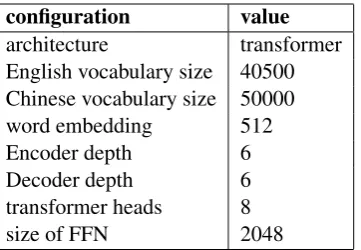
configuration value architecture transformer English vocabulary size 40500 Chinese vocabulary size 50000 word embedding 512 Encoder depth 6 Decoder depth 6 transformer heads 8
size of FFN 2048
Table 2: The main model configuration. FFN means feed forward network.
parameter value
maximum sentence length 100
batch fit true
learning rate 0.0003 label-smoothing 0.1
optimizer Adam
learning rate warmup 16000
[image:4.595.94.275.61.186.2]clip gradient 5
Table 3: The training and decoding parameter.
data number
original data 22,587,593
cleaning by rules and TM 17,969,826 original synthetic data 9,061,023 synthetic sentences cleaning by LM 4,981,288
Table 4: Cleaning parallel data and synthetic data. TM means translation model and LM means language model.
the parallel data filtering. During the training pro-cedure the number of BPE merge operation is set to 40,000 for both English and Chinese. The hy-perparameter of our baseline model configuration is shown in Table2 and the training parameter is in Table 3. After the baseline, we filter parallel data through rules and translation model. The rela-tive punctuation frequency threshold and absolute punctuation frequency threshold we mentioned in section 3 is 5 and 15 respectively. We construct the synthetic data with back translation baseline model from Chinese to English. The synthetic data is firstly filtered by Chinese language model and then filtered by English language model. Ta-ble4 shows the detail information about the data filtering.
In general, we trained 3 models to explore the effect of data filtering, which are: 1.
base-line model with provided parallel sentences; 2. baseline model with parallel sentences filtered by rules and translation model; 3. baseline model with sentences mixed parallel sentences filtered by rules and translation model and synthetic sen-tences filtered by language model. Beside the baseline models, we trained four groups of trans-lation model with fully filtered parallel data and synthetic data. Each model in the four groups is trained with different random seed and also apply Annealing Adam which get better performance compared with Adam. Therefore, we got 8 differ-ent translation models with the filtered data. We applied the greedy ensemble strategy to combine the 8 models and finally obtain the best translation performance on the development set with 3 mod-els. Another, the right-to-left model in target side is also trained to rerank n-best translation of three best translation performance models.
6 Result and analysis
Table 5 shows the BLEU score we evaluated on development set. For data filtering, we observed that the methods improve the quality of sentences and get a better BLEU score. The methods can solve some problems of corpus quality. For model training techniques, back-translation is still the most effective method of improvement on 3.83-3.93 BLEU score. Annealing Adam has an im-provement of BLEU score ranging from 0.04 to 0.36. The evaluation table shows that the higher BLEU score we get from the neural machine trans-lation model, the smaller improvement can we get from Annealing Adam. When ensemble decoding, the greedy ensemble decoding strategy get the im-provement on 0.56 BLEU score. However, when trying to decode our models ensemble with right-to-left reranking it did not improve the BLEU score as we expected.
Regard to the official evaluation we add one more post-processing step which is to convert all the SBC punctuation to DBC punctuation and it consequently further improved the BLEU score form 43.2 to 43.8.
7 Summary
[image:4.595.97.267.232.346.2] [image:4.595.76.298.382.453.2]model BLEU
baseline with PS 34.38
+ Annealing Adam 34.74
clean PS by rules and TM 35.42
+ Annealing Adam 35.56
mix cleaned PS and SS cleaned by LM 39.35
+ Annealing Adam 39.39
greedy ensemble decoding 39.95
[image:5.595.76.296.63.188.2]r2l reranking 39.91
Table 5: The BLEU score in character level for devel-opment set of English-to-Chinese direction. SS means synthetic sentences, TM means translation model, LM means language model and PS means parallel sen-tences. The greedy ensemble decoding means decod-ing the 8 models and finally obtain the best translation performance on development set with 3 models.
language model and trained translation model and showed the improvement of the data filtering, as well as constructing the synthetic through the back translation approach. In the training and decoding aspect, we applied transformer architecture as our main machine translation framework. To optimize it we utilized Annealing Adam optimize function and ensemble decoding. We also found that right to left reranking is not working according to our experiments.
Acknowledgments
This work is supported by 2020 Cognitive Intelli-gence Research Institute1of Global Tone
Commu-nication Technology Co., Ltd.2
References
Dzmitry Bahdanau, Kyunghyun Cho, and Yoshua Bengio. 2014. Neural machine translation by jointly learning to align and translate. CoRR, abs/1409.0473.
Michael J. Denkowski and Graham Neubig. 2017. Stronger baselines for trustable results in neural ma-chine translation. CoRR, abs/1706.09733.
Marcin Junczys-Dowmunt, Roman Grundkiewicz, Tomasz Dwojak, Hieu Hoang, Kenneth Heafield, Tom Neckermann, Frank Seide, Ulrich Germann, Alham Fikri Aji, Nikolay Bogoychev, Andr F. T. Martins, and Alexandra Birch. 2018. Marian: Fast neural machine translation in c++. arXiv preprint
arXiv:1804.00344.
1http://www.2020nlp.com/ 2http://www.gtcom.com.cn/
Philipp Koehn, Hieu Hoang, Alexandra Birch, Chris Callison-Burch, Marcello Federico, Nicola Bertoldi, Brooke Cowan, Wade Shen, Christine Moran, Richard Zens, et al. 2007. Moses: Open source toolkit for statistical machine translation. In Pro-ceedings of the 45th annual meeting of the ACL on interactive poster and demonstration sessions, pages 177–180. Association for Computational Linguis-tics.
Kishore Papineni, Salim Roukos, Todd Ward, and Wei-Jing Zhu. 2002. Bleu: a method for automatic eval-uation of machine translation. In Proceedings of the 40th annual meeting on association for compu-tational linguistics, pages 311–318. Association for Computational Linguistics.
Rico Sennrich, Barry Haddow, and Alexandra Birch. 2015a. Improving neural machine translation models with monolingual data. arXiv preprint
arXiv:1511.06709.
Rico Sennrich, Barry Haddow, and Alexandra Birch. 2015b. Neural machine translation of rare words with subword units. arXiv preprint
arXiv:1508.07909.
Rico Sennrich, Barry Haddow, and Alexandra Birch. 2016. Edinburgh neural machine translation sys-tems for WMT 16. CoRR, abs/1606.02891.
J Sun. 2012. jiebachinese word segmentation tool.
Jrg Tiedemann. 2012. Parallel data, tools and inter-faces in opus. InProceedings of the Eight Interna-tional Conference on Language Resources and
Eval-uation (LREC’12), Istanbul, Turkey. European
Lan-guage Resources Association (ELRA).
Ashish Vaswani, Noam Shazeer, Niki Parmar, Jakob Uszkoreit, Llion Jones, Aidan N Gomez, Łukasz Kaiser, and Illia Polosukhin. 2017a. Attention is all you need. InAdvances in Neural Information Pro-cessing Systems, pages 5998–6008.
Ashish Vaswani, Noam Shazeer, Niki Parmar, Jakob Uszkoreit, Llion Jones, Aidan N. Gomez, Lukasz Kaiser, and Illia Polosukhin. 2017b. Attention is all you need. CoRR, abs/1706.03762.