Vector-space models for PPDB paraphrase ranking in context
Marianna Apidianaki
LIMSI, CNRS, Universit´e Paris-Saclay 91403 Orsay, France
Abstract
The PPDB is an automatically built database which contains millions of paraphrases in dif-ferent languages. Paraphrases in this resource are associated with features that serve to their ranking and reflect paraphrase quality. This context-unaware ranking captures the seman-tic similarity of paraphrases but cannot serve to estimate their adequacy in specific con-texts. We propose to use vector-space se-mantic models for selectingPPDBparaphrases that preserve the meaning of specific text frag-ments. This is the first work that addresses the substitutability of PPDB paraphrases in con-text. We show that vector-space models of meaning can be successfully applied to this task and increase the benefit brought by the use of thePPDBresource in applications.
1 Introduction
Paraphrases are alternative ways to convey the same information and can improve natural language pro-cessing by making systems more robust to lan-guage variability and unseen words. The paraphrase database (PPDB) (Ganitkevitch et al., 2013) contains millions of automatically acquired paraphrases in 21 languages associated with features that serve to their ranking. In PPDB’s most recent release (2.0), such features include natural logic entailment rela-tions, distributional and word embedding similari-ties, formality and complexity scores, and scores as-signed by a supervised ranking model (Pavlick et al., 2015b). These features serve to identify good qual-ity paraphrases but do not say much about their sub-stitutability in context.
To judge the adequacy of paraphrases for specific instances of words or phrases, the surrounding con-text needs to be considered. This can be done using vector-space models of semantics which calculate the meaning of word occurrences in context based on distributional representations (Mitchell and La-pata, 2008; Erk and Pad´o, 2008; Dinu and LaLa-pata, 2010; Thater et al., 2011). These models capture the influence of the context on the meaning of a target word through vector composition. More precisely, they represent the contextualised meaning of a target word w in context c by a vector obtained by com-bining the vectors ofwandcusing some operation such as component-wise multiplication or addition (Thater et al., 2011). We use this kind of represen-tations to rank thePPDB paraphrases in context and retain the ones that preserve the semantics of spe-cific text fragments. We evaluate the vector-based ranking models on data hand-annotated with lexical variants and compare the obtained ranking to confi-dence estimates available in thePPDB, highlighting the importance of context filtering for paraphrase se-lection.
2 Context-based paraphrase ranking 2.1 Paraphrase substitutability
ThePPDB1provides millions of lexical, phrasal and syntactic paraphrases in 21 languages – acquired by applying bi- and multi-lingual pivoting on par-allel corpora (Bannard and Callison-Burch, 2005) – and is largely exploited in applications (Denkowski and Lavie, 2010; Sultan et al., 2014; Faruqui et al.,
1http://paraphrase.org/#/download
2015). PPDBparaphrases come into packages of dif-ferent sizes (going fromS toXXXL): smaller pack-ages contain high-precision paraphrases while larger ones aim for high coverage. Until now, pivot para-phrases have been used as equivalence sets (i.e. all paraphrases available for a word are viewed as se-mantically equivalent) and their substitutability in context has not yet been addressed.
Substitutability might be restrained by several factors which make choosing the appropriate para-phrase for a word or para-phrase in different contexts a non-trivial task. In case of polysemous words, para-phrases describe different meanings and can lead to erroneous semantic mappings if substituted in texts (Apidianaki et al., 2014; Cocos and Callison-Burch, 2016). Even when paraphrases capture the same general sense, they are hardly ever equiva-lent synonyms and generally display subtle differ-ences in meaning, connotation or usage (Edmonds and Hirst, 2002). Stylistic variation might also be present within paraphrase sets and substituting para-phrases that differ in terms of complexity and for-mality can result in a change in style (Pavlick and Nenkova, 2015). To increase paraphrase applicabil-ity in context, Pavlick et al. (2015a) propose to ex-tract domain-specific pivot paraphrases by biasing the parallel training data used by the pivot method towards a specific domain. This customised model greatly improves paraphrase quality for the target domain but does not allow to rank and filter the paraphrases already in the PPDB according to spe-cific contexts. To our knowledge, this is the first work that addresses the question of in-context sub-stitutability ofPPDBparaphrases. We show how ex-isting substitutability models can be applied to this task in order to increase the usefulness of this large-scale resource in applications.
2.2 Vector-space models of paraphrase adequacy
Vector-based models of meaning determine a grad-ual concept of semantic similarity which does not rely on a fixed set of dictionary senses. They are used for word sense discrimination and induction (Sch¨utze, 1998; Turney and Pantel, 2010) and can capture the contextualised meaning of words and phrases (Mitchell and Lapata, 2008; Erk and Pad´o, 2008; Thater et al., 2011). Vector composition
meth-ods build representations that go beyond individual words to obtain word meanings in context. Some models use explicit sense representations while oth-ers modify the basic meaning vector of a target word with information from the vectors of the words in its context. In the framework proposed by Dinu and Lapata (2010), for example, word meaning is rep-resented as a probability distribution over a set of latent senses reflecting the out-of-context likelihood of each sense, and the contextualised meaning of a word is modeled as a change in the original sense distribution.2 Reisinger and Mooney (2010) pro-pose a multi-prototype vector-space model of mean-ing which produces multiple “sense-specific” vec-tors for each word, determined by clustering the con-texts in which the word appears (Sch¨utze, 1998). The cluster centroids serve as prototype vectors de-scribing a word’s senses and the meaning of a spe-cific occurrence is determined by choosing the vec-tor that minimizes the distance to the vecvec-tor repre-senting the current context. On the contrary, Thater et al. (2011) use no explicit sense representation. Their models allow the computation of vector repre-sentations for individual uses of words, characteris-ing the specific meancharacteris-ing of a target word in its sen-tential context. When used for paraphrase ranking, these models derive a contextualised vector for a tar-get word by reweighting the components of its basic meaning vector on the basis of the context of oc-currence.3 Paraphrase candidates for a target word are then ranked according to the cosine similarity of their basic vector representation to the contextu-alised vector of the target.4
3 Experimental Set-up
DataIn our experiments, we use the COINCO cor-pus (Kremer et al., 2014), a subset of the “Man-ually Annotated Sub-Corpus” MASC (Ide et al., 2010) which comprises more than 15K word
in-2The latent senses are induced using non-negative matrix
factorization (NMF) (Lee and Seung, 2001) and latent Dirichlet allocation (LDA) (Blei et al., 2003).
3Depending on the model, the vector combination function
might be addition or multiplication of vector elements.
4Thater et al.’s (2011) models delivered best results in
|P|>1 |P| ≥1
PPDB # Instances # Lemmas Avg|P| # Instances
S 2146 560 2.67 5573
M 3716 855 2.92 7771
L 6228 1394 3.57 10100
XL 13344 2822 10.33 14060
[image:3.612.78.295.55.135.2]XXL 14507 3308 185.09 14593
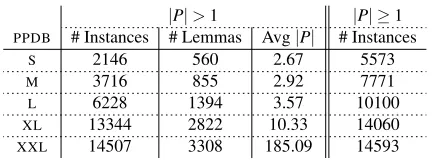
Table 1: Number of COINCOinstances and distinct lemmas covered by eachPPDBpackage.
stances manually annotated with single and multi-word substitutes. The manual annotations serve to evaluate the performance of the vector-space models on the task of rankingPPDB paraphrases. For each annotated English target word (noun, verb, adjective or adverb) in COINCO, we collect the lexical para-phrases (P={p1,p2, ...,pn}) available for the word in eachPPDBpackage (fromStoXXL).5 We do not filter by syntactic label as annotations often include substitutes of different grammatical categories. Ta-ble 1 shows the number of COINCO tokens with paraphrases in each PPDB package and the average size of the retained paraphrase sets. The larger the size of the resource, the greater the coverage of tar-get words in COINCO. The last column of the table gives the total number of instances covered, includ-ing the ones with only one paraphrase. In the rank-ing experiments, we focus on lemmas havrank-ing more than one paraphrase in thePPDB.6
MethodologyWe follow the methodology proposed in Kremer et al. (2014) to explore the extent to which vector-based models can select appropriate paraphrases for words in context. Given a target word w in a sentential context and a set of para-phrasesPextracted forwfrom aPPDBpackage, the task is to rank the elements inPaccording to their adequacy as paraphrases ofwin the given context.
We carry out experiments with three versions of the Thater et al. (2011) ranking model: (a) a
syntactically structured model (Syn.Vec) that uses vectors recording co-occurrences based on depen-dency triples, explicitly recording syntactic role
in-5Since the XXL package covers almost all annotated
in-stances in COINCO(14,507 out of 15,629) and there are 185.09 paraphrases in average for each instance, we exclude theXXXL
package from these experiments.
6We retain paraphrases of the lemmatised forms of the
tar-get words but these unsupervised ranking models can be easily applied to the wholePPDBresource and in different languages.
formation within the vectors; (b) asyntactically fil-tered model(Filter.Vec) using dependency-based co-occurrence information without explicitly represent-ing the syntactic role in the vector representations, as in Pad´o and Lapata (2007); (c) a bag of words model (Bow.Vec) using a window of ± 5 words. Co-occurrence counts were extracted from the En-glish Gigaword corpus7 analysed with Stanford de-pendencies (de Marneffe et al., 2006). The syntactic model vectors are based on dependency triples that occur at least 5 times in the corpus and have a PMI score of at least 2. The same thresholds apply to the bag of words model where the frequency thresh-old defines the minimum number of times that two words have been observed in the same context win-dow. The task of the vector-space models for each target word instance is to rank the contents of the corresponding paraphrase set (which contains all the substitution candidates available for the target in the PPDB) so that the actual substitutes are ranked higher than the rest. For example, newspaper, manuscript
and document are good paraphrase candidates for
paperbut we would expectnewspaperto be ranked higher than the other two in this sentence: “the pa-per’s local administrator”.
A contextualised vector is derived from the ba-sic meaning vector of a target word wby reinforc-ing its dimensions that are licensed by the context of the specific instance under consideration. In the Bow.Vec model, the context is made up of 5 words before and after the target while in the syntactic models, it corresponds to the target’s direct syntac-tic dependents. The contextualised vector forw is obtained through vector addition and contains infor-mation about the context words. Paraphrase can-didates are ranked according to the cosine similar-ity between the contextualised vector of the target word and the basic meaning vectors of the candi-dates. Following Kremer et al. (2014), we com-pare the resulting ranked list to the COINCO gold standard annotation (the paraphrase set of the tar-get instance) using Generalised Average Precision (GAP) (Kishida, 2005) and annotation frequency as weights. GAP scores range between 0 and 1: a score of 1 indicates a perfect ranking in which all correct substitutes precede all incorrect ones, and
PPDB Bow.Vec Syn.Vec Filter.Vec Google AGiga Ppdb1 Ppdb2 Parprob Random (5)
|
P
|
>
1
S 0.91 0.91 0.91 0.78 0.86 0.66 0.83 0.66 0.78
M 0.91 0.91 0.92 0.79 0.87 0.68 0.84 0.68 0.79
L 0.90 0.90 0.91 0.78 0.85 0.66 0.83 0.66 0.77
XL 0.78 0.79 0.79 0.58 0.67 0.44 0.66 0.43 0.58
XXL 0.53 0.56 0.57 0.27 0.36 0.12 0.58 0.12 0.27
|
P
|≥
1
S 0.97 0.97 0.97 0.91 0.95 0.87 0.93 0.87 0.91
M 0.96 0.96 0.96 0.90 0.94 0.85 0.92 0.85 0.90
L 0.94 0.94 0.94 0.87 0.91 0.79 0.90 0.79 0.86
XL 0.79 0.80 0.80 0.60 0.69 0.47 0.68 0.46 0.60
[image:4.612.85.529.57.193.2]XXL 0.54 0.56 0.58 0.28 0.37 0.13 0.59 0.14 0.28
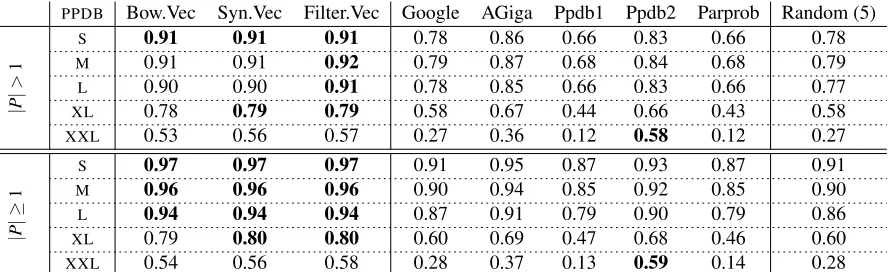
Table 2:Average GAP scores for the contextual models, five paraphrase adequacy methods and the random ranking baseline against the gold COINCOannotations. Scores reported for different sizes of the PPDB (from S to XXL).
correct high-weight substitutes precede low-weight ones. For calculating the GAP score, we assign a very low score (0.001) to paraphrases that are not present in COINCO for a target word (i.e. not pro-posed by the annotators).
4 Results
The average GAP scores obtained by the three vector-space models (Bow.Vec, Syn.Vec and Fil-ter.Vec) are shown in Table 2. The upper part of the table reports scores obtained for words with more than one paraphrase in thePPDB(|P|>1) while the
lower part gives the scores for all words.
We compare the GAP scores to five different rankings reflecting paraphrase quality in the PPDB (Pavlick et al., 2015b). We retain the following scores: 1. AGigaSim captures the distributional similarity of a phrasee1 and its paraphrasee2 com-puted according to contexts observed in the Anno-tated Gigaword corpus (Napoles et al., 2011); 2.
GoogleNgramSim reflects the distributional simi-larity ofe1 ande2 computed according to contexts observed in the Google Ngram corpus (Brants and Franz, 2006); 3. ParProb: the paraphrase proba-bility of e2 given the original phrase e1 (Bannard and Callison-Burch, 2005); 4. Ppdb1: the heuris-tic scoring used for ranking in the original release of thePPDB (Ganitkevitch et al., 2013); 5. Ppdb2: the improved ranking of English paraphrases avail-able inPPDB 2.0. The results are also compared to the output of a baseline where the paraphrases are randomly ranked. The reported baseline figures are PPDB package-specific since a different paraphrase set is retained from each package, and correspond
to averages over 5 runs. The quality of the rank-ing produced by the baseline clearly decreases as the size of thePPDBresource increases due to the higher number of retained paraphrases which makes rank-ing harder.
The results in the upper part of the table show that the vector-space models provide a better rank-ing than thePPDBestimates and largely outperform the random baseline. The three models perform similarly on this ranking task according to average GAP with the syntactically-informed models getting slightly higher scores. Differences between Syn.Vec and Filter.Vec, as well as between Bow.Vec and the syntactic models, are highly significant in the XL and XXLpackages (p-value <0.001) as computed
with approximate randomisation (Pad´o, 2006). In theL package, the difference between Syn.Vec and Filter.Vec is significant (p <0.05) and the one
be-tween Bow.Vec and Filter.Vec is highly significant. Finally, in the M package, only the difference be-tween Bow.Vec and Filter.Vec is significant (p <
0.05), while Syn.Vec and Filter.Vec seem to deal similarly well with the contents of this package.
used to fit a regression to the features available in PPDB1.0 plus numerous new features including co-sine word embedding similarity, lexical overlap fea-tures, WordNet features and distributional similarity features.8 The small difference observed between the Ppdb2 and the syntactic models score in the XXLpackage is highly significant. For the moment, Ppdb2 scores are available in thePPDBonly for En-glish. Since the vector-space methodology is unsu-pervised and language independent, it could be eas-ily applied to paraphrase ranking in other languages. The performance of the models remains high with the XL package which contains paraphrase sets of reasonable size (about 10 paraphrases per word) and ensures a high coverage, and lowers in XXLwhich contains 185 paraphrases in average per word (cf. Table 1). To use this package more efficiently, one could initially reduce the number of erroneous para-phrases on the basis of the Ppdb2 score which pro-vides a good ranking of the XXLpackage contents before applying the vector-based models.
The increase in GAP score observed when words with one paraphrase are considered shows that these paraphrases are often correct. Here too, the contex-tual models provide a better ranking than the out-of-context scores and outperform the random baseline. As in the previous case, the Ppdb2 score is slightly higher in theXXLpackage.
5 Conclusion
We have shown that vector-based models of seman-tics can be successfully applied to in-context ranking of PPDB paraphrases. Allowing for better context-informed substitutions, they can be used to filter PPDBparaphrases on the fly and select variants pre-serving the correct semantics of words and phrases in texts. This processing would be beneficial to nu-merous applications that need paraphrase support (e.g. summarisation, query reformulation and lan-guage learning), providing a practical means for ex-ploiting the extensive multilingual knowledge avail-able in thePPDBresource.
This study opens up many avenues for future work. Although tested on English, the proposed methodology can be applied to all languages in the
8The features used for computing the paraphrase ranking in PPDB2.0 are described in detail in Pavlick et al. (2015b).
PPDB even to the ones that do not dispose of a de-pendency parser (as shown by the high performance of the Bow.Vec models).
An ideal testbed for evaluation in a real applica-tion and on multiple languages is offered by MT evaluation. The METEOR-NEXTmetric (Denkowski and Lavie, 2010) provides a straightforward frame-work for testing as it already exploits PPDB para-phrases for capturing sense correspondences be-tween text fragments. In its current version, the met-ric views paraphrases as equivalent classes which can lead to erroneous sense mappings due to seman-tic distinctions present in the paraphrase sets. We have recently showed that the context-based filtering of semantic variants improvesMETEOR’s correlation with human judgments of translation quality (Marie and Apidianaki, 2015). We believe that a context-based paraphrase ranking mechanism will enhance correct substitutions and further improve the met-ric. Last but not least, the paraphrase vectors can be used for mapping the contents of thePPDBresource to other multilingual resources for which vector rep-resentations are available (Camacho-Collados et al., 2015a; Camacho-Collados et al., 2015b). The in-terest of mapping paraphrases in the vector space to concepts found in existing semantic resources is twofold: it would permit to analyse the seman-tics of the paraphrases by putting them into corre-spondence with explicit concept representations and would serve to enrich other semantic resources (e.g. BabelNet synsets) with semantically similar para-phrases.
Handling phrasal paraphrases is another natural extension of this work. We consider using a vector space model of semantic composition to calculate the meaning of longer candidate paraphrases (Dinu et al., 2013; Paperno et al., 2014) and select appro-priate substitutes for phrases in context.
Acknowledgments
References
Marianna Apidianaki, Emilia Verzeni, and Diana Mc-Carthy. 2014. Semantic Clustering of Pivot Para-phrases. InProceedings of LREC, Reykjavik, Iceland. Colin Bannard and Chris Callison-Burch. 2005. Para-phrasing with Bilingual Parallel Corpora. In Proceed-ings of ACL, pages 597–604, Ann Arbor, Michigan, USA.
David M. Blei, Andrew Y. Ng, and Michael I. Jordan. 2003. Latent dirichlet allocation. Journal of Machine Learning Research, 3:993–1022.
Thorsten Brants and Alex Franz. 2006. The Google Web 1T 5-gram Corpus Version 1.1. LDC2006T13, Philadelphia.
Jos´e Camacho-Collados, Mohammad Taher Pilehvar, and Roberto Navigli. 2015a. Nasari: a novel approach to a semantically-aware representation of items. In Pro-ceedings of the 2015 Conference of the North Ameri-can Chapter of the Association for Computational Lin-guistics: Human Language Technologies, pages 567– 577, Denver, Colorado, May–June.
Jos´e Camacho-Collados, Mohammad Taher Pilehvar, and Roberto Navigli. 2015b. A unified multilingual se-mantic representation of concepts. InProceedings of the 53rd Annual Meeting of the Association for Com-putational Linguistics and the 7th International Joint Conference on Natural Language Processing (Volume 1: Long Papers), pages 741–751, Beijing, China, July. Anne Cocos and Chris Callison-Burch. 2016. Clustering paraphrases by word sense. In The 2016 Conference of the North American Chapter of the Association for Computational Linguistics (NAACL 2016), San Diego, California, USA.
Marie-Catherine de Marneffe, Bill MacCartney, and Christopher D. Manning. 2006. Generating typed de-pendency parses from phrase structure parses. In To appear at LREC-06.
Michael Denkowski and Alon Lavie. 2010. METEOR-NEXT and the METEOR Paraphrase Tables: Im-proved Evaluation Support for Five Target Languages. In Proceedings of WMT/MetricsMATR, pages 339– 342, Uppsala, Sweden.
Georgiana Dinu and Mirella Lapata. 2010. Measuring distributional similarity in context. InProceedings of the 2010 Conference on Empirical Methods in Natural Language Processing, pages 1162–1172, Cambridge, MA, October.
Georgiana Dinu, Nghia The Pham, and Marco Baroni. 2013. Dissect - distributional semantics composition toolkit. InProceedings of the 51st Annual Meeting of the Association for Computational Linguistics: System Demonstrations, pages 31–36, Sofia, Bulgaria, Au-gust.
Philip Edmonds and Graeme Hirst. 2002. Near-Synonymy and Lexical Choice. Computational Lin-guistics, 28(2):105–144.
Katrin Erk and Sebastian Pad´o. 2008. A Structured Vector Space Model for Word Meaning in Context. InProceedings of EMNLP, pages 897–906, Honolulu, Hawaii.
Manaal Faruqui, Jesse Dodge, Sujay Kumar Jauhar, Chris Dyer, Eduard Hovy, and Noah A. Smith. 2015. Retrofitting word vectors to semantic lexicons. In Pro-ceedings of the 2015 Conference of the North Ameri-can Chapter of the Association for Computational Lin-guistics: Human Language Technologies, pages 1606– 1615, Denver, Colorado.
Juri Ganitkevitch, Benjamin VanDurme, and Chris Callison-Burch. 2013. PPDB: The Paraphrase Database. InProceedings of NAACL, Atlanta, Geor-gia, USA.
Nancy Ide, Collin Baker, Christiane Fellbaum, and Re-becca Passonneau. 2010. The manually annotated sub-corpus: A community resource for and by the peo-ple. InProceedings of the ACL 2010 Conference Short Papers, pages 68–73, Uppsala, Sweden.
Kazuaki Kishida. 2005. Property of average precision and its generalization: An examination of evaluation indicator for information retrieval experiments. Tech-nical report, TechTech-nical Report NII-2005-014E. Gerhard Kremer, Katrin Erk, Sebastian Pad´o, and Stefan
Thater. 2014. What Substitutes Tell Us - Analysis of an ”All-Words” Lexical Substitution Corpus. In Pro-ceedings of EACL, pages 540–549, Gothenburg, Swe-den.
Daniel D. Lee and H. Sebastian Seung. 2001. Algo-rithms for non-negative matrix factorization. In Ad-vances in Neural Information Processing Systems 13 (NIPS 2000), pages 556–562. MIT Press.
Benjamin Marie and Marianna Apidianaki. 2015. Alignment-based sense selection in METEOR and the RATATOUILLE recipe. In Proceedings of WMT, pages 385–391, Lisbon, Portugal.
Diana McCarthy and Roberto Navigli. 2007. Semeval-2007 task 10: English lexical substitution task. In Proceedings of the Fourth International Workshop on Semantic Evaluations (SemEval-2007), pages 48–53, Prague, Czech Republic.
Jeff Mitchell and Mirella Lapata. 2008. Vector-based Models of Semantic Composition. InProceedings of ACL/HLT, pages 236–244, Columbus, Ohio, USA. Courtney Napoles, Chris Callison-Burch, Juri
Sebastian Pado and Mirella Lapata. 2007. Dependency-based construction of semantic space models. Compu-tational Linguistics, 33(2):161–199.
Sebastian Pad´o, 2006. User’s guide to sigf: Signifi-cance testing by approximate randomisation.
Denis Paperno, Nghia The Pham, and Marco Baroni. 2014. A practical and linguistically-motivated ap-proach to compositional distributional semantics. In Proceedings of the 52nd Annual Meeting of the Associ-ation for ComputAssoci-ational Linguistics (Volume 1: Long Papers), pages 90–99, Baltimore, Maryland, June. Ellie Pavlick and Ani Nenkova. 2015. Inducing lexical
style properties for paraphrase and genre differentia-tion. In Proceedings of the 2015 Conference of the North American Chapter of the Association for Com-putational Linguistics: Human Language Technolo-gies, pages 218–224, Denver, Colorado.
Ellie Pavlick, Juri Ganitkevitch, Tsz Ping Chan, Xuchen Yao, Benjamin Van Durme, and Chris Callison-Burch. 2015a. Domain-Specific Paraphrase Extraction. In Proceedings of ACL/IJCNLP, pages 57–62, Beijing, China.
Ellie Pavlick, Pushpendre Rastogi, Juri Ganitkevitch, Benjamin Van Durme, and Chris Callison-Burch. 2015b. PPDB 2.0: Better paraphrase ranking, fine-grained entailment relations, word embeddings, and style classification. In Proceedings of ACL/IJCNLP, pages 425–430, Beijing, China.
Joseph Reisinger and Raymond J. Mooney. 2010. Multi-prototype vector-space models of word meaning. In Human Language Technologies: The 2010 Annual Conference of the North American Chapter of the As-sociation for Computational Linguistics, pages 109– 117, Los Angeles, California.
Hinrich Sch¨utze. 1998. Automatic Word Sense Discrim-ination. Computational Linguistics, 24:97–123. Md Arafat Sultan, Steven Bethard, and Tamara Sumner.
2014. Dls@cu: Sentence similarity from word align-ment. InProceedings of the 8th International Work-shop on Semantic Evaluation (SemEval 2014), pages 241–246, Dublin, Ireland, August.
Stefan Thater, Hagen F¨urstenau, and Manfred Pinkal. 2011. Word Meaning in Context: A Simple and Effec-tive Vector Model. InProceedings of IJCNLP, pages 1134–1143, Chiang Mai, Thailand.