Automatic Feature Engineering for Answer Selection and Extraction
Aliaksei Severyn DISI, University of Trento
38123 Povo (TN), Italy [email protected]
Alessandro Moschitti Qatar Computing Research Institue
5825 Doha, Qatar [email protected]
Abstract
This paper proposes a framework for automat-ically engineering features for two important tasks of question answering: answer sentence selection and answer extraction. We represent question and answer sentence pairs with lin-guistic structures enriched by semantic infor-mation, where the latter is produced by auto-matic classifiers, e.g., question classifier and Named Entity Recognizer. Tree kernels ap-plied to such structures enable a simple way to generate highly discriminative structural fea-tures that combine syntactic and semantic in-formation encoded in the input trees. We con-duct experiments on a public benchmark from TREC to compare with previous systems for answer sentence selection and answer extrac-tion. The results show that our models greatly improve on the state of the art, e.g., up to 22% on F1 (relative improvement) for answer ex-traction, while using no additional resources and no manual feature engineering.
1 Introduction
Question Answering (QA) systems are typically built from three main macro-modules: (i) search and retrieval of candidate passages; (ii) reranking or se-lection of the most promising passages; and (iii) an-swer extraction. The last two steps are the most in-teresting from a Natural Language Processing view-point since deep linguistic analysis can be carried out as the input is just a limited set of candidates.
Answer sentence selection refers to the task of se-lecting the sentence containing the correct answer
among the different sentence candidates retrieved by a search engine.
Answer extraction is a final step, required for factoid questions, consisting in extracting multi-words constituting the synthetic answer, e.g.,Barack Obamafor a question:Who is the US president?
The definition of rules for both tasks is conceptually demanding and involves the use of syntactic and se-mantic properties of the questions and its related an-swer passages.
For example, given a question from TREC QA1:
Q: What was Johnny Appleseed’s real name?
and a relevant passage, e.g., retrieved by a search engine:
A: Appleseed, whose real name was John Chapman, planted many trees in the early 1800s.
a rule detecting the semantic links betweenJohnny Appleseed’s real name and the correct answer
John Chapman in the answer sentence has to be engineered. This requires the definition of other rules that associate the question pattern
real name ?(X) with real name is(X) of
the answer sentence. Although this can be done by an expert NLP engineer, the effort for achieving the necessary coverage and a reasonable accuracy is not negligible.
An alternative to manual rule definition is the use of machine learning, which often shifts the problem
1We use it as our running example in the rest of the paper.
to the easier task of feature engineering. Unfortu-nately, when the learning task is semantically dif-ficult such as in QA, e.g., features have to encode combinations of syntactic and semantic properties. Thus their extraction modules basically assume the shape of high-level rules, which are, in any case, es-sential to achieve state-of-the-art accuracy. For ex-ample, the great IBM Watson system (Ferrucci et al., 2010) uses a learning to rank algorithm fed with hundreds of features. The extraction of some of the latter requires articulated rules/algorithms, which, in terms of complexity, are very similar to those constituting typical handcrafted QA systems. An immediate consequence is the reduced adaptability to new domains, which requires a substantial re-engineering work.
In this paper, we show that tree kernels (Collins and Duffy, 2002; Moschitti, 2006) can be applied to automatically learn complex structural patterns for both answer sentence selection and answer extrac-tion. Such patterns are syntactic/semantic structures occurring in question and answer passages. To make such information available to the tree kernel func-tions, we rely on the shallow syntactic trees enriched with semantic information (Severyn et al., 2013b; Severyn et al., 2013a), e.g., Named Entities (NEs) and question focus and category, automatically de-rived by machine learning modules, e.g., question classifier (QC) or focus classifier (FC).
More in detail, we (i) design a pair of shallow syntactic trees (one for the question and one for the answer sentence); (ii) connect them with relational nodes (i.e., those matching the same words in the question and in the answer passages); (iii) label the tree nodes with semantic information such as ques-tion category and focus and NEs; and (iv) use the NE type to establish additional semantic links between the candidate answer, i.e., an NE, and the focus word of the question. Finally, for the task of answer ex-traction we also connect such semantic information to the answer sentence trees such that we can learn factoid answer patterns.
We show that our models are very effective in pro-ducing features for both answer selection and ex-traction by experimenting with TREC QA corpora and directly comparing with the state of the art, e.g., (Wang et al., 2007; Yao et al., 2013). The re-sults show that our methods greatly improve on both
tasks yielding a large improvement in Mean Average Precision for answer selection and in F1 for answer extraction: up to 22% of relative improvement in F1, when small training data is used. Moreover, in con-trast to the previous work, our model does not rely on external resources, e.g., WordNet, or complex features in addition to the structural kernel model.
The reminder of this paper is organized as fol-lows, Sec. 2 describes our kernel-based classifiers, Sec. 3 illustrates our question/answer relational structures also enriched with semantic information, Sec. 4 describes our model for answer selection and extraction, Sec. 5 illustrates our comparative exper-iments on TREC data, Sec. 6 reports on our error analysis, Sec. 7 discusses the related work, and fi-nally, Sec. 8 derives the conclusions.
2 Structural Kernels for classification
This section describes a kernel framework where the input question/answer pairs are handled directly in the form of syntactic/semantic structures.
2.1 Feature vector approach to object pair classification
A conventional approach to represent a ques-tion/answer pairs in linear models consists in defin-ing a set of similarity features{xi}and computing
the simple scalar producth(xxx) =www·xxx=P
iwixi,
wherewwwis the model weight vector learned on the training data. Hence, the learning problem boils down to estimating individual weights of each of the similarity features xi. Such features often
en-code various types of lexical, syntactic and semantic similarities shared between a question and its can-didate. Previous work used a rich number of distri-butional semantic, knowledge-based, translation and paraphrase resources to build explicit feature vector representations. One evident potential downside of using feature vectors is that a great deal of structural information encoded in a given text pair is lost.
2.2 Pair Classification using Structural Kernels
A more versatile approach in terms of the input representation relies on kernels. A typical ker-nel machine, e.g., SVM, classifies a test input xxx using the following prediction function: h(xxx) =
P
iαiyiK(xx, xx xxi), where αi are the model
variables,xxxiare support vectors, andK(·,·)is a
ker-nel function. The latter can measure thesimilarity
between question and answer pairs.
We define each question/answer pairxxxas a triple composed of a question treeTTTqand answer sentence
treeTTTs and a similarity feature vectorvvv, i.e.,xxx =
hTTTq, TTTs, vvvi. Given two triplesxxxi andxxxj, we define
the following kernel:
K(xxxi, xxxj) = K
TK(TTTiq, TTT j q)
+ KTK(TTTis, TTT j s)
+ Kv(vvvi, vvvj),
(1)
where KTK computes a structural kernel, e.g., tree
kernel, andKvis a kernel over feature vectors, e.g.,
linear, polynomial, gaussian, etc. Structural kernels can capture the structural representation of a ques-tion/answer pair whereas traditional feature vectors can encode some sort of similarity, e.g., lexical, syn-tactic, semantic, between a question and its candi-date answer.
We prefer to split the kernel computation over a question/answer pair into two terms since tree ker-nels are very efficient and there are no efficient graph kernels that can encode exhaustively all graph fragments. It should be noted that the tree kernel sum does not capture feature pairs. Theoretically, for such purpose, a kernel product should be used. However, our experiments revealed that using the product is actually worse in practice. In contrast, we solve the lack of feature pairing by annotating the trees with relational tags which are supposed to link the question tree fragments with the related fragments from the answer sentence.
Such relational information is very important to improve the quality of the pair representation as well as the implicitly generated features. In the next sec-tion, we show simple structural models that we used in our experiments for question and answer pair clas-sification.
2.3 Partial Tree Kernels
The above framework can use any kernel for structural data. We use the Partial Tree Kernel (PTK) (Moschitti, 2006) to computeKTK(·,·)as it
is the most general convolution tree kernel, which at the same time shows rathergoodefficiency. PTK can be effectively applied to both constituency and
dependency parse trees. It generalizes the syntactic tree kernel (STK) (Collins and Duffy, 2002), which maps a tree into the space of all possible tree frag-ments constrained by the rule that sibling nodes can-not be separated. In contrast, the PTK fragments can contain any subset of siblings, i.e., PTK allows for breaking the production rules in syntactic trees. Consequently, PTK generates an extremely rich fea-ture space, which results in higher generalization ability.
3 Relational Structures
This section introduces relational structures de-signed to encode syntactic and shallow semantic properties of question/answer pairs. We first define a simple to construct shallow syntactic tree represen-tation derived from a shallow parser. Next, we in-troduce a relational linking scheme based on a plain syntactic matching and further augment it with ad-ditional semantic information.
3.1 Shallow syntactic tree
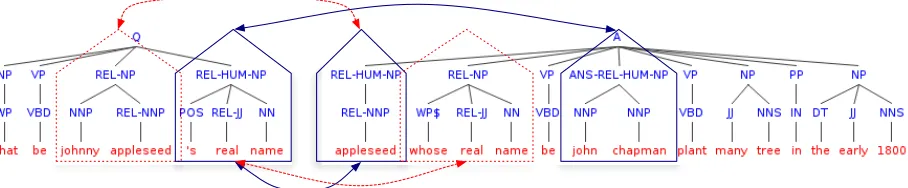
Our shallow tree structure is a two-level syntactic hierarchy built from word lemmas (leaves), part-of-speech tags that organized into chunks identified by a shallow syntactic parser (Fig. 1). We defined a similar structure in (Severyn and Moschitti, 2012) for answer passage reranking, which improved on feature vector baselines.
This simple linguistic representation is suitable for building a rather expressiveanswer sentence se-lectionmodel. Moreover, the use of a shallow parser is motivated by the need to generate text spans to produce candidate answers required by an answer extractionsystem.
3.2 Tree pairs enriched with relational links
Figure 1: Shallow tree representation of the example q/a pair from Sec. 1. Dashed arrows (red) indicate the tree fragments (red dashed boxes) in the question and its answer sentence linked by the relational RELtag, which is established via syntactic match on the word lemmas. Solid arrows (blue) connect a question focus wordnamewith the related named entities of typePersoncorresponding to the question category (HUM) via a relational tagREL-HUM. AdditionalANStag is used to mark chunks containing candidate answer (here the correct answerJohn Chapman).
higher probability to be correct answers following a mapping defined in Table 1.
Next, we briefly introduce our tree kernel-based models for building question focus and category classifiers.
Lexical Answer Type. Question Focus represents a central entity or a property asked by a question (Prager, 2006). It can be used to search for semanti-cally compatible candidate answers, thus greatly re-ducing the search space (Pinchak, 2006). While sev-eral machine learning approaches based on manual features and syntactic structures have been recently explored, e.g. (Quarteroni et al., 2012; Damljanovic et al., 2010; Bunescu and Huang, 2010), we opt for the latter approach where tree kernels handle auto-matic feature engineering.
To build an automatic Question Focus detector we use a tree kernel approach as follows: we (i) parse each question; (ii) create a set of positive trees by labeling the node exactly covering the focus with F C tag; (iii) build a set of negative trees by labeling any other constituent node withF C; (iii) we train theF C node classifier with tree kernels. At the test time, we try to label each constituent node withF C generating a set of candidate trees. Finally, we select the tree and thus the constituent associated with the highest SVM score.
Question classification.Our question classification model is simpler than before: we use an SVM multi-classifier with tree kernels to automatically extract the question class. To build a multi-class classifier we train a binary SVM for each of the classes and apply a one-vs-all strategy to obtain the predicted
Table 1: Expected Answer Type (EAT)→named entity types.
EAT Named Entity types
HUM Person
LOCATION Location
ENTITY Organization, Person, Misc DATE Date, Time, Number QUANTITY Number, Percentage CURRENCY Money, Number
class. We use constituency trees as our input repre-sentation.
Our question taxonomy is derived from the UIUIC dataset (Li and Roth, 2002) which defines 6 coarse and 50 fine grain classes. In particular, our set of question categories is formed by adopt-ing 3 coarse classes: HUM (human), LOC (loca-tion), ENTY (entities) and replacing the NUM (nu-meric) coarse class with 3 fine-grain classes: CUR-RENCY, DATE, QUANTITY2. This set of question categories is sufficient to capture the coarse seman-tic answer type of the candidate answers found in TREC. Also using fewer question classes results in a more accurate multi-class classifier.
Semantic tagging. Question focus word specifies the lexical answer type capturing the target informa-tion need posed by a quesinforma-tion, but to make this piece of information effective, the focus word needs to be linked to the target candidate answer. The focus word can be lexically matched with words present in
the answer sentence, or the match can be established using semantic information. Clearly, the latter ap-proach is more appealing since it helps to alleviate the lexical gap problem, i.e., it improves the cover-age of the n¨aive string matching of words between a question and its answer.
Hence, we propose to exploit a question focus along with the related named entities (according to the mapping from Table 1) of the answer sentence to establish relational links between the tree frag-ments. In particular, once the question focus and question category are determined, we link the fo-cus wordwf ocusin the question, with all the named
entities whose type matches the question class (Ta-ble 1). We perform tagging at the chunk level and use a relational tag typed with a question class, e.g.,
REL-HUM. Fig. 1 shows an example q/a pair where the typed relational tag is used in the shallow syntac-tic tree representation to link the chunk containing the question focusnamewith the named entities of the corresponding typePerson, i.e., Appleseed and
John Chapman.
4 Answer Sentence Selection and Answer Keyword Extraction
This section describes our approach to (i) answer sentence selection used to select the most promising answer sentences; and (ii) answer extraction which returns the answer keyword (for factoid questions).
4.1 Answer Sentence Selection
We cast the task of answer sentence selection as a classification problem. Considering a supervised learning scenario, we are given a set of questions {qi}Ni=1 where each question qi is associated with
a list of candidate answer sentences {(ri, si)}Ni=1,
withri ∈ {−1,+1}indicating if a given candidate
answer sentence si contains a correct answer (+1)
or not (−1). Using this labeled data, our goal is to learn a classifier model to predict if a given pair of a question and an answer sentence is correct or not. We train a binary SVM with tree kernels3to train an answer sentence classifier. The prediction scores ob-tained from a classifier are used to rerank the answer candidates (pointwise reranking), s.t. the sentences that are more likely to contain correct answers will
3disi.unitn.it/moschitti/Tree-Kernel.htm
be ranked higher than incorrect candidates. In addi-tion to the structural representaaddi-tion, we augment our model with basic bag-of-word features (unigram and bigrams) computed over lemmas.
4.2 Answer Sentence Extraction
The goal of answer extraction is to extract a text span from a given candidate answer sentence. Such span represents a correct answer phrase for a given ques-tion. Different from previous work that casts the an-swer extraction task as a tagging problem and apply a CRF to learn an answer phrase tagger (Yao et al., 2013), we take on a simpler approach using a kernel-based classifier.
In particular, we rely on the shallow tree represen-tation, where text spans identified by a shallow syn-tactic parser serve as a source of candidate answers. Algorithm 1 specifies the steps to generate training data for our classifier. In particular, for each ex-ample representing a tripleha, Tq, Tsicomposed of
the answera, the question and the answer sentence trees, we generate a set of training examplesEwith every candidate chunk marked with anANStag (one at a time). To reduce the number of generated exam-ples for each answer sentence, we only considerNP
chunks, since other types of chunks, e.g.,VP,ADJP, typically do not contain factoid answers. Finally, an original untagged tree is used to generate a positive example (line 8), when the answer sentence contains a correct answer, and a negative example (line 10), when it does not contain a correct answer.
At the classification time, given a question and a candidate answer sentence, all NP nodes of the sen-tence are marked with ANS (one at a time) as the possible answer, generating a set of tree candidates. Then, such trees are classified (using the kernel from Eq. 1) and the one with the highest score is selected. If no tree is classified as positive example we do not extract any answer.
5 Experiments
cor-Algorithm 1Generate training data for answer ex-traction
1: for allha, Tq, Tsi ∈DDDdo
2: E ← ∅
3: for allchunk∈extract chunks(Ts)do
4: ifnotchunk==NPthen 5: continue
6: Ts0 ←tagAnswerChunk(Ts, chunk)
7: ifcontains answer(a, chunk)then 8: label←+1
9: else
10: label← −1
11: e←build example(Tq, Ts0, label)
12: E←E∪ {e}
13: return E
rect answer keywords, i.e., a text span such as multi-words or constituents, from a given sentence.
5.1 Semantic Annotation
We briefly describe the experiments of training auto-matic question category and focus classifiers, which are more extensively described in (Severyn et al., 2013b).
Question Focus detection. We used three datasets for training and evaluating the performance of our focus detector: SeCo-600 (Quarteroni et al., 2012), Mooney GeoQuery (Damljanovic et al., 2010) and the dataset from (Bunescu and Huang, 2010). The SeCo dataset contains 600 questions. The Mooney GeoQuery contains 250 question targeted at ge-ographical information in the U.S. The first two datasets are very domain specific, while the dataset from (Bunescu and Huang, 2010) is more generic containing the first 2,000 questions from the answer type dataset from Li and Roth annotated with fo-cus words. We removed questions with implicit and multiple focuses.
[image:6.612.74.301.67.257.2]Question Classification. We used the UIUIC dataset (Li and Roth, 2002) which contains 5,952 factoid questions 4 to train a multi-class question classifier.
Table 2 summarizes the results of question focus and category classification.
4We excluded questions from TREC to ensure there is no overlap with the data used for testing models trained on TREC QA.
Table 2: Accuracy (%) of focus (FC) and question classi-fiers (QC) using PTK.
TASK SET PTK
FC
MOONEY 80.5
SECO-600 90.0 BUNESCU 96.9
QC UIUIC 85.9
TREC 11-12 78.1
5.2 Answer Sentence Selection
We used the train and test data from (Wang et al., 2007) to enable direct comparison with previous work on answer sentence selection. The training data is composed by questions drawn from TREC 8-12 while questions from TREC 13 are used for testing. The data provided for training comes as two sets: a small set of 94 questions (TRAIN) that were manually curated for errors5 and 1,229 ques-tions from the entire TREC 8-12 that contain at least one correct answer sentence (ALL). The latter set represents a more noisy setting, since many answer sentences are marked erroneously as correct as they simply match a regular expression. Table 3 summa-rizes the data used for training and testing.
Table 4 compares our kernel-based structural model with the previous state-of-the-art systems for answer sentence selection. In particular, we com-pare with four most recent state of the art answer sentence reranker models (Wang et al., 2007; Heil-man and Smith, 2010; Wang and Manning, 2010; Yao et al., 2013), which report their performance on the same questions and candidate sets from TREC 13 as provided by (Wang et al., 2007).
Our simple shallow tree representation (Severyn and Moschitti, 2012) delivers state-of-the-art ac-curacy largely improving on previous work. Fi-nally, augmenting the structure with semantic link-ing (Severyn et al., 2013b) yields additional im-provement in MAP and MRR. This suggests the utility of using supervised components, e.g., ques-tion focus and quesques-tion category classifiers coupled with NERs, to establish semantic mapping between words in a q/a pair.
5
[image:6.612.354.500.93.176.2]Table 3: Summary of TREC data for answer extraction used in (Yao et al., 2013).
data questions candidates correct
TRAIN 94 4718 348
ALL 1229 53417 6410
[image:7.612.82.291.190.304.2]TEST 89 1517 284
Table 4: Answer sentence reranking on TREC 13.
System MAP MRR
Wang et al. (2007) 0.6029 0.6852 Heilman & Smith (2010) 0.6091 0.6917 Wang & Manning (2010) 0.5951 0.6951 Yao et al. (2013) 0.6319 0.7270
+ WN 0.6371 0.7301
shallow tree (S&M, 2012) 0.6485 0.7244 + semantic tagging 0.6781 0.7358
It is worth noting that our kernel-based classifier is conceptually simpler than approaches in the previ-ous work, as it relies on the structural kernels, e.g., PTK, to automatically extract salient syntactic pat-terns relating questions and answers. Our model only includes the most basic feature vector (uni- and bi-grams) and does not rely on external sources such as WordNet.
5.3 Answer Extraction
Our experiments on answer extraction replicate the setting of (Yao et al., 2013), which is the most recent work on answer extraction reporting state-of-the-art results.
Table 5 reports the accuracy of our model in re-covering correct answers from a set of candidate an-swer sentences for a given question. Here the fo-cus is on the ability of an answer extraction system to recuperate as many correct answers as possible from each answer sentence candidate. The set of extracted candidate answers can then be used to se-lect a single best answer, which is the final output of the QA system for factoid questions. Recall (R) encodes the percentage of correct answer sentences for which the system correctly extracts an answer (for TREC 13 there are a total of 284 correct answer sentences), while Precision (P) reflects how many answers extracted by the system are actually correct.
Clearly, having a high recall system, allows for cor-rectly answering more questions. On the other hand, a high precision system would attempt to answer less questions (extracting no answers at all) but get them right.
We compare our results to a CRF model of (Yao et al., 2013) augmented with WordNet features (with-out forced voting)6. Unlike the CRF model which obtains higher values of precision, our system acts as a high recall system able to recover most of the answers from the correct answer sentences. Having higher recall is favorable to high precision in answer extraction since producing more correct answers can help in the final voting scheme to come up with a single best answer. To solve the low recall problem of their CRF model, Yao et al. (2013) apply fairly complex outlier resolution techniques to force an-swer predictions, thus aiming at increasing the num-ber of extracted answers.
To further boost the number of answers produced by our system we exclude negative examples (an-swer sentences not containing the correct an(an-swer) from training, which slightly increases the number of pairs with correctly recovered answers. Never-theless, it has a substantial effect on the number of questions that can be answered correctly (assuming perfect single best answer selection). Clearly, our system is able to recover a large number of answers from the correct answer sentences, while low pre-cision, i.e., extracting answer candidates from sen-tences that do not contain a correct answer, can be overcome by further applying various best answer selection strategies, which we explore in the next section.
5.4 Best Answer Selection
Since the final step of the answer extraction module is to select for each question a single best answer from a set of extracted candidate answers, an answer selection scheme is required.
We adopt a simple majority voting strategy, where we aggregate the extracted answers produced by our answer extraction model. Answers sharing simi-lar lemmas (excluding stop words) are grouped to-gether. The prediction scores obtained by the
Table 5: Results on answer extraction. P/R - precision and recall; pairs - number of QA pairs with a correctly ex-tracted answer, q - number of questions with at least one correct answer extracted, F1 sets an upper bound on the performance assuming the selected best answer among extracted candidates is always correct. *-marks the set-ting where we exclude incorrect question answer pairs from training.
set P R pairs q F1
Yao et al. (2013) 25.7 23.4 73 33
-+ WN 26.7 24.3 76 35
-TRAIN 29.6 64.4 183 58 65.2
TRAIN* 15.7 71.8 204 66 74.1 Yao et al. (2013) 35.2 35.1 100 38
-+ WN 34.5 34.7 98 38
-ALL 29.4 74.6 212 69 77.5
[image:8.612.74.297.349.480.2]ALL* 15.8 76.7 218 73 82.0
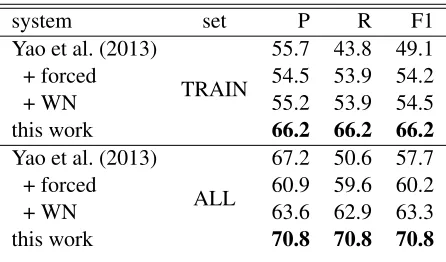
Table 6: Results on finding the best answer with voting.
system set P R F1
Yao et al. (2013)
TRAIN
55.7 43.8 49.1
+ forced 54.5 53.9 54.2
+ WN 55.2 53.9 54.5
this work 66.2 66.2 66.2
Yao et al. (2013)
ALL
67.2 50.6 57.7
+ forced 60.9 59.6 60.2
+ WN 63.6 62.9 63.3
this work 70.8 70.8 70.8
swer extraction classifier are used as votes to decide on the final rank to select the best single answer.
Table 6 shows the results after the majority vot-ing is applied to select a svot-ingle best answer for each candidate. A rather na¨ıve majority voting scheme already produces satisfactory outcome demonstrat-ing better results than the previous work. Our vot-ing scheme is similar to the one used by (Yao et al., 2013), yet it is much simpler since we do not per-form any additional hand tuning to account for the weight of the “forced” votes or take any additional steps to catch additional answers using outlier detec-tion techniques applied in the previous work.
6 Discussion and Error Analysis
There are several sources of errors affecting the fi-nal performance of our answer extraction system: (i) chunking, (ii) named entity recognition and seman-tic linking, (iii) answer extraction, (iv) single best answer selection.
Chunking.Our system uses text spans identified by a chunker to extract answer candidates, which makes it impossible to extract answers that lie outside the chunk boundaries. Nevertheless, we found this to be a minor concern since for 279 out of total 284 candidate sentences from TREC 13 the answers are recoverable within the chunk spans.
performing joint answer sentence re-ranking and an-swer extraction, is required to yield a better perfor-mance.
7 Related Work
Tree kernel methods have found many applications for the task of answer reranking which are reported in (Moschitti, 2008; Moschitti, 2009; Moschitti and Quarteroni, 2008; Severyn and Moschitti, 2012). However, their methods lack the use of important relational information between a question and a can-didate answer, which is essential to learn accurate relational patterns. In this respect, a solution based on enumerating relational links was given in (Zan-zotto and Moschitti, 2006; Zan(Zan-zotto et al., 2009) for the textual entailment task but it is computationally too expensive for the large dataset of QA. A few so-lutions to overcome computational issues were sug-gested in (Zanzotto et al., 2010).
In contrast, this paper relies on structures directly encoding the output of question and focus classifiers to connect focus word and good candidate answer keywords (represented by NEs) of the answer pas-sage. This provides more effective relational infor-mation, which allows our model to significantly im-prove on previous rerankers. Additionally, previous work on kernel-based approaches does not target an-swer extraction.
One of the best models for answer sentence selec-tion has been proposed in (Wang et al., 2007). They use the paradigm of quasi-synchronous grammar to model relations between a question and a candidate answer with syntactic transformations. (Heilman and Smith, 2010) develop an improved Tree Edit Distance (TED) model for learning tree transforma-tions in a q/a pair. They search for a good sequence of tree edit operations using complex and com-putationally expensive Tree Kernel-based heuristic. (Wang and Manning, 2010) develop a probabilistic model to learn tree-edit operations on dependency parse trees. They cast the problem into the frame-work of structured output learning with latent vari-ables. The model of (Yao et al., 2013) has reported an improvement over the Wang’s et al. (2007) sys-tem. It applies linear chain CRFs with features de-rived from TED and WordNet to automatically learn associations between questions and candidate
an-swers.
Different from previous approaches that use tree-edit information derived from syntactic trees, our kernel-based learning approach also use tree struc-tures but with rather different learning methods, i.e., SVMs and structural kernels, to automatically ex-tract salient syntactic patterns relating questions and answers. In (Severyn et al., 2013c), we have shown that such relational structures encoding input text pairs can be directly used within the kernel learning framework to build state-of-the-art models for pre-dicting semantic textual similarity. Furthermore, se-mantically enriched relational structures, where au-tomatic have been previously explored for answer passage reranking in (Severyn et al., 2013b; Sev-eryn et al., 2013a). This paper demonstrates that this model also works for building a reranker on the sen-tence level, and extends the previous work by apply-ing the idea of automatic feature engineerapply-ing with tree kernels to answer extraction.
8 Conclusions
Our paper demonstrates the effectiveness of han-dling the input structures representing QA pairs di-rectly vs. using explicit feature vector representa-tions, which typically require substantial feature en-gineering effort. Our approach relies on a kernel-based learning framework, where structural kernels, e.g., tree kernels, are used to handle automatic fea-ture engineering. It is enough to specify the desired type of structures, e.g., shallow, constituency, de-pendency trees, representing question and its can-didate answer sentences and let the kernel learning framework learn to use discriminative tree fragments for the target task.
An important feature of our approach is that it can effectively combine together different types of syntactic and semantic information, also generated by additional automatic classifiers, e.g., focus and question classifiers. We augment the basic struc-tures with additional relational and semantic infor-mation by introducing special tag markers into the tree nodes. Using the structures directly in the ker-nel learning framework makes it easy to integrate additional relational constraints and semantic infor-mation directly in the structures.
benchmark from TREC suggests that our approach is very promising as we can improve the state of the art in both answer selection and extraction by a large margin (up to 22% of relative improvement in F1 for answer extraction). Our approach makes it relatively easy to integrate other sources of semantic informa-tion, among which the use of Linked Open Data can be the most promising to enrich the structural repre-sentation of q/a pairs.
To achieve state-of-the-art results in answer sen-tence selection and answer extraction, it is sufficient to provide our model with a suitable tree structure encoding relevant syntactic information, e.g., using shallow, constituency or dependency formalisms. Moreover, additional semantic and relational infor-mation can be easily plugged in by marking tree nodes with special tags. We believe this approach greatly eases the task of tedious feature engineering that will find its applications well beyond QA tasks.
Acknowledgements
This research is partially supported by the EU’s 7thFramework Program (FP7/2007-2013) (#288024 LIMOSINEproject) and an Open Collaborative
Re-search (OCR) award from IBM ReRe-search. The first author is supported by the Google Europe Fellow-ship 2013 award in Machine Learning.
References
Razvan Bunescu and Yunfeng Huang. 2010. Towards a general model of answer typing: Question focus iden-tification. InCICLing.
Michael Collins and Nigel Duffy. 2002. New Ranking Algorithms for Parsing and Tagging: Kernels over Dis-crete Structures, and the Voted Perceptron. InACL. Danica Damljanovic, Milan Agatonovic, and Hamish
Cunningham. 2010. Identification of the question fo-cus: Combining syntactic analysis and ontology-based lookup through the user interaction. InLREC. David Ferrucci, Eric Brown, Jennifer Chu-Carroll, James
Fan, David Gondek, Aditya Kalyanpur, Adam Lally, J. William Murdock, Eric Nyberg, John Prager, Nico Schlaefer, and Chris Welty. 2010. Building watson: An overview of the deepqa project. AI Magazine, 31(3).
Michael Heilman and Noah A. Smith. 2010. Tree edit models for recognizing textual entailments, para-phrases, and answers to questions. InNAACL. Xin Li and Dan Roth. 2002. Learning question
classi-fiers. InCOLING.
A. Moschitti and S. Quarteroni. 2008. Kernels on Lin-guistic Structures for Answer Extraction. InACL. Alessandro Moschitti. 2006. Efficient convolution
ker-nels for dependency and constituent syntactic trees. In ECML.
Alessandro Moschitti. 2008. Kernel methods, syntax and semantics for relational text categorization. InCIKM. Alessandro Moschitti. 2009. Syntactic and semantic
ker-nels for short text pair categorization. InEACL. Christopher Pinchak. 2006. A probabilistic answer type
model. InIn EACL.
John M. Prager. 2006. Open-domain question-answering. Foundations and Trends in Information Retrieval, 1(2):91–231.
Silvia Quarteroni, Vincenzo Guerrisi, and Pietro La Torre. 2012. Evaluating multi-focus natural language queries over data services. InLREC.
L. Ratinov, D. Roth, D. Downey, and M. Anderson. 2011. Local and global algorithms for disambiguation to wikipedia. InACL.
Aliaksei Severyn and Alessandro Moschitti. 2012. Structural relationships for large-scale learning of an-swer re-ranking. InSIGIR.
Aliaksei Severyn, Massimo Nicosia, and Alessandro Moschitti. 2013a. Building structures from classifiers for passage reranking. InCIKM.
Aliaksei Severyn, Massimo Nicosia, and Alessandro Moschitti. 2013b. Learning adaptable patterns for passage reranking. InCoNLL.
Aliaksei Severyn, Massimo Nicosia, and Alessandro Moschitti. 2013c. Learning semantic textual similar-ity with structural representations. InACL.
Mengqiu Wang and Christopher D. Manning. 2010. Probabilistic tree-edit models with structured latent variables for textual entailment and question answer-ing. InACL.
Mengqiu Wang, Noah A. Smith, and Teruko Mitaura. 2007. What is the jeopardy model? a quasi-synchronous grammar for qa. InEMNLP.
Xuchen Yao, Benjamin Van Durme, Peter Clark, and Chris Callison-Burch. 2013. Answer extraction as se-quence tagging with tree edit distance. InNAACL. F. M. Zanzotto and A. Moschitti. 2006. Automatic
Learning of Textual Entailments with Cross-Pair Sim-ilarities. InCOLING.
F. M. Zanzotto, M. Pennacchiotti, and A. Moschitti. 2009. A Machine Learning Approach to Recognizing Textual Entailment. Natural Language Engineering, Volume 15 Issue 4, October 2009:551–582.