Proceedings of the 55th Annual Meeting of the Association for Computational Linguistics, pages 1127–1138 Vancouver, Canada, July 30 - August 4, 2017. c2017 Association for Computational Linguistics Proceedings of the 55th Annual Meeting of the Association for Computational Linguistics, pages 1127–1138
Vancouver, Canada, July 30 - August 4, 2017. c2017 Association for Computational Linguistics
A Transition-Based Directed Acyclic Graph Parser for UCCA
Daniel Hershcovich1,2 Omri Abend2
1The Edmond and Lily Safra Center for Brain Sciences 2School of Computer Science and Engineering
Hebrew University of Jerusalem
{danielh,oabend,arir}@cs.huji.ac.il
Ari Rappoport2
Abstract
We present the first parser for UCCA, a cross-linguistically applicable framework for semantic representation, which builds on extensive typological work and sup-ports rapid annotation. UCCA poses a challenge for existing parsing techniques, as it exhibits reentrancy (resulting in DAG structures), discontinuous structures and non-terminal nodes corresponding to com-plex semantic units. To our knowledge, the conjunction of these formal properties is not supported by any existing parser. Our transition-based parser, which uses a novel transition set and features based on bidirectional LSTMs, has value not just for UCCA parsing: its ability to handle more general graph structures can inform the de-velopment of parsers for other semantic DAG structures, and in languages that fre-quently use discontinuous structures.
1 Introduction
Universal Conceptual Cognitive Annotation (UCCA,Abend and Rappoport,2013) is a cross-linguistically applicable semantic representation scheme, building on the established Basic Lin-guistic Theory typological framework (Dixon,
2010a,b, 2012), and Cognitive Linguistics litera-ture (Croft and Cruse,2004). It has demonstrated applicability to multiple languages, including English, French, German and Czech, support for rapid annotation by non-experts (assisted by an accessible annotation interface (Abend et al.,
2017)), and stability under translation (Sulem et al.,2015). It has also proven useful for machine translation evaluation (Birch et al.,2016). UCCA differs from syntactic schemes in terms of content and formal structure. It exhibits reentrancy,
discontinuous nodes and non-terminals, which no single existing parser supports. Lacking a parser, UCCA’s applicability has been so far limited, a gap this work addresses.
We present the first UCCA parser, TUPA (Transition-based UCCA Parser), building on re-cent advances in discontinuous constituency and dependency graph parsing, and further introduc-ing novel transitions and features for UCCA. Transition-based techniques are a natural starting point for UCCA parsing, given the conceptual similarity of UCCA’s distinctions, centered around predicate-argument structures, to distinctions ex-pressed by dependency schemes, and the achieve-ments of transition-based methods in dependency parsing (Dyer et al., 2015; Andor et al., 2016;
Kiperwasser and Goldberg, 2016). We are fur-ther motivated by the strength of transition-based methods in related tasks, including dependency graph parsing (Sagae and Tsujii, 2008; Ribeyre et al., 2014; Tokg¨oz and Eryi˘git, 2015), con-stituency parsing (Sagae and Lavie, 2005;Zhang and Clark, 2009; Zhu et al., 2013; Maier, 2015;
Maier and Lichte, 2016), AMR parsing (Wang
et al., 2015a,b, 2016; Misra and Artzi, 2016;
Goodman et al.,2016;Zhou et al.,2016;Damonte et al.,2017) and CCG parsing (Zhang and Clark,
2011;Ambati et al.,2015,2016).
We evaluate TUPA on the English UCCA cor-pora, including in-domain and out-of-domain set-tings. To assess the ability of existing parsers to tackle the task, we develop a conversion proce-dure from UCCA to bilexical graphs and trees. Results show superior performance for TUPA, demonstrating the effectiveness of the presented approach.1
The rest of the paper is structured as follows:
1All parsing and conversion code, as well as trained parser models, are available athttps://github.com/ danielhers/tupa.
Section 2 describes UCCA in more detail. Sec-tion 3introduces TUPA. Section 4discusses the data and experimental setup. Section 5 presents the experimental results. Section6summarizes re-lated work, and Section7concludes the paper.
2 The UCCA Scheme
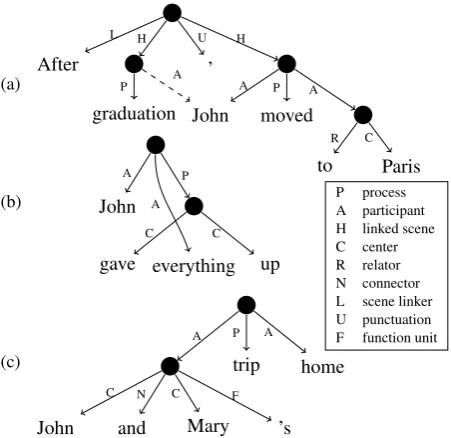
UCCA graphs are labeled, directed acyclic graphs (DAGs), whose leaves correspond to the tokens of the text. A node (or unit) corresponds to a ter-minal or to several terter-minals (not necessarily con-tiguous) viewed as a single entity according to se-mantic or cognitive considerations. Edges bear a category, indicating the role of the sub-unit in the parent relation. Figure1presents a few examples. UCCA is a multi-layered representation, where each layer corresponds to a “module” of seman-tic distinctions. UCCA’s foundational layer, tar-geted in this paper, covers the predicate-argument structure evoked by predicates of all grammatical categories (verbal, nominal, adjectival and others), the inter-relations between them, and other ma-jor linguistic phenomena such as coordination and multi-word expressions. The layer’s basic notion is thescene, describing a state, action, movement or some other relation that evolves in time. Each scene contains one main relation (marked as either a Process or a State), as well as one or more Par-ticipants. For example, the sentence “After gradu-ation, John moved to Paris” (Figure1a) contains two scenes, whose main relations are “gradua-tion” and “moved”. “John” is a Participant in both scenes, while “Paris” only in the latter. Further categories account for inter-scene relations and the internal structure of complex arguments and rela-tions (e.g. coordination, multi-word expressions and modification).
One incoming edge for each non-root node is marked asprimary, and the rest (mostly used for implicit relations and arguments) asremoteedges, a distinction made by the annotator. The primary edges thus form a tree structure, whereas the re-mote edges enable reentrancy, forming a DAG.
While parsing technology in general, and transition-based parsing in particular, is well-established for syntactic parsing, UCCA has sev-eral distinct properties that distinguish it from syn-tactic representations, mostly UCCA’s tendency to abstract away from syntactic detail that do not af-fect argument structure. For instance, consider the following examples where the concept of a scene
(a) After
L
graduation P
H , U
John A
moved P
to R
Paris C A H
A
(b) John
A
gave C
everything up C P
A PA participantprocess
H linked scene C center R relator N connector L scene linker U punctuation F function unit
(c)
John C
and N
Mary C
’s F A
trip P
home A
Figure 1: UCCA structures demonstrating three structural properties exhibited by the scheme. (a) includes a remote edge (dashed), resulting in “John” having two parents. (b) includes a discontinuous unit (“gave ... up”). (c) includes a coordination construction (“John and Mary”). Pre-terminal nodes are omitted for brevity. Right: legend of edge labels.
has a different rationale from the syntactic concept of a clause. First, non-verbal predicates in UCCA are represented like verbal ones, such as when they appear in copula clauses or noun phrases. Indeed, in Figure1a, “graduation” and “moved” are con-sidered separate events, despite appearing in the same clause. Second, in the same example, “John” is marked as a (remote) Participant in the grad-uation scene, despite not being overtly marked. Third, consider the possessive construction in Fig-ure1c. While in UCCA “trip” evokes a scene in which “John and Mary” is a Participant, a syntac-tic scheme would analyze this phrase similarly to “John and Mary’s shoes”.
These examples demonstrate that a UCCA parser, and more generally semantic parsers, face an additional level of ambiguity compared to their syntactic counterparts (e.g., “after graduation” is formally very similar to “after 2pm”, which does not evoke a scene). Section 6 discusses UCCA in the context of other semantic schemes, such as AMR (Banarescu et al.,2013).
[image:2.595.307.533.61.280.2]“gradu-ation” and “moved”, yielding a DAG rather than a tree. A second property is discontinuity, as in Figure 1b, where “gave up” forms a discon-tinuous semantic unit. Discontinuities are perva-sive, e.g., with multi-word expressions ( Schnei-der et al., 2014). Finally, unlike most depen-dency schemes, UCCA uses non-terminal nodes
to represent units comprising more than one word. The use of non-terminal nodes is motivated by constructions with no clear head, including co-ordination structures (e.g., “John and Mary” in Figure 1c), some multi-word expressions (e.g., “The Haves and the Have Nots”), and preposi-tional phrases (either the preposition or the head noun can serve as the constituent’s head). To our knowledge, no existing parser supports all struc-tural properties required for UCCA parsing.
3 Transition-based UCCA Parsing
We now turn to presenting TUPA. Building on previous work on parsing reentrancies, disconti-nuities and non-terminal nodes, we define an ex-tended set of transitions and features that supports the conjunction of these properties.
Transition-based parsers (Nivre,2003) scan the text from start to end, and create the parse incre-mentally by applying a transition at each step to the parser’s state, defined using three data struc-tures: a buffer B of tokens and nodes to be pro-cessed, a stack S of nodes currently being pro-cessed, and a graphG = (V, E, `) of constructed nodes and edges, whereV is the set of nodes,E is the set of edges, and ` : E → L is the label function,Lbeing the set of possible labels. Some states are marked as terminal, meaning that Gis the final output. A classifier is used at each step to select the next transition based on features encod-ing the parser’s current state. Durencod-ing trainencod-ing, an oracle creates training instances for the classifier, based on gold-standard annotations.
Transition Set. Given a sequence of tokens w1, . . . , wn, we predict a UCCA graphGover the
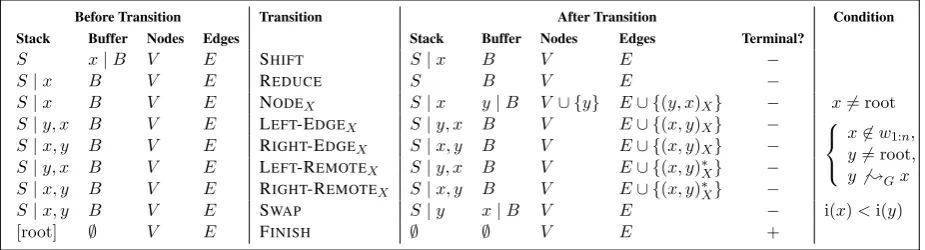
sequence. Parsing starts with a single node on the stack (an artificial root node), and the input tokens in the buffer. Figure2shows the transition set.
In addition to the standard SHIFT and RE -DUCE operations, we follow previous work in transition-based constituency parsing (Sagae and Lavie,2005), adding the NODEtransition for cre-ating new non-terminal nodes. For everyX ∈L, NODEX creates a new node on the buffer as a
par-ent of the first elempar-ent on the stack, with an X -labeled edge. LEFT-EDGEX and RIGHT-EDGEX
create a new primaryX-labeled edge between the first two elements on the stack, where the parent is the left or the right node, respectively. As a UCCA node may only have one incoming primary edge, EDGEtransitions are disallowed if the child node already has an incoming primary edge. LEFT -REMOTEX and RIGHT-REMOTEX do not have
this restriction, and the created edge is addition-ally marked as remote. We distinguish between these two pairs of transitions to allow the parser to create remote edges without the possibility of producing invalid graphs. To support the predic-tion of multiple parents, node and edge transipredic-tions leave the stack unchanged, as in other work on transition-based dependency graph parsing (Sagae and Tsujii,2008;Ribeyre et al.,2014;Tokg¨oz and Eryi˘git, 2015). REDUCEpops the stack, to allow removing a node once all its edges have been cre-ated. To handle discontinuous nodes, SWAPpops the second node on the stack and adds it to the top of the buffer, as with the similarly named transi-tion in previous work (Nivre,2009;Maier,2015). Finally, FINISHpops the root node and marks the state as terminal.
Classifier. The choice of classifier and feature representation has been shown to play an impor-tant role in transition-based parsing (Chen and Manning, 2014;Andor et al., 2016; Kiperwasser and Goldberg,2016). To investigate the impact of the type of transition classifier in UCCA parsing, we experiment with three different models.
1. Starting with a simple and common choice (e.g., Maier and Lichte, 2016), TUPASparse uses a linear classifier with sparse features, trained with the averaged structured perceptron algorithm (Collins and Roark,2004) and MIN -UPDATE (Goldberg and Elhadad, 2011): each feature requires a minimum number of updates in training to be included in the model.2
Before Transition Transition After Transition Condition Stack Buffer Nodes Edges Stack Buffer Nodes Edges Terminal?
S x|B V E SHIFT S|x B V E −
S|x B V E REDUCE S B V E −
S|x B V E NODEX S|x y|B V∪ {y} E∪ {(y, x)X} − x6= root
S|y, x B V E LEFT-EDGEX S|y, x B V E∪ {(x, y)X} −
x6∈w1:n,
y6= root, y6;Gx S|x, y B V E RIGHT-EDGEX S|x, y B V E∪ {(x, y)X} −
S|y, x B V E LEFT-REMOTEX S|y, x B V E∪ {(x, y)∗X} −
S|x, y B V E RIGHT-REMOTEX S|x, y B V E∪ {(x, y)∗X} −
S|x, y B V E SWAP S|y x|B V E − i(x)<i(y)
[image:4.595.72.535.63.188.2][root] ∅ V E FINISH ∅ ∅ V E +
Figure 2: The transition set of TUPA. We write the stack with its top to the right and the buffer with its head to the left.(·,·)X
denotes a primaryX-labeled edge, and(·,·)∗X a remoteX-labeled edge. i(x)is a running index for the created nodes. In
addition to the specified conditions, the prospective child in an EDGEtransition must not already have a primary parent.
instead of one layer with cube activation. The embeddings and classifier are trained jointly.
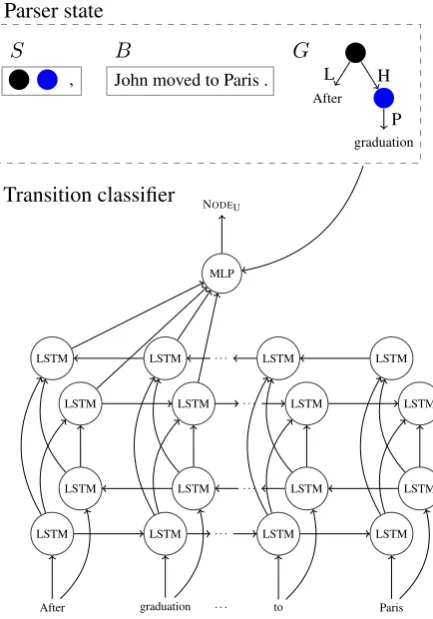
3. Finally, TUPABiLSTM uses a bidirectional LSTM for feature representation, on top of the dense embedding features, an architecture sim-ilar toKiperwasser and Goldberg(2016). The BiLSTM runs on the input tokens in forward and backward directions, yielding a vector rep-resentation that is then concatenated with dense features representing the parser state (e.g., ex-isting edge labels and previous parser actions; see below). This representation is then fed into a feedforward network similar to TUPAMLP.
The feedforward layers, BiLSTM and embed-dings are all trained jointly.
For all classifiers, inference is performed greed-ily, i.e., without beam search. Hyperparameters are tuned on the development set (see Section4). Features. TUPASparseuses binary indicator
fea-tures representing the words, POS tags, syntactic dependency labels and existing edge labels related to the top four stack elements and the next three buffer elements, in addition to their children and grandchildren in the graph. We also use bi- and trigram features based on these values (Zhang and Clark,2009;Zhu et al.,2013), features related to discontinuous nodes (Maier,2015, including sep-arating punctuation and gap type), features repre-senting existing edges and the number of parents and children, as well as the past actions taken by the parser. In addition, we use use a novel, UCCA-specific feature: number of remote children.3
For TUPAMLPand TUPABiLSTM, we replace all
indicator features by a concatenation of the vector embeddings of all represented elements: words, 3See AppendixAfor a full list of used feature templates.
POS tags, syntactic dependency labels, edge la-bels, punctuation, gap type and parser actions. These embeddings are initialized randomly. We additionally use external word embeddings initial-ized with pre-trained word2vec vectors (Mikolov et al., 2013),4 updated during training. In
addi-tion to dropout between NN layers, we apply word dropout (Kiperwasser and Goldberg,2016): with a certain probability, the embedding for a word is replaced with a zero vector. We do not apply word dropout to the external word embeddings.
Finally, for all classifiers we add a novel real-valued feature to the input vector, ratio, corre-sponding to the ratio between the number of ter-minals to number of nodes in the graphG. This feature serves as a regularizer for the creation of new nodes, and should be beneficial for other transition-based constituency parsers too.
Training. For training the transition classifiers, we use a dynamic oracle (Goldberg and Nivre,
2012), i.e., an oracle that outputs a set of opti-mal transitions: when applied to the current parser state, the gold standard graph is reachable from the resulting state. For example, the oracle would pre-dict a NODE transition if the stack has on its top a parent in the gold graph that has not been cre-ated, but would predict a RIGHT-EDGEtransition if the second stack element is a parent of the first element according to the gold graph and the edge between them has not been created. The transition predicted by the classifier is deemed correct and is applied to the parser state to reach the subse-quent state, if the transition is included in the set of optimal transitions. Otherwise, a random opti-mal transition is applied, and for the perceptron-based parser, the classifier’s weights are updated
Parser state
S ,
B
John moved to Paris . G
After
L
graduation
P H
Transition classifier
After LSTM
LSTM LSTM LSTM
graduation LSTM
LSTM LSTM LSTM
to LSTM
LSTM LSTM LSTM
Paris LSTM
LSTM LSTM LSTM
. . . . . .
. . .
. . .
[image:5.595.309.533.62.235.2]. . . MLP NODEU
Figure 3: Illustration of the TUPA model. Top: parser state (stack, buffer and intermediate graph). Bottom: TUPABiLTSM architecture. Vector representation for the input tokens is computed by two layers of bidirectional LSTMs. The vectors for specific tokens are concatenated with embedding and nu-meric features from the parser state (for existing edge labels, number of children, etc.), and fed into the MLP for selecting the next transition.
according to the perceptron update rule.
POS tags and syntactic dependency labels are extracted using spaCy (Honnibal and Johnson,
2015).5 We use the categorical cross-entropy
ob-jective function and optimize the NN classifiers with the Adam optimizer (Kingma and Ba,2014).
4 Experimental Setup
Data. We conduct our experiments on the UCCA Wikipedia corpus (henceforth, Wiki), and use the English part of the UCCA Twenty Thou-sand Leagues Under the SeaEnglish-French par-allel corpus (henceforth, 20K Leagues) as out-of-domain data.6 Table 1 presents some
statis-tics for the two corpora. We use passages of in-dices up to 676 of the Wiki corpus as our train-ing set, passages 688–808 as development set, and passages 942–1028 as in-domain test set. While
5https://spacy.io 6
http://cs.huji.ac.il/˜oabend/ucca.html
Wiki 20K
Train Dev Test Leagues
# passages 300 34 33 154
# sentences 4268 454 503 506
# nodes 298,993 33,704 35,718 29,315
% terminal 42.96 43.54 42.87 42.09
% non-term. 58.33 57.60 58.35 60.01
% discont. 0.54 0.53 0.44 0.81
% reentrant 2.38 1.88 2.15 2.03
# edges 287,914 32,460 34,336 27,749
% primary 98.25 98.75 98.74 97.73
% remote 1.75 1.25 1.26 2.27
Average per non-terminal node
# children 1.67 1.68 1.66 1.61
Table 1: Statistics of theWikiand20K LeaguesUCCA cor-pora. All counts exclude the root node, implicit nodes, and linkage nodes and edges.
UCCA edges can cross sentence boundaries, we adhere to the common practice in semantic pars-ing and train our parsers on individual sentences, discarding inter-relations between them (0.18% of the edges). We also discard linkage nodes and edges (as they often express inter-sentence rela-tions and are thus mostly redundant when applied at the sentence level) as well as implicit nodes.7 In
the out-of-domain experiments, we apply the same parsers (trained on theWikitraining set) to the20K Leaguescorpus without parameter re-tuning. Implementation. We use the DyNet package (Neubig et al., 2017) for implementing the NN classifiers. Unless otherwise noted, we use the default values provided by the package. See Ap-pendixCfor the hyperparameter values we found by tuning on the development set.
Evaluation. We define a simple measure for comparing UCCA structures Gp = (Vp, Ep, `p)
and Gg = (Vg, Eg, `g), the predicted and
gold-standard graphs, respectively, over the same se-quence of terminalsW = {w1, . . . , wn}. For an
edgee= (u, v)in either graph,ubeing the parent andv the child, its yieldy(e) ⊆ W is the set of terminals inW that are descendants ofv. Define the set ofmutual edgesbetweenGpandGg:
M(Gp, Gg) =
{(e1, e2)∈Ep×Eg|y(e1) =y(e2)∧`p(e1) =`g(e2)}
Labeled precision and recall are defined by di-viding |M(Gp, Gg)| by |Ep| and |Eg|,
[image:5.595.74.291.65.375.2]After graduation , John moved to Paris
L
U A
A H
R A
John gave everything up
A A
C
John and Mary went home
A
N C
[image:6.595.315.520.63.196.2]A
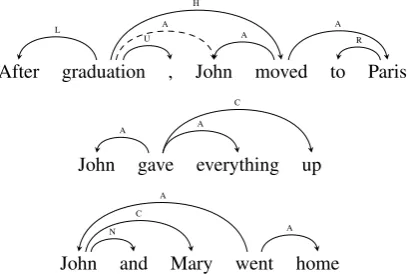
Figure 4: Bilexical graph approximation (dependency graph) for the sentences in Figure1.
We report two variants of this measure: one where we consider only primary edges, and another for remote edges (see Section2). Performance on re-mote edges is of pivotal importance in this inves-tigation, which focuses on extending the class of graphs supported by statistical parsers.
We note that the measure collapses to the stan-dard PARSEVAL constituency evaluation measure if Gp andGg are trees. Punctuation is excluded
from the evaluation, but not from the datasets. Comparison to bilexical graph parsers. As no direct comparison with existing parsers is possi-ble, we compare TUPA to bilexical dependency graph parsers, which support reentrancy and dis-continuity but not non-terminal nodes.
To facilitate the comparison, we convert our training set into bilexical graphs (see examples in Figure4), train each of the parsers, and evaluate them by applying them to the test set and then re-constructing UCCA graphs, which are compared with the gold standard. The conversion to bilexi-cal graphs is done by heuristibilexi-cally selecting a head terminal for each non-terminal node, and attach-ing all terminal descendents to the head terminal. In the inverse conversion, we traverse the bilexical graph in topological order, creating non-terminal parents for all terminals, and attaching them to the previously-created non-terminals correspond-ing to the bilexical heads.8
In Section5we report the upper bounds on the achievable scores due to the error resulting from the removal of non-terminal nodes.
Comparison to tree parsers. For completeness, and as parsing technology is considerably more 8See AppendixDfor a detailed description of the conver-sion procedures.
After
L
graduation
P H
,
U
John
A
moved
P
to
R
Paris
C A H
After graduation , John moved to Paris
L U A
H
R A
Figure 5: Tree approximation (constituency) for the sentence in Figure1a(top), and bilexical tree approximation (depen-dency) for the same sentence (bottom). These are identical to the original graphs, apart from the removal of remote edges.
mature for tree (rather than graph) parsing, we also perform a tree approximation experiment, con-verting UCCA to (bilexical) trees and evaluat-ing constituency and dependency tree parsers on them (see examples in Figure 5). Our approach is similar to the tree approximation approach used for dependency graph parsing (Agi´c et al., 2015;
Fern´andez-Gonz´alez and Martins, 2015), where dependency graphs were converted into depen-dency trees and then parsed by dependepen-dency tree parsers. In our setting, the conversion to trees con-sists simply of removing remote edges from the graph, and then to bilexical trees by applying the same procedure as for bilexical graphs.
Baseline parsers. We evaluate two bilexical graph semantic dependency parsers: DAGParser (Ribeyre et al.,2014), the leading transition-based parser in SemEval 2014 (Oepen et al., 2014) and TurboParser (Almeida and Martins, 2015), a graph-based parser from SemEval 2015 (Oepen et al., 2015); UPARSE (Maier and Lichte, 2016), a transition-based constituency parser supporting discontinuous constituents; and two bilexical tree parsers: MaltParser (Nivre et al., 2007), and the stack LSTM-based parser of Dyer et al. (2015, henceforce “LSTM Parser”). Default settings are used in all cases.9 DAGParser and UPARSE use
beam search by default, with a beam size of 5 and 4 respectively. The other parsers are greedy.
5 Results
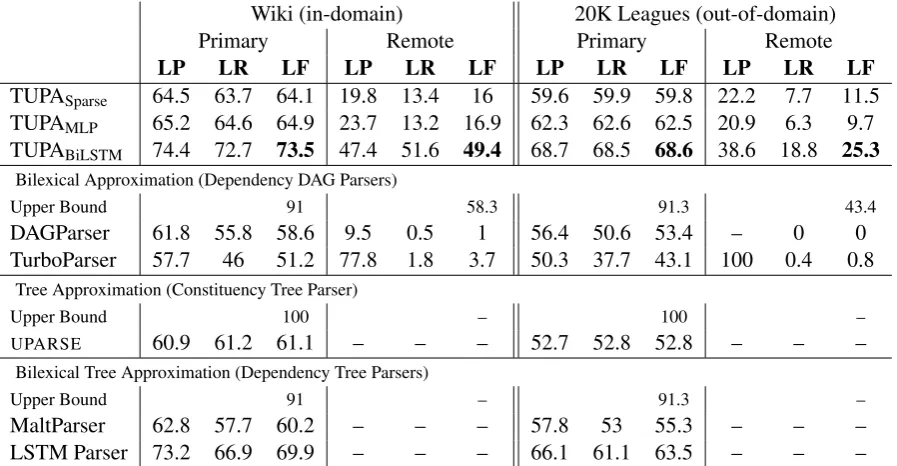
Table2presents our main experimental results, as well as upper bounds for the baseline parsers,
[image:6.595.81.290.66.203.2]Wiki (in-domain) 20K Leagues (out-of-domain)
Primary Remote Primary Remote
LP LR LF LP LR LF LP LR LF LP LR LF
TUPASparse 64.5 63.7 64.1 19.8 13.4 16 59.6 59.9 59.8 22.2 7.7 11.5
TUPAMLP 65.2 64.6 64.9 23.7 13.2 16.9 62.3 62.6 62.5 20.9 6.3 9.7
TUPABiLSTM 74.4 72.7 73.5 47.4 51.6 49.4 68.7 68.5 68.6 38.6 18.8 25.3
Bilexical Approximation (Dependency DAG Parsers)
Upper Bound 91 58.3 91.3 43.4
DAGParser 61.8 55.8 58.6 9.5 0.5 1 56.4 50.6 53.4 – 0 0
TurboParser 57.7 46 51.2 77.8 1.8 3.7 50.3 37.7 43.1 100 0.4 0.8 Tree Approximation (Constituency Tree Parser)
Upper Bound 100 – 100 –
UPARSE 60.9 61.2 61.1 – – – 52.7 52.8 52.8 – – –
Bilexical Tree Approximation (Dependency Tree Parsers)
Upper Bound 91 – 91.3 –
MaltParser 62.8 57.7 60.2 – – – 57.8 53 55.3 – – –
[image:7.595.73.522.62.295.2]LSTM Parser 73.2 66.9 69.9 – – – 66.1 61.1 63.5 – – –
Table 2: Experimental results, in percents, on theWikitest set (left) and the20K Leaguesset (right). Columns correspond to labeled precision, recall and F-score, for both primary and remote edges. F-score upper bounds are reported for the conversions. For the tree approximation experiments, only primary edges scores are reported, as they are unable to predict remote edges. TUPABiLSTMobtains the highest F-scores in all metrics, surpassing the bilexical parsers, tree parsers and other classifiers.
flecting the error resulting from the conversion.10
DAGParser andUPARSEare most directly com-parable to TUPASparse, as they also use a
percep-tron classifier with sparse features. TUPASparse
considerably outperforms both, where DAGParser does not predict any remote edges in the out-of-domain setting. TurboParser fares worse in this comparison, despite somewhat better results on remote edges. The LSTM parser of Dyer et al.
(2015) obtains the highest primary F-score among the baseline parsers, with a considerable margin.
Using a feedforward NN and embedding fea-tures, TUPAMLP obtains higher scores than
TUPASparse, but is outperformed by the LSTM
parser on primary edges. However, using bet-ter input encoding allowing virtual look-ahead and look-behind in the token representation, TUPABiLSTM obtains substantially higher scores
than TUPAMLP and all other parsers, on both
pri-mary and remote edges, both in the in-domain and out-of-domain settings. Its performance in abso-lute terms, of 73.5% F-score on primary edges, is encouraging in light of UCCA’s inter-annotator agreement of 80–85% F-score on them (Abend and Rappoport,2013).
The parsers resulting from tree approximation 10The low upper bound for remote edges is partly due to the removal of implicit nodes (not supported in bilexical representations), where the whole sub-graph headed by such nodes, often containing remote edges, must be discarded.
are unable to recover any remote edges, as these are removed in the conversion.11 The bilexical
DAG parsers are quite limited in this respect as well. While some of the DAG parsers’ difficulty can be attributed to the conversion upper bound of 58.3%, this in itself cannot account for their poor performance on remote edges, which is an order of magnitude lower than that of TUPABiLSTM.
6 Related Work
While earlier work on anchored12 semantic
pars-ing has mostly concentrated on shallow seman-tic analysis, focusing on semanseman-tic role labeling of verbal argument structures, the focus has recently shifted to parsing of more elaborate representa-tions that account for a wider range of phenomena (Abend and Rappoport,2017).
Grammar-Based Parsing. Linguistically ex-pressive grammars such as HPSG (Pollard and Sag, 1994), CCG (Steedman, 2000) and TAG (Joshi and Schabes,1997) provide a theory of the syntax-semantics interface, and have been used as a basis for semantic parsers by defining
com-11We also experimented with a simpler version of TUPA lacking REMOTEtransitions, obtaining an increase of up to 2 labeled F-score points on primary edges, at the cost of not being able to predict remote edges.
positional semantics on top of them (Flickinger,
2000;Bos, 2005, among others). Depending on the grammar and the implementation, such seman-tic parsers can support some or all of the struc-tural properties UCCA exhibits. Nevertheless, this line of work differs from our approach in two im-portant ways. First, therepresentationsare differ-ent. UCCA does not attempt to model the syntax-semantics interface and is thus less coupled with syntax. Second, while grammar-basedparsers ex-plicitly model syntax, our approach directly mod-els the relation between tokens and semantic struc-tures, without explicit composition rules.
Broad-Coverage Semantic Parsing. Most
closely related to this work is Broad-Coverage Semantic Dependency Parsing (SDP), addressed in two SemEval tasks (Oepen et al.,2014,2015). Like UCCA parsing, SDP addresses a wide range of semantic phenomena, and supports discon-tinuous units and reentrancy. In SDP, however, bilexical dependencies are used, and a head must be selected for every relation—even in construc-tions that have no clear head, such as coordination (Ivanova et al., 2012). The use of non-terminal nodes is a simple way to avoid this liability. SDP also differs from UCCA in the type of distinctions it makes, which are more tightly coupled with syntactic considerations, where UCCA aims to capture purely semantic cross-linguistically applicable notions. For instance, the “poss” label in the DM target representation is used to annotate syntactic possessive constructions, regardless of whether they correspond to semantic ownership (e.g., “John’s dog”) or other semantic relations, such as marking an argument of a nominal predicate (e.g., “John’s kick”). UCCA reflects the difference between these constructions.
Recent interest in SDP has yielded numerous works on graph parsing (Ribeyre et al., 2014;
Thomson et al.,2014;Almeida and Martins,2015;
Du et al., 2015), including tree approximation (Agi´c and Koller,2014;Schluter et al.,2014) and joint syntactic/semantic parsing (Henderson et al.,
2013;Swayamdipta et al.,2016).
Abstract Meaning Representation. Another line of work addresses parsing into AMRs ( Flani-gan et al., 2014; Vanderwende et al., 2015;Pust et al.,2015;Artzi et al.,2015), which, like UCCA, abstract away from syntactic distinctions and rep-resent meaning directly, using OntoNotes
predi-cates (Weischedel et al., 2013). Events in AMR may also be evoked by non-verbal predicates, in-cluding possessive constructions.
Unlike in UCCA, the alignment between AMR concepts and the text is not explicitly marked. While sharing much of this work’s motivation, not anchoring the representation in the text compli-cates the parsing task, as it requires the alignment to be automatically (and imprecisely) detected. In-deed, despite considerable technical effort ( Flani-gan et al.,2014;Pourdamghani et al.,2014; Wer-ling et al., 2015), concept identification is only about 80%–90% accurate. Furthermore, anchor-ing allows breakanchor-ing down sentences into seman-tically meaningful sub-spans, which is useful for many applications (Fern´andez-Gonz´alez and Mar-tins,2015;Birch et al.,2016).
Several transition-based AMR parsers have been proposed: CAMR assumes syntactically parsed input, processing dependency trees into AMR (Wang et al.,2015a,b,2016;Goodman et al.,
2016). In contrast, the parsers ofDamonte et al.
(2017) andZhou et al.(2016) do not require syn-tactic pre-processing. Damonte et al. (2017) per-form concept identification using a simple heuris-tic selecting the most frequent graph for each to-ken, andZhou et al.(2016) perform concept iden-tification and parsing jointly. UCCA parsing does not require separately aligning the input tokens to the graph. TUPA creates non-terminal units as part of the parsing process.
Furthermore, existing transition-based AMR parsers are not general DAG parsers. They are only able to predict a subset of reentrancies and discontinuities, as they may remove nodes before their parents have been predicted (Damonte et al.,
2017). They are thus limited to a sub-class of AMRs in particular, and specifically cannot pro-duce arbitrary DAG parses. TUPA’s transition set, on the other hand, allows general DAG parsing.13
7 Conclusion
We present TUPA, the first parser for UCCA. Evaluated in in-domain and out-of-domain set-tings, we show that coupled with a NN classifier and BiLSTM feature extractor, it accurately pre-dicts UCCA graphs from text, outperforming a va-riety of strong baselines by a margin.
Despite the recent diversity of semantic
ing work, the effectiveness of different approaches for structurally and semantically different schemes is not well-understood (Kuhlmann and Oepen,
2016). Our contribution to this literature is a gen-eral parser that supports multiple parents, discon-tinuous units and non-terminal nodes.
Future work will evaluate TUPA in a multi-lingual setting, assessing UCCA’s cross-linguistic applicability. We will also apply the TUPA transi-tion scheme to different target representatransi-tions, in-cluding AMR and SDP, exploring the limits of its generality. In addition, we will explore different conversion procedures (Kong et al.,2015) to com-pare different representations, suggesting ways for a data-driven design of semantic annotation.
A parser for UCCA will enable using the frame-work for new tasks, in addition to existing ap-plications such as machine translation evaluation (Birch et al.,2016). We believe UCCA’s merits in providing a cross-linguistically applicable, broad-coverage annotation will support ongoing efforts to incorporate deeper semantic structures into var-ious applications, such as sentence simplification (Narayan and Gardent, 2014) and summarization (Liu et al.,2015).
Acknowledgments
This work was supported by the HUJI Cyber Secu-rity Research Center in conjunction with the Israel National Cyber Bureau in the Prime Minister’s Of-fice, and by the Intel Collaborative Research In-stitute for Computational Intelligence (ICRI-CI). The first author was supported by a fellowship from the Edmond and Lily Safra Center for Brain Sciences. We thank Wolfgang Maier, Nathan Schneider, Elior Sulem and the anonymous re-viewers for their helpful comments.
References
Omri Abend and Ari Rappoport. 2013. Uni-versal Conceptual Cognitive Annotation (UCCA). In Proc. of ACL. pages 228–238. http://aclweb.org/anthology/P13-1023.
Omri Abend and Ari Rappoport. 2017. The state of the art in semantic representation. InProc. of ACL. To appear.
Omri Abend, Shai Yerushalmi, and Ari Rappoport. 2017. UCCAApp: Web-application for syntactic and semantic phrase-based annotation. In Proc. of ACL: System Demonstration Papers. To appear.
ˇZeljko Agi´c and Alexander Koller. 2014. Pots-dam: Semantic dependency parsing by bidirec-tional graph-tree transformations and syntactic pars-ing. In Proc. of SemEval. pages 465–470. http://aclweb.org/anthology/S14-2081.
ˇZeljko Agi´c, Alexander Koller, and Stephan Oepen. 2015. Semantic dependency graph parsing using tree approximations. InProc. of IWCS. pages 217– 227. http://aclweb.org/anthology/W15-0126.
Mariana S. C. Almeida and Andr´e F. T. Martins. 2015. Lisbon: Evaluating TurboSemanticParser on multiple languages and out-of-domain data. In Proc. of SemEval. pages 970–973. http://aclweb.org/anthology/S15-2162.
Bharat Ram Ambati, Tejaswini Deoskar, Mark Johnson, and Mark Steedman. 2015. An in-cremental algorithm for transition-based CCG parsing. In Proc. of NAACL. pages 53–63. http://aclweb.org/anthology/N15-1006.
Bharat Ram Ambati, Tejaswini Deoskar, and Mark Steedman. 2016. Shift-reduce CCG parsing using neural network models. In Proc. of NAACL-HLT. pages 447–453. http://aclweb.org/anthology/N16-1052.
Daniel Andor, Chris Alberti, David Weiss, Ali-aksei Severyn, Alessandro Presta, Kuzman Ganchev, Slav Petrov, and Michael Collins. 2016. Globally normalized transition-based neural networks. In Proc. of ACL. pages 2442–2452. http://aclweb.org/anthology/P16-1231.
Yoav Artzi, Kenton Lee, and Luke Zettlemoyer. 2015. Broad-coverage CCG semantic parsing with AMR. In Proc. of EMNLP. pages 1699–1710. http://aclweb.org/anthology/D15-1198.
Laura Banarescu, Claire Bonial, Shu Cai, Madalina Georgescu, Kira Griffitt, Ulf Hermjakob, Kevin Knight, Martha Palmer, and Nathan Schneider. 2013. Abstract Meaning Representation for sem-banking. In Proc. of the Linguistic Annotation Workshop.http://aclweb.org/anthology/W13-2322.
Alexandra Birch, Omri Abend, Ondˇrej Bojar,
and Barry Haddow. 2016. HUME: Human
UCCA-based evaluation of machine transla-tion. In Proc. of EMNLP. pages 1264–1274. http://aclweb.org/anthology/D16-1134.
Johan Bos. 2005. Towards wide-coverage semantic interpretation. In Proc.
of IWCS. volume 6, pages 42–53.
http://www.let.rug.nl/bos/pubs/Bos2005IWCS.pdf.
Michael Collins and Brian Roark. 2004. In-cremental parsing with the perceptron al-gorithm. In Proc. of ACL. pages 111–118. http://aclweb.org/anthology/P04-1015.
William Croft and D Alan Cruse. 2004. Cognitive lin-guistics. Cambridge University Press.
Marco Damonte, Shay B. Cohen, and Giorgio Satta. 2017. An incremental parser for abstract meaning representation. In Proceedings of EACL. http://homepages.inf.ed.ac.uk/scohen/eacl17amr.pdf.
Robert M. W. Dixon. 2010a. Basic Linguistic Theory: Grammatical Topics, volume 2. Oxford University Press.
Robert M. W. Dixon. 2010b. Basic Linguistic Theory: Methodology, volume 1. Oxford University Press.
Robert M. W. Dixon. 2012. Basic Linguistic Theory: Further Grammatical Topics, volume 3. Oxford University Press.
Yantao Du, Fan Zhang, Xun Zhang, Weiwei Sun, and Xiaojun Wan. 2015. Peking: Build-ing semantic dependency graphs with a hybrid parser. In Proc. of SemEval. pages 927–931. http://aclweb.org/anthology/S15-2154.
Chris Dyer, Miguel Ballesteros, Wang Ling, Austin Matthews, and Noah A. Smith. 2015. Transition-based dependeny parsing with stack long short-term memory. In Proc. of ACL. pages 334–343. http://aclweb.org/anthology/P15-1033.
Daniel Fern´andez-Gonz´alez and Andr´e FT Martins. 2015. Parsing as reduction. InProc. of ACL. pages 1523–1533. http://aclweb.org/anthology/P15-1147.
Jeffrey Flanigan, Sam Thomson, Jaime Carbonell, Chris Dyer, and Noah A. Smith. 2014. A discrim-inative graph-based parser for the abstract meaning representation. InProc. of ACL. pages 1426–1436. http://aclweb.org/anthology/P14-1134.
Daniel Flickinger. 2000. On building a more efficient grammar by exploiting types. InCollaborative Lan-guage Engineering, CLSI, Stanford, CA, volume 6, pages 15–28.
Yoav Goldberg and Michael Elhadad. 2011. Learn-ing sparser perceptron models. Technical report. http://www.cs.bgu.ac.il/˜yoavg/publications.
Yoav Goldberg and Joakim Nivre. 2012. A dynamic oracle for arc-eager dependency pars-ing. In Proc. of COLING. pages 959–976. http://aclweb.org/anthology/C12-1059.
James Goodman, Andreas Vlachos, and Jason Narad-owsky. 2016. Noise reduction and targeted explo-ration in imitation learning for Abstract Meaning Representation parsing. InProc. of ACL. pages 1– 11.http://aclweb.org/anthology/P16-1001.
James Henderson, Paola Merlo, Ivan Titov, and Gabriele Musillo. 2013. Multilingual joint pars-ing of syntactic and semantic dependencies with a latent variable model. Computational Linguistics
39(4):949–998.http://cognet.mit.edu/node/27348.
Matthew Honnibal and Mark Johnson. 2015. An im-proved non-monotonic transition system for depen-dency parsing. In Proc. of EMNLP. pages 1373– 1378.http://aclweb.org/anthology/D15-1162.
Angelina Ivanova, Stephan Oepen, Lilja Øvrelid, and Dan Flickinger. 2012. Who did what to whom? A contrastive study of syntacto-semantic dependencies. In Proc. of LAW. pages 2–11. http://aclweb.org/anthology/W12-3602.
Aravind Joshi and Yves Schabes. 1997. Tree-Adjoining Grammars. In Grzegorz Rozenberg and Arto Salomaa, editors, Handbook of Formal Lan-guages, Springer, Berlin, volume 3, pages 69–124.
Diederik P. Kingma and Jimmy Ba. 2014. Adam: A method for stochastic optimization. CoRR
abs/1412.6980. http://arxiv.org/abs/1412.6980.
Eliyahu Kiperwasser and Yoav Goldberg. 2016. Simple and accurate dependency parsing using bidirectional LSTM fea-ture representations. TACL 4:313–327. https://transacl.org/ojs/index.php/tacl/article/view/885.
Lingpeng Kong, Alexander M. Rush, and Noah A. Smith. 2015. Transforming dependencies into phrase structures. In Proc. of NAACL HLT. https://aclweb.org/anthology/N15-1080.
Marco Kuhlmann and Stephan Oepen.
2016. Towards a catalogue of linguis-tic graph banks. Computational Linguistics
https://mn.uio.no/ifi/english/people/aca/oe/cl.pdf.
Fei Liu, Jeffrey Flanigan, Sam Thomson, Norman Sadeh, and Noah A. Smith. 2015. Toward ab-stractive summarization using semantic represen-tations. In Proc. of NAACL. pages 1077–1086. http://aclweb.org/anthology/N15-1114.
Wolfgang Maier. 2015. Discontinuous incremental shift-reduce parsing. InProc. of ACL. pages 1202– 1212.http://aclweb.org/anthology/P15-1116.
Wolfgang Maier and Timm Lichte. 2016. Discontinu-ous parsing with continuDiscontinu-ous trees. InProc. of Work-shop on Discontinuous Structures in NLP. pages 47– 57.http://aclweb.org/anthology/W16-0906.
Tomas Mikolov, Kai Chen, Greg Corrado, and Jef-frey Dean. 2013. Efficient estimation of word rep-resentations in vector space. CoRRabs/1301.3781. https://arxiv.org/pdf/1301.3781.
Shashi Narayan and Claire Gardent. 2014. Hybrid simplification using deep semantics and machine translation. In Proc. of ACL. pages 435–445. http://aclweb.org/anthology/P14-1041.
Graham Neubig, Chris Dyer, Yoav Goldberg, Austin Matthews, Waleed Ammar, Antonios Anastasopou-los, Miguel Ballesteros, David Chiang, Daniel Clothiaux, Trevor Cohn, Kevin Duh, Manaal Faruqui, Cynthia Gan, Dan Garrette, Yangfeng Ji, Lingpeng Kong, Adhiguna Kuncoro, Gaurav Ku-mar, Chaitanya Malaviya, Paul Michel, Yusuke Oda, Matthew Richardson, Naomi Saphra, Swabha Swayamdipta, and Pengcheng Yin. 2017. DyNet: The dynamic neural network toolkit. arXiv preprint arXiv:1701.03980https://arxiv.org/abs/1701.03980.
Joakim Nivre. 2003.An efficient algorithm for projec-tive dependency parsing. InProc. of IWPT. pages 149–160. http://aclweb.org/anthology/W06-2933.
Joakim Nivre. 2009. Non-projective dependency pars-ing in expected linear time. InProc. of ACL. pages 351–359. http://aclweb.org/anthology/P09-1040.
Joakim Nivre, Johan Hall, Jens Nilsson, Atanas Chanev, G¨ulsen Eryigit, Sandra K¨ubler, Svetoslav Marinov, and Erwin Marsi. 2007. MaltParser: A language-independent system for data-driven de-pendency parsing. Natural Language Engineering
13(02):95–135.
Stephan Oepen, Marco Kuhlmann, Yusuke Miyao, Daniel Zeman, Silvie Cinkov´a, Dan Flickinger, Jan Hajiˇc, and Zdeˇnka Ureˇsov´a. 2015. SemEval 2015 task 18: Broad-coverage semantic dependency parsing. In Proc. of SemEval. pages 915–926. http://aclweb.org/anthology/S15-2153.
Stephan Oepen, Marco Kuhlmann, Yusuke Miyao, Daniel Zeman, Dan Flickinger, Jan Hajiˇc, An-gelina Ivanova, and Yi Zhang. 2014. SemEval 2014 task 8: Broad-coverage semantic depen-dency parsing. InProc. of SemEval. pages 63–72. http://aclweb.org/anthology/S14-2008.
Carl Pollard and Ivan Sag. 1994. Head Driven Phrase Structure Grammar. CSLI Publications, Stan-ford, CA.
Nima Pourdamghani, Yang Gao, Ulf Hermjakob, and Kevin Knight. 2014. Aligning English strings with abstract meaning representation graphs. In Proc. of EMNLP. pages 425–429. http://aclweb.org/anthology/D14-1048.
Michael Pust, Ulf Hermjakob, Kevin Knight, Daniel Marcu, and Jonathan May. 2015. Pars-ing English into abstract meanPars-ing represen-tation using syntax-based machine transla-tion. In Proc. of EMNLP. pages 1143–1154. http://aclweb.org/anthology/D15-1136.
Corentin Ribeyre, Eric Villemonte de la Clergerie, and Djam´e Seddah. 2014. Alpage: Transition-based semantic graph parsing with syntactic fea-tures. In Proc. of SemEval. pages 97–103. http://aclweb.org/anthology/S14-2012.
Kenji Sagae and Alon Lavie. 2005. A classifier-based parser with linear run-time complex-ity. In Proc. of IWPT. pages 125–132. http://aclweb.org/anthology/W05-1513.
Kenji Sagae and Jun’ichi Tsujii. 2008.Shift-reduce de-pendency DAG parsing. InProc. of COLING. pages 753–760. http://aclweb.org/anthology/C08-1095.
Natalie Schluter, Anders Søgaard, Jakob Elming, Dirk Hovy, Barbara Plank, H´ector Mart´ınez Alonso, Anders Johanssen, and Sigrid Klerke. 2014. Copenhagen-Malm¨o: Tree approximations of se-mantic parsing problems. In Proc. of SemEval. pages 213–217. http://aclweb.org/anthology/S14-2034.
Nathan Schneider, Emily Danchik, Chris Dyer, and Noah A Smith. 2014. Discriminative lex-ical semantic segmentation with gaps: run-ning the MWE gamut. TACL 2:193–206. http://aclweb.org/anthology/Q14-1016.pdf.
Mark Steedman. 2000. The Syntactic Process. MIT Press, Cambridge, MA.
Elior Sulem, Omri Abend, and Ari Rappoport. 2015. Conceptual annotations preserve struc-ture across translations: A French-English case study. In Proc. of S2MT. pages 11–22. http://aclweb.org/anthology/W15-3502.
Swabha Swayamdipta, Miguel Ballesteros, Chris Dyer, and Noah A. Smith. 2016. Greedy, joint syntactic-semantic parsing with stack LSTMs. In Proc. of CoNLL. pages 187–197. http://aclweb.org/anthology/K16-1019.
Sam Thomson, Brendan O’Connor, Jeffrey Flani-gan, David Bamman, Jesse Dodge, Swabha Swayamdipta, Nathan Schneider, Chris Dyer,
and Noah A. Smith. 2014. CMU:
Arc-factored, discriminative semantic dependency pars-ing. In Proc. of SemEval. pages 176–180. http://aclweb.org/anthology/S14-2027.
Alper Tokg¨oz and G¨ulsen Eryi˘git. 2015. Transition-based dependency DAG parsing using dynamic ora-cles. InProc. of ACL Student Research Workshop. pages 22–27. http://aclweb.org/anthology/P15-3004.
Chuan Wang, Sameer Pradhan, Xiaoman Pan, Heng Ji, and Nianwen Xue. 2016. CAMR at SemEval-2016 task 8: An extended transition-based amr parser. In Proc. of SemEval. pages 1173–1178. http://aclweb.org/anthology/S16-1181.
Chuan Wang, Nianwen Xue, and Sameer Prad-han. 2015a. Boosting transition-based AMR parsing with refined actions and auxiliary an-alyzers. In Proc. of ACL. pages 857–862. http://aclweb.org/anthology/P15-2141.
Chuan Wang, Nianwen Xue, and Sameer Pradhan. 2015b. A transition-based algorithm for AMR parsing. In Proc. of NAACL. pages 366–375. http://aclweb.org/anthology/N15-1040.
Ralph Weischedel, Martha Palmer, Mitchell Mar-cus, Eduard Hovy, Sameer Pradhan, Lance Ramshaw, Nianwen Xue, Ann Taylor, Jeff Kaufman, Michelle Franchini, et al. 2013. OntoNotes release 5.0 LDC2013T19. Lin-guistic Data Consortium, Philadelphia, PA
https://catalog.ldc.upenn.edu/LDC2013T19.
Keenon Werling, Gabor Angeli, and Christopher D. Manning. 2015. Robust subgraph genera-tion improves abstract meaning representagenera-tion parsing. In Proc. of ACL. pages 982–991. http://aclweb.org/anthology/P15-1095.
Yue Zhang and Stephen Clark. 2009. Transition-based parsing of the Chinese treebank using a global dis-criminative model. In Proc. of IWPT. Associa-tion for ComputaAssocia-tional Linguistics, pages 162–171. http://aclweb.org/anthology/W09-3825.
Yue Zhang and Stephen Clark. 2011. Shift-reduce CCG parsing. In Proc. of ACL. pages 683–692. http://aclweb.org/anthology/P11-1069.
Junsheng Zhou, Feiyu Xu, Hans Uszkoreit,
Weiguang Qu, Ran Li, and Yanhui Gu.
2016. AMR parsing with an incremental joint model. In Proc. of EMNLP. pages 680–689. http://aclweb.org/anthology/D16-1065.