Sabiha Shala, Bedri Millaku*, Adem Dreshaj, Afrim Selimaj, Emine Turkaj
University “HaxhiZeka”, Peja, R. Kosovo.
*Corresponding author’s E-mail:[email protected]
Received: 10-06-2017; Revised: 06-07-2017; Accepted: 10-08-2017.
ABSTRACT
Tomotivate and to increase people’s awareness regarding the environmental protection (water, air and earth) and the rational use of natural sources a scientific research methodology has been used. The aim of the paper is that through sensitizing activities motivate and sensitize the citizens about the management and the environment protection. For the present scientific research we are based in the results of interviews with citizens, application of statistical methods and the questionnaires used to investigate the knowledge of Kosovo citizens about the environment and pollution level. In this research are included 2350 respondents: administrative staff, citizens from both urban and rural regions, farmers, teachers and students. The citizens, students, teachers, administrative staff and Kosovo society will benefit from this research on how to protect the environment for the future generations. This paper will analyses the activities that are necessary and can be realized in school spaces, work places, industrial zones, rural and agricultural zones that deal with environment protection, increasing green zones, landscapes and the degree of environmental pollution reduction.
Keywords:Awareness, waste disposal, recycling, health, man.
INTRODUCTION
aising the public awareness to protect the environment in their work spaces, urban spaces, parks, city spaces, villages, and school spaces is of special importance for Kosovo institutions. Without sufficient knowledge about environmental pollution is not possible to expect increased awareness, culture, morals and habits to protect the environment1. The degree of green zones has a big impact because it reduces the quantity of CO2 in the nature. For example reduce the level of the dust (1 hectare forest absorbs 5.5 tons of dust within one year). The use of green zones for persons with special needs, with psychic loads, according to the data of the regional hospital of Peja it results with reducing of blood pressure, reducing of psychic pressure, stress and better sleep2.
The irrational use of drinking water by agricultural sector may create pollution of underground water basins and it may encourage the displacement of the population in urban areas. In 2011 the urban population accounted 38% of the total population in the Republic of Kosovo, in 2016 the illegal logging of trees for one year was 1.6 million m3 and degraded river surface in the value of
1219.23ha3.
The interest of human society to recognize the importance of economic value, classification and recycling of waste is not satisfactory because there is not enough interest and sensitization of government on one side and non-implementation of legislation for punishment of those who do not comply with environmental laws on the other side.
The weak management of urban and industrial waste in Kosovo, container overflowing with waste, release of heavy metals from mining activities without prior treatment as the river of Sitnica that is considered a dead river because of the high level of phenol.
Figure 1: Fish death in the river of Sitnica because of high level of phenol and other heavy metals
Some economic activities such as: industry, transport, agriculture, etc. are obviously are sources of significant influence on the environment.
METHODOLOGY
This paper methodology is the research through structured and unstructured interviews, combination of research methods and application of statistical methods. To collect the data different techniques has been used: interviews with employees in their working place, occasional citizens, farmers and students. The research was conducted in a period of six months.
Implementation of Environmental Legislation, Environmental Knowledge, Pollution, Climate
Changes, Rational Use of Natural Sources of Kosova
R
The ways to manage the water rationally and the pollution prevention
In the today world the half of the population is facing with the problem of potable water. The role of water is fundamental for living beings and for the planet. Water is needed for drinking, household needs, agriculture, industry, gardens, cleaning, etc. But it is important to understand the meaning of direct use of water as for production, supply, use and development. Nowadays, with the world's advanced developments, it is difficult to think of clean ecological water4. The steps we take today for ecological water storage from industrial wastes, urban pollution from heavy metals is of a vital importance for us and our future generations. The water today should not be used in an uncontrollably way, if so we reduce the potable water reservoirs. Any drop of water should be saved. Only in this way we can provide sufficient quantity of water for the future generation. Building dams, creation of artificial lakes to accumulate water, land drilling up to deep areas for filling the underground reservoirs is vital for today and future society5. These water collection occur during the rainy seasons otherwise is not in the interest of the society to do climatic displacement of the population. Continuing with this trend of managing the water resources in the future for sure we will have climatic displacement of the population.
Climate change/global warming
According to the Intergovernmental Panel on Climate Change there are some differences on the climate that can be identified (for example with that of statistical tests), by the changes in its average. This has to do with any climate change over time, for natural causes or as a result of human activity. The emissions of greenhouse gases, this year are released into the atmosphere about 9.5 million tons of CO2, energy sector is the biggest contributor of greenhouse gas, road transport 12%, use of soil 8%, wastes 4% and industrial processes 1%.
Poor implementation of environmental protection laws and lack of control, brought constant water, air and earth pollution. Waste disposal in the environment remains one of the most serious problems nowadays of the 21st century6. Parks and forests are heavily affected by warming phenomenon. In villages it exists a tradition from the past, they through the wastes in the banks of the river or into the river. This has caused the pollution of rivers, lakes and seas; it causes growth of a high level of bacteria and algae harmful to eutrophication of waters. The decomposition of waste produces methane, very harmful gas for fishes and other aquatic organisms this is 20 times more harmful to the climate than CO2.
In the early 2001s, the scientists warn that global warming will melt glaciers in the mountains in the north and south poles over a period of 100 years. The Fourth Assessment Report published in 2007, warned that the global warming can increase the level of seas with 0.4 – 3.7 m above the level before the industrial revolution7. In
2009 the scientists were alarmed from the last information from both poles, glaciers were melting much faster than expected, he ice layers in the Arctic Ocean could disappear in the years 2020-2040. Much of the melting of the ice is due to the release of a large amount of methane which has accumulated for decades and is disastrous for the environment as the ozone depletion. The effects of global warming are felt across the globe, regions with soft climate in the past are suffering from prolonged droughts in the summer and major floods and extreme winters. As a result of droughts and fires millions of people are now considered climatic refugees8.
What should we do to slow down and minimize global warming?
The above scenario can become a reality if we do not take urgent measures. Global warming is an already undeniable reality. Earth's history tells us that CO2 levels in the atmosphere are positively linked to global warming. Also, the evidence shows that it is clear that people are causing global warming. In order to achieve this, all developed countries need to provide more funds or at least reach 20-30% of the level of green investment.
Water pollution and the largest greenhouse effect contributors
Pressures in the waters come mainly as a result of increased volume of wastewater without proper treatment: physical, chemical and biological.All this affects water organisms to increase values in physical, chemical and microbiological parameters9 .
Also, multiple impacts come from atmospheric rainfall: gases in the air like (NOx, SO2, CO2, etc.) which are formed by acid rain and directly affect the increase of acidity in the water. Other pressures from precipitation are the irrigation of agricultural lands and other polluting surfaces whereby the growth of suspended matters (fertilizers – N, P, K, NH4+, etc) and inorganic matters (PAH, PCB, herbicides, etc.)
values of SO2 in 2016 and mainly in monitoring stations that are representative for industrial area and traffic area. There are exceedances of allowed daily values ((125 μg/m3) within 2016. Exceedances of allowed annual values of NO2 level for the health protection (40 ug/m3) for the year 20162. Based in the position of these stations, we can conclude that in the contributors in increasing the
level of NO2 are the transportation means and the fuels used for house heating.
Research questions for environment pollution
The aim of the research is to test the citizen’sawareness and to find the ways that executives can influence to the society on how to manage and protection of living environment
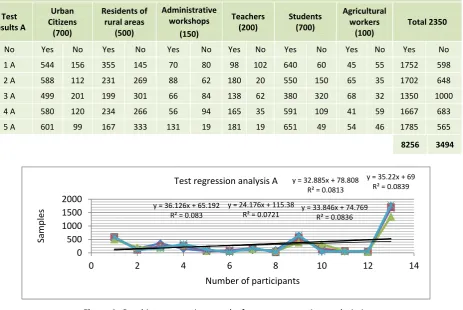
Table 1: Number of citizens tested for environmental knowledge, test A
Questions from the test (A)
1. You are familiar with the personal impact on the environment.2. Are you anxious about the environmental consequences of the 21st century? 3. Are you concerned about environmental equality globally? 4. Do you consume products that have a negative impact on the environment? 5. You know about the importance of public transport instead of using personal cars.
Test results A
Urban Citizens
(700)
Residents of rural areas
(500)
Administrative workshops
(150)
Teachers (200)
Students (700)
Agricultural workers
(100)
Total 2350
No Yes No Yes No Yes No Yes No Yes No Yes No Yes No
1 A 544 156 355 145 70 80 98 102 640 60 45 55 1752 598
2 A 588 112 231 269 88 62 180 20 550 150 65 35 1702 648
3 A 499 201 199 301 66 84 138 62 380 320 68 32 1350 1000
4 A 580 120 234 266 56 94 165 35 591 109 41 59 1667 683
5 A 601 99 167 333 131 19 181 19 651 49 54 46 1785 565
8256 3494
Figure 1: Graphic presentation, results from test regression analysis A
Table 2: Number of citizens tested for environmental awareness, test B
Questions from the test (B)
1. How much does the use of products consumed by you have an environmental impact?2. How much do you know about how your urban, rural, and land-based waste is managed?3. Know the pollutions caused by vehicles in your country and world.4. Be
aware of global warming.5. Is it in the interest of society to reduce products that adversely affect the environment?
Test results B
Urban Citizens
(700)
Residents of rural areas
(500)
Administrative workshops
(150)
Teachers (200)
Students (700)
Agricultural workers
(100)
Total 2350
No Yes No Yes No Yes No Yes No Yes No Yes No Yes No
1 B 401 299 233 267 133 17 183 17 599 101 66 34 1615 735
2 B 151 549 144 356 48 102 129 71 431 269 36 64 939 1411
3 B 488 212 312 188 77 73 167 33 598 102 39 61 1681 669
4 B 601 99 351 149 94 56 188 12 670 30 55 45 1959 391
5 B 666 34 288 212 88 62 155 45 631 69 71 29 1899 451
8093 3657
y = 35.22x + 69 R² = 0.0839
y = 33.846x + 74.769 R² = 0.0836 y = 24.176x + 115.38
R² = 0.0721
y = 32.885x + 78.808 R² = 0.0813
y = 36.126x + 65.192 R² = 0.083
0 500 1000 1500 2000
0 2 4 6 8 10 12 14
Samples
Figure 2: Graphic presentation, results from test regression analysis B
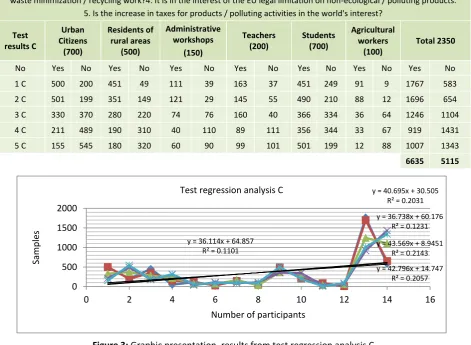
Table 3: Number of citizens tested for environmental knowledge, test C
Questions from the test (C)
1. Do Consumers Ecological Products. 2. Is it in the interest of human society to purchase ecological products? 3. How does waste minimization / recycling work?4. It is in the interest of the EU legal limitation on non-ecological / polluting products.
5. Is the increase in taxes for products / polluting activities in the world's interest?
Test results C
Urban Citizens
(700)
Residents of rural areas
(500)
Administrative workshops
(150)
Teachers (200)
Students (700)
Agricultural workers
(100)
Total 2350
No Yes No Yes No Yes No Yes No Yes No Yes No Yes No
1 C 500 200 451 49 111 39 163 37 451 249 91 9 1767 583
2 C 501 199 351 149 121 29 145 55 490 210 88 12 1696 654
3 C 330 370 280 220 74 76 160 40 366 334 36 64 1246 1104
4 C 211 489 190 310 40 110 89 111 356 344 33 67 919 1431
5 C 155 545 180 320 60 90 99 101 501 199 12 88 1007 1343
6635 5115
Figure 3: Graphic presentation, results from test regression analysis C
Based to research results we conclude that citizens do not have the necessary knowledge for environment problems, laws and environment in general.
y = 0 R² = #N/A y = 35.22x + 69
R² = 0.0839 y = 33.846x + 74.769
R² = 0.0836 y = 24.176x + 115.38
R² = 0.0721
y = 32.885x + 78.808 R² = 0.0813
y = 36.126x + 65.192 R² = 0.083
0 500 1000 1500 2000
0 2 4 6 8 10 12 14
Samples
Number of participants Test regression analysis B
y = 36.114x + 64.857 R² = 0.1101
y = 36.738x + 60.176 R² = 0.1231 y = 40.695x + 30.505
R² = 0.2031
y = 43.569x + 8.9451 R² = 0.2143
y = 42.796x + 14.747 R² = 0.2057
0 500 1000 1500 2000
0 2 4 6 8 10 12 14 16
Samples
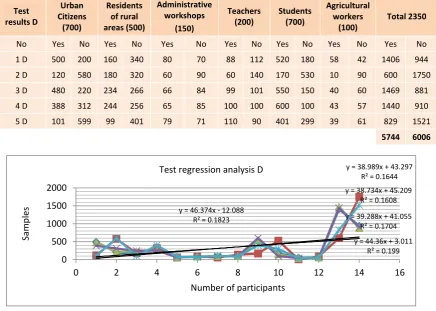
Table 4: Number of citizens tested for environmental knowledge, test D
Questions from the test (D)
1. Do you believe that ecological products are just as quality as industrial products?2. Will you pay an extra price to buy a product that has the lowest negative impact on the environment?3. Is it in the interest of society to establish EU / world laws on ecological products? 4. Do you know that people are getting infected with polluting substances /
tumors?5. Do you know how many people die per year from environmental pollution in the World / Kosovo?
Test results D
Urban Citizens
(700)
Residents of rural areas (500)
Administrative workshops
(150)
Teachers (200)
Students (700)
Agricultural workers
(100)
Total 2350
No Yes No Yes No Yes No Yes No Yes No Yes No Yes No
1 D 500 200 160 340 80 70 88 112 520 180 58 42 1406 944 2 D 120 580 180 320 60 90 60 140 170 530 10 90 600 1750 3 D 480 220 234 266 66 84 99 101 550 150 40 60 1469 881 4 D 388 312 244 256 65 85 100 100 600 100 43 57 1440 910 5 D 101 599 99 401 79 71 110 90 401 299 39 61 829 1521
5744 6006
Figure 4: Graphic presentation, results from test regression analysis D
Table 5: Citizens' overall results for environmental knowledge, test A + B + C + D
Results of groups Yes No 2350 respondent x 20 questions = 47000
Tab: 1 ( Test A ,1,2,3,4,5 ) 8256 3494 Tab: 2 ( TestB ,1,2,3,4,5 ) 8093 3657 Tab: 3 ( TestC ,1,2,3,4,5 ) 6635 5115 Tab: 4 ( TestD ,1,2,3,4,5 ) 5744 6006
Total 28728 18272 47000
DISCUSSIONS
The present research shows that the work with consulting and management projects will contribute in increasing the awareness of the society to protect the environment. Also, this research suggests to the state institutions should practice the projects’ work it comes to addressing environmental conservation topics. Awareness of society is an important civic responsible factor and healthy individuals. The research shows that citizens do not have sufficient knowledge on environmental management and its effects and consequences on health:
a) Lack of sufficient knowledge of environmental management and environmental hazards;
b) Lack of environment-friendly products and carcinogenic diseases;
c) They have no knowledge of the quality of ecological products;
d) They do not believe that their behaviour can change the environmental situation and the EU and World laws.
The research carried out has helped to raise citizens' awareness of environmental protection, as we were motivated by the results we received during this research.
y = 39.288x + 41.055 R² = 0.1704 y = 46.374x - 12.088
R² = 0.1823
y = 38.734x + 45.209 R² = 0.1608 y = 38.989x + 43.297
R² = 0.1644
y = 44.36x + 3.011 R² = 0.199
0 500 1000 1500 2000
0 2 4 6 8 10 12 14 16
Samples
Recommendations
In order to mitigate pressures on the environment it is recommended to undertake the following 10 main measures:
1. Enhancing awareness of citizens with sufficient knowledge of environmental protection;
2. Sensibilization of manufacturing organizations in reducing greenhouse gas emissions;
3. The introduction of environmental curricula at all levels of school;
4. Reduction and recycling of urban and industrial waste;
5. Management and use of more qualitative and ecological fuels;
6. Use of alternative transport that causes less environmental pollution;
7. Time limit for the use of outdated and non-catalytic vehicles;
8. Implementation of permissible noise norms by vehicles;
9. Rehabilitation of existing road infrastructure;
10. Strict monitoring of environmental laws and their application.
REFERENCES
1. Adams, D., Freund, P., Reimer, P., Smith, A. (1996). Technical response to climate change. International Energy Agency Greenhouse Gas Program.
2. Edmonds, J., Reilly, J. (1985). Global Energy: Assessing the Future. Oxford University Press; New York.
3. Gebhart, D. L., Johnson, H. B., Mayeux, H. S., Pauley, H. W. (1994). The CRP increases soil organic carbon. Soil and Water Conservation, 49, 488–492.
4. Dreshaj, Adem. Product quality management and environmental impacts in business, Prishtina 2014, Literature: f. 325-327, ISBN 978-9951-635-32-5.
5. Jesse Ausubel, IddoWernick and Paul Waggoner, “Peak Farmland and the Prospects for Sparing Nature,” Population and Development Review, vol. 38 (supplement), Population Council and Rockefeller University (2012).
6. Robert M. Carter, Climate: The counter consensus, London: Stacey International, 2010, pages 83-85.
7. IndurGoklany, Humanity Unbound: How fossil fuels saved humanity from nature and nature from humanity, Washington, DC: Cato Institute (2012).
8. Paul Driessen, Carbon Dioxide: The Gas of Life Tiny amounts of this miracle molecule make life on Earth possible, 2011. 9. Law on Environment protection–Assembly of Kosovo,
file:///C:/Users/Vostro/Downloads/p df-test.pdfUNECE
Water Convention,
(http://www.unece.org/env/water/text/text.html, 2004.
10.The Protocol on Water and Health (http://www.unece.org/env/water/pwh_text/text_protocol.html ) United Nations Framework Convention on Climate Change (UNFCCC January, 2014).
11.Kyoto Protocol to the United Nations Framework Convention on Climate Change, Kyoto, 11 December 1977. The full text of the convention is accessible at the following online address: http://unfccc.int/essential_background/kyoto_protocol/items/1 678.php (last visit 15 April 2017).
12.Legislation on environment area applicable in Kosovo is accessible at the following address: http://mmph-rks.org/en-us/Environmental-Laws (last visit 15 April, 2017).