Single-block collision attack on MD5
Marc Stevens
Cryptology Group, CWI
P.O. Box 94079, NL-1090 GB Amsterdam, The Netherlands
[email protected]
January 29, 2012
Abstract
In 2010, Tao Xie and Dengguo Feng [XF10] constructed the first single-block collision for MD5 consisting of two 64-byte messages that have the same MD5 hash. Details of their attack, developed using what they call an evolutionary approach, has not been disclosed “for security reasons”. Instead they have posted a challenge to the cryptology community to find a new different single-block collision attack for MD5. This paper answers that challenge by presenting a single-block collision attack based on other message differences together with an example colliding message pair. The attack is based on a new collision finding algorithm that exploits the low number of bitconditions in the first round. It uses a new way to choose message blocks that satisfy bitconditions up to step 22 and additionally uses three known tunnels to correct bitconditions up to step 25. The attack has an average runtime complexity equivalent to 249.8 calls to MD5’s compression function.
1
Introduction
The first MD5 collision by Wang et al. [WY05] in 2004 has set off an research impulse in the cryptanalysis of MD5. Their original attack can find collisions for MD5 in about 15 minutes up to an hour on an IBM P690 with a computational cost equivalent to about 239 calls to MD5’s compression function. Since then many improvements have been made [YS05, SNKO05, LL05, Kli05, Ste06, Kli06]. Currently, collisions for MD5 based on Wang et al.’s differential paths can be found in several seconds on a single powerful PC with a computational cost equivalent to about 224.1 compression function calls. These faster attacks use techniques based on tunnels [Kli06], controlling rotations in the first round [Ste06] and additional differential paths. Xie and Feng [XF09] have described promising message differences that might lead to a very fast attack, with possible a runtime complexity of roughly 210 compressions. However, they have not published an actual attack based on these message differences so far. Instead, they have constructed a MD5 collision attack with a complexity of about 220.96 MD5 compressions using less promising message differences. Our fastest collision attack [SSA+09] is based on slightly different message block differences than those used by Wang et al. and has a theoretical computational cost of about 216 compression function calls.
attack called achosen-prefix collision attack was introduced [SLdW07] that removes this require-ment. This additional freedom comes at a cost: chosen-prefix collision attacks are significantly slower and require more message blocks compared to identical-prefix collision attacks. Initially, a chosen-prefix collision could be found with an average computational cost of about 249 compres-sion function calls. Since then this attack has been improved to about 239 compression function calls [SSA+09]. Also a very short chosen-prefix collision attack requiring only 512 + 84 = 596 bits1 and a computational cost of about 253.2 compressions has been presented [SSA+09]. The most convincing abuse scenario of MD5 collision attacks was presented in 2009 when a rogue Certification Authority certificate signed by a trusted commercial Certification Authority was obtained using a chosen-prefix collision [SSA+09]. An overview of other abuse scenarios based on identical-prefix collisions and chosen-prefix collisions is given in [SLdW12].
Recently even single-block identical-prefix collisions have been found by Xie and Feng [XF10], although they do not present their new techniques or other details “for security reasons”. Instead, they have made a challenge to the cryptographic community to find a different single-block identical-prefix collision attack. This paper answers this challenge by presenting a new single-block identical-prefix collision attack for MD5 and an example colliding message pair. Our new collision attack uses the three known best tunnels and a new algorithm that exploits the very low number of bitconditions in the first round to deal with a rather high number of bitconditions in the second round.
2
Preliminaries
2.1
Notation
2.1.1 32-bit words
MD5 is designed with a 32-bit computing architecture in mind and operates on words (v31. . . v0) consisting of 32 bitsvi∈ {0,1}. These 32-bit words are identified with elementsv =P
31
i=0vi2i
of Z232 (a shorthand forZ/232Z). In this paper we switch freely between the bitwise andZ232 representation of 32-bit words. For 32-bit words X = (xi)31i=0 and Y = (yi)31i=0 we use the following notation:
• X∧Y = (xi∧yi)31i=0 is the bitwise AND ofX andY;
• X∨Y = (xi∨yi)31i=0 is the bitwise OR ofX andY;
• X⊕Y = (xi⊕yi)31i=0 is the bitwise XOR ofX andY;
• X = (xi)31i=0 is the bitwise complement ofX;
• X[i] is thei-th bit xi;
• X+Y andX−Y denote addition and subtraction, respectively, ofX andY in Z232;
• RL(X, n) and RR(X, n) are the cyclic left and right rotation, respectively, ofX byn bit positions:
RL(101001001111111111111111000000012, 5) = 100111111111111111100000001101002;
2.1.2 Binary signed digit representation
Abinary signed digit representation (BSDR) for anX ∈Z232 is a sequence (ki)31i=0 such that
X= 31 X
i=0
ki2i, ki∈ {−1,0,1}.
For each non-zero X there exist many different BSDRs. We use the following notation for a 32-digit BSDRZ:
• Z[i] is thei-th signed bit ofZ;
• RL(Z, n) andRR(Z, n) are the cyclic left and right rotation, respectively, ofZ byn posi-tions;
• w(Z) is the weight ofZ.
• σ(Z) =P31
i=0ki2i∈Z232 is the 32-bit word for whichZ is a BSDR.
2.1.3 Related variables and differences
In collision attacks we consider two related messagesM andM0. In this paper any variableX related to the messageM or its MD5 calculation may have a corresponding variableX0related to the messageM0 or its MD5 calculation. Furthermore, for such a ‘matched’ variableX ∈Z232 we defineδX=X0−Xand ∆X = (X0[i]−X[i])31
i=0, which is a BSDR ofδX. For a matched variable
Z that is a tuple of 32-bit words, sayZ= (z1, z2, . . .), we defineδZ and ∆Z as (δz1, δz2, . . .) and (∆z1,∆z2, . . .), respectively.
2.2
Definition of MD5
2.2.1 MD5 overview
MD5 works as follows on a given bit stringM of arbitrary bit length, cf. [Riv92]:
1. Padding. Pad the message: first append a ‘1’-bit, next append the least number of ‘0’-bits to make the resulting bit length equivalent to 448 modulo 512, and finally append the bit length of the original unpadded message M as a 64-bit little-endian integer. As a result the total bit length of the padded messageMcis 512N for a positive integerN.
2. Partitioning. Partition the padded message Mc into N consecutive 512-bit blocks M0,
M1, . . . , MN−1.
3. Processing. To hash a message consisting of N blocks, MD5 goes through N + 1 states IH Vi, for 0≤i ≤N, called theintermediate hash values. Each intermediate hash value
IH Vi is a tuple of four 32-bit words (ai, bi, ci, di). For i = 0 it has a fixed public value
called theinitial value (IV):
(a0, b0, c0, d0) = (6745230116,efcdab8916,98badcfe16,1032547616).
Fori= 1,2, . . . , N intermediate hash valueIH Viis computed using the MD5 compression
function described in detail below:
4. Output. The resulting hash value is the last intermediate hash valueIH VN, expressed as the
concatenation of the hexadecimal byte strings of the four wordsaN, bN, cN, dN, converted
back from their little-endian representation. As an example theIV would be expressed as
0123456789abcdeffedcba987654321016.
2.2.2 Definition of MD5Compress
MD5’s compression functionMD5Compressuses solely 32-bit words. The input for the compres-sion functionMD5Compress(IH Vin, B) consists of an intermediate hash valueIH Vin= (a, b, c, d) consisting of four words and a 512-bit message blockB. The compression function consists of 64 steps (numbered 0 to 63), split into four consecutive rounds of 16 steps each. Each step t uses modular additions, a left rotation, and a non-linear functionft, and involves an Addition
ConstantACtand a Rotation Constant RCt. These are defined as follows:
ACt=
232|sin(t+ 1)|
, 0≤t <64,
(RCt, RCt+1, RCt+2, RCt+3) =
(7,12,17,22) fort= 0,4,8,12, (5,9,14,20) fort= 16,20,24,28,
(4,11,16,23) fort= 32,36,40,44, (6,10,15,21) fort= 48,52,56,60.
The non-linear functionftdepends on the round:
ft(X, Y, Z) =
F(X, Y, Z) = (X∧Y)⊕(X∧Z) for 0≤t <16, G(X, Y, Z) = (Z∧X)⊕(Z∧Y) for 16≤t <32,
H(X, Y, Z) =X⊕Y ⊕Z for 32≤t <48, I(X, Y, Z) =Y ⊕(X∨Z) for 48≤t <64.
(1)
The message blockB is partitioned into sixteen consecutive wordsm0,m1, . . . , m15(with little-endian byte ordering), and expanded to 64 wordsWt, for 0≤t <64, of 32 bits each:
Wt=
mt for 0≤t <16,
m(1+5t) mod 16 for 16≤t <32,
m(5+3t) mod 16 for 32≤t <48,
m(7t) mod 16 for 48≤t <64.
We follow the description of the MD5 compression function from [HPR04] because its ‘unrolling’ of the cyclic state facilitates the analysis. For each step t the compression function algorithm maintains a working register with four state wordsQt, Qt−1, Qt−2 and Qt−3 and calculates a new state word Qt+1. With (Q0, Q−1, Q−2, Q−3) = (b, c, d, a), fort= 0,1, . . . ,63 in succession
Qt+1 is calculated as follows:
Ft=ft(Qt, Qt−1, Qt−2);
Tt=Ft+Qt−3+ACt+Wt;
Rt=RL(Tt, RCt);
Qt+1=Qt+Rt.
(2)
After all steps are computed, the resulting state words are added to the intermediate hash value and returned as output:
2.3
Bitconditions
Our collision finding algorithm depends on a set of sufficient bitconditions on (Qt[b], Q0t[b]) that
facilitates the search for a message block pair that satisfies a given differential path. Table 1 lists the possible bitconditions that may be used. We define qt[b] to denote the bitcondition on
(Qt[b], Q0t[b]), and we defineqt to denote all bitconditions (qt[i])31i=0 on (Qt, Q0t).
Table 1: Sufficient bitconditions.
Symbol condition on Qt[i] direct/indirect
. no condition direct
0 Qt[i] = 0 direct
1 Qt[i] = 1 direct
^ Qt[i] =Qt−1[i] indirect
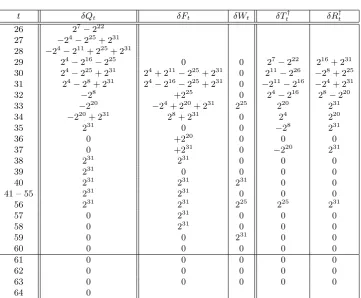
Table 2: Partial differential path
t δQt δFt δWt δTt† δR
†
t
26 27−222 27 −24−225+ 231
28 −24−211+ 225+ 231
29 24−216−225 0 0 27−222 216+ 231 30 24−225+ 231 24+ 211−225+ 231 0 211−226 −28+ 225
31 24−28+ 231 24−216−225+ 231 0 −211−216 −24+ 231
32 −28 +225 0 24−216 28−220
33 −220 −24+ 220+ 231 225 220 231
34 −220+ 231 28+ 231 0 24 220
35 231 0 0 −28 231
36 0 +220 0 0 0
37 0 +231 0 −220 231
38 231 231 0 0 0
39 231 0 0 0 0
40 231 231 231 0 0
41 – 55 231 231 0 0 0
56 231 231 225 225 231
57 0 231 0 0 0
58 0 231 0 0 0
59 0 0 231 0 0
60 0 0 0 0 0
61 0 0 0 0 0
62 0 0 0 0 0
63 0 0 0 0 0
64 0
3
Our single-block collision attack
3.1
Overview
For our single-block collision attack we have selected the following message differences:
δm8= 225, δm13= 231, δmi= 0 for 0≤i <16, i6= 8,13.
These message differences lead to the partial differential path presented in Table 2. We have chosen these message differences due to their properties similar to those of the message differences used by Xie and Fengg [XF10]: δm5= 210andδm10= 231.
In Section 3.2, we first construct a full differential path and a set of sufficient bitcondi-tions, based on the partial differential path given in Table 2, using our techniques presented in [SLdW12]. Next, we present our new collision finding algorithm in Section 3.3 followed by the collision attack complexity analysis in Section 3.4. Finally, we present a found example colliding message pair each consisting of only a single block of 512 bits in Section 3.5.
3.2
Bitconditions
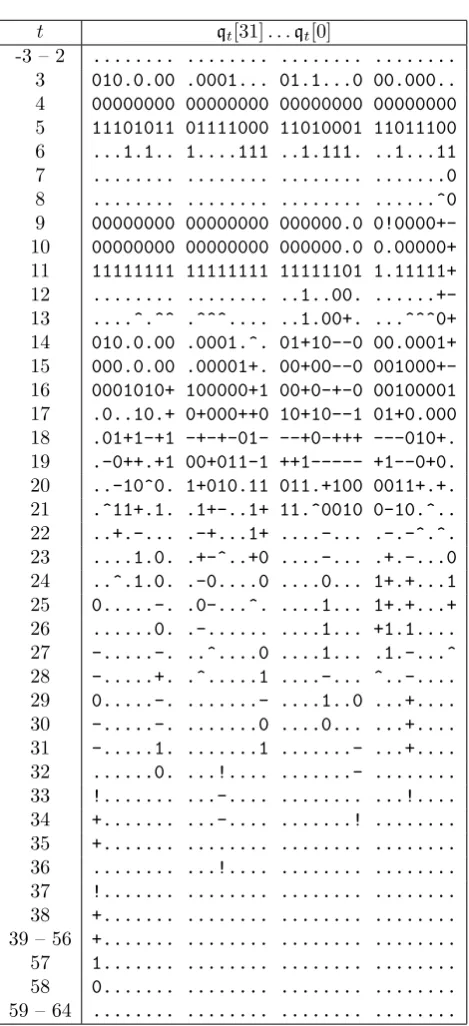
We used our differential path construction algorithm from [SLdW07]2 to construct a full differ-ential path based on the partial differdiffer-ential path in Table 2.
In order to keep the number of necessary bitconditions in the first round to a minimum, we have chosen to perform the connection over the steps 18–21, instead of our usual choice for the steps 12–15. In particular, our new collision finding algorithm depends on a low number of bitconditions on the variablesQ2,Q7,Q8,Q12andQ13, whereas all bitconditions on the variables
Q14 up to Q21 can be fulfilled freely. Differential paths of this form are usually only possible if they start withδIH Vin = (0,0,0,0), which is not the case for chosen-prefix collision attacks and the second near-collision attack in a two-block identical-prefix collision attack. However, a single-block identical-prefix collision has only one message block pair and its compression starts withδIH Vin= (0,0,0,0).
3.3
Algorithm
We present our new collision finding algorithm as Algorithm 1. It is designed to allow any number of bitconditions overQ14 up to Q21 by exploiting a large degree of freedom in the first round (very few bitconditions). Our algorithm is extended by the three known best tunnels, whose auxiliary bitconditions in the first round do not have an averse effect on the attack’s runtime complexity.
Algorithm 1 can be roughly split into four parts:
1. Instantiation (1.–3.): randomly choose values for Q14 up to Q21 satisfying the given bit-conditions. These values directly imply values for m6 (step 17), m11 (step 18), m0 (step 19),m5 (step 20) andQ1 (step 0).
2. Precomputations (4.–7.): first a lookup table is generated containing tuples of valid values for Q2 up to Q7 and Q13 that satisfy equations for steps 1 (uses m1), 5 (uses m5), 6 (usesm6) and 16 (uses m1) and the given bitconditions. The lookup table is indexed by the values of the bits of Q7 and Q13 that are involved with Q8 and Q12 due to indirect bitconditions. These bitpositions are marked with ‘1’-bits in the 32-bit word masksB8and
B13in Algorithm 1.
Table 3: Bitconditions
t qt[31]. . .qt[0]
-3 – 2 ... ... ... ...
3 010.0.00 .0001... 01.1...0 00.000..
4 00000000 00000000 00000000 00000000
5 11101011 01111000 11010001 11011100
6 ...1.1.. 1....111 ..1.111. ..1...11
7 ... ... ... ...0
8 ... ... ... ...^0
9 00000000 00000000 000000.0
0!0000+-10 00000000 00000000 000000.0 0.00000+
11 11111111 11111111 11111101 1.11111+
12 ... ... ..1..00.
...+-13 ....^.^^ .^^^.... ..1.00+. ...^^^0+
14 010.0.00 .0001.^. 01+10--0 00.0001+
15 000.0.00 .00001+. 00+00--0
001000+-16 0001010+ 100000+1 00+0-+-0 00100001
17 .0..10.+ 0+000++0 10+10--1 01+0.000
18 .01+1-+1 -+-+-01- --+0-+++ ---010+.
19 .-0++.+1 00+011-1 ++1--- +1--0+0.
20 ..-10^0. 1+010.11 011.+100 0011+.+.
21 .^11+.1. .1+-..1+ 11.^0010 0-10.^..
22 ..+.-... .-+...1+ ....-... .-.-^.^.
23 ....1.0. .+-^..+0 ....-... .+.-...0
24 ..^.1.0. .-0....0 ....0... 1+.+...1
25 0...-. .0-...^. ....1... 1+.+...+
26 ...0. .-... ....1... +1.1....
27 -...-. ..^....0 ....1... .1.-...^
28 -...+. .^...1 ....-... ^..-....
29 0...-. ...- ....1..0 ...+....
30 -...-. ...0 ....0... ...+....
31 -...1. ...1 ...- ...+....
32 ...0. ...!.... ...- ...
33 !... ...-.... ... ...!....
34 +... ...-.... ...! ...
35 +... ... ... ...
36 ... ...!.... ... ...
37 !... ... ... ...
38 +... ... ... ...
39 – 56 +... ... ... ...
57 1... ... ... ...
58 0... ... ... ...
59 – 64 ... ... ... ...
Includes bitconditions for tunnels (see Table 4). Bitconditions (and rotations) are only verified up to Q29.
Algorithm 1Single-block collision finding algorithm
Input: IH Vin∈(Z232)4;
Output: M 6=M0∈ {0,1}512 such thatMD5Compress(IH V
in, M) =MD5Compress(IH Vin, M0);
Uses the bitconditions given in Table 3 and the tunnels shown in Table 4.
Algorithm:
1. InitializeQ−3,Q−2,Q−1 andQ0 withIH Vin
2. Randomly chooseQ14, . . . , Q21satisfying bitconditions†
3. Computem6,m11,m0 andm5 at stepst= 17,18,19,20, andQ1 (at step 0)
4. Generate lookup table:
5. Loop over all values forQ3,Q4,Q5 andQ6 that satisfy bitconditions†:
6. ComputeQ7 (at step 6),Q2 (at step 5),m1 (at step 1) andQ13(at step 16)
7. IfQ7,Q2 andQ13satisfy bitconditions‡then
append tuple (Q2, Q3, Q6, Q7, Q13) to lookup table at index (Q7∧B8, Q13∧B13)
8. Loop over all values forQ9,Q10,Q11andQ12that satisfy bitconditions†:
9. ComputeQ8 at step 11
10. IfQ8 satisfies bitconditions (including indirect ones involvingQ9) then
loop over all (Q2, Q3, Q6, Q7, Q13) in lookup table at index (Q8∧B8, Q12∧B13):
11. Computem0, . . . , m15(at steps 0, . . . ,15) andQ22andQ23
12. IfQ22andQ23satisfy bitconditions then
Loop over tunnelT4 to alterm3,m4 andm7:
13. Computem4(step 4) andQ24(step 23)
14. IfQ24satisfies bitconditions then
loop over tunnelT9 to alterm8,m9 andm12:
15. Computem9 (step 9) andQ25(step 24)
16. IfQ25satisfies bitconditions then
loop over tunnelT14 to alterm2,m3,m6 (at steps 6 and 17),m13andm14:
17. Computem14,m3,m8,m13(steps 14, 3, 8, 13) andQ26–Q29 (steps 25–28)
18. IfQ26,Q27,Q28 andQ29 satisfy bitconditions then:
19. LetM= (mi)15i=0andM
0
=M+δM
20. IfMD5Compress(IH Vin, M) =MD5Compress(IH Vin, M0) thenreturn(M, M0).
21. Repeat steps1. through20. (until a collision is found)
†Ignoring any indirect bitconditions involving variablesQiwhose values are not yet known.
‡Including all indirect bitconditions involving these variables and variablesQiwhose values are known.
Note: The wordsB8, B13∈Z232 are constants such thatBt[b] = 1⇔qt[b] =‘^’ fort∈ {8,13}, b∈ {0, . . . ,31}.
3. Main loop (8.–11.): iterate over valid values forQ8 up toQ12 satisfying bitconditions and the step equation for step 11 usingm11: Find all values in the lookup table that satisfy all indirect bitconditions betweenQ7andQ8, and betweenQ12andQ13 using the index. For each of these values, the variables Q−3 up to Q16 are known and thus the entire message block is determined. ComputeQ22andQ23and if they satisfy the given bitconditions then do the last part.
corrections to the message block pair such that all bitcondition up toQ23 remain fulfilled. For all message block pairs that satisfy bitconditions q−3 up to q29, check whether the message block pair forms a collision.
Our algorithm uses the three known best tunnels that are described in Table 4 and allow to efficiently satisfy bitconditionsq24,q25 andq26.
Table 4: Tunnels for MD5.
Tunnel Change Affected Extra bitconditions? Bitmask T4 Q4[b] m3, m4, m7, Q24..Q64 Q5[b] = 0, Q6[b] = 1 14872e2316 T9 Q9[b] m8, m9, m12, Q25..Q64 Q10[b] = 0, Q11[b] = 1 fffffdbc16 T14 Q14[b] m13, m14, m6, Q26..Q64 Q15[b] =Q16[b] = 0, Q3[b] =Q14[b]† eb78d1dc16
Q3[b] m2, m3 Q4[b] = 0, Q5[b] = 1‡
?Extra bitconditions refer only toQt[b] and not toQ0t[b]. E.g.,Q5[b] = 0 is met by bothq5[b] = ‘0’ andq5[b] = ‘+’. A 32-bit word whose ‘1’-bits describe the bitsbthat are used for tunnels in combination with Table 3.
†Bitconditionq3[b] = ‘.’ and no other indirect bitconditions may involveQ3[b].
‡An extra bitconditionQ12[b] =Q13[b] may be used such that the change inm14can be accurately predicted.
3.4
Complexity analysis
We have implemented our single-block collision attack in C++. The sources and a Windows executable can be found athttp://marc-stevens.nl/research. Our algorithm can be freely parallelized by using different instantiations for each thread.
Our implementation frequently shows the number of message block pairs it has found that satisfies bitconditionsq−3, . . . ,q29, together with the wall time that has passed. Based on these numbers, we have experimentally determined the average runtime complexity of finding one message block pair that satisfies bitconditionsq−3, . . . ,q29being equivalent to about 215.96MD5 compressions3. Furthermore, we have experimentally determined that the probability that a message block pair satisfyingq26,q27,q28 andq29 results in a collision is about 2−33.85. Hence, our single-block collision attack has a runtime cost equivalent to about 215.96·233.85 = 249.81 MD5 compressions.
3.5
Results
Based on our complexity analysis and a number of computers available for our collision search, we estimated that it would take approximately five weeks. As this was feasible enough, we started the actual search.
It was our fortune that a collision was found a bit earlier, namely after only three weeks. We present our found example colliding message pair in Table 5. The two colliding messages can also be downloaded athttp://marc-stevens.nl/research.
Table 5: Example single-block collision – in hexadecimal notation
Message 1
4d c9 68 ff 0e e3 5c 20 95 72 d4 77 7b 72 15 87 d3 6f a7 b2 1b dc 56 b7 4a 3d c0 78 3e 7b 95 18 af bf a2 00 a8 28 4b f3 6e 8e 4b 55 b3 5f 42 75 93 d8 49 67 6d a0 d1 55 5d 83 60 fb 5f 07 fe a2
Message 2
4d c9 68 ff 0e e3 5c 20 95 72 d4 77 7b 72 15 87 d3 6f a7 b2 1b dc 56 b7 4a 3d c0 78 3e 7b 95 18 af bf a2 02 a8 28 4b f3 6e 8e 4b 55 b3 5f 42 75 93 d8 49 67 6d a0 d1 d5 5d 83 60 fb 5f 07 fe a2
Common MD5 hash
008ee33a9d58b51cfeb425b0959121c9
4
Concluding remarks
Tao Xie and Dengguo Feng [XF10] have posted a challenge to the cryptology community to find a new different single-block collision attack for MD5. In this paper we have met their challenge by presenting a new single-block collision attack for MD5 that is based on other message differences than those used by Xie and Feng. Our single-block collision attack has a runtime complexity equivalent to about 249.8 calls to MD5’s compression function. Since Xie and Feng disclosed very little details about their attack, we are unable to compare the complexities of these two single-block collision attacks for MD5.
Furthermore, we have successfully implemented our collision attack which resulted in an example colliding message block pair. Our implementation sources, a Windows executable and the two colliding 64-byte messages can be found athttp://marc-stevens.nl/research.
References
[HPR04] Philip Hawkes, Michael Paddon, and Gregory G. Rose,Musings on the Wang et al. MD5 Collision, Cryptology ePrint Archive, Report 2004/264, 2004.
[Kli05] Vlastimil Klima, Finding MD5 Collisions on a Notebook PC Using Multi-message Modifications, Cryptology ePrint Archive, Report 2005/102, 2005.
[Kli06] Vlastimil Klima, Tunnels in Hash Functions: MD5 Collisions Within a Minute, Cryptology ePrint Archive, Report 2006/105, 2006.
[LL05] Jie Liang and Xuejia Lai,Improved Collision Attack on Hash Function MD5, Cryp-tology ePrint Archive, Report 2005/425, 2005.
[SLdW07] Marc Stevens, Arjen K. Lenstra, and Benne de Weger,Chosen-Prefix Collisions for MD5 and Colliding X.509 Certificates for Different Identities, EUROCRYPT (Moni Naor, ed.), Lecture Notes in Computer Science, vol. 4515, Springer, 2007, pp. 1–22.
[SLdW12] Marc Stevens, Arjen K. Lenstra, and Benne de Weger, Chosen-prefix collisions for MD5 and applications, 2012, to appear in: Internation Journal of Applied Cryptog-raphy.
[SNKO05] Yu Sasaki, Yusuke Naito, Noboru Kunihiro, and Kazuo Ohta, Improved Collision Attack on MD5, Cryptology ePrint Archive, Report 2005/400, 2005.
[SSA+09] Marc Stevens, Alexander Sotirov, Jacob Appelbaum, Arjen K. Lenstra, David Mol-nar, Dag Arne Osvik, and Benne de Weger,Short Chosen-Prefix Collisions for MD5 and the Creation of a Rogue CA Certificate, CRYPTO (Shai Halevi, ed.), Lecture Notes in Computer Science, vol. 5677, Springer, 2009, pp. 55–69.
[Ste06] Marc Stevens, Fast Collision Attack on MD5, Cryptology ePrint Archive, Report 2006/104, 2006.
[WY05] Xiaoyun Wang and Hongbo Yu, How to Break MD5 and Other Hash Functions, EUROCRYPT (Ronald Cramer, ed.), Lecture Notes in Computer Science, vol. 3494, Springer, 2005, pp. 19–35.
[XF09] Tao Xie and Dengguo Feng,How To Find Weak Input Differences For MD5 Collision Attacks, Cryptology ePrint Archive, Report 2009/223, 2009.
[XF10] Tao Xie and Dengguo Feng,Construct MD5 Collisions Using Just A Single Block Of Message, Cryptology ePrint Archive, Report 2010/643, 2010.