Multi-feature Fusion Based Image Retrieval
Scheme
V.Amukta Malyada1, Ch.Srinivasa Rao2
PG Student (Systems & Signal Processing), Dept. of ECE, JNTUK-UCEV, Vizianagaram, Andhra Pradesh, India1
Professor, Dept. of ECE, JNTUK-UCEV, Vizianagaram, Andhra Pradesh, India2
ABSTRACT: Content Based Image Retrieval is a scheme that uses content as image features to search the required image from databases according to the query. This paper mainly focuses on multi-feature fusion method which concentrates on extracting colour, shape as well as texture features for Content Based Image Retrieval (CBIR).The Color feature of the image is extracted by using color moments in RGB color space combined with 72 bin color histogram in HSV space. Texture feature of the image is extracted by using GLCM and the Exact Legendre Moments are used to extract the shape of the image. Multi-feature fusion has been done to the three individual features. The retrieval performance of the proposed method is measured on Corel-10 image database.
KEYWORDS:Content Based Image Retrieval (CBIR), Colour Moments (CM), Colour Histogram (CH), Gray Level Co-occurrence Matrix (GLCM), Exact Legendre Moments (ELM), Multi-feature fusion.
I. INTRODUCTION
An image retrieval system helps us to retrieve the images efficiently from the databases. Text Based Image Retrieval was used in the past, but presently CBIR is being used due to its advantages compared to the former scheme. CBIR scheme uses image features to search the image database. The term "CONTENT" in CBIR might refer to low level feature such as shape, color, texture, or any data related to the image or the high level features which include tags, keywords, etc. [1]. It is used to obtain the images which are relevant to the query image which is given as input to the system. Figure.1 shows structure of CBIR system.
A database consists of large number of images with different formats. The features of the query image which is an input to the system and the image database are extracted to obtain the query feature and the database features. Matching between the query features and the database features is done. The commonly used similarity method is the Distance method. Those images which have minimum distances are returned to the user. These are said to be the relevant images [3].
The paper is organized as follows. A review on various CBIR systems existing in the literature is given in section 2.The feature extraction techniques used in retrieval is presented in section 3.The proposed method for CBIR has been discussed in Section 4. Section 5contains the experimental results which are obtained. Conclusions are presented in Section 6..
II. RELATED WORK
Haralick et al [2]used the GLCM to extract the texture feature of the image. He extracted the fourteen statistical features to describe the texture. By using a combination of edge information in combination with GLCM statistical features, the precision of the system is improved [14].
Previous researches were based on the gray-scale texture, such as GLCM, Tamura texture and wavelet texture. But the author used texture caused by color differences .By using the quantified chroma, to these textures; it is proven that the chroma texture has better retrieval than that of the luminance texture. The retrieval performance increases significantly[10].
Other method for retrieving color images has been presented using texture feature, which uses the color co-occurrence matrix. The authors obtained the color connectivity region set .The GLCM for each connectivity region in four orientations is extracted. The texture correlation in addition to the color information is obtained from the feature. This method is superior to the GLCM method and color histogram method [11].
Another method has been introduced in which colour feature of the image is extracted by using quantized colour histogram in HSV space .Texture of the image is extracted by using GLCM method. The authors adopted the linear weighted mode along with similar distances of chroma and texture for retrieving the images with high retrieval performance. The accurate results were obtained by using the weights of the colour and texture feature as 0.5 and 0.5.By using this method better retrieval results were obtained [12].
Hosney proposed a new strategy in computing the Legendre Moments quickly for binary as well as gray images. The method discussed is independent of geometric moments, and can be extended in computing 3D Legendre moments [8]. Due to non-orthogonality of MI and poor reconstruction of ZM, the retrieval efficiency of using these methods for image retrieval in CBIR is less. Therefore, an efficient method to overcome these problems is needed. ELMs perform efficiently compared to MI, ZM and LM. The given method is superior over other moments. ELM can be used to represent the shape of an image compactly [7].This motivated us to use Exact Legendre Moments for extracting the shape feature of the image.
Jing-Yan Wang and Zhen Zhu[13] introduced a method which uses multi-feature fusion for image retrieval. They extracted the color feature of the image using color histogram, texture feature using GLCM method, and moment invariants for shape feature.
III. FEATURE EXTRACTION WORK
Feature extraction is an essential part in CBIR. It is used to separate the visual content of the query image and the database images. These are stored in the form of feature vectors in the feature database for matching [4].
The following features have been used for image retrieval in the presented paper:
Color Moments in RGB color space combined with Color Histogram in HSV color space as color feature. GLCM properties as texture feature.
Exact Legendre Moments as shape feature.
A. Retrieval Based On Color Feature
Color is the essential low level feature utilized for image retrieval.
a) Color Moments
These moments are used to obtain the color distributions in an image.
First Order Moment (Mean) :
Returns the mean values of the elements in different dimensions along the array.
Second Order Moment (Standard Deviation) :
Returns the standard deviation values of the elements in different dimensions along the array.
Third Order Moment (Skewness) :
It is the measure of symmetry of data around the sample mean.
⎩ ⎪ ⎪ ⎪ ⎨ ⎪ ⎪ ⎪
⎧ = 1
×
= 1
× ( − )
= 1
× (p − )
/ (1)
where is the color component of the pixel in the image, and U×Vis the number of pixels present in an image.
b) Color Histogram
The color histogram (CH) has been used which provides an efficient color feature representation of an image. The discrimination capacity depends on the number of bins. If the bins are more this method has higher discrimination capability. The advantage of using HSV space is that HSV tries to capture the component in the way we humans perceive colour.
Making L = 9H + 3S + V, we obtain 72 color values which is the color vector. Color quantization is done. This reduces the number of colors to represent an image. As it is difficult to represent 256×256×256 bins, quantization scheme has been employed. Color feature of the image is obtained [6].
B. Retrieval Based on Texture Feature
Gray level co-occurrence matrix is used for texture extraction. To obtain the texture of an image we obtain offset parameters in four orientations (0°,45°,90°,135°) as GLCM. Four statistical features using GLCM are obtained. The statistical features used are given below:
a) Angular Second Moment(Energy)
F = Q(l, m) (2)
The angular second-moment gives the degree of uniformity of an image [6].Q(l,m) is one value of GLCM.
b) Contrast (Moment of inertia)
F = (l−m) Q(l, m) (3)
Contrast reflects the local variations present in an image [2].
c) Correlation
F = (l− μ)(m− μ )Q(l, m)
σ σ
,
(4)
This feature gives the grade of similarity of values of GLCM in row as well as column direction [2].
d) Entropy
F =− Q(l, m)logQ(l, m) (5)
It is used to obtain the randomness of texture feature of an image. It is maximum when all the values in GLCM are equal [6].
C. Retrieval Based on Shape Features
Shape features help in object identity. Exact Legendre Moments have been used in this paper to extract the shape features. A method to compute the Legendre Moments is given by Hosney [8] which is as follows.
Legendre moments of an image of order o= (m+ n) whose intensity function is F(y, z) are
=(2 + 1)(2 + 1)
4 ( ) ( ) ( , ) (6)
where, (y) is the order Legendre polynomial which is given as
( ) = , =
1
2 ! [( −1)] (7)
where, y [-1,1] and (y) follows the recursive relation given below.
( ) =(2 + 1)
( + 1) ( )− + 1 ( ) (8)
with (y)=1 , (y) = y and M> 1.
The Legendre polynomials { (y)}form an orthogonal basis set defined on the interval [-1, 1]. An image is an array of pixels. The size of the image is P×P. ( , ) is the centre.
In order to improve accuracy, we obtained the approximated form as
= ( ) (9)
where,
=
( ) ( ,
)
(10)where,
Hence, the shape feature is extracted using ELM. The shape feature is obtained as explained above [7].
IV. PROPOSED ALGORITHM
The steps of proposed method are given below:
Input the query image.
Extract the colour, texture and shape features of the image.
Extract the color feature using color moments in RGB color space combined with color histogram in HSV space.
Extract the texture feature using GLCM.
Extract the shape feature using ELM.
Multi-feature fusion is done. Fuse these three features to form a single feature vector (F). F= {color, texture, shape} = {CM, CH, GLCM, ELM}.
Euclidean distance between the query image and the database images is found. Retrieve the relevant images using similarity measures.
The relevant images are retrieved.
V.EXPERIMENTALRESULTS
Average retrieval rate is found for the presented CBIR system by conducting experiments on corel-10 Image database. Experiments are conducted using MATLAB 2013.
Fig.2 Sample images of ten different classes from Corel-10 database
Fig.3 Retrieved images with top left image as query image
The 20 images which are retrieved with top left image as input is shown in Fig.3. In the presented method we found the relevant images from top ‘20’ matches.
CLASS
CM+Colour Histogram+GLCM
CM+Colour Histogram+GLCM+LM
CM+Colour Histogram+GLCM+ELM
Snowy Mountains
37.8 44.35 39.15
Food 64.75 65.4 65.6
Horse 88.8 89.7 90.8
Rose 73.9 76.1 77
Elephants 51.15 52.2 53.15
Dinosaurs 94.45 94.7 95.95
Bus 58.35 59 55.75
Beach 44 44.6 49.95
African People 65.95 65.5 47.25
Building 50.05 49.15 60.5
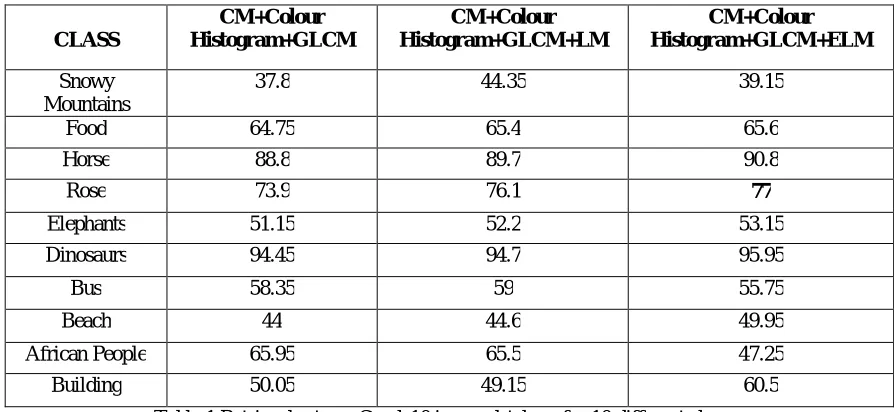
Table 1.Retrieval rate on Corel-10 image database for 10 different classes
The retrieval performance of the given method is compared using Euclidean distance.From the results shown in table 1 it is observed that by using multi-features the retrieval rate of the images has been increased.
VI.CONCLUSION
which works well when compared to the other shape retrieval methods. Multi-feature fusion for image retrieval gives better retrieval efficiency.
REFERENCES
[1] RoshiChoudhary, Nikita Raina, Neeshu Chaudhary, Rashmi Chauhan, Dr. R H Goudar, “An Integrated Approach to Content Based Image Retrieval”, International Conference on Advances in Computing, Communications and Informatics (ICACCI),pp 2404-2410, 2014.
[2] Robert M. Harlick, ,K.Shannugam, ,Its’hakDinsten, ”Textural features for image classification”, IEEE,Transaction on Systems Man &Cybernetics, Vol. SMC-3,Issue-6 ,pp 610-621, Nov-1973.
[3] Swapnalini Pattanaik, Prof.D.G.Bhalke, “Beginners to Content Based Image Retrieval”, International Journal of Scientific Research Engineering and Technology, Volume 1, Issue 2, pp 040-044, May 2012.
[4] Young Deok Chun, Nam Chul Kim and Ick Hoon Jang, "Content-Based Image Retrieval Using Multi resolution Color and Texture Features", Multimedia, IEEE Transactions, Volume: 10, Issue: 6, pg no: 1073 – 1084, Oct. 2008.
[5] Dr. Fuhui Long, Dr. Hongjiang Zhang and Prof. David Dagan Feng, Book title:”Fundamentals of Content-based Image Retrieval”.
[6] Min Huanga, Huazhong Shua, Yaqiong Mab, Qiuping Gongba “Content-based image retrieval technology using multi-feature fusion” Optik 126 pp 2144–2148, 2015.
[7 ]Ch.Srinivasa Rao, S. Srinivas Kumar, B. Chandra Mohan, “Content based image retrieval using exact legend moments ad support vector machine”The international journal of multimedia and its applications (IJMA), vol.2,issue 2,may 2010.
[8] Khalid M. Hosny, “Exact Legendre moment computation for gray level images”, Pattern Recognition, Vol40, 2007.
[9] Jie, B. Wang, G. Li,” Textural feature extraction and classification study research digital image”, Electr. Measur. Technol. ,Vol31, Issue5,pp 52– 55,2008.
[10] Menglin Liu, Li Yang, Yanmei Liang, “A chroma texture-based method in color image retrieval” Optik 126, pp 2629–2633, 2015.
[11] Wang Xing-yuan , Chen Zhi-feng, Yun Jiao-jiao,”An effective method for color image retrieval based on texture”, Computer Standards & Interfaces, vol. 34, pp. 31–35, 2012.
[12] Jun Yue, Zhenbo Li, Lu Liu, Zetian Fu. “Content based image retrieval using color and texture fused features”, Mathematical and Computer Modelling Elsevier, vol 54, Issue 3-4, pp1121–1127, 2011.
[13] Jing-Yan Wan, Zhen Zhu, “Image Retrieval System Based On Multi-Feature Fusion and Relevance Feedback”Proceedings of the Ninth International Conference on Machine Learning and Cybernetics, Qingdao, Vol 4 11-14 July 2010.
[14] J. Zhang, G.-L. Li and S.-Wun, “Texture–Based Image Retrieval by Edge detection Matching GLCM”, the 10th international Conference on High Performance computing and Communications, pp. 782-786, 2008.
BIOGRAPHY
V.Amukta Malyada is currently pursuing Post Graduation in Systems and Signal Processing, Department of E.C.E.JNT University Kakinada, Vizianagaram-535003. She has interest in the area of Contest Based Image Retrieval.