MONPA: Multi-objective Named-entity and Part-of-speech Annotator for
Chinese using Recurrent Neural Network
Yu-Lun Hsieh
SNHCC, TIGP, Academia Sinica, and National Cheng Chi University, Taiwan
Yung-Chun Chang
Graduate Institute of Data Science, Taipei Medical University, Taiwan
Yi-Jie Huang, Shu-Hao Yeh, Chun-Hung Chen, and Wen-Lian Hsu
IIS, Academia Sinica, Taiwan
{aszx4510,night,hep chen,hsu}@iis.sinica.edu.tw
Abstract
Part-of-speech (POS) tagging and named entity recognition (NER) are crucial steps in natural language processing. In ad-dition, the difficulty of word segmenta-tion places extra burden on those who deal with languages such as Chinese, and pipelined systems often suffer from error propagation. This work proposes an end-to-end model using character-based recur-rent neural network (RNN) to jointly ac-complish segmentation, POS tagging and NER of a Chinese sentence. Experi-ments on previous word segmentation and NER competition datasets show that a sin-gle joint model using the proposed ar-chitecture is comparable to those trained specifically for each task, and outperforms freely-available softwares. Moreover, we provide a web-based interface for the pub-lic to easily access this resource.
1 Introduction
Natural language processing (NLP) tasks often rely on accurate part-of-speech (POS) labels and named entity recognition (NER). Moreover, for languages that do not have an obvious word boundary such as Chinese and Japanese, segmen-tation is another major issue. Approaches that at-tempt to jointly resolve two of these tasks have re-ceived much attention in recent years. For exam-ple,Ferraro et al.(2013) proposed that joint solu-tions usually lead to the improvement in accuracy over pipelined systems by exploiting POS infor-mation to assist word segmentation and avoiding error propagation. Recent researches (Sun,2011; Qian and Liu,2012;Zheng et al.,2013;Zeng et al., 2013;Qian et al.,2015) also focus on the develop-ment of a joint model to perform Chinese word
segmentation, POS tagging, and/or informal word detection.
However, to the best of our knowledge, no exist-ing system can perform word segmentation, POS tagging, and NER simultaneously. In addition, even though there are methods that achieved high performances in previous competitions hosted by the Special Interest Group on Chinese Language Processing (SIGHAN)1, there is no off-the-shelf NLP tools for Traditional Chinese NER but only two systems for word segmentation and POS tag-ging, which poses a significant obstacle for pro-cessing text in Traditional Chinese. These prob-lems motivate us to devise a unified model that serves as a steppingstone for future Chinese NLP research.
In light of the recent success in applying neu-ral networks to NLP tasks (Sutskever et al.,2014; Lample et al., 2016), we propose an end-to-end model that utilizes bidirectional RNNs to jointly perform segmentation, POS tagging, and NER in Chinese. This work makes the following major contributions. First, the proposed model conducts multi-objective annotation that not only handles word segmentation and POS tagging, but also can recognize named entities in a sentence simultane-ously. We also show that these tasks can be effec-tively performed by the proposed model, achiev-ing competitive performances to state-of-the-art methods on word segmentation and NE recogni-tion of previous SIGHAN shared tasks. More-over, our system not only outperforms off-the-shelf NLP tools, but also provides accurate NER results. Lastly, we provide an accessible online API2 that has been utilized by several research groups.
1http://sighan.cs.uchicago.edu/
2Please visit http://monpa.iis.sinica.edu.
tw:9000/chunk
Bidirectional LSTM Encoder
C1
C
2Cn
⋮
◦
◦
◦
◦
BW FW
◦
◦
●●
●●
LSTM Decoder
T
1T
2T
n⋮
softmax
softmax
⊗
⊗
⊗
attention weights
●●
softmax
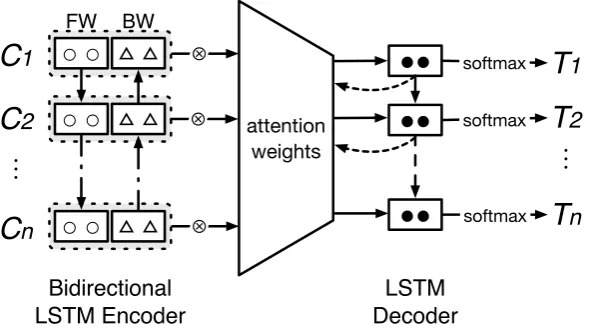
Figure 1: Overview of the encoder-decoder model with attention mechanism. Character embeddingsC1
toCnof the input sentence is sequentially fed into the bidirectional LSTM, and the concatenated output
is multiplied by attention weights and sent to the decoder for predicting the tag sequenceT1 toTn. For
simplicity, multiple layers of encoder and decoder as well as dropout layers between them are omitted.
2 Methods
Figure 1 illustrates the overview of our model, which in essence is an encoder-decoder (Sutskever et al., 2014) with attention mechanism (Luong et al., 2015). The input is a sequence of Chi-nese characters that may contain named entities, and the output is a sequence of POS tags and pos-sibly NEs in the form of BIES tags. Our model mainly consists of: embedding layer, recurrent en-coder layers, attention layer, and deen-coder layers. Detailed description of these layers are as follows. Embedding Layer converts characters into em-beddings (Mikolov et al.,2013), which are dense, low-dimensional, and real-valued vectors. They capture syntactic and semantic information pro-vided by its neighboring characters. In this work, we utilize pre-trained embeddings using word2vec and over 1 million online news ar-ticles. Recurrent Encoder Layers use LSTM, or Long Short-Term Memory (Hochreiter and Schmidhuber,1997), cells which have been shown to capture long-term dependencies (Greff et al., 2017). An LSTM cell contains a “memory” cell
ct and three “gates”, i.e., input, forget, and
out-put. The input gate modulates the current input and previous output. The forget gate tunes the content from previous memory to the current. Fi-nally, the output gate regulates the output from the memory. Specifically, letxtbe the input at timet,
andit,ft,ot correspond to input, forget, and
out-put gates, respectively.ctdenotes the memory cell
andhtis the output. The learnable parameters
in-cludeWi,f,o,candUi,f,o,c. They are defined as: it=σ(Wixt+Uiht−1)
ft=σ(Wfxt+Ufht−1) ot=σ(Woxt+Uoht−1) ˜ct= tanh(Wcxt+Ucht−1) ct=ft◦ct−1+it◦˜ct ht=ot◦tanh(ct)
possible POS and NE tags. The loss of the model is defined as the averaged cross-entropy between a output sequence and true label sequence.
3 Experiments
Test corpora from five previous SIGHAN shared tasks, which have been widely adopted for Tradi-tional Chinese word segmentation and NER, were used to evaluate the proposed system. Besides the participating systems in the above shared tasks, we also compare with existing word segmenta-tion toolkits Jieba and CKIP (Hsieh et al.,2012). The word segmentation datasets were taken from SIGHAN shared tasks of years 2003–2008, and NER dataset is from 2006. We follow the standard train/test split of the provided data, where 10,000 sentences of the training set are used as the vali-dation set. Details of the word segmentation and NER datasets are shown in Table1and2, respec-tively. Three metrics are used for evaluation: pre-cision (P), recall (R) and F1-score (F), defined by
F = 2×PP+×RR
For word segmentation, a token is considered to be correct if both the left and right boundaries match those of a word in the gold standard. For the NER task, both the boundaries and the NE type must be correctly identified.
Table 1: Statistics of the word segmentation datasets (Number of words).
Year AS CityU
#Train #Test #Train #Test 2003 5.8M 12K 240K 35K 2005 5.45M 122K 1.46M 41K 2006 5.5M 91K 1.6M 220K
2008 1.5M 91K -
-Table 2: Statistics of the 2006 NER dataset (Num-ber of words).
#Train/Test Words
Person Location Organization 36K / 8K 48K / 7K 28K / 4K
3.1 Experimental Setup
In order to obtain multi-objective labels of the training data, we first merge datasets from the 2006 SIGHAN word segmentation and NER shared tasks. Since rich context information is able to benefit deep learning-based approach, we augment the training set by collecting online news articles3. There are three steps for annotating the newly-created dataset. We first collect a list of NEs from Wikipedia and use it to search for NEs in the corpus, where longer NEs have higher pri-orities. Then, an NER tool (Wu et al., 2006) is utilized to label NEs. Finally, CKIP is uti-lized to segment and label the remaining words with POS tags. Three variants of the proposed model are tested, labeled as RNNCU06, RNNYA,
and RNNCU06+YA. RNNCU06 is trained using
only word segmentation and NER datasets from the 2006 City University (CU) corpus; RNNYA
is trained using only online news corpus, and RNNCU06+YA is trained on a combination of the
above corpora.
We implemented the RNN model using pytorch4. The maximum sentence length is set to 80, where longer sentences were truncated and shorter sentences were padded with zeros. The forward and backward RNN each has a dimen-sion of 300, identical to that of word embeddings. There are three layers for both encoder and de-coder. Dropout layers exist between each of the recurrent layers. The training lasts for at most 100 epochs or when the accuracy of the validation set starts to drop.
4 Results and Discussion
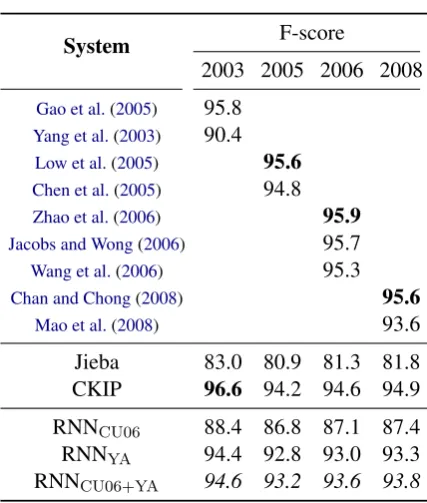
Note that since we combined external resources, performances of the compared methods are from the open track of the shared tasks. Table 3a lists the results of the RNN-based models and top-performing systems for the word segmenta-tion subtask on the Academia Sinica (AS) dataset. First of all, RNNs exhibit consistent capabilities in handling data from different years and is compa-rable to the best systems in the competition. In ad-dition, it is not surprising that the RNNYAmodel
perform better than RNNCU. Nevertheless, our
method can be further improved by integrating the CU06 corpus, demonstrated by the results from
3News articles are collected from the Yahoo News website
and contains about 3M words.
Table 3: Results for word segmentation on the Academia Sinica (AS) and City University (CU) datasets from different years of SIGHAN shared tasks. Bold numbers indicate the best performance in that column.
(a) AS dataset, open track
System F-score
2003 2005 2006 2008
Gao et al.(2005) 95.8
Yang et al.(2003) 90.4
Low et al.(2005) 95.6
Chen et al.(2005) 94.8
Zhao et al.(2006) 95.9
Jacobs and Wong(2006) 95.7
Wang et al.(2006) 95.3
Chan and Chong(2008) 95.6
Mao et al.(2008) 93.6
Jieba 83.0 80.9 81.3 81.8 CKIP 96.6 94.2 94.6 94.9 RNNCU06 88.4 86.8 87.1 87.4
RNNYA 94.4 92.8 93.0 93.3
RNNCU06+YA 94.6 93.2 93.6 93.8
(b) CU dataset, open track
System F-score 2003 2005 2006
Ma and Chen(2003) 95.6
Gao et al.(2005) 95.4
Peng et al.(2004) 94.6
Yang et al.(2003) 87.9
Low et al.(2005) 96.2
Chen et al.(2005) 94.5
Zhao et al.(2006) 97.7
Wang et al.(2006) 97.7
Jacobs and Wong(2006) 97.4
Jieba 80.3 81.2 82.4 CKIP 89.7 89.0 89.8 RNNCU06 87.6 85.8 87.8
RNNYA 88.0 87.2 88.5
RNNCU06+YA 91.5 90.1 91.7
the RNNCU06+YAmodel. This indicates that RNN
can easily adapt to different domains with data augmentation, which is an outstanding feature of end-to-end models. As for the CU dataset listed in Table3b, all of the RNN models show consider-able decrease in F-score. We postulate that it may be due to the training data, which is processed us-ing an external tool focused on texts from a differ-ent linguistic context. It is also reported by (Wu et al.,2006) that segmentation criteria in AS and CU datasets are not very consistent. However, by fusing two corpora, the RNNCU06+YA can even
surpass the performances of CKIP. Finally, com-parison with Jieba validates that the RNN model can serve as a very effective toolkit for NLP re-searchers as well as the general public.
Table4lists the performances of proposed mod-els and the only system that participated in the open track of the 2006 SIGHAN NER shared task. We can see that RNNCU06 outperforms the model
fromYu et al.(2006), confirming RNN’s capabil-ity on jointly learning to segment and recognize NEs. Interestingly, RNNYAobtains a much lower
F-score for all NE types. And RNNCU06+YA
can only obtain a slightly better F-score for per-son recognition but not the overall performance of RNNCU06, even with the combined corpus. We
believe that boundary mismatch may be a major contributing factor here. We also observe that there are a large number of one-character NEs such as abbreviated country names, which can not be easily identified using solely character features.
Table 4: Results from the 2006 SIGHAN NER shared task (open track). Bold numbers indicate the best performance in that column.
System F-score
PER LOC ORG Overall Yu et al.(2006) 80.98 86.04 68.01 80.51
RNNCU06 81.13 86.92 68.77 80.68
RNNYA 70.54 67.80 31.35 52.62
RNNCU06+YA 83.01 82.46 54.57 75.28
5 Conclusions
inter-face for easy access. In the future, we will inte-grate existing knowledge bases, in order to provide a more advanced tool for the NLP community. Acknowledgments
We are grateful for the constructive comments from three anonymous reviewers. This work was supported by grant MOST106-3114-E-001-002 from the Ministry of Science and Technology, Taiwan.
References
Samuel WK Chan and Mickey WC Chong. 2008. An agent-based approach to Chinese word segmenta-tion. InIJCNLP. pages 112–114.
Aitao Chen, Yiping Zhou, Anne Zhang, and Gor-don Sun. 2005. Unigram language model for Chi-nese word segmentation. InProceedings of the 4th SIGHAN Workshop on Chinese Language Process-ing. Association for Computational Linguistics Jeju Island, Korea, pages 138–141.
Jeffrey P Ferraro, Hal Daum´e III, Scott L DuVall, Wendy W Chapman, Henk Harkema, and Peter J Haug. 2013. Improving performance of natural lan-guage processing part-of-speech tagging on clini-cal narratives through domain adaptation. Journal of the American Medical Informatics Association
20(5):931–939.
Jianfeng Gao, Mu Li, Andi Wu, and Chang-Ning Huang. 2005. Chinese word segmentation and named entity recognition: A pragmatic approach.
Computational Linguistics31(4):531–574.
Alex Graves, Santiago Fern´andez, and J¨urgen Schmid-huber. 2005. Bidirectional lstm networks for im-proved phoneme classification and recognition. Ar-tificial Neural Networks: Formal Models and Their Applications–ICANN 2005pages 753–753.
Klaus Greff, Rupesh K Srivastava, Jan Koutn´ık, Bas R Steunebrink, and J¨urgen Schmidhuber. 2017. LSTM: A search space odyssey. IEEE transactions on neural networks and learning systemsPP(99):1– 11.
Sepp Hochreiter and J¨urgen Schmidhuber. 1997. Lstm can solve hard long time lag problems. In Ad-vances in neural information processing systems. pages 473–479.
Yu-Ming Hsieh, Ming-Hong Bai, Jason S Chang, and Keh-Jiann Chen. 2012. Improving PCFG chi-nese parsing with context-dependent probability re-estimation. CLP 2012page 216.
Aaron J Jacobs and Yuk Wah Wong. 2006. Maxi-mum entropy word segmentation of Chinese text. In
COLING* ACL 2006. page 185.
Guillaume Lample, Miguel Ballesteros, Sandeep Sub-ramanian, Kazuya Kawakami, and Chris Dyer. 2016. Neural architectures for named entity recognition. InProceedings of NAACL-HLT. pages 260–270. Jin Kiat Low, Hwee Tou Ng, and Wenyuan Guo. 2005.
A maximum entropy approach to Chinese word seg-mentation. In Proceedings of the Fourth SIGHAN Workshop on Chinese Language Processing. volume 1612164, pages 448–455.
Thang Luong, Hieu Pham, and Christopher D. Man-ning. 2015. Effective approaches to attention-based neural machine translation. InProceedings of the 2015 Conference on Empirical Methods in Natu-ral Language Processing. Association for Compu-tational Linguistics, Lisbon, Portugal, pages 1412– 1421.http://aclweb.org/anthology/D15-1166. Wei-Yun Ma and Keh-Jiann Chen. 2003. Introduction
to ckip Chinese word segmentation system for the first international Chinese word segmentation bake-off. In Proceedings of the second SIGHAN work-shop on Chinese language processing-Volume 17. Association for Computational Linguistics, pages 168–171.
Xinnian Mao, Yuan Dong, Saike He, Sencheng Bao, and Haila Wang. 2008. Chinese word segmentation and named entity recognition based on conditional random fields. InIJCNLP. pages 90–93.
Tomas Mikolov, Ilya Sutskever, Kai Chen, Greg S Cor-rado, and Jeff Dean. 2013. Distributed representa-tions of words and phrases and their compositional-ity. InAdvances in neural information processing systems. pages 3111–3119.
Fuchun Peng, Fangfang Feng, and Andrew McCallum. 2004. Chinese segmentation and new word detec-tion using condidetec-tional random fields. In Proceed-ings of the 20th international conference on Compu-tational Linguistics. Association for Computational Linguistics, page 562.
Tao Qian, Yue Zhang, Meishan Zhang, Yafeng Ren, and Donghong Ji. 2015. A transition-based model for joint segmentation, pos-tagging and nor-malization. In Proceedings of the 2015 Con-ference on Empirical Methods in Natural Lan-guage Processing. Association for Computational Linguistics, Lisbon, Portugal, pages 1837–1846. http://aclweb.org/anthology/D15-1211.
Xian Qian and Yang Liu. 2012. Joint
Weiwei Sun. 2011. A stacked sub-word model for joint chinese word segmentation and part-of-speech tagging. In Proceedings of the 49th Annual Meeting of the Association for Com-putational Linguistics: Human Language Tech-nologies. Association for Computational Linguis-tics, Portland, Oregon, USA, pages 1385–1394. http://www.aclweb.org/anthology/P11-1139. Ilya Sutskever, Oriol Vinyals, and Quoc V Le. 2014.
Sequence to sequence learning with neural net-works. InAdvances in neural information process-ing systems. pages 3104–3112.
Xinhao Wang, Xiaojun Lin, Dianhai Yu, Hao Tian, and Xihong Wu. 2006. Chinese word segmentation with maximum entropy and n-gram language model. In
COLING* ACL 2006. page 138.
Chia-Wei Wu, Shyh-Yi Jan, Richard Tzong-Han
Tsai, and Wen-Lian Hsu. 2006. On using
ensemble methods for Chinese named en-tity recognition. In Proceedings of the Fifth SIGHAN Workshop on Chinese Language Pro-cessing. Association for Computational Lin-guistics, Sydney, Australia, pages 142–145. http://www.aclweb.org/anthology/W/W06/W06-0122.
Jin Yang, Jean Senellart, and Remi Zajac. 2003. Sys-tran’s Chinese word segmentation. InProceedings of the second SIGHAN workshop on Chinese
lan-guage processing-Volume 17. Association for Com-putational Linguistics, pages 180–183.
Xiaofeng Yu, Marine Carpuat, and Dekai Wu. 2006. Boosting for Chinese named entity recognition. In
Proceedings of the Fifth SIGHAN Workshop on Chi-nese Language Processing. pages 150–153. Xiaodong Zeng, Derek F. Wong, Lidia S. Chao,
and Isabel Trancoso. 2013. Graph-based semi-supervised model for joint chinese word seg-mentation and part-of-speech tagging. In Pro-ceedings of the 51st Annual Meeting of the Association for Computational Linguistics (Vol-ume 1: Long Papers). Association for Computa-tional Linguistics, Sofia, Bulgaria, pages 770–779. http://www.aclweb.org/anthology/P13-1076. Hai Zhao, Chang-Ning Huang, Mu Li, et al. 2006. An
improved Chinese word segmentation system with conditional random field. InProceedings of the Fifth SIGHAN Workshop on Chinese Language Process-ing. Sydney: July, volume 1082117.