MODIFIED ALGORITHM FOR REAL TIME SAR SIGNAL PROCESSING
Y. K. Chan and V. C. Koo
Faculty of Engineering & Technology Multimedia University
Jalan Ayer Keroh Lama, Bukit Beruang, 75450 Melaka, Malaysia B. K. Chung and H. T. Chuah
Faculty of Engineering Multimedia University
Jalan Multimedia, 63100 Cyberjaya, Malaysia
Abstract—The generation of the picture out of the SAR raw data is a computational intensive task. Both range compression and azimuth compression utilized Fast Fourier Transform (FFT) algorithms and Inverse Fast Fourier Transform (IFFT) in order to perform convolution with respective reference signal. Thus FFT and IFFT occupied about 70% of the total computation operation in SAR image formation. In this paper a modified algorithm based on conventional FFT is proposed to optimize the computation performance. It is shown that the proposed algorithm can essentially achieve better performance with minimum computational burden compare to conventional FFT.
1. INTRODUCTION
SAR is an important tool for the collection of high-resolution all-weather earth images, from both airborne and space-borne platform. The potential of SAR in a diverse range of application such as sea and ice monitoring [2], mining [3], oil pollution monitoring [4], oceanography [5], snow monitoring [6], classification of earth terrain [7] etc. led to the development of a number of airborne and spaceborne SAR systems [8]. An extensive literature exists on various processing techniques for generating an image from the radar returns of a SAR [2, 9–14]. The SAR signal processing can be broken into two phases: range processing and azimuth processing. Most coherent radars use some form of modulation or coding of the transmitted waveform to improve resolution. Resolution enhancement is achieved by two-dimensional signal processing of the radar data. Range (across-track) resolution is improved by correlation of the pulse echoes with transmitted pulse in the range compression process. Azimuth (along-track) resolution is improved by synthetically generating a long antenna aperture, while the real aperture is relatively small. This operation is known as azimuth compression. Azimuth compression is based on the fact that each echo reflected from a single point target has a different phase shift. This phase shift appears to be quadratic in time and results in a linear frequency shift of the successive pulse echoes. The azimuth compression operation focuses the echo signal in such a way that a zero phase shift remains and integrates the focus echo. As a result the resolution is improved.
R aw Data
R ange FT
R ange R eference function
R ange I FT
A zimuth FT
A zimuth I FT
A zimuth R eference function
Compressed Data
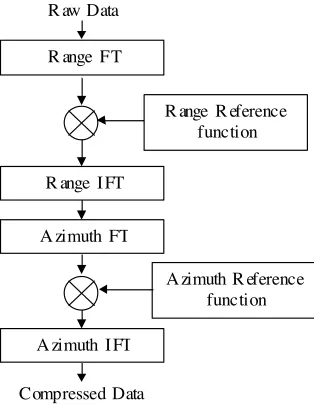
Figure 1. SAR processing in frequency domain via FFT.
2. PROBLEM STATEMENT
Fourier Transform (FT) is an important tool in SAR signal processing which plays a major role in convolution process of range and azimuth compression. Numerous textbooks devoted to the theory, properties and implementation of FT to digital processing [15–18] are available. In order to process the signal digitally either with computer or others dedicated digital processor, it is essential that the quantities involved be discrete. A sampled time signal satisfies this requirement. A FT that involves sampling both in time and frequency is called discrete FT (DFT). For a discrete-time signalg(n) of length N, the DFT pair can be written as:
DFT :G(k) =
N−1
n=0
g(n) exp
−j2πkn N
, k= 0,1, . . . , N −1 (1)
IDFT :g(n) = 1 N
N−1
n=0
G(k) exp
j2πkn N
, n= 0,1, . . . , N −1 (2)
real multiplication and two real additions, and one complex additions consists of two real additions. Thus eachN-point DFT consists of 4N2 number of real multiplications and 4N2−2N of real additions.
When N is a power of 2, fast FT (FFT) methods exist to implement the DFT or IDFT efficiently [15–18]. The most important fact about all FFT algorithms is that they are mathematically equivalent to DFT and FFT improves the DFT by reducing the computational load. The number of operations in theN-point FFT or its inverse, the IFFT, is the order of Nlog2N, when N is a power of two. To be specific, the number of complex multiplications in radix-2 FFT is (N/2) log2N, and the number of complex additions isNlog2N. FFT consists of 2Nlog2N and 3Nlog2N number of real multiplications and real additions respectively.
When the number of sample is not equal to a power of 2, a technique call zero padding can be used. Zeros are added to the sample signal to produce the length of the signal needed by FFT which is equal to a power of 2, i.e., 2M whereM is an integer. For SAR signal processing, the length of data in range or azimuth normally will not satisfied the condition of 2M, thus zero padding is necessary. Padding a large number of zeros will greatly increase the computational load and reduce the processing efficiency. An effective FFT algorithm should be developed in order to reduce the computational load, thus reduce the hardware requirement for the realization of real time SAR imaging. 3. PROPOSED METHOD AND COMPUTATION
COMPLEXITY
For a signal g(n) with data length of N, if N = 2M but can be separated, let N =N1N2 so that g(n) can be divided into a number
of N2 arrays with data length of N1. Thus an N point 2-dimensional
DFT can be written as, G(k)
=
N2−1
n2=0 N1−1
n1=0
g(N2n1+n2)e−
2π(k1+N1k2) N1N2 e−2π
(N2n1+n2) N1N2
=
N2−1
n2=0 N1−1
n1=0
g(N2n1+n2)e−2π N2n1k1
N1N2 e−2π k1n2 N1N2e−2π
N1k2n2 N1N2 e−2π
Since e−2π
N2n1k1
N1N2 =e−2π n1k1
N1 , e−2π N1k2n2
N1N2 =e−2π k2n2
N2 , e−2π
N1k2N2n1 N1N2 =
e−2πN2n1 = 1, therefore Equation (3) can be further expressed as,
G(k) =
N2−1
n2=0 N1−1
n1=0
g(N2n1+n2)e− 2πn1k1
N1
e−2π
k1n2 N1N2
e−2π
k2n2 N2 (4)
Therefore the DFT of a signal with data length ofN can be processed in three steps: N2 numbers ofN1-point FFT, follow byN1 numbers of
N2 point complex multiplications and finallyN1 numbers ofN2-point
DFT. IfN1 is power of two, then standard radix-2 FFT algorithm can
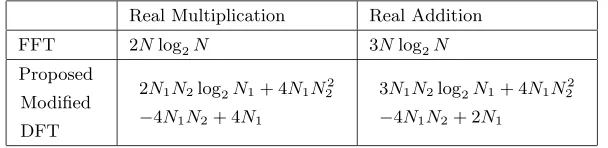
be used to reduce the computational load. The total number of real multiplications and additions operations for the proposed method is summarized in Table 1. The selection of N1 and N2 will affect the
computation efficiency. In order to minimize the computational load, N1 should be a number much larger thanN2 and in the form of power
of two so that FFT can be utilized to increase the computation speed.
Table 1. Computation load of N-point FFT and N-point proposed modified FFT method.
Real Multiplication Real Addition
FFT 2Nlog2N 3Nlog2N
Proposed
Modified
DFT
2N1N2log2N1+ 4N1N22 −4N1N2+ 4N1
3N1N2log2N1+ 4N1N22 −4N1N2+ 2N1
4. SAR PROCESSING IMPLEMENTATION
2800 1200 point FT and IFT
Range Compression
1200 2800 point FT and IFT
Azimuth compression Corner Turn
×
×
Figure 2. SAR image formation signal flow chart.
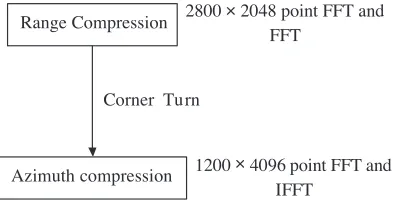
For conventional FFT method, 1200 range point need to be zero padded to 2048 point and for 2800 point in azimuth direction need to be zero padded to 4096 point in order to perform FFT and IFFT in both compressions. Therefore the required computation load will be greatly increased; the memory requirement and data bandwidth of the SAR processor have to be increase as well. The signal flow chart for conventional FFT and IFFT is shown in Figure 3.
2800 2048 point FFT and FFT
Range Compression
1200 4096 point FFT and IFFT
Azimuth compression Corner Turn
×
×
Figure 3. Conventional SAR image formation signal flow chart using FFT & IFFT.
4.1. SAR FFT Modified Algorithm
power of two so that FFT can be utilized to increase the computation speed; and N2 should be as small as possible and usually is a odd
number. Therefore in order to minimize the computational load in range and azimuth direction, searching procedure of correct value of N,N1 and N2 is proposed as below:
(i) Initial value of M is determine as M = int(log2N), where int( ) means truncated to an integer number.
(ii) Zero padding so thatN =N1×N2 = 2M−1×N2 whereN2 is an
odd number. Besides the number ofN must satisfy the condition ofN ≤N ≤2int(log2N)+1.
(iii) Let m=m−1, repeat step (ii) until m= 2.
(iv) Compare the computational amount of all possible solution by using formula listed in Table 1, the smallest number of operation involved will determine the number ofN.
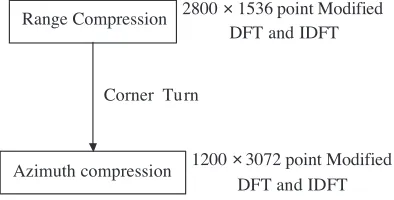
For conventional radix-2 FFT,N = 2048 and 4096 will be used for range and azimuth processing respectively. For the proposed method, let the range point to be decomposed as N = 512 × 3 = 1536, therefore 336 zeros to be added. For azimuth direction, one can choose N = 1024×3 = 3072 (i.e., 272 zeros to be added to 2800 data point). The propose scheme is illustrated in the figure below.
2800 1536 point Modified DFT and IDFT Range Compression
1200 3072 point Modified DFT and IDFT Azimuth compression
Corner Turn ×
×
Figure 4. Modified SAR image formation signal flow chart using proposed method.
The number of operations for the proposed method is calculated and listed in Table 2. It is shown that the computation operations of the proposed method is significantly less than the conventional radix-2 FFT especially for number of data point which is much lesser than 2M. In addition, the algorithm will support implementation
Table 2. Case study of computation operation based on 1200×2800 array of data.
a) 1200 data point (range direction)
Real Multiplication Real Addition
FFT 45056 67584
Proposed Modified DFT 41984 54784 Percentage of improvement 6.81% 18.9% b) 2800 data point (azimuth direction)
Real Multiplication Real Addition
FFT 98304 147456
Proposed Modified DFT 90112 118784 Percentage of improvement 8% 19.4%
c) Total number of operation to process 1200×2800 array of data for both methods
Real Multiplication Real Addition FFT & IFFT 488243200 731364800 Proposed Modified DFT
and Inverse 451379200 591872000 Percentage of improvement 7.55% 19.07%
5. CONCLUSION
REFERENCES
1. Curlander, J. C. and R. N. McDounough, Synthetic Aperture Radar, Systems and Signal Processing, John Wiley & Sons, New York, 1991.
2. Drinkwater, M. K., R. Kwok, and E. Rignot, “Synthetic aperture radar polarimetry of sea ice,”Proceeding of the 1990 International Geoscience and Remmote Sensing Symposium, Vol. 2, 1525–1528, 1990.
3. Lynne, G. L. and G. R. Taylor, “Geological assessment of SIR-B imagery of the amadeus basin,” IEEE Trans.on Geosc.and Remote Sensing, Vol. 24, No. 4, 575–581, 1986.
4. Hovland, H. A., J. A. Johannessen, and G. Digranes, “Slick detection in SAR images,” Proceeding of the 1994 International Geoscience and Remmote Sensing Symposium, 2038–2040, 1994. 5. Walker, B., G. Sander, M. Thompson, B. Burns, R. Fellerhoff,
and D. Dubbert, “A high-resolution, four-band SAR Testbed with real-time image formation,” Proceeding of the 1986 International Geoscience and Remmote Sensing Symposium, 1881–1885, 1996. 6. Storvold, R., E. Malnes, Y. Larsen, K. A. Hogda, S.-E. Hamran,
K. Mueller, and K. Langley, “SAR remote sensing of snow parameters in norwegian areas — Current status and future perspective,”Journal of Electromagnetic Waves and Applications, Vol. 20, No. 13, 1751–1759, 2006.
7. Kong, J. A., S. H. Yueh, H. H. Lim, R. T. Shin, and J. J. van Zyl, “Classification of earth terrain using polarimetric synthetic aperture radar images,” Progress In Electromagnetics Research, PIER 3, 327–370, 1990.
8. Chan, Y. K. and V. C. Koo, “An introduction to synthetic aperture radar (SAR),”Progress In Electromagnetics Research B, Vol. 2, 27–60, 2008.
9. Soumekh, M., Synthetic Aperture Radar Signal Processing, John Wiley & Sons, New York, 1999.
10. Cumming, I. G. and F. H. Wong,Digital Processing of Synthetic Aperture Radar Data: Algorithms and Implementation, Artech House, Boston, 2005.
11. Chang, C. Y., M. Jin, and J. C. Curlander, “Squint mode processing algorithm,”Proc.IGARSS’89, 1702–1706, 1989. 12. Cumming, I. G., Y. L. Neo, and F. H. Wong, “Interpretations of
13. Franceschetti, G. and R. Lanari, Synthetic Aperture Radar Processing, CRC Press LLC, 1999.
14. Raney, R. K., H. Runge, R. Bamler, I. G. Cumming, and F. H. Wong, “Precision SAR processing using chirp scaling,”IEEE Trans.Geosci.Remote Sensing, Vol. 32, No. 4, 786–799, 1994. 15. Ofanidis, S. J., Introduction to Signal Processing, Prentice Hall,
New Jersey, 1996.
16. Porat, B., A Course in Digital Signal Processing, John Wiley & Sons, New York, 1997.
17. Smith, W. W. and J. M. Smith, Handbook of Real-time Fast Fourier Transforms: Algorithms to Product Testing, IEEE Press, New York, 1995.