R E S E A R C H
Open Access
Optimal power allocation in NOMA-based
two-path successive AF relay systems
Shiguo Wang
1, Shu Cao
1and Rukhsana Ruby
2*Abstract
Due to the characteristic of transmitting multiplexed signals in superposed mode over the same spectrum,
non-orthogonal multiple access (NOMA) technology is deemed as a promising way to improve spectral efficiency in fifth generation (5G) networks. In this paper, we develop a NOMA cooperative system based on the two-path successive relaying concept, in which the data at the source node is divided into two parallel parts and is transmitted to the destination in superposed mode via the assistance of two amplify-and-forward (AF) relays. On the condition that the transmit power of the individual nodes and the entire system are all constrained, the maximization of achievable rate is formulated as an optimization problem. Following the guidelines of Karush-Kuhn-Tucher (KKT) conditions, the dual decomposition method is adopted to obtain the closed-form expressions of the optimal power allocation. Moreover, to balance the achievable rate between two superposed signals, which is equivalent to minimizing the required spectrum bandwidth, a power allocation scheme between the superposed signals is proposed. In order to verify the effectiveness and efficiency of the proposed power allocation scheme, we conduct extensive numerical simulation on some realistic system setup. The results demonstrate that our analytical insights about the optimal power allocation are aligned with the simulation outcome.
Keywords: Non-orthogonal multiple access (NOMA), Successive AF relay, Karush-Kuhn-Tucker (KKT), Optimal power allocation
1 Introduction
In wireless networks, spectrum efficiency and energy effi-ciency are two most important metrics to consider, as their improvement is one of the promising means to real-ize broadband-green communication concept. Compared to the conventional orthogonal multiple access (OMA) scheme, non-orthogonal multiple access (NOMA) tech-nique can further improve spectrum efficiency and system achievable rate, as the interference cancelation between difference users can be successfully implemented as long as one user’s received signal-to-interference-plus-noise ratio (SINR) for the other user’s signal is larger than or equal to the received SINR of the other user for its own signal [1]. Therefore, it has been deemed as a promis-ing technique to mitigate spectrum congestion in the fifth generation (5G) networks [2–4]. On the other hand, with the assistance of relay(s), greater system capacity
*Correspondence:[email protected]
2College of Computer Science and Software Engineering, Shenzhen University, Shenzhen, China
Full list of author information is available at the end of the article
can be obtained with the same power consumption or lower power consumption is required while keeping the system capacity intact [5, 6]. However, the spectral effi-ciency of cooperation system will be reduced greatly if the relay operates in half-duplex mode, as such relay(s) can-not transmit and receive signals simultaneously. Hence, two-path relay protocol is commonly used in cooperation systems. Consequently, when NOMA and two-path relay cooperation techniques are combined effectively, the per-formance of spectral efficiency and power consumption can be improved greatly. Currently, NOMA-based relay-ing systems have been an emergrelay-ing research topic in the recent days.
For NOMA-based relaying systems, when relays operate in half-duplex decode-and-forward (DF) mode, many sys-tem models and resource allocation schemes already have been proposed. In [7], for a system in which NOMA tech-nique is applied in both direct and relay transmissions, analytical expressions for outage probability and ergodic sum capacity are derived. In [8], a NOMA-based relay-ing system is proposed to improve spectral efficiency as
well as its achievable capacity is investigated. A buffer-aided NOMA relaying system is proposed in [9], its per-formance is investigated, and an adaptive transmission scheme for such system is proposed in [10]. For a sys-tem with slowly faded NOMA-equipped multiple-relay channels, the benefit of joint network channel coding and decoding is studied in [11]. In [12], an analytical frame-work for a NOMA-based relaying system is developed, and then, its performance over Rician fading channels is studied. In [13], the impact of relay selection on the per-formance of cooperative NOMA is studied, and then, a two-stage relay selection strategy is proposed. In [14], a novel signal detection scheme for a simple NOMA-based relaying system is proposed, and then, the ergodic sum rate and outage performance of the system are investi-gated. In [15], based on Alamouti space-time block-coded NOMA technique, a two-phase cooperative DF relaying scheme is proposed. In [16], a dual-hop cooperative relay-ing scheme usrelay-ing NOMA is proposed, where two sources communicate with their corresponding destinations in parallel over the same channel via a common relay. To maximize the throughput of a NOMA-equipped wireless network with multiple relays, in [17], a novel approach to dynamically select an optimal relay mode and optimal transmit power is proposed.
On the other hand, when relays operate in half-duplex amplify-and-forward (AF) mode, many schemes have been proposed to improve the performance of NOMA-based relaying systems. In [18], a NOMA-based multi-antenna-equipped relaying network is designed, and then, its outage performance is analyzed. When a base station communicates with multiple mobile users simultaneously through the help of a relay over Nakagami-m fading chan-nels, the overall performance is analyzed in [19]. For a NOMA-equipped single-cell relay network, where an OFDM-based AF relay allocates its spectrum and power resources to source-destination (SD) pairs, a many-to-many two-sided SD pair-subchannel matching algorithm is proposed in [20]. In [21], a joint power allocation and relay beamforming design problem is investigated, and then, an alternating optimization-based algorithm is proposed to maximize the achievable rate. In [22], the outage performance of a cooperative NOMA-equipped relay system is studied, and then, an accurate closed-form approximation of the outage probability is derived. In [23], when multiple users transmit messages to two destina-tions under the help of multiple AF relays, an optimal relay selection criterion is proposed to improve outage perfor-mance, and closed-form analytical expressions for the out-age probability are derived. In [24], a relay-aided NOMA technique is proposed for uplink cellular networks, where the cooperative relay transmission is used to accommo-date more than one user per orthogonal resource block in the context of interference-limited scenarios.
To enhance system flexibility, in [25], for NOMA-equipped cooperative networks with both the DF and AF relaying protocols, where one base station communicates with two mobile users with the aid of multiple relays, a two-stage relay selection strategy is proposed while con-sidering different quality-of-service (QoS) requirements of the users. In [26], the analytical performance of a NOMA-equipped cellular system, with multiple AF and DF relays, is analyzed and then compared with that of four traditional schemes. To enable continuous signal transmission, a full-duplex cooperative NOMA system between dual users is proposed in [27] and then the outage probability and achievable ergodic sum capacity of the corresponding system are investigated. In [28], a NOMA-based multi-pair two-way relay network is devel-oped, and then, a rate splitting scheme and a successive group decoding strategy are proposed to optimize its performance.
Under saturated traffic scenarios, a source node usu-ally transmits messages continuously at every time slot. If the corresponding system has a relay that forwards messages to the destination, this relay should have full-duplex functionality or more than one relay should be deployed in order to avoid buffer overflow at the source node. Two-path relaying is one of the complementary techniques to mitigate the hardware difficulty in realiz-ing full-duplex functionality of a srealiz-ingle relay node. To the best of our knowledge, only the authors in [28] consid-ered the joint two-path relay and NOMA-based scenario. Nevertheless, they just focused on rate splitting and group decoding for NOMA-equipped multi-pair scenario and ignored optimal power allocation among the source and relay nodes. In this paper, we develop a NOMA-based two-path relay system with the full interference cancella-tion (FIC) concept, where a source node transmits signals to a single user under the assistance of two AF relays with half-duplex mode. In such system, while targeting on the maximization of achievable rate and the minimization of required frequency band, the power allocation among the source and relay nodes, is formulated as an optimiza-tion problem. Following the guidelines of Karush-Kuhn-Tucker (KKT) conditions, the dual decomposition method is adopted to solve both problems. Though the commonly used multicarrier scenario is not considered, the pro-posed scheme can be extended the multicarrier case with imperfect CSI, such as the system model in literature [29]. Overall, the main contributions of the paper are listed as follows.
superposed mode. Because of adopting the idea of superposition model in the NOMA technique, intuitively, lower level of system frequency is required compared to a system with OMA scheme. In such system, while targeting on the maximization of the system capacity, the power allocation among the source and relay nodes is an optimization problem given that there are power constraints at the individual nodes as well as the entire system. The dual decomposition method is adopted to obtain the closed form expressions of the optimal power allocation.
• Once the optimal power allocation at each node is known, in order to separate the superposed received messages at the destination, the optimal power allocation between the two data streams is formulated as an optimization problem while targeting on the minimization of the required frequency band. Similar to the solution scheme of the first problem, the dual decomposition method is adopted to obtain the closed form expression of the optimal power allocation.
• We conduct extensive numerical simulation in order to verify the effectiveness and accuracy of the proposed power allocation scheme from different angles. Under different scenarios, we verify the analytical insights of the proposed power allocation scheme with the simulation results.
The rest of the paper is organized as follows. In Section2, a novel NOMA-based two-path AF relay sys-tem model is presented, and then, the corresponding optimization problem is formulated. The optimal power allocation strategy is proposed in Section3. We evaluate the proposed scheme in Section4. Finally, we conclude the paper with some future research direction in Section5.
2 System description
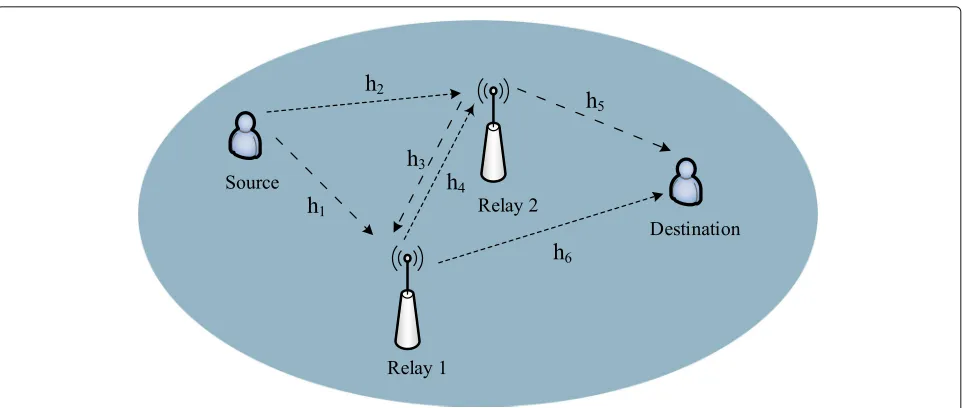
In Fig.1, we demonstrate a novel NOMA-based two-path successive relay system. The system consists of a source node, a destination node, and two relays that operate in AF mode. For notational simplicity, the channel gain between two corresponding terminals is denoted as hi, i∈ {1, 2,· · ·, 6}. It is supposed that the relays work in half-duplex mode. Therefore, when the source node transmits signals continuously at every time slot,relay 1andrelay 2receive the transmitted signals and forward them to the destination successively in an alternative manner1.
For such two-relay cooperative systems, the location of the relays affects system performance greatly. Hence, to maximize the system achievable rate, the relays should be put on the optimal positions. Generally speaking, when the interference between two relays can be canceled com-pletely, the relays are usually put in the same place due
to the sake of management. Hence, the distance from the relays to the source and the destination are equal.
The superposed signal, transmitted from the source node, can be written as √a1pss1 + √a2pss2, where ps denotes transmit power, s1 and s2 are transmitted data
symbols with E|s1|2
= E|s2|2
= 1, a1 and a2 are
power allocation coefficients between the transmitted sig-nalss1ands2while satisfyinga1+a2 = 1 anda1 > a2
constraints. In each slot, the destination node tries to recover the superposed signals and then decodes1ands2
individually through the successive interference cancela-tion (SIC) technology. Similar to the system model in [6, 30], it is assumed that the channel between the source node and the destination node is in deep fade, and hence, the direct link between them can be ignored. The channel gain between two nodes is constant in a symbol duration, and it is inversely proportional to the fourth power of the distance between the transmitter and the receiver. Noise signal of each link follows Additive White Gaussian Noise (AWGN) distribution with zero mean andσ2variance.
To facilitate the formulation, it is assumed that relay 1 and relay 2 receive signal from the source node and forward it to the destination in odd and even symbol dura-tion, respectively. When the source node transmits its superposed signals, the forwarded signal from relay 1 in the oddnth slot can be shown as:
x1[n]=α1r1[n−1] (1)
where pr is the transmit power at relay 1 and α1 is
amplifying coefficient, which can be expressed as α1 =
√
pr1/|r1[n−1]|to normalize transmit power. Note that
r1[n−1] is the received signal in the(n− 1)th symbol
period and it can be formulated as (2), wherex2[n−1] is
the transmitted signal from relay 2 in the(n−1)th symbol duration,η1[n−1] is the noise added to received signal,
ands1[n−1] ands2[n−1] are the transmitted superposed
signals in the(n−1)th symbol duration. From now on, for the sake of simplicity,√a1pss1[n−1]+√a2pss2[n−1]
is denoted asxs[n−1] until the final system capacity is computed.
r1[n−1]=h1
√
a1pss1[n−1]+√a2pss2[n−1]
+h3x2[n−1]+η1[n−1] .
(2)
Therefore, the received signal at the destination in the nth symbol duration can be shown as:
yd[n]=h6x1[n]+nd[n]
=α1h1h6xs[n−1]+α1h3h6x2[n−1]
+α1h6η1[n−1]+ηd[n]
(3)
Fig. 1A sample NOMA-based two-path successive AF relay system
In (3),α1h1h6xs[n−1] is the desired signal to be recov-ered,α1h6η1[n−1]+ηd[n] is the additive noise at the des-tination, and the termα1h3h6x2[n−1] is the interference
from relay 2 which should be canceled or suppressed. In the (n + 1)th even symbol duration, the received signal at the destination can be obtained in the similar manner, which can be shown as (4), where xs[n] is the transmitted superposed signal from the source in thenth symbol duration,ηd[n] is the noise signal, andα2 is an
amplifying factor.
yd[n+1]=α2h2h5xs[n]+α2h4h5x1[n]
+α2h5n2[n]+nd[n+1] .
(4)
It is assumed that the transmit power of the relays are equal in the system. Hence, the corresponding amplifying factor at the relays can be represented
as α1 = √pr/
|h1|2ps+ |h3|2pr+σ12 and α2 =
√p
r/
|h2|2ps+ |h4|2pr+σ22, where the transmit power
at both relay 1 and relay 2 are considered as the same and it ispr. Without loss of generality, we assume that all the additive Gaussian noise be independent and identically distributed (i.i.d) with zero-mean andσ2variation.
3 Achievable rate analysis and optimal power allocation
3.1 Achievable rate analysis and problem formulation The received superposed signal √a1pss1 + √a2pss2
at the destination can be shown as S =
|htot|2√a1pss1+ √a2pss2
+ ηtot, where htot repre-sents the equivalent fading coefficient during the signal transmission process from the source to the destination and ηtot is the total equivalent additive noise added to the original signal. For the transmitted data stream
s1 and s2, after SIC is employed to cancel interference
between them, their achievable rate can be shown as C1 = log2(1 + |htot|2a1ps/
|htot|2a2ps+σtot2
and C2 = log2
1+ |htot|2a2ps/σtot2
, respectively. Hence, the sum achievable rate can be shown as (5), which implies that only when the combined signal achieves maximal rate canC1+C2reach its maximal point. Consequently,
in order to maximize the system achievable rate, the achievable rate of the superposed signals should be maxi-mized. In this paper, under predetermined constrains, we first explore the optimal power allocation between the source and relay nodes in order to obtain the maximal achievable rate. Then, we propose a power allocation strategy to balance the transmission rate between differ-ent data streams while targeting on the minimization of the required frequency band.
C=C1+C2
=log2 1+ |htot|
2a 1ps
|htot|2a2ps+σtot2
+log2 1+|htot|
2a 2ps
σ2
tot
=log2 1+|htot|
2ps
σ2
tot
.
(5)
In thenth odd symbol duration, the received signal at the destination is shown as (3), from which we can see that x2[n−1] is the forwarded signal from relay 2. On the other
hand, the received signal at the destination in the(n−1)th symbol duration can be shown asyd[n−1]= h5x2[n−
yd[n]=α1h1h6xs[n−1]+η[n] . (6)
As all the additive noise is assumed to have zero mean and unit variance, after substituting the expression of α1, the achievable rate in the
odd symbol duration can be shown as Codd =
log21+ |h1|2|h5|2|h6|2pspr/
In the same way, the achievable rate in the even symbol duration can be obtained, which is shown as Ceven =
log21+ |h2|2|h5|2|h6|2pspr/ system achievable rate is equivalent to maximizing the achievable rate at both the odd and even symbol duration. However, under given constraints on transmit power, it is impossible to obtain maximal achievable rate in both the even and odd symbol duration simultaneously due to the variation channel fading. Therefore, we investigate the system achievable rate at the odd and even symbol duration separately while realizing the optimal power allocation. As both the processes and schemes are similar, we only present the scheme to maximize the achievable rate at the odd symbol duration for brevity, and the max-imal achievable rate in the even symbol duration can be obtained in the similar manner. For notational simplicity, we usefito denote|hi|2,i∈ {1, 2,· · ·, 6}hereafter.
It is straightforward to see that maximizing the achiev-able rate is equivalent to maximizing the SNR of the received signal. Hence, the optimization problem at the odd symbol duration can be formulated as:
max
wherepsmaxandprmaxare the maximal transmit power that the source node and the corresponding relay node can provide, respectively, andpmaxis the total transmit power due to the consideration of interference threshold to other users when a cognitive scenario is investigated.
It is easy to see the formulation in (8) is a convex prob-lem, so there is a optimal solution. However, though pr only appears in the numerator of expression,psappears both in the numerator and denominator. Furthermore, three constrains on them should be considered jointly. Hence, it is difficult to obtain the solution straightfor-wardly.
3.2 The optimization of the achievable rate
To solve the problem in (8), the dual decomposition method is adopted. As a result, the resultant Lagrange function can be obtained, which can be shown as:
L(ps,pr,λ1,λ2,λ3)=
Based on the dual method, the relations in (10) can be derived while taking KKT conditions into account.
∂L
According to (10), the scheme to achieve the optimally allocated power is presented as follows.
On the condition that ps
max +prmax ≤ pmax holds, it is straightforward to see that the maximal achievable rate can be obtained by settingps = psmax andpr = prmax. there is no available solutions for this case. Consequently, to maximize the system achievable rate in the odd symbol duration, three cases need to be considered: (1)λ2 = 0
andλ3 > 0, (2)λ3 = 0 andλ2 > 0, and (3)λ2 = 0 and
λ3=0.
For this case, based on (10e), pr = prmaxcan be con-cluded. Combining with theps+ pr = pmax condition, ps=pmax−prmaxcan be derived.
To identify its application scenario, substituting the allo-cated power into (10a) and (10b), and combining with the λ3>0 constraint, the following can be derived:
It implies that when the relation in (11) is satisfied,pr = prmaxandps=pmax−prmaxare the optimal level of power to maximize the system achievable rate. To simplify nota-tion, leta = f1f5−f5f6−f3f6−f3f5
,b = f1f5pmax+f5.
It is easy to see thatb > 0 always holds. Accordingly, the relation in (11) can be rewritten as (12).
/ashould hold. Moreover, it can be tes-tified thatb+b(b−apmax)
/a < pmax hold. Hence, the available scenario is prmax < < 0 holds,prmaxlocates in a positive range which is prac-tical. Furthermore, as ps = pmax − prmax and prmax <
/acan be concluded, which implies that
psmax>
−b+apmax+b(b−apmax
should hold. To summarize, to maximize the system capacity,pr = prmax andps = pmax −prmax should be set for the
sce-For this case, the solution can be obtained in the simi-lar manner as that of case 1. As a result,ps = psmaxand pr = pmax−psmaxcan be concluded. As λ2 > 0,
com-bined with (10a) and (10b), the corresponding applicable condition can be shown as:
be derived, which locates in a positive range. Hence, it is consistent with practical scenarios. When a < 0 , psmax > −b+apmax− should hold. Moreover, it is easy to prove that 0 < −b+apmax+ the feasible solution is psmax <
To summarize, when psmax <
the optimally allocated power can be set asps=psmaxand pr=pmax−psmax.
Case 3:λ2=0 andλ3=0.
For this case, substitutingλ2 =0 andλ3 =0 into (10a)
and (10b), the following can be obtained: ⎧ derived. Then, it can be rewritten as (17).
For the relation in (17), the feasible solution can be derived3, which can be shown as (18) under both thea>0 anda<0 conditions. As a result, the corresponding allo-cated power for the source node can be obtained, which can be shown as (19).
prmax ≥ b−b(b−apmax)
Combining all the above cases, the optimal power allo-cation scheme can be summarized as follows.
• Whenprmax<b−b(b−apmax)
In the similar manner, to maximize the achievable rate in the even symbol duration, the allocated power can be obtained, which is shown as follows, wherec=f2f6−f5f6−
3.3 The optimization of the required frequency band As shown in (5), when total transmit power ps is fixed and channel state information is given, the optimal sys-tem achievable rate can be determined. Nevertheless, for the given powerpsobtained optimally from the previous
subsection, the proportional factors between the transmit data streams s1 and s2 affect the system spectral
effi-ciency. As we know, for the given data stream C, when they are divided equally into two halves and transmitted in parallel mode with NOMA technique, the required fre-quency bandwidth is minimal, that isC/2. If C1 = C2,
the required frequency is the bigger one, which means it is greater thanC/2. Consequently, to minimize the required system bandwidth, the allocated power on two data sym-bols and relay should guaranteeC1=C2. Hence, (20) can
be concluded, and its solution can be shown as (21).
|htot|2psa22+2σtot2a2−σtot2 =0. (20)
In this section, a linear network is simulated to verify the effectiveness of our proposed schemes. Generally speak-ing, wireless channel is affected by Rayleigh and shadow fadings. For the resultant channels (in between the source, the relays and the destination) in the considered system, Rayleigh fading is statistically the same, and hence, we only consider the shadow fading in the simulation. To sim-plify the simulation process, the parameters of the shadow fading, represented byfi = |hi|2, i ∈ {1, 2,· · ·, 6}, are generated randomly in the (0, 1)range. Furthermore, as two relays are put together, their distance towards the source node and the destination node are equal, and so the allocated power in the odd and even symbol duration are the same. Consequently, for the sake of brevity, we only evaluate the performance of the odd symbol dura-tion. Without loss of generality, it is furthermore assumed that all the Gaussian white additive noises are indepen-dent and iindepen-dentically distributed (i.i.d.) with zero mean and unit variance. For the sake of notational simplicity, all the transmit power and power consumption are normal-ized by the power of the additive noise in the following simulations.
2 4 6 8 10 12 14 16 18 20
Transmit power threshold P
max (w)
0 0.2 0.4 0.6 0.8 1
Achievable rate (b/Hz)
Proposed scheme with p max r
=p max s
=10w
Equal scheme with p max
r =p
max
s =10w
Proposed scheme with p max r
=p max s
=20w
Equal scheme with p max
r =p
max
s =20w
Fig. 2The system achievable rate with the increasing total transmit power threshold
the results, it can be seen that the achievable rate of our proposed scheme is always larger than that of the equal allocation scheme for the same total transmit powerpmax. It is understandable that whenpmax < psmax+prmax, the proposed scheme can allocate the total transmit power optimally in accordance with the specific channel con-dition to maximize the system capacity. However, the allocated power obtained by the equal allocation scheme always remains fixed irrespective of the instant channel state information, which is not necessary the optimal allo-cated power. At the same time, when pmax ≥ 16 w, the
system capacity of scenariopsmax=Prmax=20 w is greater than that of scenariopsmax = Prmax = 10 w though their total power consumption is the same. As the constrains ps ≤ psmax andpr ≤ prmax are considered during power allocation, the allocated power allocated with larger max-imal transmit power threshold (psmax or Prmax) is more optimal than smaller one in maximizing system capacity.
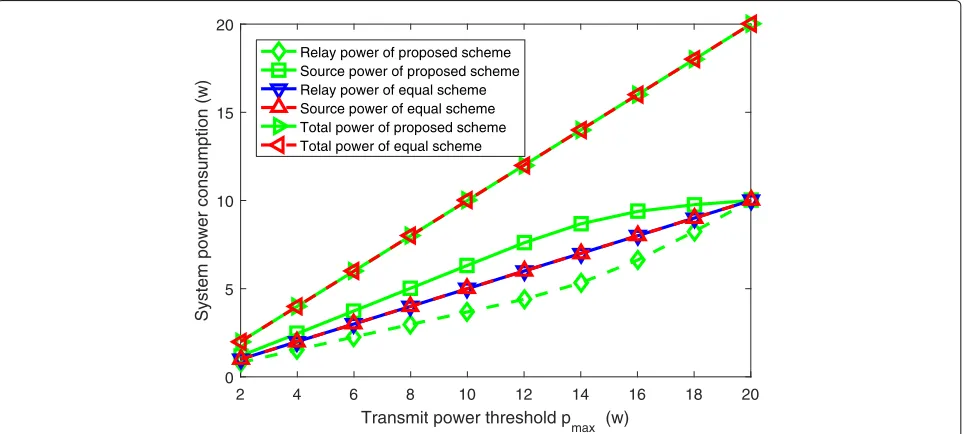
The corresponding power consumption in Fig.2is also shown in Fig.3 for thepr
max = psmax = 10 w scenario. Combined with Fig.2, it can be concluded that the pro-posed scheme can obtain greater achievable rate while
2 4 6 8 10 12 14 16 18 20
Transmit power threshold p
max (w)
0 5 10 15 20
System power consumption (w)
Relay power of proposed scheme Source power of proposed scheme Relay power of equal scheme Source power of equal scheme Total power of proposed scheme Total power of equal scheme
2 4 6 8 10 12 14 16 18 20 Transmit power threshold p
max (w)
0 1 2 3 4 5 6 7 8
Transmit power on S1 and S2 (w)
Power on S1 with p max
r =10w
Power on S1 with p max
r =20w
Power on S2 with p max r
=10w
Power on S2 with p max r
=20w
Fig. 4Transmit power of the separated superposed signal with the increasing total transmit power threshold
consuming the same level of power. It can also be seen that, at thepmax = 20 w point, resultant both the relay transmit power and the source transmit power are the same no matter these are obtained by our scheme or the benchmark scheme. We know that under the pmax = 20 w and prmax = psmax = 10 w conditions, pmax ≥ psmax + prmax holds. As a result, according to the pro-posed scheme, pr = prmax and ps = psmax should be set. It also can be seen that when pmax < 20 w, it holds thatps > pr. It is easy to know that the received signal at a relay is the combination of two transmitted
signals that are from source node and the other relay simultaneously. The transmitted signals from relay is the intended signal for destination, but it is interference for the other relay. Hence, in order to obtain maximal sys-tem capacity, the transmit power of source node should always be greater than or equal to the allocated power of relay. Therefore, we can say that the simulation results are consistent with the theoretical analysis discussed above.
Under the same settings, once the allocated power to maximize the system achievable rate is obtained, the
1 2 3 4 5 6 7 8 9 10
Transmit power threshold p
max (w)
0 0.1 0.2 0.3 0.4 0.5 0.6
Achievable rate (b/Hz)
Case 1 Case 2 Case 3
p
max >=pmax r
+p max s
1 2 3 4 5 6 7 8 9 10
Transmit power threshold p
max (w)
0 2 4 6 8 10
System power consumption (w)
Case 1 Case 2 Case 3
p
max >= pmax r
+ p max s
Fig. 6Power consumption under four different cases:case1,case2,case3,case4i.e.,pmax≥psmax+prmax
power consumption of superposed symbolss1ands2are
also simulated, which are shown in Fig.4. From the results, it can be seen that the transmit power ofs1ands2always
increase with the total transmit power thresholdpmax, and the allocated power ons1is always greater than that ons2.
All these results are consistent with our aforementioned theoretical analysis.
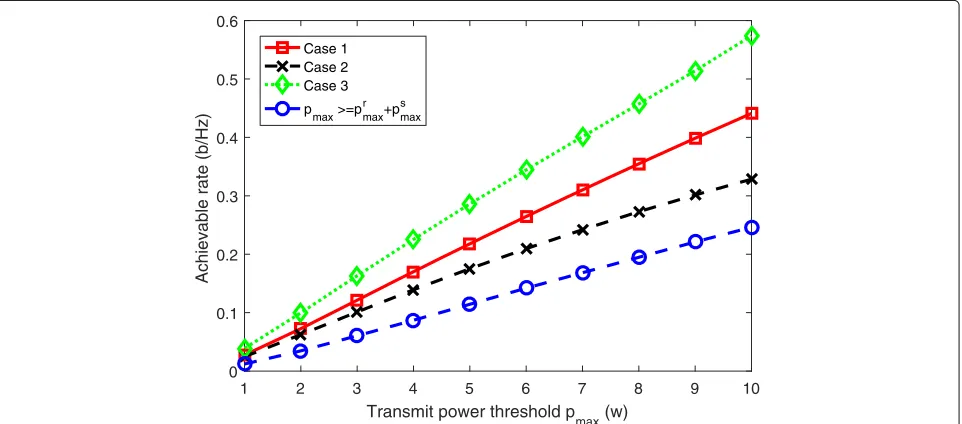
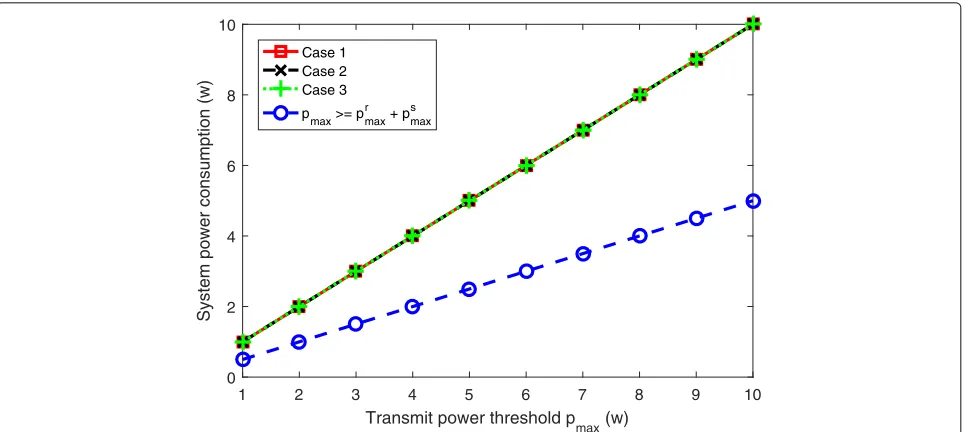
To show the performance of our proposed scheme under different cases, all possible scenarios are simulated separately. The system achievable rate and the corre-sponding power consumption are shown in Figs.5and6, respectively. In order to be closer to the practical scenar-ios, the maximal transmit power at the relay node and the source node are generated randomly in the(0, 10)range, and the maximal total transmit power is set topmax = 10 w.
From Figs. 5 and 6, it can be seen that the achiev-able rate in case 3 is the largest. Moreover, the power consumption of case 2, case 1, and case 3 are equal. It implies that when prmax ≥ (b− b(b−apmax))/aand ps
max≥(−b+apmax+
b(b−apmax))/ahold, the largest achievable rate can be obtained under the same power consumption. Thepr
max ≥ (b −
b(b−apmax))/aand psmax≥(−b+apmax+
b(b−apmax))/aconditions imply that the optimally allocated power between the relay node and the source node always satisfy their individual con-strains. Hence, the resultant power allocation is globally optimal in which the achievable rate is the largest.
5 Conclusion
For a NOMA-equipped cooperative relay system with the SIC mode, where the cognitive relays operate in the
AF mode, a power allocation scheme was proposed to maximize the achievable rate under some pre-determined transmit power constraints. Based on the KKT condi-tions, network scenarios were divided into two different types. The power allocation to maximize the achievable rate of each type was presented in a closed-form expres-sion. Then, based on the optimally allocated source power, a power allocation scheme was proposed for the trans-mit data streams while targeting on the minimization of the required frequency band. Extensive simulations were conducted to evaluate the performance of the pro-posed power allocation schemes. As of future research, we would like to extend the single-user scenario to the multi-user one while keeping the same NOMA-based cooperative relay idea. Incorporating massive millime-ter multiple-input multiple-output (MIMO) technology in such a system could be another possible research direction.
Endnotes
1In our considered system, though it is a simple point to point system, when NOMA technique and superposition transmission are taken, two data streams can be transmit-ted in parallel mode with the same frequency spectrum. In this way, the spectral efficiency can be improved greatly.
2Asa>0 andb>0 hold, it can be concluded that(b+
b(b−apmax))/a>b/a=(f1f5pmax+f3f5pr+f5)/(f1f5−
f5f6−f3f6−f3f5) >pmax, which conflicts with thepr+ps= pmaxconstraint, and so it should be excluded. Moreover, it can also be concluded that 0< (b−b(b−apmax))/a= bpmax/(b+
is practical under the given constraint. Hence, the feasible scenario ispr
max< (b− is feasible. On the other hand, whena < 0, the solution pr =[b−
b(b−apmax)]/a < pmaxis feasible. Conse-quently, the available solution is (18) no matter fora>0 ora<0.
Abbreviations
5G: Fifth generation; AF: Amplify-and-forward; DF: Decode-and-forward; FIC: Full interference cancellation; KKT: Karush-Kuhn-Tucher; NOMA:
Non-orthogonal multiple access; OFDM: Orthogonal frequency division multiplexing; QoS: Quality-of-service
Acknowledgements Not applicable.
Funding
This work was supported by the Open Project Program of the Key Laboratory of Universal Wireless Communications (2016-KFKT-2016104), Ministry of Education, the Beijing University of Posts and Telecommunications, the National natural Science Foundation of China (61771414) and the Natural Science Foundation of Hunan Province of China (2017JJ2249).
Availability of data and materials Not applicable.
Authors’ contributions
SW was responsible for the mathematical derivation and paper writing. SC was responsible for the numerical simulation. RR was responsible for the derivation checking and language smoothing. All authors read and approved the final manuscript.
Authors’ information
Shiguo wang received the Master and Ph D. degrees in power electronics and power transmission from Xiangtan University and in information
communication systems from the Beijing University of Posts and
Telecommunications, China, in 2004 and 2010, respectively. He is currently a professor in the key Laboratory of Intelligent Computing and Information Processing, Ministry of Education, Xiangtan University, Xiangtan, 411105, China. From March 2015 to March 2016, he was a visiting scholar in the University of British Columbia (UBC), and cooperated with Prof. Victor C. M. Leung. He has co-authored more than 20 technical papers in international journals and conference proceedings. His research interests are in wireless cooperative communication, cognitive networks, and small-cell backhaul networks. Rukhsana Ruby obtained her Masters and PhD degrees from University of Victoria and the University of British Columbia on 2009 and 2015, respectively. Her resource interest includes resource management and optimization in wireless networks. She published more than 20 papers in top-level journals and conferences. She now is a post doctor in Shenzhen University. Shu Cao is a master in Xiangtan University.
Competing interests
The authors declare that they have no competing interests.
Publisher’s Note
Springer Nature remains neutral with regard to jurisdictional claims in published maps and institutional affiliations.
Author details
1Key Laboratory of Intelligent Computing and Information Processing, Ministry
of Education, Xiangtan University, Xiangtan, China.2College of Computer Science and Software Engineering, Shenzhen University, Shenzhen, China.
Received: 26 February 2018 Accepted: 7 November 2018
References
1. Y. Sun, D. W. K. Ng, Z. Ding, R. Schober, Optimal Joint Power and Subcarrier Allocation for Full-Duplex Multicarrier Non-Orthogonal Multiple Access Systems. IEEE Trans. Commun.65(3), 1077–1091 (2017) 2. S. M. R. Islam, N. Avazov, O. A. Dobre, K. Kwak, Power-domain
non-orthognal multiple access (NOMA) in 5G systems: potentials and challenge. IEEE Commun. Surveys Tuts.19(2), 721–742 (2017)
3. Z. Ding, Y. Liu, J. Choi, Q. Sun, M. Elkashlan, C.-L. I. H. V. Poor, Application of non-orthogonal multiple access in LTE and 5G networks. IEEE Commun. Mag.55(2), 185–191 (2017)
4. Z. Ding, X. Lei, G. K. Karagiannidis, R. Schober, J. Yuan, V. K. Bhargava, A survey on non-orthogonal multiple access for 5G networks: research challenges and future trends. IEEE J. Sel. Areas Commun.35(10) (2181) 5. Z. Hasan, H. Boostanimehr, V. K. Bhargava, Green cellular networks: a
survey, some research issues and challenge. IEEE Commun. Survey Tuts. 13(4), 524–540 (2011)
6. S. Wang, R. Ruby, V. C. M. Leung, Z. Yao, X. Liu, Z. Li, Sump-Power Minimization Problem in Multisource Single-AF-Relay Networks: A New Revisit to Study the Optimality. IEEE Trans. Veh. Technol.66(11), 9958–9971 (2017)
7. J.-B. Kim, I.-H. Lee, Non-orthogonal multiple access in coordinated direct and relay transmission. IEEE Commun. Lett.19(11), 2037–2040 (2015) 8. J.-B. Kim, I.-H. Lee, Capacity analysis of cooperative relaying systems using
non-orthogonal multiple access. IEEE Commun. Lett.19(11), 1949–1952 (2015)
9. Q. Zhang, Z. Liang, Q. Li, J. Qin, Buffer-aided non-orthogonal multiple access relaying systems in Rayleigh fading channels. IEEE Trans. Commun. 65(1), 95–106 (2017)
10. S. Luo, K. C. Teh, Adaptive transmission for cooperative NOMA system with buffer-aided relaying. IEEE Commun. Lett.21(4), 937–940 (2017) 11. A. Mohamad, R. Visoz, A. O. Berthet, inProc. IEE ICC. Code design for
multiple-access multiple-relay wireless channels with non-orthogonal transmission, (London, 2015), pp. 2318–2324
12. R. Jiao, L. Dai, J. Zhang, R. Machenzie, M. Hao, On the performance of NOMA-based cooperative relaying systems over Rician fading channels. IEEE Trans. Veh. Technol.66(12), 11409–11413 (2017)
13. Z. Ding, H. Dai, H. V. Poor, Relay selection for cooperative NOMA. IEEE Wireless Commun. Lett.5(4), 416–419 (2016)
14. M. Xu, F. Ji, M. Wen, W. Duan, Novel receiver design for the cooperative relaying system with non-orthogonal multiple access. IEEE Commun. Lett. 20(8), 1679–1682 (2016)
15. M. F. Kader, S. Y. Shin, Cooperative relaying using space-time block coded non-orthogonal multiple access. IEEE Trans. Veh. Technol.66(7), 5894–5903 (2017)
16. M. F. Kader, M. B. Shahab, S. Y. Shin, Exploiting non-orthogonal multiple access in cooperative relay sharing. IEEE Commun. Lett.21(5), 1159–1162 (2017)
17. R.-H. Gau, H.-T. Chiu, C.-H. Liao, C.-L. Wu, Optimal power control for NOMA wireless Networks with relays. IEEE Wireless Commun. Lett.7(1), 22–25 (2018)
18. J. Men, J. Ge, Non-orthogonal multiple access for multiple-antenna relaying networks. IEEE Commun. Lett.19(10), 1686–1689 (2015) 19. J. Men, J. Ge, C. Zhang, Performance analysis of nonorthogonal multiple
access for relaying networks over Nakagami-m Fading channels. IEEE Trans. Veh. Technol.66(2), 1200–1208 (2017)
20. S. Zhang, B. Di, L. Song, Y. Li, sub-channel and power allocation for non-orthogonal multiple access relay networks with amplify-and-forward protocal. IEEE Trans. Wirelss Commun.16(4), 2249–2261 (2017) 21. C. Xue, Q. Zhang, Q. Li, J. qin, Joint power allocation and relay
beamforming in nonothogonal multiple access amplify-and-foward relay networks. IEEE Trans. Veh. Technol.66(8), 7558–7562 (2017)
22. X. Liang, Y. Wu, D. W. K. Ng, Y. Zuo, S. Jin, H. Zhu, Outage performance for cooperative NOMA transmission with an AF relay. IEEE Commun. Lett. 21(3), 664–667 (2017)
24. W. Shin, H. Yang, M. Vaezi, J. Lee, H. V. Poor, Relay-aided NOMA in uplink cellular networks. IEEE Sig. Proc. Lett.24(12), 1842–1846 (2017) 25. Z. Yang, Z. Ding, Y. Wu, P. Fan, Novel relay selection strategies for
cooperative NOMA. IEEE Trans. Veh. Tehnol.66(11), 10114–10123 (2017) 26. Y. Liu, G. Pan, H. Zhang, M. Song, Hybrid decode-forward &
amplify-forward relaying with non-orthogonal multiple access. IEEE Access.4, 4912–4921 (2016)
27. C. Zhong, Z. Zhang, Non-orthogonal multiple access with cooperative full-duplex relaying. IEEE Commun. Lett.20(12), 2478–2481 (2016) 28. B. Zheng, X. Wang, M. Wen, F. Chen, NOMA-based multi-pair two-way
relay networks with rate spliting and group decoding. IEEE J. Sel. Areas Commun.34(10), 2328–2341 (2017)
29. Z. Wei, D. W. K. Ng, J. Yuan, H. Wang, Optimal Resource Allocation for Power-Efficient MC-NOMA With Imperfect Channel State Information. IEEE Trans. Commun.65(9), 3944–3961 (2017)