© 2015, IRJET.NET- All Rights Reserved Page 334
Analysis of LFM and NLFM Radar Waveforms and their Performance
Analysis
Shruti Parwana
1, Dr. Sanjay Kumar
21
Post Graduate Student, Department of ECE,Thapar University Patiala, Punjab, India
2Assistant professor, Department of ECE, Thapar University Patiala, Punjab, India
---***---Abstract -
The linear frequency modulated (LFM)signal is extensively worn in practical radar systems. A weighting function is required for LFM in order to reduce the side lobes, which considerably decreases the SNR. In an attempt to attain low autocorrelation side lobes without applying weighting function, a different kind of radar waveform is needed, that exhibits high SNR and high range resolution. In this paper, a Non linear frequency modulated (NLFM) waveform is investigated. Different performance parameters for the NLFM and LFM are calculated with the help of computer simulations and comparative study is performed. Moreover Radar ambiguity function (RAF) is also analysed and used for studying various performance parameters of both NLFM and LFM waveforms.
Key Words:
Linear frequency modulated waveform,
non-linear frequency modulated waveform, radar
ambiguity function.
1. INTRODUCTION
© 2015, IRJET.NET- All Rights Reserved Page 335 where is the instantaneous phase given by the
equation as below
(2)
The instantaneous frequency as a linear function of time is expressed as [2] applying various methods but at the cost of reduced SNR. Therefore to overcome this we opt for a new waveform NLFM which can do the same with good SNR and low cost. In the next section NLFM waveform is thoroughly interference mitigation [3]. NLFM is having superior detection rate characteristics and is more precise in range determination than LFM [3]. In case of NLFM, it is observed that the time frequency characteristic is non-linear in nature.
Fig. 2 Time vs. frequency plot of linear FM chirp The complex exponential of NLFM waveform is given by
[4]
(5)
Here in this case, the instantaneous frequency is given as [4]
(6)
where f0 is the fundamental frequency
t is the instantaneous time
k is the slope
Non linear frequency modulation waveform does not require weighting function as they have an in built weighting function. NLFM is a waveform which cannot be easily generated, to understand the principle of generation of NLFM one must understand the principle of stationary phase which is described in the next section.
2.3 Principle of stationary phase :
The method for evaluation of integrals of the type is given by stationary phase principle [5]
(7)
where is function of x which is rapidly varying over most of the range of integration, F(x) is gradually varying
The cancellation of sinusoids with rapidly varying phases is the basic idea of the stationary phase method. Rapidly varying phases means that the factor I is roughly zero above those regions of the integrand and the only significant non zero contribution to the integral occurs in region of the integration where =0
Points of stationary phase are labeled and is defined by
It should be noted that F(x) = F( )
Now expanding in a Taylor series near the point and keeping only the first two non zero terms given by
(8)
Substituting this in the integral
(9)
2.4 Radar ambiguity function:
The foremost tool for analyzing radar signals is ambiguity
function. The ambiguity function is primarily used to gain
an understanding of how a signal processor responds to a
given returned signal. It defines the range and doppler
resolution. The ambiguity function of the waveform s(t)
can be defined in terms of the cross-correlation of a
Doppler-shifted version of the waveform, that is s(t)exp
© 2015, IRJET.NET- All Rights Reserved Page 336 (10)
where is the delay time
is the Doppler frequency shift
s(t) = 1 ; if
=0 ; elsewhere
As the function describes more about the waveform than just its ambiguity properties, hence the name ambiguity function is quite misleading.
Properties of radar ambiguity function:
1. Maximum at (0,0)
Ambiguity function is highest at the origin
2. Constant volume
3. Symmetry with respect to origin
4. Linear FM effect [7]
2.5 Radar ambiguity functions for LFM signal:
The LFM complex envelope signal given by [8]
(11)
For computing LFM complex envelope we take the following case:
When
Therefore the integration limits becomes
Now the ambiguity function is given by [8]
(11)
Now substituting equation 1 in equation 2
(12)
And the above equation follows that
(13)
after applying integration steps we get the following equation
, (14)
Similarly, examination for the case when be able to be carried out where the integration limits will
become . Similar result can be obtained by by means of the symmetry property of the ambiguity function . It follows an expression for that is suitable for any is given by
(15)
and the LFM ambiguity function is
(16)
3. RESULTS AND DISCUSSIONS
For linear frequency modulated waveform:
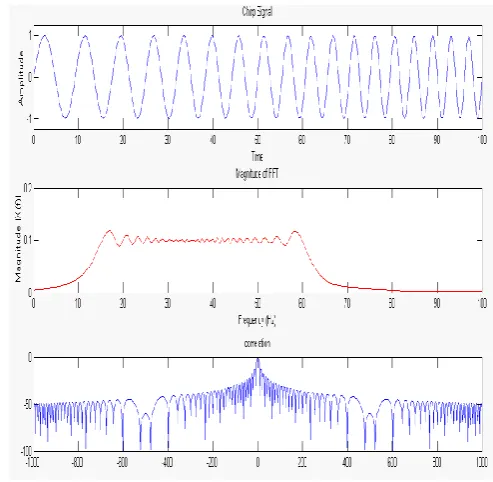
© 2015, IRJET.NET- All Rights Reserved Page 337 Here in fig. 3 chirp signal is generated and its
corresponding magnitude spectrum is plotted. The matched filter response is the sinc function which is the autocorrelation function of the original signal. The side lobes of this matched filter response comes about -13dB.
For non linear frequency modulated waveforms:
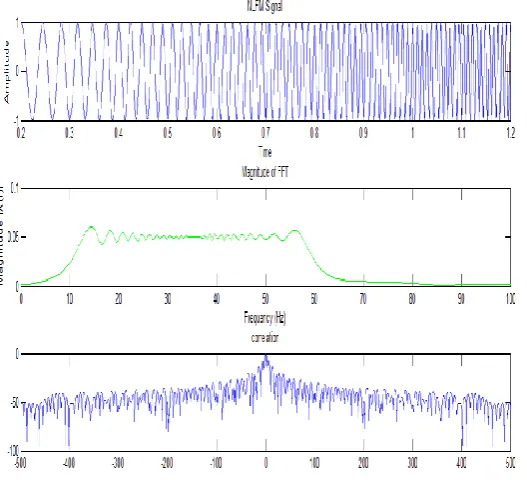
Fig. 4 shows NLFM signal, its magnitude spectrum and its
matched filter response respectively.
Here in fig. 4 NLFM signal is generated and its corresponding magnitude spectrum is plotted. The matched filter response is the sinc function which is the autocorrelation function of the original signal. The side lobes of this matched filter response comes about -40dB.
Ambiguity plots :
For linear frequency modulated waveforms:
Fig. 5(a) ambiguity plot of LFM
Fig. 5(b) contour plot of LFM
Fig. 5(c) Doppler cut plot of LFM
© 2015, IRJET.NET- All Rights Reserved Page 338 For non- linear frequency modulated waveforms :
Fig. 6(a) ambiguity plot of NLFM
Fig. 6(b) contour plot of NLFM
Fig. 6(c) doppler cut plot of NLFM
Fig . 6(d) delay cut plot of NLFM
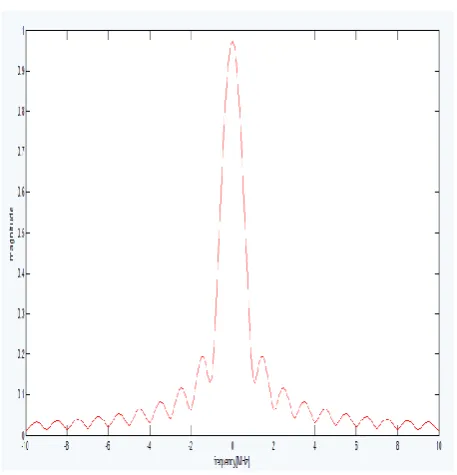
The above shown plots are the ambiguity function plots for LFM and NLFM waveforms. Fig 5(a) shows the ambiguity plot. Contour plot of the ambiguity function for LFM is shown in Fig 5(b), contour plot is the projection of the ambiguity function. By default, contour traces are assigned a colour from the rainbow colour. Red is having the minimum magnitude and violet is having maximum magnitude. Fig 5(c) shows the zero doppler cut of the ambiguity function plot which is obtained by putting fd =0
© 2015, IRJET.NET- All Rights Reserved Page 339 comes out to be 1/B which is equal to (1/0.5)= 2. Fig 5(d)
shows the delay cut plot of the ambiguity function for LFM.
Correspondingly, Fig 6(a) shows the ambiguity function plot for the NLFM waveform, Fig 6(b) shows the projection of the ambiguity function which is known as the contour plot. Fig6(c) shows the zero doppler cut of the ambiguity function plot, it tells about the range resolution of the waveform and here in case of NLFM range resolution comes out to be (1/B)=(1/0.1)=10. Fig 6(d) shows the delay cut plot of the ambiguity function for NLFM.
3.1 Comparative analysis of LFM and NLFM
waveforms:
There exist certain performance parameters that distinguish LFM and NLFM waveforms. They are mentioned as PSL, Range resolution, Doppler shift. Table 1 below shows different calculated values of these performance parameters via computer simulations. parameters embrace PSL, range resolution and doppler shift. Moreover the matched filter response of both the waveforms is approximated by a sinc function; only difference lies in the side lobe suppression. In case of LFM, we have sinc function with -13dB side lobes and in case of NLFM, we have sinc function with -40 dB side lobes. Doppler shift means that if two targets are at the same range, they need to have a difference of 1 MHz(LFM) and 1.3MHz(NLFM) in the doppler domain to be separated. In summary, NLFM came out to be a more practical,
constructive and functional radar signal waveform. It has been an effective technique for side lobe suppression. If the doppler intolerance of the NLFM is enhanced in a controlled manner, NLFM can be worn as the most used practical radar waveform in future.
ACKNOWLEDGEMENT
The authors are highly thankful to the editorial board and the reviewers for their potential efforts.
REFERENCES
[1] Y.K Chan, M.Y Chua and V.C Koo, “Side lobe reduction using simple two and tri stages non linear frequency modulation (NLFM),” Progress in Electromagnetic Research, vol. 98, pp. 33-52, 2009
[2] C. Baylis, R.J Marks and Robert Johnk, “ Spectrum analysis considerations for radar chirp waveform spectral compliance measurements”, IEEE ambiguity function”, International Conference on Information Function, pp. 82-88,2009
[7] N. levanon, E. Mozeson , Radar Signals, Wiley, new jersey,2004