FORMULATION OPTIMIZATION AND EVALUATION OF MOUTH DISSOLVING FILM OF
APREPITANT
ADITI D BAVISKAR*, BARI MM, BARHATE SD
Department of Pharmaceutics, Shree Sureshdada Jain Institute of Pharmaceutical Education and Research, Jamner, Maharashtra, India. Email: [email protected]
Received: 13 June 2019, Revised and Accepted: 15 July 2019 ABSTRACT
Objectives: The aim of the present research is to prepare mouth dissolving film of aprepitant used in the prevention and treatment of post-operative nausea and vomiting.
Methods: The MDF was prepared using Kollicoat IR, PEG 400, and spraying technique. Formulation was optimized by central composite design. Compatibility study was carried out using Fourier-transform infrared and differential scanning calorimetry. The films were evaluated for thickness, folding endurance, weight variation, disintegration time, dissolution studies, drug content, and in vitro diffusion test.
Results: From the results, it was found that there was no drug excipient interaction. The prepared optimized batch AP2 showed disintegration time 18 sec, highest dissolution rate 101.53%, drug diffused 39.58 mg/cm2 within 10 min and also passes all the physicochemical parameters. It was concluded that plasticizer PEG 400 plays a very much important role in the preparation of aprepitant MDF.
Conclusion: MDF of aprepitant was found to be a better option in the prevention and treatment of post-operative nausea and vomiting by the way of fast onset of action for patient convenience and compliance. In the near future, the MDF market will expand very fastly to treat various diseases. Keywords: Aprepitant, Kollicoat IR, PEG-400, Mouth dissolving film, Spraying technique, Central composite design.
INTRODUCTION
Oral delivery is currently the gold standard in the pharmaceutical industry, where it is regarded as the safest, most convenient, and most economical method of drug delivery having the highest patient compliance. However, the problem associated with oral route of administration is first-pass metabolism, drug degradation in variable pH condition of gastrointestinal tract, inadequate absorption, slow onset of action, and drawbacks related to particular class of patients which includes geriatric, pediatric, and dysphagia patients associated with many medical conditions as they have difficulty in swallowing or chewing solid dosage forms. To overcome these issues, fast dissolving drug delivery systems are gaining considerable attention. Fast disintegrating drug delivery systems are an alternative to tablets, syrups, and capsules, for pediatric and geriatric patients who rapidly disintegrate and dissolve in saliva and then easily swallowed without the need of water which is a major benefit over conventional dosage form. It consists of a fast dissolving tablet and fast dissolving film. Moreover, FDTs usually have insufficient mechanical strength, so careful handling is required. To protect the dosage form and to overcome such problems, new technology was developed as fast dissolving oral films [1-6].
Mouth dissolving films are the most advanced form due to more flexibility and comfort. It improves the efficacy of the drug by dissolving within a minute in the oral cavity after the contact with saliva without chewing and no need of water for administration. It gives quick absorption and instant bioavailability of drugs due to high blood flow and permeability. MDF is a postage stamp size polymeric film which contains active pharmaceutical ingredient and excipients. When placed on the patient’s tongue it rapidly disintegrates/disperse and releases the drug when it comes in contact with saliva, with an in vitro disintegration time of approximately 30 s or less.
Post-operative nausea and vomiting (PONV) is one of the complex and significant problems in anesthesia practice, with a growing trend toward ambulatory and daycare surgeries. It is a common complication of surgery and anesthesia. Although it is rarely fatal, PONV is unpleasant and associated with patient discomfort and dissatisfaction with their perioperative care. Patients have reported that avoidance of PONV is of greater concern than avoiding post-operative pain. PONV is also associated with delayed discharge from the recovery room and prolonged hospital care and, therefore, increases health-care costs. Morbidity associated with PONV includes wound dehiscence, dehydration, electrolyte disturbance, interference with nutrition and, more rarely, esophageal rupture (Boerhaave syndrome) or aspiration pneumonitis. Aprepitant is an antiemetic chemical compound that belongs to a class of drugs called substance P antagonists. It mediates its effect by blocking the neurokinin 1 receptor. Aprepitant is useful in the prevention of acute and delayed chemotherapy-induced nausea and vomiting and for prevention of PONV. It was approved by the FDA in 2003. Aprepitant may also be useful in the treatment of cyclic vomiting syndrome [7].
The drug belongs to BCS Class IV (low solubility and low permeability). There is a need to improve the solubility and dissolution rate of the drug. The micellar solubilization technique was used to improve the solubility and dissolution rate of the drug. In which sodium lauryl sulfate was used in the concentration of 1% w/v. SLS is an ionic surfactant. The most important property of surfactant is the formation of micelles in solution, which have particular significance in medicine because of their ability to enhance the solubility of poorly, water-soluble drugs. Low aqueous solubility is the major problem encountered with formulation development of new chemical entities. The use of surfactants to improve the dissolution of lipophilic drugs in an aqueous medium.
© 2019 The Authors. Published by Innovare Academic Sciences Pvt Ltd. This is an open access article under the CC BY license (http://creativecommons. org/licenses/by/4. 0/) DOI: http://dx.doi.org/10.22159/ajpcr.2019.v12i9.34553
MATERIALS AND METHODS
Aprepitant was obtained as a gift sample from Glenmark, Sikkim, India. Kollicoat IR is obtained as a gift sample from Transchem, Bhiwandi, Mumbai, India. PEG-400, Citric acid, aspartame, raspberry red, and vanilla flavor were purchased from Jinendra Scientific, Jalgaon, India.
Compatibility studies
Identification of drug and polymer by Fourier-transform infrared (FTIR) Started the instrument and initialise the software. Fixed the ATR unit in the compartment and cleaned the surface of the crystal using solvent, set the process parameter such as number of scans, resolution, and wavelength range. Background scan was taken. Placed the sample on the crystal and pressure was applied to have proper contact between crystal and sample. The sample was scan. Generated spectrum was analyzed.
Identification of drug and polymer by differential scanning calorimetry (DSC)
3–5 mg of sample was weighed on weighing balance. Crimped the sample pan with lead using crimping tool. Put reference and sample pan in the DSC detector. TAWS collection monitor software was opened and set the temperature program. Gave the details related to sample in file information and started the program. After the program is over, the obtained thermogram was analyzed.
Preparation of standard curve of aprepitant in phosphate buffer pH 6.8 containing 1% SLS
10 mg of aprepitant was weighed and dissolved in phosphate buffer pH 6.8 containing 1% SLS and volume was made up to 100 ml in a volumetric flask to get 100 μg/ml solution. From this solution, 0.2 ml solution was pulled out and diluted up to the 10 ml by phosphate buffer ph 6.8 containing 1% SLS to get 2 μg/ml solution, likewise 4 μg/ml, 6 μg/ml, 8 μg/ml, 10 μg/ml, and 12 μg/ml solutions were prepared. The absorbance of each solution was measured at 210 nm using UV-visible spectrophotometer (Shimadzu-1800) and phosphate buffer pH 6.8+1% SLS used as a reference standard, and the standard curve was generated.
Methods
Preparation of mouth dissolving film of aprepitant by spraying technique All the ingredients were weighed properly. Weighed Kollicoat IR was dissolved in 5 ml of distilled water under the constant stirring until the solution becomes clear. Remaining excipients such as aspartame and citric acid were dissolved in the above polymeric solution under constant stirring up to the formation of clear solution. Aprepitant was dissolved in sufficient quantity of ethanol and transferred the same into the polymeric solution. Raspberry red was dissolved in a little amount of water, then added into the polymeric solution under constant stirring to get a homogenized solution. Then, vanilla flavor was added under constant stirring for 5–10 min.
Above solution was added in a spraying gun and frequently sprayed the solution on the rectangle glass plate and intermittently dried using hot air blower at a temperature 30–35°C. The dried film was peeled off from the glass plate. Then, the film was cut into the desired size and shape (2.5×3.5 cm) and evaluated. Prepared mouth dissolving films of aprepitant are presented in Fig. 1.
Calculation of aprepitant loaded in the film
Surface area of TLC plate = Length×Height = 5×17.5 = 87.5 cm2
Each film surface area = 2.5×3.5 = 8.75 cm2 8.75 cm2 contain = 40 mg aprepitant
Therefore, 87.5 cm2 contain = 400 mg aprepitant
Aprepitant is a highly insoluble drug, after adding 400 mg of drug in 900 mg Kollicoat IR, film reduces its elasticity and tensile strength, and the prepared film was not easily peelable and brittle in nature. Hence, increased the concentration of Kollicoat IR from F2 to F7 batches but the problem was not solved and hence decided to add plasticizer (PEG 400) to enhance the elasticity as well as strength of the film. The data are reported in Table 1.
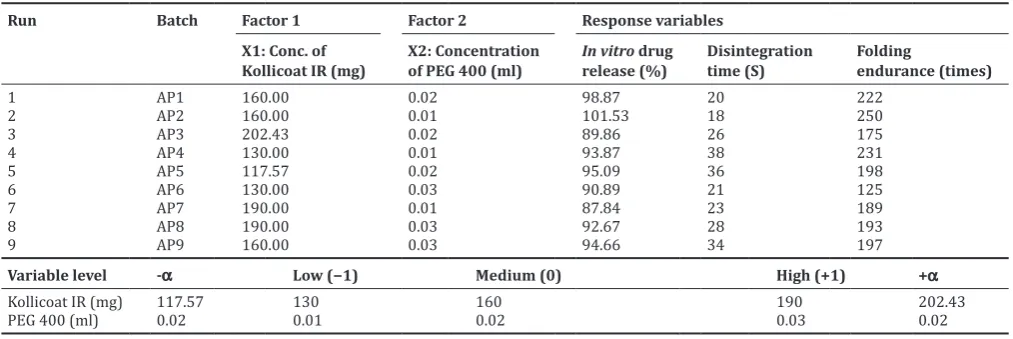
Based on preliminary trials, two factors and three levels central composite design was employed by using design expert software to study the effect of independent variables on dependent variables. Thirteen runs were generated, among which one formulation was repeated four times then for the repeated formulation considered one formulation for further study and hence study was done on nine formulations. The data are reported in Table 2.
Evaluation parameters for aprepitant MDF Weight variation test
The cast film was cut at different places and the weight of each film was checked with the help of an electronic weighing balance and the average weight was calculated [8].
Thickness test
The thickness of the film was measured by digital Vernier caliper at different position of the film (four corners and one center), and the average thickness was calculated [9].
Folding endurance
The folding endurance is expressed as the number of folds (number of times of film is folded at the same plain) required breaking the specimen or developing visible cracks. This gives an indication of the brittleness of the film. A small strip of 4 cm2 was subjected to this test by folding the film at the same plane repeatedly several times until a visible crack was observed [10].
Surface pH
The film to be tested was placed in a Petri dish and moistened with 0.5 ml of distilled water and kept for 30 s. The pH was noted after bringing the electrode of the pH meter in contact with the surface of the film and allowed to equilibrate for 1 min [11].
In vitro wetting time
A circular tissue paper was cut as per the size of the Petri plate. 1.1% w/v methylene blue solution was prepared and added to the Petri plate. The film was placed into the Petri plate. The time required for the dye to appear on the surface of the film was noted as the wetting time. In vitro wetting time of aprepitant film is presented in Fig. 2 [11].
In vitro disintegration test
A film of 2.5 cm×3.5 cm was cut and was put in the beaker containing 50 ml distilled water. The time when the film was completely disintegrated noted as disintegration time. The standard value of disintegration time is 5–30 s for the mouth dissolving film as per CDER [8,12].
Drug content
disappearance of any characteristic peak of the aprepitant, which confirms the absence of chemical interaction between aprepitant and carrier. Hence, the excipient Kollicoat IR, which was observed to be compatible with aprepitant, was selected for further development of the formulation.
Compatibility studies by DSC
An endothermic peak was observed for the aprepitant at 253.39°C, and an endothermic peak was observed for the Kollicoat IR at 216.49. In spectrophotometrically at 210 nm. The drug content was calculated
using the following formula.
It was determined by placing aprepitant MDF (2.5 cm×3.5 cm) in a desiccator for 24 h to ensure the complete drying of the film before the actual test. 500 ml saturated solution of sodium chloride was poured in a desiccator. The film was then weighed in dry form and further placed the Petri plate containing MDF in a desiccator whose relative humidity was maintained at 75% for 1 week. The percentage relative humidity in the desiccator was measured using a digital hygro thermometer. Then, after the 1 week, aprepitant MDFs were reweighed and percentage weight increased due to moisture uptake was noted.
Percentage of moisture uptake=Final weight Initial weight Ini
−
ttial weight × 100
In vitro drug release test
In vitro drug release study was carried out using a dissolution apparatus USP type II (paddle). The volume of dissolution medium 300 ml phosphate buffer pH 6.8+1% SLS used. The temperature was maintained at 37°C±0.5°C, and 50 RPM was set. Samples were withdrawn at suitable time intervals of 1 min–10 min and replaced with an equal amount with the same dissolution medium. The percentage drug release was determined by measuring the absorbance in UV spectrophotometer at 210 nm. Percentage DR was calculated using the following formula,
% DR
In vitro diffusion study was carried out using three-stage modified Franz diffusion cell having an internal diameter 2.5 cm. The cellophane membrane was mounted between the donor and the receptor compartment. In the donor compartment, MDF of aprepitant was placed. Receptor compartment filled with 20 ml of simulated salivary fluid of pH 6.8 containing 1% sodium lauryl sulfate, which was maintained at 37°C±2°C, and hydrodynamics was maintained using a magnetic stirrer. Samples (2 ml) were withdrawn from the receptor compartment (phosphate buffer pH 6.8+1% SLS) at suitable time intervals of 1 min and replaced with an equal amount in the receptor compartment with same diffusion medium. The percentage amount of drug diffused in the receptor compartment was determined by measuring the absorbance in UV spectrophotometer at 210 nm [13,14].
RESULTS AND DISCUSSION Ultraviolet spectroscopy analysis
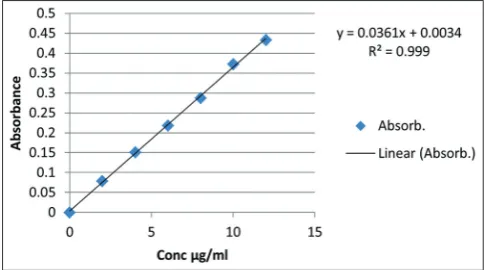
It was observed that the concentration range of 2-12 µg/ml obeyed the beers-lamberts law. The correlation coefficient was found to be R2=0.999. Slope was found to be 0.036. The calibration curve of aprepitant is presented in Fig. 3.
Compatibility studies
Compatibility study by FTIR and DSC
The compatibility study between aprepitant and its physical mixtures with formulation excipients was carried out using FTIR spectrometer and is presented in Figs. 4-6.
The physical mixture of aprepitant and excipients was subjected to FTIR to identify any interaction between them. There was no appearance or
Fig. 1: Mouth dissolving film of aprepitant
Fig. 3: Calibration curve of aprepitant
Table 1: Preliminary trial batches of aprepitant mouth dissolving the film
S. No. Ingredient Batches
F1 F2 F3 F4 F5 F6 F7
1 Aprepitant 40 40 40 40 40 40 40
2 Kollicoat IR 90 90 130 160 160 160 160
3 PEG-400 - - - 0.01
*All quantities are expressed for (2.5 cm×3.5 cm) 8.75 cm2 film in mg except
PEG-400, ethanol, flavor, and water in ml. PEG: Polyethylene glycol
Fig. 2: (a-c) Invitro wetting time of aprepitant MDF
Fig. 4: Fourier-transform infrared spectrum of aprepitant
Fig. 8: Identification of overlay of aprepitant and Kollicoat IR by differential scanning calorimetry
Fig. 7: Identification of aprepitant by differential scanning calorimetry
Fig. 5: Fourier-transform infrared spectrum of Kollicoat IR
DSC of aprepitant and Kollicoat IR, there was no any interaction and hence the aprepitant and Kollicoat IR were compatible with each other for further development of formulation. The spectrums were analyzed and interpreted in Figs. 7-8
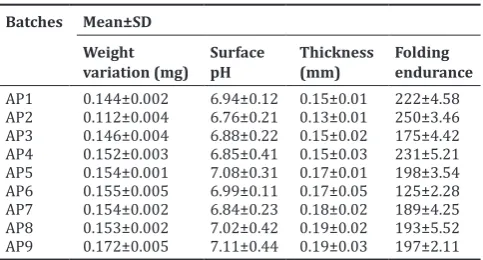
From the above results of aprepitant mouth dissolving film, it was observed that AP2 batch showed highest folding endurance which indicates prepared film having good flexibility and the surface pH was found to be 6.76±0.21 which is as similar as the pH of the oral cavity. The thicknesses of the prepared mouth dissolving films were found to be in the range of
0.13 nm–0.19 nm. The AP2 batch showed 0.13±0.01 mm thickness, which is lowest than other batches, as the concentration of polymer increases the thickness of the film increases. Results are shown in Table 3.
Formulation AP2 showed better results with percentage moisture uptake and moisture content among all batches. AP2 batch showed 98.87% drug content, which is highest in all batches. Film disintegrate in 18.5±2.55 s and having wetting time 25.1±1.5 s which is lesser among all. From the results formulation, AP2 was selected as the best-optimized batch (Table 4).
By comparing all the formulations (AP1–AP9), it was concluded that formulation AP2 showed the highest drug release and hence selected as the best formulation (Fig. 9). Formulation AP2 showed maximum drug release of 101.53% at 10 min (Table 5).
The cumulative amount of drug diffused was plotted against time to obtain the diffusion profile. It was found that in 10 min, the entire quantity of the drug from the formulation diffused completely and hence indicated a good diffusion coefficient, which is essential for faster onset of action. The AP2 batch diffused 39.58 mg/cm2 drug within 10 min. These data are reported in Table 6 and Fig. 10.
Optimization and data analysis/statistical analysis
On the basis of the preliminary trials, a two factor central composite design was employed to study the effect of independent variables, i.e., concentration of Kollicoat IR (X1) and concentration of PEG 400 (X2) on dependent variables in vitro drug release % (Y1), disintegration time (Y2), and folding endurance (Y3) (Table 7). Analysis and optimization were done by Design-Expert Software (version 7.1.5, State-Ease Inc., Minneapolis, USA).
Optimization of dependent variables Response 1 (in vitro drug release % Y1)
Aprepitant used in PONV that requires fast effect, so percentage DR within 10 min considered as a suitable time for desired therapeutic effect. Therefore, percentage DR in 10 min forms important criteria Fig. 10: In vitro drug diffusion study of optimized batch of
aprepitant MDF (AP2)
Fig. 9: Comparative in vitro drug dissolution profiles of aprepitant film (Batch AP1 to AP9)
Table 2: Composition of optimized batches of aprepitant mouth dissolving the film
S. No. Ingredient Batches
AP1 AP2 AP3 AP4 AP5 AP6 AP7 AP8 AP9
1 Aprepitant 40 40 40 40 40 40 40 40 40
2 Kollicoat IR 160 160 202.43 130 117.57 130 190 190 160
3 PEG-400 0.02 0.01 0.02 0.01 0.02 0.03 0.01 0.03 0.03
4 Aspartame 10 10 10 10 10 10 10 10 10
*All quantities are expressed for 8.75 cm2 (2.5 cm×3.5 cm) film in mg except PEG-400 (polyethylene glycol), vanilla flavor, ethanol and water in ml. PEG: Polyethylene
glycol
Table 3: Evaluation parameters for optimized batches of mouth dissolving film of aprepitant
Batches Mean±SD Weight
variation (mg) Surface pH Thickness (mm) Folding endurance
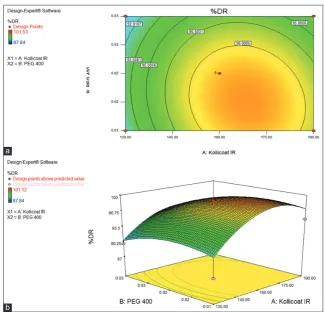
Fig. 11: (a) Contour plot for percentage DR of optimized formulation AP2. (b) Response surface plot for percentage DR of optimized formulation AP2
a
b
Fig. 12: (a) Contour plot for disintegration time of optimized formulation AP2. (b) Response surface plot for disintegration time of optimized formulation AP2
a
Fig. 13: (a) Contour plot for folding endurance of optimized batch AP2. (b) Response surface plot for folding endurance of optimized batch AP2
a
b
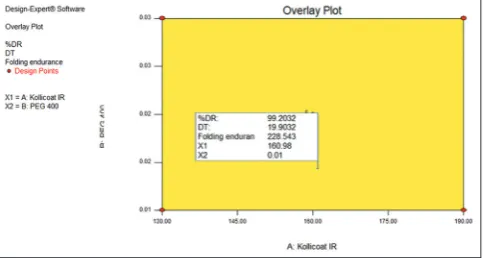
Fig. 14: Overlay plot showing compositions for optimized formulation AP2 and the predicted values for the responses Y1,
Y2, Y3
and hence selected as the dependent variable for optimization. On applying central composite design, the quadratic model suggested by software and found significant with a model F value of 4.76 implies that the model is significant. There is only a 3.24% chance that a “Model F-value” this large could due to noise.
Values of “Prob > F” <0.0500 indicate model terms are significant. In this case, X12 are significant model terms. Values >0.1000 indicate that the model terms are not significant.
Following quadratic equation could describe the % DR response,
Y1 = +98.87+2.03 X1−1.37 X2−0.61 X1X2−3.96 X12−1.60 X22 From the above quadratic equation, positive (+) sign of X1 indicates that factor X1 (concentration of Kollicoat IR) has positive effect on response Y1 (% DR in 10 min) and negative (−) sign of X2 indicates that factor X2
(concentration of PEG 400) has a negative effect on response Y1 (% DR in 10 min). That is percentage drug release in 10 min increases with increase in Kollicoat IR concentration and decreases with increase in PEG 400 concentration. The release of drug was found to be dependent on swelling property.
The contour plot and 3D response surface plots show the combined effect of concentration of Kollicoat IR and PEG 400 on percentage DR in 10 min. In this case, the results indicated that Kollicoat IR concentration had a more significant positive effect on response Y1 than the negative effect of PEG 400 concentration. As the concentration of PEG 400 increases in the formulation more than 14% w/w of polymer, the water uptake capacity of the film decreases and a significant decrease in percentage DR in 10 min obtained at the same level of Kollicoat IR concentration with an increase in PEG 400 concentration. Formulation containing the lowest amount of PEG 400 (0.01 ml) got disintegrate first and thus enhance release rate of the drug. AP2 formulation contains the lowest amount of PEG 400 (0.01 ml) and medium amount of Kollicoat IR (160 mg) showed the highest amount of drug release in 10 min (Fig. 11).
Response 2 (in vitro disintegration time Y2)
Disintegration time of the film varies from 20 s (batch 1) to 34 s (batch 9) for the selected independent factor combinations. The model F-value of 4.76 implies that the model is significant. There is only a 3.24% chance that a “Model F-value” this large could occur due to noise. Value of “Prob > F” < 0.0500 indicate that model terms are significant. In this case, X12 are significant model terms. Values >0.1000 indicate that the model terms are not significant. Following quadratic equation could describe the disintegration time response,
Table 4: Evaluation parameters for optimized batches of mouth dissolving film of aprepitant
Batches Mean±SD Drug content (%) Wetting time (S),
mean±SD Moisture content (%) Moisture absorption (%) Disintegration time (S)
AP1 2.7±4.2 1.91±0.1 20.2±3.16 92.11 26.5±1.2
AP2 1.4±2.5 1.77±0.1 18.5±2.55 98.87 25.1±1.5
AP3 1.8±2.2 1.98±0.2 26.3±3.42 95.44 30.4±2.1
AP4 1.6±3.5 1.88±0.1 38.2±2.24 88.69 42.6±2.5
AP5 1.7±2.8 2.21±0.3 36.4±2.22 89.21 40.5±1.1
AP6 1.6±2.6 2.19±0.2 21.6±4.16 92.22 24.2±2.2
AP7 1.8±3.8 1.87±0.1 23.2±3.32 96.55 30.6±2.3
AP8 2.4±4.2 2.31±0.4 28.4±2.21 88.87 32.4±1.3
AP9 2.5±3.7 2.18±0.2 34.4±4.32 91.22 39.6±3.5
*±SD (n=3). SD: Standard deviation
Table 6: In vitro drug diffusion study of optimized batches of MDFs of aprepitant (AP2)
S. No. Time (min) Abs. Conc. (µg/ml) Total amount of drug diffused CADD/cm2 (CADD/unit area)
(µg) (mg) (µg/cm2) (mg/cm2)
1 1 0.248 6.805 34,027.77 34.02 10,836.87 10.83
2 2 0.355 9.777 48,888.88 48.88 15,569.70 15.56
3 3 0.454 12.527 62,638 62.63 19,948.69 19.94
4 4 0.594 16.416 82,083.33 82.08 26,141.18 26.14
5 5 0.658 18.194 90,972.22 90.97 28,972.04 28.97
6 6 0.691 19.111 95,555.55 95.55 30,431.70 30.43
7 7 0.701 19.388 96,944.44 96.94 30,874.02 30.87
8 8 0.768 21.25 106,250 106.25 33,837.57 33.83
9 9 0.821 22.722 113,611.11 113.61 36,181.88 36.18
10 10 0.898 24.86 124,305.55 124.305 39,587.75 39.58
*CADD: Cumulative amount of drug diffused
Table 5: In vitro drug release study of optimized batches of mouth dissolving film of aprepitant
S. No. Time (min) AP1 AP2 AP3 AP4 AP5 AP6 AP7 AP8 AP9
1 1 51.32 54.85 38.56 48.11 45.87 38.06 41.88 51.14 46.76
2 2 53.72 55.57 42.88 52.46 52.48 43.66 49.08 54.44 49.04
3 3 59.84 64.38 53.11 62.38 57.01 47.72 51.03 57.72 55.54
4 4 66.77 67.66 63.47 67.01 63.54 57.66 56.88 60.61 58.15
5 5 72.58 79.63 72.31 73.42 70.68 65.31 62.14 66.98 66.68
6 6 78.68 81.80 77.12 76.13 73.55 70.55 66.14 73.31 72.70
7 7 81.03 89.01 80.81 78.08 81.62 75.08 73.88 76.66 77.80
8 8 89.55 97.38 82.54 87.07 87.01 79.12 83.60 82.24 83.38
9 9 94.77 99.60 87.67 91.60 94.54 85.08 85.33 86.61 89.94
10 10 98.87 101.53 89.86 93.87 95.09 90.89 87.84 92.67 94.66
Table 7: Results of optimized batches of aprepitant by central composite design
Run Batch Factor 1 Factor 2 Response variables
X1: Conc. of
Kollicoat IR (mg) X2: Concentration of PEG 400 (ml) Inrelease (%)vitro drug Disintegration time (S) Folding endurance (times)
1 AP1 160.00 0.02 98.87 20 222
2 AP2 160.00 0.01 101.53 18 250
3 AP3 202.43 0.02 89.86 26 175
4 AP4 130.00 0.01 93.87 38 231
5 AP5 117.57 0.02 95.09 36 198
6 AP6 130.00 0.03 90.89 21 125
7 AP7 190.00 0.01 87.84 23 189
8 AP8 190.00 0.03 92.67 28 193
9 AP9 160.00 0.03 94.66 34 197
Variable level -α Low (−1) Medium (0) High (+1) +α
Kollicoat IR (mg) 117.57 130 160 190 202.43
PEG 400 (ml) 0.02 0.01 0.02 0.03 0.02
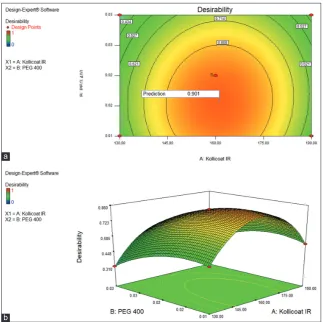
Fig. 15: (a) Contour graph for desirability of optimized formulation AP2. (b) Response surface graph for the desirability of optimized formulation AP2
a
b
(concentration of PEG 400) have positive effect on response Y2 (in vitro disintegration time). That is, disintegration time decreases with an increase in Kollicoat IR and PEG 400 concentration. Kollicoat IR and PEG 400 directly related to disintegration time as they show good swelling due to its hydrophilic nature (Fig. 12). As the level of Kollicoat IR increases, the capacity of water uptake increases resulting in swelling.
Response 3 (folding endurance Y3)
PEG 400 acts as a plasticizer and which is used in many of the pharmaceutical products due to its low human toxicity and desirable formulation properties. It is capable to improve the flexibility of the film and reduces the brittleness of the film. Plasticizers significantly improve the strip properties by reducing the glass transition temperature of the polymer and thus increase folding endurance. The model F-value of 5.28 implies that the model is significant. There is only a 2.50% chance that a “Model F-value” this large occurred due to noise. Values of “Prob. > F” <0.0500 indicate that model terms are significant. In this case, X1 and X12 are significant model terms. Values >0.1000 indicate that the model terms are not significant. Following quadratic equation could describe the folding endurance response (Y3).
Y3 = +222.00+22.61 X1−11.92 X2+3.25 X1X2−24.50 X12−2.75 X22 From the above quadratic equation, positive (+) sign of X1 indicates that factor X1 (concentration of Kollicoat IR) has positive effect on response Y3 (folding endurance) and negative (−) sign of X2 (concentration of PEG 400) indicates that negative effect on response Y3 (folding endurance). That is, folding endurance increases with increase in the concentration of X1 (Kollicoat IR) and decreases with increase in the concentration of X2 (concentration of PEG 400) above 14% w/w of the polymer (Fig. 13).
Selection of optimized batch
The overlay plot (Fig. 14) reflects that the yellow region of the area showed the area of interest (experimental region). From the overlay plot, it was found that the concentration of X1 (Kollicoat IR) and concentration of X2 (PEG 400) were same as that of the selected optimized batch from quadratic equations, contour plots, and response surface plot but there is somewhat variation in the responses of percentage % DR, DT, and folding endurance, which is negligible. From the results selected optimized batch was found to be AP2. The desirability of the optimized formulation AP2 was found to be 0.901, which is lies between 0-1 and it represents the closeness of a response to it’s ideal value (Fig. 15). From the results selected optimized batch was found to be AP2.
CONCLUSION
AP2 batch showed good physicochemical parameters, the highest percentage of drug release, and less disintegration time. The in vitro release of the drug was found to be 101.53% within 10 min. The disintegration time was found to be 18 sec. It was found that in 10 min, the entire quantity of the drug from the AP2 formulation diffused completely and hence indicated a good diffusion coefficient, which is essential for fast onset of action. The AP2 batch diffused 39.58 mg/cm2 drug within 10 min. It was concluded that MDF of aprepitant was found to be a better option in control/avoidance of post-operative nausea and vomiting by the way of fast onset of action for patient convenience and compliance. Among the plethora of avenues explored for drug releasing products, MDF is gaining much attention. In the near future, the MDF market will expand very fastly to treat various diseases.
ACKNOWLEDGMENT
I would like to acknowledge, Shree Sureshdada Jain Institute of Pharmaceutical Education and Research, Jamner, Maharashtra, India, for supporting for continuous support, encouragement, and fulfillment of this work.
AUTHORS’ CONTRIBUTIONS
The three authors contributed equally to this work.
CONFLICTS OF INTEREST
The authors declare that they have no conflicts of interest.
REFERENCES
1. Irfan M, Rabel S, Bukhtar Q. Orally disintegrating film: A modern expansion in drug delivery system. Saudi Pharm J 2016;24:537-46. 2. Ankita DC, Bhagawati ST, Udupa N. An overview on fast dissolving
oral films. Asian J Pharm Technol 2015;5:129-37.
3. Venkateswarlu K. Preperation and evaluation of fast dissolving buccal thin films of bufotenin. J In Silico In Vitro Pharmacol 2016;2:1-5. 4. Deepak H, Geeta A, Kumar SL. Recent trends of fast dissolving drug
delivery system-an overview of formulation technology. Pharmacophore 2013;4:1-9.
5. Vanksha K, Juber A, Shazia U. A review on fast dissolving formulation technologies. World J Pharm Pharm Sci 2015;4:574-85.
6. Available from: https://www.pharmatutor.org/articles/review-fast-dissolving-drug-delivery-system.
7. Mohamed HR, Jane B. Post-operative nausea and vomiting. Pharm J 2008;273:786.
8. Puja C, Rajesh K. A review on oral fast dissolving films a novel drug delivery system. Asian J Res Chem Pharm Sci 2016;4:165-75. 9. Shweta K, Mayank B. Recent trends in the development of oral
dissolving film. Int J Pharm Tech Res 2012;4:725-33.
10. Yassin GE, Abass HA. Design and evaluation of fast dissolving Oro-dispersible films of metoclopramide hydrochloride using 32 multifactorial designs. Int J Pharm Pharm Sci 2016;8:218-22.
11. Rajni B, Shailesh S. Formulation and evaluation of fast dissolving film of aprepitant by using design of experiment. Bull Fac Pharm Cario Univ 2018;56:159-68.
12. Prabhakara P, Akhilesh D, Karthik K. Formulation and evaluation of fast-dissolving films of lisinopril. Egypt Pharm J 2015;14:56-64. 13. Dias RJ. Laboratory Manual of Biopharmaceutics and Pharmacokinetics.
Satara: Trinity Publishing House; 2010. p. 22-4.