Integration with System 75 and
DEFINITY
®
Communications System
Generic 1 and Generic 3
Notice
Every effort was made to ensure that the information in this book was complete and accurate at the time of printing. However, information is subject to change.
Your Responsibility for Your System’s Security
Toll fraud is the unauthorized use of your telecommunications system by an unauthorized party, for example, persons other than your com-pany’s employees, agents, subcontractors, or persons working on your company’s behalf. Note that there may be a risk of toll fraud associ-ated with your telecommunications system and, if toll fraud occurs, it can result in substantial additional charges for your telecommunica-tions services.
You and your system manager are responsible for the security of your system, such as programming and configuring your equipment to pre-vent unauthorized use. The system manager is also responsible for reading all installation, instruction, and system administration docu-ments provided with this product in order to fully understand the fea-tures that can introduce risk of toll fraud and the steps that can be taken to reduce that risk. Lucent Technologies does not warrant that this product is immune from or will prevent unauthorized use of com-mon-carrier telecommunication services or facilities accessed through or connected to it. Lucent Technologies will not be responsible for any charges that result from such unauthorized use.
Lucent Technologies Fraud Intervention
If you suspect that you are being victimized by toll fraud and you need technical support or assistance, call Technical Service Center Toll Fraud Intervention Hotline at 1 800 643-2353.
Federal Communications Commission Statement
Part 15: Class A Statement. This equipment has been tested and
found to comply with the limits for a Class A digital device, pursuant to Part 15 of the FCC Rules. These limits are designed to provide rea-sonable protection against harmful interference when the equipment is operated in a commercial environment. This equipment generates, uses, and can radiate radio-frequency energy and, if not installed and used in accordance with the instructions, may cause harmful interfer-ence to radio communications. Operation of this equipment in a resi-dential area is likely to cause harmful interference, in which case the user will be required to correct the interference at his own expense.
Part 68: Network Registration Number. This equipment is
regis-tered with the FCC in accordance with Part 68 of the FCC Rules. It is identified by FCC registration number AS5USA-20411-VM-E.
Part 68: Answer-Supervision Signaling. Allowing this equipment to
be operated in a manner that does not provide proper answer-supervi-sion signaling is in violation of Part 68 Rules. This equipment returns answer-supervision signals to the public switched network when:
• Answered by the called station • Answered by the attendant
• Routed to a recorded announcement that can be administered by the CPE user
This equipment returns answer-supervision signals on all DID calls forwarded back to the public switched telephone network. Permissi-ble exceptions are:
• A call is unanswered • A busy tone is received • A reorder tone is received
Canadian Department of Communications.
Le Présent Appareil Nomérique n’émet pas de bruits radioélectriques dépassant les limites applicables aux appareils numériques de la class A préscrites dans le reglement sur le brouillage radioélectrique édicté par le ministére des Communications du Canada.
Trademarks
See the preface of this document.
Ordering Information
Call: Lucent Technologies Publications Center
Voice 1 800 457-1235 International Voice 317 361-5353 Fax 1 800 457-1764 International Fax 317 361-5355
Write: Lucent Technologies Publications Center P.O. Box 4100
Crawfordsville, IN 47933
Order: Document No. 585-310-214 Comcode 107857047 Issue 5, September 1996
For additional documents, refer to the section in “About This Docu-ment” entitled “Related Resources.”
You can be placed on a standing order list for this and other docu-ments you may need. Standing order will enable you to automatically receive updated versions, billed to account information that you pro-vide. For more information or to be put on a list to receive future issues of this document, contact the Lucent Technologies Publications Center.
European Union Declaration of Conformity
Lucent Technologies Business Communications Systems declares that MAP/40 and MAP/100 equipment specified in this document con-forms to the referenced European Union (EU) Directives and Harmo-nized Standards listed below:
EMC Directive 89/336/EEC Low-Voltage Directive 73/23/EEC
The “CE” mark affixed to the equipment means that it conforms to the above directives.
Disclaimer
Intellectual property related to this product and registered to AT&T Corporation has been transferred to Lucent Technologies Incorpo-rated.
Any references within this text to American Telephone and Telegraph Corporation or AT&T should be interpreted as references to Lucent Technologies Incorporated. The exception is cross references to books published prior to December 31, 1996, which retain their original AT&T titles.
Heritage
Lucent Technologies - formed as a result of AT&T’s planned restruc-turing - designs, builds, and delivers a wide range of public and private networks, communication systems and software, consumer and busi-ness telephone systems, and microelectronics components. The world-renowned Bell Laboratories is the research and development arm for the company.
About This Book
xiii■ Purpose xiii
■ Intended Audience xiii
■ How This Document Is Organized xiv
■ Conventions Used xvi
■ Trademarks and Service Marks xvi
■ Related Resources xviii
■ Training xviii
■ How to Make Comments About This Book xix
1
Switch Integration Requirements
1-1■ An Introduction to Switch Integration and DCIU 1-2
■ Switch Releases Supported by the
Lucent INTUITY System 1-3
■ DCIU Circuit Card and GPSC/AT/E 1-4
■ SN229 Circuits — Do Not Use 1-4
■ Lucent INTUITY System Switch Connections 1-5 Connections through an IDI 1-5
Hardware Required for the Connection 1-5
Connections through an MPDM 1-8
Hardware Required for the Connection 1-8
2
Switch Integration Planning
2-1Section 1: MPDM Information 2-11
Section 2: Processor Interface Data Link
Information 2-12
■ DCS Worksheets 2-19
3
System 75 and DEFINITY Generic 1
Administration
3-1■ Administer the Voice Ports as Stations 3-2
Create a Unique COR 3-3
Create a Unique COS 3-4
Administer the First Voice Port 3-5
Duplicate the Station 3-8
■ Assign the Hunt Group 3-9
■ Assign the Data Link 3-15
Assign the MPDM 3-16
Assign the Processor Interface Data Module 3-18
Assign the Interface Link 3-20
Assign the Processor Channel 3-23
Verify the Link 3-25
4
DEFINITY G3r Administration
4-1■ Assign User Defined Adjunct Names 4-2
■ Administer the Voice Port Stations 4-4
Create a Unique COR 4-4
Create a Unique COS 4-5
Administer the First Voice Port Station 4-6
Duplicate the Station 4-9
■ Assign the Hunt Group 4-11
■ Assign the Data Link 4-18
Administer the Packet Gateway Board 4-19
Assign the BX.25 Data Module 4-21
Assign the Interface Link 4-25 Assign the Processor Channel 4-26
5
DEFINITY G3i, G3i-Global, G3s, and
G3vs Administration
5-1■ Administer the Voice Port Stations 5-2
Create a Unique COR 5-2
Create a Unique COS 5-3
Administer the First Voice Port 5-4
Duplicate the Station 5-7
■ Assign the Hunt Group 5-8
■ Assign the Data Link 5-13
Assign the MPDM 5-14
Assign the Processor Interface Data Module 5-17
Assign the Interface Link 5-19 Assign the Processor Channel 5-21
Verify the Link 5-23
6
DCS Administration
6-1■ DCS Description 6-2
A Lucent INTUITY System in a DCS Configuration
Using BX.25 Data Channels 6-3
A Lucent INTUITY System in a DCS
Configuration Using ISDN-PRI D-Channel
(DEFINITY G3i, G3r, G3s, and G3vs only) 6-3
Example DCS Solution 6-4
Connectivity 6-4
■ System 75 and DEFINITY G1 DCS Administration 6-7
Assign the Processor Channel at the Remote
Switch 6-8
Disable the Host to Remote Switch DCS Link 6-9 Administer the Processor Channel 6-9 Enable the Host to Remote Switch DCS Link 6-12
Release the Host-to-Remote Switch DCS Link
and the Host-to-Lucent INTUITY System Link 6-17 Assign the Hunt Group at the Remote Switch 6-17
■ G3r DCS Administration 6-22
Assign User Defined Adjunct Names 6-24
DCS with BX.25 Signaling Administration 6-25
Assign the Processor Channel at the Remote
Switch 6-26
Assign the Hop Channel 6-30
DCS Via ISDN-PRI D-Channel Administration 6-33 Assign the Processor Channel at the Host Switch
DCS 6-34
Assign the Signaling Group at the Host Switch 6-36 Assign the ISDN TSC Gateway Channel at the
Host Switch 6-42
Administer DCS through ISDN-PRI at the
Remote Switch 6-44
Assign the Hunt Group at the Remote Switch 6-49
■ G3i, G3s, G3vs DCS Administration 6-54
DCS with BX.25 Signaling Administration 6-57
Assign the Processor Channel at the Remote
Switch 6-57
Assign the Hop Channel 6-61
DCS Via ISDN-PRI D-Channel Administration 6-65 Assign the Processor Channel at the Host Switch
DCS 6-66
Assign the Signaling Group at the Host Switch 6-68 Assign the ISDN TSC Gateway Channel at the
Host Switch 6-74
Administer DCS through ISDN-PRI at the
Remote Switch 6-76
Assign the Hunt Group at the Remote Switch 6-82
■ Administer the Subscribers (Remote Switch) 6-85
Assign the Call Coverage Path for Subscribers
(Remote Switch) 6-85
Modify the Station Screen for Each Remote
7
Lucent I
NTUITYSystem
Administration for Switch Integration
7-1■ Administer the Lucent INTUITY System
for a Non-DCS Switch Integration 7-2
■ Administer the Lucent INTUITY System
for a DCS Network Switch Integration 7-5
Administer the DCS Network Time Zone 7-7
■ Country Parameter Administration 7-9
Procedure to Administer Country Parameters 7-9
■ Customizing Switch Parameters on
the Lucent INTUITY System 7-12 Procedure to Administer Switch Parameters 7-12
■ Changing the Switch Extension Length
on the Lucent INTUITY System 7-16 Change the Lucent INTUITY System Settings 7-16 Stopping and Starting the Voice System 7-18
8
Acceptance Test Administration
8-1■ Acceptance Test Procedures 8-2
Assign the Call Coverage Path for the Test
Subscribers 8-2
Modify the Station Screen for Each Subscriber 8-5
9
Cut-to-Service Administration
9-1■ Cut-to-Service Procedures 9-2
10
Optional Switch Administration for
Lucent I
NTUITYSystem Features
10-1■ INTUITY AUDIX Digital Networking
Package Switch Administration 10-1 Configure the Data Module 10-2
Create a Hunt Group 10-3
■ Automated Attendant Administration 10-5
Assign a Station 10-5
Assign a Hunt Group 10-5
■ Night Service to Automated Attendant Administration 10-7
From Incoming Trunk Administration 10-7
From Listed Directory Number (LDN) 10-7
■ Automated Attendant Substitute Strategies 10-8
■ Transfer into Lucent INTUITY 10-8
■ Switch Recorded Announcement 10-9
■ Switch Multiple Coverage Paths 10-10
A
Security
A-1■ Protecting Your Voice/Fax Messaging System A-1
Voice Messaging A-2
Automated Attendant A-2
■ MERLIN LEGEND Switch Administration A-3
Restrict Outward Dialing A-3
Restrict Toll Areas A-3
Create Disallowed Number Lists A-3
Create Allowed Number Lists A-3
Restrict AMIS Networking Number Ranges A-4
■ Switch Administration A-5
Restrict Outward Dialing A-5
Assign Low Facilities Restriction Level (FRL) A-5
Restrict Toll Areas A-7
Block Subscriber Use of Trunk Access Codes
Create Restricted Number Lists (G1, G3, and
System 75 Only) A-9
Create Allowed and Disallowed Number Lists
(MERLIN LEGEND Only) A-9
Restrict AMIS Networking Number Ranges A-9
■ Subscriber Password Guidelines A-10
■ INTUITY AUDIX Administration A-11
Mailbox Administration A-11
Outcalling A-11
Basic Call Transfer (5ESS, DMS-100, MERLIN
LEGEND, and Non-Lucent Switches) A-12
Enhanced Call Transfer (System 75, System 85,
G1, G2, G3) A-13
Lucent INTUITY FAX Messaging A-13
■ Detecting Voice Mail Fraud A-14
Call Detail Recording (or SMDR) A-14
Call Traffic Report A-15
Trunk Group Report A-15
SAT, Manager I, and G3-MT Reporting A-16
ARS Measurement Selection A-16 Automatic Circuit Assurance A-16
Busy Verification A-18
AUDIX Traffic Reports A-18
■ Lucent’s Statement of Direction A-19
Lucent Security Offerings A-20
Lucent Toll Fraud Crisis Intervention A-21 Lucent Corporate Security A-21
B
Country-Specific Parameter Administration
B-1Busy, Dial, Reorder, Ring, and Stutter Tone
Screens B-5
First, Second, and Third Additional Tones B-8
Analog Interface Parameters B-10
■ Country Default Settings B-12
Country : Argentina B-13
Country : Australia B-14
Country : Belgium B-15
Country : Brazil B-16
Country : Canada B-17
Country : Colombia B-18
Country : France B-19
Country : Germany B-20
Country : Greece B-21
Country : Hong Kong B-22
Country : India B-23
Country : Japan B-24
Country : Luxembourg B-25
Country : Mexico B-26
Country : Netherlands B-27
Country : New Zealand B-28
Country : Singapore B-29
Country : Spain B-30
Country : Thailand B-31
Country : United Kingdom B-32
Country : United States B-33
C
Switch Administration for Lucent
I
NTUITYLodging
C-1■ Hunt Group Administration C-1
■ Message Retrieval Administration C-2
Message Retrieval in Lodging Systems without
AUDIX C-2
Retrieval from the AUDIX Application C-2 Retrieval from the Lodging Application C-2
Alternate Message Retrieval Method C-3
■ Voice Mail Administration C-4
■ Call Coverage Path C-5
■ Do Not Disturb C-5
■ Cut to Service C-5
Gradual Cut to Service C-6
One-Step Cut to Service C-6
ABB
Abbreviations
ABB-1GL
Glossary
GL-1Purpose
This document, INTUITY Integration with System 75 and DEFINITY
Communications System Generic 1 and Generic 3, Issue 5, 585-310-214, contains the procedures required to administer a System 75, DEFINITY® Communications System Generic 1 (G1), Generic 3i (G3i), Generic 3r (G3r), Generic 3s (G3s), and Generic 3vs (G3vs) to integrate with a Lucent INTUITY
system.
Intended Audience
How This Document Is Organized
This document is organized into the following chapters:
■ About This Book
This preface describes the document’s purpose, intended audiences, organization, conventions, trademarks and service marks, and related resources. This preface also explains how to make comments about the document.
■ Chapter 1, "Switch Integration Requirements"
This chapter contains information that explains switch integration
processes, terms, and requirements includes an introduction to the switch integration process, a section on switches supported by the Lucent INTUITY system, configuration descriptions that explain each of the integration hardware components, and configuration diagrams that show you the different hardware, physical connections, and cables used to connect the Lucent INTUITY system and the switch
■ Chapter 2, "Switch Integration Planning"
This chapter contains worksheets that must be completed before performing the switch administration. The worksheets allows you to completely plan the integration.
■ Chapter 3, "System 75 and DEFINITY Generic 1 Administration"
This chapter contains procedures for administering a System 75 or DEFINITY G1 switch for integration with the Lucent INTUITY system.
■ Chapter 4, "DEFINITY G3r Administration"
This chapter contains procedures for administering a DEFINITY G3r switch for integration with the Lucent INTUITY system.
■ Chapter 5, "DEFINITY G3i, G3i-Global, G3s, and G3vs Administration"
This chapter contains procedures for administering a DEFINITY G3i, G3i-Global, G3s, and G3vs switch for integration with the Lucent INTUITY
system.
■ Chapter 6, "DCS Administration"
This chapter contains procedures for administering a Distributed Communications System (DCS) switch network with a Lucent INTUITY
system. The Lucent INTUITY system can serve more than one switch when the switches are part of a DCS network.
■ Chapter 7, "Lucent INTUITY System Administration for Switch Integration" This chapter contains procedures for administering the Lucent INTUITY
system switch parameters to integrate with the switch.
This chapter explains how to administer the switch to perform acceptance tests for the Lucent INTUITY system.
■ Chapter 9, "Cut-to-Service Administration"
This chapter explains how to administer the switch for the Lucent INTUITY
system cut-to-service process. Cutting over an Lucent INTUITY system requires you to change the coverage path used by all subscribers. Performing a cut-to-service provides all subscribers with voice messaging services.
■ Chapter 10, "Optional Switch Administration for Lucent INTUITY System Features"
This chapter contains procedures required to administer the switch to operate with the optional features of the Lucent INTUITY system such as AUDIX® Digital Networking, AMIS Analog Networking, Lucent INTUITY
Voice Response, and Automated Attendant.
■ Appendix A, "Security"
This appendix provides important information for securing the system against telecommunications fraud. Review the information in this appendix before starting the switch integration process.
■ Appendix B, "Country-Specific Parameter Administration"
This appendix provides information about country parameter
administration, including parameter tuning options and a listing of the default parameter settings for each country.
■ Appendix C, "Switch Administration for Lucent INTUITY Lodging"
This appendix provides information about operating the system with only the Lucent INTUITY Lodging application or with both INTUITY AUDIX and Lucent INTUITY Lodging.
■ Abbreviations
This section provides a list of abbreviations and acronyms used in Lucent INTUITY Voice Processing documentation.
■ Glossary
The Glossary provides a definition of terms and acronyms used in Lucent INTUITY system documentation.
■ Index
Conventions Used
The following conventions were used in this document:
■ Rounded boxes represent keyboard keys that you press.
For example, an instruction to press the enter key is shown as
Press .
■ Square boxes represent phone pad keys that you press.
For example, an instruction to press zero on the phone pad is shown as
Press .
■ The word “enter” means to type a value and press .
For example, an instruction to type y and press is shown as
Enter y to continue.
■ Two or three keys that you press at the same time (that is, you hold down
the first key while pressing the second and/or third key) are shown as a rounded box that contains two or more words separated by hyphens. For example, an instruction to press and hold while typing the letter d is shown as
Press
■ Commands and text you type or enter appear in bold.
■ Values, instructions, and prompts that you see on the screen appear as
follows: Press any key to continue.
■ Variables that the system supplies or that you must supply appear in
italics.
For example, an error message including one of your file names appears as
The filefilenameis formatted incorrect.
Trademarks and Service Marks
The following trademarked products are mentioned in the books in the Lucent INTUITY library:
■ AT™ is a trademark of Hayes Microcomputer Products, Inc.
■ AUDIX® is a registered trademark of Lucent Technologies™.
■ BT-542B™ is a trademark of BusLogic Inc.
■ COMSPHERE® is a registered trademark of Lucent Technologies™
Paradyne Corp.
■ CONVERSANT® is a registered trademark of Lucent Technologies™.
ENTER
0
ENTER ENTER
ALT
■ DEFINITY® is a registered trademark of Lucent Technologies™ in the U.S.
and throughout the world.
■ Dterm™ is a trademark of NEC Telephones, Inc.
■ Equinox™ is a trademark of Equinox Systems, Inc.
■ 5ESS® is a registered trademark of Lucent Technologies™.
■ INTUITY™ is a trademark of Lucent Technologies™.
■ MD110® is a registered trademark of Ericsson, Inc.
■ MEGAPLEX™ is a trademark of Equinox System, Inc.
■ MEGAPORT™ is a trademark of Equinox Systems, Inc.
■ Meridian™ is a trademark of Northern Telecom Limited.
■ MERLIN LEGEND® is a registered trademark of Lucent Technologies™.
■ Microcom Networking Protocol® is a registered trademark of Microcom,
Inc.
■ Microsoft® is a registered trademark of Microsoft Corporation.
■ MS® is a registered trademark of Microsoft Corporation.
■ MS-DOS® is a registered trademark of Microsoft Corporation.
■ NEAX™ is a trademark of NEC Telephone, Inc.
■ NEC® is a registered trademark of NEC Telephones, Inc.
■ Netware® is a registered trademark of Novell, Inc.
■ Netware® Loadable Module™ is a trademark of Novell, Inc.
■ NLM® is a registered trademark of Novell, Inc.
■ Northern Telecom® is a registered trademark of Northern Telecom
Limited.
■ Novell® is a registered trademark of Novell, Inc.
■ ORACLE™ is a trademark of Oracle Corporation.
■ Paradyne® is a registered trademark of Lucent Technologies™.
■ Phillips® is a registered trademark of Phillips Screw Company.
■ Rolm® is a registered trademark of International Business Machines.
■ SL-1™ is a trademark of Northern Telecom Limited.
■ softFAX® is a registered trademark of VOXEM, Inc.
■ Windows™ is a trademark of Microsoft Corporation.
Related Resources
For Release 3 system installations:
■ Intuity Software Installation for Release 3, 585-310-160
■ Intuity AUDIX Release 3.3 Administration and Feature Operations,
585-310-552
For Release 4 system installations:
■ Intuity Messaging Solutions Release 4 MAP/40 and MAP/40s System
Installation, 585-310-169
■ Intuity Messaging Solutions Release 4 MAP/100 System Installation,
585-310-173
■ Intuity Messaging Solutions Release 4 Administration, 585-310-564
Training
For more information on Lucent INTUITY training, call the BCS Education and Training Center at one of the following numbers:
■ Organizations within Lucent Technologies: (904) 636-3261
How to Make Comments About This
Book
We are interested in your suggestions for improving this book. Please complete and return the reader comment card that is located behind the title page.
If the reader comment card has been removed, send your comments to:
Lucent Technologies, Inc.
Product Documentation Development Department Room 22-2H15
11900 North Pecos Street Denver, Co 80234
Please include the name and order number associated with this book:
INTUITY Integration with System 75 and DEFINITY Communications System Generic 1 and Generic 3
Issue 5 585-310-214
1
This chapter contains information that explains switch integration processes, terms, and requirements including:
■ An introduction to switch integration that provides you with a brief
explanation of the switch integration processes
■ An explanation of the switches supported by the Lucent INTUITYsystem
■ Configuration descriptions that explain each of the components required
to establish a link with the switch
■ Configuration diagrams that show you the different hardware, physical
connections, and cables used to connect the Lucent INTUITY system and
the switch
Read the information in this chapter to understand the basic requirements of a Lucent INTUITY system switch integration before you attempt to administer the
An Introduction to Switch Integration
and DCIU
Switch integration refers to the sharing of information between a voice
messaging system and a switch to provide a seamless interface to callers and subscribers. A fully integrated voice messaging system answers calls with information taken directly from the switch.
To create an integrated environment for the Lucent INTUITY system and a Lucent System 75, DEFINITYCommunication System Generic 1 (G1), Generic 3i (G3i), Generic 3r (G3r), Generic 3s (G3s), or Generic 3vs (G3vs) switch, the system uses a Digital Communications Interface Unit (DCIU) link to the switch. The DCIU link transfers digital call information, such as called party and calling party information, to the Lucent INTUITY system. The system exchanges analog voice information with the switch through analog telephone lines. DCIU is also referred to as Switch Communication Interface (SCI) or the Processor Interface (PI).
DCIU acts as a processor with nine physical channels. One of the channels connects to the switch processor. The remaining eight channels can connect to external processors, such as a Lucent INTUITY system, an AUDIX system, another switch on a Distributed Communications System (DCS), or a Call Management System (CMS). Each of the DCIU physical links can have multiple logical channels, with a maximum of 64 channels. The 64 channels can be distributed to the external adjuncts using various methods. For example, if you have a Lucent INTUITY system and a DCS network, you could use 48 of the channels for the Lucent INTUITY system and 16 of the channels for the DCS network.
When integrated through a DCIU link, the Lucent INTUITY system sends message packets to the switch using the BX.25 protocol at 9.6 Kbps. The messages received by the DCIU from the Lucent INTUITY system can be routed to something else, such as the host switch, or they can be routed on another outgoing channel. This processing power allows a remote switch on a DCS, a host switch, and a Lucent INTUITY system to work together.
DCIU serves as a message router or a multiplexer, receiving information on one side and sending the information out to various places, because DCIU routes or
hops messages from the Lucent INTUITY system to switch.
Switch Releases Supported by the
Lucent I
NTUITY
System
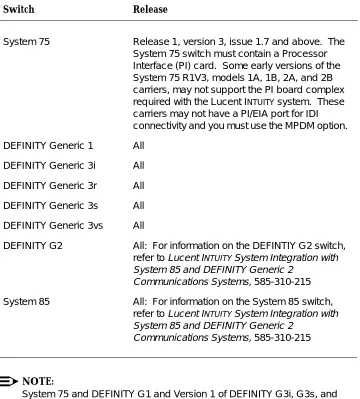
The Lucent INTUITY system supports several Lucent switches (also called Private Branch Exchanges or PBXs). Table 1-1 shows you the supported switches and required software releases.
Table 1-1. Lucent INTUITY System Supported Switches
NOTE:
System 75 and DEFINITY G1 and Version 1 of DEFINITY G3i, G3s, and G3vs switches do not support two I-Channels per port for INTUITY AUDIX Digital Networking. Version 2 and above of DEFINITY G3i, G3s, and G3vs do support two I-Channels as a purchasable option.
Switch Release
System 75 Release 1, version 3, issue 1.7 and above. The System 75 switch must contain a Processor Interface (PI) card. Some early versions of the System 75 R1V3, models 1A, 1B, 2A, and 2B carriers, may not support the PI board complex required with the Lucent INTUITY system. These carriers may not have a PI/EIA port for IDI connectivity and you must use the MPDM option.
DEFINITY Generic 1 All
DEFINITY Generic 3i All
DEFINITY Generic 3r All
DEFINITY Generic 3s All
DEFINITY Generic 3vs All
DEFINITY G2 All: For information on the DEFINTIY G2 switch, refer to Lucent INTUITY System Integration with System 85 and DEFINITY Generic 2
Communications Systems, 585-310-215
System 85 All: For information on the System 85 switch, refer to Lucent INTUITY System Integration with System 85 and DEFINITY Generic 2
DCIU Circuit Card and GPSC/AT/E
For all DEFINITY switch integrations with a Lucent INTUITY system, a DCIU or a general-purpose synchronous controller AT-enhanced (GPSC/AT/E) card is required. The DCIU and GPSC circuit cards communicate with the switch through the DCIU link and transfer digital call information. For DCIU and GPSC card installation instructions, refer toone of the following documents:
For Release 3.0 systems:
■ INTUITY MAP/5 Hardware Installation, 585-310-146
■ INTUITY MAP/40 Hardware Installation, 585-310-138
■ INTUITY MAP/100 Hardware Installation, 585-310-139
For Release 4.0 systems:
■ INTUITY Messaging Solutions Release 4 MAP/40 and MAP/40s
Maintenance, 585-310-171
■ INTUITY Messaging Solutions Release 4 MAP/100 Maintenance,
585-310-174
SN229 Circuits — Do Not Use
Do not connect Lucent INTUITY voice ports to SN229 circuits in DEFINITY switches. The SN229 circuits do not provide the positive disconnect that the Lucent INTUITY system uses for outcalling and AMIS Analog Networking.
Instead, connect to TN754B or SN228B circuits. If you are using SN228B circuits on the DEFINITY switch, use the following settings:
■ Program the station as on-prem.
■ Set the board to 600 Ω low gain. (The board ships from the factory with a
Lucent I
NTUITY
System Switch
Connections
Use the information and diagrams in this section to understand the different configurations for connecting a Lucent INTUITY system with a System 75, DEFINITY G1, G3i, G3r, G3s, and G3vs. You can use the following methods to connect to the switch:
■ Isolating Data Interface (IDI) connections
■ Modular Processor Data Module (MPDM) connections
Read the configuration information to determine the best connection for your system.
Connections through an IDI
Use the IDI connection where there is little distance between the Lucent INTUITY
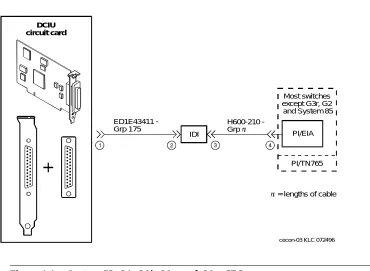
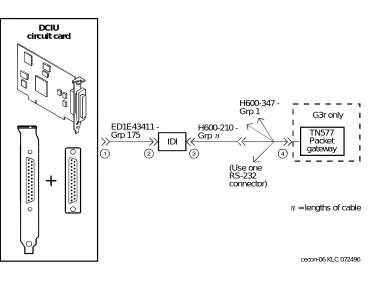
system and the switch. Figure 1-1 and Figure 1-2 illustrate IDI connections to the switches covered by this book. Study the diagrams to understand the
connections.
The maximum length between a Lucent INTUITY system GP-Sync or DCIU card and an IDI is 15 meters (50 feet). This limitation applies only to the distance between the GP-Sync or DCIU card and the IDI and does not affect or include the distance between the IDI and the switch. (This distance is separately covered in the switch documents). If the Lucent INTUITY MAP and the switch must be more than 15 meters (50 feet) apart, use an MPDM to facilitate the connection. Refer to the next section, ‘‘Connections through an MPDM’’ on page 1-8, for information on MPDM connectivity.
Hardware Required for the Connection
■ One IDI
■ One ED-1E43411-Group 175 cable
■ One H600-210, Group 1 through 7. The group depends on cable length.
■ For a DEFINITY G3r only: One H600-347, Group 1 cable (male 50-pin
Amphenol to four RS-232C male connectors)
■ Gender-changer for the DCIU circuit card (comcode 406783613, shipped
Figure 1-1. System 75, G1, G3i, G3s, and G3vs IDI Connection to the Switch
= lengths of cable Most switches except G3r, G2 and System 85
PI/EIA
PI/TN765 IDI
ED1E43411 -Grp 175
H600210 -Grp
cecon-03 KLC 072496
Figure 1-2. DEFINITY G3r IDI Connection to the Switch
= lengths of cable G3r only TN577 Packet gateway ED1E43411
-Grp 175
IDI
H600210 -Grp
H600347 -Grp 1
(Use one RS-232 connector)
cecon-06 KLC 072496
Connections through an MPDM
Use an MPDM to connect a Lucent INTUITY platform to a switch that is located
more than 15 meters (50 feet) away. For a local or closely located Lucent INTUITY
platform and switch, use an IDI as described in ‘‘Connections through an IDI’’ on page 1-5. Figure 1-3 and Figure 1-4 show the connections for the System 75, DEFINITY G1, G3i, G3r, G3s, and G3vs. Study the diagrams to understand the connections.
Hardware Required for the Connection
■ One MPDM with an RS-232C interface card
■ One ED-1E434-1I Group 110 cable (comcode 524124658)
■ One 25-pair cable (connects the TN754 to the cross-connect field)
■ One D8W-87 4-pair module cord
■ One 103A adapter with 3-pair cord
■ Gender-changer for the DCIU circuit card (comcode 406783613, shipped
with the circuit card)
■ For a DEFINITY G3r only:
— A second 25-pair cable (connects the second TN754 to the cross-connect field)
— A second D8W-87 4-pair modular cord
— A second 103A adapter with a 3-pair cord
— A second MPDM with an RS-232C interface card
— One M25A 50-foot RS-232C male-to-female cable
Figure 1-3. MPDM: System 75, G1, G3i, G3s, and G3vs
All switches except G3r
TN754
PI/TN765 103A
847118171 cable comcode
110 V MPDM
3 pair
25 pair I/O D8W-87
cross connect
cecon-04 KLC 080996 DCIU
Figure 1-4. MPDM: DEFINITY G3r
G3r only
TN577 Packet gateway
TN754 TN754
Administered connection
103A 847118171
cable comcode
110 V MPDM
110 V MPDM
25 pair I/O
D8W-87
cross connect
25 pair I/O cross connect 103A
M25A RS-232C
H600347 -Grp 1 (Use one RS-232 connector)
cecon-05 KLC 080996 DCIU
2
Before you integrate the Lucent INTUITY system with a switch, you must plan the
process. This chapter provides worksheets and information to help you plan and record the integration. You use the worksheets later to complete the switch integration process. The planning and worksheets in this chapter must be completed before the Lucent INTUITY system is installed. This chapter includes
worksheets to collect the following information:
■ Voice port information
■ Local and remote switch hunt group information
■ Remote and local data link information
■ Call coverage assignments
■ Hop channel assignments
■ Remote and host ISDN information
You may be referred to Lucent INTUITY New System Planning for Release 3.0, 585-310-605, to verify or copy information. Continue with the instructions on the next page to plan the switch integration.
NOTE:
For installations outside of the United States and Canada: During planning, you may wish to check the default settings for country parameter
Worksheet A:
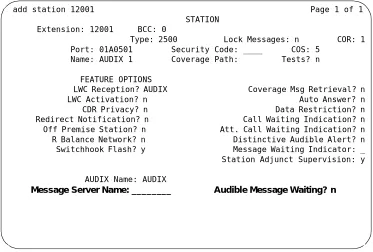
Voice Port Station
Information
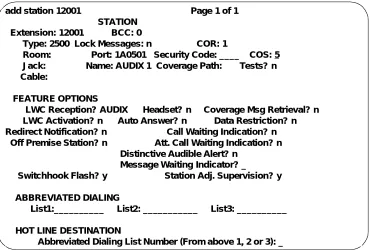
Complete the information on this worksheet to collect information required to administer the Lucent INTUITY system voice ports on the switch.
Date:
Prepared By:
Contact Telephone Number:
Field Recommended Your Entry
User Defined Adjunct Names (G3r only)
Record the name you plan to use for the Lucent INTUITY system on the User Defined Adjunct Names form. You can enter a maximum of seven characters.
Extension Complete worksheet B
Type System 75, DEFINITY
G1,
G3i, G3i-Global, G3r, G3s, and G3vs: 2500
Port Complete worksheet B
Name Complete worksheet B
Lock Messages n
recommends that you create a COR for voice ports that allows subscribers to call only other numbers with the same COR. If you later decide that subscribers need to call numbers with different CORs, add permissions for the other CORs one at a time. The AMIS Analog Networking, Message Delivery, and Outcalling features require the ability to call numbers with different CORs.
Class of Service (COS)
Create a COS for the voice ports that permits the Data Privacy feature. Lucent recommends that you do not enable any other features on the COS.
Tests n
LWC Reception All switches: AUDIX
Headset (System 75 and DEFINITY G1 only)
n
LWC Activation n
SMDR (CDR) Privacy (Not available on System 75 or G1)
n
Redirect Notification n
Off Premise Station n
Coverage Message Retrieval n
Auto Answer n
Data Restriction n
Call Waiting Indication n
Adjunct Supervision (G3i/s only) y
R Balance Network (Not available on System 75 or G1)
n
Switchhook Flash y
Message Server Name (G3r only) blank blank
Audible Message Waiting (G3r only) n
Enter the location, name, and extension for each of the purchased (maximum of 64) voice ports in the following worksheet.
Date:
Prepared By:
Contact Telephone Number:
Lucent INTUITY
Port
Analog Port Equipment
Location1 Name2 Extension
1
AUDIX 1
2 AUDIX 2
3 AUDIX 3
4 AUDIX 4
5 AUDIX 5
6 AUDIX 6
7 AUDIX 7
8 AUDIX 8
9 AUDIX 9
10 AUDIX 10
11 AUDIX 11
12 AUDIX 12
13 AUDIX 13
14 AUDIX 14
15 AUDIX 15
20 AUDIX 20
21 AUDIX 21
22 AUDIX 22
23 AUDIX 23
24 AUDIX 24
25 AUDIX 25
26 AUDIX 26
27 AUDIX 27
28 AUDIX 28
29 AUDIX 29
30 AUDIX 30
31 AUDIX 31
32 AUDIX 32
33 AUDIX 33
34 AUDIX 34
35 AUDIX 35
36 AUDIX 36
37 AUDIX 37
38 AUDIX 38
39 AUDIX 39
40 AUDIX 40
41 AUDIX 41
42 AUDIX 42
43 AUDIX 43
44 AUDIX 44
45 AUDIX 45
46 AUDIX 46
47 AUDIX 47
Lucent INTUITY
Port
Analog Port Equipment
1. For System 75, the equipment location is a 5-character identifier; the first character identifies the carrier, the 2nd and 3rd characters identify the slot number, and the 4th and 5th characters identify the port number. As an example, a valid location for System 75 is B0701: carrier B, slot 07, and port 01. For all other switches, an additional 1 or 2 digits is added to the carrier, slot, and port location to identify the cabinet. For example, the location 02B0701 specifies cabinet 02, carrier B, slot 07, port 01.
2. These are the recommended names.
49 AUDIX 49
50 AUDIX 50
51 AUDIX 51
52 AUDIX 52
53 AUDIX 53
54 AUDIX 54
55 AUDIX 55
56 AUDIX 56
57 AUDIX 57
58 AUDIX 58
59 AUDIX 59
60 AUDIX 60
61 AUDIX 61
62 AUDIX 62
63 AUDIX 63
Worksheet C:
Assign the Hunt Group
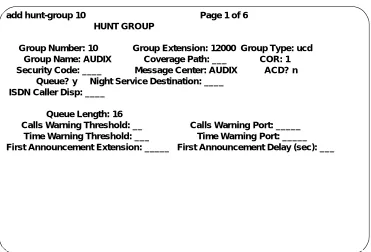
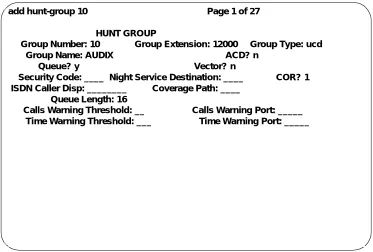
The following information is required to define a hunt group (containing the voice port members) for the Lucent INTUITY system voice ports.
NOTE:
Only the number of ports actually purchased should be administered in the hunt group
Date:
Prepared By:
Contact Telephone Number:
Field Recommended Your Entry
Group Number:
Enter the number you would like to use to identify the Lucent INTUITY hunt group. This number, preceded by an h, is entered in the voice port Coverage Path form and in subscriber coverage paths.
Group Extension
Enter the extension number you want subscribers to dial to retrieve their messages from the Lucent INTUITY system.
Group Type ucd
Group Name
Enter the name you would like to appear on display sets when subscribers call the Lucent INTUITY
system. AUDIX must be included in the name for G3-MA to recognize the name as an Lucent INTUITY
group.
Message Center AUDIX
ACD n
Queue y
vector-controlled if call vectoring is a feature on the switch.
Security Code leave blank leave blank
Coverage Path leave blank leave blank
COR
Enter the Class of Restriction (COR) you would like assigned to the extension that subscribers will call to reach the Lucent INTUITY system. For security reasons, AUDIX and Lodging hunt groups should be assigned their own CORs which have been
restricted from accessing all outgoing trunks or only those trunks needed for Outcalling or AMIS Analog Networking. The default COR is not recommended.
ISDN Call Disp (not available on System 75 and G1)
If ISDN-PRI is enabled, enter grp-name or mbr-name to specify whether the hunt group name or number is sent to the originating subscriber.
AUDIX Extension (System 75 R1V3 only)
This field appears only on a remote switch in a DCS network when message center is active.
The field refers to the host switch Lucent INTUITY
extension number. This is the number the remote Lucent INTUITY users will dial to access the hunt
group. Normally this field is left blank for the Lucent INTUITY system.
Queue Length
A suggested length is the number of configured Lucent INTUITY voice ports.
Calls Warning Threshold leave blank leave blank
Calls Warning Port leave blank leave blank
Time Warning Port leave blank leave blank
First Announcement Extension (n/a for G3r)
If you want a switch-recorded announcement, enter the extension number here.
First Announcement Delay (sec) (n/a for G3r)
Optional if the queue is y – must be blank if there is no first announcement.
G3i-Global, G3s, and G3vs Switches
Use this worksheet to plan the data link for a System 75, DEFINITY G1, G3i, G3i-Global, G3s, or G3vs switch. If you have a DEFINITY G3r switch, proceed to
Worksheet E: Assign the Data Link for a DEFINITY G3r Switch.
Date:
Prepared By:
Contact Telephone Number:
Section 1: MPDM Information
Complete the following section of the worksheet only if you plan to use an MPDM and a TN754 digital line port to connect the Lucent INTUITY system to the switch. If you do not have a connection through an MPDM, proceed to Section 2 of the worksheet.
Field Recommended Your Entry
MPDM Data Module
Data Extension
Type pdm
Port
The port location for the TN754 that connects to the MPDM
Name
The data extension name for this port that identifies the Lucent INTUITY system (perhaps AUDIX or
lodging)
COS See
Section 2: Processor Interface Data Link
Information
Complete the information in this section to assign the Processor Interface data link.
COR See
Worksheet A: Voice Port Station Information
Connected to dte
Remote Looparound Test n
Processor Interface Data Module
Field Recommended Your Entry
Data Extension
Type procr-infc (G1, G3i/s)
interface (System 75)
Physical Channel 01 if using the EIA port
02-04 if using an MPDM
If two PI circuit packs are installed, enter:
05-08 if using an MPDM
Name AUDIX
COS See Worksheet A:
Voice Port Station Information
COR See Worksheet A:
Voice Port Station Information
Maintenance Extension
Complete the information in this section of the worksheet to assign the Processor Channel and Interface data link.
Field Recommended Your Entry
Processor Channel
Processor channel number Use the switch
port number on the Lucent INTUITY
Switch
Administration screen
Application AUDIX
Interface Link Number
Enter the same number you entered for the physical channel in Section 2 of this worksheet.
Interface Channel Number
This field contains the logical channel number of the interface link. Use the same number entered in the Logical Channel field on the Lucent INTUITY
System Switch Interface Administration screen.
Use 1 to 64. This field must match the Remote Proc Chan field.
Priority h
Remote Proc Chan
This field contains the logical channel number of the interface link. Use the same number entered in the Logical Channel field on the Lucent INTUITY
System Switch Interface Administration screen.
Use 1 to 64. This field must match the Interface Channel Number field.
Machine-ID
This number must match the AUDIXNumber field on the Lucent INTUITY Switch Interface
Administration screen
Interface Link
Link
Prot
Protocol type BX25 BX25
Destination Digits
Enter the MPDM extension if an MPDM is used or eia if link 1 is used with an IDI.
Destination Brd leave blank leave blank
DTE/DCE dte
Identification AUDIX
Use this worksheet to plan the data link for a DEFINITY G3r switch. If you have a System 75, DEFINITY G1, G3i, G3i-Global, G3s, or G3vs, proceed to Worksheet D: Assign the Data Link for System 75, DEFINITY G1, G3i, G3i-Global, G3s, and G3vs Switches.
Date:
Prepared By:
Contact Telephone Number:
Section 1: BX.25 Data Module Information
Complete the information in section to plan for assigning the BX.25 data module.
Field Recommended Your Entry
Name for the PGATE application
You can only change the information in this field when you add a PGATE card.
AUDIX
PGATE card location
You can only change the information in this field when you add a PGATE card.
Type
You can only change the information in this field when you add a PGATE board.
BX.25
Port
Enter the PGATE port location to which the BX.25 data module connects.
Name
Enter the name that identifies the Lucent INTUITY
system connection
AUDIX
Section 2: Interface Link and Processor
Channel Information
Complete the information in this section to plan the Interface Link and Processor Channel assignments.
Baud Rate 9600
Error Logging n
Remote Looparound Test n
Permanent Virtual Circuit
Highest PVC Logical Channel
Switched Virtual Circuit
Layer 2 Parameters
Number of Outstanding Frames 1
Retry Attempt Counter 2
Frame Size 135
Retransmission Timer (1/10 seconds) 10
Idle timer (1/10 seconds) 30
Layer 3 Parameters
Number of Outstanding Packets 2
Restart Timer (seconds) 8
Reset Timer (seconds) 180
Field Recommended Your Entry
Interface Link
Link Number 1-8
Enabled y
BX.25 Extension
Enter the extension of the BX.25 data module.
Destination Number external
Connected Data Module blank blank
Identification
Enter the same name you entered in the User Defined Adjunct Name field on Worksheet A: Voice Port Station Information.
Processor Channel Processor channel number
1-128
Application AUDIX
Interface Link Number
Must be the same as the Link Number set above
Interface Channel Number
This field contains the logical channel number of the interface link. Use the same number entered in the Logical Channel field on the Lucent INTUITY System Switch Interface Administration screen.
This field must match the Remote Port field.
Local Port
Use the same number entered in the Switch Port field on the Lucent INTUITY System Switch Interface Administration screen.
Remote Port
This field contains the logical channel number of the interface link. Use the same number entered in the Logical Channel field on the Lucent INTUITY System Switch Interface Administration screen.
This field must match the Interface Channel Number field.
Adjunct Name
Enter the same name you entered in the User Defined Adjunct Name field on Worksheet A: Voice Port Station Information.
Machine-ID
Worksheet F:
Assign the Call
Coverage
Path for Subscribers
Complete this worksheet to define call coverage paths for subscribers.
Date:
Prepared By:
Contact Telephone Number:
You have completed the worksheets and planning necessary for a Lucent INTUITY
system switch integration. If you do not have a DCS environment, proceed to the administration chapter for your switch. If you are placing a Lucent INTUITY system in a DCS network, proceed to the next collection of planning worksheets in the ‘‘DCS Worksheets’’ on page 2-19 section.
Field Recommended Your Entry
Coverage Path Number
Enter the number you want to identify the call coverage path for subscribers.
Next Path Number
If desired, enter the second path to which calls will be directed in case the current path fails.
Coverage Criteria
Station/Group Status Active? (Inside Call/ Outside Call)
y/y
Busy? (Inside Call/Outside Call) y/y
Don’t Answer? (Inside Call/Outside Call) y/y
All? (Inside Call/Outside Call) n/n
SAC/Go to Cover? (Inside Call/Outside Call) y/y
Number of rings
Enter the number of rings (1-99) you would like before a call goes to coverage.
3
Coverage Points
DCS Worksheets
Complete worksheets G through P if the Lucent INTUITY system operates in a DCS environment. If you have an existing DCS network or if you are installing one, the BCS Design Center may have designed the DCS network for the Lucent INTUITY
system. The worksheets in this section contain the same information the Design Center may have already created. Use these worksheets to verify that you have all required information and as a single point of reference.
This section contains worksheets for both BX.25 signaling and ISDN signaling. If the DCS network uses BX.25 signaling, complete the following worksheets:
■ Worksheet G: Remote Non-G3r Processor Channel Assignment DCS
BX.25 Signaling Information
■ Worksheet H: Remote G3r Processor Channel Assignment DCS BX.25
Signaling Information
■ Worksheet I: Host Hop Channel Assignment DCS BX.25 Signaling
Information
■ Worksheet J: Assign the Remote Switch Hunt Group
■ Worksheet K: Assign the Call Coverage Path for DCS Remote Switches
If the DCS network uses ISDN signaling, complete the following worksheets:
■ Worksheet L: Non-G3r Host Processor Channel Assignment ISDN
Gateway Information
■ Worksheet M: G3r Host Processor Channel Assignment ISDN Gateway
Information
■ Worksheet N: HOST ISDN Signaling Group Information
■ Worksheet O: Remote ISDN Signaling Group Information
■ Worksheet P: Host ISDN TSC Gateway Channel Assignment
For each remote switch in the DCS network, complete one set of DCS
Worksheet G:
Remote Non-G3r
Processor Channel Assignment DCS
BX.25 Signaling Information
Use this worksheet to plan the remote processor channels for a System 75, DEFINITY G1, G3i, G3i-Global, G3s, or G3vs switch. Complete one copy of this worksheet for each remote switch in the DCS network.
If you have a DEFINITY G3r switch, proceed to Worksheet H: Remote G3r Processor Channel Assignment DCS BX.25 Signaling Information.
Date:
Prepared By:
Contact Telephone Number:
Field Recommended Your Entry
Processor channel number
59, if available
Application AUDIX
Interface Link Number
Enter the DCS link that connects this remote switch to the host switch.
Interface Channel Number
This field contains the logical channel number of the interface link. Use the number entered in the Logical Channel field on the Lucent INTUITY Switch Interface Administration screen that represents the node number of the switch.
This field must match the Remote Proc Chan field.
Remote Proc Chan
This field contains the logical channel number of the interface link. Use the same number entered in the Logical Channel field on the Lucent INTUITY Switch Interface Administration screen that represents the node number of the switch.
This field must match the Interface Channel Number field.
Priority h
Machine-ID
Worksheet H:
Remote G3r Processor
Channel Assignment DCS BX.25
Signaling Information
Use this worksheet to plan the remote processor channels for a DEFINITY G3r switch. Complete one copy of this worksheet for each remote switch in the DCS network.
If you have a System 75, DEFINITY G1, G3i, G3i-Global, G3s, or G3vs switch, refer to Worksheet G: Remote Non-G3r Processor Channel Assignment DCS BX.25 Signaling Information.
Date:
Prepared By:
Contact Telephone Number:
Field Recommended Your Entry
User-Defined Adjunct Names
Enter the name you entered in the User Defined Adjunct Name field on Worksheet A: Voice Port Station Information.
Processor Channel Assignments
Processor channel number 1-128
Application AUDIX
Interface Link Number
Enter the DCS link that connects this remote switch to the host switch.
Interface Channel Number
This field contains the logical channel number of the interface link. Use the number entered in the Logical Channel field on the Lucent INTUITY
Switch Interface Administration screen that represents the node number of the switch.
Remote Port
This field contains the logical channel number of the interface link. Use the same number entered in the Logical Channel field on the Lucent INTUITY
Switch Interface Administration screen that represents the node number of the switch.
This field must match the Interface Channel Number field.
Local Port
This is the Switch Port number used on the Lucent INTUITY Switch Interface Administration screen.
Adjunct Name AUDIX
Machine-ID
Enter the Machine ID for the Lucent INTUITY system. This number must agree with the AUDIX Number field on the Lucent INTUITY Switch Interface Administration screen.
Worksheet I:
Host Hop Channel
Assignment DCS BX.25 Signaling
Information
Complete this worksheet for each hop from a remote switch to the Lucent INTUITY
system on the host switch.
Date:
Prepared By:
Contact Telephone Number:
Field Recommended Your Entry
Link
Enter the Interface Link from the host switch Processor Channel Assignment screen for the link that connects the remote switch to the host switch.
Chan
Enter the Interface Channel from the remote switch Processor Channel Assignment screen for the channel that connects the remote switch to the Lucent INTUITY system on the host switch.
Link
Enter the Interface Link from the host switch Processor Channel Assignment screen for the link that connects the host switch to the Lucent INTUITY
system.
Chan
Enter the Remote Processor Channel from the remote switch Processor Channel Assignment screen for the channel that connects the Lucent INTUITY system to the remote switch.
Priority
Does not apply for G3r.
Worksheet J:
Assign the Remote
Switch Hunt Group
Complete this worksheet for each DCS switch-node that has mailboxes for subscribers on the Lucent INTUITY system. The information is required to define a hunt group for the Lucent INTUITY system voice ports for a remote switch.
Date:
Prepared By:
Contact Telephone Number:
Field Recommended Your Entry
Group Number
Enter the number you plan to use to identify the remote switch Lucent INTUITY hunt group. This number, preceded by an h, is entered on the voice port Coverage Path screen for the remote switch and in remote subscriber coverage paths.
Group Extension
Enter the extension number you want subscribers to dial to retrieve their messages from the Lucent INTUITY system.
Group Type ucd
Group Name
Enter the name you want to appear on display sets when subscribers call the Lucent INTUITY system.
AUDIX must be included in the name for G3-MA to recognize the name as an Lucent INTUITY group.
Message Center rem-AUDIX
ACD n
Queue n
Night Service Destination blank blank
Vector (y/n)?
The Lucent INTUITY hunt group may be
vector-controlled if call vectoring is a feature on the switch.
Security Code blank blank
Coverage Path blank blank
COR
Enter the Class of Restriction (COR) you plan to assign to the extension subscribers call to access the Lucent INTUITY system. For security reasons, assign a unique COR to the Lucent INTUITY hunt group that restricts access to all outgoing trunks or only those trunks needed for Outcalling or AMIS Analog Networking. Do not use the default COR.
ISDN Call Disp (not available on System 75 and G1)
If ISDN-PRI is enabled, enter grp-name or
mbr-name to specify whether the hunt group name or number is sent to the originating subscriber.
AUDIX Extension
Enter the extension number assigned to the Lucent INTUITY system hunt group at the host switch on
Worksheet C: Assign the Hunt Group.
Worksheet K:
Assign the Call
Coverage Path for DCS Remote
Switches
Use this worksheet to define a call coverage path for remote subscribers in a DCS network. Complete one copy of the worksheet for each switch in the DCS network.
Date:
Prepared By:
Contact Telephone Number:
Field Recommended Your Entry
Host Switch Number
Enter the number of the host switch that connects directly to the Lucent INTUITY
system.
Coverage Path Number
Enter the number you want to identify the call coverage path for subscribers.
Next Path Number
If desired, enter a second path for calls. The field allows you to create additional coverage options. If the call does not meet the criteria for the first coverage path, the call attempts to use the second path.
Coverage Criteria
Station/Group Status Active? (Inside Call/ Outside Call)
y/y
Busy? (Inside Call/Outside Call) y/y
Don’t Answer? (Inside Call/Outside Call) y/y
SAC/Go to Cover? (Inside Call/Outside Call)
y/y
Number of rings
Enter the number of rings (1-99) you would like before a call goes to coverage.
3
Coverage Points
For Point1, Point2, or Point3, enter h followed by the Lucent INTUITY remote hunt group number.
Worksheet L:
Non-G3r Host
Processor
Channel Assignment ISDN Gateway
Information
Use this worksheet to plan the assignment of the host processor channels in a DCS through an ISDN-PRI configuration for a System 75, DEFINITY G1, G3i, G3i-Global, G3s, or G3vs switch. If you have a DEFINITY G3r switch, proceed to
Worksheet M: G3r Host Processor Channel Assignment ISDN Gateway Information.
Date:
Prepared By:
Contact Telephone Number:
Field Recommended Your Entry
Processor channel number
Application isdn
Interface Link Number
Enter the Interface link from the host switch Interface Links screen for the Lucent INTUITY link.
Interface Channel Number
This field contains the logical channel number of the interface link. Use the number entered in the Logical Channel field on the Lucent INTUITY
Switch Interface Administration screen that represents the node number of the switch.
This field must match the Remote Port field.
Remote Proc Chan
This field contains the logical channel number of the interface link. Use the same number entered in the Logical Channel field on the Lucent INTUITY Switch Interface Administration screen that represents the node number of the switch.
This field must match the Interface Channel Number field.
Priority h
Worksheet M:
G3r Host Processor
Channel Assignment ISDN Gateway
Information
Use this worksheet to plan the assignment of the host processor channels in a DCS through an ISDN-PRI configuration for a DEFINITY G3r switch. If you have a System 75, DEFINITY G1, G3i, G3i-Global, G3s, or G3vs switch, refer to
Worksheet L: Non-G3r Host Processor Channel Assignment ISDN Gateway Information.
Date:
Prepared By:
Contact Telephone Number:
Field Recommended Your Entry
Processor channel number
1-128
Application gateway
Interface Link Number
Enter the Interface link from the host switch Interface Links form for the Lucent INTUITY link.
Interface Channel Number
This field contains the logical channel number of the interface link. Use the number entered in the Logical Channel field on the Lucent INTUITY
Switch Interface Administration screen that represents the node number of the switch.
This field must match the Remote Port field.
Remote Port
This field contains the logical channel number of the interface link. Use the same number entered in the Logical Channel field on the Lucent INTUITY Switch Interface Administration screen that represents the node number of the switch.
Local Port
This is the Switch Port number used on the Lucent INTUITY Switch Interface Administration screen.
Adjunct Name blank blank
Machine-ID
This number must agree with the AUDIX field entry on the Lucent INTUITY Switch Interface
Administration screen.
Worksheet N:
HOST ISDN Signaling
Group Information
Complete the information on this worksheet to define the ISDN signaling group for the host in a DCS/ISDN environment.
Date:
Prepared By:
Contact Telephone Number:
Field Recommended Your Entry
Group Number
Enter the number of the signaling group associated with the DCS non-call associated temporary signaling connection (NCA-TSC) on the remote switch.
Associated Signaling n
Primary D-channel
Enter the port number associated with the DS1 interface circuit-pack port.
Secondary D-channel
Enter the port number associated with the DS1 interface circuit-pack port used for secondary D-channel signaling.
Max Number of NCA TSC
Increment the current field entry by 1.
Max number of CA TSC
Maximum number of simultaneous Call Associated Temporary Signaling Connections (CA-TSCs) that can exist in the Signaling Group.
Trunk Group for NCA TSC
Trunk Brd
Enter a 5-character DSI Interface circuit pack number that has trunk members belonging to this Signaling Group.
[3]
Interface ID
An interface ID (0 31) for the corresponding DS1 Interface Circuit pack.
Service Feature
Service type for all administered NCA-TSCs assigned in the Signaling Group.
As-needed Inactivity Time-out (min)
Enter 10-90.
TSC Index
Choose a free index. Worksheet O: Remote ISDN Signaling Group Information, also contains this field.
Local Ext
Enter an unassigned extension number.
Enabled y
Establish permanent
Dest. Digits
The digits needed to route the administered NCA-TSC to the far-end switch.
Application gateway
Machine ID
Machine ID of the far-end switch to which this NCA-TSC is to be connected.
Adj Name (G3r only)
Enter the name of the Lucent INTUITY system entered on Worksheet A: Voice Port Station Information to be used on the G3r User Defined Adjunct Names screen.
Worksheet O:
Remote ISDN
Signaling
Group Information
Complete the information on this worksheet to define the ISDN signaling group for a remote switch in a DCS/ISDN environment.
Date:
Prepared By:
Contact Telephone Number:
Field Recommended Your Entry
Group Number
Enter the number of the signaling group associated with the DCS non-call associated temporary signaling connection (NCA-TSC) on the remote switch.
Associated Signaling n
Primary D-channel
Enter the port number associated with the DS1 interface circuit-pack port.
Secondary D-channel
Enter the port number associated with the DS1 interface circuit-pack port used for secondary D-channel signaling.
Max Number of NCA TSC
Increment the current field entry by 1.
Max number of CA TSC
Trunk Group for NCA TSC
ISDN-PRI trunk group number whose incoming call handling table will be used to handle incoming NCA-TSCs through the signaling group.
Trunk Brd
Enter a 5-character DSI Interface circuit pack number that has trunk members belonging to this Signaling Group.
[3]
Interface ID
An interface ID (0-31) for the corresponding DS1 Interface Circuit pack.
Service Feature
Service type for all administered NCA-TSCs assigned in the Signaling Group.
As-needed Inactivity Time-out (min)
Enter 10-90.
TSC Index
Choose a free index. This index is also entered on Worksheet N: HOST ISDN Signaling Group Information.
Local Ext
Enter the Dest. Digits entered on Worksheet N: HOST ISDN Signaling Group
Information.
Enabled y
Establish permanent
Dest. Digits
Enter the Local Ext entered on Worksheet N: HOST ISDN Signaling Group Information.
Application AUDIX
Machine ID
Machine ID of the far-end switch to which this NCA-TSC is to be connected.
Adj Name (G3r only)
Enter the name of the Lucent INTUITY system
entered on Worksheet A: Voice Port Station Information to be used on the host G3r User Defined Adjunct Names screen.
Worksheet P:
Host ISDN TSC
Gateway Channel Assignment
Complete the information on this worksheet to plan the channel assignments for a DCS/ISDN TSC Gateway.
Date:
Prepared By:
Contact Telephone Number:
Field Recommended Your Entry
Sig Group
Enter the group number from Worksheet N: HOST ISDN Signaling Group Information.
Adm’d NCA TSC Index
Enter the TSC Index chosen on Worksheet N: HOST ISDN Signaling Group Information.
Processor Channel
Enter the processor channel chosen on Worksheet L: Non-G3r Host Processor Channel Assignment ISDN Gateway Information or Worksheet M: G3r Host Processor Chann