ALTERNATIVE METHOD FOR TESTING THE UNIT ROOT NULL
HYPOTHESIS IN THE PRESENCE OF A BREAK
by
Seungho Huh and David A Dickey
Department of Statistics, North Carolina State University
Institute of Statistics Mimeograph Series No. 2529
Febniary 200 1
o
ALTERNATIVE ME1lJOD FUR TESTING 1UE UNIT ROO!' NUlL HYl'Ol'HESIS IN 1UE PRESmCE OF A BREAK
BY
SE1JNGID HUH AND DAVID A DIa<EY
-DEPT. OF Sl'ATISfICS, NCSU
MIMED 00•• 2529. Feb. 2001
Presence of a Break
Seungho Huh and David A. Dickey
Department of Statistics, North Carolina State University, Raleigh, NC27695-8203,
•
Abstract In this paper, we suggest alternative test statistics for testing the unit
root null hypothesis in the presence of a trend-break. Our new test procedure which
we call the "bisection" method is based on the idea of subgrouping. The idea here is
to split the data in half and look at the minimum of the resulting two unit root test
statistics. This avoids the necessity of searching for the break. It uses all the data in
the sense that the minimum is chosen, but clearly is not efficient in its use of the data.
We anticipate paying a price in power for a gain in simplicity. Considering some data
generating processes, we display empirical size and power results from simulation. We
also apply our bisection method to the well-known Nelson and Plosser (1982) data set
and compare the results with those of other researchers. The simple bisection method
rejects unit roots in several, but not all, of the series for which the more complicated
search methods reject.
1
Introduction
Since the pioneering work by Perron (1989), many researchers have been interested
in testing for a unit root in time series with a trend-break. It is known that power
decreases in finite samples as the trend-break becomes larger when the usual
Dickey-Fuller (1979) test is used.
Perron (1989) suggested formal statistical tests of the null hypothesis of a unit
root which can distinguish the unit root hypothesis from that of stationarity around
a trend with a single trend-break (either in the intercept or the slope). His original
approach assumed the trend-break is known a priori and treated as exogenous. Perron
(1997) and Vogelsang and Perron (1998), on the other hand, considered unit root tests
treating the date of a possible trend-break as unknown. They introduced various
methods of choosing the break date. A variation of Perron's (1989) test in which the
break point is estimated rather than fixed was also studied by Zivot and Andrews
•
the break time is unknown, it is ignored rather than estimated. Using the new test
statistic, we perform a Monte Carlo simulation to obtain its empirical powers which
are rather invariant to the break size.
Section 2 describes the idea of subgrouping and simulation results to find the
optimal number of subgroups. As a result, we suggest new test statistics in section
3. Section 4 presents the data generating processes and some empirical power results
from a Monte Carlo simulation. In section 5, we apply our test procedure to the real
data analyzed originally by Nelson and Plosser (1982). We finally make concluding
remarks in section 6.
2
Subgrouping of data
Our new test procedure is based on the idea of dividing the whole data into some
subgroups of the same size. For each subgroup, a certaint type statistic is calculated.
Then the minimum of all these statistics is defined as a new test statistic for the unit
root null hypothesis in time series with a break.
Suppose we have stationary series around a broken trend. After dividing the
data into subgroups, we expect to have a smaller value of the test statistic from a
subgroup without a break than from another subgroup with a break. Therefore taking
the minimum among all the statistics might give us reasonable power as we are using
left tailed tests. This is a key motivation for our subgrouping idea.
The approach by Perron (1989) assumes the break point is known a priori. Using
dummy variables, he combines the data before the break with the data after the
break. We do not have to assume a known break point in our new procedure.
With the break point assumed unknown, Zivot and Andrews (1992) choose the
Then they take thet type statistic giving that break point. Our procedure is simpler
because it does not consider estimating the unknown break point.
We perform some simulations to decide the optimal number of subgroups. The
data generating process given by (1) in section 4 is used for various numbers of
subgroups. We consider
nCo-l)
type statistics from the ordinary least squares (OL8) estimator, the simple symmetric (88) estimator and the weighted symmetric (W8)estimator. The number of replications is 5,000 and the sample size per replication is
n
=
100. We consider the break point c=
36 (for OL8) or c=
37 (for 88 and W8)and the break size () = 1, 3, 5 and 7. In Tables 1 - 3 and Figures 1 - 3, we show
empirical size and power results from simulation.
Clearly the optimal number of subgroups is 2. We expect similar results for t
type statistics. The next section describes our new test procedure which we call the
"bisection" method.
3
Bisection method
From the previous work by Leybourne et al (1998) and Huh and Dickey (1999), we
know that, in the presence of an early break, the conventional Dickey-Fuller (1979)
test based on the least squares estimator can be subject to serious size distortion
but tests based on the weighted symmetric estimator cure this problem. Therefore
our bisection method in this paper is based on the W8 estimator of p,
Pw,
and theassociated pivotal statistic Tw in the non-zero mean AR(1) process
Our new bisection test statistic is defined as
where Tw,k is Tw for subgroup k for k = 1,2. Each subgroup is supposed to have
•
process (1) in section 4. We assume n
=
100, c=
75, 0=
5 and p=
.7. Notice thatthe empirical distributions ofTw,l and T~ are very close to each other since the break
is in the second subgroup (c = 75). That does not necessarily mean that they have
the same power for a certain p because the critical values are different as shown in
Figure 4. In the figure, the vertical line on the left denotes the critical value forT~, so
the power for T~ is lower than that for Tw,l as can be seen in Figure 5. This generally
holds good for other values ofp.
As to the linear trend adjusted case, we consider the WS estimator ofp and the
associated pivotal statistic TW,T in the model
rt
= J1+
f3t+
Prt-l
+
et·TW,T can be regarded as the linear trend adjusted version ofTw . We then use T~,T' the
minimum of two TW,T statistics, as a new test statistic. See Huh and Dickey (1999)
for more details about Tw and Tw,T"
4
Empirical size and power results
In this section, we display some size and power simulation results using bisection
test statistics.
We consider two data generating processes (DGPs) given by
rt
rt
OaI(t>
c)
+
W t , Wt = pWt-1+
et, t = 1,2, ,n'Ya(t - c)I(t
>
c)
+
W t , Wt=
pWt-1+
et, t=
1,2, ,n(1)
(2)
where the et are normal independent (0,a2
) random variables and c is the break point.
We can assume a
=
1 sincePw
is the ratio of two quadratic forms so it is invariant to,
and DGP (2) to a break-in-slope model with slopes 0 and
'Ya.
Figures 6 - 9 presentsome typical time series data generated from DGPs (1) and (2).
We perform a Monte Carlo simulation for some values of 0, "I, c and p. The
number of replications is 5,000 and the sample size per replication is n = 100. The
critical values for T~ and T~,T are also calculated by simulation.
4.1
Data with a break in level
4.1.1 Mean adjusted case
For DGP (1), we first use the mean adjusted statistics Tw and T~. As might be
expected from the results in Huh and Dickey (1999), neither Tw nor T~ show size
distortion for DGP (1).
Ifwe use T~ as a test statistic, the powers are in general higher than those for the
usualTw when there is a break. Some exceptions are for the early break (c= 1) or the
late break (c = 99). For given p, the powers for T~ are relatively invariant whereas
those for the usual Tw decrease dramatically as 0 becomes larger.
Ifthere is no break (0 = 0), on the other hand, the usualTw is more powerful than
T~. This is so especially for large values ofp. Notice that our power results for T w in
Table 4 agree closely with those of Pantula et al (1994).
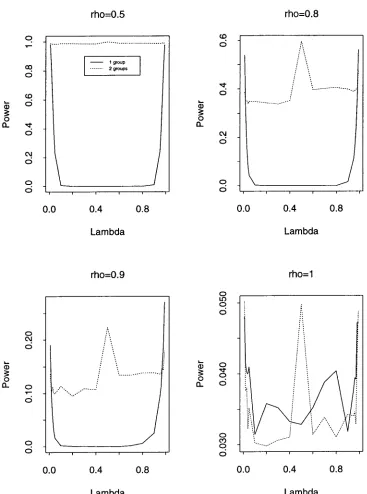
Table 4 and Figures 10 - 12 present the empirical size and power results for DGP
(1) using Tw and T~. As might be expected, Tw outperforms T~ for small breaks and
T~ outperforms Tw for larger breaks. In all cases, T~ is more uniform with respect to
A.
We compare the size and power properties of our test procedure with those of
Vogelsang and Perron (1998). They consider a DGP
Yt
OI(t
> Tb)
+
'Y(t - Tb)I(t
> Tt)
+
Zt,
•
(Tb(t&), n(!ti'l), Tb(ti') and n(FO,i')) according to the methods of estimating the true
break date. For their simulation, n
=
100 and Tt=
50. When p=
.8, our T~ showshigher power than most of their statistics regardless of the break size (). Although one
statistic (n(t&)) with ()= 10 has higher power than our T~, that can be attributed to
its size distortion problem. In Table 5, we show empirical powers for DGP (1) using
various statistics.
4.1.2 Linear trend adjusted case
We next use the linear trend adjusted statistics TW,T and T~,T for DGP (1). Both
TW,T and T~,T retain empirical sizes (p = 1) close to the nominal 5% significance level.
When there is no break, TW,T shows higher power than T~,T for given p. Notice
also that TW,T and T~,T generate lower power than Tw and T~ respectively.
When the break is fairly big (()
=
10), the powers for T~,T are generally higherthan those for TW,T' As in the mean adjusted case, the powers for T~,T are relatively
invariant compared with those for TW,T'
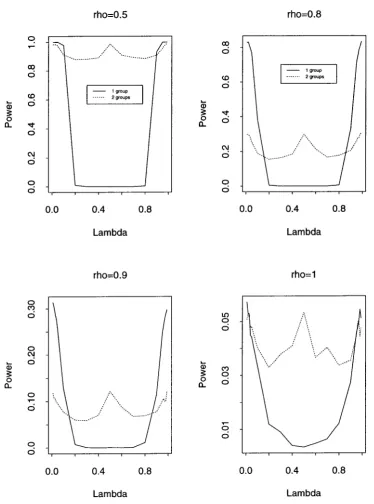
The empirical size and power results using TW,T and T~,T are presented in Table 6
and Figures 13 - 15.
4.2
Data with a break in slope
For DGP (2) which represents a break-in-slope model, we adopt the linear trend
adjusted statistics TW,T and T~,T' Even though both TW,T and T~,T retain the nominal
5% significance level, TW,T becomes severely under-sized as I grows larger.
As expected, T~,Tgives smaller powers thanTW,T if there is no break. AsI becomes larger, the powers for TW,T decrease dramatically except for the early or late breaks
whereas T~,T maintains reasonable powers. T~,T is generally more powerful than TW,T
•
The simulation results for DGP (2) using IW,T and I~,T are displayed in Table 7
and Figures 16 - 18.
To compare with the results of Vogelsang and Perron (1998), we consider DGP
(3) with a
=
'l/J= () =
0 which is exactly the same as our DGP (2). When p=
.8, thepowers of our I~,T are as good as those of their statistics for some values of'Y. Power
comparisons between I~,Tand statistics of Vogelsang and Perron (1998) are displayed
in Table 8.
5
Empirical applications
We now apply our bisection method to the data set analyzed originally by Nelson
and Plosser (1982). The data set consists of 14 major macroeconomic time series
which include measures of output, spending, money, prices and interest rates. The
data are annual, generally averages for the year, with starting dates from 1860 to
1909 and ending in 1970 in all cases. We analyze the natural logarithm of all the data
except for the interest rate series, which is analyzed in levels form. Many researchers
have referred to this data set. See Nelson and Plosser (1982) for more details about
the data set.
In Table 9, we compare our unit root test results with those of Nelson and Plosser
(1982), Perron (1989), Zivot and Andrews (1992) and Perron (1997). Numbers are
the values of the test statistics.
Nelson and Plosser (1982) apply the usual Dickey-Fuller test with extra lags of
the first differences of the data (augmented Dickey-Fuller test). Methods of Perron
(1989) and Zivot and Andrews (1992) are briefly described in section 2. Perron
(1997) is closely related to and complements Zivot and Andrews (1992) in that similar
procedures are analyzed. See the original articles for more details.
Our method adopts the number of augmenting terms, k, producing the minimum
..
erated from simulation. Our bisection method using T~,T rejects the unit root null
hypothesis at a = .05 for the series "Real GNP", "Real per capita GNP", "Industrial
production", "Unemployment rate", "Real wages" and "Money stock".
6
Summary
In this work, we suggest new test statistics T~ and T~,T for testing the unit root
null hypothesis in the presence of a trend break. These statistics are based on the
idea of dividing the data into subgroups of the same size. The optimal number of
subgroups turns out to be 2.
Our bisection method can be used without assuming a known break point unlike
Perron's (1989) original approach. It is simpler than the methods of Zivot and An-drews (1992) and Perron (1997). When there is a trend-break and the break size is
fairly big, the empirical powers of the new statistics are in general higher than the
usual T w and TW,T respectively. Based on simulation studies, the power properties of
our test procedure are as good as those of Vogelsang and Perron's (1998).
We also apply our procedure to the well-known Nelson and Plosser (1982) data
•
Table 1: Empirical size and power for DGP (1) using various subgroups (OLS, n = 100, C
=
36)No. of subgroups 1 2 5 10 20
() =
1, P =.1 1.0000 1.0000 0.9994 0.6938 0.0994.2 1.0000 1.0000 0.9936 0.5424 0.0884
.3 1.0000 1.0000 0.9600 0.4026 0.0826
.4 1.0000 1.0000 0.8554 0.2948 0.0752
.5 1.0000 0.9984 0.6788 0.2096 0.0682
.6 1.0000 0.9780 0.4740 0.1434 0.0634
.7 0.9974 0.8388 0.2898 0.0974 0.0598
.8 0.9132 0.5042 0.1626 0.0744 0.0544
.9 0.4288 0.1870 0.0962 0.0528 0.0524
1 0.0474 0.0470 0.0530 0.0504 0.0488
() =
3, p=.1 1.0000 1.0000 0.9986 0.6764 0.0946.2 1.0000 1.0000 0.9888 0.5246 0.0848
.3 0.9996 1.0000 0.9416 0.3856 0.0798
.4 0.9976 0.9992 0.8126 0.2806 0.0728
.5 0.9806 0.9852 0.6260 0.1980 0.0658
.6 0.9144 0.9052 0.4298 0.1342 0.0606
.7 0.7458 0.6786 0.2564 0.0930 0.0576
.8 0.4824 0.3650 0.1472 0.0710 0.0530
.9 0.2382 0.1464 0.0886 0.0476 0.0504
No. of subgroups 1 2 5 10 20
() =
5, p =.1 0.7650 1.0000 0.9986 0.6760 0.0946.2 0.5990 1.0000 0.9886 0.5240 0.0844
.3 0.4212 1.0000 0.9408 0.3846 0.0792
.4 0.2654 0.9990 0.8104 0.2792 0.0726
.5 0.1612 0.9818 0.6224 0.1966 0.0656
.6 0.0976 0.8920 0.4230 0.1330 0.0604
.7 0.0712 0.6440 0.2482 0.0908 0.0576
.8 0.0626 0.3116 0.1394 0.0694 0.0530
.9 0.0686 0.1114 0.0808 0.0466 0.0504
1 0.0386 0.0418 0.0464 0.0470 0.0476
() =
7, p =.1 0.0064 1.0000 0.9986 0.6760 0.0946.2 0.0018 1.0000 0.9886 0.5240 0.0900
.3 0.0004 1.0000 0.9408 0.3846 0.0768
.4 0 0.9990 0.8104 0.2792 0.0724
.5 0 0.9818 0.6224 0.1966 0.0708
.6 0 0.8920 0.4230 0.1330 0.0678
.7 0.0004 0.6424 0.2480 0.0908 0.0632
.8 0.0008 0.3060 0.1382 0.0692 0.0504
.9 0.0128 0.0978 0.0790 0.0464 0.0546
Table 2: Empirical size and power for DGP (1) using various subgroups (88, n
=
100, c=
37)No. of subgroups 1 2 5 10 20
() =
1, P =.1 1.0000 1.0000 0.9968 0.6278 0.1916.2 1.0000 1.0000 0.9806 0.4670 0.1602
.3 1.0000 1.0000 0.9178 0.3584 0.1266
.4 1.0000 0.9998 0.7978 0.2696 0.1144
.5 1.0000 0.9992 0.5980 0.1874 0.1058
.6 1.0000 0.9754 0.3856 0.1336 0.0802
.7 0.9982 0.8314 0.2360 0.1024 0.0766
.8 0.9384 0.4970 0.1326 0.0730 0.0698
.9 0.4960 0.1856 0.0800 0.0644 0.0542
1 0.0536 0.0470 0.0512 0.0482 0.0494
() =
3, P =.1 1.0000 1.0000 0.9934 0.6062 0.1872.2 1.0000 1.0000 0.9684 0.4490 0.1562
.3 0.9998 1.0000 0.8896 0.3418 0.1242
.4 0.9980 0.9990 0.7462 0.2516 0.1106
.5 0.9866 0.9886 0.5396 0.1736 0.1010
.6 0.9324 0.9036 0.3392 0.1258 0.0778
.7 0.7828 0.6590 0.2152 0.0946 0.0732
.8 0.5340 0.3600 0.1242 0.0682 0.0682
.9 0.2770 0.1548 0.0734 0.0600 0.0522
No. of subgroups 1 2 5 10 20
() =
5, p=.1 0.8080 1.0000 0.9932 0.6060 0.1854.2 0.6590 1.0000 0.9682 0.4482 0.1544
.3 0.4718 1.0000 0.8888 0.3416 0.1224
.4 0.3176 0.9986 0.7420 0.2510 0.1092
.5 0.1868 0.9848 0.5340 0.1724 0.1002
.6 0.1244 0.8860 0.3294 0.1246 0.0770
.7 0.0832 0.6200 0.2018 0.0930 0.0722
.8 0.0680 0.3078 0.1142 0.0666 0.0672
.9 0.0804 0.1162 0.0672 0.0586 0.0506
1 0.0436 0.0406 0.0448 0.0444 0.0474
() =
7, p=.1 0.0110 1.0000 0.9932 0.6060 0.1852.2 0.0024 1.0000 0.9682 0.4482 0.1544
.3 0.0014 1.0000 0.8888 0.3416 0.1224
.4 0 0.9986 0.7420 0.2510 0.1092
.5 0 0.9848 0.5338 0.1724 0.1002
.6 0.0002 0.8860 0.3292 0.1246 0.0768
.7 0 0.6184 0.2004 0.0930 0.0722
.8 0.0014 0.3012 0.1132 0.0666 0.0672
.9 0.0154 0.1008 0.0654 0.0584 0.0504
Table 3: Empirical size and power for DGP (1) using various subgroups (WS, n = 100, c
=
37)No. of subgroups 1 2 5 10 20
() =
1, p=.1 1.0000 1.0000 0.9988 0.5346 0.1500.2 1.0000 1.0000 0.9842 0.4218 0.1246
.3 1.0000 1.0000 0.9312 0.3052 0.1012
.4 1.0000 0.9998 0.8060 0.2262 0.0958
.5 1.0000 0.9992 0.6092 0.1666 0.0904
.6 1.0000 0.9844 0.4166 0.1218 0.0698
.7 0.9992 0.8750 0.2438 0.0932 0.0634
.8 0.9592 0.5470 0.1486 0.0708 0.0600
.9 0.5518 0.1942 0.0738 0.0560 0.0498
1 0.0526 0.0488 0.0514 0.0484 0.0484
() =
3, P =.1 1.0000 1.0000 0.9966 0.5144 0.1456.2 1.0000 1.0000 0.9748 0.4044 0.1204
.3 0.9996 1.0000 0.9050 0.2880 0.0996
.4 0.9994 0.9992 0.7600 0.2122 0.0928
.5 0.9924 0.9914 0.5554 0.1562 0.0866
.6 0.9576 0.9318 0.3722 0.1148 0.0678
.7 0.8338 0.7214 0.2154 0.0882 0.0622
.8 0.5912 0.4088 0.1344 0.0658 0.0590
.9 0.3070 0.1544 0.0688 0.0522 0.0468
No. of subgroups 1 2 5 10 20
() =
5, p =.1 0.8564 1.0000 0.9966 0.5142 0.1432.2 0.7314 1.0000 0.9746 0.4042 0.1182
.3 0.5670 0.9998 0.9014 0.2872 0.0964
.4 0.4028 0.9978 0.7582 0.2118 0.0904
.5 0.2524 0.9874 0.5490 0.1556 0.0844
.6 0.1656 0.9174 0.3654 0.1144 0.0664
.7 0.1088 0.6748 0.2084 0.0872 0.0610
.8 0.0846 0.3446 0.1248 0.0640 0.0574
.9 0.0876 0.1172 0.0630 0.0512 0.0462
1 0.0452 0.0410 0.0452 0.0446 0.0466
() =
7, p =.1 0.0232 1.0000 0.9966 0.5142 0.1428.2 0.0064 1.0000 0.9746 0.4042 0.1178
.3 0.0020 0.9998 0.9014 0.2872 0.0962
.4 0.0004 0.9978 0.7582 0.2118 0.0906
.5 0 0.9874 0.5490 0.1556 0.0842
.6 0.0002 0.9172 0.3648 0.1144 0.0662
.7 0.0002 0.6736 0.2076 0.0872 0.0604
.8 0.0016 0.3366 0.1240 0.0640 0.0570
.9 0.0142 0.1024 0.0612 0.0512 0.0460
Table 4: Empirical size and power for DGP (1) using Tw and T~
(}=o (}=5 () = 10
p C Tw T*w Tw T*w Tw T*w
0.5 1 1.0000 1.0000 0.9998 0.9968 0.9810 0.9900
0.5 20 1.0000 1.0000 0.6532 0.9878 0.0000 0.9884
0.5 50 1.0000 1.0000 0.1898 1.0000 0.0000 0.9996
0.5 80 1.0000 0.9996 0.6576 0.9884 0.0000 0.9902
0.5 99 1.0000 0.9996 1.0000 0.9970 0.9774 0.9940
0.8 1 0.9834 0.6006 0.8782 0.4746 0.5392 0.3858
0.8 20 0.9824 0.5890 0.2132 0.3476 0.0000 0.3416
0.8 50 0.9854 0.5994 0.0780 0.5918 0.0000 0.5960
0.8 80 0.9840 0.6020 0.2594 0.4016 0.0000 0.4056
0.8 99 0.9816 0.5918 0.8532 0.5094 0.5614 0.4784
0.9 1 0.6090 0.2256 0.4218 0.1690 0.1904 0.1362
0.9 20 0.6236 0.2244 0.1214 0.1210 0.0006 0.0952
0.9 50 0.6220 0.2316 0.0912 0.2332 0.0002 0.2234
0.9 80 0.6294 0.2188 0.1746 0.1496 0.0056 0.1380
0.9 99 0.6256 0.2258 0.4632 0.2020 0.2708 0.1790
1 1 0.0588 0.0516 0.0504 0.0494 0.0480 0.0502
1 20 0.0538 0.0524 0.0470 0.0398 0.0358 0.0298
1 50 0.0516 0.0496 0.0518 0.0484 0.0328 0.0498
1 80 0.0508 0.0466 0.0496 0.0434 0.0404 0.0310
P 1 0.8
() 0 5 10 0 5 10
n(t&)t
0.040 0.108 0.507 0.295 0.435 0.861n(lt-yl)t
0.049 0.048 0.032 0.301 0.098 0.042Tb(t-y)
t 0.050 0.050 0.040 0.350 0.133 0.055n(F' ,
(),'Y)t 0.052 0.050 0.020 0.339 0.194 0.163r*w 0.050 0.048 0.050 0.599 0.592 0.596
Table 6: Empirical size and power for DGP (1) using TW,T and T:U,T
0=0 0=5 0=10
P c TW,T T:U T TW,T T WT* TW,T T:U T
0.5 1 1.0000 0.9880 0.9986 0.9498 0.9270 0.9088
0.5 20 1.0000 0.9848 0.8418 0.8906 0.0018 0.8802
0.5 50 1.0000 0.9850 0.9720 0.9850 0.0992 0.9854
0.5 80 1.0000 0.9844 0.8406 0.9044 0.0012 0.8854
0.5 99 1.0000 0.9892 0.9984 0.9516 0.9258 0.9170
0.8 1 0.8292 0.2970 0.6226 0.2494 0.3082 0.1912
0.8 20 0.8386 0.2954 0.2842 0.2016 0.0050 0.1486
0.8 50 0.8346 0.3040 0.4354 0.3068 0.0484 0.3016
0.8 80 0.8312 0.2986 0.2946 0.2152 0.0060 0.1848
0.8 99 0.8238 0.2938 0.6160 0.2542 0.3454 0.2372
0.9 1 0.3066 0.1084 0.2150 0.0936 0.0982 0.0816
0.9 20 0.2968 0.1126 0.1298 0.0932 0.0162 0.0594
0.9 50 0.2974 0.1152 0.1874 0.1130 0.0528 0.1090
0.9 80 0.2906 0.1108 0.1426 0.0936 0.0232 0.0654
0.9 99 0.2982 0.1082 0.2306 0.1048 0.1318 0.0902
1 1 0.0574 0.0558 0.0544 0.0524 0.0426 0.0458
1 20 0.0620 0.0496 0.0496 0.0470 0.0342 0.0316
1 50 0.0540 0.0498 0.0528 0.0466 0.0342 0.0480
1 80 0.0498 0.0502 0.0536 0.0448 0.0362 0.0314
"(=0 "(=1 "(=2
P c TW,T T* * TW,T *
WT TW,T TWT TWT
0.5 1 1.0000 0.9858 1.0000 0.9872 1.0000 0.9860
0.5 20 1.0000 0.9862 0.0000 0.8884 0.0000 0.8804
0.5 50 1.0000 0.9860 0.0000 0.9852 0.0000 0.9892
0.5 80 1.0000 0.9862 0.0000 0.8848 0.0000 0.8852
0.5 99 1.0000 0.9868 1.0000 0.9860 1.0000 0.9822
0.8 1 0.8296 0.3098 0.8172 0.2974 0.8322 0.3084
0.8 20 0.8170 0.2934 0.0000 0.1544 0.0000 0.1572
0.8 50 0.8256 0.3060 0.0000 0.2980 0.0000 0.3020
0.8 80 0.8330 0.3126 0.0000 0.1704 0.0000 0.1672
0.8 99 0.8170 0.3016 0.8138 0.2940 0.7774 0.3064
0.9 1 0.2962 0.1128 0.2994 0.1006 0.3002 0.1088
0.9 20 0.3050 0.1138 0.0000 0.0524 0.0000 0.0538
0.9 50 0.2968 0.1106 0.0000 0.1118 0.0000 0.1206
0.9 80 0.2974 0.1078 0.0000 0.0624 0.0000 0.0582
0.9 99 0.3026 0.1130 0.2894 0.1114 0.0552 0.1180
1 1 0.0572 0.0510 0.0556 0.0568 0.0566 0.0470
1 20 0.0526 0.0498 0.0000 0.0302 0.0000 0.0282
1 50 0.0552 0.0504 0.0000 0.0496 0.0000 0.0516
1 80 0.0622 0.0514 0.0000 0.0260 0.0000 0.0270
Table 8: Empirical size and power for DGP (2) using various statistics (n = 100, c= 50)
p 1 0.8
'Y 0 1 2 0 1 2
Tb(ta)t
0.040 0.044 0.076 0.295 0.236 0.386n(lt-yl)t 0.049 0.036 0.032 0.301 0.239 0.230
n(t-y)t
0.050 0.072 0.061 0.350 0.376 0.371n(F-
(),'YA)t 0.052 0.027 0.021 0.339 0.193 0.184T~r 0.050 0.050 0.052 0.306 0.298 0.302
Series n N&pt P1§ Z&A' P21l Bisection**
Real GNP 62 -2.99 -5.03* -5.58* -5.93* -4.09t
Nominal GNP 62 -2.32 -5.42* -5.82* -8.16* -2.28
Real per capita GNP 62 -3.04 -4.09t -4.61 -4.81 -3.71t
Industrial production 111 -2.53 -5.47* -5.95* -6.01* -5.72t
Employment 81 -2.66 -4.51* -4.95t -5.14t -3.46
Unemployment rate 81 -3.55t N/A N/A N/A -4.06t
GNP deflator 82 -2.52 -4.04t -4.12 -4.14 -2.67
Consumer prices 111 -1.97 -1.28 -2.76 -3.09 -3.18
Wages 71 -2.09 -5.41* -5.30t -5.41t -2.93
Real wages 71 -3.04 -4.28t -4.74 -5.41 -4.35t
Money stock 82 -3.08 -4.29t -4.34 -4.69 -4.48t
Velocity 102 -1.66 -1.66 -3.39 -2.81 -2.44
Interest rate 71 0.686 -0.45 -0.98 -1.35 -0.80
Common stock prices 100 -2.05 -4.87t -5.61* -5.50t -3.34
*statistical significance at the 1%level
tstatistical significance at the 5% level lNelson and Plosser (1982)
§Perron (1989)
'Zivot and Andrews (1992) IIPerron (1997)
theta=1 theta=3 \ \ \ \ \ \ \ \ \ \ ,,, , ,, , ,, , C?
....
IX)a
"- <0 Q)a
:= 0 a.. "'<ta
C\Ia
---
---..:=:..-...:.:.--
...'. C? IX)a
Qj <0
a
:= 0 a.. "'<ta
C\Ia
\ \ \ \ \ \ \ \ \ ,, ,, ,, , ,, , ,---
... . .0.2 0.4 0.6 0.8 1.0
rho
0.2 0.4 0.6 0.8 1.0
rho
theta=5 theta=7
C? C?
IX) IX)
0
a
\ \
<0 \ <0 \
L-a
\"-a
\Q) , Q) \
:=
,,:=
\\
0 \ 0 \
a.. "'<t \ a..
~ \ \ \
a
\ 0 , ,, ,, ,, ,, , C\I ,C\I , ,
a
,,,a
,,,, ,
---
---~.:..~---
-0
a
0.2 0.4 0.6 0.8 1.0 0.2 0.4 0.6 0.8 1.0
rho rho
C! C!
..
co co
c:i c:i
...
co \ coQ) c:i \ Q; c:i
~ \
~
\
0 \ 0
a.. \ a..
"<t \ "<t
c:i \
c:i
\
..
..
..
..C\J
..
..
C\Jc:i ......
..
..
..
c:i'.
...
----
..
'.-.:.~~..-..
0.2 0.4 0.6 0.8 1.0
rho
theta
=
5... \ \ \ \ \ \.. \.. ..
..
....
..
'"""---... "... . .
---0.2 0.4 0.6 0.8 1.0
rho
theta
=
7...... ...
---C! co c:i...
co Q) c:i ~ 0 a.. -.:J: a C\J c:i \ \ \ \ \ .... \....
..
.. ..
......
0.2 0.4 0.6 0.8 1.0
rho C! co c:i
...
co Q) c:i ~ 0 a.. "<t c:i C\J c:i a c:i ... \ \ \ \ \ .... \....
.. ......
..
... ...---0.2 0.4 0.6 0.8 1.0
rho
C! co 0
...
CD Q) 0 :;: 0 a.. '<:I: a C\I 0 C! co 0 CD Qi 0 :;: 0 a.. ~ 0 C\I 0theta= 1
\ \ \ \ \ \ \ \ , ,, , " .
--.::.~::-.:.~-0.2 0.4 0.6 0.8 1.0
rho
theta=5
.... '. \ \ \ \ \ \ \ \, , ,,
--
... ...- - - - -..:
:--..:::.2::.:.:~0.2 0.4 0.6 0.8 1.0
rho C! co 0
...
CD Q) 0 :;: 0 a.. ~ 0 C\I 0 C! co 0...
CD Q) 0 :;: 0 a.. ~ 0 C\I 0 a 0theta=3
... ,, ,, ,,, \ , ,, , , '.
-
-
- - --..:::.'::~...0.2 0.4 0.6 0.8 1.0
rho
theta=7
... \ \ \ \ \ \ \ \ , ,, --"':~-..:::.2:~.
0.2 0.4 0.6 0.8 1.0
rho
-4 -3 -2 -1 0 1
test statistics
Taul R: R: R: Tau2 '.n
"T .rr. Tau
J. Taul Tau2 Tau
: /"\
, : \
·1
ri.! I 1\
I \
: f \
if
\
'{ i
[ \
I '
\
J
']
,l"E;:
\
/.~
\",,;.~ \
M V
;
,
; ,,;~
'M 'I
l ' /
I
;~{
1
/
r
[1mHH Taum Taum
Legend f(x) 130 120 110 100 90 80 70 60 50 40 30 20 10 0
-7 -6 -5
0.5
Legend
0.6
'T'--'''' -"F Tau
L'- n
I I
0.7 0.8
rho
M ~1- M Taum Taul
0.9
R R R Tau2
1.0
Figure 5: Empirical size and power of test statistics (WS, n = 100, C= 75 and () = 5;
>-C\I
o
>-C\I
o
o
20 40 60 80 100o
20 40 60 80 100theta
=
5 theta= 100
<D
CO
'<t <D
>- C\I >- '<t
C\I
0
0
~ ~
0 20 40 60 80 100 0 20 40 60 80 100
theta= 0 theta= 2.5
0 0
u;>
>-
>-LO
0
-r;-0
LO
....
,0 20 40 60 80 100 0 20 40 60 80 100
theta= 5 theta= 10
>-o
C\I
LO
o
LO
o
>- 0
o 20 40 60 80 100 o 20 40 60 80 100
>-o
'<t
I
In
~
M
.r
,
H
"
I~~
~
v
o
20 40 60 80 100gamma=1
>-o
C\l
o
LO
o
o
20 40 60 80 100gamma=2
0
LO
0
'<t
0
C')
>-0
C\l
0
0
0 20 40 60 80 100
0 0
...
0
lX)
0
CD
>-0
'<t
0
C\l
0
0 20 40 60 80 100
gamma=0
0
C")
0
....
LOC\l
0
C\l
>- LO
>-LO
0 ..-0
LO
o
20 40 60 80 100gamma=0.5
o
20 40 60 80 100gamma= 1
0
LO
0
~
0
C")
>- 0
C\l
0
0
o
20 40 60 80 100gamma=2
0 0
0
co
0
CD
>-0
~
0
C\l
0
0 20 40 60 80 100
~ Q) ~ o a.. to en en c:i o en en c:i \.j [""
j .
en c:i to c:i ~ Q) f'o.. ~ c:i 0 a.. <0 c:i ~ 00.0 0.4 0.8 0.0 0.4 0.8
Lambda Lambda
rho=O.9 rho=1
0.8 0.4
/\/\\\
j
'i\\i
I
0.0 LO LO 0 c:i Q> ~ 0 0 LO a.. 0 c:i LO '<t 0 c:i ...·f 0.8 ... 0.4 LO c:i ~ '<t Q) c:i ~ 0 a.. M c:i C\I c:i .. 0.0 Lambda Lambda
Figure 10: Empirical size and power for DGP (1) using
T
w (1 group) andT:V
(2 groups)rho=0.5 rho=0.8
q 1 group
CO 2groups
0
CO
0
CD
0
CD CD CD
/
...~ 0 ~
0 0
a.. a.. "d:
0 "d:
0
C\l
0
C\l
0
0.0 0.4 0.8 0.0 0.4 0.8
Lambda Lambda
rho=0.9 rho=1
CD
~
o
a..
C\l
o
". . / '..
...
...
Q)
~ o
a..
o
1O
o
o
o
'<t
o
o
0.0 0.4 0.8 0.0 0.4 0.8
Lambda Lambda
~ ,.... ~ 0 co
...
0 Q) 3: 0 a- '<t 0 C\J 0 0 0 ...----_ -- .r-
19roupI
I 2groups
(fi 3: o a-C\J
o
oo
1\
.~-- - . ~'...' 0.0 0.4 Lambda0.8 0.0 0.4
Lambda 0.8 rho=O.9 rho=1 0 LO ~ 0 , 0 !\
C\J :...
0
j
\m
...
...
0Q) Q)
3: 3: '<t0
0 0
0
a- 0 ':....
a-0
0
1\
0 C') ' "
0 ~0
0.0 0.4 0.8 0.0 0.4 0.8
Lambda Lambda
Figure 12: Empirical size and power for DGP (1) usingTw (1 group) andT~ (2 groups)
rho=O.5 rho=0.8 ... .... Q) ~ o a.. o q to (J)
o
/... / . ....: ... \...: \1 \./ 'oJ :: I"'-0 CD 0 .... Q) ~ I() 0 0 a.. '<t 0 C') 0 ".:,.,f=
1group1
2groups
...;
0.0 0.4
Lambda
0.8 0.0 0.4
Lambda 0.8 rho=O.9 rho=1
~
to I() I() 0 N 0 0 '<t I() 0 0.... N .... 0
Q)
0 Q)
~ ~
0 0
a.. a.. 0
I() I()
0
0 0
0 i .. · .. · .. ·· .. , , ' n . _" CD'<t
.,~ ... ,.."':
0
0 '.. ....
0
0.0 0.4 0.8 0.0 0.4 0.8
Lambda Lambda
a
C! co
0
I
- 1group... 2groups
t.O t.O
O'! 0
a
Qi Qi v
== ==
0 0 0
0- a
0-O'! a
C':?
a
t.O
C\l ...
/:
\\
...ex:> ...
0 0
'.#.-0.0 0.4 0.8 0.0 0.4 0.8
Lambda Lambda rho=0.9 rho=1 Qi == o 0-a C\l
o
t.Oo
a ,...ci ...'. .././.:'.\\ . ...
··..·i v t.O a ci a t.O a Qi ci == 0 0- co v a ci C\l v a ci
0.0 0.4 0.8 0.0 0.4 0.8
Lambda Lambda
Figure 14: Empirical size and power for DGP (1) using TW,T (1 group) and T~,T (2
rho=0.5 rho=0.8
...
.•.
/\
...~...~!···.._ n . . . . • • • • •
C? co d CD
...
d CD :: 0 n.. v d N d C? 0 0.0 1 group 2groups 0.4 Lambda 0.8 C') d...
N CD d :: 0 n.. d o d 0.0 0.4 Lambda 0.8 rho=0.9 rho=1 0 It) 0 d 0m/\
....
d 0...
Q> vCD 0
:: :: d
0
CD 0
n.. 0 n..
d ..
0
N C')0
0 d
d
0.0 0.4 0.8 0.0 0.4 0.8
Lambda Lambda
Figure 15: Empirical size and power for DGP (1) usmg TW,T (1 group) and T~,T (2
····\
···
f
0.8 1group 2groups ...:/\-.. . 0.41=
co 0 <0 0...
(]) 3= "f" 0 0 a.. C\I .. 0 0 0 0.0 0.8I
0.4 \ 0.0 l::! ,... co 0 <0 Qj 0 3= 0 a.. "f" 0 C\I 0 0 0 Lambda Lambda rho=0.9 rho=1 0 C') 0 10/\
0 0 0 C\ICD 0
...
(]) C') ...3= 3= 0
0 0 0
a.. a.. 0 ... ,... 0 ... ,... l::! 0 l::! 0
0.0 0.4 0.8 0.0 0.4 0.8
Lambda Lambda
Figure 16: Empirical size and power for DGP (2) using TW,T (1 group) and T~,T (2
rho=O.5 rho=0.8
C!
'\
,',7
~a..' • • . . . . • • • • h• • • • • •
~
I
- 1groupa CD .--... 2groups
0
CD
1=
12groupgroupsI
.... 0 Q)
CD
s: s: '<t
0 0 0
a.. '<t a..
0 :\
C\J
C\J 0
.--0
a a I
0 0
0.0 0.4 0.8 0.0 0.4 0.8
Lambda Lambda rho=0.9 rho=1 .:' -.../...: \...
/
. ... a C") 0 a C\J 0 Q) s: 0 a.. a 0 a 0 0.0 0.4 Lambda 0.8 '<t ao
C\J C! a C! a 0.0 0.4 Lambda 0.8Figure 17: Empirical size and power for DGP (2) using 7W ,7 (1 group) and 7';,7 (2
Lambda 0.4 0.8 ...--- ...:: -- --. 1group 2groups
1=
q .... co
.' 0
... -... ....-...
CO
0
~
1=
I
0CO 21 groupgroups
~ 0 ~
(]) (])
~ ~ -.:t
0 0 0
a.. -.:t a..
0 C\I C\I 0 0 0 0 0 0
0.0 0.4 0.8 0.0
Lambda rho=0.9 rho=1 0 C') 0
!\
-.:t 0 0 C\I 0 0iD ~ .'.
(])
~ ~ ..:
0 0 ... ~: .... -.:
a.. a..
0 :/\" C\I0
0
.:/
....\...0
...
0 0 .)
0 0
0.0 0.4 0.8 0.0 0.4 0.8
Lambda Lambda
Figure 18: Empirical size and power for DGP (2) using TW,T (1 group) and T~,T (2
..
Appendix: Limiting distribution of the bisection
test statistic
Consider a data generating process
yt
=
()aI(t>
c)
+
Wt , Wt=
pWt -1+
et, t=
1,2,"',n=
100.We are deriving the limiting distribution of T~
=
min(Tw,l, Tw,2) under the null hy-pothesis ofHo : p= 1.We know that
Under p = 1,
yt-y
W
+
(1- >.)ma{
Wt -
~
- (1 ->.
)maWt - W +>.ma
ift :::; c= n>.
ift
>
c=
n>..t
Wt =
Lej.
j=1
We divide the data into 2 groups with ~
=
50 observations each. Without loss ofgenerality we can assume further that
51
<
c<
100,i.e., the break is in the second group. Then
W100 W50
+
e5l+
e52+ ... +
e100·Let
1 50
502:Wt
t=l
1 50 t
502: 2:ej
t=lj=l
and
1 100 50 2: Wt
t=5l
1 100 t
50 2:(W50
+
2: ej).t=5l j=5l
Then we can easily show that
Wt - WI
=
function only of (el'e2, ••• , e50)and
W
t -W
2 = function only of (e5l'e52, ••. ,e100)t
=
1,2, ... ,50t
= 51,52, ... , 100.Therefore we can conclude that (WI - WI, W2 - WI,"', W50 - WI) and (W5l
-W2 ,W52 - W2 , " ' ,WlOO - W2 ) are independent.
Since 51
<
c<
100, for the first group,Wt
t
=
1,2, ... ,501 50 _
50 2:yt = WI'
t=l
Therefore
t
= 1,2, ... ,50For the second group,
..
and so
{
Wt
Wt+ma
1 100
-LYt
50t=Sl
- 100 - C
W2
+
50 mao51 ~ t ~ c
c
<
t
~ 100Yt-f;
{
Wt - W"2 -
10~ocma
51~
t
~
cWt - W"2
+
csgo
ma c<
t
~ 100function only of (WS1 - W"2' WS2 - W"2,···, W lOO - W"2).
Therefore we can conclude that (Y1 -
Y
1, Y2 -Y
1, ... ,1'50 -
Yd
and (1'51 -Y
2, YS2-f;" .. ,
YlOO -Y
2) are independent as arew -
-- Lt=2(Yt - Y1)(Yt-1 - Y1)
Pw,l
=
",49('J
y;)2
1 "'SO (""\".
Y;)2
L.t=2 Lt - 1
+
so L.t=l Lt - 1and
100 -
-- Lt=S2(Yt - Y2)(Yt-1 - Y2)
Pw,2 = ",99 (""\". Y;)2 1 ",100 (""\". Y;)2 .
L.t=S2 Lt - 2
+
so L.t=Sl Lt - 2Now let's think about Tw,l and Tw,2. We also know that Tw,l and Tw,2 are
indepen-dent since, by definition,
and
where
-2
•
•
and
Our example so far has n
=
100. We can now generalize to n observations andsplit into 2 groups of ~ observations each.
By Theorem 10.1.8, Fuller, Tw,l and Tw,2 are independent with common limiting
distribution
0.5(T2
- 1) - TH - G
+
2H2VG-H2
since we showed in Huh and Dickey (1999) that a fixed level shift does not affect the
limiting distribution ofTw . Recall that we showed that the asymptotic distributions
of the tests based on the symmetric estimators under p
=
1 are unaffected by astructural break of fixed size, as suggested for the tests based on the OL8 estimator
by Amsler and Lee (1995).
Therefore
P(T~ ::; x)
..
1.
1 - P(TW,1
>
X, Tw,2>
x)1 - P(Tw,1
>
X)P(Tw,2>
x)1- {1- P(Tw,1
:s;
x)}{I- P(Tw,2:S; x)}n=too
1 - {I - P(X:s;
x)}{1 -
P(X:s;
x)}
2P(X
:s;
x) - {P(X:s;
X)}2where
X rv O.5(T2 - 1) - TH - G
+
2H2. JG-H2Here
and
G
H
T
fal
W2
(t)dt,fal
W(t)dt W(I)•
Amsler, C. and Lee, J. (1995), An LM test for a unit root in the presence of a
structural change. Econometric Theory 11, 359-368.
Dickey, D. A. and Fuller, W. A. (1979), Distribution of the estimators for
autoregres-sive time series with a unit root. Journal of the American Statistical Association
74, 427-431.
Fuller, W. A. (1996), Introduction to Statistical Time Series. Wiley, New York, NY.
Huh, S. and Dickey, D. A. (1999), Comparison of break induced size distortions
among unit root test statistics. Unpublished manuscript, North Carolina State
University, Raleigh, NC.
Leybourne, S. J., Mills, T. C. and Newbold, P. (1998), Spurious rejections by
Dickey-Fuller tests in the presence of a break under the null. Journal of Econometrics
87, 191-203.
Nelson, C. R. and Plosser, C. I. (1982), Trends and random walks in macroeconomic
time series: Some evidence and implications. Journal of Monetary Economics 10,
139-162.
Pantula, S. G., Gonzalez-Farias, G. and Fuller, W. A. (1994), A comparison of
•
Perron, P. (1989), The great crash, the oil price shock, and the unit root hypothesis.
Econometrica 57, 1361-1401.
Perron, P. (1997), Further evidence on breaking trend functions in macroeconomic
variables. Journal of Econometrics 80, 355-385.
Vogelsang, T. J. and Perron, P. (1998), Additional tests for a unit root allowing for a
break in the trend function at an unknown time. International Economic Review
39, 1073-1100.
Zivot, E. and Andrews, D. W. K. (1992), Further evidence on the great crash, the
oil price shock, and the unit root hypothesis. Journal of Business
&
Economic