Review on Pollution Forecasting using 2Phase
Neural Network
Gaurav Kumar Yadav 1, Nandani Sharma2
P.G. Student, Department of Computer Science & Engineering, SRCEM, Palwal, Haryana, India1
Assistant Professor, Department of Computer Science & Engineering, SRCEM, Palwal, Haryana, India 2
ABSTRACT: The rate at which pollution is developed in urban and rural India the air contamination developed crosswise over India is disturbing. A larger part of urban areas are gotten in the dangerous web as air quality neglects to meet wellbeing based models. All urban areas are reeling under serious particulate contamination while fresher poisons like oxides of nitrogen and air toxics have started to add to the general wellbeing challenge. New Delhi is among the most dirtied urban areas on the planet today. WHO says India positions among the worlds most noticeably awful for its dirtied air. Out of the 20 most contaminated urban areas on the planet, 13 are in India. Delhi is among the most dirtied urban communities on the planet today. As stated, we felt, on the off chance that we nearly think about the Air Quality Data for New Delhi, we ought to have the capacity to distinguish designs (spike in air contamination levels), recognize relating factors on key levels of Air Pollution crosswise over key areas of New Delhi. Through this investigation the forecasting methodology or system using 2NN and integrated knowledge-base based on 2NN that can enable to advocate and forecast the pollution of Delhi City. Under this scheme we propose an expectation technique is created 2Phase Neural Network System. A few parameters, for example, sulfur dioxide (SO2), carbon monoxide (CO), nitrogen dioxide (NO2), nitric oxide (NO), temperature, relative moistness and air speed are considered in this examination. The execution of the created demonstrate was evaluated through a measure of Mean Square Error (MSE) and estimation of R2 . From the developed systems, the best forecast execution was seen in a model with arrange structure 7-20-4 with R2 estimation of 0.57 and MSE 0.062.
KEYWORDS: Pollution Forecasting, 2 Phase Neural Network, Genetic Algorithm, Mean Square Error, Machine
Learning.
I. INTRODUCTION
Air contamination is a critical issue these days, being a factor which impacts both human wellbeing and activities. There are various concoction substances that add to it. These chemicals originate from an assortment of sources. On one hand, there are common sources, for example, forest fires, volcanic emissions, wind disintegration, dust dispersal, dissipation of natural mixes and normal radioactivity. What's more, then again, the human mechanical action speaks to the counterfeit air contamination sources. Among the many sorts of air poisons are nitrogen oxides, sulfur oxides, carbon monoxides, ozone and natural exacerbates that can dissipate and enter the air.Mobile Ad Hoc Networks (MANETs) consists of a collection of mobile nodes which are not bounded in any infrastructure. Nodes in MANET can communicate with each other and can move anywhere without restriction. This non-restricted mobility and easy deployment characteristics of MANETs make them very popular and highly suitable for emergencies, natural disaster and military operations.
worlds most noticeably awful for its dirtied air. Delhi is among the most dirtied urban communities on the planet today. New Delhi's PM10 Levels over a 10-year time span against Indian Standard and WHO Standard AIR QUALITY INDEX the examination that connections the poison, pm 10 (particulate issue littler than 10 microns), to these diseases. The focal administrative expert as of late recommended stricter standards for various air poisons and contaminations yet overlooked modification of the standard for pm 10. The lessening in respiratory effectiveness and weakened ability to transport oxygen through the blood caused by a high centralization of air toxins might be perilous to those having prior respiratory and coronary conduit infection]. Subsequently, it has turned into a fundamental errand to precisely monitor the variety of surrounding air contamination levels in urban zones.
With progressively extreme air contamination, it is essential to anticipate air quality precisely to provide legitimate activities and controlling techniques so the unfavorable impacts can be limited. Because of this worry, a few examinations on air quality expectation utilizing 2Phase Neural Network System will be developed. Not at all like other demonstrating procedures, have artificial neural network (ANN) made no earlier suppositions concerning the information dissemination. ANN (artificial neural network) is equipped for displaying exceptionally non-straight connections and can be prepared to precisely sum up when given another informational index. The solid ability of simulated neural systems in foreseeing fluffy information and the fruitful utilization of this approach in different fields gives executing ANN (artificial neural network) to anticipate air quality in light of past information. This examination will endeavor to utilize nourish forward neural system displaying in the expectation estimation where verifiable
information gathered throughout the years is utilized to „train‟ the model. This examination was done due to the
people’s absence of mindfulness about the ongoing air quality status. The forecast model will be created by utilizing machine learning programming techniques.
II. RELATED WORK
The air we inhale ordinary can be tainted by dirtying substances radiated by ventures, vehicles, or different sources. These contaminating substances can have awful impacts both on human wellbeing and on the earth. A standout amongst the most perilous contaminations is PM10, which is particulate issue having a normal streamlined width littler
than 10 μm. Wellbeing impacts extend from minor impacts, for example, nose and throat bothering, to more genuine
impacts, for example, disturbance of existing respiratory and cardiovascular infection, expanded healing center confirmations and unexpected passing (Dockery et al. 1989, 1993; Gamble 1998; IARC 1987; Oberdorster 2001; Slaughter et al. 2005).
Air contamination control is important to keep the circumstance from exacerbating over the long haul. Then again, here and now gauging of air quality is required so as to make preventive and shifty move amid scenes of airborne contamination. An established determining technique depends on multivariate measurable investigation, however now, the counterfeit neural system (ANN) is turning into a compelling and mainstream implies then again to customary strategies. Actually, amid the most recent decade, the expansion of PC control has allowed the usage of numerous computerized reasoning systems (Hertz et al. 1991; Hecht-Nielsen 1989, 1990; Kohonen 1988; Korn 1991).
contamination guaging in respect to the SO2 got from control plants that utilization non-renewable energy sources. Field et al. (1996) build up a neural system for the determining of SO2 fixation got from mechanical ranges. The neural system gauges cautioning circumstances and assesses the normal SO2 fixation. To fulfill these two undertakings, two distinctive neural systems taking a shot at similar informational collection have been utilized. A control of the mistake is performed on the genuine incentive for each estimating. The systems utilized are shaped by 15 info and ten neurons in the shrouded layer.
About the particulate issue, Corani (2005) creates and looks at two various types of systems (pruning and feedforward neural systems) to anticipate the surpassing of PM10 and ozone alert edge. In Zickus et al. (2002), four diverse methodologies have been utilized to gauge if the day by day mean grouping of PM10 surpasses the limit of 50
μg/m3 . For this situation, the yield of the model is a double code as opposed to a fixation.
Kukkonen et al. (2003) endeavored to gauge the day by day mean convergence of PM10, despite the fact that it doesn't give any execution with respect to the overabundance of the edge. Grivas and Chaloulakou (2006) assess the capability of different created neural system models to give solid expectations of PM10 hourly focuses and contrast the neural system execution and a various straight relapse show. Ibarra-Berastegi et al. (2008) concentrate on the expectation of hourly levels up to 8 h ahead for five toxins (SO2, CO, NO2, NO and O3) and six areas in the territory of Bilbao (Spain). The execution of these models at the diverse sensors in the region run from a greatest estimation of R2 =0.88 for the forecast of NO2 1 h ahead to a base estimation of R2 =0.15 for the expectation of ozone 8 h ahead.
Papanastasiou et al. (2007) create models utilizing different relapse and neural system (NN) strategies that may deliver exact 24-h expectations of every day normal estimation of PM10 fixation and at relatively survey the previously mentioned methods. Hooyberghs et al. (2005) portray the improvement of a neural system instrument to conjecture the day by day normal PM10 focuses in Belgium 1 day ahead. Pérez and Reyes (2006) display an investigation about the capacity of three sorts of strategies for PM2.5 anticipating 1 day ahead of time: a multilayer neural system, a straight calculation and a bunching calculation. In spite of the fact that the three strategies might be utilized as operational apparatuses, the grouping calculation appears to be more exact in distinguishing high focus circumstances.
III.PROPOSEDWORK
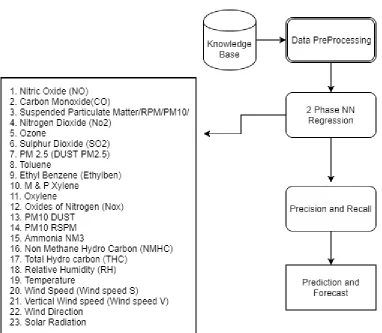
Figure 1: Work Flow of Proposed Scheme using 2Phase Neural Network for Pollution Forecasting with Regression the above figure depicts the from knowledge based the data will be extracted thereinafter the noise will be removed subsequently using the 2Phase NN (Regression and Classification) the results will be derived. Consequently, at last using precision and recall the accuracy, efficiency will be evaluated and results will be produced in form of forecast or
prediction.
IV.CONCLUSION AND FUTURE WORK
REFERENCES
1. Pope, C.A.; Dockery, D.W. Health effects of fine particulate air pollution: Lines that connect. J. Air Waste Manag. Assoc. 2006, 56, 709– 742. [CrossRef] [PubMed]
2. Pope, C.A., Burnett, R.T.; Thun, M.J.; Calle, E.E.; Krewski, D.; Ito, K.; Thurston, G.D. Lung cancer, cardiopulmonary mortality, and long-term exposure to fine particulate air pollution. JAMA 2002, 287, 1132–1141. [CrossRef] [PubMed]
3. Weber, S.A.; Insaf, T.Z.; Hall, E.S.; Talbot, T.O.; Huff, A.K. Assessing the impact of fine particulate matter (PM2.5) on respiratory-cardiovascular chronic diseases in the New York City Metropolitan area using Hierarchical Bayesian Model estimates. Environ. Res. 2016, 151, 399–409. [CrossRef] [PubMed]
4. Rattigan, O.V.; Felton, H.D.; Bae, M.; Schwab, J.J.; Demerjian, K.L. Multi-year hourly PM2.5 carbon measurements in New York: Diurnal, day of week and seasonal patterns. Atmos. Environ. 2010, 44, 2043–2053. [CrossRef]
5. Byun, D.; Schere, K.L. Review of the governing equations, computational algorithms, and other components of the Models-3 Community Multiscale Air Quality (CMAQ) modeling system. Appl. Mech. Rev. 2006, 59, 51–77. [CrossRef]
6. McKeen, S.; Chung, S.H.; Wilczak, J.; Grell, G.; Djalalova, I.; Peckham, S.; Gong, W.; Bouchet, V.; Moffet, R.; Tang, Y.; et al. Evaluation of several PM2.5 forecast models using data collected during the ICARTT/NEAQS 2004 field study. J. Geophys. Res. Atmos. 2007, 112. [CrossRef]
7. Yu, S.; Mathur, R.; Schere, K.; Kang, D.; Pleim, J.; Young, J.; Tong, D.; Pouliot, G.; McKeen, S.A.; Rao, S.T. Evaluation of real-time PM2.5 forecasts and process analysis for PM2.5 formation over the eastern United States using the Eta-CMAQ forecast model during the 2004 ICARTT study. J. Geophys. Res. Atmos. 2008, 113. [CrossRef]
8. Huang, J.; McQueen, J.; Wilczak, J.; Djalalova, I.; Stajner, I.; Shafran, P.; Allured, D.; Lee, P.; Pan, L.; Tong, D.; et al. Improving NOAA NAQFC PM2.5 Predictions with a Bias Correction Approach. Weather Forecast. 2017, 32, 407–421. [CrossRef]
9. Doraiswamy, P.; Hogrefe, C.; Hao, W.; Civerolo, K.; Ku, J.Y.; Sistla, G. A retrospective comparison of model-based forecasted PM2.5 concentrations with measurements. J. Air Waste Manag. Assoc. 2010, 60, 1293–1308. [CrossRef] [PubMed] 10. Gan, C.-M.; Wu, Y.; Madhavan, B.L.; Gross, B.; Moshary, F. Application of active optical sensors to probe the vertical structure of the urban boundary layer and assess anomalies in air quality model PM2.5 forecasts. Atmos. Environ. 2011, 45, 6613–6621. [CrossRef] 11. Files in /mmb/aq/sv/grib. Available online: http://www.emc.ncep.noaa.gov/mmb/aq/sv/grib/ (accessed on 1 December 2016).
10. NCEP Operational Air Quality Forecast Change Log. Available online: http://www.emc.ncep.noaa.gov/ mmb/aq/AQChangelog.html (accessed on 1 May 2017).
11. Lee, P.; McQueen, J.; Stajner, I.; Huang, J.; Pan, L.; Tong, D.; Kim, H.; Tang, Y.; Kondragunta, S.; Ruminski, M.; et al. NAQFC developmental forecast guidance for fine particulate matter (PM2.5). Weather Forecast. 2017, 32, 343–360. [CrossRef]
12. McKeen, S.; Grell, G.; Peckham, S.; Wilczak, J.; Djalalova, I.; Hsie, E.; Frost, G.; Peischl, J.; Schwarz, J.; Spackman, R.; et al. An evaluation of real-time air quality forecasts and their urban emissions over eastern Texas during the summer of 2006 Second Texas Air Quality Study field study. J. Geophys. Res. Atmos. 2009, 114. [CrossRef]
13. Demuth, H.; Beale, M. MATLAB and Neural Network Toolbox Release 2016a; The MathWorks, Inc.: Natick, MA, USA, 1998. 14. Wu, Y.; Pena, W.; Diaz, A.; Gross, B.; Moshary, F. Wildfire Smoke Transport and Impact on Air Quality Observed by a
Multi-Wavelength Elastic-Raman Lidar and Ceilometer in New York City. In Proceedings of the 28th International Laser Radar Conference, Bucharest, Romania, 25–30 June 2017. Atmosphere 2017, 8, 161
15. Anderson, W.; Krimchansky, A.; Birmingham, M.; Lombardi, M. The Geostationary Operational Satellite R Series SpaceWire Based Data System. In Proceedings of the 2016 International SpaceWire Conference (SpaceWire), Yokohama, Japan, 25–27 October 2016.