© 2019 by the Serbian Biological Society How to cite this article: Budinski I, Jovanović VM, Pejić B, Blagojević J, Rajičić 767 M, Paunović M, Presetnik P, Vujošević M. Mitochondrial phylogeography of
the Mediterranean horseshoe bat on the Balkan Peninsula. Arch Biol Sci. 2019;71(4):767-74.
Mitochondrial phylogeography of the Mediterranean horseshoe bat on the Balkan Peninsula
Ivana Budinski1,*, Vladimir M. Jovanović1, Branka Pejić1, Jelena Blagojević1, Marija Rajičić1, Milan Paunović2,
Primož Presetnik3 and Mladen Vujošević1
1Department of Genetic Research, Institute for Biological Research “Siniša Stanković” – National Institute of Republic of
Serbia, University of Belgrade, Bulevar despota Stefana 142, 11060 Belgrade, Serbia
2Department of Biological Collections, Natural History Museum, Njegoševa 51, 11000 Belgrade, Serbia
3Centre for Cartography of Fauna and Flora, Ljubljana Office, Tacenska cesta 20, SI-1210 Ljubljana, Slovenia
*Corresponding author: [email protected]
Received: May 29, 2019; Revised: August 5, 2019; Accepted: September 9, 2019; Published online: September 13, 2019
Abstract: The Balkan Peninsula is identified as one of the major glacial refugia in Europe during the Pleistocene, and it has served as a genetic source for post-glacial recolonization for many temperate species. The aim of this study was to investigate the genetic diversity and phylogeographic patterns of the Mediterranean horseshoe bat, Rhinolophus euryale Blasius 1853, on the Balkan Peninsula. We also analyzed its demographic history and tested the hypothesis that this region was a glacial refugium for this species. We collected 82 samples from 20 localities in the Balkans and Italy and sequenced the mitochon-drial D-loop region. Our results revealed low nucleotide but high haplotype diversity, with 20 out of 24 haplotypes reported for the first time. All Balkan and Italian samples belonged to a single genetic clade in the phylogenetic reconstruction, where they clustered together with previously published samples from Turkey, southern France and North Africa. The haplotype network had a star-like pattern that is indicative of recent population expansion. Both mismatch distribution and shallow genetic differentiation also supported the scenario of a sudden demographic expansion. We estimated that expansion within this lineage commenced in the Late Pleistocene. We suggest that the Balkan Peninsula was a glacial refugium for R. euryale.
Keywords: D-loop; mitochondrial DNA; refugium; Rhinolophus euryale
INTRODUCTION
The genetic structure of a species reflects both con-temporary (e.g. dispersal, migration, roosting behavior, mating ecology) and past processes (e.g. range contrac-tion/expansion, colonization and admixture events) [1]. The analysis of relationships among genetic lineages and their spatial distribution using molecular tools can help to infer the evolutionary and demographic history of species and populations, as well as reconstruct major events that shaped their current distribution [2].
In Europe, the Pleistocene was characterized by cli-matic fluctuations that consisted of multiple glacial and interglacial periods, i.e. repeated cycles of climate cool-ing and warmcool-ing. Those oscillations had a profound impact on the current distribution range and genetic variability (phylogeographic structuring) of many Eu-ropean species [1,3]. During glacial periods (ice ages),
distributions of many European animal species were restricted to southern refugia, where isolated popula-tions differentiated in allopatry. After the last glacial maximum, parts of these populations expanded their range northwards and recolonized the rest of Europe [1]. It is therefore expected that southern (refugial) populations harbor higher genetic diversity than north-ern ones. This pattnorth-ern of population expansion and ge-netic diversity is common for many European temper-ate species [1,4]. Large Mediterranean peninsulas like the Iberian, Italian (Apennine) and Balkan, have been identified as three main glacial refugia in Europe [1,3]. These southern refugia have had different contributions to the recolonization of Europe. Thus, populations from the Balkan Peninsula have been shown to be the major genetic source for many present-day species [5].
bat species: Barbastella barbastellus [6], Miniopterus schreibersii [7,8], Myotis bechsteinii [9], M. myotis [10], Nyctalus noctula [11], N. leisleri [12], Plecotus austriacus [13], Rhinolophus euryale [14,15], R. fer-rumequinum [16,17], R. hipposideros [18], and ge-netic evidence of post-glacial range expansion from southern refugia was found in many contemporary bat populations. For many European bat species, the Bal-kan and Iberian peninsulas were the main sources of post-glacial recolonization, while the Italian Peninsula played a smaller role [6]. The Balkan Peninsula has been proposed as the main or at least as one of several glacial refugia for B. barbastellus [6], M. schreibersii [8], M. bechsteinii [9], P. auritus [19], R. euryale [14] and R. ferrumequinum [16].
Rhinolophus euryale is a medium-sized horseshoe bat distributed throughout the Mediterranean region. It is present in northwest Africa, in Europe on the Iberian Peninsula through France, Italy, the Balkans and parts of Asia Minor, and it also occurs in central Europe, east Mediterranean (Levant), Caucasus, Iran and Turkmenistan [20–23]. It is considered to be a sedentary species with seasonal movements up to 50 km [24], and a cave-dwelling species across most of its distribution range [21]. The evolutionary history of R. euryale has been investigated in two studies to date. Bilgin et al. [14] analyzed the phylogeography of this species in Anatolia and southeastern Europe (Thrace and western Bulgaria) based on D-loop sequences, and detected two monophyletic clades within the studied area. One clade was found in the entire sam-pling range (on both sides of the Marmara Sea and in Anatolia), and the authors suggested that population expansion within this clade could have started from the Balkan Peninsula. The second clade was restrict-ed to eastern Anatolia, and the existence of another glacial refugium near the Caspian Sea was proposed. Najafi et al. [15]evaluated the phylogeography of the species in Iran using D-loop and Cytb mitochondrial sequences. Their results revealed the presence of two monophyletic clades corresponding to northern and southern parts of the country and confirmed the exis-tence of a glacial refugium south of the Zagros moun-tains for the Mediterranean horseshoe bat.
The first genetic study of this species on the Bal-kan Peninsula was carried out recently using nuclear microsatellites [25], and to the best of our knowledge,
there are no published data on mitochondrial diversity in R. euryale from this region. We conducted extensive sampling of R. euryale colonies in Serbia and neigh-boring countries and analyzed D-loop sequences of mitochondrial DNA in order to compare results with previously published data. The aims of this study were (i) to analyze the genetic diversity of R. euryale based on the mitochondrial DNA (mtDNA) sequences; (ii) to assess the relationships of Balkan populations with those from Anatolia and Iran; (iii) to investigate the demographic history of R. euryale on the Balkan insula; (iv) to test the hypothesis that the Balkan Pen-insula was one of the glacial refugia for this species.
MATERIALS AND METHODS
Ethics statement
Capturing and sampling were carried out under the permits provided by the responsible authorities in Ser-bia, Bosnia and Herzegovina, Montenegro and Slove-nia (the list of licenses are presented in Supplementary file S1). According to the laws in the listed countries, no further ethical approval by a committee is required for the aforementioned procedures, which were car-ried out in accordance with the species-specific rec-ommendations of the Canadian Council on Animal Care [26]. All animals were successfully released in good condition at the place where they were captured.
Sampling
DNA extraction and sequencing
Genomic DNA was extracted from wing punches using the Quick-gDNA Mini Prep Kit (Zymo-Research) fol-lowing the manufacturer’s protocol, after tissue incuba-tion overnight in digesincuba-tion buffer containing protein-ase K [30]. A 711-bp fragment of mitochondrial DNA including tRNA-Thr, tRNA-Pro and the hypervariable region 1 (HV-1) of the D-loop, was amplified using the following primers: REM-DL-F1 (5’-AATCGGAGGC-CAACCTGT-3’) (Puechmaille S, from the Zoologi-cal Institute and Museum, University of Greifswald, Greifswald, Germany; unpublished sequence), and mtDNA-F2-R (5’-ATGGCCCTGAAGAAAGAAC-CAGATG-3’) [31]. PCR amplifications were carried out in a final volume of 25 μL containing 1×DreamTaq Buffer (Thermo Scientific™), 0.4 μL of each primer, 0.2 mM dNTPs, 1 U of DreamTaq DNA Polymerase (Thermo Scientific™) and 2 μL of DNA template, as fol-lows: initial denaturation at 95°C for 10 min, 10 cycles for 15 s at 95°C, 30 s at 65°C (reduced by 2°C every 2 cycles, 65-57°C), 1 min at 72°C, followed by 30 cycles of 15 s at 95°C, 30 s at 55°C, 1 min at 72°C; final step of 10 min at 72°C. Amplification products were sent to Macrogen Inc. (Netherlands) for commercial sequenc-ing in both directions.
Sequences were manually edited and trimmed in Chromas 2.5.1 (https://technelysium.com.au/wp/chro-mas/; Technelysium Pty Ltd. Australia), and aligned using the ClustalW algorithm [32] as implemented in Mega6 [33], and alignments were reviewed by eye.
Data analysis
Sequences were collapsed into haplotypes using DnaSP v6 [34]. The same software was used to cal-culate the number of haplotypes, haplotype diversity (h), nucleotide diversity (π) and the number of poly-morphic sites.
For phylogenetic reconstructions we combined our dataset with existing sequences from Gen-Bank (Accession numbers: AY923062, DQ417500-DQ417507, DQ417509-DQ417510, DQ417512-DQ417514, DQ417516-DQ417519, DQ445458-DQ445459, KU531305, KF031267-KF031268 and MH223409-MH223432). Rhinolophus mehelyi (Ac-cession numbers: KF031265-KF031266,
KU531357-KU531358, MH223434) and R. blasii (Accession numbers: KU531263-KU531269) sequences were used as outgroups. The final dataset consisted of 141 sequences including 129 R. euryale sequences, five from R. mehelyi and seven from R. blasii. We trimmed the sequences to 404 bp to have equal lengths, to be used in all following analyses.
Phylogenetic analyses were performed using Bayesian inference as implemented in BEAST v2.4.3 [35]. The HKY substitution model was selected using jModelTest v2.1.10 [36], based on the Bayesian infor-mation criterion. The strict clock model and constant population size served as a tree prior. Two indepen-dent runs were performed for 1x10⁷ generations and
sampled every 10000th. Convergence of the runs and
effective sample sizes (ESS) was checked in Tracer v1.7.1 [37]. Runs were combined in LogCombiner v2.4.3 (https://github.com/CompEvol/beast2/releases/ tag/v2.4.3) and a consensus tree was built in TreeAn-notator v2.4.3 (https://github.com/CompEvol/beast2/ releases/tag/v2.4.3) using the maximum clade credibil-ity topology, median node heights with the posterior probability limit set to 0.5. The first 20% of trees were discarded as burn-in and the final tree was visualized in FigTree v1.4.3 (http://tree.bio.ed.ac.uk/software/fig-tree/). Genetic distances within and between supported clades were calculated using the Kimura 2-parameter (K2P) model [38] as implemented in Mega6 [33] soft-ware, taking into account population sizes.
A median-joining method [39] as implemented in NETWORK 5.0.0.3 software (Fluxus Technology, http://www.fluxus-engineering.com) was used to con-struct the haplotype network.
these tests was assessed using 10000 coalescent simu-lations in the DnaSP v6 [34]. Where expansion was detected, the time of expansion was estimated from τ=2ut [40], where u is the mutation rate per locus (product of substitution rate and sequence length). We used a substitution rate of 20% per million years as proposed by Petit et al. [11], generation time of 2 years as for congeneric species R. ferrumequinum and R. hipposideros [17,18], and we considered sample sizes from previously published data in these analyses.
RESULTS
In total, we identified 24 haplotypes based on 711-bp D-loop sequences. The obtained sequences were deposited in GenBank under Accession numbers MK977743-MK977824. There were 23 polymorphic sites in the analyzed fragment, of which 12 were par-simony informative. The haplotype diversity h (±SD) was 0.871 (±0.028), and the nucleotide diversity π (±SD) was 0.00292 (±0.00025). After trimming se-quences generated in this study to a length of 404 bp
(removed parts were invariable) to be comparable with previously published ones, twenty haplotypes were recorded for the first time, while four were previ-ously reported by Bilgin et al. [14].
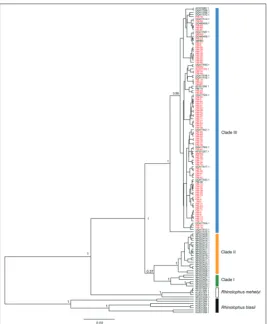
Phylogenetic reconstructions using the Bayesian approach revealed three major monophyletic clades, but relationships among them are not clearly resolved due to low posterior probability (Fig. 1). Clades I and II included the Iranian samples (all 25 haplotypes pub-lished by Najafi et al. [15]) corresponding to different geographic regions in Iran. Clade I corresponded to subclade B in Najafi et al. [15] and comprised samples from south Iran, while samples from the rest of Iran clustered in clade II (subclade A in Najafi et al. [15]). Clade III contained the samples from Europe, Turkey and North Africa, including all those generated in this study. Divergence between the samples from Iran and clade III was 4.2%, but due to low posterior probabil-ity (0.37 for clustering two Iranian lineages into one clade), phylogenetic relationships between two Iranian lineages and their relationships with clade III are un-clear. Genetic variation within clades I, II and III was
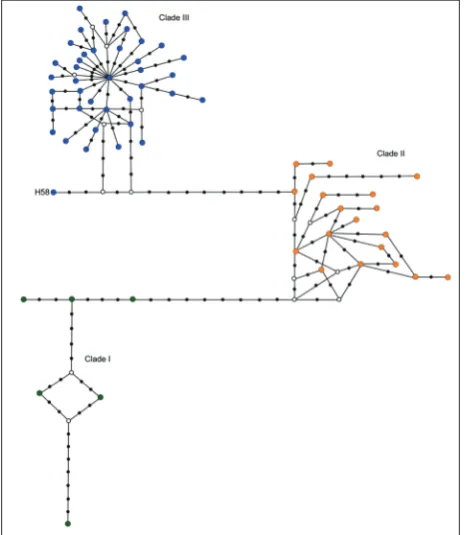
2.1% (range 0.5-4.1%), 0.7% (range 0-1.5%) and 0.6% (range 0-2.8%), respectively. Within clade III, one sample from Turkey (Accession number DQ417510, from Hatay; Eastern Mediterranean [14], named H58 in the cur-rent study) was noticeably diffecur-rent (Fig. 1, Fig. 2), and all other samples clustered in one highly supported group. Divergence among H58 and other samples within this lineage ranged between 1.5-2.8%.
The obtained median-joining haplotype network (Fig. 2) revealed three clearly dis-connected mtDNA subnetworks, congruent with the main lineages detected in the phy-logenetic analysis (Fig. 1). Two of them com-prised haplotypes restricted to Iran (clades I and II), whereas the third one consisted of haplotypes from Europe, Turkey and North Africa (clade III). The subnetwork
ing clade III showed star-like topology, which is in-dicative of population expansion. The most abundant haplotype (H5) had a central position within the net-work, and was surrounded by less frequent haplotypes differing with mostly 1-2 mutations. The majority of haplotypes were restricted to geographic regions. For instance, haplotypes H1-2 and H6-8 were present in eastern Serbia, while H10-14 and H19-20 were found in western Serbia only (Fig. 3).
Mismatch distribution analysis of clade III showed unimodal distribution. The observed values revealed that this genetic lineage was more consistent with the model of sudden demographic expansion (Fig. 4B) than with a constant-sized-population demo-graphic history (Fig. 4A). The value of Harpending’s raggedness index was r=0.0252, with a statistically insignificant p-value for the observed and simulated data. Additionally, Fu’s Fs (Fs=-38.346, p<0.001) and Tajima’s D (D=-2.090, p<0.05) tests also supported
the scenario of population expansion for the clade III. Applying a substitution rate of 20% per million years, we estimated that expansion within this clade occurred about 23000 years before the present.
DISCUSSION
In the current study we estimated the genetic diversity of the mtDNA of the Mediterranean horseshoe bat on the Balkan Peninsula using D-loop sequences. In line
Fig. 2. Median-joining haplotype network. Circle sizes are not proportional to the frequency of the particular haplotype. Col-ors correspond to clades obtained in Bayesian analysis that are shown. Black dots represent mutations and white circles median vectors. Sequences from Iran (Clades I and II) and Turkey, France and North Africa (within clade III, labelled in Fig. 3) have been downloaded from GenBank.
Fig. 3. Median-joining network of R. euryale mtDNA haplotypes that belong to Clade III. Pie sizes are proportional to the number of individuals having specific haplotype. Black dots show mutation events, white circles median vectors and colors represent different geographic regions. Sequences from Turkey, France and North Africa have been downloaded from GenBank and the rest was obtained in this study.
with previous investigations, our results revealed high haplotype diversity and the obtained values for hap-lotype and nucleotide diversity were similar to those reported from Turkey [14] and Iran [15].
Based on the analyzed mtDNA data set, we de-duced the existence of three major monophyletic lin-eages, which were also reported by Najafi et al. [15] using both D-loop and Cytb mitochondrial sequences. The same authors proposed that there were two re-fugial areas for the Mediterranean horseshoe bat in Iran during the Pleistocene. The samples from clade I probably originated from a glacial refugium south of the Zagros mountains, while samples from clade II might have diverged north of the Elborz mountains in the Caspian refugium. Similar phylogeographic pat-terns were observed for two moth species from Iran, having glacial refugia in similar regions [43].
In agreement with Bilgin et al. [14], we suggest that samples from clade III probably originated from the Balkan glacial refugium, which is supported by descriptive statistics, phylogenetic and haplotype net-work analysis. The haplotype subnetnet-work represent-ing this lineage has a star-like structure, indicatrepresent-ing recent population expansion. The most common and the most abundant haplotype is H5 and it is present in southern Italy, Montenegro, western and eastern Serbia, Albania and Turkey. Having a central posi-tion within the network, it is surrounded by many haplotypes differing by only one or very few bp, so that H5 is potentially the most ancestral haplotype in this group. The vast majority of haplotypes are unique to geographic regions (or to localities) and have low frequencies, while the more frequent haplotypes are the only ones shared among geographic regions (e.g. H3-H5). Most of haplotypes from Turkish popula-tions are derived from the ancestral haplotype by one mutation event, and it is possible that they originated in the Balkans. Only two haplotypes have been re-corded in Montenegro, and both are also present in Italy and eastern Serbia. Genetic similarity between R. euryale populations in eastern Serbia and Monte-negro has also been reported based on nuclear mic-rosatellite data [25]. Within clade III, H58 from the eastern Mediterranean area is evidently different from the other haplotypes in this lineage, and it is possible that they evolved in different glacial refugia. However, this assumption is based on a single sequence
avail-able from Hatay, and reaching any further conclusions would be too speculative. Additional samples from that region are needed for more prudent conclusions. Çoraman et al. [44] analyzed the phylogeographic pat-terns of 33 bat species present in Anatolia using ND1 and Cytb mitochondrial genes. In their study, all R. euryale samples formed a single monophyletic group, similar to clade III in the current study.
In the present study, Italian haplotypes clustered together with all other samples from the Balkans, Tur-key and North Africa, and two haplotypes were shared between Italy and the Balkans. During the last glacial maximum, the level of the Mediterranean Sea was much lower, which was responsible for the existence of “land bridges” between the Balkan and Apennine peninsulas [45], facilitating gene flow between them (more examples are presented in Randi [4] and Ruedi et al. [10]). It is possible that Italy was populated by Balkan source populations, resulting in their genetic similarities. If we assume that the samples from France and North Africa originated from another glacial re-fugium (e.g. the Iberian Peninsula), more prominent differences between them and Balkan samples would be expected. However, those samples also belong to the same (European) lineage, so samples from the Balkans, Italy, France and North Africa seem to have originated from the same source population. The sig-nificance of the Balkan Peninsula as a main source of postglacial recolonization has been pointed out for many European species, while due to mountainous barriers, the Iberian and Apennine peninsulas prob-ably played moderate and small roles, respectively [5]. It is possible that European populations of the Mediterranean horseshoe bat originated from a single refugium that was on the Balkan Peninsula, similarly as for M. bechsteinii [9] and N. noctula [11]. However, due to the small sample size from the rest of Europe (and none from the Iberian Peninsula), we cannot exclude the possibility that there were other glacial refugia for this species in Europe.
The star-like topology of median-joining tree, mismatch distribution and shallow genetic differentia-tion in R. euryale point to a relatively recent and rapid population expansion, while the high genetic diversity supports the hypothesis that the Balkan region was the most likely refugium for the clade III of R. euryale during the Late Pleistocene. Balkan populations of the Mediterranean horseshoe bat harbor relatively high levels of genetic diversity, at both the nuclear [25] and mitochondrial levels. These populations have been recognized as the most stable and the most numerous in Europe [21], and since they carry a substantial part of the species’ genetic variation, their protection is of great importance.
Funding: The study was supported by the Minis-try of Education, Science and Technological Develop-ment of Serbia, Grant No. 173003, and by the Ministry of Environmental Protection of Serbia, Project No. 401-00-200/2016-17.
Acknowledgments: We are grateful to Heliana Dundarova, Boyan Petrov and Luca Cistrone for pro-viding us samples from Albania, Bulgaria and Italy, respectively. We would like to thank Sebastien Puech-maille for the primer sequences and to Jelena Aleksić for the help with Bayesian analyses. We also thank two anonymous reviewers whose valuable comments greatly improved the first version of this manuscript.
Author contributions: IB, VJ, BP, MR, PP col-lected the samples. IB and VJ performed the analyses. IB wrote the first draft of the manuscript, and all au-thors contributed substantially to revisions.
Conflict of interest disclosure: The authors de-clare that there are no conflicts of interest.
REFERENCES
1. Hewitt GM. Post-glacial re-colonization of European biota. Biol J Linnean Soc. 1999;68:87-112.
2. Avise JC. Phylogeography: the history and formation of spe-cies. Cambridge, Mass: Harvard University Press; 2000. 464 p. 3. Taberlet P, Fumagalli L, Wust-Saucy A-G, Cosson J-F.
Com-parative phylogeography and postglacial colonization routes in Europe. Mol Ecol. 1998;7:453-64.
4. Randi E. Phylogeography of South European mammals. In: Weiss S, Ferrand N, editors. Phylogeography of Southern European Refugia. Dordrecht: Springer Netherlands; 2007. p. 101-26.
5. Hewitt GM. Mediterranean Peninsulas: The Evolution of Hotspots. In: Zachos FE, Habel JC, editors. Biodiversity Hotspots. Berlin, Heidelberg: Springer Berlin Heidelberg; 2011. p. 123-47.
6. Rebelo H, Froufe E, Brito JC, Russo D, Cistrone L, Ferrand N, Jones G. Postglacial colonization of Europe by the barbastelle bat: agreement between molecular data and past predictive modelling. Mol Ecol. 2012;21:2761-74.
7. Bilgin R, Gürün K, Rebelo H, Puechmaille SJ, Maracı Ö, Pre-setnik P, Benda P, Hulva P, Ibáñez C, Hamidovic D, Fressel N, Horáček I, Karataş A, Karataş A, Allegrini B, Georgiakakis P, Gazaryan S, Nagy ZL, Abi-Said M, Lučan RK, Bartonička T, Nicolaou H, Scaravelli D, Karapandža B, Uhrin M, Paunović M, Juste J. Circum-Mediterranean phylogeography of a bat coupled with past environmental niche modeling: A new paradigm for the recolonization of Europe? Mol Phylogenet Evol. 2016;99:323-36.
8. Furman A, Öztunç T, Postawa T, Çoraman E. Shallow genetic differentiation in Miniopterus schreibersii (Chiroptera: Ves-pertilionidae) indicates a relatively recent re-colonization of Europe from a single glacial refugium. Acta Chiropterol. 2010;12:51-9.
9. Kerth G, Petrov B, Conti A, Anastasov D, Weishaar M, Gaz-aryan S, Jaquiéry J, König B, Perrin N, Bruyndonckx N. Com-munally breeding Bechstein’s bats have a stable social system that is independent from the postglacial history and location of the populations. Mol Ecol. 2008;17:2368-81.
10. Ruedi M, Walter S, Fischer MC, Scaravelli D, Excoffier L, Heckel G. Italy as a major Ice Age refuge area for the bat Myotis myotis (Chiroptera: Vespertilionidae) in Europe. Mol Ecol. 2008;17:1801-14.
11. Petit E, Excoffier L, Mayer F. No Evidence of bottleneck in the postglacial recolonization of Europe by the Noctule Bat (Nyctalus noctula). Evolution. 1999;53:1247-58.
12. Boston ESM, Ian Montgomery W, Hynes R, Prodohl PA. New insights on postglacial colonization in western Europe: the phylogeography of the Leisler’s bat (Nyctalus leisleri). Proc R Soc Lond B Biol Sci. 2015;282:20142605.
13. Razgour O, Juste J, Ibáñez C, Kiefer A, Rebelo H, Puech-maille SJ, Arlettaz R, Burke T, Dawson DA, Beaumont M, Jones G. The shaping of genetic variation in edge-of-range populations under past and future climate change. Ecol Lett. 2013;16:1258-66.
14. Bilgin R, Furman A, Çoraman E, Karataş A. Phylogeogra-phy of the Mediterranean horseshoe bat, Rhinolophus euryale (Chiroptera: Rhinolophidae), in southeastern Europe and Anatolia. Acta Chiropterol. 2008;10:41-9.
15. Najafi N, Akmali V, Sharifi M. Historical explanation of genetic variation in the Mediterranean horseshoe bat Rhi-nolophus euryale (Chiroptera: Rhinolophidae) inferred from mitochondrial cytochrome-b and D-loop genes in Iran. Mito-chondrial DNA A DNA Mapp Seq Anal. 2019;30(1):135-47. 16. Bilgin R, Çoraman E, Karataş A, Morales JC. Phylogeogra-phy of the Greater horseshoe bat, Rhinolophus ferrumequinum (Chiroptera: Rhinolophidae), in Southeastern Europe and Anatolia, with a specific focus on whether the Sea of Marmara is a barrier to gene flow. Acta Chiropterol. 2009;11:53-60. 17. Flanders J, Jones G, Benda P, Dietz C, Zhang S, Li G, Sharifi
Rhinolophus ferrumequinum : contrasting results from mito-chondrial and microsatellite data. Mol Ecol. 2009;18:306-18. 18. Dool SE, Puechmaille SJ, Dietz C, Juste J, Ibáñez C, Hulva P, Roué SG, Petit EJ, Jones G, Russo D, Toffoli R, Viglino A, Martinoli A, Rossiter SJ, Teeling EC. Phylogeography and postglacial recolonization of Europe by Rhinolophus hippo-sideros : evidence from multiple genetic markers. Mol Ecol. 2013;22:4055-70.
19. Juste J, Ibáñez C, Muñoz J, Trujillo D, Benda P, Karataş A, Ruedi M. Mitochondrial phylogeography of the long-eared bats (Plecotus) in the Mediterranean Palaearctic and Atlantic Islands. Mol Phylogenet Evol. 2004;31:1114-26.
20. Benda P, Faizolâhi K, Andreas M, Obuch J, Reiter A, Ševčík M, Uhrin M, Vallo P, Ashrafi S. Bats (Mammalia: Chiroptera) of the Eastern Mediterranean and Middle East. Part 10. Bat fauna of Iran. Acta Soc Zool Bohem. 2012;76:163-582. 21. Dietz C, Kiefer A. Bats of Britain and Europe. 1st ed.
Blooms-bury Publishing; 2016. p. 400.
22. Juste J, Alcaldé J. Rhinolophus euryale. [cited 2018 Dec 10]. In: The IUCN Red List of Threatened Species. [Internet]. IUCN; 2016 Apr 25. Available from: https://www.iucnredlist.org/spe-cies/19516/21971185
23. Uhrin M, Boldogh S, Bücs S, Paunović M, Mikova E, Juhász M, Juhász M, Csősz I, Estók P, Fulín M, Gombkötő P, Jére4 C, Barti L, Karapandža B, Matis Š, Nagy Z, Szodoray-Parádi F, Benda P. Revision of the occurrence of Rhinolophus euryale in the Carpathian region, Central Europe. Vespertilio. 2012;16:289-328.
24. Hutterer R, Ivanova T, Meyer-Cords C, Rodrigues L. Bat migrations in Europe: A review of banding data and litera-ture. 1st ed. Bonn: Landwirtschaftsvlg Münster; 2005. p. 180. 25. Budinski I, Blagojević J, Jovanović VM, Pejić B, Adnađević T, Paunović M, Vujošević M. Population genetic structure of the Mediterranean horseshoe bat Rhinolophus euryale in the central Balkans. PLoS One. 2019;14:e0210321.
26. Canadian Council on Animal Care, CCAC species-specific rec-ommendations on: BATS [Internet]. Ottawa, Canada: Canadian Council on Animal Care; 2003 [updated 2003 May 10; cited 2018 Dec 10]. Available from: https://www.ccac.ca/Documents/ Standards/Guidelines/Add_PDFs/Wildlife_Bats.pdf . 27. Brunet-Rossinni AK, Wilkinson GS. Methods for age
esti-mation and the study of senescence in bats. In: Kunz TH, Parsons S, editors. Ecological and behavioral methods for the study of bats. 2nd ed. John Hopkins University Press; 2009. p. 315-25.
28. Racey PA. Reproductive assessment of bats. In: Kunz TH, Par-sons S, editors. Ecological and behavioral methods for the study of bats. 2nd ed. The Johns Hopkins University Press; 2009. p. 249-64.
29. Worthington Wilmer J, Barratt EM. A non-lethal method of tissue sampling for genetic studies of chiropterans. Bat Research News. 1996;37:1-3.
30. Strauss WM. Preparation of genomic DNA from mammalian tissue. Curr Protoc Mol Biol. 2001;Chapter 2:Unit2.2. 31. Puechmaille SJ, Gouilh MA, Piyapan P, Yokubol M, Mie KM,
Bates PJ, Satasook C, New T, Hla Bu SS, Mackie IJ, Petit EJ, Teeling EC . The evolution of sensory divergence in the con-text of limited gene flow in the bumblebee bat. Nat Commun. 2011;2:573.
32. Thompson JD, Higgins DG, Gibson TJ. CLUSTAL W: improv-ing the sensitivity of progressive multiple sequence alignment through sequence weighting, position-specific gap penalties and weight matrix choice. Nucleic Acids Res. 1994;22:4673-80.
33. Tamura K, Stecher G, Peterson D, Filipski A, Kumar S. MEGA6: Molecular evolutionary genetics analysis version 6.0. Mol Biol Evol. 2013;30:2725-9.
34. Rozas J, Ferrer-Mata A, Sánchez-DelBarrio JC, Guirao-Rico S, Librado P, Ramos-Onsins SE, Sánchez-Gracia A. DnaSP 6: DNA sequence polymorphism analysis of large data sets. Mol Biol Evol. 2017;34:3299-302.
35. Bouckaert R, Heled J, Kühnert D, Vaughan T, Wu C-H, Xie D, Suchard A, Rambaut A, Drummond AJ. BEAST 2: A software platform for Bayesian evolutionary analysis. PLoS Comput Biol. 2014;10:e1003537.
36. Darriba D, Taboada GL, Doallo R, Posada D. jModelTest 2: more models, new heuristics and parallel computing. Nat Methods. 2012;9:772.
37. Rambaut A, Drummond AJ, Xie D, Baele G, Suchard MA. Posterior summarization in Bayesian phylogenetics using Tracer 1.7. Syst Biol. 2018;67:901-4.
38. Kimura M. A simple method for estimating evolutionary rates of base substitutions through comparative studies of nucleo-tide sequences. J Mol Evol. 1980;16:111-20.
39. Bandelt HJ, Forster P, Röhl A. Median-joining networks for inferring intraspecific phylogenies. Mol Biol Evol. 1999;16:37-48.
40. Rogers AR, Harpending H. Population growth makes waves in the distribution of pairwise genetic differences. Mol Biol Evol. 1992;9:552-69.
41. Fu YX. Statistical tests of neutrality of mutations against population growth, hitchhiking and background selection. Genetics. 1997;147:915-25.
42. Tajima F. Statistical method for testing the neutral mutation hypothesis by DNA polymorphism. Genetics. 1989;123:585-95.
43. Rajaei Sh H, Rödder D, Weigand AM, Dambach J, Raupach MJ, Wägele JW. Quaternary refugia in southwestern Iran: insights from two sympatric moth species (Insecta, Lepidop-tera). Org Divers Evol. 2013;13:409-23.
44. Çoraman E, Furman A, Karataş A, Bilgin R. Phylogeo-graphic analysis of Anatolian bats highlights the importance of the region for preserving the Chiropteran mitochondrial genetic diversity in the Western Palaearctic. Conserv Genet. 2013;14:1205-16.
45. Shackleton JC, van Andel TH, Runnels CN. Coastal paleoge-ography of the Central and Western Mediterranean during the last 125.000 years and its archaeological implications. J Field Archaeol. 1984;11:307-14.
Supplementary Material