• No results found

A SURVEY OF PROACTIVE AND REACTIVE PROTOCOLS IN MOBILE AD HOC NETWORKS P.Aruna Devi *, Dr.K.Karthikeyan

N/A
N/A
Protected

Academic year: 2020

Share "A SURVEY OF PROACTIVE AND REACTIVE PROTOCOLS IN MOBILE AD HOC NETWORKS P.Aruna Devi *, Dr.K.Karthikeyan"

Copied!
6
0
0

Loading.... (view fulltext now)

Full text

(1)

[Devi P et al., 3(7): July, 2016]

ISSN 2349-4506

Impact Factor: 2.545

G

lobal

J

ournal of

E

ngineering

S

cience and

R

esearch

M

anagement

A SURVEY OF PROACTIVE AND REACTIVE PROTOCOLS IN MOBILE AD HOC

NETWORKS

P.Aruna Devi *, Dr.K.Karthikeyan

*

Research Scholar, Ph.D(Computer Science), Dr.SNS Rajalakshmi College of Arts and

Science,Coimbatore-49

Head,Dept of Computer Science, Government Arts and Science College, Karambakudi.

DOI:

KEYWORDS

:

MANET, DSDVR, CGSR, GSR, AODV, TORA.

ABSTRACT

Mobile Ad Hoc Network (MANET) is one of wireless communication with a collection of more than one device or nodes or terminals which contain network capability that communicate with each other. A Mobile ad-hoc network is set of different types of movable nodes and consists of mobile platforms which are free to move randomly. MANET can be deployed at low cost in variety of application and it contains different types of routing protocols which are classified under the category of proactive (Table driven Protocols) and reactive protocols (on-demand). Nodes can directly communicate to all other nodes within the broadcast communication. If node could not have direct communication then they can act as intermediate node to communicate with other nodes. This paper focus on the survey of proactive and reactive routing protocols namely DSDVR, CGSR, GSR, WRP and DSR, AODV, TORA respectively.

INTRODUCTION

A Mobile Ad hoc Network is wireless mobile nodes that dynamically self-organize in arbitrary manner. Mobile ad hoc networks are group of wireless networks, which consists of large number of mobile nodes. Nodes in MANETs can link and go off the network dynamically. There is no fixed infrastructure and centralized administration in this type of networks. Nodes can be interconnected through wireless interface. Sometimes Mobile ad-hoc networks are also known as short-lived networks. This is a new form of network and might be able to provide services at any places where it is not possible. Flexibility is the advantages of Mobile adhoc network it means people want to communicate anywhere at any time. A MANET is a collection of wireless nodes that exchange information without using any predefined infrastructure. Each device called router in a MANET is free to move independently in any direction at any time.

Figure: 1

Example for Mobile Ad hoc Network

CHALLENGES IN MANETS

Autonomous and infrastructureless - No centralized supervision is available to manage the different mobile nodes operation.

(2)

[Devi P et al., 3(7): July, 2016]

ISSN 2349-4506

Impact Factor: 2.545

G

lobal

J

ournal of

E

ngineering

S

cience and

R

esearch

M

anagement

Device heterogeneity - Identifying relevant new nodes and informing about their existence Bandwidth constrained

Variable capacity links - Wireless links have considerably lower capability than the wired links.

Limited resources- Mobile nodes contain limited battery constraints.

Network scalability - Scalability is defined as whether the network is able to accept the level of service if it contains large number of nodes.

Limited substantial security- Flexibility implies higher security risks Such as peer-to- peer network architecture. Eavesdropping, spoofing and denial-of-service attacks, Traffic analysis should be considered.

Poor communication Quality- This is an inbuilt problem of wireless networks caused by several error result in declining of the received signal.

Adhoc addressing - Challenges in normal addressing scheme.

Network configuration- The whole ad hoc infrastructure is dynamic.

Topology protection- Information can be changed among nodes in ad hoc is a major challenge.

OVERVIEW OF PROACTIVE AND REACTIVE PROTOCOLS

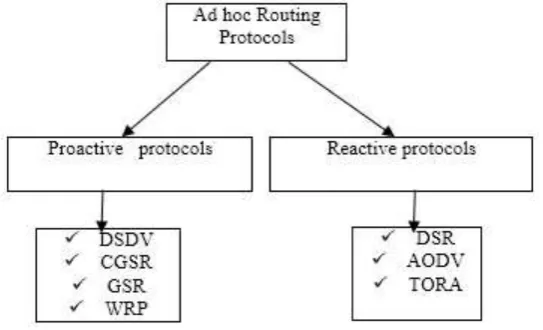
The routing protocols for ad hoc networks can be divided into two categories: Table-driven protocols (proactive) and on-demand protocols (reactive). They differ from each other so they obtain the routing information. The table driven protocols habitually maintain the routing table of the whole network whereas the on-demand protocols maintains information of only active paths to the destination nodes.

Figure: 2

Different types of Ad hoc Routing Protocols

Proactive protocols

Destination-sequenced distance vector routing (DSDV)

(3)

[Devi P et al., 3(7): July, 2016]

ISSN 2349-4506

Impact Factor: 2.545

G

lobal

J

ournal of

E

ngineering

S

cience and

R

esearch

M

anagement

Cluster head Gateway Switch Routing (CGSR)

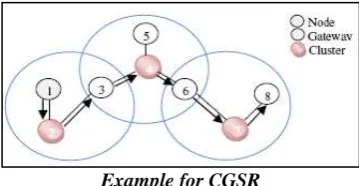
The Cluster head Gateway Switch Routing is also a table driven routing protocol. In this protocol the packet cannot be openly sent to the destination instead cluster heads are used for routing.The portable devices will be grouped to form a cluster. The combination is based on the range and each cluster is controlled by cluster head. Then each cluster head is connected to gateway and form a hierarchical structure. All the portable devices will maintain two types of table namely cluster member and routing.

Figure -3

Example for CGSR

Global State Routing (GSR)

Global State Routing (GSR) is almost the same as Destination-sequenced distance vector routing, because it deals with link state routing .The aim is to reduce the flooding of routing messages. In this algorithm each node consists of a distance table, a neighbor list, a topology table, a next hop table. The distance table contains the shortest path to each destination node. The routing messages will be created for each link when link changes. There is a updating of topology table when it receives routing message. After that it updates sequence number stored in the table and it then reconstructs its routing table and broadcasts the packets to its neighbors. The neighbor list of a node consists of the list of its neighbors. The next hop table includes the next hop details to which the packets to be send.

Wireless Routing Protocol (WRP)

WRP is one of the path-finding algorithms and defined as the set of circulated shortest path algorithms, which calculate the paths based on length and hop. Wireless Routing Protocol uses the routing table for each node in the record to complete the routing. It requires each node to operate with four tables namely Distance vector table, Routing table, Link-cost table, Message retransmission list table. Message retransmission list is used to update records which need re-transmission and requires acknowledgement. A node can decide whether to update its routing table after receiving an update message from a neighbor and always it looks for a best path using the new information.

Reactive protocols

Dynamic Source Routing (DSR)

DSR is one type of on-demand routing protocol for ad hoc networks. In DSR the source consist of full routing path in the packets header. The intermediate nodes use this technique to forward packets towards the destination and maintain a route cache table. It is a protocol in which source finds unexpired route to the destination to send the packet. This protocol used in the network with the moderate speed. Routing in DSR can be done using two phases: Route request and Route reply.

Route request

The source sends the information to the destination will create a message as route request by adding its own identification number and broadcasts it in the network.

Route reply

(4)

[Devi P et al., 3(7): July, 2016]

ISSN 2349-4506

Impact Factor: 2.545

G

lobal

J

ournal of

E

ngineering

S

cience and

R

esearch

M

anagement

and generate a route error message which will be sent back to the source. Then source will re-established the link for further transmission.

Ad Hoc On-demand Distance Vector (AODV)

AODV is one type of on-demand routing protocol for ad hoc networks. AODV uses hop-by-hop routing. It maintains routing table entries at each node. In mobile adhoc networks it is known as a source initiated routing protocol .This On-demand Distance Vector algorithm consists of two phases: Route discovery phase, Route maintenance phase. The best feature of AODV is to provide broadcasting, unicasting, and multicasting communication. During route discovery phases it uses a broadcast communication and for reply it uses unicast communication.

Route discovery

The source does not have any route to the destination in its route cache, then it send a route request as RREQ message to the destination node. It specifies for which node it requests the route. The RREQ message consists of a route record which specifies the sequence of nodes. When an intermediate node receives a RREQ message from source then it checks whether the node is already present in the route record or not. If node is present in the record then it drops the message. This is done to prevent from loops. The intermediate node sends the RREQ to the next router according to the route which is specified in the header field. When the destination node receives the RREQ from the source node, it sends back a route reply message (RREP) as a response to the source. Intermediate nodes can also use the route cache to reply to RREQs.

Route maintenance

Route maintenance is maintained when a node detects a broken link. If there is a broken link, node cannot forward a message to next hop but it sends a route error (RERR) message back to the source. When an RERR message is received from broken node it deletes all the links.

Temporally Ordered Routing Algorithm (TORA)

TORA is also a source initiated routing algorithm. It creates multiple routes for any source or destination. The advantage is that route discovery is not required for every modification in the network topology. TORA consists of three basic functions: Route Creation/discovery, Route maintenance, Route erasure. TORA uses three types of packets: Query Packets for creating a route, Update Packets for both creating and maintenance. The route will be found from the source to destination only when a request is made for the transmission between sender and receiver. In this algorithm the source will generate a query packet to broadcast the messages in the network. When the destination is known about an update packet then it will be generated and sent back to the source. The update packet maintains the path information, if more than one update packet is received by the source. It means there are multiple paths to the destination so source has to choose best path available in the network.

(5)

[Devi P et al., 3(7): July, 2016]

ISSN 2349-4506

Impact Factor: 2.545

G

lobal

J

ournal of

E

ngineering

S

cience and

R

esearch

M

anagement

TORA: Route maintenance.

COMPARISON OF PROTOCOLS

OUTLINE OF PROTOCOLS

CONCLUSION

(6)

[Devi P et al., 3(7): July, 2016]

ISSN 2349-4506

Impact Factor: 2.545

G

lobal

J

ournal of

E

ngineering

S

cience and

R

esearch

M

anagement

protocols discover routes only when they are needed, they may still produce a huge amount of traffic when the network or topology changes frequently. Depending on the amount of network traffic and number of flows, the routing protocols could be chosen.

REFERENCES

1. V. Ramesh, P. Subbaiah, N. Koteswar Rao and M. Janardhana Raju, Performance comparison and analysis of DSDV and AODV for MANET, (JJCSE) International Journal on Computer Science and Engineering , vol. 02 , pp. 183-188, 2010

2. H. Yang, H. Luo, F. Ye, S. Lu, and L. Zhang, “Security in Mobile Ad Hoc Networks: Challenges and Solutions”, IEEE Wireless Communications, pp. 38-47, 2004.

3. I. Awan and K. Al-Begain, “Performance evaluation of wireless networks”, International Journal of Wireless Information Networks, vol. 13, no. 2, pp. 95–97, 2006.

4. J. Broch, D. Johnson, and D. Maltz, “The dynamic source routing protocol for mobile ad hoc networks”, IETF Internet Draft, December 1998, http://www.ietf.org/internetdrafts/

5. A. E. Mahmoud, R. Khalaf & A, Kayssi, “Performance Comparison of the AODV and DSDV Routing Protocols in Mobile Ad-Hoc Networks”, Lebanon, 2007.

6. Md. Monzur Morshed, Md. Habibur Rahman, Md.Reazur Rahman Manzumder, “Performance evaluation of DSDV and AODV Routing Protocols in Mobile Ad-hoc Networks”, 4th International conference on new trends in information science and service science (NISS), On page(s): 399-403 Location: Gyeongju Print ISBN: 978-1-4244-6982-6

7. Rutvij H.Jhaveri, Ashish D. Patel, Jatin D. Parmar, Bhavin I. Shah, “Manet Routing Protocol and Wormhole Attack against AODV”,IJCSNS International Journal of Computer Science and Network Security, VOL.10 No.4, April 2010.

8. Karlsson, Jonny; Dooley, Laurence S. and Pulkkis, Goran, “Routing Security in Mobile Ad-hoc Networks”. Informing Science and Information Technology Education 2012 Conference (InSITE’12), 22-27 June 2012, Montreal, Canada (Forthcoming), 2012.

9. Ashwani Garg, Vikas Beniwal, “A Review on Security Issues of Routing Protocols in Mobile Ad-Hoc Networks”, International Journal ofAdvanced Research in Computer Science and Software Engineering, Volume 2, Issue 9, pp.145-148, September-2012

10. Preeti Bathla, Bhawna Gupta, “Security Enhancements in AODV Routing Protocol”, IJCST Vol. 2, Issue 2, June 2011.

11. Supriya Tayal , Vinti Gupta,” A Survey of Attacks on Manet Routing Protocols”,IJIRSET Vol. 2, Issue 6, June 2013.

12. Govind. P. Gupta, A. K. Pandey, “Performance Comparison of Ad Hoc Routing Protocols over IEEE 802.11 DCF and TDMA MAC Layer Protocols”.

Figure

Figure: 2
Figure -3

References

Related documents

It is therefore important to estimate survival in all older people with colorectal cancer irrespective of the intention for operative or non-operative management to aid in

Berdasarkan hasil diskusi dengan Ustad Tajul Muluk dan beberapa warga Syi’ah Sampang di Rumah Susun Puspa Agro Sidoarjo bahwa asal muasal komunitas Syi’ah Sampang bermula

That breed- ing season encounters amongst females were also of longer duration than non-breeding season encounters could indicate intrasexual competition amongst females,

Existing approaches to phantom protection in B trees (namely, key range locking) cannot be applied to multidimensional data structures since they rely on a total order over the

The implication is that countries considering the adoption of wage subsidies should clearly define the objectives and expectations. Without learning effects, wage subsi- dies

The initial response scale for the 15 items consisted of a 7-point scale of how a patient ’ s life was affected, with patients asked to write a number in a box to show whether

 Studies on seismic risk zooning and seismic geotechnical telecommunications in Qeshm and micro- zoning studies of seismic geotechnics in Qeshm and

Abstract: This study detected the expression level of IL-1 β in gastric cancer tissue and paracarcinoma tissue, and also analyzed its relationship with clinical