Spectrum Access in Cognitive Wireless Networks
Nils Morozs Ph.D. University of York Electronics September 2015Abstract
This thesis studies the applications of distributed reinforcement learning (RL) based machine intelligence to dynamic spectrum access (DSA) in future cognitive wireless networks. In particular, this work focuses on ways of accelerating distributed RL based DSA algorithms in order to improve their adaptability in terms of the initial and steady-state performance, and the quality of service (QoS) convergence behaviour. The performance of the DSA schemes proposed in this thesis is empirically evalu-ated using large-scale system-level simulations of a temporary event scenario which involves a cognitive small cell network installed in a densely populated stadium, and in some cases a base station on an aerial platform and a number of local primary LTE base stations, all sharing the same spectrum. Some of the algorithms are also theo-retically evaluated using a Bayesian network based probabilistic convergence analysis method proposed by the author.
The thesis presents novel distributed RL based DSA algorithms that employ a Win-or-Learn-Fast (WoLF) variable learning rate and an adaptation of the heuristically accel-erated RL (HARL) framework in order to significantly improve the initial performance and the convergence speed of classical RL algorithms and, thus, increase their adapt-ability in challenging DSA environments. Furthermore, a distributed case-based RL approach to DSA is proposed. It combines RL and case-based reasoning to increase the robustness and adaptability of distributed RL based DSA schemes in dynamically changing wireless environments.
Contents
Abstract 3 List of Figures 8 List of Tables 12 Acknowledgements 13 Declaration 14 1 Introduction 16 1.1 Overview . . . 16 1.2 Hypothesis . . . 17 1.3 Thesis Outline . . . 18 2 Literature Review 20 2.1 Introduction . . . 202.2 Dynamic Spectrum Access and Spectrum Sharing . . . 21
2.2.1 Spectrum Database Approach . . . 21
2.2.2 Opportunistic Spectrum Sensing Approach . . . 22
2.2.3 Regulatory Approach . . . 24
2.2.4 Mitola’s Cognition Cycle of a Wireless Device . . . 25
2.3 Reinforcement Learning . . . 27
2.3.1 Model-Based Reinforcement Learning . . . 29
2.3.2 Model-Free Reinforcement Learning . . . 31
2.3.3 Multi-Agent Reinforcement Learning . . . 37
2.4 Intelligent Dynamic Spectrum Access . . . 40
2.4.1 Centralised Reinforcement Learning Approach . . . 41
2.4.2 Distributed Reinforcement Learning Approach . . . 42
2.4.3 Transfer Learning Approach . . . 45
3 Experimental Methodology 48
3.1 Cognitive Wireless Network Simulator . . . 48
3.1.1 Scenario and Network Architecture . . . 49
3.1.2 Radio Propagation . . . 51
3.1.3 Link Model . . . 52
3.1.4 Traffic Model . . . 53
3.1.5 Power Control and Cell Association . . . 53
3.1.6 Inter-Cell Interference Coordination Signalling . . . 54
3.2 Empirical Evaluation . . . 55
3.2.1 Performance Metrics . . . 55
3.2.2 Statistical Validation of Results . . . 57
3.3 Heuristic Schemes for Baseline Comparison . . . 57
3.3.1 Dynamic ICIC . . . 57
3.3.2 Spectrum Sensing . . . 60
3.4 Conclusion . . . 62
4 Distributed Q-Learning Based Dynamic Spectrum Access 63 4.1 Intelligent Dynamic Spectrum Access . . . 63
4.1.1 Reinforcement Learning . . . 64
4.1.2 Distributed Stateless Q-Learning . . . 65
4.2 Choice of the Learning Rate . . . 67
4.2.1 Win-or-Learn-Fast Variable Learning Rate . . . 67
4.2.2 Performance Comparison Using Different Learning Rates . . 70
4.2.3 Temporal Performance . . . 71
4.2.4 Comparison with Heuristic Schemes . . . 72
4.3 Q-Learning Based Dynamic Spectrum Sharing . . . 73
4.3.1 Spectrum Occupancy Analysis . . . 74
4.3.2 Spatial Distribution of User Throughput . . . 75
4.3.3 Primary and Secondary User Quality of Service . . . 76
4.4 Conclusion . . . 79
5 Bayesian Network Based Convergence Analysis 80 5.1 Motivation . . . 80
5.2 Simple Inter-Cell Interference Model . . . 81
5.3 Bayesian Network Model . . . 82
5.3.1 Prior and Conditional Probability Distributions . . . 83
5.3.2 Bayesian Network Inference . . . 85
5.4 Probabilistic Analysis vs Monte Carlo Simulation . . . 86
5.5 Absorbing Markov Chain Formulation . . . 87
5.6 Conclusion . . . 88
6 Distributed Heuristically Accelerated Q-Learning 89 6.1 Motivation. . . 89
6.2 Heuristically Accelerated Reinforcement Learning . . . 90
6.3 Distributed ICIC Accelerated Q-Learning . . . 92
6.4 Theoretical Evaluation . . . 94
6.4.1 Modified Bayesian Network Model . . . 95
6.4.2 Prior and Conditional Probability Distributions . . . 96
6.4.3 Convergence Behaviour of DIAQ . . . 99
6.4.4 Absorbing Markov Chain Analysis . . . 100
6.5 Simulation Results . . . 102
6.5.1 Temporal Performance . . . 102
6.5.2 Initial and Final Performance. . . 104
6.6 Conclusion . . . 105
7 Robust Intelligent Dynamic Spectrum Sharing 107 7.1 Motivation. . . 107
7.2 HARL for Dynamic Spectrum Sharing . . . 108
7.2.1 Spectrum Monitoring . . . 110
7.2.2 Spectrum Occupancy Estimation . . . 110
7.2.3 REM Based Heuristic Function . . . 111
7.2.4 Superimposed Heuristic Functions . . . 112
7.2.5 Q-Value Based Admission Control . . . 113
7.2.6 HARL Algorithms for Spectrum Sharing . . . 114
7.2.7 Choice of Parameters . . . 116
7.3.1 Spectrum Occupancy Analysis . . . 118
7.3.2 Primary User Quality of Service . . . 119
7.3.3 Statistical Analysis . . . 120
7.3.4 Temporal Performance . . . 123
7.4 Conclusion . . . 123
8 Case-Based Reinforcement Learning for Dynamic Environments 125 8.1 Motivation . . . 125
8.2 Dynamic Wireless Environments . . . 126
8.2.1 Dynamic Topology Management. . . 127
8.2.2 Dynamic Non-Uniform Traffic Load . . . 127
8.2.3 Rapidly Deployable Aerial Platform . . . 128
8.3 Distributed Case-Based Q-Learning . . . 128
8.3.1 Case-Based Reinforcement Learning . . . 128
8.3.2 Case Identification . . . 130
8.3.3 Case Retrieval . . . 131
8.3.4 Multi-Criteria Case Identification . . . 132
8.3.5 The Case-Based Q-Learning Algorithm . . . 133
8.4 Simulation Results . . . 134
8.4.1 Topology Management . . . 135
8.4.2 Dynamic Traffic Hotspot Area . . . 136
8.4.3 Temporal Network-Wide Traffic Variations . . . 139
8.4.4 Spectrum Sharing with Dynamic Aerial eNB Deployment . . 141
8.5 Conclusion . . . 144
9 Conclusions and Further Work 146 9.1 Conclusions . . . 146
9.1.1 Original Contributions . . . 147
9.1.2 Hypothesis Revisited . . . 150
9.2 Recommendations for Further Work . . . 151
Glossary 155
List of Figures
2.1 Secondary dynamic spectrum access facilitated by a geo-location database 21
2.2 Opportunistic spectrum access using spectrum sensing in cognitive ra-dio (CR) networks. . . 23
2.3 Mitola’s cognitive radio cycle [61] . . . 26
2.4 Simplified Mitola’s cognition cycle of an intelligent wireless device . 27
2.5 Flow diagram of model-based reinforcement learning . . . 29
2.6 Flow diagram of model-free reinforcement learning . . . 32
2.7 Structure of the actor-critic learning methods . . . 35
2.8 Distributed reinforcement learning based dynamic spectrum access in a cellular network . . . 44
2.9 Transfer learning based dynamic spectrum access in a cellular net-work, where the base stations periodically exchange their knowledge to aid the distributed learning process . . . 45
3.1 Stadium temporary event scenario . . . 49
3.2 Stadium small cell network architecture . . . 50
3.3 Inter-cell interference coordination (ICIC) signalling among neigh-bouring eNodeBs . . . 54
3.4 Flow diagram of the dynamic ICIC scheme used for baseline comparison 58
3.5 Probability of retransmission at the stadium network employing dy-namic ICIC with a range of RNTP thresholds and MNRSS levels . . . 59
3.6 Flow diagram of the spectrum sensing based opportunistic spectrum access scheme used for baseline comparison . . . 61
3.7 Probability of retransmission at the stadium network using the spec-trum sensing based DSA scheme with different interference detection thresholds . . . 62
4.1 Flowchart of the distributed stateless Q-learning based DSA algorithm 66
4.2 The magnitude of the change in the Q-value (|∆Q(a)|) after a Q-learning update using the WoLF variable Q-learning rate (αwin< αlose) . 69
4.3 Probability of retransmission using different combinations of learning ratesαwinandαlose . . . 70
4.4 Average probability of retransmission temporal response at 1 Gbps of-fered traffic using the distributed Q-learning based DSA scheme with and without the WoLF variable learning rate . . . 72
4.5 Average probability of retransmission at a range of traffic loads using different intelligent and heuristic DSA algorithms . . . 73
4.6 Subchannel occupancy of the primary eNBs and the stadium small cells that employ the stateless Q-learning based DSA algorithm . . . . 75
4.7 Spatial distribution of user throughput (UT) outside (primary users) and inside the stadium (secondary users) . . . 75
4.8 Capacity and quality of service in the secondary stadium network at a range of primary and secondary system traffic loads . . . 77
4.9 Capacity and quality of service in the primary network at a range of primary and secondary system traffic loads. . . 78
5.1 2 base station 2 user equipment network model . . . 81
5.2 Bayesian network describing the behaviour of distributed Q-learning . 82
5.3 Convergence of distributed Q-learning using Bayesian network analy-sis and a Monte Carlo simulation . . . 86
5.4 An absorbing Markov chain describing the transitions between two states of the joint policy derived from Bayesian network model of the 2 base station 2 user equipment cellular network . . . 88
6.1 Block diagram of heuristically accelerated reinforcement learning . . 91
6.2 Flowchart of the distributed ICIC accelerated Q-learning (DIAQ) scheme 94
6.3 Bayesian network describing the behaviour of distributed ICIC accel-erated Q-learning applied to the 2 eNB 2 UE dynamic spectrum access network . . . 95
6.4 Convergence behaviour of Q-learning and DIAQ, using the probabilis-tic model of the 2 eNodeB 2 user equipment cellular network . . . 100
6.5 Absorbing Markov chains describing the transitions between two states of the joint Q-learning policy in the 2 eNodeB 2 user equipment net-work scenario . . . 101
6.6 Probability of retransmission time response using dynamic ICIC, pure Q-learning and distributed ICIC accelerated Q-learning (DIAQ) . . . 103
6.7 Initial and final probabilitiy of retransmission using pure ICIC, pure Q-learning and distributed ICIC accelerated Q-learning (DIAQ) at dif-ferent system throughput densities . . . 104
7.1 Dynamic spectrum sharing scenario designed for stadium temporary events . . . 108
7.2 Secondary spectrum sharing using a spectrum monitoring system and a radio environment map (REM) . . . 109
7.3 The effect of superimposed heuristic functions HICIC(a) ∈ {0,−3}
andHREMAeN B(a)∈ {0,−7}on the range of masked Q-table values . . . 113
7.4 Subchannel occupancy of primary eNBs, aerial eNB and small cells using different spectrum sharing schemes . . . 118
7.5 Spatial distribution of user throughput (Mb/s) outside of the stadium (the triangles represent the primary eNB locations) . . . 120
7.6 Boxplots of the primary and secondary system performance from 50 different simulations . . . 121
7.7 Probability of retransmission time response at the aerial eNB . . . 123
8.1 A simple topology management case, where a number of eNBs are switched off after a decrease in the overall traffic load . . . 127
8.2 Block diagram of case-based reinforcement learning . . . 129
8.3 Example of a second order neighbourhood used for case identification by the middle eNodeB . . . 130
8.4 Traffic load based partial deployments of the stadium small cell net-work (centralised topology management) . . . 136
8.5 Asymmetric network topology due to a local traffic hotspot area . . . 137
8.6 Probability of retransmission of the small cell stadium network with a dynamically moving traffic hotspot . . . 138
8.7 Temporal variations in the stadium network-wide offered traffic density 139
8.8 Probability of retransmission of the stadium network with temporal variations in the network-wide offered traffic. . . 140
8.9 Temporal variations in the stadium network-wide offered traffic den-sity in the full spectrum sharing scenario . . . 141
8.10 Probability of retransmission of the stadium network and the Aerial eNB in a dynamically changing radio environment . . . 142
List of Tables
5.1 Prior probability distributions used in the Bayesian network model of distributed stateless Q-learning . . . 83
5.2 Conditional probability distributions used in the Bayesian network model of distributed stateless Q-learning . . . 84
6.1 Prior probability distributions used in the Bayesian network model of distributed ICIC accelerated Q-learning (DIAQ) . . . 97
6.2 Conditional probability distributions used in the Bayesian network model of distributed ICIC accelerated Q-learning (DIAQ) . . . 98
8.1 Primary user quality of service (QoS) with and without the presence of the secondary network (SN) . . . 144
Acknowledgements
I would like to express my deepest gratitude to my supervisors Tim Clarke and David Grace for providing me with their insightful guidance, yet at the same time giving me so much freedom to explore different research directions.
I would also like to thank my examiners Luiz DaSilva and Paul Mitchell for the moti-vating in-depth discussions during the viva and the valuable feedback on my work.
Thanks to my colleagues at the Department of Electronics for creating a friendly and intellectually stimulating research environment. In particular, thanks to Andy, Stuart, Tautvydas and Alan for countless discussions over lunch and at the pub that made this work easy and enjoyable.
My sincere thanks go to my family - Ieva, Polina, Vadim, Inessa and Kesha (the dog) - without whom none of this work could have possibly happened.
Finally, I would like to acknowledge that this work has been funded by the ABSO-LUTE Project (FP7-ICT-2011-8-318632), which received funding from the 7th Frame-work Programme of the European Commission.
Declaration
All work presented in this thesis is original to the best knowledge of the author. Ref-erences to other researchers have been given as appropriate. This work has not pre-viously been presented for an award at this or any other institution. The research presented in this thesis features in a number of the author’s publications listed below.
Journal Articles
N. Morozs, T. Clarke, and D. Grace, “Distributed heuristically accelerated Q-learning for robust cognitive spectrum management in LTE cellular systems,” inIEEE Trans-actions on Mobile Computing, 2015.
N. Morozs, T. Clarke, and D. Grace, “Distributed heuristically accelerated reinforce-ment learning for dynamic secondary spectrum sharing,” inIEEE Access, 2015.
N. Morozs, T. Clarke, and D. Grace, “Cognitive spectrum management in dynamic cellular environments: a case-based Q-learning approach,” submitted toTransactions on Emerging Telecommunications Technologies, 2015.
Conference Papers
N. Morozs, T. Clarke, and D. Grace, “A novel adaptive call admission control scheme for distributed reinforcement learning based dynamic spectrum access in cellular net-works,” in International Symposium on Wireless Communication Systems (ISWCS), 2013.
N. Morozs, D. Grace, and T. Clarke, “Case-based reinforcement learning for cogni-tive spectrum assignment in cellular networks with dynamic topologies,” in Military Communications and Information Systems Conference (MCC), 2013.
N. Morozs, T. Clarke, D. Grace, and Qiyang Zhao, “Distributed Q-learning based dy-namic spectrum management in cognitive cellular systems: choosing the right learning
rate,” in IEEE International Symposium on Computers and Communications (ISCC), 2014.
N. Morozs, D. Grace, and T. Clarke, “Distributed Q-learning based dynamic spectrum access in high capacity density cognitive cellular systems using secondary LTE spec-trum sharing,” inInternational Symposium on Wireless Personal Multimedia Commu-nications (WPMC), 2014.
N. Morozs, T. Clarke, and D. Grace, “Using Bayesian networks for convergence anal-ysis of intelligent dynamic spectrum access algorithms,” in IEEE International Con-ference on Communications Workshops (ICC Workshops), 2015.
N. Morozs, T. Clarke, and D. Grace, “Case-based cognitive cellular systems for tem-porary events,” extended poster abstract in European Conference on Networks and Communications (EuCNC), 2015.
N. Morozs, T. Clarke, and D. Grace, “Intelligent dynamic spectrum access in cellular systems with asymmetric topologies and non-uniform traffic loads,” inIEEE Vehicular Technology Conference (VTC-Fall), 2015.
N. Morozs, T. Clarke, and D. Grace, “Intelligent secondary LTE spectrum sharing in high capacity cognitive cellular systems,” in IEEE Vehicular Technology Conference (VTC-Fall), 2015.
Chapter 1.
Introduction
Contents
1.1 Overview . . . 16 1.2 Hypothesis . . . 17 1.3 Thesis Outline . . . 181.1
Overview
One of the fundamental tasks of a wireless network is spectrum management, con-cerned with dividing the available spectrum into a set of resource blocks or channels and assigning them to voice calls and data transmissions in a way that provides a good quality of service (QoS) to the users. Spectrum sharing and flexible dynamic spectrum access (DSA) techniques play a key role in utilising the given spectrum efficiently in the face of an ever increasing demand for mobile data capacity [16][84].
Some of the early work on DSA, then commonly referred to as dynamic channel as-signment (DCA), dates back to the early 1970s. For example, Cox and Reudink [24] and Anderson [5] demonstrate through simulation experiments that their proposed DSA algorithms, which give all base stations access to the whole spectrum pool of a cellular network, significantly increase the capacity of mobile cellular systems com-pared to the classical, fixed channel allocation approach. More recently the idea of DSA and the need for efficient spectrum utilisation has given rise to novel wireless communication systems such as cognitive radio (CR) networks [86] and cognitive cel-lular systems [34]. Such networks employ intelligent opportunistic DSA techniques that allow them to access licensed spectrum underutilized by the incumbent users.
An emerging state-of-the-art technique for intelligent DSA is reinforcement learning (RL); a machine learning technique aimed at building up solutions to decision prob-lems only through trial-and-error [87]. It has been successfully used for a wide range of DSA problems and scenarios such as CR networks [43][89], small cell networks
[7][26], multi-hop backhaul networks [101], and cognitive wireless mesh networks [18][19]. The chief advantage of the RL approach to DSA is its capability to facilitate full self-organisation in a wireless network. It eliminates the need for the potentially challenging and time-consuming spectrum planning process carried out by human ex-perts, whilst enabling the wireless network to learn flexible and highly efficient spec-trum management policies [8]. However, an inherent disadvantage of RL algorithms is their need for the exploration process, which normally involves a large number of trial-and-error iterations, during which the system exhibits poor performance due to its lack of initial knowledge of the environment [87].
The purpose of the work described in this thesis is to increase the adaptability of dis-tributed RL based DSA algorithms by proposing a number of techniques that signifi-cantly improve their temporal characteristics such as initial performance, convergence speed and steady-state performance. The ultimate aim of these contributions is to enable reliable opportunistic RL based DSA methods that are a feasible option for implementation in real-world commercial wireless networks.
1.2
Hypothesis
The following hypothesis is used to guide the work presented in this thesis:
“Appropriate use of available heuristic information can accelerate distributed rein-forcement learning algorithms to enable highly adaptable dynamic spectrum access in cognitive wireless networks.”
The adaptability of cognitive wireless networks is assessed by inspecting the temporal QoS performance of the proposed RL algorithms in a range of large-scale DSA and spectrum sharing simulation scenarios. Specifically, it is essential for the cognitive wireless devices to exhibit sufficiently good performance at the initial stages of learn-ing and to show a high convergence speed in order to be able to adapt to challenglearn-ing and potentially dynamic radio environments. These aspects of the distributed RL based DSA algorithm performance are the focus of the simulation experiments discussed in this thesis.
1.3
Thesis Outline
The rest of the thesis is organised as follows:
• Chapter2first reviews the existing research literature on conventional DSA tech-niques based on heuristic spectrum awareness information, e.g. geo-location databases, distributed interference measurements and license repositories. It then discusses a number of distributed machine intelligence methods based on RL found in the general artificial intelligence literature. Finally, the last sec-tion of Chapter2reviews the state-of-the-art in the applications of RL towards intelligent DSA in wireless networks.
• Chapter3explains the experimental methodology used for empirical evaluation of the DSA algorithms proposed in this thesis. It presents the details of the cog-nitive wireless network simulation model, the metrics used to assess the network performance, and two conventional DSA schemes used for baseline comparison.
• Chapter4introduces the distributed Q-learning based DSA algorithm used as the basis for the DSA schemes proposed in the further chapters of this thesis. It also introduces the concept of the Win-or-Learn-Fast (WoLF) variable learning rate principle and empirically demonstrates the network performance improvements achieved by applying it to every learning agent in the environment. The last section of Chapter 4presents the simulation results of using the distributed Q-learning based DSA algorithm in the context of secondary spectrum sharing.
• Chapter 5 presents a novel empirically validated probabilistic model for con-vergence analysis of distributed RL based DSA algorithms. It is based on a Bayesian network that describes a simple generalised inter-cell interference prob-lem with two base stations and two user equipments.
• Chapter6proposes a DSA algorithm designed for Long Term Evolution (LTE) cellular systems - distributed ICIC accelerated Q-learning (DIAQ). It combines distributed RL and standardized inter-cell interference coordination (ICIC) sig-nalling in the LTE downlink, using the framework of heuristically accelerated RL (HARL). Its purpose is to improve the initial performance and the
conver-gence speed of distributed RL based DSA algorithms and, thus, to increase their robustness and adaptability in challenging wireless environments.
• Chapter7extends the HARL framework proposed in Chapter6 and presents a novel mechanism for dynamic secondary spectrum sharing based on it. It utilises a radio environment map (REM) as external information for guiding the learning process of cognitive wireless networks. Furthermore, the novel principle and the general structure of heuristic functions proposed in the context of HARL are applicable to a wide range of self-organisation problems beyond the wireless communications domain.
• Chapter 8 proposes a case-based RL (CBRL) approach that stabilises the per-formance of intelligent DSA algorithms in dynamic wireless environments. The proposed algorithm is the combination of classical RL and a novel implementa-tion of case-based reasoning (CBR) which aims to facilitate a number of learning processes running in parallel. It is assessed using a number of simulations of a cognitive wireless network with a dynamically changing topology.
• Chapter9presents the conclusions of this thesis, summarises its original contri-butions, and discusses a number of recommendations for further work.
Chapter 2.
Literature Review
Contents
2.1 Introduction . . . 20
2.2 Dynamic Spectrum Access and Spectrum Sharing . . . 21
2.2.1 Spectrum Database Approach . . . 21
2.2.2 Opportunistic Spectrum Sensing Approach . . . 22
2.2.3 Regulatory Approach . . . 24
2.2.4 Mitola’s Cognition Cycle of a Wireless Device . . . 25
2.3 Reinforcement Learning . . . 27
2.3.1 Model-Based Reinforcement Learning . . . 29
2.3.2 Model-Free Reinforcement Learning . . . 31
2.3.3 Multi-Agent Reinforcement Learning . . . 37
2.4 Intelligent Dynamic Spectrum Access . . . 40
2.4.1 Centralised Reinforcement Learning Approach . . . 41
2.4.2 Distributed Reinforcement Learning Approach . . . 42
2.4.3 Transfer Learning Approach . . . 45
2.5 Conclusion . . . 47
2.1
Introduction
Spectrum management is one of the fundamental tasks performed by wireless net-works. It is concerned with dividing the available spectrum into a set of resource blocks or channels and assigning them to voice calls and data transmissions in a way that provides a good quality of service (QoS) to the users. Flexible dynamic spectrum access (DSA) and spectrum sharing techniques are often considered the key spectrum management paradigm for utilising the wireless spectrum efficiently in order to accom-modate the ever increasing demand for mobile data capacity [16][84]. This motivated
the design of novel wireless communication systems such as CR networks [86] and cognitive cellular systems [34]. Such networks employ opportunistic DSA techniques that allow them to access licensed spectrum underutilized by the incumbent users.
2.2
Dynamic Spectrum Access and Spectrum Sharing
This section first introduces a number of well-established DSA methods designed for cognitive wireless networks that do not involve machine intelligence. It then presents a simplified adaptation of the Mitola’s cognition cycle of an intelligent wireless device [61] and discusses how these conventional DSA techniques differ from the intelligent methods that involve all aspects of the Mitola’s cognitive cycle.
2.2.1
Spectrum Database Approach
The classical application of DSA in cognitive wireless networks is the use spectrum databases. In particular, the most widely known type of DSA networks that rely on spectrum databases are TV white space (TVWS) based CR networks. Such networks aim to reuse the spectrum allocated to TV broadcasters for other wireless communi-cations, whilst eliminating harmful interference to the incumbent TV receivers, e.g. [30][35].
The coexistence between the primary TV broadcasting networks and the secondary wireless networks is facilitated by geo-location databases that describe in detail the unused TV spectrum bands at given geographical locations, i.e. the white spaces. Such a setup is depicted in Figure2.1, where the maintenance of the TVWS database is controlled by the national telecoms regulator such as Ofcom in the United Kingdom
Secondary Network Telecoms Regulator
Spectrum Database
maintain access
or the Federal Communications Commission (FCC) in the United States [27]. The sec-ondary cognitive networks are then allowed to gain access to the TV spectrum without the need for a license, provided that they do not interfere with the primary licensed users. The key source of information that enables them to satisfy this requirement is the TVWS database.
The most notable example of the practical use of TVWS technologies aided by geo-location databases is the IEEE 802.22 standard for license-exempt wireless regional area networks (WRAN), the first ever world-wide standard for CR and TVWS com-munications [22]. For example Ishizu et al. [38] have conducted a field experiment where an IEEE 802.22 WRAN system was used to provide broadband communica-tions (4.5 Mbps uplink and 5.2 Mbps downlink) to a remote rural area 12.7 km away. Such wide coverage broadband communications without the need for dedicated spec-trum is the main application of IEEE 802.22 WRAN networks since the TVWS occur at appropriately low frequencies to support long distance transmissions, e.g. [52][85].
Such spectrum database DSA methods provide a robust and highly controllable solu-tion for increasing the spectrum utilisasolu-tion efficiency by allowing secondary cognitive devices access to spectrum bands otherwise unused by the incumbent users. However, there is limited scope for flexibility and adaptability of the secondary wireless devices employing such DSA methods due to the restrictive and relatively static regulatory control of the spectrum databases.
2.2.2
Opportunistic Spectrum Sensing Approach
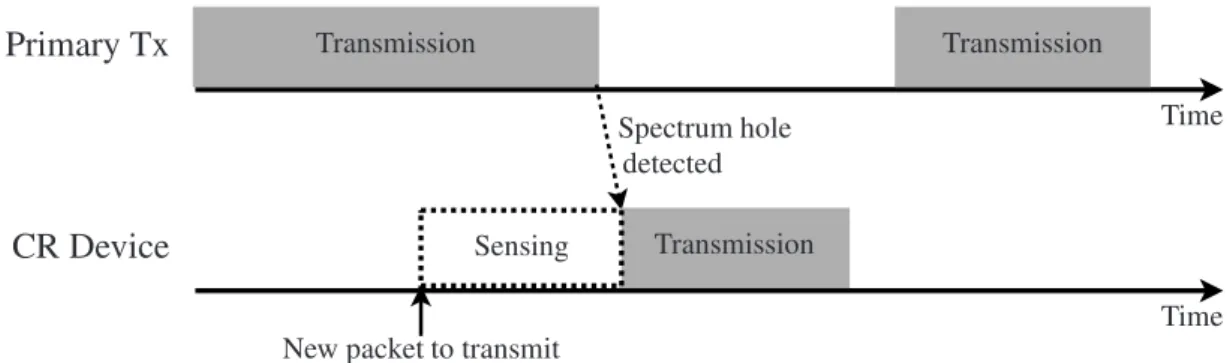
A more flexible and dynamic approach to DSA which is highly popular in the CR research domain is the use of spectrum sensing for dynamic identification of unused spectrum eligible for secondary access [86][99]. Here, the cognitive wireless devices continuously measure the interference levels on the channels potentially available for secondary reuse and transmit their packets as soon as they detect the unused spectrum due to the interference on a particular channel dropping below a pre-defined threshold, e.g. -107 dBmW for TVWS [23]. A simplified scenario that describes this opportunis-tic approach to DSA is depicted in Figure2.2. When the CR device has a new packet
replacements Primary Tx CR Device Transmission Transmission Transmission Sensing Time Time
New packet to transmit
Spectrum hole detected
Figure 2.2: Opportunistic spectrum access using spectrum sensing in cognitive radio (CR) networks
to transmit, it starts sensing the interference levels received from the primary system transmitters and in some cases from other CR transmitters. As soon as it detects the lack of primary or secondary transmissions on a particular channel it transmits its own packet using the detected spectrum hole. If another primary user transmission starts before the secondary CR transmission finishes, the latter is interrupted and resumed at the next opportunity.
This “listen-before-talk” principle had already been studied by the wireless commu-nications research community before the concepts of CR and primary-secondary user spectrum sharing were first introduced [47]. A classical example of such interference measurement based DSA algorithms is the scheme proposed by Akerberg and Brouwer [4]. There, the interference level is measured by the base station (BS) on each channel to determine whether it is available for assignment. The authors investigate the effects of varying the interference threshold, which sets the maximum interference level at which a channel can be assigned to a user, for the least interfered channel scheme, i.e. where a channel with the lowest level of interference is always chosen if available.
Since then such interference measurement based DSA methods have become a highly popular approach to spectrum management among CR researchers, as well as among those investigating more traditional wireless networks without the primary-secondary spectrum sharing considerations. For example, Cheng and Chuang [20] show that a simple aggressive least interference DSA algorithm, that always opportunistically assigns a channel with the least aggregate interference without any admission con-trol, achieves the best performance in a classical hexagonal cell network compared to other known interference sensing based approaches. Ramachandran et al. [69]
propose a dynamic interference-aware algorithm that minimises interference between routers in wireless mesh networks, as well as between the mesh networks and the other co-located wireless networks. They also empirically demonstrate the performance im-provement gained by their algorithm on a physical IEEE 802.11 testbed. A notable example of research on opportunistic spectrum access in CR networks is the paper by Huang et al. [37], where the authors give a closed form analysis of the primary and secondary CR user performance that provides theoretical insight into the capacity of opportunistic spectrum access under primary user protection constraints. Another well-known example of theoretical work on opportunistic spectrum access in CR net-works is a number of cognitive medium access control (MAC) protocols proposed by Zhao et al. [100] based on the partially observable Markov decision process (POMDP) model of the DSA problem they develop. These decentralised protocols are designed to optimise the performance of the secondary users while limiting the interference perceived by the primary users.
Opportunistic spectrum sensing described in this subsection is a significantly more dynamic and adaptable approach to DSA which has the potential to achieve higher spectrum utilisation efficiency, compared with the spectrum database approach. How-ever, there are also some drawbacks associated with it [99]. For example, the hardware required to facilitate precise spectrum sensing is likely to cause a significant increase in the cost and energy consumption of the CR devices. They are also susceptible to the hidden terminal effect, where a CR node is unable to detect an incumbent transmission due to the effects of shadowing and multipath fading, which in turn results in harmful interference for the primary user.
2.2.3
Regulatory Approach
A more recent problem investigated by researchers, mobile network operators (MNOs) and regulators is LTE/LTE-Advanced spectrum sharing facilitated by an emerging framework known as licensed shared access (LSA) [58]. Here, licenses for the use of LTE spectrum are issued upon agreement for a specific geographical area and required time duration. A successful live field trial of implementing LSA-based spectrum shar-ing has already taken place in Finland [66]. Here, an LSA controller was used to
autonomously configure an existing LTE network based on the incumbent spectrum usage data stored in the LSA Repository, i.e. a process similar to the TVWS database approach described in Subsection2.2.1took place but with a higher degree of regula-tory control.
This is a static regulatory approach to spectrum sharing that does not involve any intelligence or cognition in wireless devices and does not require any opportunistic spectrum access techniques. The advantage of this approach is its reliability and the same QoS guarantees as those normally provided to the users of conventional LTE networks with their own exclusive spectrum, but with no need for a permanently owned LTE spectrum band. However, the focus of this thesis is to investigate more flexible opportunistic techniques for DSA that have a greater potential in terms of the spectrum utilisation efficiency, since they are not limited by licenses that restrict the number of different spectrum users sharing the same geographical area.
2.2.4
Mitola’s Cognition Cycle of a Wireless Device
The three well-established approaches to DSA described in this section so far work based solely on spectrum awareness information either measured by the wireless de-vice itself or obtained from a spectrum database or a license repository. They do not involve all aspects of the cognition cycle of an intelligent wireless device originally introduced by Mitola in his PhD thesis [61] where the term “cognitive radio” was coined. This cognition cycle is shown in Figure 2.3. It identifies six fundamental functions performed by a CR device, specifically by its cognitive engine - observe, orient, learn, plan, decide and act. The CR device decides which action it needs to apply to its wireless environment and actsusing the chosen action. It then observes
the consequences of taking that action, orients itself, i.e. processes the observation, and decides upon its next action. In order to decide which action the CR device should take, e.g. which channel it should select for secondary access, it must have a capability toplan its own strategy. Utilising different spectrum awareness information sources, e.g. interference measurements, a geo-location database or an LSA license repository, can be viewed as the “planning” function of a CR device. In all three different DSA approaches described in this section the spectrum awareness information is used to
Figure 2.3: Mitola’s cognitive radio cycle [61]
identify white spaces or spectrum holes eligible for access by the given wireless de-vice, i.e. this functionality enables the wireless device toplanits spectrum assignment strategy. A key function of a CR device as defined by Mitola that is missing from the DSA mechanisms described in this section is the capability tolearnfrom its own ex-perience, i.e. to enable the wireless device to gradually build up an internal knowledge base and improve its performance over time.
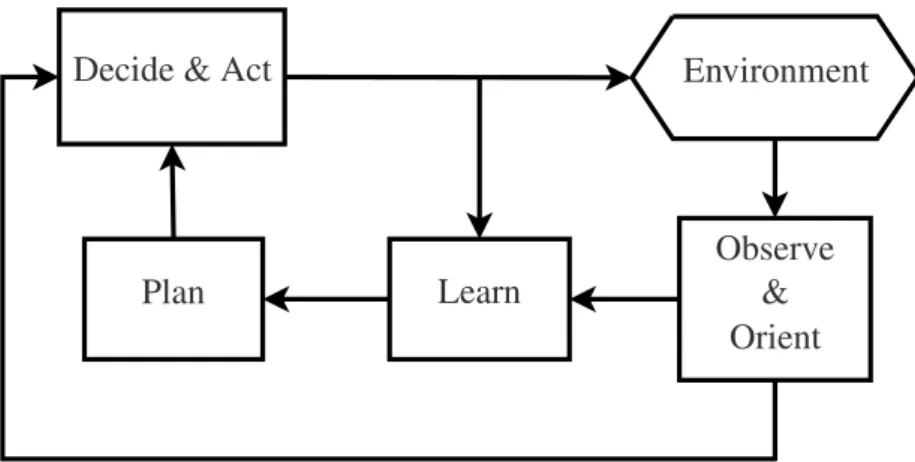
A close inspection of Mitola’s CR cycle shown in Figure 2.3 reveals a fundamental mistake in this diagram - the ”learning” function only has incoming arrows and does not output the learnt information to any other function. A way of fixing this issue proposed in this subsection is reversing the arrow between “learning” and “planning”, since it makes sense to base one’s plans on what has been learnt. It is also consistent with the way humans operate in simple terms - they learn, gain experience and then plan their future actions based on that knowledge.
Secondly, this diagram can be further simplified by removing or modifying several links that are optional for describing a machine’s cognition cycle. For example, the arrow from “orient” to “act” is not required, since the machine always needs todecide
Environment Observe & Orient Learn Plan Decide & Act
Figure 2.4: Simplified Mitola’s cognition cycle of an intelligent wireless device
delay, it can still be classified as adecision. The “observe-learn” link can be replaced by the “orient-learn” link, since it is the same information feeding into the learning process, but appropriately processed. The “orient-plan-decide” link can be assumed to flow either through the “learn” process or bypass ”plan” and straight to ”decide”, since the learning updates are the only thing that can possibly change the existingplan. Therefore the arrow between “orient” and “plan” can be removed. Finally, the “decide-learn” link is equivalent to the “act-“decide-learn” link, since it carries the same information about the chosen action that is fed back to the learning process.
These simplifications result in a considerably more readable and intuitive dual-loop cognition cycle proposed in Figure2.4. There is an outerdecision loopwhich simply looks at the processed outputs of the environment, or itsstate, and chooses an action to be taken in this state. The intelligence is provided by the inner learning and planning loop, where the machine, i.e. an intelligent wireless device, is observing the outputs of the environment caused by its actions and builds up a knowledge base which describes its experience in a way which could be used to derive a plan or apolicyautonomously. The rest of this chapter reviews the existing methods of achieving such machine intel-ligence both in general and specifically in the context of DSA.
2.3
Reinforcement Learning
An emerging state-of-the-art technique for intelligent DSA is reinforcement learning (RL); a machine learning technique aimed at building up solutions to decision
prob-lems only through trial-and-error. The fundamental idea behind RL is that learning processes of all organisms are based on interaction with the environment. The aim of RL methods is to imitate this behaviour in artificial systems [87]. The key feature of RL that can potentially enable full self-organisation and high adaptability in cognitive wireless networks is its lack of need for any a priori knowledge of the environment model [93]. This feature is the main reason for the widespread use of RL for DSA in wireless networks, since building an accurate analytical model of an arbitrary wireless communications environment is often unfeasible or even impossible.
The goal of any RL algorithm is to create a function which maps perceived situations orstatesof the environment toactionswhich need to be taken in them. This is known as thepolicy function. It is developed through system experience of trying different actions in each state and noting the result. This trial-and-error approach does not make any assumptions about the environment model, e.g. such as its structure or whether it exhibits the Markov property. Each state or state-action pair receives a numerical
reward which indicates its desirability. Calculating the reward for each state or state-action pair is handled by thereward function. Another important RL term is thevalue function, also referred to asvalue table, Q-functionorQ-table. It maps each state or state-action pair to the total discounted sum of rewards expected to be accumulated over the future, starting from that state. This is equivalent to the reward in the long run, as opposed to an immediate return.
One of the biggest challenges of RL is estimating the value function. The reward function is often relatively easy to design, since it is only concerned with immediate benefits of taking a certain action in a certain state. However, estimating the value function requires predicting the future of the system to some extent, which is a signif-icantly harder task without the knowledge of a system model.
Another challenge of RL is a trade-off betweenexplorationandexploitation. In each state an RL algorithm always faces two options:
• Choose a previously known action which guarantees the best reward among all other known actions, referred to as thegreedy action. In this case the system is
• Choose a previously unknown action which is likely to have a lower reward than the greedy action. However, there is also a low probability of it being better and becoming the new greedy action. In this case the system is exploringnew possibilities.
2.3.1
Model-Based Reinforcement Learning
One of the fundamental approaches to RL is model-based RL, where a learning agent attempts to build up a model of the environment in a form which would allow it to compute a suitable policy [75][96].
Figure2.5shows a flow diagram of the processes involved in model-based RL. There is an outer output-state-action loop, where outputs of the environment are observed and processed to yield the environment state information, and then the best action is chosen for the current state based on the policy of the learning agent. There is also an inner learning loop, whose role is to learn a good policy to be used by the learning agent. It achieves this goal by observing the actions taken by the learning agent and their outcomes and estimating a model of the environment in the form of a transition probability matrix (TPM) and a transition reward matrix (TRM). The role of the TPM is to indicate the probability of being in a certain state, executing a certain action and making a transition to another state. The TRM states the immediate reward received after a certain state-action-state transition. A policy is then computed from the estimated TPM and TRM using a dynamic programming (DP) algorithm and used for
Outputs Choose Action Compute Policy Estimate Model Sample Outputs Environment Action State State Model Policy
choosing an action in the current environment state. It can be seen from the diagram in Figure 2.5 and the description above that model-based RL follows the dual-loop cognition cycle framework described in Subsection2.2.4, which supports the fact that this is an intelligent learning technique.
Model Estimation
One of the methods of building up TPMs and TRMs is by straightforward counting [75]. It is also referred to as the maximum likelihood model estimation by Wiering [96]. There, for each state-action pair a learning agent counts how many times it made a transition to any other state. It can then normalise the counter values to become a discrete probability distribution. For example, [2, 4, 2] would become [0.25, 0.5, 0.25] which indicates the probabilities of a system to enter one of the three states after executing a certain action in a certain state.
This is a good method for static environments, i.e. where the environment dynamics do not change over time. This approach needs to be modified to be adaptable in dy-namically changing environments which are highly relevant in this thesis, where the investigated environment is a wireless network. For example, Wiering [96] proposes a scheme which aims to reset the TPM and TRM counters according to specially derived formulae and then use prioritised sweeping to update the policy. Prioritised sweeping is a method of filtering and analysing only a small portion of the state-action space, to eliminate the need for analysing the full state-action space, most of which might be irrelevant at a given moment in time [63].
Dynamic Programming
Given the TPMs and TRMs built up by the model estimation algorithm, it is then the task of a DP algorithm to derive the best policy from them. There is a large number of DP algorithms for solving the Markov decision processes (MDPs) expressed by TPMs and TRMs. They all have the same goal - solve the recursive Bellman optimality equation, given below [87]:
Q∗(s, a) =X
s′
P(s, a, s′)[R(s, a, s′) +γmax
a′Q∗(s′, a′)] (2.1)
whereQ∗(s, a)is the long-term cumulative reward of taking actiona in states (also referred to as the Q-value),P(s, a, s′)is the probability of going to states′after taking action a in state s (element of TPM), R(s, a, s′) is the expected immediate reward when an agent takes action a in state s and goes to state s′ (element of TRM), and γ ∈ [0,1] is the discount factor which weights the importance of future long-term rewards with respect to the immediate reward.
It is then straightforward to derive a greedy policy from Q∗(s, a), which maximises the Q-value for every state of the environment. The choice of actions would follow the rule given in (2.2), which states that an action with the highest Q-value must be chosen for every state’s policy.
π(s) =argmaxaQ∗(s, a) (2.2)
Using the model-based RL approach to DSA could provide valuable insight into the dynamics of cognitive wireless network environments by explicitly building up the knowledge about the transition probabilities between various states of the environment, e.g. discrete probability distributions that describe how particular spectrum assignment decisions in certain situations are likely to affect the QoS of the network. However, for the specific purpose of on-line learning and decision making in an arbitrary wireless environment model-free RL methods described in the next subsection are more flexible and significantly more popular in the research literature.
2.3.2
Model-Free Reinforcement Learning
An alternative to model-based RL methods is model-free RL [45], where the Q-function, also known as the Q-table in discrete state-action space,Q∗(s, a)is estimated directly from received rewards, i.e. without the intermediate step of constructing TPMs and TRMs. This type of RL is more popular, since it is significantly more computation-ally efficient and does not require the environment to fit the TRM and TPM model
Outputs Choose Action Derive Policy Estimate Q-Table Sample Outputs Environment Action State State Q-Table Policy
Figure 2.6: Flow diagram of model-free reinforcement learning
template.
Figure 2.6 shows a flow diagram of the processes involved in model-free RL. There is the same outer output-state-action loop as that shown in Figure 2.5, where outputs of the environment are observed and processed to yield the environment state infor-mation, and then the best action is chosen for the current state based on the policy of the learning agent. However, the components of the inner learning loop are different from those of model-based RL. Instead of estimating an environment model in the form of TPMs and TRMs, the Q-values of the state-action pairs are directly estimated and stored in the Q-table. The policy derivation step is then much simpler and does not require a full DP algorithm, but is simply the last step of a DP algorithm defined in Equation (2.2). Since model-free RL has an identical dual-loop cognition structure to model-based RL and the modified Mitola’s cognition cycle defined in Subsection
2.2.4, it can equivalently be viewed as an intelligent learning technique.
Q-Learning
The most popular RL algorithm is Q-learning introduced by Watkins [94]. It is an off-policy method, i.e. the learning of an optimum policy does not depend on the policy followed by a learning agent. It is updating its policy based on the best possible future scenario, rather than what actually happens after an action is taken. Therefore this approach is not experimentation-sensitive, i.e. the learning is not affected by the amount of exploration performed by an agent.
One of its advantages over other RL algorithms is that it has been mathematically proven, e.g. [39][90], that it is guaranteed to converge on an optimal policy for an MDP in a theoretical case where each state is visited and each action is taken an infinite number of times.
The formula for updating a Q-table entry is given in the equation below [87]:
Q(s, a)←Q(s, a) +α(r+γmaxa′Q(s′, a′)−Q(s, a)) (2.3)
where:
• sis the current state of the system,
• ais the action taken in the current states,
• s′ is the next state of the system,
• a′ is the action that can be taken in the next states′,
• Q(s, a)is the Q-value of the current state-action pair.
• α∈[0,1]is the learning rate.
• γ ∈[0,1]is the discount factor.
• maxa′Q(s′, a′)is the maximum Q-value out of all actions in the next states′.
The key steps of the Watkins’ Q-learning algorithm are summarised in Algorithm1.
Algorithm 1Watkins’ Q-learning algorithm [87]
1: Initialise Q-table arbitrarily
2: whilethe learning episode has not finisheddo
3: Detect present state
4: whilepresent state is not terminaldo
5: Choose current action according to action selection policy
6: Take this action, observe next state and reward
7: Update Q-table entry for current state-action pair using Equation (2.3)
8: Store next state as the present state
9: end while
10: end while
The simplicity and convergence properties of Q-learning are the key reasons why it is the most widely used RL algorithm and why most multi-agent RL algorithms are
derived from it [14]. It is also the most widely used RL algorithm in the DSA literature reviewed in Section2.4.
SARSA
The on-policy alternative to Q-learning is the SARSA algorithm [74]. The difference between Q-learning and SARSA is best described by the difference between their up-date formulae given in Equations (2.3) and (2.4) respectively. Instead of using the Q-value of the best action in the next state - maxa′Q(s′, a′), SARSA uses the action
actually chosen in the next state - Q(s′, a′), giving rise to its name {State, Action, Reward, State, Action}. Therefore, its performance is dependent on the exploration strategy chosen by the learning agent, i.e. it is experimentation-sensitive.
Q(s, a)←Q(s, a) +α(r+γQ(s′, a′)−Q(s, a)) (2.4) Although the fact that SARSA is experimentation-sensitive is often considered as a drawback compared to the classical Q-learning algorithm, there are certain cases where SARSA may exhibit better convergence properties than Q-learning, e.g. a simple grid-world walking problem used by Sutton and Barto [87] throughout their book. There-fore, it is also one of the most widely used RL algorithms in the general RL literature and could prove to be effective for DSA in wireless environments.
Actor-Critic Learning
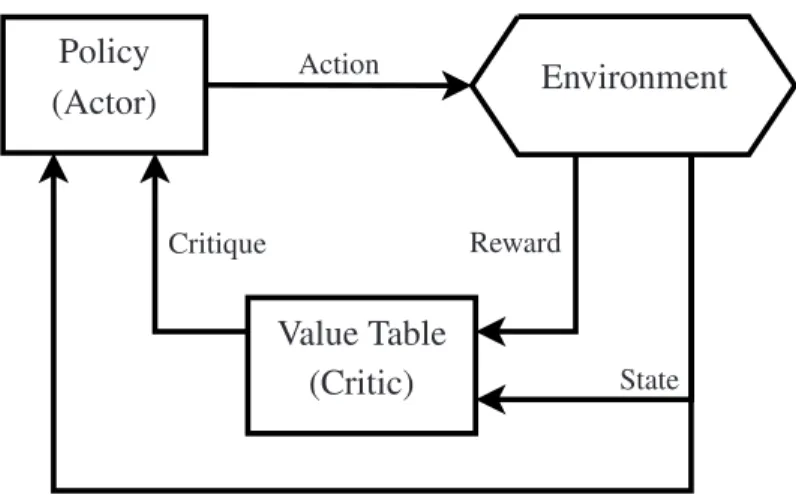
The actor-critic learning methods belong to another popular type of RL, first inves-tigated by Witten [97]. Their general structure is slightly different from that of Q-learning and SARSA. They explicitly separate the policy and the value table in the learning process as shown in Figure2.7.
The policy is an actor responsible for choosing an action in a given state of the en-vironment, and the value table is a critic which observes the outcomes and rewards caused by the chosen actions and critiques them accordingly. If the critique is positive, then the probability of the actor choosing the same action in the same state in future
Environment Value Table (Critic) Policy (Actor) Action State Reward Critique
Figure 2.7: Structure of the actor-critic learning methods
should be increased and vice versa [87].
One potential advantage of such methods is their ability to learn an explicitly stochas-tic policy, i.e. to optimise a probability distribution of selecting various actions in all environment states, e.g. a probability distribution over the potential channels or spectrum holes that could be accessed by a cognitive wireless device. However, a typical disadvantage of the actor-critic methods discussed by Grondman et al. [33] is the lack of adaptability of the critic part of the algorithm in dynamically changing environments. This is a significant issue that limits the applicability of such methods in realistic wireless communications environments which are likely to have a dynamic nature, e.g. in terms of the offered traffic levels and the network topology.
Stateless Q-learning
In some learning problems where an environment does not have to be represented by states, the learning agents are stateless and only the action space and a 1-dimensional Q-tableQ(a)can be considered [21][46]. The job of an RL algorithm then becomes simpler, it aims to estimate an expected value of a single reward for each action avail-able to the learning agent:
Q(a) =E[rt] (2.5)
whereQ(a)is the Q-value of actionaandE[rt]is the immediate reward the learning
agent expects to receive after taking actionaat timet. An equivalent representation of the classical RL algorithms such as Q-learning and SARSA that consider environments
represented by states is the following: Q(s, a) =E " T X t=0 γtrt # (2.6)
whereQ(s, a)is the Q-value of actionain states,rtis the numerical reward received
ttime steps after actionais taken in states, T is the total number of time steps until the end of the learning process or episode, andγis a discount factor.
Claus and Boutilier [21] propose the stateless Q-learning algorithm for independent learners in co-operative multi-agent systems, a simplified version of the classical Q-learning algorithm. Its recursive update equation is given below:
Q(a)←(1−α)Q(a) +αr (2.7) whereQ(a)represents the Q-value of the actiona,ris the reward associated with the most recent trial and is determined by a reward function, andα ∈[0,1]is the learning rate parameter which weights recent experience with respect to previous estimates of the Q-values.
The advantage of formulating learning environments as stateless decision problems and employing the stateless Q-learning algorithm instead of its classical counterpart is the significant reduction in the number of Q-values that need to be estimated by the learning agent, and, therefore, a potentially dramatic reduction in the number of trials needed for it to learn a mature strategy. The latter is also likely to be caused by the fact that the problem of estimating every individual Q-value in stateless Q-learning is significantly simpler as demonstrated by Equation (2.5), as opposed to classical Q-learning or SARSA described by Equation (2.6). Such a significant increase in the speed of the learning process would directly translate into the higher adaptability of RL based cognitive wireless devices, since it would take them less time to learn appropriate DSA policies in a new or dynamically changing wireless environment.
2.3.3
Multi-Agent Reinforcement Learning
Multi-agent reinforcement learning (MARL) is concerned with cases when there is more than one learning agent in the same environment. MARL has strong links with game theory. An MDP in single-agent RL becomes a stochastic game (SG) in MARL, sometimes also referred to as a multi-agent MDP. A large number of MARL algorithms are based on game theory, since it is one of the most suitable frameworks to model the interactions among several agents in a common environment [55]. This gives rise to the investigation of the applications of MARL to different types of SGs - fully cooperative, fully competitive and mixed games.
Extending RL to the multi-agent case presents several challenges investigated by Bu-soniu et al. [14]. In many cases a formal definition of a multi-agent learning goal becomes a difficult task. Every learning agent is affected by the actions of the other learning agents. Therefore, the environment is no longer static, it becomes highly dynamic from the viewpoint of each individual agent. This significantly increases the complexity of the learning tasks and invalidates most convergence guarantees of single-agent RL. A popular way to specify a MARL goal is to use a Nash Equilibrium (NE), as used in the game theory context, where none of the agents in the environment has an incentive to deviate from its policy.
Nevertheless, employing the MARL methods also presents a number of benefits [14]. For example, there is scope for experience sharing among the learning agents to im-prove the initial and steady-state performance of an RL algorithm and, thus, to increase its adaptability. This paradigm lies within the emerging research topic of transfer learning (TL), sometimes also referred to as docitive learning in the wireless commu-nications domain [31]. MARL is also inherently more robust than SARL in that in a certain type of RL problems the faulty agents can be supported or replaced by new ones. Finally, there is a high degree of scalability in MARL, because most MARL algorithms allow easy insertion of new learning agents into the environment.
The rest of this subsection gives examples of several notable MARL algorithms found in the literature.
Nash-Q
The Nash-Q algorithm introduced by Hu and Wellman [36] is an extension of Q-learning to the multi-agent case, where the goal of all agents is to converge to an NE strategy in every state of the environment. The drawback of this algorithm is that every learning agent is supposed to observe the actions taken and rewards received by all other learning agents, and to store all their Q-tables. This is an assumption that may not be valid in many learning problems. It is also inefficient in terms of memory and communication overhead among the agents. However, the advantage of this method, as presented by Hu and Wellman [36], is the proven convergence of this algorithm towards a mixed strategy NE, which is rare in the MARL domain.
Distributed-Q
The Distributed-Q algorithm for fully cooperative SGs is proposed by Lauer and Ried-miller [51]. Here, every learning agent senses the entire environment and performs a single-agent Q-learning algorithm assuming that all other agents will be choosing a certain greedy action at all times. This works extremely well in deterministic envi-ronments. However, in the wireless communications domain the real-world learning problems are bound to be highly stochastic instead, due to random environmental ef-fects which cannot be modelled and predicted. It also assumes that every learning agent is able to accurately estimate the greedy actions of the other agents. This may not be possible in a number of distributed multi-agent learning problems.
Conjecture-Based Reinforcement Learning
A more promising variation of multi-agent Q-learning recently proposed by Chen et al. [19] is called conjecture-based RL. It deals with the stochastic nature of the learning process by defining aconjectureterm which is used in the Q-table update formula. It is effectively a probability of all other learning agents in the environment choosing a particular set of policies, which determines the reward received by the learning agent. It then calculates the expected reward as a weighted sum of possible rewards depend-ing on policies chosen by other agents. Chen et al. [19] successfully use this algorithm
to enable CR devices in a simulated wireless mesh network to learn optimal spectrum and power allocation strategies for improved energy efficiency of the network. How-ever, this approach has only been applied to a relatively small and analytically tractable scenario with six secondary users and five primary users. The scalability of this algo-rithm has not been tested. For example, it is not clear whether this algoalgo-rithm would exhibit good performance during the initial exploration stage of the learning process in a significantly larger and more complex wireless environment, and whether it would maintain its property of converging towards optimal strategies.
Independent Single-Agent Reinforcement Learning
The simplest approach to MARL is the “naive” implementation of independent single-agent RL algorithms for each learning single-agent in the environment, e.g. [77][88]. Despite the fact that the independent learning agents are not even aware of the existence of the other learning agents in the environment, this approach has been successfully applied to various coordination tasks, e.g. [46][77]. For example, an implementation of inde-pendent stateless Q-learning agents in a multi-agent environment has also been shown to exhibit remarkably similar convergence performance in a simple coordination task as the “joint action learner”, but with significantly less information available to the learning agents [21].
The fundamental advantage of this approach is the lack of assumptions about each learning agent’s awareness of the actions performed by the other agents required by the rest of the MARL algorithms described in this subsection so far. It significantly increases the breadth of potential applications of this MARL approach with different information availability constraints, including those in the wireless communications domain.
Heuristically Accelerated Reinforcement Learning
A common disadvantage of RL algorithms is their need for many learning iterations to converge on an acceptable solution. A lot of researchers have been addressing this problem, and one of the more recent promising solutions is the heuristically
ac-celerated reinforcement learning (HARL) approach. Its goal is to speed up the RL algorithms, particularly in the multi-agent domain, by guiding the exploration of the state space using additional heuristic information. According to Bianchi et al. [11], a heuristic policy is derived from additional knowledge, either external or internal, which is not included in the learning process. The goal of the heuristic policy is to influence the action choices of a learning agent, i.e. to modify its current policy in a way which would accelerate the learning process. For example, the first evidence of HARL in the literature is the paper by Bianchi et al. [12], where a heuristic function H(s, a) is defined that dictates which actions should be taken in which states to ex-plore the state-space more efficiently. This function can be obtained from additional expert knowledge or “existing clues in the learning process itself” [12]. In [11] the authors prove the convergence of four multi-agent HARL algorithms and demonstrate that they outperform their classical RL counterparts.
This approach is particularly relevant in the DSA environment where various stan-dardised signals with useful spectrum awareness information may be available to the learning agents.
2.4
Intelligent Dynamic Spectrum Access
This section presents recent developments in the field of intelligent DSA. In the context of this thesis intelligent DSA methods are defined as those based on machine intelli-gence techniques which involve all aspects of the modified Mitola’s cognition cycle of wireless devices discussed in Subsection2.2.4, particularly the learning and planning functionality.
A large amount of research on intelligent DSA in wireless networks focuses on RL techniques, e.g. [7][43][65][89]. The RL algorithms applied to DSA problems can generally be divided into two groups, centralised and distributed. The centralised methods employ one RL agent which controls the operation of the whole network, whereas the distributed methods are multi-agent RL systems which involve signifi-cantly less network-level information exchange and primarily use local measurements to make spectrum assignment decisions.
2.4.1
Centralised Reinforcement Learning Approach
Early research work on RL based DSA largely focuses on centralised methods, which use a single control unit for the whole network. It has access to all network information and better suits the original Q-learning algorithm developed by Watkins [94], the most widely used RL algorithm to date. One of the main advantages of the classical single-agent Q-learning approach is that it was proven to converge on an optimal solution in a single-agent MDP context, as explained in Subsection 2.3.2. As soon as other Q-learning agents are introduced into the environment, this convergence is no longer guaranteed.
A classical example of the original Q-learning algorithm applied to a centralised DSA problem is the algorithm proposed by Nie and Haykin [65], where a state of the envi-ronment is determined by the index of a cell where a call arrival occurs and the num-ber of channels available for assignment in the given cell. This algorithm is shown to significantly outperform fixed spectrum assignment schemes using a classical cel-lular network simulation model. It also produces comparable performance to the best known DSA scheme to date - MAXAVAIL, but with a significant reduction in com-putational complexity. Senouci and Pujolle [78] extend the work of Nie and Haykin [65] and implement a centralised Q-learning algorithm which is capable of learning DSA policies considering call admission control, channel assignment and two classes of traffic, all incorporated in their proposed semi-MDP model of the problem. Singh and Bertsekas [82] model the states of the DSA problem in classical cellular networks using the list of occupied and unoccupied channels at each cell and the event that can cause a state transition, i.e. call arrival, departure or hand-off. They then use a tem-poral difference RL algorithm [87] to enable the cellular network to learn the best channel reuse patterns depending on the state of the network. These learnt dynamic channel reuse policies are shown to outperform the best analytical methods found in the literature to date.
Although all of these early works have been instrumental in generating great interest in RL based DSA in the wireless communications research community, a crucial part of the evaluation of their proposed RL algorithms is missing, namely the temporal
characteristics of the learning process. Since classical RL algorithms are based solely on the trial-and-error experience of the learning agent, it typically takes a large number of trials for it to build up a mature knowledge base and to learn an acceptable solution to the given decision problem [87]. In RL based DSA this initial exploration process is likely to result in poor QoS provided to the users of the given wireless environment. Therefore, it is essential to analyse the network performance throughout all stages of the learning process and to minimise the deterioration in QoS caused by the exploration process of the RL mechanism in place. The main goal of most contributions of this thesis is to alleviate this problem of poor temporal performance of RL based DSA algorithms, and to make them more robust and adaptable in such challenging real-time decision problems as DSA in wireless networks.
2.4.2
Distributed Reinforcement Learning Approach
Distributed intelligent DSA schemes became significantly more popular than the cen-tralised methods since the introduction of CR networks which normally involve dis-tributed decision making by a number of wireless devices [42]. For example, Jiang et al. [41] apply distributed RL with an explicit random exploration stage to a network of independent CR transmitter-receiver pairs to enable them to learn efficient spectrum sharing patterns. In [43] Jiang et al. further improve the performance of this dis-tributed RL algorithm by combining it with a more efficient weight-driven exploration scheme. In addition to being fully distributed, the fundamental difference between the DSA scheme proposed by Jiang et al. [41][43] and the centralised RL methods discussed in the previous subsection is that the former uses spectrum sensing as the primary source of information to inform spectrum access decisions, while RL is used to enable the CR devices to suggest appropriate channels with potentially low inter-ference on them. Therefore, the poor performance during the exploration stage of the learning process is not a major issue there, since the opportunistic interference sensing approach introduced in Subsection2.2.2will always be able to achieve adequate QoS before the knowledge obtained through RL further improves it.
Wu et al. [98] propose a MARL based Q-learning approach where every CR device in the radio environment learns a spectrum and power allocation strategy using the