Abstract: Several remote sensing software packages are used to the explicit purpose of analyzing and visualizing remotely sensed data, with the developing of remote sensing sensor technologies from last ten years. Accord-ing to literature, the remote sensAccord-ing is still the lack of software tools for effective information extraction from remote sensing data. So, this paper provides a state-of-art of multi-sensor image fusion technologies as well as review on the quality evaluation of the single image or fused images in the commercial remote sensing pack-ages. It also introduces program (ALwassaiProcess) developed for image fusion and classification.
Keywords: Commercial Processing Systems, Image Fusion, quality evaluation.
INTRODUCTION
Automatic recognition, description, classification, and grouping of patterns are important problems in a variety of engineering and scientific disciplines such as statistics, computer-aided diagnosis, marketing, com-puter vision, bio-medicine, and remote sensing. This topic has been extensively studied and applied to several tasks in various areas, with continual evolution of com-puters and sensors, it has become increasingly important to understand the interactions and associations between data from different sensors and deduce meaningful in-ferences. Remote sensors offer a wide variety of image data with different characteristics in terms of temporal, spatial, radiometric and spectral resolutions. Very high spatial resolution enables an accurate description of shapes, features and structures while high spectral reso-lution enables better identification and discrimination of the features based on their spectral response in each of the narrow bands. A current remote sensor offers multi-spectral sensors and advanced multi-multi-spectral sensors called hyper-spectral sensors, it detects hundreds of very narrow spectral bands throughout the visible, near-infrared, and mid-infrared portions of the electromag-netic spectrum. also, high spatial ranges from (0.5m-10m) in remote sensing commercial domain such as IKONOS, QuickBird, OrbView-3 and SPOT-5…etc. despite that more than 80% of the modern earth obser-vation satellite sensors and many airborne digital cam-eras simultaneously, offers a tradeoffs between high spatial and high spectral resolution, and no single sys-tem offers both (i.e. collects high-resolution panchro-matic (Pan) and low-resolution multispectral (MS) im-ages or the opposite). For example TM Sensors on
board the Landsat-series of satellites imagery has sig-nificant advantage in 6 spectral wavebands but is very poor in spatial resolution (30m) for certain applications, whereas The HRV sensors on board the SPOT-series of satellites performed very well in spatial resolution 10m but with low-spectral resolution, as a single-channel PAN image and three multispectral images at spatial resolution 20m. In order to automate the processing of these satellite images the concepts for image fusion are needed.
The term “image fusion” covers multiple techniques used to combine the geometric detail of a high-resolution panchromatic image and the colour information of a low-resolution multispectral image to produce a final image with the highest possible spatial information content, while still preserving good spectral information quality. Multi-sensor image fusion is widely recognized as an efficient tool for improving overall performance in im-age based application. Some of the common applications of image fusion includes; visual display enhancement, pattern recognition, machine learning, Object separa-tion[1], texture information[2] image categorization and retrieval [3], Classification of Forest [4], and vehicle detection [5.], targets tracking [6], ….etc. The applica-tions themselves usually used to drive the choice of as-sociated with fusion algorithms. Although advance-ments in image fusion have been made, the research has established that no single fusion algorithm can work for every application; because the sensors of images them-selves have varying responses under different operating conditions such as merging images of multi-spectral differ with merging hyper-spectral satellite sensor data. As a result, a lot of variations of image fusion tech-niques appeared in the lecturer. Thus, associated algo-rithms are generally tuned toward specific tasks and leading to custom solutions as well as depends upon the user’s experience. Image fusion is only an introductory stage to another task Therefore; the performance of the fusion algorithm must be measured in terms of im-provement or image quality to evaluate the possible benefits of fusion. With increasingly sophisticated algo-rithms, the need for a cost-effective and standardized on designing software for image Fusion and quality evalu-ate the possible benefits of fusion.
Recently
, quite a few survey papers have been pub-lished, providing overviews of the history, develop-ments, Evaluation, and the current state of the art of image fusion in the image-based application fields [7-11]. But recent development of multi-sensor data fusion in remote sensing software packages has not been dis-cussed in detail. The objectives of this paper are to pre-IMAGE FUSION TECHNOLOGIES IN COMMERCIAL REMOTE SENSING PACKAGESFirouz Abdullah Al-Wassai1 and N.V. Kalyankar2
1
Research Student, Computer Science Dept., (SRTMU), Nanded, India
2
Principal, Yeshwant Mahavidyala College, Nanded, India
sent an overview of the image fusion tools in the soft-ware packages are available for the explicit purpose for visualizing of remote sensing images. Focuses mostly on image fusion and quality evaluation of the single image or fused images components of these packages. The subsequent sections of this paper are organized as follows: section II gives the brief overview of the text-books with their software implementation. III covers the review on Image Processing Systems; IV This section gives a quick overview the program ALwassaiProcess for image fusion and classification and is subsequently followed by the conclusion.
REVIEW ON THE TEXTBOOKS WITH THEIR SOFTWARE IMPLEMENTATION
There are many textbooks in image processing which include a software implementation include: Lindley, C. A.: Practical Image Processing in C [12] and Pitas, I.: Digital Image Processing Algorithms [13] which both cover basic image processing and computer vision algo-rithms. Parker, J. R.: Practical Computer Vision Using C [14] offers an excellent description and implementa-tion of low-level image processing tasks within a well-developed framework, but again does not extend to some of the more recent and higher level processes in computer vision in his later text Image Processing and Computer Vision such as image [15]. In Computer Vi-sion and Image Processing [16] takes an applications-oriented approach to computer vision and image proc-essing, offering a variety of techniques in an engineer-ing format, together with a workengineer-ing package with a GUI. However, image fusion techniques were absent. Image Processing in Java [17], concentrates on Java only and concentrates more on image processing sys-tems implementation than on feature extraction (giving basic methods only) as the previous the image fusion was absent. Masters, T.: Signal and Image Processing with Neural Networks– a C++ Sourcebook [18] offers good guidance in combining image processing tech-nique with neural networks and gives code for basic image processing technique, such as frequency domain transformation. The newest textbook in depth of image processing of remote sensing Mather, P. M.: Computer Processing of Remotely-Sensed Images [19] offers an excellent description and implementation of image processing for Remotely-Sensed Images tasks.
Through, A hundreds of variations of image fusion techniques Publications in the lecturer it were absent in these previous books with their software implementa-tion as well as the image quality to evaluate the possible benefits of fusion, except [19] has some methods as the image fusion techniques.
REVIEW ON COMMERCIAL REMOTE SENSING PACKAGES
In recent years, a number of commercial remote sens-ing packages have been greatly developed, their per-formance and functionality owing to the advances in computing technology in direct response to the need for
efficiently processing a huge quantity of remote sensing data and many are screen-based using a Windows sys-tem. There are so many Image fusion techniques among them some are used for image fusion in these system includes, intensity-hue-saturation (IHS), high-pass fil-tering (HPF), principal component analysis (PCA), dif-ferent arithmetic combination e.g., Brovey transform (BT) and wavelet transform [20-25]. A number of ma-ture image processing systems for illustration and de-scription remotely sensed data, but are not limited to, include:
1.
IDRISI is a sophisticated desktop raster geographic information and image processing system; it is de-veloped by the Graduate School of Geography at Clark University, Worcester, and Massachusetts. The latest release, called IDRISI Andes (version 15), is 32-bit Windows NT– compatible. This affordable system comprises over 250 modules or stand-alone programs for the digital analysis and visualization of spatial data, including the remotely sensed imagery, in a single package [26]. It is widely being used by government agencies, schools, research institutions, academia, and the private sector testifies to its popu-larity [27]. However, IDRISI offered limited capa-bilities of image fusion technologies as maintained above, as well as the image quality evaluation, there was absent.2. ERDAS Imagine is one of the oldest and leading geoinformatic software companies. Its major prod-uct, Imagine, contains a suite of comprehensive and sophisticated tools for digital analysis of remotely sensed data. ERDAS Imagine is offered at three le-vels, Essentials, Advantage, and Professional. Im-agine Essentials encompasses a set of powerful tools for manipulating geographic and imagery data, such as image georeferencing, visualization, and map output. Imagine Advantage extends the capabilities of Imagine Essentials through addition of several more functions, such as mosaicking, surface interpo-lation, advanced image interpretation. Imagine Pro-fessional contains more classification and spectral analysis, and radar processing utilities than Imagine Essential. In addition to all those modules included in both Essentials and Advantage, it also encom-passes add-on tools for complex image analysis and modeling, radar data analysis and advanced classifi-cation [26]. Despite that ERDAS Imagine has the limited range of image fusion it offers the most pop-ular methods as the previous system, and the image quality evaluation for evaluation the possible benefit of fusion it was absent. Also, with many add-on modules, ERDAS image could be quite expensive. 3. ENVI:Produced by Research Systems (now called
ITT Visual Information Solutions), ENVI is a com-prehensive icon-driven image analysis package de-signed especially for processing large multispectral and hyperspectral remote sensing data [28]. ENVI contains in image processing functions for image fu-sion, but with the most popular methods as
main-tained above. As an important image analysis sys-tem, ENVI offers a wide range of traditional and nontraditional image classifiers. For instance, it is one of the earliest systems with the capability of im-age classification based on machine learning. At present ENVI is able to classify images using neural network and binary encoding [26]. However, image quality evaluation for evaluation the possible benefit of fusion it was absent. Also, the operation of ENVI can be further improved via better organization of some functions such as image display; Graphic icons may be added to accompany the functions in the toolbar for quick access.
4. ER Mapper is an Australian software company spe-cializing in digital image analysis. Its major product of the same name is a powerful window-based im-agery analysis package that offers a complete suite of image processing tools [29]. However, ER Map-per has a limited range of image fusion functions. ER Mapper offer the evaluated of classified images results for their accuracy. The produced confusion matrix shows the producer’s and user’s accuracy, as well as the overall accuracy. But no special modules are available for assessment of the other images quality.
5. PCIGeomatica: Headquartered in Toronto, Canada, PCI is a leading software developer specializing in remote sensing, digital photogrammetry, and carto-graphy. This package of an extensive suite of geos-patial tools offers the most complete geosgeos-patial solu-tion via its many built-in capabilities. The strength of PCI lies in its high degree of automation and custo-mized workflows [26]. However, this advantage turns to a limitation at the same time as it can be ap-plied to a narrow range of image fusion and the as-sessment of the image quality it was absent as the previous systems.
6.
GRASS GIS: commonly referred to as GRASS(Geographic Resources Analysis Support System), is free Geographic Information System (GIS) software used for geospatial data management and analysis, image processing, graphics/maps production, spatial modeling, and visualization. GRASS GIS is current-ly used in academic and commercial settings around the world, as well as by many governmental agen-cies and environmental consulting companies. GRASS GIS is an official project of the Open Source Geospatial Foundation (OSGeo) [30]. Also has a limitation of image fusion technique as well as the assessment of the image quality it been absent. SUMMARY OF PROGRAM ALWASSAI-PROCESS FUNCTIONS
This program has been created to serve as a laboratory to implement routines of image processing. ALwassai-Process runs in Window and free software for academic.
Its interface and implemented in VB6 Aiming simplicity at simplicity we did not use complex classes to model images and other objects, so the code looks like an ex-tended C++ or C. In several situations ALwassaiProcess can be the tool to develop new Image Processing algo-rithms, articles, thesis and dissertations.
This section gives a quick overview of running AL-wassaiProcess. The Starting ALwassaiProcess by Instal-lation of ALwassaiProcess under Windows, ALwassai-Process is available as a standard installer package. As-suming that ALwassaiProcess is installed in the PATH, you can start ALwassaiProcess by double clicking on the ALwassaiProcess application link (or shortcut) on the desktop. When starts ALwassaiProcess it appears with the main window as shown in Fig.1, It include, menu bar and Tool bar. The Toolbar includes some Icons for quick access to the functions in menu bar items.
The functions provided by ALwassaiProcess are ac-cessed from the main menu bar items as the following: File, Edit, View, Image Processing, Filter, Transforma-tion, ClassificaTransforma-tion, Measure and analysis, Tools, Win-dow and help.
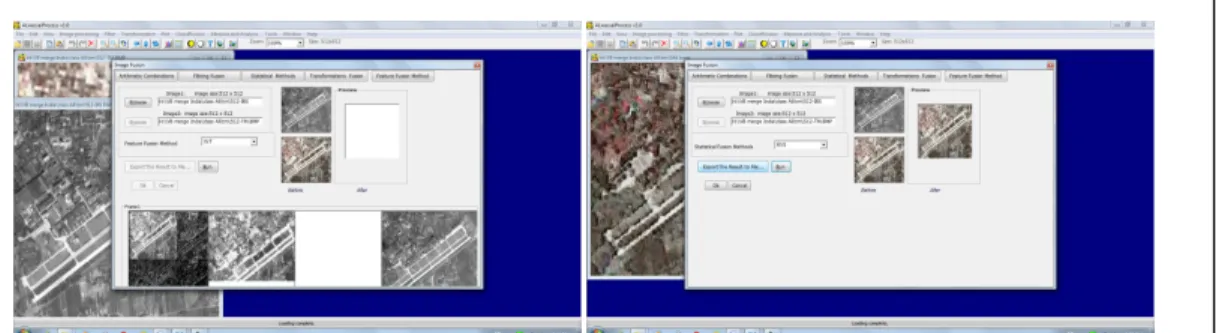
There are many functions provided for image process-ing in the program, but we cannot describe it properly, because of limitations. But here few snapshots are illus-trated for some functions it’s appeared in Fig.2-8. This program exactly interested with image fusion and classification. The most important thing is introduced in it that is evaluation of images for different purpose in academic research subject. The goal of this program provides the functions for automatic image fusion and classification, which is difficult as well as limited in the previous software as maintained. And some of them are very costly. Here, the program is cover most the effec-tive algorithms in image fusion as well as in classifica-tion. There is a need for image fusion or classification that are manipulations such as re-sampling radiometric correction, noise reduction, filtering,....etc, this program offers it or above things. We would like to maintain in the program, the filtering methods work corresponding to textbooks of image processing.
Fig.1 The Main Window, showing the menu bar at the top, Tool bar and children window containing a Composite RGB for landsat-TM.
Fig. 2:
File Menu
Fig. 2: Examples for some functions such as WV and Automatically Displays the Results of Fuse as well as Export the Results by Icon.
Fig. 3 Snapshots Illustrated the Arithmetic Combination and Statistical Fusion Methods Menu Respec-tively.
Fig. 4 Snapshots Illustrated the Component Substitution and Feature Fusion Menu Respectively.
Fig. 5a
Fig. 5b
Conclusion
In this way the paper presenting the review on the some textbooks that are implementations the software and some commercial remote sensing packages which are working for image processing and analysis. The results of this review in the textbooks implementation software the image fusion was absent mostly there and the most of commercial remote sensing packages have been widely offer the popularity of fusion algorithms (i.e. PCA, IHS, HPF, BT and WV), despite a lot of variations of image fusion techniques. Are these meth-ods in these products better performance than can be achieved by other techniques to make image fusion
practitioners suitable or accurate enough to use remote sensing specialists communicated efficiently?
However, with the popularity of commercial remote sensing packages, it is easy to obtain processed remote sensing products based on fusion algorithms or Classifi-cation. But, it is noteworthy that these products may not be suitable or accurate corresponding to the conditions of image fusion to use. Where the result of fusion proc-ess is depends on its many applications, so we should to evaluate the benefits of fusion. Therefore, it is still ur-gent needed to make image fusion practitioners effi-ciently. Also, the result of review on commercial remote sensing packages for image evolution is absent there. So, we introduce our program which that it covers 15 techniques of image fusion to answer the previous ques-Fig. 6 Snapshots Illustrated Some Functions for Classification.
Fig. 7a
Fig. 7b
Fig. 7(a, b) Snapshots Illustrated
Automatic quality assessment for
SomeFunctions.Fig. 8a
Fig. 8b
tion. Also, introduces maximums tools in the program which are needed in image fusion and classification as well as provide tools for
automatic quality
assess-ment impleassess-mented in [23-25, 31-33]
Finally, we hope that this program will be helpful in the future to them who want to study in this field and f
urther investigations are necessary
to develops image fusion algorithms.ACKNOWLEDGMENTS
Authors would like to thank everyone who contributed, directly or indirectly, either in the accomplishment or testing of this work. Thanks to Mr. Arvindkumar Gaikwad for helps, during this work.
REFERENCES
[1] Zhao Y., Zhang L., Zhang D., Q. Pan, 2009. “Object separation by polarimetric and spectral imagery fusion”, Computer Vision and Image Understanding, 113 (2009) pp. 855–866.
[2] Mariz C., Gianelle D., Bruzzone L., Vescovo L., 2009. “Fusion of multi-spectral SPOT-5 images and very high resolution texture information extracted from digital or-thophotos for automatic classification of complex Alpine areas”. International Journal of Remote Sensing Vol. 30, No. 11, pp. 2859–2873.
[3] Tuia D., Camps-Valls D., Matasci G., Kanevski M., 2010. “Learning Relevant Image Features With Multiple-Kernel Classification”. IEEE TRANSACTIONS ON GEOSCIENCE AND REMOTE SENSING, VOL. 48, NO. 10, pp. 3780 – 3791.
[4] Wang Y., W. Huang W., Liu Y., Hu Li,
2011.”Classification of Forest Land Information Using Environment Satellite (HJ-1) Data”. I.J. Intelligent Sys-tems and Applications, 4, pp.33-40.
[5] Chen, Y.; Han, C., 2005. “ Maneuvering vehicle tracking based on multi-sensor fusion”. Acta Autom. Sin. 2005, 31, pp. 625–630.
[6] Liu, C.; Feng, X., 2006. “An algorithm of tracking a maneuvering target based on ire sensor and radar in dense environment”. J. Air Force Eng. Univ. 2006, 7,pp. 25–28. [7] Smith, M.I.; Heather, J.P., 2005. “Review of image fu-sion technology in 2005”. In Proceedings of Defense and Security Symposium, Orlando, FL, USA, 2005. [8] Zhang J., 2010. “Multi-source remote sensing data
fu-sion: status and trends”, International Journal of Image and Data Fusion, Vol. 1, No. 1, pp. 5–24.
[9] Zhang J., 2010. “Multi-source remote sensing data fu-sion: status and trends”, International Journal of Image and Data Fusion, Vol. 1, No. 1, pp. 5–24.
[10]Wang K., S.E. Franklin, X. Guo, M. Cattet, 2010. “Re-mote Sensing of Ecology, Biodiversity and Conservation: A Review from the Perspective of Remote Sensing Spe-cialists”. Sensors 2010, 10, pp. 9647-9667.
[11]Dong J., Zhuang D., Huang Y.,Fu J., 2009. “ Advances in Multi-Sensor Data Fusion: Algorithms and Applica-tions”, Sensors 2009, 9, PP.7771-7784.
[12]Lindley, C. A., 1991. “Practical Image Processing in C”, Wiley & Sons Inc., NY USA.
[13] Pitas, I., Digital Image Processing Algorithms, Prentice-Hall International (UK) Ltd, Hemel Hempstead UK, 1993
[14] Parker, J. R., 1994. “Practical Computer Vision using C”, Wiley & Sons Inc., NY USA.
[15]Parker, J. R., 1996.” Algorithms for Image Processing and Computer Vision”, Wiley & Sons Inc., NY USA. [16]Umbaugh, S. E., 1998.”Computer Vision and Image
Processing, Prentice-Hall International (UK) Ltd, Hemel Hempstead UK.
[17]Lyon, D. A., 1999.”Image Processing in Java, Prentice Hall.
[18]Masters, T., 1994. “Signal and Image Processing with Neural Networks – A C++ Sourcebook”, Wiley and Sons Inc., NY USA.
[19]Mather P. M., 2004. “Computer processing of Remotely Sensed Images”. 3rd Edition, John Wiley & Sons Ltd. [20]Pohl C. and Van Genderen J. L., 1998. “Multisensor
Image Fusion In Remote Sensing: Concepts, Methods And Applications”.(Review Article), International Jour-nal Of Remote Sensing, Vol. 19, No.5, pp. 823-854 [21]Zhang Y., 2004.”Understanding Image Fusion”.
Photo-grammetric Engineering & Remote Sensing, pp. 657-661. [22] Alparone L., Baronti S., Garzelli A., Nencini F. , 2004. “ Landsat ETM+ and SAR Image Fusion Based on Gener-alized Intensity Modulation”. IEEE Transactions on Geo-science and Remote Sensing, Vol. 42, No. 12, pp. 2832-2839.
[23]Firouz A. Al-Wassai , N.V. Kalyankar , A. A. Al-zuky ,2011. “Arithmetic and Frequency Filtering Methods of Pixel Image Fusion Techniques “.IJCSI International Journal of Computer Science Issues, Vol. 8, Issue 3, No. 1, May 2011, pp. 113- 122.
[24]Firouz A. Al-Wassai, N.V. Kalyankar, A. A. Al-zuky, 2011. “The IHS Transformations Based Image Fusion”. Journal of Global Research in Computer Science, Vol-ume 2, No. 5, May 2011, pp. 70 – 77.
[25]Firouz A. Al-Wassai, N.V. Kalyankar, A. A. Al-zuky, 2011. “Multisensor Images Fusion Based on Feature”. In-ternational Journal of Advanced Research in Computer Science, Volume 2, No. 4, July-August 2011, pp. 354 – 362.
[26]Jay GAO, 2009. “Digital Analysis of Remotely Sensed Imagery”. The McGraw-Hill Companies, Inc.
[27] Simonovic, S. P. 1997. “Software review: IDRISI for Windows, 2.0.” Journal of Geographic Information and Decision Analysis. 1(2), pp. 151–157.
[28]ITT. 2007. ENVI—get the information you need from imagery, http://www.ittvis.com/envi/
[29] ER Mapper. 2007. ER Mapper Professional Datasheet, http://www.ermapper.com/frame_redirect.asp?url=/ermap per/ prodinfo/index.htm.
[30]GRASS. http://grass.osgeo.org/
[31]Firouz A. Al-Wassai, N.V. Kalyankar , A.A. Al-Zuky, 2011.” The Statistical methods of Pixel-Based Image Fu-sion Techniques”. International Journal of Artificial In-telligence and Knowledge Discovery Vol.1, Issue 3, July, 2011 5, pp. 5- 14.
[32] Firouz A. Al-Wassai, N.V. Kalyankar, 2012. “A Novel Metric Approach Evaluation For The Spatial Enhance-ment Of Pan-Sharpened Images”, CS & IT 06, pp. 479–493, 2012. DOI : 10.5121/csit.2012.2347.
[33] Firouz Abdullah Al-Wassai, N.V. Kalyankar, A. A. Zaky, 2012."Spatial and Spectral Quality Evaluation Based on Edges Regions of Satellite: Image Fusion”, IEEE Computer Society, 2012 Second International Conference on ACCT 2012, pp.265-275.