ISSN: 2348-7860 (O) | 2348-7852 (P) | Vol. 5 No. 7 | July 2018 | PP.
445-449
Digital Object Identifier DOI®
http://dx.doi.org/10.21276/ijre.2018.5.7.2
Copyright © 2018 by authors and International Journal of Research and Engineering
This work is licensed under the Creative Commons Attribution International License (CC BY).
creativecommons.org/licenses/by/4.0
|
|
ORIGINAL ARTICLE
Comparison of Different Distance Measure Methods in
Text Document Clustering
Author(s): *
1Yin Min Tun
Affiliation(s):
1Faculty of Computer Sciences
University of Computer Studies, Mandalay, Myanmar
*
Corresponding Author : [email protected]
Abstract:
Clustering
text
document
is
an
unsupervised learning method to find common
groups. The clustering of text documents are the
special issue in text mining for unlabelled train
documents. Fortunately, there are many proposed
features and methods to resolve this problem. The
framework of text document classification consists
of: input text document, pre-processing, feature
extraction
and
clustering.
The
common
classification methods are: self-organization map,
k-means and mixture of Gaussians. The correlation
of resulted clusters is based on selecting a distance
measure method. The main focus of this paper is to
present different exiting distance measure methods
along with k-means clustering for text document
clustering. The experiment performed k-means
clustering on the Newsgroups dataset and measure
clustering entropy to evaluate the different distance
measure methods.
Keywords:
Text mining; text document clustering;
distance measure, k-means clustering.
I.
INTRODUCTION
In information analysis and text mining, document classification or categorization of documents is a special issue to label the document to one or more classes. The text document is the unstructured information and has much useful information. The text document clustering is an unsupervised learning to group text documents for useful information and manages the source of text documents. The document clustering can be done in manual but it takes many times and cost. The automatic document clustering is required to over these problems and therefore many researches try to propose many features with different clustering methods.
The early system uses text document clustering for to assign incoming email to group such as change of bank connection, promotion mail, personal mail and membership. This system supported of decrease response time, flexibility and mail management. The other application areas of text document clustering are: Spam filtering, Language identification, News topic classification, Authorship attribution, Genre classification and Email surveillance.
An automatic text document clustering system can assign each document to suitable cluster and extract what is important from data, categorizing and making it available for more effective search and analysis. Document (or text) clustering is a subset of the larger field of data clustering, which borrows concepts from the fields of information retrieval (IR), natural language processing (NLP), and machine learning (ML), among others. This is exclusively support news sites, publishers or anyone who manages many categories. This paper mainly presents the properties of different existing distance measure methods in K-means clustering algorithm.
In general, the approaches to documents clustering problem, including the (multilevel) self-organization map [1], mixture of Gaussians [2], spherical k-means [3], bi-section k-means [4], mixture of multinomial [5]. Most of the existing approaches to documents clustering problems did not consider the time-dependent important of the clusters i.e. "how clusters change over time (user-specified time’s example: past versus present and yesterday versus today, etc.)". However some work done on clustering data streams take into account the time depend important of clusters and employ a special statistics structure called cluster profile.
Document clustering is too slow for large dataset and not support for retrieval. Other browsing techniques and fast clustering algorithms are proposed to improve the performance of retrieval [6]. Genetic algorithm (GA), harmony search (HS) algorithm, and particle swarm optimization (PSO) algorithm are proposed for feature selection algorithms with feature weight scheme and
dynamic dimension reduction for the text document clustering problem. A new dynamic dimension reduction (DDR) method is also proposed to reduce the number of features used in clustering and thus improve the performance of the algorithms. Finally, k-mean, which is a popular clustering method, is used to cluster the set of text documents based on the terms (or features) obtained by dynamic reduction [7].
Rest of the paper is listed as follows. Section II presents the general framework of text document clustering. Section III includes the brief review on various distance measures in text document clustering. Then section IV concludes this paper along with possible future works.
Text Document Classification
The document classification composed of three phases:
1. Text Preprocessing 2. Feature extraction process 3. Clustering process.
The overview of the system design is described in Figure 1.
Fig. 1. Overview of text document Clustering system
A. Text Preprocessing
In text preprocessing, the documents are processed and formed into vector of term defined by a dictionary. The dictionary is created from the preprocessing of documents. The preprocessing tasks are: tokenization, stop words removing and stemming.
• Tokenization breaks up a sequence of strings into pieces such as words or keywords called tokens. Tokens can be individual words, phrases or even whole sentences. In the process of tokenization, some characters like punctuation marks are discarded. • The useless words from tokens are defined as stop
words. The stop word list is a list of commonly used word (such as “the”, “a”, “an”, “in”) that can’t effect the meaning and information of text documents. The stop words removal removes words that occur commonly across all the documents in the corpus. • Stemming algorithms cuts off the end or the beginning
of the word and takes into account a list of common prefixes and suffixes. This indiscriminate cutting can be successful in some occurrences, but remain some issues to solve. The stemming task reduces different grammatical forms / word forms of a word like its noun, adjective, verb, adverb etc. to its root form.
B. Feature Extraction
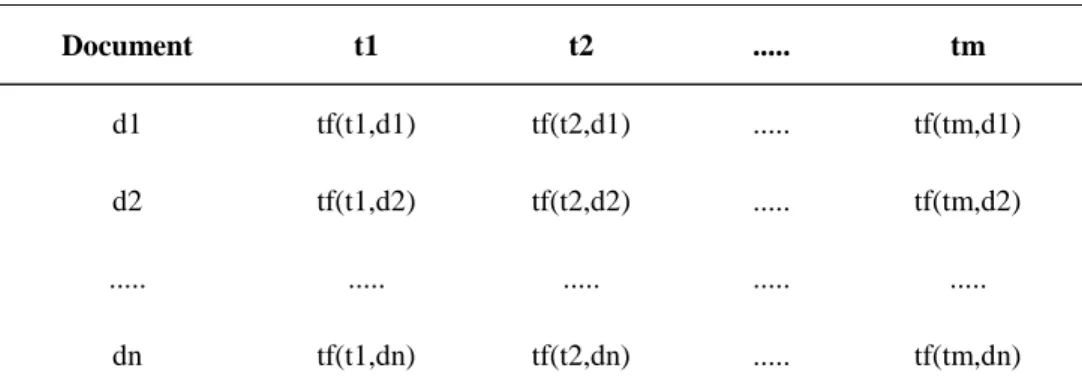
Feature extraction from text document is to create a matrix of numerical values to represent text documents. The common ways of feature extraction are: Term Frequency vector (TF) and Term Frequency inversed Document Frequency (TFIDF) vector. After preprocessing on all documents, all tokens are lowercase, stop words removed and no duplicate. This collection of tokens is called dictionary or corpus. The Term Frequency TF (t,d) is simply to calculate the number of times each word appeared in each document. The dictionary has the m term and the vector representation for total number of n documents is shown in table 1. Text documents Text Preprocessing Feature Extraction Clustering Cluster 1 …. Cluster 2 Cluster k
TABLE I. TERM FREQUENCY VECTOR FOR DOCUMENTS
Document t1 t2 ... tm
d1 tf(t1,d1) tf(t2,d1) ... tf(tm,d1)
d2 tf(t1,d2) tf(t2,d2) ... tf(tm,d2)
... ... ... ... ...
In table I, t1=term 1, t2=term 2, m= total terms in dictionary, tf(tm,dn)=the frequency of term m in document n and n is the total number of documents .
tfidf(t,d,D)=tf(t,d)×idf(t,D) (1)
where t denotes the terms; d denotes each document; D denotes the collection of documents. The formula for idf (t,D) is:
( ) (2)
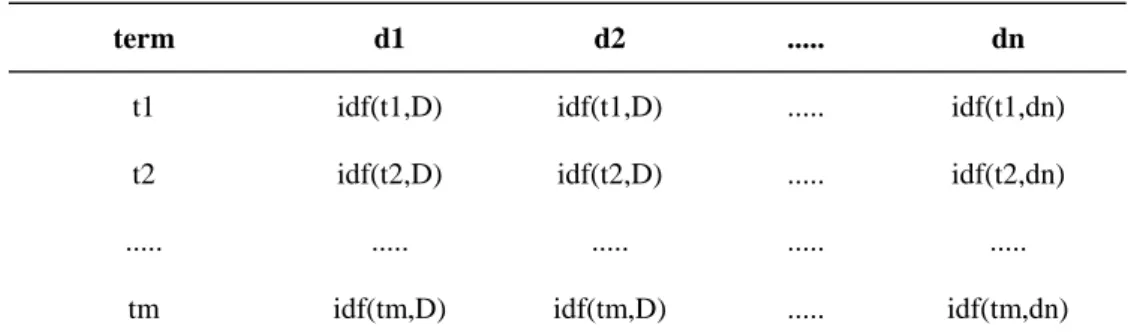
where D = d1,d2,…,dn where n is the number of documents in collection. | {dD:td} | is the total number of times in which term t appeared in all of your document d ( the dD restricts the document to be in current document space ). The idf for all terms in dictionary is shown in table 2.
C. Text Document Clustering
In text document clustering, the k clusters are formed by using k-means clustering algorithm. The K-means clustering algorithm clusters the data into k groups where k is predefined. Select k points at random as cluster centers.
Fig. 2. K-means Clustering Algorithm
Assign objects to their closest cluster center according the Euclidean distance function. The different distance measuring methods can be used instead of Euclidean distance measure. The k-means algorithm for text document clustering is shown in figure 2.
The inputs for k-means clustering are tfidf matrix representation for all documents and number of cluster. In this paper, we use k=20 and 20 news groups text dataset. The output of the k-means is number of clusters and their centriod. These resulted centriod valued can be used for new incoming text document to assign to the one of the cluster.
II.
DIFFERENT
DISTANCE
MEASURE
AND
EXPIREMENT
The choice of distance measures is an important step in text document clustering. It defines how the similarity of two elements (x, y) is calculated and it will affect the shape of the clusters. The classical methods for distance measures are Euclidean, Manhattan distance, Minkowski, cosine and humming.
Euclidean distance measure is:
( ) √∑ ( ( ) ( )) (3)
Manhattan distance measure is:
( ) ∑ ( ) ( ) (4)
Minkowski distance measure is:
( ) (∑ ( ) ( ) ) ⁄ (5) One minus the cosine is used as distance measure:
( ) ( (∑ ( ) ( ) )
√∑ ( ) √∑ ( )) (6) Hamming distance is:
( ) (∑ ( ) ( ) ) (7) TABLE II. IDF FOR ALL TERMS IN DICTIONARY
term d1 d2 ... dn
t1 idf(t1,D) idf(t1,D) ... idf(t1,dn)
t2 idf(t2,D) idf(t2,D) ... idf(t2,dn)
... ... ... ... ...
A. Text Dataset
The Newsgroups text dataset consists of 18,846 articles evenly divided among 20 UseNet discussion groups. The resulting vocabulary, after preprocessing has 26,214 words. This paper used Newsgroups dataset to show the advantages of different distance measure in text document clustering. This dataset originally separate 10191 text files for training and 7532 for testing.
B. Experiment and Evaluation
The system is evaluated on Newsgroups text dataset and compares the average entropy value of clusters according to the distance function. Typical goal of clustering is to attain high intra-cluster similarity and low inter-cluster similarity. For analytical research clustering, we need to measure the entropy of clusters. Entropy of Clustering C is :
( ) ∑ ( ) (8)
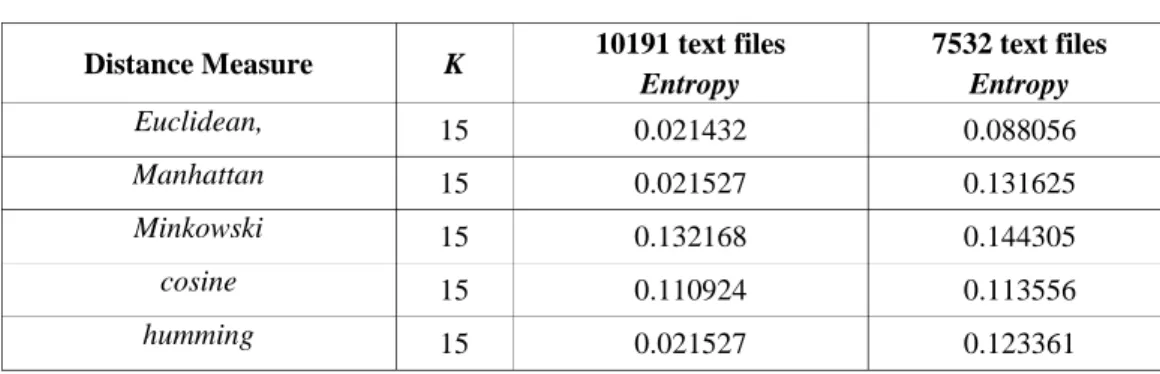
Where Di is the number of document in resulted cluster and n is the actual number of document in cluster i. The experimental results for different distance functions are shown in table 3. The entropy value is between 0 and 1. The best entropy value is closed to 0.
.
III.
CONCLUSION
This paper focused on different distance measure methods that have been used for text document clustering. The major distance functions for text document clustering are Euclidean, Manhattan distance, Minkowski, cosine and humming. The paper reviews and proposed different distance functions to show a good result with an ability to cluster text documents. The experiment shows the adding of documents in next time. K-means is one of the simplest unsupervised learning algorithms that solve the well-known clustering problem and can cooperate with different distance functions for better clustering entropy result. Our experiment shows the advantages and influence of distance measures in k-means. In future, we need to exploit more distance measure methods to successfully cluster the massive unlabeled train data in unsupervised learning.
IV.
DECLARATION
Author has disclosed no conflicts of interest. The project was self-funded.
TABLE III. ENTROPYOFCLUSTERINGRESULTACCORDINGTODISTANCEMEASURE
FUNCTIONSWITHK=15
Distance Measure K 10191 text files 7532 text files
Entropy Entropy Euclidean, 15 0.021432 0.088056 Manhattan 15 0.021527 0.131625 Minkowski 15 0.132168 0.144305 cosine 15 0.110924 0.113556 humming 15 0.021527 0.123361
In table 3, we cluster 10191 text files using k-means clustering with k=15. After getting 15 clusters and their centrids we test 7532 text files to assign suitable cluster by measuring the distance between and centriods.
TABLE IV. ENTROPYOFCLUSTERINGRESULTACCORDINGTODISTANCEMEASUREFUNCTIONS
WITHK=20
Distance Measure K 10191 text files 7532 text files
Entropy Entropy Euclidean, 20 0.091231 0.094672 Manhattan 20 0.013494 0.138389 Minkowski 20 0.013494 0.138389 cosine 20 0.011144 0.015128 humming 20 0.00521 0.013043
In table 4, we cluster 10191 text files using k-means clustering with k=20. After getting 20 clusters and their centroids we test 7532 text files to assign suitable cluster by measuring the distance between and centroids.
REFERENCE
[1]. Kohonen, S. Kaski, K. Lagus, J. Honkela, V. Paatero, A. Saarela, "Self organization of massive document collection", IEEE Trans,Neural Networks, vol.11, 2000, pp. 574-585.
[2]. J Tanturm, A. Murua, W. Stuetzle, "Hierarchical model-base clustering of large database through fraction ", Proc. 8th ACM SGKDD Int. Conf Knowledge Discovery and Data Mining, 2002, pp. 183-190.
[3]. S. Dhillon , D. S. Modha, "Concept decompositions for large sparse text data using clustering", Machine Learning, vol. 42, 2001, pp. 143-175.
[4]. M. Steinbach, G. Karypis, V. Kumar, "A comparison of document clustering techniques", KDD Workshop on Text Mining, 2000, pp. 109-110.
[5]. S. Vaithlyanathan, B. Dom, "Model-based hierarchical clustering", Proc. 16th Conf. Uncertainty in Artificial Intelligence, 2000, pp. 599-608.
[6]. Cutting, D. R., Karger, D. R., Pedersen, J. O., & Tukey, J. W. (2017, August). Scatter/gather: A cluster-based approach to browsing large document collections. In ACM SIGIR Forum (Vol. 51, No. 2, pp. 148-159). ACM.
[7]. Abualigah, Laith Mohammad, et al. "Text feature selection with a robust weight scheme and dynamic dimension reduction to text document clustering." Expert Systems with Applications 84 (2017): 24-36.