294 | P a g e
STRENGTH APPRAISAL BY FIBRE EINFORCEMENT
IN CONCRETE
Madhuri M. Nerpawar
1, S.S.Bachhav
2, D.Y. Kshirsagar
31
Master of Engineering Student, 2 PG Coordinator, 3Head of Department
Department of Civil Engineering, S.S.V.P.S. Collage of engineering Dhule, Maharashtra (India)
ABSTRACT
This paper presents the Compressive strength of high strength concrete with the replacement of cement with
Alccofine and Fly ash, also addition of polypropylene fibre to increase bonding strength. The necessity of high
strength concrete is increasing because of demands in construction industry. Efforts for improving the
performance of concrete over the past few years suggest that cement replacement materials along with mineral
and chemical admixtures can improve the strength and durability characteristics of concrete. An experimental
program was carried out to explore its effects on compressive, flexural strength under atmospheric curing
condition. The main aim of the investigation program is to study the effect of cement replacement material
alccofine and Fly ash content mix by varying content such as 5%, 7.5%, 10%,12.5% and finding the optimum
Mineral Admixture content also effect of Polypropylene fibre mix by varying content such as 1%,1.5% & 2%
and finding the optimum Polypropylene fibre content. The concrete specimens were tested for mechanical
properties of concrete, namely, cube compressive strength, flexural strength.
Keywords:
Compressive strength, Alccofine, Fly ash, Polypropylene fiber, Flexural strength.
I. INTRODUCTION
During years, many innovations and modernizations in concrete have occurred for betterment of concrete
properties. Regular concrete with Portland cement has been used for several years until the concept of HSC
concrete came in demand. Before the concrete with grade greater than M40 were classified under HSC
but after years the criteria is changed to M60. . It needs many efforts for getting that level strength such as
taking under consideration the qualities of the materials used in concrete and the compaction and mixing of
the concrete where the other criteria. After several years of the regular concrete the new methodology of
concrete mixing came to account and that was usage of admixtures both chemical and minerals. The chemical
admixture is in form of Plasticizers and Superplasticizer required for HSC. And the mineral admixtures are
295 | P a g e
Ambuja cements- India. Which not only is the substitute to silica fume but also improves the strength ofconcrete to level. polypropylene is resistant to fatigue, most plastic living hinges, such as those on flip-top
bottles, are made from this material. However, it is important to ensure that chain molecules are oriented
across the hinge to maximise strength.
II. EXPERIMENTAL PROGRAM
Experimental program has been designed to provide results of Alccofine and Fly ash with polypropylene for
making High Strength concrete.To check the performace of Alccofine nd Fly ash various proportion are
studied in investigation.
A) MATERIAL USED
1) Cement- Ordinary cement-53 grade (Ambuja cement) Have been used in investigation.The cement was
tested according to IS 12262:1987.
Table 1.Physical properties of cement
SR.NO. DESCRIPTION OF TEST RESULTS
1 Fineness of cement (residue on IS sieve no. 9) 2%
2 Standard consistency of cement 30-25%
3 Setting time of cement
a) Initial Setting time
b) Final Setting time
40 minute
10 hr.
4 Compressive strength of cement
a) 3 days
b) 7 days
33.56 N/mm2
43.43 N/mm2
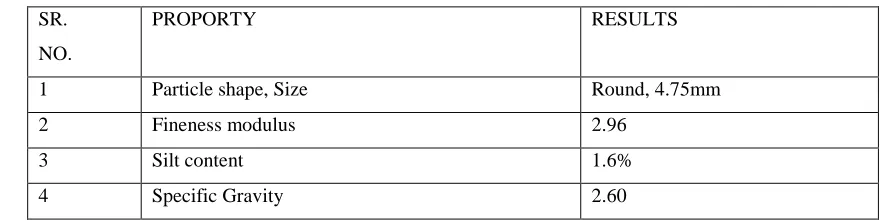
2) Fine aggregate- Locally available river sand is used.
Table 2.Physical properties of Fine aggregate
SR.
NO.
PROPORTY RESULTS
1 Particle shape, Size Round, 4.75mm
2 Fineness modulus 2.96
3 Silt content 1.6%
296 | P a g e
3) Course aggregate- Course aggregate of 10mm and 20mm size are used.Table 3.Physical properties of course aggregate
SR. NO. PROPERTY RESULTS
1 Particle shape, Size Angular, 10mm and 20mm
2 Fineness modulus of 20mm aggregate 7.4
3 Fineness modulus of 10mm aggregate 6.57
4 Specific Gravity 2.65
5 Water absorption 0.40%
4) Alccofine-
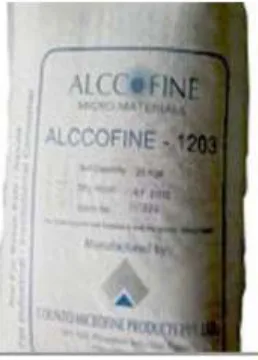
ALCCOFINE is a specially processed product based on slag of High glass content with high reactivity
obtained through the process of controlled granulation. Alccofine have used conforming to ASTM 989-99.
Fig 1. Alccofine bag
Table 4.Physical and Chemical properties of Alccofine
Chemical Analysis Mass% Physical Analysis Range
CaO 32-34 Bulk Density 600-700 kg/m3
Al2O3 18-20 Surface Area 12000 cm
2 /gm
Fe2O3 1.8-2 Particle shape Irregular
SO3 0.3-0.7 Partical size, D10 < 2 micron
MgO 8-10 D50 <5 micron
SiO2 33-35 D90 <9 micron
297 | P a g e
a g e5) Fly ash
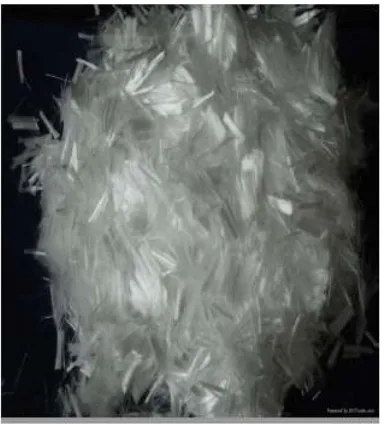
6) Polypropelene fibre- Polypropylene is a thermoplastic it is by product of oil refining process. The
long 12mm straight polypropylene fibre is used.
Fig. 2. PPF (polypropylene fibre)
B) MIX DESIGN-
Alccofine and Fly ash proportion is varied from 5%,7.5%,10%,12.5% and Polypropylene content is Varied
from 1%,1.2%,2% respectively.
Table 5.Mix design of M60 grade
Water Cement Fine aggregate Coarse aggregate
158.08 kg/m3 416 kg/m3 771.42 kg/m3 1042.245 kg/m3
0.38 1 1.85 2.50
C) EXPERIMENTAL PROCESS-
The specimen of Standard cube ( 150mm X 150mm X 150mm ) used for compressive strength. And specimen
of Standard Beam (100mm X 100mm X 500mm ) used for Flexural test. They have tested after 28days water
298 | P a g e
Fig.3. Compressive test Fig.4. Flexural test
III RESULT OBTAINED
Compressive strength test Result-
300 | P a g e
IV. CONCLUSIONS
From the results of beams we found that
1) flexural strength of concrete was found maximum when we used 2% of fiber volume fraction by weight of
cement.Flexural strength of beams was found to be more for 5%, 7.5%, 10% and 12.5 % Mineral Admixture.
Among all the results the value was found to be maximum at 12.5% MA with 2% PPF.
From the results of cubes we found that
For compressive strength of cubes it was found to be maximum corresponding to 10% of Mineral Admixture
The minimum value was found at 1.5% of fibers corresponding to 7.5% of alccofine by weight of cement.
The test carried our at 7 till 28 days shows that strength gain is rapid. As per literature review the strength
gain will go on till 56th day but in slower rate.
301 | P a g e
REFERENCES
[1]. Amit Rai and Dr. Y. P. Joshi “Applications and Properties of Fibre Reinforced concrete” ISSN:2248-9622,
Vol. 4, Issue 5, (Version I), May 2014.
[2]. Dr.T.Ch.Madhavi L.Swamy Raju, Deepak Mathur “Polypropylene Fiber Reinforced Concrete-A Review”
(ISSN 2250-2459, ISO 9001:2008 Certified Journal, Volume 4, Special Issue 4, June 2014)
[3]. Indian Standard Specification for Coarse and Fine aggregates from natural source for concrete. IS
383:1970, Bureau of Indian standards, New Delhi.
[4]. Indian Standard Specification for granulated slag for manufacture of Portland slag cement.IS 12089:1987,
Bureau of Indian standards, New Delhi.
[5]. Kolli.Ramujee Associate Professor, Department of Civil Engineering, VNR Vignana jyothi Institute of
Engineering & Technology, Hyderabad, Andhra Pradesh, India. “Strength properties of Polypropylene fiber
reinforced Concrete” ISSN: 2319-8753 Vol. 2, Issue 8, August 2013
[6]. M. Tamil Selvi and
Dr. T.S. Thandavamoorthy “Studies on the Properties of Steel and Polypropylene Fibre Reinforced Concrete without any Admixture” ISSN: 2277-3754 Volume 3, Issue 1, July 2013
[7]. Milind V. Mohod “ Performance of Polypropylene Fibre Reinforced Concrete” e-ISSN: 2278-1684,p-ISSN:
2320-334X, Volume 12, Issue 1 Ver. I (Jan- Feb. 2015)
[8]. Parveen,1 Ankit Sharma2 12Department of Civil Engineering DCRUST, Sonepat, Haryana, India “
Structural Behaviour of Fibrous Concrete Using Polypropylene Fibres” Vol.3, Issue.3, May-June. 2013
pp-1279-1282 ISSN: 2249-6645
[9]. Priti A. Patel, Dr. Atul K. Desai and Dr. Jatin A. Desai “Evaluation of Engineering properties for
polypropylene Fibre reinforced concrete” E-ISSN 0976-3945.
[10].Siddharth p upadhyay “Effect on compressive strength of high performance concrete incorporating alccofine
and fly ash” ISSN: 2320-5083, Volume 2, Issue 2, March 2014