240 |
P a g e
ENHANCING SECURE COMMUNICATION USING
GENERALIZED RSA AND COLOR COMPONENT
REPLACEMENT STEGANOGRAPHY
Vishnu G. Nair
1, Sminesh C.N.
2 1M.Tech Student,
2Associate Professor, Department of Computer Science, Govt. Engineering College,
Thrissur, Kerala (India)
ABSTRACT
Security protocols are essential for communication over digital media and Internet. To provide secure communication, sender and receiver should exercise an efficient technique to convert original plain text message to an unintelligible format to everyone except the intended receiver. Cryptography and Steganography are the two popular techniques to provide secure communication, where Cryptography distorts the message and Steganography hide the existence of the message. In this paper, the strength of Generalized RSA cryptosystem and Color component replacement steganography are utilized as a single system for enhancing security of secret information, and then comparing its performance with the existing systems. Generalized RSA is the generalization of RSA variants using Jordan’s Totient function, which is the generalized function of classical Euler’s function. RSA implementation can be speed up by using Jordan’s Totient function instead of Euler’s
function. Color component replacement Steganography hides the secret data in color components of cover images. It is the enhanced version of Least Significant Bit replacement Steganography with minimum quality degradation of cover images. The proposed system hides the cipher text generated by Generalized RSA cryptosystem in color components of cover images using Color component replacement Steganography.
Keywords:
Color Component Replacement, Cryptography, Generalized RSA, Jordan’s Totient
function, LSB
I.
INTRODUCTION
Security protocols are a must for the secret communication between two parties. Now a days we need secrecy in
all the electronic communication areas like personal communication, military purposes, financial transactions,
electronic banking, medical diagnosis etc. To attain security in these communications, the commonly used
techniques are Cryptography and Steganography.
Cryptography ensure the security by encrypting the plain text into ’Cipher text’ form by using cryptographic
algorithms and secret keys. The cipher text is send from sender to receiver side. Unauthorized user cannot
understand the actual plain text message from cipher text without knowing the secret keys. At the receiver’s side, by using decryption algorithm and secret keys the receiver decrypts the cipher text and obtains the plain
241 |
P a g e
messages cannot be seen by the unauthorized user. Steganographic algorithm embeds the plain text into thecover files and obtain the ‘Stego files’. These stego files are sending from the sender to the receiver. The
authorized receiver knows that the secret is present in the stego file and he can extract the actual message from
stego file using proper steganographic algorithms and secret keys.
In this project, the features of Cryptography and Steganography are utilized as a single system. The main areas
involved in this system are Cryptographic algorithms and Manipulation of cipher text. These two areas should
be managed properly by an efficient cryptosystem.
One of the most popular and classical cryptosystem is RSA cryptosystem[5]. There are number of variants of
RSA cryptosystem, we find out some of them and list out their properties and limitations. Finally most of these
limitations can be resolved using an algorithm which uses Jordan’s Totient function for the computations. Since the Jordan’s Totient function is the generalization of Euler’s Totient function, we call this algorithm as ’Generalized RSA Cryptosystem’[1].
By using Generalized RSA algorithm, plain text messages can be encrypted and decrypted securely. In
conventional cryptosystem after encryption process, the generated cipher text is text format. The syntax and
semantics of these text are completely different from conventional communication language. There is a
possibility to an intruder to guess that there exist a secret within that text file. This limitation is overcame by
hiding cipher text within the color components of color cover image files[2]. The proposed system uses the
assumption that hiding data is better than sending it shown as encrypted. So we use color images are the
medium for data hiding. In color component replacement steganography, data is hiding in the RGB (Red, Green,
Blue) color components in different manner [9].
II. PROPOSED SYSTEMS AND DESIGN
By combining the strength Cryptography and Steganography, the security of secret data communication can be
enhanced[ 3]. The Strength of Cryptography is mainly depends on the security of the cryptographic key and the
time required to break the key. This can be ensured using very large size key for encryption and decryption. But
it leads to large requirements to the algorithm and complex computational issues [4]. So, to an efficient
cryptographic system, the requirements of the algorithm should be simple and time required for encryption and
decryption should be less. Also these features do not affect the security aspects of the cryptosystem.
In the case of conventional RSA cryptosystem, the security is mainly depends on key size and factorization
problem of large numbers. To attain these goals, requirements of RSA and computational issues of RSA are
high [7]. Here we require very large prime numbers for very large size key generation and complex
computations for encryption and decryption.
Use of Generalized RSA Cryptosystem [9] resolves these limitations. Instead of using the classical Euler’s
Totient function it uses Jordan’s Totient function[6] for all its computations. For the same set of prime numbers
Generalized RSA generate larger sized key than conventional RSA cryptosystem. When we use very large
prime numbers, it can generate very large sized secret keys. By utilizing the features of Jordan’s Totient
function the complex exponential computations are reduced to multiplication operations[8]. So the
242 |
P a g e
2.1 Proposed System Design
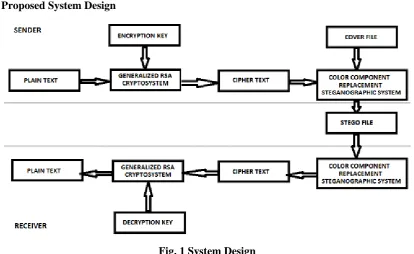
Fig. 1 System Design
The overall design of the proposed system can be depicted as shown in Fig. 1. Here plain text is encrypted using
generalized RSA cryptosystm[1] and the obtained cipher text is processed with the steganographic module.
Steganographic module takes cipher text and a color image file as inputs and embeds the cipher text into cover
image using color components replacement steganography. Then, the obtained stego file is send to the receiver.
Receiver extracts the stego file into cipher text and cover image file. The cipher text is decrypted using the
decryption algorithm of generalized RSA cryptosystem and private key of the receiver. The entire system
consists of Cryptographic module and Steganographic module.
2.2 Data Flow Diagram for Cryptographic Module
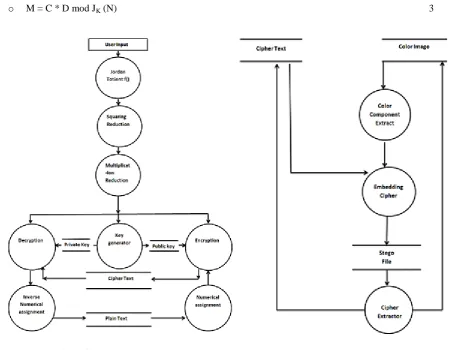
Fig. 2 shows the overall design of the Generalized RSA cryptosystem and it consists of following components.
Jordan’s Totient Function computing:
This module compute the value of Jordan’s Totient function based on the user input[6]. In this stage user input
are set of prime numbers and the generalizing index of Generalized RSA cryptosystem. The generated value is
required for all the sub modules such as Key generator, Encryptor, and Decryptor.
JK (N) = NK ∏P/n (1 – P-K ) Where K, N are positive integers 1
Key Generator:
Key Generator is the module which generate the public key and private key for decryption and encryption.
o Select a random integer E such that, gcd (E, JK(N)) = 1, where 1 < E < JK (N), E = M mod JK(N)
o Select integer D such that, ED = 1 (mod JK (N)) i.e., D = E-1 mod JK (N) where 1 < D < JK (N) Encryption:
Encryption module performs the encoding of plain text with public key. Output of encryption process is the
cipher text. This cipher text is in unreadable form and Decryption process is required to make it readable. Given
a public-key (JK (N);E) and a message M compute the cipher text
243 |
P a g e
Decryption:
Decryption module performs the decoding of cipher text with private key. Only the intended receiver can
decrypt the cipher into readable plain text.
Given a private-key (JK (N), D) and cipher text C, compute the message
o M = C * D mod JK (N) 3
Fig. 2 Cryptographic Module Fig. 3 Steganographic Module
Numerical assignment:
This module assigns the numerical values to the characters. Since the public key cryptography is based on the
mathematical functions, it is necessary to assign numerical values to characters before encryption.
Inverse Numerical assignment:
This module performs the inverse mapping of numerical to character assignment. It is necessary after the
decryption.
After the encryption process the generated cipher text is in text format[8]. Even though its syntax and semantics
are differ from the natural languages, the intruder can assume the presence of something secrets in cipher text
and he can try for the actual message. Here we uses the assumption that hiding data is better than sending it
shown as encrypted. So we use Color Component Replacement Steganography for data hiding. This algorithm is
an enhanced version of LSB technique[9][11]. Since the original LSB which is quite vulnerable, most common
and well known method, hackers can easily try this method to retrieve the message[13]. So instead of hiding
data within least significant bits of the pixel, data is hiding in the RGB(Red,Green,Blue) color components in
244 |
P a g e
cipher text, two color components of a pixel is replaced with 4 bits of a cipher text character in one componentand remaining 4 bits in another color component, and at a time all color components altered with one cipher
character’s bit values.
The primary objective of steganography is to avoid drawing attention to the transmission of hidden information.
If any attacker or hacker noted any changes in the stego file, then he can try for the inner contents. So the quality
degradation of stego file should be prevent. The proposed color component replacement steganography is also a
comparative study of, altering different color components, to ensure minimum quality degradation. The quality
degradation of color images can be measured using the PSNR and here we maintain the PSNR above the
allowable limit.
2.3 Data Flow Diagram for Steganographic Module
The above diagram (Fig. 3).represents the complete data flow of the steganographic module and it consists of
following components.
Color component extractor:
Color component replacement steganography is performed on color images by extracting color components of
each pixels and replace these components with cipher text in different manner. The different methods are one
color component complete replacement with one character of cipher text, two color components of a pixel is
replaced with 4 bits of a cipher text character in one component and remaining 4 bits in another color
component, and at a time all color components altered with one cipher character’s bit values. A color component
separator module is required to perform this function.
Embedding Cipher:
This process embedded the cipher text character into the particular color components extracted by the color
component extractor module. Red component of first pixel is replaced with binary of value of first cipher text
character, Green component of second pixel is replaced with binary of second cipher text character, Blue
component of third pixel is replaced with binary of third cipher text character and so on.
Cipher extractor:
This module extracts the cipher text from the stego image. Input to this module is stego file and output from this
module are cipher text and cover file. The technique used here is taking the cipher text, which is generated by
the cryptographic module is taken as the input of steganographic module.
III. IMPLEMENTATION AND PERFORMANCE ANALYSIS
The proposed system design for cryptographic module and steganographic module are implemented in
MATLAB. The performance of the proposed system can be analyzed using following parameters. In
cryptographic module it can be measured using Key size, Message space size, Encryption time, and Decryption
time etc. In Steganographic module it can be measured using cipher text capacity and Peak Signal to noise
Ratio(PSNR). Since data is embedded into cover file is insertion of some noise into the actual cover, PSNR can
245 |
P a g e
3.1 Cryptographic Module
3.1.1 Key Size
Key size determine the number of bits used to represent the encryption decryption keys. Strength of RSA mainly
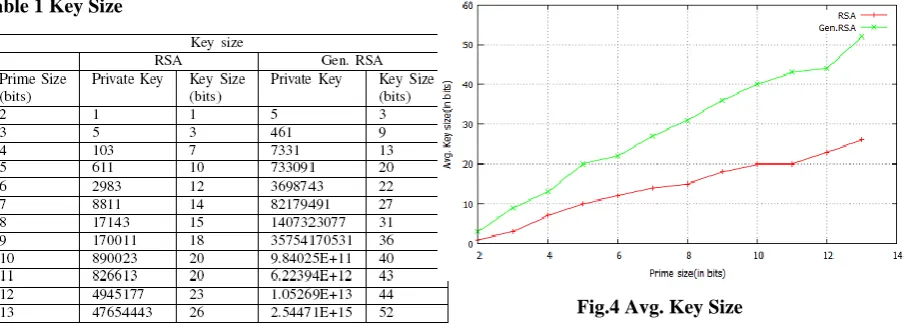
depends on Key size. For the same set of prime numbers Generalized RSA provide large key size than RSA.
The largest and second largest prime numbers which can be represented using 2 bits are 3 and 2. By using these
two prime numbers RSA generate the private key as 1 which is size of one bit. But for these prime numbers
Generalized RSA with index value 2 generate the private key as 5 which is size of three bits. Below table
(Table. 1) represents the key size generated from different size prime numbers. The values of table(Table. I)is
plotted below(Fig. 4) which shows for the same set of prime numbers Generalized RSA provide large key size
than RSA.
Table 1 Key Size
Fig.4 Avg. Key Size
3.1.2 Message space size:
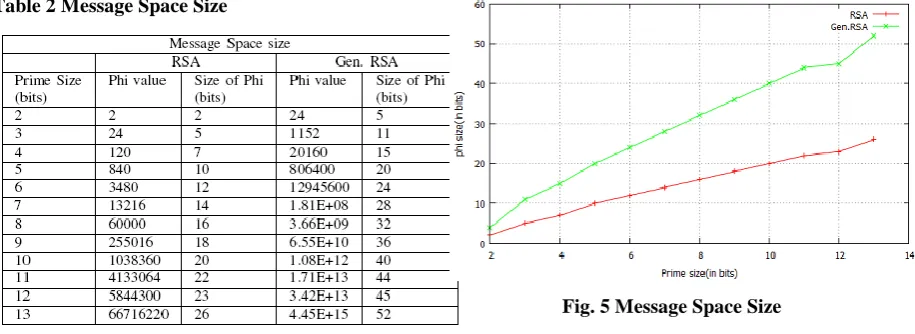
It is the phi value generated and it is used for the modular operations. As the phi value increases size of message
space also increases. Generalized RSA with indexing factor greater than one will give higher message space
than RSA. The largest and second largest prime numbers which can be represented using 2 bits are 2 and 3.
For RSA, ф = (2 - 1) *(3 - 1) = 2 Which can be represented using 2 bits
For Generalized RSA with index 2,
Ф = (22- 1) * (32 - 1)
= 24 Which requires 5 bits to represent
Below table (Table. 2) represents the phi value generated from different size prime numbers. One of the security
aspects of RSA is factorization problem of larger numbers. Here with smaller requirements Generalized RSA
246 |
P a g e
Table 2 Message Space Size
Fig. 5 Message Space Size
3.1.3 Encryption time:
Encryption time is the average time required to Encrypt the message into cipher text. The encryption and
decryption time are measured in a computer system with following specifications:
CPU Type: Intel Xenon E5 Clock speed: 3.70 GHZ RAM Size: 16 GB
Monitor Type: 15 inch color monitor
Generalized RSA is faster than RSA in the case of encryption (Fig. 6).
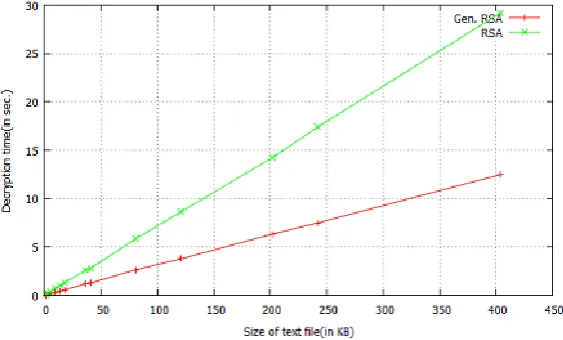
3.1.4 Decryption time:
Decryption time is the average time required to Decrypt the cipher text using private key. Generalized RSA
require less time for decryption process (Fig. 7).
Table 3 Encryption And Decryption Time
247 |
P a g e
Fig.6 Decryption Time
3.2 Steganographic Module
3.2.1 PSNR
Peak Signal to Noise Ratio is used to measure the quality degradation of the stego image from the cover image.
Since embedded cipher text is treated as noise to the image it measure the amount of noise added. It can be
computed as shown below
PSNR = 20 log10 (MAXi ) – 10 log10 (MSE) 4
MAXi is the maximum possible pixel value of the image and MSE is the sum over all squared value differences
divided by image size and by three. If PSNR(4) is greater than 60 decibel, human eye cannot detect the changes
happened in the color images. So it is necessary to maintain the PSNR greater than 60 after embedding cipher to
the cover image. In first case, One color component of one pixel is completely replaced with one character of
cipher text. This improve the cipher capacity but it affect the quality of stego image, PSNR becomes less than 60
To solve this problem one character of the cipher text is embedded within two color components of a pixel by
replacing 4 bits at a time. This method improves the quality of image and PSNR value. To get more better
PSNR one character of cipher text is embedded within 3 color components of a pixel by replacing 2 bits of
RED, 3 bits of GREEN, 3 bits of BLUE at a time. It improves the quality of stego image and maintain the
capacity of 8 bits per pixel(Fig. 8)..
Table 4 PSNR Comparison
248 |
P a g e
IV. CONCLUSION
Combining Cryptography and Steganography in communication can enhance the security. Generalized RSA
reduces the requirements of RSA cryptosystem such as the requirement exponential computations for encryption
and decryption. For the same set of prime numbers, Generalized RSA provide better key size and message space
size than the conventional RSA. Generalized RSA is faster than RSA in the case of encryption and decryption.
Color components replacement steganography gives more PSNR for very large size data if we replace less than
four bits of a color component at a time. By combining Cryptography and Steganography and utilizing their
features in the combined manner we can enhance the security of secret data communication. The work done in
this project provides basis for future research in steganography and can be extended in several ways. One
possible extension is to use cover video files for color component replacement steganography without degrading
the quality of video. The possibility and the impact of such work needs to be investigated.
REFERENCES
[1] Vishnu G Nair and Sminesh C N, RSA Generalization using Jordan’s Totient function, International
Journal of Advanced Research Trends in Engineering and Technology(IJARTET), vol.2 issue X , March
2015, ISSN 2394-3777(Print), ISSN 2394-3785(Online)
[2] A Joseph Raphael and Dr. V sundaram, Cryptography and Steganography A Survey, International Journal
for Computer Applications.Vol 2 (3), 626-630
[3] Khalil Challita and Hikmat Farhat, Combining Steganography and Cryptography: New Directions,
International Journal on New Computer Architectures and Their Applications (IJNCAA) 1(1): 199-208,
The Society of Digital Information and Wireless Communications, 2011 (ISSN 2220-9085)
[4] R.L. Rivest, A. Shamir, and L. Adleman, A Method for Obtaining Digital Signatures and Public-Key
Cryptosystems,
[5] A.Shamir, How to check modular exponentiation, Eurocrypt 97, May 1997
[6] S. Thajoddin and S. Vangipuram, A Note On Jordans Totient function, Indian j. pure appl. Math December
1988
[7] Suresh K and Venkataramana.K, Study of Analysis on RSA and its Variants, International Journal of
Computer Science Research & Technology (IJCSR),Vol. 1 Issue 4, September 2013
[8] E.Madhusudhana Reddy, B. Muneendra Nayak and M.Padmavathamma, Communication between two
Parties using MJ2 -RSA Cryptosystem and Signature Scheme, IEEE CONECCT 2013
[9] Vipul Sharma and Sunny Kumar, A New Approach to Hide Text in Images Using Steganography,
International Journal of Advanced Research in Computer Science and Software Engineering, Volume 3,
Issue 4, April 2013
[10] Vijay Kumar Sharma and Vishal Shrivastava, A Steganography algorithm for hiding image in image by
improved LSB substitution by minimize detection, Journal of Theoretical and Applied Information
Technology, 15th February 2012 Vol. 36 No.1
[11] Chi-Kwong Chan and L M Cheng, Hiding data in images by simple LSB Substitution, The Journal of the
249 |
P a g e
[12] Abbas Cheddad, Joan Condell, Kevin Curran and Paul Mc Kevitt, Digital Image Steganography: Surveyand Analysis of Current Methods, Signal Processing, Volume 90, Issue 3, March 2010
[13] H. Wu, H. Wang, C. Tsai and C. Wang, Reversible image steganographic scheme via predictive coding,