International Journal of Research in Engineering and Science (IJRES)
ISSN (Online): 2320-9364, ISSN (Print): 2320-9356
www.ijres.org Volume 7 Issue 2 Ser. I ǁ 2019 ǁ PP. 51-57
Capacity Building on Land Registration Systems for Sustainable
Development in Kenya
Robert Nilson Wayumba
11(School of Surveying and Geospatial Sciences/ Technical University of Kenya, Kenya)
ABSTRACT: Capacity building on Land Registration Systems can contribute towards sustainable development
in Kenya. Internationally, the United Nations has adopted the Sustainable Development Goals (SDGs) as a means of improving our World. Land registration systems enable sustainable development by improving: land tenure security, access to credit, real estate transactions, land use planning, land development, taxation and dispute resolution among others. In general, land registration can be described as the process of legally recording interests in land. Despite the ability contribute towards development, the systems seem to be struggling in most developing countries. In these countries, only about thirty percent of the land is registered. In areas where registration has been introduced, informal transactions persist, hence the systems do not always reflect the situation on the ground. In addition, the records are usually kept in paper format which has undergone wear and tear. Based on case study methodology, this paper explains how the problems facing land registration can be solved through capacity building. The results are divided into three main categories. The first category is on “who?” should be included in the capacity building. In this regard, the category is further divided into three themes, namely, societal, organizational and individual. The second category is on aspects of registration that should be included in the capacity building. The aspects are divided further into two main themes, static and dynamic. The static theme describes information kept in the register in regard to objects and identifiers. The dynamic component describes the processes within the system, such as first registration, transfer of whole parcels and cadastral procedures such as subdivision, partitions and amalgamation. The third category is on land records management. The hope is that this paper will contribute towards capacity building of land registration systems, not only in Kenya, but also in other developing countries.
Key Words - Capacity Building, Land Registration Systems, Kenya
--- --- Date of Submission: 28-07-2019 Date of acceptance:10-08-2019 --- ---
I.
INTRODUCTION
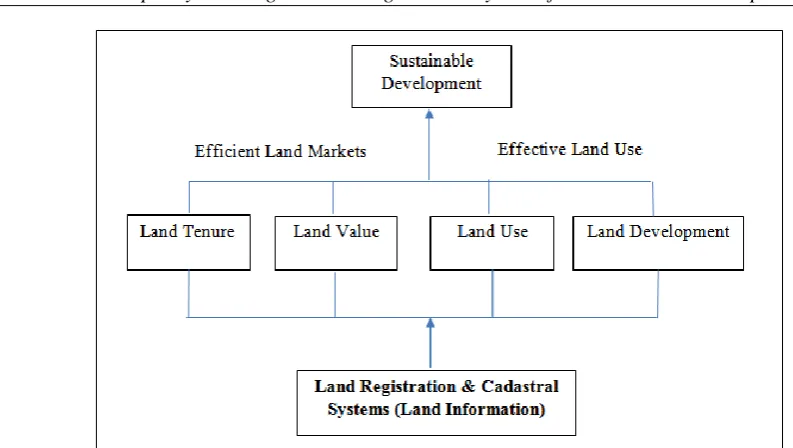
This paper explains how capacity building can be carried out on Land Registration Systems as a means of enabling sustainable development in Kenya. Internationally, the United Nations has adopted the Sustainable Development Goals (SDGs) as a means of improving our World [1]. Sustainable development can be described as the ability of current generations to meet their own needs without compromising the needs of future generations [2]. Effective Land Registration Systems contribute towards sustainable development by improving: land tenure security, real estate markets, and access to credit, taxation, land valuation, land use planning, land development and dispute resolution among others [2]. The link between the systems and sustainable development is shown in Fig. 1.
Figure 1 Shows Land Registration Systems as the foundation for four land administration functions that contribute to sustainable development (adopted from Williamson et al., 2010 p.119)
Despite the ability to contribute towards sustainable development, most land registration and cadastral system are not working properly in developing countries. In most of these countries, only about thirty percent of the land is registered [6]. In the areas where registration has been introduced, informal transactions persist, hence the registers do not always reflect changes on the ground [7]. Further, most of the land records are held in paper format which has undergone wear and tear [8].
In order to solve the problems facing the systems, there is a need for capacity building. In this paper, capacity building is defined as follows.
[Capacity building is] the development of knowledge, skills and attitudes in individuals and groups of people relevant in design, development, management and maintenance of institutional and operational infrastructures and processes that are locally meaningful [9].
Hence, this paper will provide explanations on how capacity building can be carried out for Land Registration Systems in Kenya.
II.
METHODOLOGY
This paper employed case study methodology to explain how capacity building on Land Registration Systems can be carried out in Kenya. This methodology was selected because it enables researchers to study complex phenomenon within their context [10]. The methodology is also appropriate for building new theories about complex phenomenon [11]. In this case, aspects of Land Registration Systems are complex and are embedded within a society. The systems include, legal, technical and organizational aspects and are not easily observable. Case study methodology was also selected because it allows the researcher to use multiple sources of data [10]. The methodology was also selected because it is recommended for carrying out research on cadastral systems [12]. In this case, the main source of data was written materials, such as books, journal articles and land laws among others.
Based on existing literature, key categories were developed. The first category was on people who should be included in the capacity building and the second category was on aspects of the systems. Further, the first category was divided into three main themes, namely people in societal level, organizational and individual level. The second category was divided into four main themes, namely, the type of property rights that are being created, the process of survey and mapping, transactions within the systems and finally record management and dissemination. Based on these themes, the following explanations are given.
III.
CATEGORIES
OF
PEOPLE
FOR
CAPACITY
BUILDING
Capacity Building on Land Registration Systems for Sustainable Development in Kenya
(i) Societal level
Land registration is usually and national activity and affects the whole society in a country as a whole. Hence, the highest level in which capacity should be developed is at society level [13]. This will enable the people to use the systems. In general, the capacity building should convince people in the society that the introduced system is positive and beneficial for their use. According to path dependence analysis, human beings tend to reinforce activities that bring them positive rewards, and shun/ reduce on activities that bring negative results [14]. Hence, capacity building should create some reinforcement that the introduced system has positive results. In subsequent sections explanations will be given on how the systems can be made more pro-people, so that they are better accepted.
The positive reinforcement on the benefits of land registration can be carried out at for the people in Kenya as a whole. At the society level, there is a need to use media and local meetings, called barazas in Swahili, to educate people on the benefits of land registration. The media should include television, radio and newspapers. The media can run advertisements or short features on the potential benefits of land registration for the society. This might encourage more people to use the systems. Nonetheless, the systems should also be adjusted to be more pro-people.
(ii) Organizational level
Different types of organizations should be included in the capacity building. In Kenya, the Ministry of Lands and Physical Planning, the National Land Commission, various parastatals and 47 county governments should be involved. The aim should be to improve the capacity of the organizations to carry out their role in the process of land registration. The capacity building can be carried out through seminars and workshops for people within these organizations, re-engineering procedures used for registration, and purchasing and deploying equipment such as computers and survey equipment.
One of the main challenges facing registration in developing countries is that procedures are usually lengthy and expensive. Hence, the capacity building can include a component of how to evaluate and streamline procedures for the benefit of all people. Hence, a holistic approach is required to improve skills, attitudes and equipment for land registration within organizations.
Universities and the Technical and Vocational Education and Training (TVET) institutions should also be included in the capacity building at organizational level. In this regard, curriculum being taught should be revised to better meet the needs of land registration in the current era. The need for equipment to train students adequately should also be addressed. If the training institutions carry out their mandate correctly, then the produced workforce will be in a better position to improve and implement land registration.
(iii)Individual level
This level enables individuals/ persons to function efficiently and effectively within organizations and in the society [13]. There is a need to assess skills gaps in existing staff members within organizations and provide mechanisms with which to cover the gaps. For example, short courses can be organized to cover various aspects of registration. The courses should cover both technical and soft skills. The technical skills can include use of computers and survey equipment. The soft skills include how to evaluate and measure systems, how to better manage people, projects and resources among others.
Detailed training of individuals can be carried out in longer term education in training institutes. The organizations can partner with universities and TVET institutes to enable that the required skills are imparted at undergraduate level. Further, the organizations can sponsor people to attend postgraduate courses that can enhance the performance of the people within the system.
Apart from addressing the needs at the three levels, there is also a need to improve various aspects of land registration. The next section explains these issues.
IV.
IMPROVING
ASPECTS
OF
LAND
REGISTRATION
In this paper, the aspects of land registration are divided into static and dynamic aspects. As stated earlier, the static theme describes information kept in the register in regard to objects and identifiers. The dynamic component describes the processes within the system, such as first registration, transfer of whole parcels and cadastral procedures such as subdivision, partitions and amalgamation. Thus, the capacity building should include both aspects of registration.
(a) Statics Aspects of registration
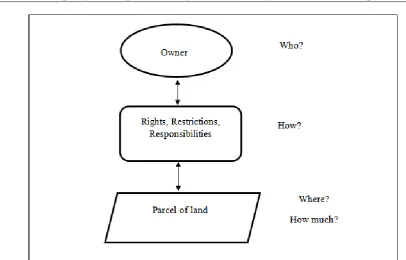
Figure 2 shows the three main components of the static view of land registration (adopted from Zevenbergen, 2002 p. 104)
Based on the static view, as shown in Fig. 2, the first component is the owner/ who? In the register, the person is usually identified by their full names as indicated in the national identity card or passport and their postal address. In the second component, the Rights, Restrictions and Responsibilities (RRRs) are captured. In the past, in the ―how?‖ section, the focus was only on rights [15]. Today, the focus is on RRRs, to show that land owners have some restrictions as imposed by the law, such as wayleave rights, and also that they have responsibilities to the wider community [16]. The third component is on the where? And how much? Land. This is usually captured through the process of land surveying. Using various techniques, surveyors are able to determine the location of parcels and its size in acres or hectares.
One of the fundamental evaluations that should be carried out in Kenya is with the first and second components. In this regard, Kenya acquired a ―Western‖ view of property rights, which has been perpetuated by post-independence governments [17]. In the ―Western‖ model, exclusive property rights are assigned to individuals or groups of people. This exclusive property rights are often contrary to communal land tenure in which people share access to some portions of land [17]. Hence, there is a need for a critical review on whether the exclusive property rights are suitable for every part/ community in Kenya, and whether alternative, possibly more suitable methods can be developed for more communal land registration. In this regard, Kenya has implemented the Community Land Act, 2016. However, as at 2019, the act is yet to be used to register a section of land, possibly because it is not yet very clear how it is to be implemented.
Capacity Building on Land Registration Systems for Sustainable Development in Kenya
(b) Dynamic Aspects of registration
There should also be capacity building on the processes of land registration. These processes include first registration, transfer of whole parcels and cadastral procedures such as subdivision, partitions and amalgamation among others.
(i) First registration
First registration provides the process of recording interests in land into a formal system. In Kenya, the British colonial government initiated a process of land registration as a means of converting communal land tenure into individual or group rights to land [19]. In summary, the process of land registration started with the enactment and implementation of various laws during the colonial period. Some of the laws include: the East Africa Land Regulations, 1894; Crown Lands Ordinance, 1902, Land Titles Act, 1908; Government Lands Act, 1915; Survey Act, 1923; Land Registration Special Areas Ordinance, 1959; Registered Land Act, 1963; Land Adjudication Act, 1968; Land Consolidation Act, 1968 and the Land (Group Representatives) Act, 1968 among others [20]. Based on this various laws, the colonial and post-independence government introduced formal land registration. Hence, the training component of capacity building should include a synopsis of these laws, so that people have an understanding of how the system was established.
Subsequently, the Republic of Kenya has carried out reforms and introduced new land laws. A National Land Policy was developed and adopted in 2009. In the year 2010, Kenya promulgated a new constitution, through which the previous land laws repealed and replaced by new laws. The new laws are the Land Act, 2012; Land Registration Act, 2012; and the National Land Commission Act, 2012. In addition, some of the previous laws still stand, such as the Land Control Act, the Sectional Properties Act and Survey Act among others. Further, A community Land Act was established in 2016, as a means of enhancing the process of land registration in areas where formalization has not happened [20].
The main reform that should be considered during first registration is the type of property rights that are created. As stated earlier, the current process of registration is based mostly on ―Western‖ concepts of property rights that include exclusivity [17]. Considering that most Kenyans practice some form of communal land tenure, there is a need to possibly reconsider whether exclusivity is working. Records indicate that only about thirty percent of land in developing countries is registered [6]. Maybe one of the reasons why the process of implementation is slow is because the introduced systems are not compatible with communal tenure.
(ii) Transfers
Formal transfers help to keep the established land register current. In this regard, transfers refer to processes that include: selling, mortgaging, charging, letting and succession. These tasks should be carried out by registered estate agents and lawyers among other professionals. In this case, transfers refer to the process of moving rights in land from one person to another through legal instruments.
Despite the presence of formal systems and processes for transferring land, most transfers remain informal in Kenya. In most developing countries, communal means of securing transferred rights to land persist [21]. In addition, due to socio-economic changes, such as urbanization, population growth and monetarization of the economy, new informal means have also emerged as ways of securing transfers [22]. In this regard, people write transfer documents between each other, without processing the sale through the land register. In some cases, they get chiefs or government officials to sign the documents to provide them with some form of officialdom [23].
The main challenge facing transfers is the retention of informal procedures. In most parts of the country, people subdivide land informally, without effecting the changes on official survey maps [7]. The created parcels of land are then sold, or inherited without making changes of ownership in the register. Equally, some people ―mortgage‖ (give out land for money at a fee) informally, without reflecting it in the register. Hence, parts of the formal register are obsolete because they do not fully reflect the situation on the ground. To this end, there is a need to reform the systems to make them more attractive for use by people. Possibly, the existing processes are too burecratic and expensive for locals. The capacity building should include means of evaluating the processes and establish better ways of officially conducting land transfers. In essence, the evaluation should be ―concerned with questions such as: are we doing the right thing, are we doing things right, and what lessons can we learn from the experiences?‖ [24].
(iii)Cadastral procedures
of land and re-allotment refers to the process through which different parcels of land are re-organized to form more socially and economic parcels of land [25]. A sample of these cadastral procedures is shown in Fig. 3.
Figure 3 shows some cadastral survey procedures to be included in the capacity building
There are several improvements that should be made to the process of cadastral survey procedures. As stated earlier, there is a need to find ways to geo-reference general boundaries. This will help to reduce boundary disputes. In this regard, the surveyors should possibly explore ways of using Global Navigation Satellite Systems (GNSS) equipment for the geo-referencing. The capacity building should include the process of developing guidelines for geo-referencing. Adoption of fit-for-purpose techniques can also be adopted [26]. In the fit-for-purpose methods, high geo-referenced satellite images are recommended as one way of quickly mapping property boundaries. In areas where planted hedges can grow, the satellite images can provide a quick means of providing maps that have some form of mathematical reference (coordinates or a grid on the maps).
V.
LAND
RECORDS
MANAGEMENT
Finally, the capacity building should include better and modern methods of managing land records. One of the major challenges facing land registration systems is that records are largely held in paper format which is susceptible to wear and tear. The records include different types of maps and associated records in files [8]. The paper based records could be one of the reasons why processes in the system are burecratic and shunned by locals.
There is a need to develop appropriate Land Information Management Systems (LIMS) that can be used to better manage the records [27]. A LIMS can be described as a computerized system that is used to manage survey maps and associated records on rights, restrictions and responsibilities on land [27]. The Ministry of Lands and Physical Planning has attempted to develop parts of a LIMS [8]. However, after many years, the process has not been completed and the use of paper records persists. Similarly, the National Land Commission (NLC) has tried to implement a LIMS [28]. Unfortunately, the efforts of NLC have not been complete and the country does not yet have a fully functioning LIMS. Hence, there is a need to find out why attempts at developing LIMS have failed and also provide alternative solutions with which implementation may be successful.
VI.
CONCLUSION
Capacity Building on Land Registration Systems for Sustainable Development in Kenya
www.ijres.org 57 | Page] Kenya and other developing countries hope to achieve the Sustainable Development Goals (SDGs), there must be some form of capacity building on land registration systems.
REFERENCES
[1]. SDGs, U. N. (2015). United Nations sustainable development goals. UN. Org.
[2]. Williamson, I., Enemark, S., Wallace, J., & Rajabifard, A. (2010). Land administration for sustainable development (p. 487). Redlands, CA: ESRI Press Academic.
[3]. Zevenbergen, J. (2002). Systems of land registration aspects and effects. Publications on Geodesy, 51.
[4]. UNECE (1996) Land Administration Guidelines, with special reference to countries in transition. United Nations, Economic Commission for Europe (UN ECE).
[5]. Bannister, A. (2006). Surveying (Vol. 1). Pearson Education India.
[6]. Zevenbergen, J., Augustinus, C., Antonio, D., & Bennett, R. (2013). Pro-poor land administration: Principles for recording the land rights of the underrepresented. Land use policy, 31, 595-604.
[7]. Odwe, P., Mwasumbi, A., & Wayumba, R. Application of Unmanned Aerial Vehicles in Strengthening Land Rights for the Youths in Kenya.
[8]. Nyongesa, L. N., (2012). GIS–Based National Land Information Management System (NLIMS). Paper for FIG Working Week. [9]. Enemark, S. (2003). Capacity building for developing sustainable land administration infrastructures. Azimuth, 7(41), 12-18. [10]. Yin, R. K. (2011). Applications of case study research. Sage.
[11]. Eisenhardt, K. M., & Graebner, M. E. (2007). Theory building from cases: Opportunities and challenges. Academy of management journal, 50(1), 25-32.
[12]. Çağdaş, V., & Stubkjær, E. (2009). Doctoral research on cadastral development. Land Use Policy, 26(4), 869-889.
[13]. Enemark, S., & Williamson, I. (2004). Capacity Building in Land Administration–A Conceptual Approach. Survey review, 37(294), 639-650.
[14]. Ebbinghaus, B. (2005). Can path dependence explain institutional change? Two approaches applied to welfare state reform (No. 05/2). MPIfG Discussion Paper.
[15]. Henssen, J. (1995). Basic principles of the main cadastral systems in the world. In Proceedings of the one day seminar held during the Annual Meeting of Commission (Vol. 7).
[16]. Lemmen, C. H. J. (2012). A domain model for land administration.
[17]. Wayumba, R. (2015). Impacts of Different Land Registration Systems on Communal Tenure in Kenya (Doctoral dissertation, University of Otago).
[18]. Siriba, D. N., Voß, W., & Mulaku, G. C. (2011). The Kenyan Cadastre and Modern Land Administration. Zeitschrift fur Vermessungswesen, 136, 177-186.
[19]. Wayumba, G. (2013). An evaluation of the cadastral system in Kenya and a strategy for its modernization (Doctoral dissertation). [20]. Wayumba, G. (2004). A review of special land tenure issues in Kenya. In Expert Group Meeting on Secure Land Tenure: Non-legal
Frameworks and Tolls. FIG (International Federation of Surveyors) Commission (Vol. 7).
[21]. Goodwin, D. (2013). Whatever it takes: Tenure security strategies of communal land right holders in Zimbabwe. Africa, 83(1), 164-187.
[22]. Chauveau, J. P. (2007). Changes in customary land tenure systems in Africa. Iied.
[23]. Chimhowu, A., & Woodhouse, P. (2006). Customary vs private property rights? Dynamics and trajectories of vernacular land markets in Sub‐Saharan Africa. Journal of agrarian change, 6(3), 346-371.
[24]. Steudler, D., Rajabifard, A., & Williamson, I. P. (2004). Evaluation of land administration systems. Land Use Policy, 21(4), 371-380.
[25]. Mattsson, H. (2017). Aspects of Real Property Rights and their Alteration. In The Ontology and Modelling of Real Estate Transactions (pp. 23-34). Routledge.
[26]. Enemark, S., McLaren, R., & Lemmen, C. (2015). Fit-for-purpose land administration guiding principles. Global Land Tool Network (GLTN): Copenhagen, Denmark.
[27]. Wayumba, R., & Ayugi, S. Training on Land Information Management Systems for Sustainable Development in Africa.
[28]. Kuria, D. N., Ngigi, M. M., Gikwa, C. W., Mundia, C. N., & Macharia, M. W. (2016). A Web-Based Pilot Implementation of the Africanized Land Administration Domain Model for Kenya—A Case Study of Nyeri County.