ISSN 1479-4403 360 ©Academic Publishing International Ltd Reference this paper as: Hew KF and Cheung WS “Students’ use of asynchronous voice discussion in a
Students’ use of
Asynchronous Voice Discussion in a
Blended-Learning Environment: A study of two
undergraduate classes
Khe Foon Hew and Wing Sum Cheung
National Institute of Education, Nanyang Technological University, Singapore
[email protected]
[email protected]
Abstract: Contemporary discussions of education in blended-learning environments increasingly emphasize the social nature of learning which emphasizes interactions among students, or among students and instructors. These interactions can occur asynchronously using a text based discussion forum. A text-based discussion forum, however, may not work well for all participants as some find it difficult to explain complex concepts in words, while others complain of being misunderstood due to the absence of verbal cues. In this study, we investigated the use of a Wimba Voice Board to support asynchronous voice discussion. A quasi-experiment research design involving two classes of undergraduate students was conducted. One of the classes (n = 24 students) used the Wimba Voice Board while the other (n = 18 students) used a text discussion forum in BlackBoard. The results of an independent t-test analysis suggested that there was no significant difference in the students’ degree of participation in the two classes, asynchronous voice discuss class (M = 2.92, SD = 1.586) and text discussion class (M = 2.78, SD = 1.353), (t = 0.299, df = 40, p = 0.767) at the 0.05 level of significance. However, the online discussion appeared to be more sustained in the asynchronous voice discussion group. Analyses of the students’ reflection data suggested that asynchronous voice discussion have several advantages over text forums. Specifically, an asynchronous voice discussion: enables students to understand one another’s messages better, allows students, who prefer speaking to writing, or students who are not proficient in written English, to participate in the discussion, promotes originality of students’ ideas, and helps to foster a sense of online community.
Keywords: blended-learning, asynchronous online discussion, voice board, discussion forum, participation, Wimba Voice Board
1. Introduction
The use of the blended learning approach is increasingly being adopted in many colleges and universities around the world (Cheung and Hew 2011). However, many scholars and educators realize that it is not sufficient to merely place content on a web site for students to read or download materials for a blended learning course to be successful. Maximizing success in a blended-learning environment requires a well-supported approach (Dzuiban et al., 2004) that includes on-going technical support for both faculty and students, as well as opportunities for students to interact with one another, among others. In fact, contemporary discussions of education increasingly emphasize the social nature of learning (Palincsar and Herrenkohl 2002) which emphasizes interactions or discussions among students, or among students and instructors. A discussion provides a means for students to exchange opinions, share multiple perspectives, and clarify various thoughts (Dunlap 2005). Some scholars have identified student discussion as being one of the activities that students found most beneficial to their learning (Ertmer et al 2007; Richardson and Swan 2003).
In a blended-learning environment, discussions among students and instructors may occur synchronously or asynchronously over the Internet. The former such as chat room requires students to simultaneously log on to the software or platform in order to interact with one another, while the latter such as Google Group does not. Of the two modes of communication, the time-independent nature of asynchronous discussion makes it particularly well received by many educators (Hew, Cheung and Ng 2010; Romiszowski and Mason 2004) because participants can choose to post their comments or questions at their own convenience. In addition students have time to respond to other students’ comments (Murphy and Coleman 2004), which could help students develop critical thinking skills, and solve ill-structured problems (Hew and Knapczyk 2007).
In this paper, we report a study of two undergraduate classes situated within the context of teacher education. Students in these two classes attended face-to-face tutorials, in addition, to working independently in their own time during the online component. One of the classes used the Wimba Voice Board, while the other employed a threaded text based discussions forum. The Wimba Voice Board allows users to record and post audio messages. The audio messages are arranged in threads, similar to threaded text discussion forums. Students also have the option of typing a text description to be appended to the audio clip. The text description can be entered in a small text box located at the bottom of the Wimba Voice Board screen. At the end of the two classes, students’ online posts were tabulated. In addition, students’ reflection about the advantages of voice-discussion were coded and counted. An independent t-test analysis suggested no significant difference in terms of number of message posted between students who used the Voice Board and their text-based counterparts. However, the online discussion appeared to be more sustained in the asynchronous voice discussion group. Analysis of the reflection data indicated that voice discussion has several advantages over text based discussion.
2. Literature review
In this section, we discussed the importance of student participation in asynchronous online discussion, followed by a summary of some past available research on asynchronous voice discussion. First it is important to note that the benefits of asynchronous online discussion can only be enjoyed if students choose to participate in the discussions in the first place (Hew & Cheung, 2008). If no postings of messages are made, there will be no messages for students to read in the first place, let alone discuss. Indeed, the findings of several previous studies have suggested that a necessary, if not sufficient, condition for a discussion to aid learning is for students to participate by posting a sizeable number of messages such as comments or questions (Davies & Graff, 2005; Gaspar, Langevin, Boyer, & Armitage, 2010; Nagel, Blignaut & Cronje, 2009; Palmer, Holt, & Bray, 2008; Yukselturk, 2010). Nagel et al. (2009), for example, reported that high performing students on average were active in the discussions. They posted their viewpoints and responded to other students’ comments. Students who failed or abandoned a course, on the other hand, posted on average significantly fewer messages in the online discussions than their successful counterparts. Unfortunately, more often than not, student participation in online discussions is limited (Hew & Cheung, 2012). Previous studies have found that students tend to post very few messages in the discussions. Wan and Johnson (1994), for example reported that students posted less than one message per week, while Kucuk et al. (2010) lamented that close to 95% of students did not contribute a single note in the online discussion. One possible reason for this lack of student participation could be the medium by which the online discussion is conducted.
Many of the current asynchronous online discussion environments are text-based and require typing skills and a keyboard (Girasoli and Hannafin 2008). This, however, may not successfully meet the needs of all students; therefore their participation in the online discussion tends to be minimal. Some participants, for example, find it difficult to explain complex concepts using the text-based discussion, while others find that they run the risk of being misunderstood due to the lack of verbal cues (Hew and Hara 2007). Still others find it very burdensome to read and respond because they have weak reading or writing abilities (Bowe, 2002). In order to overcome this obstacle, we have begun to examine the use of asynchronous voice discussion. Some of the available technological tools that support asynchronous voice discussion include the Wimba Voice Board, and Voice Thread.
The use of audio or voice in blended-learning is, of course, not new. According to Yaneske and Oates (2010), audio has been employed for many years through radio, audiocassettes, compact discs, and recently podcasts, which refer to audio files that can be automatically downloaded to a learner’s computing device. However, such voice technologies suffer from a lack of interactivity (Junor 1992). Many instructors tend to use these technologies to transmit information one-way to the students. In an extensive review of podcast, Hew (2009) found that the most common use of podcasting is limited to either the instructor distributing voice recordings of lectures or supplementary materials (e.g., assignment tips) for students to listen and review the subject matter at their own time and pace. The use of asynchronous voice discussion, however, provides a means for multiple-way interaction such as students interacting with other students, or with the instructor. Similar to text-based discussion tool, asynchronous voice discussion technologies such as Wimba Voice Board and Voice
Thread are independent of time and geographical location; hence allowing students time to think and respond.
Overall, our analysis of the literature suggested that asynchronous voice discussion has the following advantages: it helps participants, particularly students who are learning English as a second language, to practise speaking, listening, and do self-diagnosis of pronunciation errors (Gleason and Suvorov 2011; Yaneske and Oates 2010), it can help increase social presence because the ability to hear other people’s voices helps foster a more personal connection to them (Yaneske and Oates 2010), it is relatively easy to use (Gleason and Suvorov 2011; McCormack 2010), it provides a more natural and hence easier way to present ideas and respond to others (Marriott and Hiscock 2002), and it provides participants with a richer means of communication such as verbal cues and emotional context which helps enhance the meaning of a message posted (Marriott and Hiscock 2002; Yaneske and Oates 2010). This last advantage could potentially help the receiver understand a sender’s message better and therefore reduce the risk of misunderstanding. Consequently, this may promote more student participation the online discussion
On the other hand, some of the challenges of using asynchronous voice discussion include the following: it is difficult to correct errors because participants were unable to edit the recordings once they were posted (Gleason and Suvorov 2011; Marriott and Hiscock 2002), some participants were embarrassed to record their voices and let others hear how they sounded (Marriott and Hiscock 2002; McIntosh et al 2003; Yaneske and Oates 2010), the absence of an ability to sort and search messages (Yaneske and Oates, 2010), and an inability to skim audio quickly forces participants to replay the message repeatedly should they want to hear something again or could not hear it properly (Yaneske and Oates 2010).
We found several limitations concerning the existing research on asynchronous voice discussion. The studies were limited to an examination of students’ affective outcome such as their satisfaction of using asynchronous voice discussion. This highlights the need to investigate whether the use of asynchronous voice discussion could affect other outcomes such as students’ degree of participation. The majority of studies focus on disciplines such as communications studies or second language learning, and involved students from North America. Therefore, there is a need to examine other contexts such as students from the Asia Pacific region to better understand the use of asynchronous voice discussion.
3. Research questions
The study addresses the following research questions:
Is there a significant difference in the degree of students’ participation in asynchronous voice based compared to text based discussion?
How do thread depths differ between the asynchronous voice and text based discussion groups?
What advantages do asynchronous voice discussions have over text based discussions?
4. Methodology
4.1 Participants
This study is situated in an Asian-Pacific, teacher education context. A total of 42 undergraduate students from a teacher education institute participated in the current study. The 42 students came from two classes of 24 and 18 each. The ages of the students were between 19 and 24 years old. All 42 students were studying for a bachelor’s degree in education at the time of the study. The same instructor taught the two classes for a semester (12 weeks) on the same topic entitled Use of Technology in Teaching and Learning. In both classes, students used the same course materials, did the same assignments, attended face-to-face tutorials, as well as worked on their own time and at their own pace during the asynchronous discussion component.
4.2 Procedure and data analysis
A mixed-method research design approach that involved the collection and analysis of both quantitative and qualitative data was carried out in this study. One of the two classes (n = 24 students) used the Wimba Voice Board while the other (n = 18 students) used a text discussion forum. It is to be noted that the Voice Board class had used a text discussion forum before in their
previous classes but this was the first time they employed an asynchronous voice discussion forum. Therefore, students in the Voice Board class were given an introduction to the tool, along with some hands-on-experience before the actual class online discussion commenced. Both the Voice Board and the text discussion forum were available in BlackBoard. The two classes used the same topic for their discussions – How can teachers engage students during an online discussion? In addition, both classes were given the same time duration of two weeks to complete the discussions.
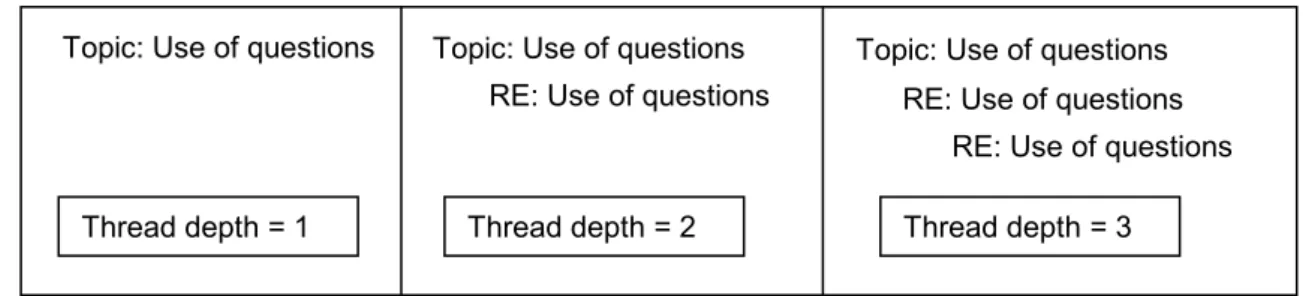
To answer question (1) “Is there any significant difference in the degree of students’ participation in asynchronous voice versus text discussions?”, online messages posted by the students in the asynchronous voice and text discussion platforms were analyzed. The number of postings was tabulated and the difference between the classes was examined using an independent sample t-test. To answer question (2) “How do thread depths differ between the asynchronous voice and text based discussion groups?”, we also examined the students’ online messages. Specifically, we refer thread depth to the number of messages that are linked together consecutively in a particular thread. For example, a thread that has only a starter message has a thread depth of one, while a thread that has a starter message and one reply has a thread depth of two, and a thread that has three consecutive messages has a thread depth of three (see Figure 1). According to Hew and Cheung (2008), a greater thread depth not only suggests that an online discussion is taking place but also the possibility that the discussion is sustained. A sustained discussion should ideally be the norm because it usually takes more than a few message exchanges for students to share opinions, negotiate issues, and create mutual understandings (Guzdial & Turns, 2000). Essentially, a thread that has only a thread depth count of one is an orphaned thread; it is basically a dead thread that does not generate any responses at all. A thread that has a depth of two is also very limited because there is no further response beyond the second message.
Figure 1:Thread depth
To answer question (3) “What advantages do audio discussions have over text based discussions?”, students who used the Wimba Voice Board were asked to comment on two open-ended questions at the end of the course: “What do you think are the benefits of using asynchronous voice discussions?”, “What do you think are the challenges of using asynchronous voice discussions?” The students’ open-ended responses were examined by a qualitative coding approach that followed the methods of Neuman (2006). Basically, the students’ responses were initially examined to group similar comments into themes. The relationship between the themes and the fit between each statement and the theme were then evaluated. Finally, each theme was given a label and a representative statement for each was selected.
5. Results and discussion
Is there any significant difference in the degree of students’ participation in asynchronous voice
versus text discussions?
The results of the independent t-test analysis suggested that there was no significant difference in the students’ degree of participation in the two classes, asynchronous voice discuss class (M = 2.92, SD = 1.586) and text discussion class (M = 2.78, SD = 1.353), (t = 0.299, df = 40, p = 0.767) at the 0.05 level of significance, although the mean number of posts in the former was higher than that in the latter.
From this result, we may conclude that students tended to participate more or less equally in either asynchronous voice or text discussion forum, despite the findings of some previous research studies suggesting that voice discussion provides a more natural and hence easier way to present ideas and
Topic: Use of questions RE: Use of questions
RE: Use of questions RE: Use of questions
Topic: Use of questions Topic: Use of questions
respond to others, as well as its ability to increase social presence due to the ability to hear other people’s voices (Marriott and Hiscock 2002; Yaneske and Oates 2010).
Why is this so? Analyses of the students’ reflection open-ended responses suggested that not all students find the Wimba Voice Board a convenient tool. Some students complained that they could not edit their voice postings if they said something wrong. Instead they had to delete their entire voice postings and record their voices again. This whole procedure of delete-and-record-again makes it very bothersome for some students to participate in the voice discussion.
We also found some participants being very self-conscious about how they sounded in the asynchronous voice discussion environment. Several students reported that they were afraid of appearing foolish should they speak too fast or that their voices sounded too high pitched, while others felt awkward speaking into a microphone.
How do thread depths differ between the asynchronous voice and text based discussion groups? Although there was no significant difference in the number of messages posted by the two groups, we found that the asynchronous voice discussion group had an overall greater thread depth (see Table 1).
Table 1: Comparison of thread depth between the asynchronous voice and text based discussion groups
Type of discussion
Thread depth
1 2 3 4
Voice 4 6 5 3
Text 6 12 3 0
On the whole, the asynchronous voice discussion group had five 3-level deep threads and three level deep threads, while the text discussion group had only three 3-level deep threads, and zero 4-level deep threads. This suggests the possibility that the online discussion is more sustained in the voice discussion group. We also found the text based discussion group had twice as many threads that were only two-level deep as compared to the asynchronous voice group. This indicates that a sustained discussion is not really taking place in the text group because such threads contained only two posts – the starter message and a reply to the starter.
One possible reason for finding more sustained discussions in the asynchronous voice group is the ability of the spoken word to project a sense of actually dealing with real people as compared to text discussions. According to Durbridge (1984), this sense of realism could motivate an individual to continue conversing with other people. This is highlighted by the following representative students’ statements:
“A voice-based discussion, clearly gives the sense of dealing with real people because we get to hear their voices, making us feel as if we are in a real discussion rather than within the boundaries of technology [sic].”
“A voice forum appears more personal [as we can hear people’s voices], hence creating a closer sense of realism for communicating with real people in real-life [sic].”
“The voice-based discussion instills a sense of actually dealing with real people as it is more realistic with real voice, intonation and emotions, compared to the mere reading of printed texts off the computer screen [sic].”
What advantages do asynchronous voice discussions have over text discussions?
Analyses of the students’ open-ended responses revealed several advantages of using voice discussions. We discuss four main ones in this paper. First, students were able to understand one another’s messages better because they could hear the tone and emotion expressed by the voice participants. This finding is consistent with that reported in some of the previous studies (Marriott &
Hiscock, 2002; Yaneske & Oates, 2010). The following representative statements from some of the students’ data help to illustrate this point:
“We are able to interpret not only the ideas presented but how it is presented such as the
intonations that may give us a clearer picture of the message posted [sic].”
“In my opinion, through voice-based discussions, participants will be able to portray their feelings through the tones of their voice. This will enable those who listen to them to
better understand what they are trying to say about a certain issue [sic].”
Second, the use of asynchronous voice discussion is particularly useful for learners who prefer talking to writing, or who may not be proficient in the use of grammar as highlighted by the following comments:
“It [asynchronous voice discussion] comes in handy for those who are better in speaking
than in writing. This will ensure that he/she is able to raise his/her views clearly and avoid
confusion [sic].”
“Voice-based discussions have several advantages such as enabling a participant to voice out his/her views as much as possible without having to worry about grammar or vocabulary as compared to writing, hence making the person actually enjoys what he or
she is doing [sic].”
Third, we found that the use of asynchronous voice discussion could help promote originality of ideas. Results of our analysis suggested that this was mainly due to the spontaneity nature of voice discussion. The following representative statements from some of the students’ data help to illustrate this point:
“It is more in promptu. People tend not need to over think before they say, and hence their spoken comments provide a more realistic picture of what they actually feel [sic].”
“It enables us to speak our minds without the need for any type and delete, type and delete going on. It will be like truly speaking our mind without any hesitation [sic].”
Fourth, the use of asynchronous voice discussion could help foster a sense of online community: “I think that a voice-based discussion puts forth the notion of the strong sense of online community because we (virtually) let our voice and opinions be heard and when all of these 'voices' come together, a sense of unity is felt, together with shared emotions that we hear from the voices [sic].”
“It creates a stronger sense of online community within a group because we could
actually listen to each other. This would help to bond us together [sic].”
6. Conclusion
In this study, we investigated the impact of using asynchronous voice discussion on the degree of student participation. We also explored the students’ perceptions of the advantages of asynchronous voice discussion. Overall, the results of the current study showed no significant difference in terms of the number of message posted between students who participated in the asynchronous voice discussion environment and their text-discussion counterparts. However, the online discussion appeared to be more sustained in the asynchronous voice discussion group, In addition, students who took part in the asynchronous voice discussions reported four main advantages of using audio. These include: the ability to understand someone better due to the presence of emotions and tonal cues, greater convenience and ease for students who prefer speaking to writing or who are weak in grammar to participate in the online discussion, the ability to foster a sense of online community, and the ability to help promote originality of ideas due to the spontaneity or impromptu nature of oral communication.
Due to the relatively small number of participants (n=42), the results of this study should be interpreted with caution. A larger sample would be needed to further test and confirm the veracity of the findings. Whether the findings would hold true with students from other courses, disciplines and academic abilities is unclear.
The actual online discussion in the current study took place over a relatively short period of two weeks. For many students, this was the first time they recorded their voices using microphones.
Therefore, it is not very surprising that some students felt a sense of awkwardness using the asynchronous voice discussion tool. Whether the students would participate more often on the Voice Board platform when this sense of awkwardness fades is still uncertain.
Despite these limitations, we believe that the findings are useful to other researchers and educators who are similarly interested in examining the use of asynchronous voice discussion in e-learning or blended-learning environments. For future research, we suggest that a longer duration of study be conducted. Perhaps, students could be given the opportunity to participate in asynchronous voice discussion for an entire semester. Further research about the use of asynchronous voice discussion should also be conducted using a larger cohort of students from various disciplines.
We also urge future research to examine aspects of students’ performance outcome such as their level of critical thinking in asynchronous voice discussion environments, and how these may differ from text-input forums. Students’ level of critical thinking may be assessed in terms of their level of information processing – surface or in-depth. Surface level of information processing includes: making prediction, generalizations, conclusions or judgements without offering justification or suggesting which is most appropriate, sticking to prejudices or assumptions, and off-topic/faulty reasoning (Cheung & Hew, 2006). On the other hand, in-depth level of information processing may involve setting out the advantages and disadvantages of an idea or solution, making prediction, generalizations, conclusions or judgements supported by justification, providing proof or examples, and bringing outside knowledge or experience to bear on problem (Cheung & Hew, 2006). Other students’ performance outcomes that could be investigated include the levels of student social construction of knowledge, and student problem solving skill (Hew, Liu, Martinez, Bonk, & Lee, 2004). Finally, future research should also examine the use of asynchronous voice discussion on small screen wireless mobile devices. Examples of such devices include PDAs with wireless access and smart phones (e.g., iPhones) (Cheung & Hew, 2009). Since it is not easy for students to post messages using a text-based input on small screen mobile devices, asynchronous voice discussion input via built-in microphones may be a viable alternative. Furthermore, the cost of text entry may be too high to scale towards multiple communication sessions using mobile devices (Zinman, 2006), hence asynchronous voice could be a superior medium to support scalable group communication.
References
Bowe, F. G. (2002) “Deaf and hard of hearing Americans’ instant messaging and e-mail use: A national survey”, American Annals of the Deaf, Vol 147, No. 4, pp 6–10.
Cheung, W. S. and Hew, K. F. (2006) “Examining students' creative and critical thinking and student to student interactions in an asynchronous online discussion environment: A Singapore case study”, Asia-Pacific Cybereducation Journal, 2(2), [online], http://acecjournal.org/current_issue/article/2_2_examining_full.php (accessed on 01/09/12).
Cheung, W. S. and Hew, K. F. (2009) “A Review of Research Methodologies used in Exploring Selected Studies on Mobile Handheld Devices in K-12 and Higher Education Settings”, Australasian Journal of Educational Technology, Vol 25, No. 2, pp 153-183.
Cheung, W. S. and Hew, K. F. (2011) “Design and evaluation of two blended learning approaches: Lessons learned”, Australasian Journal of Educational Technology, Vol 27, No. 8, pp 1319-1337.
Davies, J. and Graff, M. (2005) “Performance in e-learning: Online participation and student grades”, British Journal of Educational Technology, Vol 36, No. 4, pp 657-663.
Dziuban, C.D., Hartman, J.L. and Moskal, P.D. (2004) “Blended learning”, Educause Center for Applied Research (ECAR) Research Bulletin, 7, [online], http://net.educause.edu/ir/library/pdf/ERB0407.pdf (accessed on 16/02/12)
Dunlap, J. C. (2005) “Workload reduction in online courses: Getting some shuteye”, Performance and Improvement, Vol 44, No. 5, pp 18-25.
Durbridge, N. (1984) “Media in course design, No. 9, audio cassettes”, The role of technology in distance education, Kent, UK: Croom Helm.
Ertmer, P., A., Richardson, J. C., Belland, B., Camin, D., Connolly, P., Coulthard, G., Lei, K. and Mong, C (2007) “Using peer feedback to enhance the quality of student online postings: An exploratory study”, Journal of Computer Mediated Communication, 12(2), [online],
http://jcmc.indiana.edu/vol12/issue2/ertmer.html (accessed on 20/01/12).
Gaspar, A., Langevin, S., Boyer, N. and Armitage, W. (2010) “Students’ activity focus in online asynchronous peer learning forums”, Informatics in Education, Vol 9, No. 1, pp 1-36.
Girasoli, A. J. and Hannafin, R. D. (2008) “Using asynchronous AV communication tools to increase academic self-efficacy”, Computers & Education, Vol 51, pp 1676-1682.
Gleason, J. and Suvorov, R. (2011) “Learner perceptions of asynchronous oral computer-mediated communication tasks using Wimba Voice for developing their L2 oral proficiency”, in Huffman, S. and
Hegelheimer, V. (ed.) The role of CALL in hybrid and online language courses. Ames, Iowa State University.
Guzdial, M. and Turns, J. (2000) “Effective discussion through a computer-mediated anchored forum”, Journal of the Learning Sciences, Vol 9, No. 4, pp 437-469.
Hew, K. F. (2009) “Use of Audio Podcast in K-12 and Higher education: A Review of Research Topics and Methodologies”, Educational Technology Research and Development, Vol 57, No. 3, pp 333-357. Hew, K. F. and Cheung, W. S. (2012) “Student Participation in Online Discussions: Challenges, Solutions, and
Future Research”, Springer: New York.
Hew, K. F. and Cheung, W. S. (2008) “Attracting student participation in asynchronous online discussions: A case study of peer facilitation”, Computers and Education, Vol 51, pp 1111-1124.
Hew, K. F., Cheung, W. S. and Ng, C. S. L. (2010) “Student Contribution in Asynchronous Online Discussion: A Review of the Research and Empirical Exploration”, Instructional Science, Vol 38, No. 6, pp 571-606. Hew, K. F. and Hara, N. (2007) “Empirical Study of Motivators and Barriers of Teacher Online Knowledge
Sharing”, Educational Technology Research and Development, Vol 55, No. 6, pp 573-595.
Hew, K. F. and Knapczyk, D. (2007) “Analysis of Ill-Structured Problem Solving, Mentoring Functions, and Perceptions of Practicum Teachers and Mentors Toward Online Mentoring In A Field-Based Practicum”, Instructional Science, Vol 35, No. 1, pp 1-40.
Hew, K. F., Liu, S., Martinez, R., Bonk, C. and Lee, J. Y. (2004) “Online education evaluation: What should we evaluate?” Proceedings of the Association for Educational Communications and Technology, USA, Vol 27, pp 243-246.
Junor, L. (1992) “Teaching by tape: Some benefits, problems, and solutions”, Distance Education, Vol 13, No. 1, pp 93-107.
Kucuk, M., Genc-Kumtepe, E. and Tasci, D. (2010) “Support services and learning styles influencing interaction in asynchronous online discussions”, Educational Media International, Vol 47, No. 1, pp 39-56.
Marriott, P. and Hiscock, J. (2002) “Voice vs Text-based Discussion Forums: an implementation of Wimba Voice Boards”, in Driscoll, M. and Reeves, T. (ed.) Proceedings of World Conference on E-Learning in Corporate, Government, Healthcare, and Higher Education 2002, pp 640-646, Association for the Advancement of Computing in Education, Virginia.
McCormack, V. (2010) “Increasing teacher candidate responses through the application of VoiceThread”, International Journal of Arts and Sciences, Vol 3, No. 11, pp 160-165.
McIntosh, S., Braul, B. and Chao, T. (2003) “A case study in asynchronous voice conferencing for language instruction”, Educational Media International, Vol 40, No. 1, pp 63-74.
Murphy, E. and Coleman, E. (2004) “Graduate students’ experiences of challenges in online asynchronous discussions”, Canadian Journal of Learning and Technology, Vol 30, Vol 2, [online],
www.cjlt.ca/content/vol30.2/cjlt30-2_art-2.html (accessed on 03/04/07).
Nagel, L., Blignaut, A. S. and Cronje, J. C. (2009) “Read-only participants: A case for student communication in online courses”, Interactive Learning Environments, Vol 17, No. 1, pp 37-51.
Neuman, W, L. (2006) Social Research Methods: Qualitative and Quantitative Approaches, Sixth Edition, Pearson Education, London.
Palincsar, A. S. and Herrenkohl, L. R. (2002) “Designing collaborative learning contexts”, Theory into Practice, Vol 41, No. 1, pp 26-32.
Palmer, S., Holt, D. and Bray, S. (2008) “Does the discussion help? The impact of a formally assessed online discussion on final student results”, British Journal of Educational Technology, Vol 39, No. 5, pp 847-858. Richardson, J. C. and Swan, K. (2003) “Examining social presence in online courses in relation to students’
perceived learning and satisfaction”, Journal of Asynchronous Learning Networks, Vol 7, No. 1, pp 68-88. Romiszowski, A and Mason, R. (2004) “Computer-Mediated Communication”, in Jonassen, D. (ed.) Handbook of
Research on Educational Communications and Technology, pp 397-431, Lawrence Erlbaum Associates, New Jersey.
Wan, D. and Johnson, P. M. (1994) “Computer supported collaborative learning using CLARE: The approach and experimental findings”, in Furuta R. and Neuwirth C. (eds.) Proceedings of CSCW’94, pp. 187–198, Chapel Hill, NC: ACM.
Yaneske, E. and Oates, B. (2010) “Using Voice Boards: pedagogical design, technological implementation, evaluation and reflections”, ALT-J Research in Learning Technology, Vol 18, No. 3, pp 233-250. Yukselturk, E. (2010) “An investigation of factors affecting student participation level in an online discussion
forum”, The Turkish Online Journal of Educational Technology, Vol 9, No. 2, [online], http://tojet.net/articles/923.pdf (accessed on 11/08/11)
Zinman, A. (2006) “RadioActive: Enabling large-scale asynchronous discussions on mobile devices”, Unpublished Master thesis. Massachusetts Institute of technology, MA.
ISSN 1479-4403 368 ©Academic Publishing International Ltd Reference this paper as: Hwang I, Tam M, Lam S Land Lam P “Review of Use of Animation as a Supplementary
Material of Physiology Content in Four Academic Years
Isabel Hwang
1, Michael Tam
1, Shun Leung Lam
2and Paul Lam
2 1School of Biomedical Sciences, The Chinese University of Hong Kong, Hong
Kong, China
2
Centre for Learning Enhancement And Research, The Chinese University of
Hong Kong, Hong Kong, China
[email protected]
[email protected]
[email protected]
[email protected]
Abstract: Dynamic concepts are difficult to explain in traditional media such as still slides. Animations seem to offer the advantage of delivering better representations of these concepts. Compared with static images and text, animations can present procedural information (e.g. biochemical reaction steps, physiological activities) more explicitly as they show the steps in an orderly manner. Quite a few empirical studies showed promising results animations have on learning (e.g. Trevisan, Oki and Senger, 2009; Hays, 1996). There are, however, also limitations. Designing and developing quality animations for teaching and learning can be challenging sometimes (Morrison, Tversky and Betrancourt, 2000). Kesner and Linzey (2005) even found no improvement on students’ learning in using animations in their study. It thus occurs to the researchers that there are factors that govern successful use of animation in teaching and learning. Our study explored such factors in the context of physiology teaching. 913 students in twelve different classes (collected in two stages, four years in total) in the same physiology course learned complicated microscopic mechanisms with assistance from animations provided as supplementary materials primarily for self-study. Surveys and group interviews were conducted that provided both qualitative and quantitative feedback. Results were mostly positive - animations surely explain contents more explicitly to students (especially for the explanation of dynamic and complicated biological processes), make students more interested in the subjects taught; and there is a greater demand for similar learning tools from the students. It is strongly believed that animations are good supplementary learning materials for students particularly for learning complicated concepts. Important success factors we found included the detailed explanation of content, a good balance between clear presentation and beautiful interface, the speed of running/ loading of the animations, and the provision of more references, etc.
Keywords: teaching dynamic physiology process, supplementary use of animation, advantage of animation in teaching, successful factors of using animation, animation for student revision, learning with animation
1. Animation in teaching and learning
Dynamic concepts are difficult to explain in traditional media such as still slides. Animations seem to have the advantage of delivering better representations of these concepts. A wide range of subject areas such as chemistry and computer sciences are currently using animation to demonstrate their course contents (e.g. Kehoe, Stasko and Taylor, 2001; Payne, Chesworth and Hill, 1992; Dyck, 1995; Harrison, 1995; Tversky and Morrison, 2001). Similarly, Kesner and Linzey (2005) remarked that animation can be applied in the study of physiology, such as presenting modules covering the muscular, respiratory, urinary, cardiovascular and nervous systems.
There are claims about the advantage of using animation over traditional paper-based explanation. Lowe (2004) suggested that animations have the potential to serve both affective function and cognitive function. Affective function refers to portraying things in a humorous, spectacular, or bizarre way so that learners will be attracted to pay additional attention on the learning materials and motivated to learn.
Cognitive function refers to the clear presentation of dynamic matters (which might be abstract and difficult) that can allow learners to understand in an easier way. Compared with static images and text, animations can present procedural information (e.g. biochemical reaction steps, physiological mechanisms) more explicitly as they show the steps in an orderly manner. Hegarty (2005) mentioned that animation is used for representing the mechanical motions directly while static images could just show the motions indirectly through arrows and phase diagrams. She carried on suggesting that animations bring “more realistic representations, that is more isomorphic to the reality they represent”
(Hegarty, 2005: 451). Moreover, we think animations allow representations of objects that are either too microscopic (e.g. viruses, nuclei) or even invisible (e.g. electricity current, magnetic force) for the naked eyes. Details can be viewed from angles not feasible in real life.
A number of empirical studies showed promising results animations have on learning. Trevisan, Oki and Senger (2009) compared two groups of students who used a video of traditional lecture and animation as the learning material respectively. The learning topic was about follicular dynamics, a topic in physiology. The students invited for the study were from an undergraduate reproductive physiology course in six universities in USA. An immediate one-off test was used as the evaluation instrument. The results in general showed that those used animation as the learning material got significantly higher marks.
Hays (1996) reported a study of using three different media: animation, static graphs, and textual material. They were for students to learn the movement of molecules, the effects of heat and pressure on molecules movements, and how molecule diffused from different concentrations. Students were divided into groups of high and low spatial ability and they were asked to use the three different media to learn. A test was administrated at the end to compare the learning performance of students in each group. The results showed that animation was effective to help students who were low in spatial ability.
There are, however, limitations concerning with the use of animations in teaching and learning. Designing and developing quality animations for teaching and learning can be challenging. Morrison, Tversky, and Betrancourt (2000), for example, remarked that fast-paced animations would impose difficulties to the students in observing detailed procedural information. Moreover, animations are costly and time-consuming to make. Viewing them may be time-consuming too. If a concept can be understood using a static diagram or using text, it will be time-saving.
Kesner and Linzey (2005) found no improvement on students’ learning in using animations. A learning package was developed for students to learn physiology. Animations were an important component of the learning package. The students were studying courses of human anatomy and physiology in a university in Midwestern USA. The materials were used as a supplementary learning material. The time students spent on using the learning package and their examination results were compared. The result was that use of the package “did not have a significant impact on student performance” (Kesner and Linzey, 2005: 211).
Morrison, Tversky, and Betrancourt (2000) reviewed more than 12 previous studies that were about the comparison of static graphics and animations, with follow-up tests/ tasks scores as indicators. They concluded that real benefits (in terms of student scores) of animations to learning were not found in at least four of the studies. Even for the studies that students who used animations outperformed those who did not, Morrison, Tversky, and Betrancourt thought that the benefits were not a result of animations alone but were a combination of the followings: The animations contained additional or important information, while the static graphics did not (in the studies of Large, Beheshti, Breuleux and Renaud, 1996; Rieber, 1990, 1991a, 1991b); the number of static graphics used was not enough since the molecular steps of the processes were not shown (in the studies of Park and Gittelman, 1992; Lee, 1997); or the method of study was not well designed (in the study of Kieras, 1992).
In this study, it is considered that a comparison of animations with text/ pictures will not be meaningful in the actual teaching and learning context because animations are always used as supplementary learning materials in the real setting. The research focus of the present paper, therefore, is on following:
What are the roles of animations in supplementing learning?
How should teachers and courseware developers attend to the various design features of animations and improve them, for bringing more learning benefits to students?
2. Our study background
Our students are students in a foundation physiology course in The Chinese University of Hong Kong. Students taking this course are majors in a range of disciplines: Pharmacy, Medicine, Chinese Medicine, Human Biology and Nursing. Almost all of the students are year 1 students. It was expected
that animation would be a good tool for learning many physiology concepts as many topics in this field of study are complex, occurring at the molecular level which is not observable, and involving multiple steps and/or multiple components, such as the working mechanisms of electrical signal generated in the nerve cell, contraction and relaxation of skeletal muscle fibers and reabsorption of water in different segments of the kidney tubules.
Starting in 2008, with the support of Courseware Development Grants, four online animation modules have been developed on topics in action potential (AP), skeletal muscle contraction (SMC), cardiovascular physiology (CP) and urine formation in kidney (UK). The animations served as supplementary learning materials primarily for students’ self-study at home. Some animations were also chosen and also played during lectures to reinforce key physiological concepts before students spend time reviewing the animation module again at home.
These animations were used by twelve classes of full-time students in two stages (four years in total) who took the physiology course. In Stage 1 (2008–2009 and 2009–2010) the animations were used as supplementary learning materials in eight classes. Students’ comments and suggestions about the animation courseware were collected for the research team and the teacher to learn about the effectiveness and usefulness of the animation courseware. The courseware was then slightly modified according to some useful suggestions from students, and was then adopted in four classes in Stage 2 (2010–2011 and 2011–2012). Stage 2 served as a follow-up study of the effectiveness and usefulness of the animation courseware, as to let the teacher and the research team to confirm factors that influence learning effects of animations.
Great care has been paid to the designs of the animations to maximise the learning potentials of these supplementary learning materials and make our effort worthwhile. Pedagogical and technical services from the Centre for Learning Enhancement And Research (CLEAR) and Information Technology Services Centre (ITSC) have been used. Significant effort has also been paid to evaluate the materials through surveying the students and meeting some of them over the four years of use. Mayer (2002) proposed a cognitive theory model in order to explain the effects of multimedia materials on learning. In this model, cognition performs in the following ways: dual channel assumption (learner processes visual and auditory information through separate channels), limited capacity (learner’s working memory is limited that he can only process in each channel at one time) and active processing (learning is the process of the learner’s integrating the information received with other information). Based on these assumptions and supported with empirical evidence, Mayer carried on and made the following suggestions for an effective learning material.
Giving explanations/ remark next to the image instead of far away from the image;
Providing narration to the animation simultaneously instead of successively;
Eliminate extraneous words, pictures and sounds;
Using pictures and words are better than words alone;
Animation with narration is better than animation with words;
Animation with narration only is better than animation with narration and words;
Allowing students to have prerequisite knowledge about the objects in the animation at first is better than without such knowledge;
Telling students the summary or letting them know “how the ideas are organized into a causal chain” (p. 128) is better without that;
Present the words in conversational style is better than formal style.
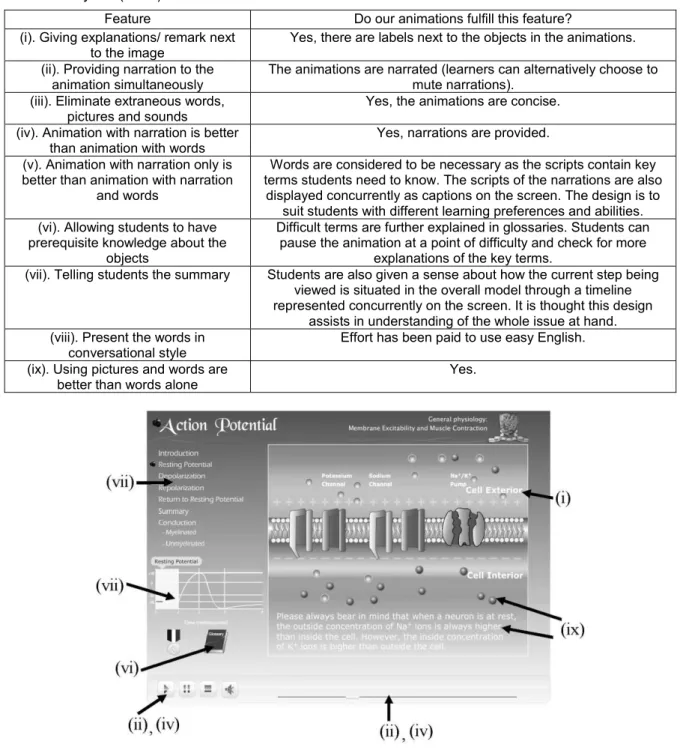
The following table is about how our animations in both stages corresponded to these features. Figure 1 shows the layout of one of our animations (AP module) and illustrates how these considerations influenced our animations.
Table 1: Mayer’s (2002) nine features and the fulfillment of our animations
Feature Do our animations fulfill this feature?
(i). Giving explanations/ remark next to the image
Yes, there are labels next to the objects in the animations. (ii). Providing narration to the
animation simultaneously
The animations are narrated (learners can alternatively choose to mute narrations).
(iii). Eliminate extraneous words, pictures and sounds
Yes, the animations are concise. (iv). Animation with narration is better
than animation with words
Yes, narrations are provided. (v). Animation with narration only is
better than animation with narration and words
Words are considered to be necessary as the scripts contain key terms students need to know. The scripts of the narrations are also
displayed concurrently as captions on the screen. The design is to suit students with different learning preferences and abilities. (vi). Allowing students to have
prerequisite knowledge about the objects
Difficult terms are further explained in glossaries. Students can pause the animation at a point of difficulty and check for more
explanations of the key terms.
(vii). Telling students the summary Students are also given a sense about how the current step being viewed is situated in the overall model through a timeline represented concurrently on the screen. It is thought this design
assists in understanding of the whole issue at hand. (viii). Present the words in
conversational style
Effort has been paid to use easy English. (ix). Using pictures and words are
better than words alone
Yes.
Figure 1: Screen capture of the AP module
Apart from the above considerations, we also took effort to ensure that:
The animations are professionally prepared: colourful, high-quality images that are attractive to the viewers and motion of components at molecular level that are also run smoothly. It is aimed at providing visualisation of complicated molecular processes with clearer and graphically richer features when compared to text or static graphics.
Students have full control of how the animations are played – through using the VCR-type button controls or through using the sliding bar. In this way, a certain step in the processes in the animations can be played slowly, paused, revisited or skipped depending on the needs of individual learners.
Students can view them in any sequence they like. There is no prescribed learning path.
Students are constantly checked for understanding with built-in exercises. The exercises are auto-corrected and students are given immediate feedback on their performance.
3. Evaluation
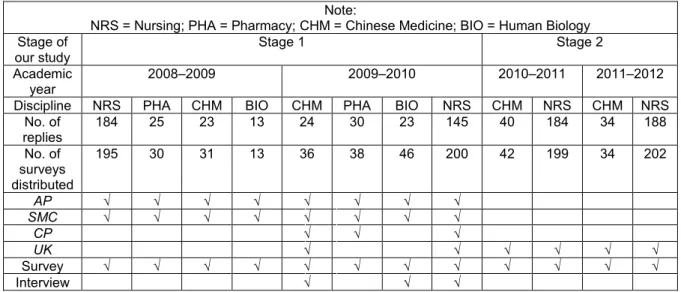
Students’ perceptions of the use of animations were obtained by administrating surveys and focus -group interviews which provided both qualitative and quantitative data for our study. Table 2 explains the exact animations used in each of the classes over the two stages in the four year period and the evaluation data collected in each class.
Table 2: Types of animations used and the evaluation strategies used in each class Note:
NRS = Nursing; PHA = Pharmacy; CHM = Chinese Medicine; BIO = Human Biology Stage of
our study
Stage 1 Stage 2
Academic year
2008–2009 2009–2010 2010–2011 2011–2012
Discipline NRS PHA CHM BIO CHM PHA BIO NRS CHM NRS CHM NRS
No. of replies
184 25 23 13 24 30 23 145 40 184 34 188
No. of surveys distributed
195 30 31 13 36 38 46 200 42 199 34 202
AP √ √ √ √ √ √ √ √
SMC √ √ √ √ √ √ √ √
CP √ √ √
UK √ √ √ √ √ √
Survey √ √ √ √ √ √ √ √ √ √ √ √
Interview √ √ √
The survey was consisted of two parts: Likert-scale questions and open-ended questions. A total of 913 students (out of 1066 students, response rate being 86%) replied the surveys over the four years in the twelve different classes.
For the focus-group interviews, an invitation was sent to all students who took the course in the academic year 2009–2010 (Stage 1). Participation was voluntary. A total of 12 students accepted the invitation and three focus-group meetings was held in May and June 2010. They were students from three disciplines: Human Biology (6 students), Chinese Medicine (5 students) and Nursing (1 student). A list of simple interview questions (protocol) was prepared to guide the interviews. They were about students’ perceived effectiveness of using animation to learn, choice of animations or text for study, and suggestions for improvements. A list of simple interview questions were prepared for the interview, they were about students’ perceived effectiveness of using animation to learn, choice of different learning media, the improvements of the animation(s) they wished, and other opinions. These questions were guiding questions for the interviewers rather than rigid prescribed structure of the interviews. The interview was taken in a natural approach that students were encouraged to comment freely on the use of the four animations for learning the topics, and suggest what could be improved in the animations. The students attended our interview at three different times (Table 3). Table 3: Interview date, time and participants
1st interview 2nd interview 3rd interview Date and time 20 May 2010, 13:00 –
13:25
26 May 2010, 13:40 – 14:05
9 June 2010, 10:40 – 10:50 Participants and their
backgrounds
6 students, Chinese Medicine
5 students, Human Biology
1 student, Nursing
4. Findings
4.1 Stages 1 and 2
In the focus-group interviews conducted at the end of Stage 1, students had the opportunity to elaborate on how animations had assisted in their learning. The students in the three groups in general perceived that the strengths of the animations were clear presentations of the topic content, and therefore it would facilitate understanding of the topics. The followings were the summary of their comments and some quotations.
Students mentioned that it would be more explicit to present procedural information, processes that involved many interactions and dynamic changes by animation that involved many steps, such as some periodical changes (the thickness change of the uterus), the movement of ions (in the topic of counter-current in kidney), ion movement in ion channel in the topic of action potential and the topic about how hormones function. Moreover, easier memorisation of content was also the advantage of animation. Students also remarked that graphics in animations were better than book as they were colourful while many images in books were black and white which was difficult to perceive. The following are some quotations:
“The (dynamic) graphics showed the steps in process clearly, for this aspect they were better than text and the teaching during lesson”
“It is good to have animations as a supplementary tool for our learning of complicated process in human body such as the mechanism of filtering wastes in blood by kidney. That process involved many steps, components (ions coming in and out), and flows of fluid.”
“Animation is most needed for mechanisms in physiology that are complicated, for example the ion channel in action potential.”
“Some physiology topics involve too many types of hormones and interactions. This was quite confusing. Presenting them with animation will be a good practice”
“I just partially understood the process of osmolarity change (in the topic of kidney) during lesson but fully understood after I had viewed the animation … Although there were figures in textbook that showed the value changes of osmolarity in kidney, such changes were still difficult to perceive. I just noted they were discrete changes but not trends of changes”
Students also elaborated on what topics had been challenging to them could be good candidates for our future work.
“It would be better to have animations as a supplementary tool for our learning of complicated process in human body such as the mechanism of filtering wastes in blood by kidney. That process involved many steps, components (ions coming in and out), and flows of fluid.”
“Some physiology topics involve too many types of hormones and interactions. This was quite confusing. Presenting them with animation will be a good practice.”
However, although students tend to agree that the graphics in animation looked good, they did not find animations had a strong effect on learning motivation.
“It was certain that no matter how attractive the animation was, the motivation effect would not be strong, especially when compared with examination. Moreover, good personal mood should be a more important factor for learning than the provision of animations”
“I think I was a bit interested in the animation, however, I do not think animation would be a major factor for students’ interest of learning. I think learning interest is intrinsic”
Lastly, students gave a few short suggestions on the improvements of the animations:
“Speed to play the animation: all students thought the playing speed was too slow that it needed more time to view, and they suggested making them faster”
“Add some translations for the difficult terms”
“Some students suggested adding more topics for animations (e.g. brain, gastro-intestinal tract, endocrine system)”
“Add exercises in the animations”
“Animations provided were not informative enough. For example, the explanations of some terms could not be found in animations”
Similar remarks about improvement ideas were also collected in Stage 1 from an open-ended question in the survey. Some of these remarks were:
To develop more of similar learning tools for other topics as well (mentioned in 10 out of the 62 replies (16.2%) in 2008–2009 and 7 out of the 43 replies (16.3%) in 2009–2010);
Some students thought the running was slow such as long loading time, slow speed of narration (mentioned in 13 out of the 39 replies (33.3%) in 2008–2009 and 9 out of the 31 replies (29.0%) in 2009–2010);
Difficult to access/ open the animation (mentioned in 8 out of the 39 replies (20.5%) in 2008–2009 and 1 out of the 31 replies (3.2%) in 2009–2010);
To provide more references to let students learn more or to facilitate students with less biology knowledge to understand the content (12 out of the 44 replies (27.3%) in 2008–2009; 7 out of the 34 replies (20.6%) in 2009–2010).
Data collected in Stage 1 thus on the whole confirmed the learning benefits of animations. There were also rooms for improvement and some of them were dealt with in Stage 2 (2010–2011 and 2011– 2012).
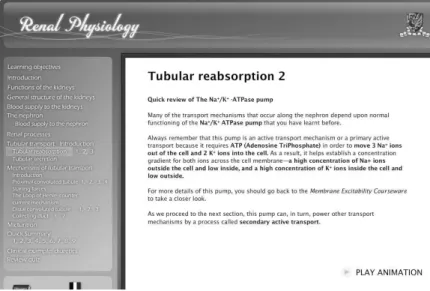
One of the main changes was the addition of extending reading of the topic of the animations. As an example, Figure 2 shows how ‘tubular reabsorption’ is explained in fuller details on separate pages rather than within the animation.
Figure 2: Screen capture of a section page in the modified UK module in Stage 2
The more details added could serve two purposes: to allow students to get a general understanding of topic concepts by skimming through the text first, before they view the animation; and to allow students to learn more in detail after they have viewed the animation.
Captions and explanations appearing together with the animations were still important as they served to foster understanding during the time of viewing the animations. The text, however, was downsized to avoid too much overlapping with the added content. We acknowledged that, as noted by Mayer’s (2002), explanations or remarks should be placed next to the image instead of far away from the image. Moreover, results in some empirical studies also echoed Mayer’s point. For example, Holsanova, Holmberg and Holmqvist (2009) reported a study carried out with 31 Swedish people as the subjects. The study was to investigate whether different spatial arrangement of text and image would cause different cognitive load. The first setting was that the texts and images placed far away from each other while the second one was with the relevant texts and images placed closed to each other. The results showed that the first setting tended to make readers more difficult to find the correspondences between the texts and the images. In another study by Harter and Ku (2008), 98 sixth-grade American students were randomly assigned learning materials of different spatial arrangements of relevant messages. The result showed that students assigned materials of relevant messages put closed together had higher gains in scores.
4.2 Overall data
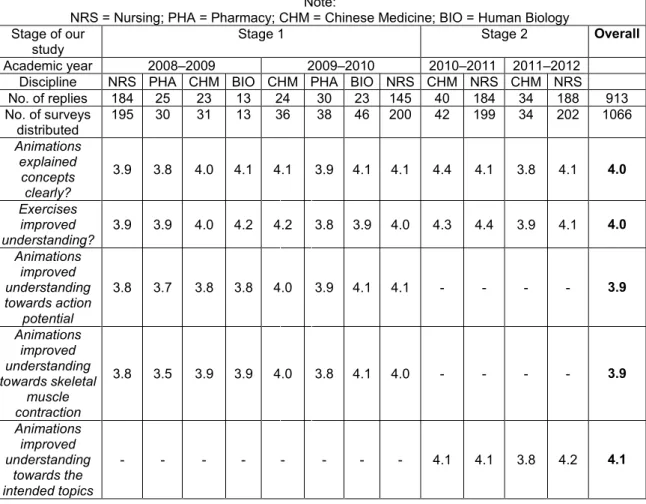
The quantitative data collected in the surveys among the two stages (the four academic years from 2008 to 2012) were promising in general. Table 4 shows students’ replies in two of the questions that best represent our main objectives in developing the animations: clearer explanation of the concepts and students’ better understanding as a result of the additional resources. Students stated how much they agreed to the achievement of these benefits on a 5-point Likert scale Scores, with ‘1’ being strongly disagreed and ‘5’ being strongly agreed.
As you can see from Table 4, students’ ratings of many items on the questionnaire approached 4. The perceived learning outcomes of the animations were also to a large extent confirmed: concepts were explained clearly (overall score is at 4.0) and students remarked animation improved their understanding of the various topics (range of overall scores is at 3.9–4.1).
Table 4: Quantitative data of students’ perception to the use of animation on learning the physiology topics
Note:
NRS = Nursing; PHA = Pharmacy; CHM = Chinese Medicine; BIO = Human Biology Stage of our
study
Stage 1 Stage 2 Overall
Academic year 2008–2009 2009–2010 2010–2011 2011–2012 Discipline NRS PHA CHM BIO CHM PHA BIO NRS CHM NRS CHM NRS No. of replies 184 25 23 13 24 30 23 145 40 184 34 188 913 No. of surveys
distributed
195 30 31 13 36 38 46 200 42 199 34 202 1066
Animations explained
concepts clearly?
3.9 3.8 4.0 4.1 4.1 3.9 4.1 4.1 4.4 4.1 3.8 4.1 4.0 Exercises
improved understanding?
3.9 3.9 4.0 4.2 4.2 3.8 3.9 4.0 4.3 4.4 3.9 4.1 4.0 Animations
improved understanding towards action
potential
3.8 3.7 3.8 3.8 4.0 3.9 4.1 4.1 - - - - 3.9
Animations improved understanding towards skeletal
muscle contraction
3.8 3.5 3.9 3.9 4.0 3.8 4.1 4.0 - - - - 3.9
Animations improved understanding
towards the intended topics
- - - 4.1 4.1 3.8 4.2 4.1
Students’ open-ended replies on the surveys also echoed the same positive attitudes towards the animation courseware. For example, students mentioned many advantages of the animations and the key ones were:
Animations sparked students’ interest to learn (mentioned in 11 out of the 48 replies (22.9%) in 2008–2009 and 6 out of the 21 replies (28.6%) in 2009–2010);
Animations improved students’ understanding of concepts (mentioned in 10 out of the 48 replies (20.8%) in 2008–2009, 5 out of the 21 replies (23.8%) in 2009–2010, 15 out of the 73 replies (20.5%) in 2010–2011 and 27 out of the 101 replies (26.7%) in 2011–2012);
Animations provided clear explanations on the subject matters (mentioned in 16 out of the 121 replies (13.2%) in 2008–2009, 12 out of the 71 replies (16.9%) in 2009–2010, 31 out of the 73 replies (42.5%) in 2010–2011 and 31 out of the 101 replies (30.7%) in 2011–2012);
Other minor advantages mentioned by students in the two stages included convenience for self-studying the topics, allowing a better efficiency of learning, enabling a self-controlled mode of learning due to the feature of the animation (e.g. can re-play and pause the animation), checking their understanding of the topic and good for revision.
Certainly, there can be some possible improvements in the future, by considering the following comments about the modified version of the animation in Stage 2:
Some students thought the running was too fast (mentioned in 6 out of the 31 replies (19.4%) in 2010–2011 and 5 out of the 44 replies (11.4%) in 2011–2012);
The animation was not informative enough, such as explanation to answers, summaries, detailed explanations about the concepts, etc (18 out of the 38 replies (47.4%) in 2010–2011, 6 out of the 44 replies (13.6%) in 2011–2012);
Not enough function (9 out of the 31 replies (29%) in 2010–2011).
5. Discussion
5.1 Role of animations as learning resources
The feedback collected from students in general confirmed that animations are beneficial to learning. The quantitative data indicated that animations were a good media to explain concepts more clearly, and to improve understanding of the content of topics, as to students’ perception. In the quantitative data, students pointed out that animations were particularly helpful in explaining complicated and dynamic concepts which were otherwise difficult to represent through mere text or static images. In addition, some students mentioned that they became more interested in learning, and the animations facilitated memorizing of content.
The advantages of clear presentation of procedural information of animations, however, did not mean that they were superior learning media. When students were asked to take animation or learning materials with static interfaces such as textbook and PowerPoint slides as their first choice of learning medium, students gave different answers. About half of the students selected animation as their first choice of learning medium, while others preferred static media more. The former type of students reasoned that the animations were not informative enough. For example, the explanations of some terms could not be found in animations but could be found in notes or textbooks. If they view animation first, they would not able to understand some terms. They therefore put forward that their comment practices were to read notes first, to get a perception of the topic in brief, then view the animations, and followed by reading books. More topic content was added in the animations in Stage 2 as for improvement.
There had been worries that animations may represent actions in high speed such that perception of the procedural changes in processes can be difficult (Morrison, Tversky, and Betrancourt, 2000). Such worries were not found in our study. It may be because this study is to emphasise on the supplementary function of animations. Animations assist in the descriptions of concepts on the traditional media rather than acting as a replacement for the traditional media. In addition, the animations can be made to be easily plausible and repeatable through controlling the scroll-bar. The interface allows students to pause and think before going on to the next step.
5.2 Design features and improvement
Considering students’ feedback on the aspects they liked best and the areas they would like to have improvement, it was summarised the following points for the design and application of animations for more learning benefits.
Explanations should be rich and clear (translation may be necessary) so that the animations are self-sufficient learning resources.
There should be a good balance between clear presentation and beautiful interface, enough function and the speed of running/ loading of the animations.
Animations are better media for certain types of topics: for example, dynamic concepts involving movement of tiny components, or actions that involve complicated interactions different parts. Care is needed to spend effort in the most needed scenarios.
6. Conclusion
In this project, animations were developed as supplementary learning resources for students in a physiology course for challenging and dynamic concepts that are difficult to represent on text and static images. 913 students used all or some of the animations in twelve different classes of the same course over a period of four years (in two stages). Perceptions of students in Stage 1, collected through surveys and focus-group interviews, were positive and demonstrated that animations could explain complicated contents more explicitly to students and there was a great student demand for similar learning tools for other challenging topics in the discipline as well. Our earlier experience tended to show that animations are good supplementary learning materials for students particularly