MZ5: SPACE- AND TIME-EFFICIENT STORAGE OF MASS SPECTROMETRY DATA SETS
MATHIAS WILHELM1,2,3,†
, MARC KIRCHNER1,3,4,†
, JUDITH A. J. STEEN1,5, AND HANNO STEEN1,3,4
Abstract. Across a host of MS-driven -omics fields, researchers witness the acquisition of ever increasing amounts of high throughput MS data and face the need for their compact yet efficiently accessible storage. Addressing the need for an open data exchange format, the Proteomics Stan-dards Initiative (PSI) and the Seattle Proteome Center at the Institute for Systems Biology (ISB) independently developed themzDataandmzXMLformats, respectively. In a subsequent joint effort they defined an ontology and associated controlled vocabulary that specifies the contents of MS data files, implemented as the newermzMLformat. All three formats are based on XML and are thus not particular efficient in either storage space requirements or read/write speed. This contri-bution introducesmz5, a complete reimplementation of the mzMLontology that is based on the efficient, industrial strength storage back-end HDF5. Compared to the current mzMLstandard, this strategy yields an average file size reduction to ∼54% and increases linear read and write speed∼3−4 fold. The format is implemented as part of theProteoWizardproject and is available under a permissive Apache license. Additional information and download links are available from http://software.steenlab.org/mz5.
Keywords: mass spectrometry, mz5, HDF5, mzML, open data format, bulk data storage
1. Introduction
Mass spectrometry (MS) data are acquired on a wide variety of mass analyzer technologies and brands that deliver data sets in various proprietary data formats and make use of a multi-tude of architecture-dependent libraries. In the past, this situation has severely complicated the development and application of alternative, vendor independent data analysis pipelines [1, 2, 3], highlighting the need for and fueling the development of a common and open storage format for MS data sets [4, 5].
The Proteomics Standards Initiative (PSI) and the Seattle Proteome Center at the Institute for Systems Biology (ISB) independently developed themzData andmzXML formats, respectively [6, 4]. They subsequently merged their efforts, leading to the development ofmzML[7] which features a generic ontology for the representation of MS data. The mzML format is universally applicable and, combined with the readily available open source reference implementation ProteoWizard [1], it significantly simplifies data import and export as well as general data handling. Most notably, mzML introduces a controlled vocabulary (CV) that enables the addition of novel as well as user-defined data types without requiring changes to the underlying XML schema. As a consequence, laboratories are able to store, analyze and share MS data using an open exchange format, even for highly specialized workflows [8, 9, 10, 11].
Continuous improvements in mass resolution and acquisition speed pose a serious challenge for existing data formats: current MS setups commonly acquire several hundreds of megabytes of 1
Proteomics Center, Children’s Hospital Boston, Boston, MA, USA, 2Faculty of Technology, Uni-versity Bielefeld, Bielefeld, NRW, GER, 3Department of Pathology, Children’s Hospital Boston, Boston, MA, USA, 4Department of Pathology, Harvard Medical School, Boston, MA, USA,
5
Department of Neurobiology, Harvard Medical School and F. M. Kirby Neurobiology Center, Chil-dren’s Hospital, Boston, MA, USA,†Authors contributed equally.
E-mail addresses: [email protected], [email protected],
[email protected], [email protected].
1
MCP Papers in Press. Published on September 29, 2011 as Manuscript O111.011379
data for each run, and space requirements for complete proteomics experiments easily exceed tens of gigabytes. As a consequence, space and time efficiency of data format implementations have become increasingly critical.
While based on excellent ontologies, relying on the extended markup language (XML) for the straightforward implementation ofmzData,mzXMLandmzMLmakes for a major efficiency bottle-neck. XML was designed to be a human readable, textual data format with considerable inherent verbosity and redundancy. XML was not designed for efficient bulk data storage, and the general modus operandi requires reading complete files to construct the XML parse tree. The mzXML and mzML formats partly circumvent these limitations by using base-64 encoding and (optional) compression of the raw MS scan data in combination with an application-specific indexing system. Despite the improvements gained from these efforts, vendor formats in general outperformmzXML and mzMLin terms of space requirements as well as in read and write efficiency.
This contribution introduces mz5, a novel data representation that combines the merits of the mzMLontology with the efficiency of the HDF5 [12] format. HDF5 is an established industrial stan-dard for efficient storage and retrieval of large amounts of complex data and is based on a portable binary representation. HDF5 was specifically designed for large datasets; the key features used in ourmz5 implementation are its native support for compression and cached partial read and write access. HDF5 library implementations are available for a range of languages and computational platforms and the format is distributed under a permissive licensing scheme. Introduced more than 20 years ago, the continued use of HDF5 as the standard format for NASA’s earth observing system (EOS) as well as its adaption as a prime format for data intensive applications in fields as diverse as astronomy, geology, remote sensing and avionics [13, 14, 15, 16] ensures broad, ongoing use and technical support for many years to come.
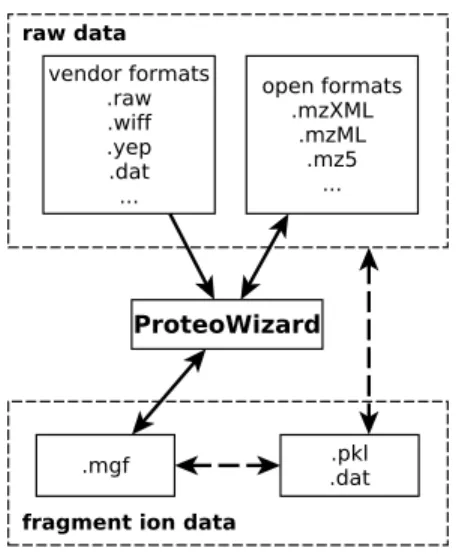
Our analyses show that mz5 dramatically outperforms the XML-based representations of the mzXMLand mzMLformats in terms of both space requirements and I/O speed and is competitive with proprietary vendor formats in terms of space requirements. Because mz5 is implemented inside the ProteoWizard [1] framework, it is already available for use by the mass spectrometry community andmz5 files can immediately be created from all open or proprietary formats supported by ProteoWizard (Figure 2).
2. Experimental Procedures and Results
Twenty LC-MS/MS runs of fractionated HeLa S3 cell lysate were acquired in data-dependent acquisition mode on an LTQ/Orbitrap classic (Thermo Scientific) system hyphenated to a nanoflow HPLC system (Eksigent). The survey scan range was limited to m/z 400−2000 at a nominal resolution of 60000 and MS/MS scans were limited to the 8 most abundant precursor ions. The resulting raw data files were converted tomzMLusing theProteoWizard[1] tool set,mzMLfiles were converted to mz5, and identity of themzMLand mz5 file contents was confirmed. For all formats, data was stored in compressed double precision. For the mzXMLand mzMLformats indexing was turned on. All experiments were conducted using the same hardware, with all resources dedicated to the test runs (no parallel jobs).
Overall, we consider the selected data set to be a reasonably common example of LC-MS/MS data acquisition and hence expect that the results generalize to a large majority of practical use cases.
To assess mz5 performance we conducted three types of comparative experiments, testing (i) write performance; (ii) read performance; and (iii) space requirements. For each of the 20 input files, we generated a set of 10 subsets of increasing sizes (sets of 800, 1600, . . . , 8000 spectra, and the complete set of all spectra present in the respective input file). This strategy yielded 220 test cases. All time measurements were averaged over 10 repeats for every test case, after discarding the minimum and maximum timings. For performance comparisons between different formats, we fitted linear models with intercepts and determined relative slopes over time and space (see
Supplementary Material). mz5 files were used to generate each test case for mzXML, mzML and mz5, to guarantee that all three file formats contain the same data.
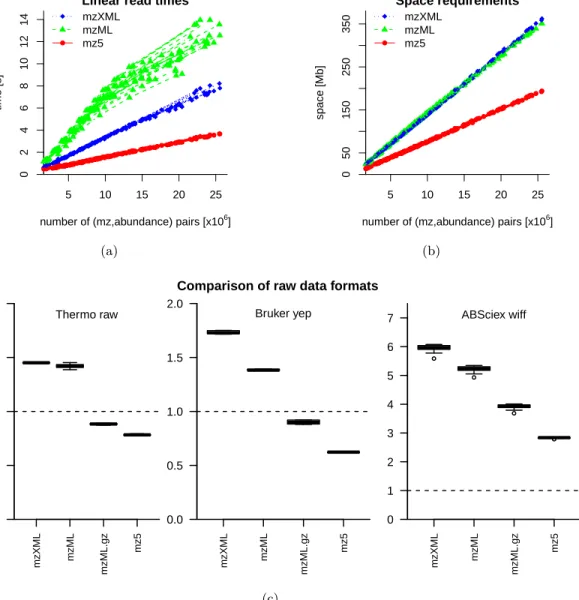
To test linear read performance, we measure the time it takes to read each of the test cases from the file it is stored in. Figure 1a shows the linear read times of all test cases vs. the number of (m/z, abundance) pairs. Themz5 format outperforms themzXMLandmzMLformats by factors of∼2.3 and ∼3.7, respectively. We note in passing that the mz5 gains overmzML are not strictly linear; this indicates optimization opportunities for the parsing of smaller mzML files. Interestingly, the mz5 linear read times also exhibit smaller variation compared tomzXMLand, in particular,mzML read times.
For strictly random reading,mz5 is significantly faster thanmzML but performs slightly slower than mzXML. This is due to the underlying HDF5 caching/compression tradeoff. We focused on the vast majority of conceivable use cases and geared the tradeoff towards efficient linear reading. Random read and initialization performance tests, as well as benchmarks for different mass analyzer types can be found in the Supplementary Material.
To test write performance, we extract every test case from the respective mz5 input file and measure the time it takes to write the data to disk, usingmzXML,mzML, andmz5. Consequently, potential read time delays only cause a constant offset that is identical between the different formats and does not affect the slopes. Supplementary Figure 1a illustrates the results for all 220 test cases. Time measurements for mzXML, mzML and mz5 are shown as diamonds, triangles and circles, respectively. It is apparent that mz5 is consistently faster than mzXML and mzML. The read-time-corrected relative slopes show improvements of a factor of ∼4.7 for mz5 over mzXML and ∼3.9 over mzML(Table 1).
Figures 1b illustrates storage consumption versus the number of (m/z, abundance) pairs. It is evident that the mz5 format requires little more than half the disk space (54%) of the mzXML andmzMLformats. ThemzXML andmzMLstorage requirements are practically identical. Figure 1c illustrates that mz5 even supersedes XML-based formats that are compressed at the file and spectrum level for off-line long term storage. Hence,mz5 provides better compression levels while still offering immediate data access and avoiding the need for time-consuming file level compression and decompression.
Figure 1c also provides a rough comparison of space requirements for three popular proprietary vendor formats (Thermo .raw, Bruker .yep, and AB/Sciex .wiff) against the open mzXML,mzML andmz5 formats. Themz5 format compares very favorably against the Thermo and Bruker formats and is the best open alternative for the AB/Sciex format. The Bruker .yep file data was generated from E. coli whole cell lysate and was acquired on a Bruker amaZon instrument. The AB/Sciex .wiff file data stems from subcellular fractions of a HeLa cell lysate and was analyzed by LC/MS on an TripleTOF 5600.
3. Implementation
The mz5 format maps the mzML ontology, as implemented in the ProteoWizard library, into a collection of HDF5 objects. HDF5 object persistence is provided by the HDF5 library.
The design of mz5 is tailored to meet two specific goals: to create an open exchange format with both I/O speed and storage space requirements that rival existing vendor formats. The practical challenge was to develop data representations that enable the use of the HDF5 properties conducive to the above goals. In mz5, we represent mzML tags as HDF5 compound data types, which correspond to classical abstract data types. Collections of compounds are stored in instances of a multidimensional array type (H5::DataSet). Instances are compressed and stored to disk. It should be noted that the straightforward representation ofmzMLtags in terms of HDF5 groups is not a viable solution, as such an approach would prohibit data compression for technical reasons.
The HDF5 library is already highly optimized for file I/O [17]. Themz5 implementation guar-antees optimized buffer sizes to minimize the number of necessary I/O operations, collecting raw
data before bulk writes are performed. HDF5 natively supports compression filters, and in or-der to optimize compression rates, our implementation makes heavy use of HDF5 datatypes that are amenable to compression, in particular avoiding variable length datatypes where possible. In addition,mz5 removes zero intensity scans and encodesm/z measurements in a delta mass repre-sentation, storing distances between consecutivem/zobservations. The latter two measures yield a storage requirement reduction of 55%. Tests showed that there were no numerical errors introduced by delta storage.
The implementation at hand features considerable versatility: it is possible to adapt the raw data datatype (float/double), configure compression level and filtering strategies, and to configure HDF5 buffer sizes. The default configuration provides a reasonable parameter setting for most common use cases. mz5 is currently limited to collections of (m/z, abundance) and (time, abundance) for spectral and chromatographic measurements, respectively. The extension to other forms of measurements is possible and straightforward.
4. Application
For practical applications, the main impact of themz5 format is likely going to be the significant decrease in storage space requirements. Many proteomics core facilities have substantial data storage and archiving costs, and the efficient use of available space can help to reduce these costs. Although standard database searches as they are currently performed are unlikely to benefit from increased read and write speeds, we expect that mz5 will be of particular interest for spectral library searches which are likely to become more relevant in the future [18, 19]. Furthermore mz5 will be of interest for data processing pipelines setups as the read and write speeds and storage space requirements offered by mz5 will increase the efficiency of data exchange between different components of a tool chain and reduce the impact caused by data conversion from proprietary vendor formats to an open standard.
To enanble the transparent, straightforward use of themz5 format in existing and future software applications, we have implemented mz5 within the ProteoWizard library; hence, any application that already makes use ofProteoWizard-based transparent data file access will automatically sup-port mz5. This eliminates the need for any mz5-specific conversion tools or software adaptions because theProteoWizard interface already enables the use of many proprietary and open formats and requires only a single implementation effort on the user side. We have successfully used the mz5/ProteoWizard combination under Windows, Linux and Mac OSX.
5. Summary
This contribution introduces an efficient open data format for bulk mass spectrometry storage termed mz5. It combines the merits of HDF5, an established industry standard, and the mzML ontology developed by the HUPO PSI. The mz5 format offers dramatically faster I/O than the mzXML and mzML formats and requires only approximately half (54%) the storage space. The currentmz5 implementation is fully integrated into theProteoWizard library and supports conver-sion operations for all proprietary data formats supported by ProteoWizard itself.
All software is available from: http://software.steenlab.org/mz5.
The mz5 format is a first step towards providing extended capabilities for MS data storage. Depending on future mzML ontology development and forthcoming HDF functionality this may include physical and logical merging of large experimental data sets, distributed read and write access for high throughput workflows, and novel strategies for large data repositories [20, 21].
6. Acknowledgments
The authors would like to thank Matthew Chambers from the Tabb Lab (funded by R01 CA126218-05) for his substantial ProteoWizard integration support and Fiona Pachl and Bern-hard Kuster for providing Bruker YEP datasets. M.K. gratefully acknowledges financial support by the Alexander von Humboldt-Foundation (DEU/1134241). This work is funded in part by NIH grants R01-NS066973-01 (J.S.) and R01-GM094844-01 (H.S.).
References
[1] Kessner, D., Chambers, M., Burke, R., Agus, D., and Mallick, P. (2008) ProteoWizard: open source software for rapid proteomics tools development,Bioinformatics,24, 2534–2536
[2] Deutsch, E. W., et al. (2010) A guided tour of the trans-proteomic pipeline,Proteomics,10, 1150–1159 [3] Bertsch, A., Gr¨opl, C., Reinert, K., and Kohlbacher, O. (2011) OpenMS and TOPP: open source software for
LC-MS data analysis,Methods Mol. Biol. (N. Y.),696, 353–367
[4] Pedrioli, P. G. A., et al. (2004) A common open representation of mass spectrometry data and its application to proteomics research,Nat. Biotechnol.,22, 1459–1466
[5] Orchard, S., Montechi-Palazzi, L., Deutsch, E. W., Binz, P.-A., Jones, A. R., Paton, N., Pizarro, A., Creasy, D. M., Wojcik, J., and Hermjakob, H. (2007) Five years of progress in the standardization of proteomics data 4th annual spring workshop of the hupo-proteomics standards initiative april 23-25, 2007 ecole nationale suprieure (ens), lyon, france,Proteomics,7, 3436–3440
[6] PSI-MS: Mass Spectrometer Standards Working Group (2010). http://www.psidev.info/index.php?q=node/80 [7] Martens, L., et al. (2011) mzML – a community standard for mass spectrometry data,Mol. Cell. Proteomics,
10, R110.000133
[8] Orchard, S. (2009) Data deposition as an integral part of the publication process, J. Proteomics Bioinf., 2, 334–335
[9] Jones, P., Cˆot´e, R. G., Cho, S. Y., Klie, S., Martens, L., Quinn, A. F., Thorneycroft, D., and Hermjakob, H. (2008) PRIDE: new developments and new datasets,Nucleic Acids Res.,36, D878–D883
[10] Desiere, F., et al. (2005) Integration with the human genome of peptide sequences obtained by high-throughput mass spectrometry,GenomeBiology,6, R9
[11] Deutsch, E. W., Lam, H., and Aebersold, R. (2008) PeptideAtlas: a resource for target selection for emerging targeted proteomics workflows,EMBO Rep.,9, 429–434
[12] The HDF Group (2000–2010), Hierarchical data format version 5. http://www.hdfgroup.org/HDF5
[13] Millard, B. L., Niepel, M., Menden, M. P., Muhlich, J. L., and Sorge, P. K. (2011) Adaptive informatics for multifactorial and high-content biological data.,Nat Methods,8, 487–492
[14] Anderson, K., Alexov, A., Baehren, L., Griessmeier, J.-M., Wise, M., and Renting, A. (2010) LOFAR and HDF5: Toward a new radio data standard,International SKA Forum 2010
[15] Bauer, B., et al. (2011) The ALPS project release 2.0: Open source software for strongly correlated systems,J. Stat. Mech.: Theory Exp.,2011, P05001
[16] Dougherty, M. T., Folk, M. J., Zadok, E., Bernstein, H. J., Bernstein, F. C., Eliceiri, K. W., Benger, W., and Best, C. (2009) Unifying biological image formats with HDF5,Commun. ACM,52, 42–47
[17] Howison, M., Koziol, Q., Knaak, D., Mainzer, J., and Shalf, J. (2010) Tuning HDF5 for lustre file systems, Workshop on Interfaces and Abstractions for Scientific Data Storage (IASDS10)
[18] Bandeira, N., Tsur, D., Frank, A., and Pevzner, P. A. (2007) Protein identification by spectral networks analysis., Proc Natl Acad Sci U S A,104, 6140–6145
[19] Lam, H., Deutsch, E. W., Eddes, J. S., Eng, J. K., King, N., Stein, S. E., and Aebersold, R. (2007) Development and validation of a spectral library searching method for peptide identification from ms/ms., Proteomics, 7, 655–667
[20] Askenazi, M., Webber, J. T., and Marto, J. A. (2011) mzServer: Web-based programmatic access for mass spectrometry data analysis,Mol. Cell. Proteomics,10, M110.003988
[21] Webber, J. T., Askenazi, M., and Marto, J. A. (2011) mzResults: An interactive viewer for interrogation and distribution of proteomics results,Mol. Cell. Proteomics,10, M110.003970
5 10 15 20 25 0 2 4 6 8 10 12 14
number of (mz,abundance) pairs [x106]
time [s]
Linear read times mzXML mzML mz5 (a) 5 10 15 20 25 0 50 150 250 350
number of (mz,abundance) pairs [x106]
space [Mb] Space requirements mzXML mzML mz5 (b) relativ e space requirements Thermo raw mzXML mzML mzML.gz mz5 0.0 0.5 1.0 1.5 2.0 Bruker yep mzXML mzML mzML.gz mz5 0.0 0.5 1.0 1.5 2.0
Comparison of raw data formats
ABSciex wiff mzXML mzML mzML.gz mz5 0 1 2 3 4 5 6 7 (c)
Figure 1. Linear read/write times and storage space requirements for different file formats on 22 file fragments over 10 repeats. Linear read and write speed are measured in 106 (mz, abundance) pairs per second; storage space is measured in MB per 106 (mz, abundance) pairs. Allmz5,mzXMLand mzMLmeasurements are shown as circles, diamonds and triangles, respectively. (a) Themz5 format exhibits a 2.28-fold increase in reading speed compared to mzXML and a 3.65-fold increase compared to mzML; (b) mz5 roughly halves the storage space requirements when compared withmzXML(53%) andmzML(55%); (c) Space requirements formzXML, mzML,mzML with file-level compression (gzip), and mz5 relative to Thermo raw, Bruker yep and ABSciex wiff format (dashed line). The mz5 format minimizes storage requirements while providing fast raw data I/O.
Figure 2. The mz5 format and its relation to common in- and output formats. Format conversions that are supported by theProteoWizard [1] framework are rep-resented by solid arrows; format conversions that currently require additional soft-ware are shown with dashed arrows. Because themz5 format has been implemented within the ProteoWizard framework it can readily be generated from a wide range of propietary vendor raw formats.
mz5 mzML mzXML mzMLmz5 mzXMLmz5
tlr 0.13 0.49 0.30 3.65 2.28
tw 0.63 2.08 2.46 3.28 3.90
tw−tmzlr 5 0.5 1.95 2.33 3.89 4.66
space 7.57 13.72 14.13 1.81 1.87
Table 1. Average read/write times and space requirements for 106 (m/z, abun-dance) pairs for the mz5, mzML, and mzXML file formats. Rows correspond to the linear read timetlr, the write time tw, the mz5 read-time-corrected write time
tw−0.13 and the space requirements. All timings are in seconds or MB per 106 data points, respectively. Columns 4 and 5 show that mz5 outperforms the mzML and mzXMLformats in all respects.