686
A CA MODEL OF CULTURE INFORMATION
DISSEMINATION IN THE NETWORK ERA AND THE
SIMULATION OF ITS DYNAMIC CHARACTER
1
KUN LI, 2ZHILONG JIA, 2YONGSHENG QIAN, 2JUNWEI ZENG, 2MIN WANG,2JUN ZHOU
1
College of Music, Northwest Normal University, Lanzhou 730070, Gansu, China
2
School of Traffic and Transportation, Lanzhou Jiaotong University, Lanzhou 730070, Gansu, China
ABSTRACT
Through analyzing the characteristics of the culture information dissemination of the network era, the complex network theory is used to study it deeply. It shows that the process of network information dissemination has typical network topology structure. The kind of network structure has both small world and scale-free features, and the self-organization characteristic. On the basis of the features and main influence factors of the network information dissemination, a two-dimensional cellular automata (CA) model is presented to simulate the evolutionary process and dynamics characteristics of the network information dissemination in different conditions. The result shows that the value of the information is the key point that affects the dissemination speed and efficiency. If the value of a key node degree is relatively higher, the role it plays will be more important. The existence of key node is an important reason that the information could spread quickly in network era. The information dissemination in the network has latent and hysteresis quality.
Keywords: Culture Information Dissemination, Complex Network, Cellular Automata, Dynamics, Evolving Model
1. INTRODUCTION
The continuous development of network technology has a profound impact on many aspects of social life, which greatly facilitates the exchange of information. The increasing network bandwidth enables people obtain more information in unit time, and medias in network providing information are unceasingly rich. With the rise of search engine, point to point communication, large-scale portal website, and the perfection of hardware, software and service, the technical doorsill of Internet has reduced greatly, and common people also can realize the impact of Internet on their lives [1]. The quickly spread of network information has a profound effect on production and people's life, as well as the progress of social development [2]. Network information communication process has typical complex network characteristics and transmission dynamics characteristics. Theory analysis and simulation on the communication process of network era will be helpful for further understanding of the mechanism of network information dissemination, and evaluating the effect of network information communication. Theory analysis and simulation on the communication
process will be able to provide comments and suggestions for dissemination and control, so as to effectively guide the information dissemination, control the direction of public opinion, and maintain the stability and healthy development of society.
2. CHARACTERISTICS OF INFORMATION DISSEMINATION IN NETWORK ERA
ISSN: 1992-8645 www.jatit.org E-ISSN: 1817-3195
687 with the rapid development of computer, mobile phone and other new media, especially the rise of blog, forum, micro-blog, QQ, MSN, and portal websites [3], network communication model began breaking the unidirectional traditional mode (point to point, point to area), and gradually formed a new communication mode of point to point, point to area, and area to area. Network information communication has showed obvious characteristics and advantages in dissemination process.
2.1Wide Audiences
The network information dissemination has a huge user base, by the end of 2011, the scale of China's Internet users reached 513000000, wherein the total number of mobile phone users is 356000000, accounting for 69.3% of the total Internet users. The ratio of desktop computer uses is 73.4%, and the mobile phone usage is approaching the traditional desktop computer usage. With the continuous development of mobile communication technology and Internet technology, the number of Internet users is keeping growing, which leading to a wide coverage. Because of the rise of each network information dissemination mode, information reception is no longer limited by environment, identity, and social state, and enables people to participate in the dissemination of information process whenever and wherever possibly. The universality of the audience expands the influence sphere of their own ceaselessly, and the impact on social life becomes deeper. Network information dissemination has reached the height of the traditional transmission mode can not match in dispersion.
2.2Rapid Dissemination Speed Improves The Timeliness
Compared with traditional media, the network has greatly accelerated information dissemination. With the constant improvement of network technology in terms of hardware and software, network information dissemination has broken the constraints of geography, time and terminal equipment; network users are able to receive text, images, sounds and other types of information anytime and anywhere, and can release and transfer information more timely. The dissemination and reception of information truly realize the synchronization between users and information, its efficiency is higher than ever before, the speed and efficiency of information spread and exchange are further enhanced. Compared with traditional media, internet media has obvious advantage in the
coverage of emergencies. With internet media, users can express in words, pictures, sound recordings, and even video, achieving live broadcast of the first time, scene, and perspective, which is out of the ability of traditional media. The rapid development of the way of information dissemination in the Internet era has changed the way people acquiring knowledge, and has provided people with the fastest, and the most authentic news reports. Meanwhile, the development of the Internet increases the expectation of people for accessing information with network, and constantly enhances the enthusiasm of people to participate in the network information dissemination, and further promotes the speed and efficiency of the network information dissemination.
2.3More Interactive Information Dissemination
In the process of network information dissemination, the communication and interaction between audiences and disseminators, disseminators and disseminators, are enhance [4, 5]. For traditional information dissemination, audiences and disseminators are in the state of temporal and spatial isolation, the vast majority of the information is transferred from the disseminators to the audiences singly; the interaction of information spread is tenuity, Network information dissemination has fundamentally changed the characteristics of traditional information dissemination. With the incensement of information amount carried on the Internet, people have more selections on information to be accepted, and becomes more initiative when obtain information on the Internet, namely, in a greater degree, they can decide when and where in which manner to access what information. The development of mobile communication technology and Internet technology have provided people with a more suitable platform to express their views; Internet users can express their views on focus incident concerned and freely discuss in a relatively equal footing point at the same time and space.
2.4The Personalization Of Network Information Dissemination
688 dissemination is reflected in the very complex personalized users involved in network spread, including stars, officials, celebrities, and also government, business, media, as well as the general anonymouspublic ; all the people mentioned above can take part in network information dissemination[6]. Secondly, it is reflected in the personalized content of the information transferred, namely, people can independently choose information according to their own interests and hobbies to receive and send. Finally, it is the personalized present ways and routes. In information dissemination process, network users can add their own views and opinions into the information expressed, and they have autonomy to choose the ways and routes for the information released, such as through microblogs, forums and other forms.
3. COMPLEX NETWORK
CHARACTERISTICS OF INFORMATION DISSEMINATION IN NETWORK ERA
Complex network is a system that contains a lot of individuals and their interactions, which is ubiquitous in the nature and human society. The research area of this new interdisciplinary covers engineering, biology, management, political, social and other fields. In recent years, with the continuous deepening on the understanding of complex systems, study on the interactions between the various subsystems in a complex system and its holistic nature has gradually attracted people's attention. As a typical complex system, research on the network structure nature of network information dissemination has great significance for in-depth understanding of the dynamics of the network information dissemination. Network information dissemination process has the characteristics of obvious topology characteristics, small-world and scale-free networks, as well as self-organization.
3.1Topology Of Information Dissemination In Internet Era
Network information dissemination is people oriented, relying on the interaction between people. Nowadays, people are paying more attention on the source of information. This way accessing information has shifted the focus onto the information source and people sharing the information. Information dissemination network takes users involved as nodes, and information is transferred between these nodes, thus mutual communication of these nodes is formed. The network information dissemination process is
dynamic, orderly and adaptive. In network information dissemination process, the transfer of information between nodes is directional, and its topology is a directed network. Under normal circumstances, information reception and transmission of the same node will point to different nodes, after receiving the information, the node will propagate the information to other nodes; meanwhile, after receiving the information, the node may feedback the information, thus there are two-way exchange between nodes, which is because of the exchange and discussion in the process, and the information dissemination is interactive. It can be seen that the network information dissemination has complex network topology. If the complexity of network structure is ignored, it is impossible to understand the internal mechanism of information dissemination process deeply.
3.2Small-World Characteristics Of Information Dissemination In Internet Era
The small-world characteristic of network refers to network having high clustering coefficient and small average distance at the same time [7]. Stanley Milgram, the Harvard University social psychologist, gave out the inference in the 1960s based on social survey: the average distance between any two people on Earth is 6. That is, only through 5 people (average), you can contact with any person in the world. It is the famous inference of six degrees of separation. The information spread network of the Internet age is a typical small-world network [8], where the information can reach any nodes in the network through a few nodes.
3.3Scale-Free Features Of Information Dissemination In Internet Era
ISSN: 1992-8645 www.jatit.org E-ISSN: 1817-3195
689 key role in information dissemination process, and are taken as critical nodes. These nodes play an important role in the process of information dissemination, through these nodes, focus incidents and perspectives will be transferred explosively, and quickly become the focus of concern. In-depth understanding and awareness of the significance of the critical nodes in network information dissemination process are conducive to control network information dissemination, and guide the public opinion.
3.4The Self-Organization Of Information Dissemination In Internet Era
The self-organization of the network information dissemination means the network system autonomously completes the dissemination of information based on its own internal structure. Each node participating in the network information dissemination has strong autonomy in the information dissemination process, and can decide whether to receive and disseminate information. Thus the structure of the network as a whole is very complicated, the information transmission process is the result of the interaction of the nodes in the network, and different network structure will produce different effects on the speed and efficiency of the information dissemination. The dynamic characteristic of the network information dissemination is determined by the structure and the nature of its internal nodes [10]. The self-organization endows information dissemination with chaotic characteristics, and the process of information dissemination and its impact are often unforeseen.
4. THE ESTABLISHMENT OF INFORMATION DISSEMINATION DYNAMICS CELLULAR AUTOMATA MODEL
Cellular automata model is an effective method on studying complex system’s space dynamics characteristics, and has been widely used in the field of sociology. In this paper, the dynamic characteristics of information dissemination in Internet era was examined, the state of information dissemination is influenced by previous information reception state, which is essentially the same as the cellular automata model. Therefore, it is reasonable to simulate the information dissemination process with cellular automata model.
4.1Spread Evolution Mechanism
In the network of information dissemination, the information issued by someone will be seen by other people, and will be shared and disseminated obeying a certain probability. If the neighbor node of a certain node in the network received information and disseminated it to this node, this node would receive and spread the information with a certain probability. Neighbor nodes transmit information to the central node, and the central node decides whether to receive and spread the information according to its interests and the value of the information itself. The information will be transferred and changed along the links established between nodes in the network.
There are key nodes in information dissemination network, such as traditional media (television, radio, newspapers) and network transmission routes (news portal, the major forums, celebrity microblog). After receiving information, a key node will disseminate the information to the entire network, and the other nodes in the network will receive the information with a certain probability. The probability for nodes in the network receiving the information disseminated by the key node represents the value of the key node, the greater the value, the more important the key node. The probability for a node in the network receiving information, is not only related to the status its neighbor nodes, but also related to the status of key nodes in the network. Define propagation rules below:
(1) If a node has not received information, and its neighbor nodes have received the information and transmitted the information to the node; or this node has received the information from key nodes with a certain probability
p
1, then the node willreceive and spread the information with the probability of
p
2.(2) If the information has not reached the key node, the key node will not disseminate the information to the entire network, namely nodes in the network will only receive the information passed by their neighbor nodes.
(3) Each node in the network will continue to pass the information out, to perform discussion and exchange with other nodes, and to accumulate the potential energy of information dissemination.
4.2Establishment Of CA Model
(1) Cell: each node of the network involved in the information dissemination;
690 dissemination process, the
l
×
l
two-dimensional square grid. The interconnection between cells does not mean the direct connection in space, but connection on the network;(3) Cell neighbor: according to the characteristic of information dissemination network, adopt the Moore form;
(4) Cell state:
S
it=
{
1
,
0
}
,S
itis the state of celli
att
. If celli
has not received information,t i
S
=0; If celli
has received information,S
it=1; (5) Evolution rule: evolution rule is the dynamic function determining the cell state at the next moment based on the current state of the cell and its neighbors. To determine the cell state of any cell in the network at the next moment, it is necessary to determine the current cell state and its neighbors, as well as whether received the information from the key node.)
,
,
,
(
1 21
p
p
S
S
f
S
t N t i t i=
+ (1)Where,
S
it+1is the state of celli
att
+
1
,S
it is the state of celli
att
,S
Nt is the state of theneighbor of cell
i
att
,p
1is the probability forcell receiving information from the key node,
p
2 is the probability for cell receiving and spreading information,f
is the cell state transition function.Taking
M
it as the intensity of neighbor cell and the key node transferring information to celli
:∑
+
=
t N i ti
a
S
M
(2) If celli
has received information from the key node,a
i=
1
; If celli
has not received information from the key node,a
i=
0
.Cell state
S
it+1 is relevant to the value of t iM
;if
M
it=
0
, thenS
it+1=
0
; ifM
it>
0
, then:⎩
⎨
⎧
≤
>
=
+ 2 2 1,
1
,
0
p
p
if
p
p
if
S
it (3)p
is random variable, obeys uniform distribution on[
0
,
1
]
. IfM
it>
0
, then the probability for nodei
without disseminating and receiving information is1
−
p
2 . The probability for nodei
withoutdisseminating and receiving information within the time period
[
t
,
t
+
∆
t
]
is:t t
i
p
p
∆=
(
1
−
2)
∆ (4)Taking
V
it as the dissemination potential energyof cell
i
att
, each node in the network continue to pass out information, even a node has received and disseminated information, it still will receive information with probabilityp
2, and thus continueto accumulate potential energy for information dissemination. The length between the node generating information and the key node has a major impact on the speed and efficiency of information dissemination in the network. If the position of the information generating node and the key node is
(
i
1,
j
1)
and(
i
2,
j
2)
respectively, thelength
r
between the two is:2
1
i
i
x
=
−
,y
=
j
1−
j
2 (5))
,
min(
x
y
y
x
r
=
−
+
(6) In the established model, assume that the position of the information generating node and the key node is(
i
1,
j
1)
and(
i
2,
j
2)
respectively, theprobability for a node receiving information from the key node is
p
1, and the probabilityp
2 for nodereceiving and spreading information is given in the initial condition as a constant.
5. SIMULATION RESULTS AND ANALYSIS
This paper simulated an abstract dynamic process of information dissemination of the Internet age, taking the cell space as
5000
×
5000
. First, simulated the information dissemination process with and without key node; then, simulated the dynamic process under different receiving and spreading probability, different value of key node, and different path length.5.1 Simulation Analysis Of The Importance Of The Key Node In Information
Dissemination Process Of The Internet Era
In the information dissemination process, the value of the key node degree is related to the size of cell space and the probability for node receiving information from the key node, and it can be approximated as follows:
1
p
l
l
n
≈
×
×
(7) The key node plays an important role in information transmission process. Parameters in the model are set to be:i
1=
j
1=
580
,i
2=
j
2=
500
, andp
2=
0
.
1
. The information disseminationISSN: 1992-8645 www.jatit.org E-ISSN: 1817-3195
691 simulated in this work. The simulation results are shown in Figure 1.
(a)
[image:6.612.117.285.131.371.2](b)
Figure 1: Influence Of The Key Node On Information Dissemination Speed
Figure 1(a) shows the curve of cumulative total number of cells receiving and disseminating information, the abscissa represents time, and the ordinate represents number of cells receiving and disseminating information (the same as following Figures). Figure 1(b) indicates the curve that the information has not reached the key node. In the evolution process without key node, the releasing node is taken as the pole, to spread the information out continuously. In the evolution process with key node, after 321 evolution steps, the key node receives the information, while the information is distributed to the entire network, and the key node takes place the releasing node as the pole. As can be seen from the figure, the cell number changing curve is essentially coincident with the curve without key node; after the information reaches the key node, cell number increases rapidly; after 800 evolution steps, all nodes in the network substantially receives the information. While in the case without key node, information dissemination is very slow; after 1000 evolution steps, only part of the nodes receives and disseminates the information. It can be seen that, the key node plays a key role in the entire network information dissemination process, and has an important impact on the speed and efficiency of information dissemination.
5.2Dynamic Analysis On Network Information Dissemination Process Under Different Receiving Probability
[image:6.612.330.513.222.445.2]Parameters in the model are set to be:
i
1=
j
1=
580
,i
2=
j
2=
500
, andp
1=
0
.
000005
,p
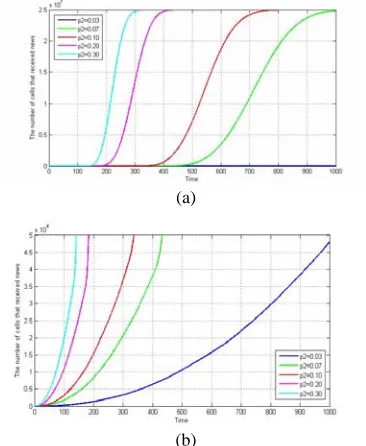
2 is 0.30, 0.20, 0.10, 0.07, and 0.03. The simulation results are shown in Figure 2.(a)
(b)
Figure 2: Influence Of Different Receiving Probability On Information Dissemination Speed \
Figure 2(a) shows the curve of cumulative total number of cells receiving and disseminating information under different probabilities; Figure 2(b) shows the curve before the information reach the key node. According to the Figure, when
03
.
0
2
=
692 resonance of the communicators, the information will be easier to spread in the network quickly. So, hot social issues tend to become the focus of attention. Through simulation analysis, we find that the information with greater value is more likely to cause the attention of traditional media and portal news website, which means it will spread to the key node faster. If the information disseminated is not concerned strongly, the information will spread slowly in the network; even through the key node, it still will not get wide concern, so, its spread is less efficient. Therefore, the value of the information itself is the key to affect the speed and efficiency of the dissemination in the network.
5.3Dynamic Analyses On Network Information Dissemination Process Under Different Degree Value Of The Key Node
Parameters in the model are set to be:i1= j1=580,
i
2=
j
2=
500
, andp
2=
0
.
1
.The information dissemination process of
1
p
=0.0000004, 0.000002, 0.000005, 0.000008, 0.000016,namelyn
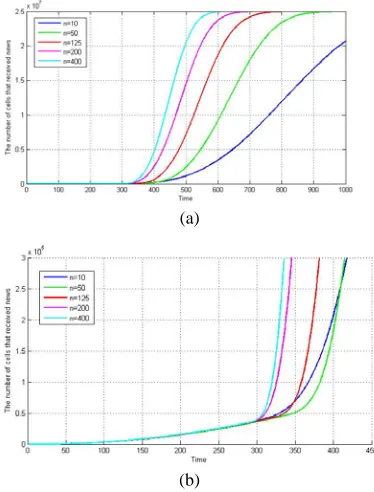
=10, 50, 125, 200, 400, are simulated in this work. The simulation results are shown in Figure 3.(a)
[image:7.612.105.292.418.664.2](b)
Figure 3: Influence Of Different Degree Value Of The Key Node On Information Dissemination Speed
Figure 3(a) shows the curve of cumulative total number of cells receiving and disseminating
information under different degree values; Figure 3(b) shows the curve before the information reach the key node. It can be seen from the figure that the size of the degree value of the key node has a significant impact on the information dissemination in the network. Under different degree values, after 292,336,321,292,292 evolution steps respectively, the information disseminated will reach the key node. For the cases with different degree values, the time needed for the information from the publication node to the key node is substantially the same; before the information gets to the key node, the cell total number curves are substantially coincide. This is because before the information gets to the key node, the information is not subjected to the impact of the key node, and the information is disseminated taking the publication node as the pole. When the information gets to the key node, the dissemination speed increases significantly; the greater the degree value of the key node, the faster the spread speed. When the information dissemination reaches a certain extent, the spread speed will reduce, which means the number of nodes receiving and disseminating information is close to saturation. It can be seen through the analysis of the spread speed of different key node degree values, after the reaching the key node, the information will be transferred faster if the key node degree value is greater. Greater degree value means greater influence of the key node in information dissemination process; the presence of the key node is an important reason for the rapid spread of Internet age.
5.4Dynamic Analysis On Network Information Dissemination Process Under Different Length Between The Node Generating Information And The Key Node
Parameters in the model are set to be:
p
1=
0
.
000005
,p
2=
0
.
15
,i
2=
j
2=
500
.The information dissemination process of
r
=450, 350, 250, 250, 50, are simulated in this work. The simulation results are shown in Figure 4. [image:7.612.326.516.606.723.2]ISSN: 1992-8645 www.jatit.org E-ISSN: 1817-3195
693
[image:8.612.89.294.73.219.2](b)
Figure 4: Influence Of Different
r
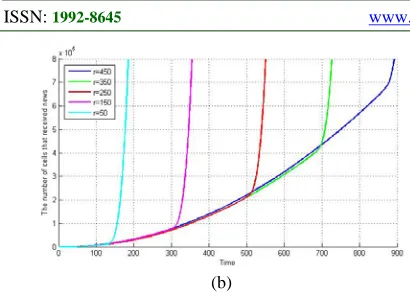
On Information Dissemination SpeedFigure 4(a) shows the curve of cumulative total number of cells receiving and disseminating information under different
r
; Figure 4(b) shows the curve before the information reach the key node. In the information dissemination network, time needed for information reaching the key node is determined by the lengthr
between the node generating information and the key node. Under different lengthr
, after 861, 680, 497, 296, 125 evolution steps respectively, the information disseminated will reach the key node. Time needed for information reaching the key node increases with the increase of lengthr
. It can be seen from Figure 4, before the information gets to the key node, the cell total number curves are substantially coincide. Time needed for information reaching the key node is different, but after the information getting to the key node, the cell total number curves are substantially coincide, indicating the dissemination speed is the same after the key node. Through the analysis on network information dissemination process under different lengthr
, it can be found that the dissemination of information has the nature of hysteresis. Before the information released by a node causing the prompt attention of the traditional and online media, the dissemination speed is relatively slow; only after being reported by the mainstream media, the information will be able to be disseminated quickly. Therefore, the spread of information in the network has the nature of latency and hysteresis; some information will not become hot social issues immediately before a very long time.6. CONCLUSION
With the rapid development of network technology, the rapid spread of information plays an important role in promoting production and people's life, as well as the development and progress of the society. In the network era, the information dissemination process is very complex.
In this paper, we made in-depth analysis on network information dissemination according to the ideology of complex network, established the simulation model using the Cellular Automata principle, and simulated the information dissemination process with or without key node; then simulated the dynamic process of information dissemination under different receiving probability, key node degree value, and the length between the node generating information and the key node. The simulation results show that: the value of the information itself is the key factor affecting the dissemination speed and efficiency in the network, information with greater value is more likely to cause the concern of the traditional media and portal news site, and is disseminated faster; greater degree value means greater influence of the key node in information dissemination process, and the presence of the key node is an important reason for the rapid information spread of Internet age; the spread of information in the network has the nature of latency and hysteresis, some information will not become hot social issues immediately before a very long time.
In this paper, we simulated the complex network of information dissemination process using cellular automaton principle, and analysised the complex systems development process combined the complex network theory with cellular automaton theory innovatively, which has important theoretical value. Meanwhile, profound analysis of the complex process of information dissemination in the network era and its internal mechanism were discussed in this work, providing a new way for solving similar problems. However, the model established in this article could not accurately reflect the scale-free property of network information dissemination, and the degree value of each node was given in advance, and was not in line with power-law distribution, so the model should be further improved.
ACKNOWLEDGEMENTS
694
REFERENCES:
[1] Long En-Bao, “New model of Information Dissemination in the Network and Influence of Real Society”, Economic and social development, Vol. 5, No. 3, 2007, pp. 172-174. [2] Qiu Jun-Ping, Chen Yuan, Ni Chao-Qun, “Value
of Information Dissemination in the Network”,
ShanDong Social Sciences, Vol. 161, No. 1, 2009, pp. 58-61.
[3] Hu Shasha, “Analysis on the Value of the Dissemination of the Network Information-Taking the Microblog for Example”, Journal of Modern Information, Vol. 31, No. 12, 2011, pp. 152-155.
[4] Wang Shu-Liang, Gong Xiu-Ying, “Character of Information Dissemination: Interaction”,
Heilongjiang Science and Technology Information, Vol. 2, 2012, pp. 65.
[5] Qian Yongsheng, Ren Zhengzheng, Lin Fang, Zeng Qing, “How The Swine Lineage Influenza A (H1N1) Virus Spread?”, 2010 International Conference on Components, Packaging and Manufacturing Technology, Key Engineering Materials, December 9-10, 2010, pp.21-25. [6] Cao Jin-Song, “Communication and Innovation
of Chinese Government Institutional Microblogs”, Modern Communication, Vol. 178, No. 5, 2011, pp. 59-63.
[7] Watts DJ, Strogatz SH, “Collective dynamics of 'small-world' networks”, Nature, Vol. 393, No. 6684, 1998, pp. 440-442.
[8] TANG Yong, MA Yong-kai, “Information Diffusion in Small-world Social Networks”,
Journal of System Simulation, Vol. 18, No. 4, 2006, pp. 1084-1087.
[9] Albert-László Barabási, “Scale-Free Networks: A Decade and Beyond”, Science, Vol. 325, No. 5939, 2009, pp. 412-413.