International Journal of Emerging Technology and Advanced Engineering
Website: www.ijetae.com (ISSN 2250-2459, Volume 2, Issue 1, January 2012)330
Comparative Analysis of PCA and 2DPCA in Face
Recognition
Dhiraj K. Das
HOD, Computer Science and Engineering, Nepal Engineering College
Changunarayan, Bhaktapur [email protected]
Abstract- - The growing need for effective biometric identification is widely acknowledged. Human face recognition is an important area in the field of biometrics. It has been an active area of research for several decades, but still remains a challenging problem because of the complexity of the human face.
The Principal Component Analysis (PCA), or the eigenfaces method, is a de-facto standard in human face recognition. Numerous algorithms tried to generalize PCA in different aspects. More recently, a technique called Two Dimensional Principal Component Analysis (2DPCA) was proposed to reduce the computational cost of PCA. Unlike PCA treats images as vectors, 2DPCA views an image as a matrix. To analysis the effectiveness of the PCA and 2DPCA, a number of Eigenvalues were obtained and then compared. And then results have been presented in graphical form to show the effectiveness and accuracy. This 2DPCA algorithm can be easily implemented in any programming language on a digital computer. 2DPCA algorithm is found to be very accurate and more effective.
Keywords: biometric, human face, Principal Component Analysis, Two Dimensional Principal Component Analysis, Eigenvalues, effectiveness and accuracy
I.
I
NTRODUCTIONInformation and Communication Technologies (ICT) are increasingly entering in all aspects of our life and in all sectors, opening a world of unprecedented scenario where people interact with electronic devices, embedded in environments that are sensitive and responsive to the presence of users. Image analysis is a process of discovering, identifying, and understanding patterns that are relevant to the performance of an image-based task. Face recognition has recently received significant attention. It plays an important role in many application areas, such as human-machine interaction, authentication and surveillance.However, the wide-range variations of human face, due to pose, illumination, and expression, result in a highly complex distribution and deteriorate the recognition performance.
In addition, the problem of machine recognition of human faces continues to attract researchers from disciplines such as image processing, pattern recognition, neural networks, computer vision, computer graphics, and psychology. In identification problems, the input to the system is an unknown face, and the system reports back the determined identity from a database of known individuals, whereas in verification problems, the system needs to confirm or reject the claimed identity of the input face. The solution to the problem involves segmentation of faces (face detection) from cluttered scenes, feature extraction from the face regions, recognition or verification. Robust and reliable face representation is crucial for the effective performance of face recognition system and still a challenging problem. Feature extraction is realized through some linear or nonlinear transform of the data with subsequent feature selection for reducing the dimensionality of facial image so that the extracted feature is as representative as possible.
PCA is a useful statistical technique that has found application in fields such as face recognition and image compression, and is a common technique for finding patterns in data of high dimension. PCA is a powerful tool for analyzing data [7].
A straightforward image projection technique, called two-dimensional principal component analysis (2DPCA), is developed for image feature extraction. As opposed to conventional PCA, 2DPCA is based on 2D matrices rather than 1D vectors. That is, the image matrix does not need to be previously transformed into a vector. Instead, an image covariance matrix can be constructed directly using the original image matrices. In contrast to the covariance matrix of PCA, the size of the image covariance matrix using 2DPCA is much smaller.
International Journal of Emerging Technology and Advanced Engineering
Website: www.ijetae.com (ISSN 2250-2459, Volume 2, Issue 1, January 2012)331
The main ideas of the PCA and 2DPCA methods are to find the vectors that best account for the distribution of target images within the entire image space. In the general PCA /2DPCA method, eigenvectors are calculated from training images that include all the poses or classes. But for classification a large number of hand poses for a large number of users, need large number of training datasets from which eigenvectors generation is tedious and may not be feasible for a personal computer [8].
II.
L
ITERATURER
IVIEWFace recognition is a biometric approach that employs automated methods to verify or recognize the identity of a living person based on his/her physiological characteristics. In general, a biometric identification system makes use of either physiological characteristics (such as a fingerprint, iris pattern, or face) or behaviour patterns (such as hand-writing, voice, or key-stroke pattern) to identify a person. Because of human inherent protectiveness of his/her eyes, some people are reluctant to use eye identification systems. Face recognition has the benefit of being a passive, non intrusive system to verify personal identity in a “natural” and friendly way [5].
There are numerous possible applications for facial image processing algorithms. The most important of them concern face recognition. In this regard, one has to differentiate between closed worlds and open world settings. In a closed world application, the algorithm is dedicated to a limited group of persons, e.g. to recognize the members of a family. In an open world context the algorithm should be able to deal with images from “unknown” persons, i.e. persons that have not been presented to the system during its design or training. For example, an application indexing large image databases like Google images or television programs should recognize learned persons and respond with “unknown” if the person is not in the database of registered persons [5] [6].
Concerning face recognition, there further exist two types of problems: face identification and face verification (or authentication). The first problem, face identification, is to determine the identity of a person on an image.
The second one only deals with the question: “Is „X‟ the identity of the person shown on the image?” or “Is the person shown on the image the one he claims to be?”. These questions only require “yes” or “no” as the answer.
Face recognition system can help in many ways:
1) Checking for criminal records.
2) Enhancement of security by using surveillance cameras in conjunction with face recognition system. 3) Finding lost children's by using the images
received from the cameras fitted at some public places. 4) Knowing in advance if some VIP is entering the hotel. 5) Detection of a criminal at public place.
6) Can be used in different areas of science for comparing a entity with a set of entities.
This research is a step towards developing a face recognition system which can verify static images. In case the dynamic images, received from the camera can first be converted in to the static one's and then the same procedure can be applied on them. Some of the factors can be considered for dynamic images as distance between the camera and the person, magnification factor, view [top, side, front] etc.
The databases used in developing face recognition systems rely on images of human faces captured and processed in preparation for implementing the recognition system. The variety of information in these face images makes face detection difficult. For example, some of the conditions that should be accounted for, when detecting faces are [5][9]:
1) Occlusion: faces may be partially occluded by other objects
2) Presence or absence of structural components: beards, mustaches and glasses
3) Facial expression: face appearance is directly affected by a person's facial expression
4) Pose (Out-of Plane Rotation): frontal, 45 degree, profile, upside down
5) Orientation (In Plane Rotation):face appearance directly varies for different rotations about the camera's optical axis
6) Imaging conditions: lighting (spectra, source distribution and intensity) and camera characteristics (sensor response, gain control, lenses), resolution 7) Facial feature extraction (for local face recognition)
a. To detect the presence and location of features such as eyes, nose, nostrils, eyebrow, mouth, lips, ears, etc
b. Usually assume that there is only one face in an image
8) Human pose estimation and tracking
III.
S
YSTEMA
RCHITECTUREInternational Journal of Emerging Technology and Advanced Engineering
Website: www.ijetae.com (ISSN 2250-2459, Volume 2, Issue 1, January 2012)332
Although this is a research-based project, we laid out certain physical requirements for our software during the planning stage:
1) It should have a GUI through which the user can execute each task;
2) The interface should be simple, clear, and systematic: one button, one function;
3) It should allow the user to select the test image;
4) Each subprogram should be straightforward and should not contain functions that overlap;
5) It should display recognition results so that we are able to evaluate and analyze.
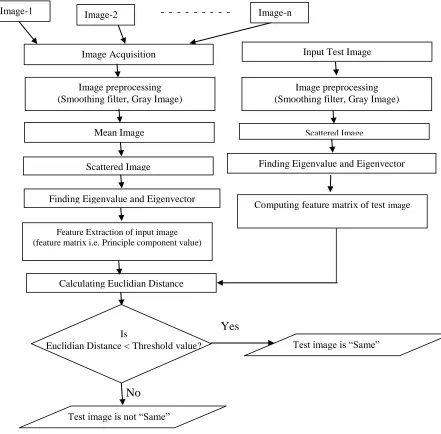
[2] The next things that considered were the image processing tasks. Internally, all pattern recognition systems have the following processes. Each operation must complete its task before the next one can begin: Image acquisition, Image enhancement, Feature extraction and classification and, Detection/recognition.
[image:3.612.132.573.275.709.2]Since the output of each operation is the input to the next, the functional parts (i-iv) must execute in sequence. The size of every image (input and output) is to be kept standard so that there is better control and accuracy during matrix computation and parameter training.
Figure 2: Overall System Block diagram
Finding Eigenvalue and Eigenvector
Image-1 Image-2 Image-n
Image Acquisition
Image preprocessing (Smoothing filter, Gray Image)
Mean Image
Scattered Image
Finding Eigenvalue and Eigenvector
Feature Extraction of input image (feature matrix i.e. Principle component value)
Computing feature matrix of test image Input Test Image
Image preprocessing (Smoothing filter, Gray Image)
Scattered Image
Calculating Euclidian Distance
Is
Euclidian Distance < Threshold value?
Yes
No
Test image is not “Same”
International Journal of Emerging Technology and Advanced Engineering
Website: www.ijetae.com (ISSN 2250-2459, Volume 2, Issue 1, January 2012)333
IV.
A
LGORITHMF
ORP
CAAlgorithm: Training
Input: Finger spelling training images
Output: Finger spelling image features, eigenvector matrix, feature matrix
Method:
a) Apply pre-processing techniques to the training images. b) Transform the training images into column vector by
appending the columns in the image consecutively.
c) Build the data matrix A of image column vectors with a label vector L having the corresponding alphabet names of the image columns in A.
d) Get mean column vector M of the data matrix A.
e) Subtract mean M from each of the columns of A to result in mean centered matrix A.
f) Compute the covariance matrix C of A as C = AAT.
g) Obtain eigenvectors matrix E and eigenvalues vector V of C.
h) Rearrange the eigenvector columns in E as the corresponding eigenvalues in V are sorted in descending order.
i) Project the centered matrix A onto E to get feature matrix P = ETA.
Training ends.
Following is the algorithm designed for recognition. Algorithm: Recognition
Input: Finger spelling image Bto be recognized, number of dimensions to be considered m, feature matrix P, eigenvectors matrix E, mean vector M, labels vector L Output: Classification label of input image
Method:
a) Apply the respective pre-processing technique on B
b) Transform the processed image Binto a column vector J by placing the columns in the image consecutively.
c) Subtract the mean vector M from the image vector J, J = J – M.
d) Project the image vector J onto the eigen matrix E to get the feature vector Z= ETJ.
e) Compute the Euclidian distance d between the feature vector Z and all the column vectors in the feature matrix P considering only m elements in the vectors and identify the column having the minimum distance d.
f) Obtain the label from vector L corresponding to the column identified in P having the minimum distance to Z.
Recognition ends.
V.
A
LGORITHMF
OR2DPCA
Algorithm: Training
Input: Finger spelling training images
Output: Finger spelling image features, eigenvector matrix, feature matrix
Method:
a) Applying pre-processing techniques to the training images.
b) Obtain the average image A of all training samples:
Mi
A
iM
A
1
1c) Estimate the image covariance (scatter) matrix G: d) Compute d orthonormal vectorsX1;X2; : : : ;Xd
corresponding to the d largest eigenvalues of G. X1;X2; : : : ;Xd construct a d-dimensional projection subspace. Yang et al. [1] have showed that X1;X2; : : : ;Xd are the d optimal projection axes, such that when projecting the sample images on each axis Xi, the total scatter of the projected images is maximum.
e) Project A1; : : : ;AM on each vector X1; : : : ;Xd to obtain the principal component vectors:
Yij = AjXi; i = 1; : : : ; d; j = 1; : : :
;M
Training ends.
Following is the algorithm designed for recognition.
Algorithm: Recognition
a) Apply the respective pre-processing technique on B b) When a testing image with 2D intensity matrix B
arrives, compute the principal component vectors of the new image: YBi = BXi; i = 1; : : : ; d
c) Compute the Euclidean distance between (YB1 ; : : : ; YBd ) and (Yj1 ; : : : ; Yjd ) (j = 1; : : : ;M):
2
1
||
||
)
,
(
ijd
i B i
j
Y
Y
A
B
dist
Where || YiB – Yij ||2 is the Euclidean distance between YiB and Yij
d) Use dist(B;Aj ) (j = 1; : : : ;M) and a threshold value to decide the label of the testing image.
International Journal of Emerging Technology and Advanced Engineering
Website: www.ijetae.com (ISSN 2250-2459, Volume 2, Issue 1, January 2012)334
VI.
S
ELECTINGT
HRESHOLD VALUESThis face pattern is classified using the eigenface method, whether it belongs to known person or unknown person. The eigenvectors are calculated from the known persons face images for each face class and k-number of eigenvectors corresponding to the highest eigenvalues are chosen to form principal components for each class. The Euclidean distance is determined between the weight vectors generated from the training images and the weight vectors generated from the detected face by projecting them onto the eigenspaces. If minimum Euclidian distance is lower than the predefined threshold value then corresponding person is identified otherwise result is unknown person.
In this experiment, the threshold values are defined from the given equation:
d k k n i ieigenvalue
est
l
d
of
Sum
value
Eigen
all
of
Sum
1 1arg
VII.
E
XPERIMENT&
R
ESULTA
NALYSISA.
Experimental Setup
The PCA and 2DPCA methods was used for face recognition and tested on face image database. The database was used to evaluate the performance of PCA and 2DPCA under conditions where the pose, sample size, lightning conditions and illumination are varied. The results were analyzed in comparison to the PCA model and the 2DPCA model.
B.
Magnitude of Eigenvalues
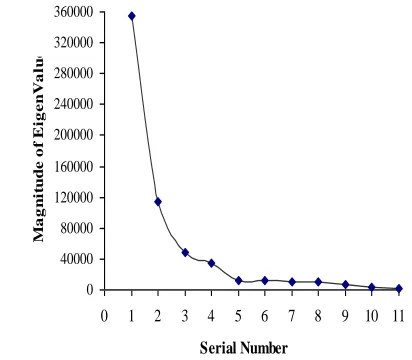
[4] The face image database consists of six to seven images of each. First, an experiment was performed using the first two images for feature extraction, and the remaining images for test. The 2DPCA and PCA algorithm was first used for feature extraction. Here, the size of image is 20 X 20, so the size of covariance matrix Gt was 20 X 20 in the case of 2DPCA, so it was very easy to calculate its all Eigenvalues, in this case 20 (out of 20, 11 are positive Eigenvalues) whereas in the case of PCA, the size of covariance matrix Gt was 400 X 400, so it was hard to get all the Eigenvalues and eigenvector in personal computer. The magnitude of Gt‟s Eigenvalues is plotted in decreasing order as shown in figure 2 below.
0 40000 80000 120000 160000 200000 240000 280000 320000 360000
0 1 2 3 4 5 6 7 8 9 10 11
Serial Number M a g n it u d e o f E ig e n V a lu e
The unit eigenvectors u1,…up of the covariance matrix S are called the principal components of the data. The first principal component is the eigenvector corresponding to the largest Eigenvalues of S, the second principal component is the eigenvector corresponding to the second largest Eigenvalues of S, and so on.
%
53
.
58
2905
.
606697
7294
.
355124
Eigenvalue
All
of
Sum
Eigenvalue
Largest
First
component
principal
First
%
75
.
18
2905
.
606697
252
.
113779
Eigenvalue
All
of
Sum
Eigenvalue
Largest
Second
component
principal
Second
And so on.
[image:5.612.345.551.142.322.2]Chart representation of magnitude of principal component shown in figure.
International Journal of Emerging Technology and Advanced Engineering
Website: www.ijetae.com (ISSN 2250-2459, Volume 2, Issue 1, January 2012)335
0 10 20 30 40 50 60 70
1 2 3 4 5 6 7 8 9 10 11
Principal Component
M
a
g
n
it
u
d
e
(
%
)
A. Comparison of PCA and 2DPCA
In this section, PCA and 2DPCA were compared and performed two type of test.
a) Type 1: Based on number of training image and one largest Eigenvalues
b) Type 2: Based on number of largest Eigenvalues and four training image
c) Type 1: Based on number of training image and one largest Eigenvalues
Method
No. of training
image
Accuracy %
PCA
2 8/15(53%)
2DPCA 11/15 (73%)
PCA
3 8/15(53%)
2DPCA 11/15 (73%)
PCA
4 9/15(60%)
[image:6.612.58.262.137.283.2]2DPCA 13/15(80%)
Table 1: Recognition Accuracy based on Number of training sample
0 20 40 60 80 100
2 3 4
Number of Picture
A
c
c
u
ra
c
y
PCA 2DPCA
a) Type 2: Based on number of largest Eigenvalues and
four training image
Method No. of
Eigenvalues
Accuracy % PCA
2 5/8(50%)
2DPCA 5/8(50%)
PCA
3 5/8(50%)
2DPCA 6/8(62.5%)
PCA
4 6/8(75%)
[image:6.612.348.520.196.299.2]2DPCA 7/8(87.5%)
Table 2: Recognition Accuracy based on Number of Largest Eigenvalues
0 20 40 60 80 100
2 3 4
Number of Largest EigenValue
A
cc
u
ra
cy
PCA 2DPCA
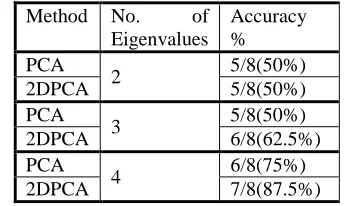
The performance of the PCA and 2DPCA is compared on the face database and two different tests are constructed. 1) By taking first largest eigenvalue and changing the
number of training images. It is found that accuracy rate is high in the case of 2DPCA.
2) In second set of experiment, keeping the number of training images fixed and changing the number of eigenvalue. It is found that if the difference between the eigenvalue is large, then the performance is same in all the cases but if the difference is small then recognition rate increases.
Size of Covariance Matrix and Time of feature extractions
The disadvantage of PCA method is computation time. It takes 2 hours to find the feature of image where in 2DPCA requires nearly 3-4 second to complete the same number of test images. But the above result is also dependent on the CPU speed and available memory.
Figure 5: Recognition Accuracy based on Number of training sample
[image:6.612.332.586.346.453.2] [image:6.612.57.279.576.695.2]International Journal of Emerging Technology and Advanced Engineering
Website: www.ijetae.com (ISSN 2250-2459, Volume 2, Issue 1, January 2012)336
PCA is the high computational complexity. Suppose that the image are of size M X N, and the number of training images is greater than M X N, performing PCA needs O((M X N)3) computations. This is quite expensive even for medium size images.
VIII.
C
ONCLUSIONIn this research, two face recognition systems, PCA and 2DPCA algorithms are examined. The feature projection vectors obtained through the PCA and 2DPCA methods and these vectors are applied to test image. PCA and 2DPCA face recognition systems that use Euclidean Distance based classifier. Additionally, the recognition performance of 2DPCA is higher than the PCA.
Eigenvalues is also a very important aspect of the face and the result shows that first largest Eigenvalues keeps the large amount of principal component information; second largest keeps the second largest principal component information. Experiment shows that by combination of largest Eigenvalues gives higher accuracy in face detection.
References
[1] G.M.Beumer, Q. Tao, A.M. Bazen and R.N.J. Veldhuis, A landmark paper in face recognition, 2006
[2] Rafel C. Gonzalez, Richard E. Woods, Digital Image Processing, Pearson Education, Six Indian Reprint, 2001
[3] Hui Kong, Xuchun Li, Lei Wang, Eam Khwang Teoh, Jian-Gang Wang, Ronda Venkateswarlu “Generalized 2D Principal Component Analysis”, IEEE International Joint Conference on Neural Network (IJCNN), Montreal, Canada, 2005. [4] Serge Lang, Linear Algebra, Addison-Wesley,
Second Edition,1985.
[5] S. Z. Li and A. K. Jain, Eds., Handbook of Face Recognition. Springer, 2005.
[6] Liwei Wang, Xiao Wang, Ming Chang, and Jufu Feng , "Is Two-Dimensional PCA a New Technique?" Acta Automatica, vol. 31, no. 5, pp.782-787, 2005.
[7] Matthew A. Turk and Alex P. Pentland, Face recognition Using Eigenfaces, 1991.
[8] J. Yang, D. Zhang, A. F. Frangi, and J. Yang, “Two-dimensional PCA: A new approach to appearance-based face representation and recognition,” IEEE Transactions on Pattern Analysis and Machine Intelligence, vol. 26, no. 1, pp. 131–137, Jan 2004.
[9] WenYi Zhao, Rama Chellappa “Image based Face Recognition Issues and Methods” Method Training
Image
Covariance matrix size
Time required for feature extraction
PCA 4 400 X 400 2 hrs