Content based Image Retrieval using Combination
between Moment and DCT Methods
Salah Sleibi Al-Rawi
College of Computer-Anbar University-Anbar- Iraq
Ahmed Tariq Sadiq
University of Baghdad-Baghdad-Iraq
Ahmed Fawzi Shafeeq
College of Computer-Anbar University-Anbar-Iraq
ABSTRACT
In this paper a content based image retrieval CBIR is introduced, a color is one of the important features in image processing and CBIR so the Discrete Cosine Transform (DCT) and Color Moment(CM) used to extract features of a query image to compare with image feature in database, the two methods DCT and Color Moment have best result when apply the program by using WANG database images and test 100 image from the database 10 image from each class, the average retrieval of precision of combination DCT and moment with constant weights was 89.3% and the best results were obtained from making the weights variable was 90.7%. and the best results were obtained from dinosaurs , elephants, flowers classes.
General Terms
Image retrieval , combination algorithms , Content Based Image Retrieval .
Keywords
CBIR , DCT, Color Moment , Image Retrieval.
1.
INTRODUCTION
Images are an increasingly important class of data, especially as computers become more usable with greater memory and communication capacities. evaluation in digital photography has led to a huge collection of still images that are stored in digital format. As the demand for digital images increases, that appear the need to save and retrieve images in an efficient way. so, the field of content-based image retrieval has stand out as an important research domain in computer vision and image processing As the amount of collections of digital images increases, the problem finding a desired image becomes a hard job. There is a need to expansion an efficient method to retrieve digital images, CBIR is a hotspot of digital image processing techniques, CBIR research started in the early 1990’s and is likely to continue during the first two decades of the 21st century. Many scientists and research groups in leading universities and companies are actively worked in this area and a fairly large number of prototypes and commercial products are already available. However, the a solutions are still far from reaching the optimal goal [1] .
2.
LITERATURE REVIEW
Many papers and researches are published related to this subject as below:
Mann-Jung Hsiao , (2010), Introduced approach partitions images into a number of regions with fixed absolute locations .Each region is represented by its low-frequency Discrete Cosine Transform DCT coefficients in the YUV color space. Two policies are provided in the matching procedure: local match and global match. In the local match, the user formulates a query by selecting the interested region in the image. Candidate images are then analyzed, by inspecting each region in turn, to find the best matching region with the query region. So with help of friendly GUI, their system also
allows users of any experience level to effortlessly get interested images from database [2].
T.V. Saikrishna ,(2012),They are propose a color image retrieval method based on color moments. First, an image is divided into four segments. Then, the color moments of all segments are extracted and clustered into four classes. so mean moments of each class are considered as a primitive of the image. They used all primitives as features and each class mean combined into single class mean. The distance between query image mean with the corresponding database images are calculated by using Sum Absolute Difference (SAD) method.. Color histograms and color moments are considered for retrieval. The retrieval efficiency of the color descriptors was investigated by means of recall and precision .in their Experiment results the most of the images categories color moment’s shows better performance than the local histogram method [3].
P.A.Hemalatha, K.S.Ravichandran and B.santhi,(2013), They uses Statistical Region Merging (SRM) algorithm for image segmentation. and use of DCT (Discrete Cosine Transform) to determine the shape and color feature vectors are obtained by RGB component values. These feature vectors are used to retrieve the similar images from the image database in analogy with the query image. their work enhances the retrieval efficiency by retrieving the images based on both shape and color where the retrieval is refined with most similar images, the mean precision of three categories of the query image is C1 80%, C2 76% and C380% [4].
3.
CBIR STRUCTURE
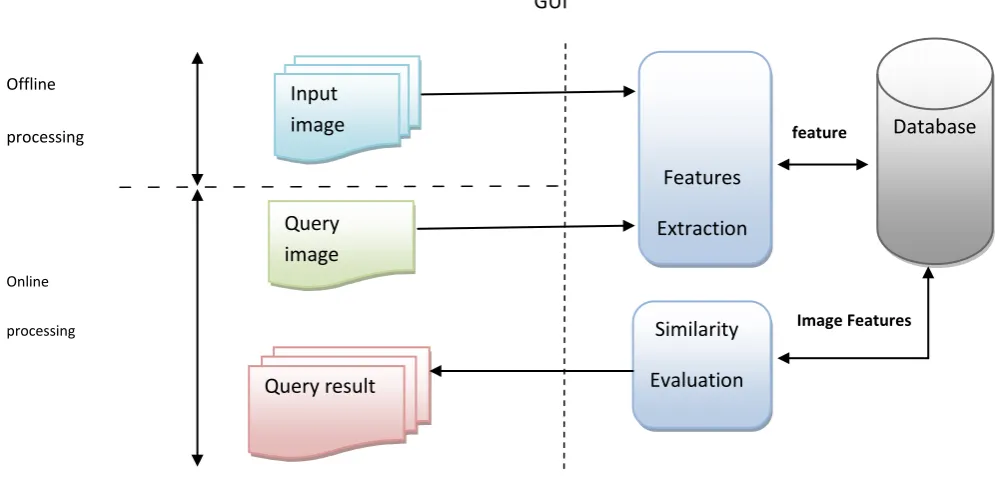
Finally, the system ranks the search results and then returns the results that are most similar images to the query image. If the user is not satisfied with the search results, he can provide
relevance feedback to the retrieval system, which contains a mechanism to learn the user’s information needs [5].
Figure ( 1 ) , CBIR structure
4.
DISCRITE COSINE TRANSFORM
Like any Fourier-related transform, discrete cosine transforms (DCTs) express a signal or a function in terms of a sum of the sinusoids with different amplitudes and frequencies. Like the discrete Fourier transforms (DFT), a DCT operates on a function at the finite number of points of discrete data. The obvious distinction between a DCT and a DFT is that the former uses only cosine functions, while the latter uses both cosines and sine's (in the form of complex exponentials). It is a separable linear transformation; that is, the two-dimensional transform is equivalent to a one dimensional DCT performed along a single dimension followed by a one-dimensional DCT in the other dimension[6].
Apply a DCT according to equation (1) and the inverse (2 ) on each images. The output matrix consists of DCT coefficients, which is arranged in a way that coefficients containing useful and important data for representation of the frame be in the upper left of the matrix and in the lower right coefficients containing less useful information. The DCT coefficient is at position (0,0) in the upper left-hand corner of the matrix and it represents the average of the in the matrix. The formula of 2-D DCT is defined as[7] :
For the inverse 2-D DCT is defined as
for u=0,…..,N-1 and v=0,…,N-1
5.
COLOR MOMENT
Can define the Color moments like measures that can be used differentiate images based on their features of color. Once calculated, these moments provide a measurement for color similarity between images. These features of query image can then be compared to the features of images indexed in a database for tasks like image retrieval .
The color moments basis lays in the assumption that the distribution of color in an image can be interpreted as a probability distribution. Probability distributions are different by a number of unique moments (e.g. Normal distributions are differentiated by their mean and variance). It therefore follows that if the color in an image follows a certain probability distribution, the distribution of moments can then be used as features to identify that image based on color featured . Use three central moments of a image's color distribution. They are Mean, Standard Deviation and Skewness .
A color can be defined by 3 or more values. (Here we will restrict ourselves to the HSV scheme of Hue, Saturation and brightness, although alternative encoding could just as easily be used.) Moments are calculated for each of these channels in an image. An image therefore is characterized by 9 moments 3moments for each 3 color channels. We will define the i-th color channel at the j-th image pixel as pij .
The three color moments can then be defined as: [8 ] :
1.Mean : Mean can be understood as the average color value in the image.
=
……… (3)
Input
image
Query
image
Query result
Similarity
Evaluation
Features
Extraction
Offlineprocessing
Online
processing
Database
feature
s
Image Features
[image:2.595.58.556.113.356.2]2. Standard Deviation: The standard deviation is the square root of the variance of the distribution.
………. (4)
3. Skewness : Skewness can be understood as a measure of the degree of asymmetry in the distribution.
………. (5)
6.
COMBINATION METHOD
The similarity between query and target image is measured from two types of color features which includes Moment , and DCT features. Two types of characteristics of images represent different aspects of property. So, during similarity measure, appropriate weights are considered to combine the features. The distance between the query image and the image in the database is calculated as follows:
Here, w1 is the weight of the first color features, w2 is the weight of the second color features and d1 and d2 are the distances calculated using color moment and DCT equations . Experiments show that better retrieval performances are achieved when we make w1 and w2 variable by the user. The weight factor of every color feature distance is difference than the weight factor of other color feature distance because our database consists of difference images.
The above distance ‘d’ is calculated between the query image and all the images in the database and it is sorted in ascending order. The image corresponding to the first element of d is the most similar image compared with the query image. The first 10 top most similar images are then displayed.
7.
IMAGE DATABASE
For evaluation of the proposed method, it has been implemented using visual studio 2010 and tested on a general purpose WANG database containing 1000 core images in JPEG format of size 384 x 256 or 256 x 384. The image set comprises 100 images in each of 10 categories. In our experiment, we have selected 100 images randomly, containing 10 images in each category and the images are resized to 256 x 384. Within this database, it is known whether any two images are of the same category. In particular, a retrieved image is considered a match if and only if it is in the same category as the query. The following figure sample of Wang database images [9].
Figure(2) , sample of images for Wang database
8.
RESULTS AND ANALYSIS
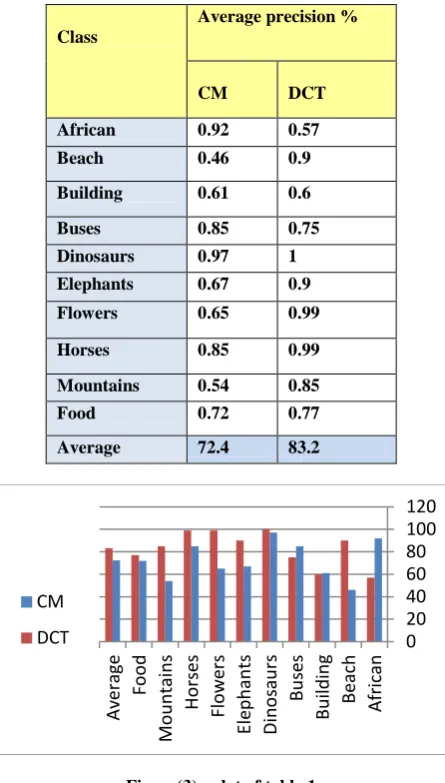
The results of a retrieval system can be measured in terms of its precision and recall. Precision measures can be defined as the ability of the system to retrieve only models that are relevant, while Recall measures is defined as the ability of the system to retrieve all models that are relevant at which defined as number of relevant images retrieved, in this paper we test five images in each class of database to retrieve 10 similar image for each category.
Precision = =
Recall= =
Where A represents the number relevant images that are retrieved, B represents the number of irrelevant items and C is the number of relevant items that were not retrieved in database.
The precision and Recall was calculated for each algorithm alone in table(1) and in table(2) combined algorithms in two state the first state where the weight of combination is constant in value 0.2 and the second state where the weight of combination is variable , the range of variable weight between 0 and 1 so when give weight 0 to any algorithm like not use of algorithm because there is no value for algorithm in combination.
fake distribution of the color in the image , Figure (3) shows a plot of the results in table (2).
Table(1), the precision result of DCT and Color moment(CM) individual .
Class
Average precision %
CM DCT
African 0.92 0.57
Beach 0.46 0.9
Building 0.61 0.6
Buses 0.85 0.75
Dinosaurs 0.97 1
Elephants 0.67 0.9
Flowers 0.65 0.99
Horses 0.85 0.99
Mountains 0.54 0.85
Food 0.72 0.77
Average 72.4 83.2
Figure(3) , plot of table 1
Table (2) shows the precision results of testing the system using the combinations of two implemented algorithms with constant weights and variable weight . The best results were obtained from combining the Moment and DCT with variable weights . This is because both Moment and DCT divide the image into parts before extracting the features. At the retrieving process, the features of each part (block) is compared with the corresponding part(block). The other combination also gave good results and they were better than performing each algorithm individually Figure (4) shows a plot of the results in table (2).
Table(2), the precision result of combination of DCT and Color moment(CM) with constant and variable weights.
Figure(4) , plot of table 2
9.
CONCLOSION
From the results show that the combination of two or more than on feature is give more best result when test every algorithm alone and making the weights variable gave better results than constant weight because each category has its 0
20 40 60 80 100 120
Af
rican
Be
ach
Bu
ildin
g
Bu
se
s
Din
o
sau
rs
Ele
p
h
an
ts
Flow
ers
H
o
rs
es
Mou
n
ta
ins
Foo
d
Av
era
ge
CM
DCT
0 20 40 60 80 100 120
Af
rican
Be
ach
Bu
ildin
g
Bu
se
s
Din
o
sau
rs
Ele
p
h
an
ts
Flow
ers
H
o
rs
es
Mo
u
n
ta
in
s
Foo
d
Av
era
ge
CM+DCT constant
CM+DCT variable class
Average precision %
CM+DCT constant
CM+DCT variable
African 0.82 0.85
Beach 0.82 0.88
Building 0.74 0.78
Buses 0.93 0.93
Dinosaurs 1 1
Elephants 0.96 0.96
Flowers 0.98 0.98
Horses 0.97 0.97
Mountains 0.82 0.83
Food 0.89 0.89
[image:4.595.318.579.112.664.2] [image:4.595.56.279.138.530.2]own color distribution, control by weight when query give more power to the system ,the result of combined DCT and Moment is raised from 89.3%to 90.7%. Since the implemented algorithms work on color features of the image, therefore dividing the image (in DCT and Moment) into blocks or parts gave more quality in retrieving the required images .combination of the moment and DCT don't affect at the time retrieval.
10.
REFERENCES
[1] Neetu Sharma., Paresh Rawat and jaikaran Singh," Efficient CBIR Using Color Histogram Processing", Signal & Image Processing , An International Journal(SIPIJ) Vol.2, No.1, March, 2011.
[2] Mann-Jung Hsiao , Yo-Ping Huang , Tienwei Tsai and Te-Wei Chiang , " An Efficient and Flexible Matching Strategy for Content-based Image Retrieval ", Life Science Journal, Vol 7, No 1, 2010.
[3] T.V. Saikrishna1, Dr.A.Yesubabu ,.A.Anandarao and T.Sudha ,"A Novel Image Retrieval Method Using Segmentation and Color Moments ", Advanced Computing: An International Journal ( ACIJ ), Vol.3, No.1, January, 2012.
[4] P.A.Hemalatha, K.S.Ravichandran and B.santhi," Query By Image Content using DiscreteCosine Transform",International Journal of Engineering and Technology (IJET),Vol 5 No 2, Apr-May 2013.
[5] Wei , Li, C. and Wilson , "A Content-Based Approach to Medical Image Database Retrieval", Idea Group Inc , 2006.
[6] Vibha Bhandari1 and Sandeep ," CBIR Using DCT for Feature Vector Generation", International Journal of Application or Innovation in Engineering & Management (IJAIE) ,Volume 1, Issue 2, October 2012. [7] IRINA BOCHAROVA," Compression for Multimedia",
AMBRIDGE UNIVERSITY PRESS, 2010.
[8] Krishnapuram, R., Medasani, S., Jung, S., Choi, Y. and Balasubramaniam, R., "Content-Based Image Retrieval Based on a Fuzzy Approach", IEEE Transactions on Knowledge and Data Engineering, Vol. 16, No. 10, Pp. 1185-1199, 2004.