Multi-Algorithmic Face Authentication System
Vaidehi V
1, Teena Mary Treesa
2Naresh Babu N T
2, Annis Fathima A
2, Balamurali P
3, Girish Chandra M
3Abstract- In this paper, multiple algorithm and score-level fusion for enhancing the performance of the face based Biometric Person Authentication System is discussed. Though many algorithms are conferred, several crucial issues are still involved in the face authentication. Most traditional algorithms are based on certain assumptions failing which the system will not give appropriate results. Due to the inherent variations in face with time and space, it is a big challenge to formulate a single algorithm based on the face biometric that works well under all variations. This paper addresses the problem of illumination and pose variations, by using three algorithms for face recognition, Block Independent Component Analysis (B-ICA), Discrete Cosine Transform (DCT) and Kalman Filter and weighted average based score level fusion to improve the results obtained of the system. An intensive analysis of the various algorithms has been performed and the results indicate an increase in accuracy of the proposed system.
Index Terms- Biometric, B-ICA, DCT, Kalman filtering, Empirical mode decomposition
I. INTRODUCTION
Biometric authentication systems evolved in the wake of intense concerns about security and advancements in networking and computer vision systems. Biometrics is described as recognizing an individual based on physiological or behavioral qualities. Biometric systems relying on physiological traits are more secured and free of spoof attacks. Face is considered as the appropriate physiological feature for authentication since it does not demand a strict posture for the person and the biometric can be captured and analyzed even without the person’s knowledge. The Biometric algorithms developed are based on assumptions about the input images and operate on assumed ideal input conditions. But in any real time system, enforcing constraints is time consuming, user-hostile and undependable. Real time systems have to be regulated and adapted to the changes in the input introduced due to environmental conditions, time and other factors.
In the face recognition system, the variation due to pose, orientation, illumination and occlusion affects the identification of an individual. In the literature, there is no face recognition theory that is invariant to all face variations.
\
Manuscript submitted January2011. This work is supported by Tata Consultancy Service (TCS), Bangalore, INDIA.
1 Head of the Department of Information Technology, MIT, Anna
University, Chennai, India ([email protected]).
2 Department of Electronics Engineering, MIT, Anna University, Chennai,
India ([email protected], [email protected],
3 Innovations lab, TCS Bangalore, India
The algorithms developed for face recognition are under the assumption of ideal conditions and addresses any one or two face variations. The complementarities of established face recognition algorithms can be utilized to develop a robust system for real-time and can be able to overcome the variations. Thus focusing the objective for developing Multi-algorithm based Face Recognition System.
The multi-algorithmic authentication methods for face recognition proposed in [7], [8] have not handled on the challenges of occlusion, pose and illumination altogether. So, based on these approaches the person may be falsely rejected. The two basic steps of the system are feature extraction and classification. In the feature extraction stage, distinctions are extracted in order to recognize a person. For successful and input invariant recognition, extracted features should be invariant to the changes caused due to the factors discussed above.
This paper proposes a face recognition architecture which uses three different feature extraction algorithms to address the problems of illumination, pose variant and incorporates sensor fusion for handling occlusion along with a score level fusion with an intelligent way of assigning weights based on the analysis of the input. Rest of the paper is organized as follows. Section II describes the proposed Person Authentication System (PAS).Section III provides the results of the implementation and analysis of the proposed PAS. Section IV gives the conclusion.
II. PERSONAUTHENTICATIONSYSTEM(PAS)
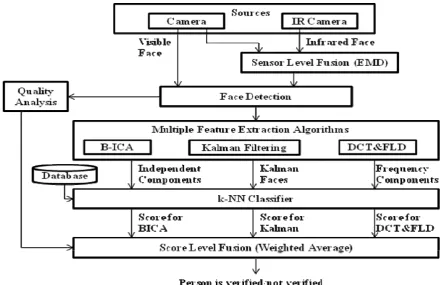
The block diagram of the proposed PAS is shown in Fig. 1.The proposed PAS is a multi-algorithmic, multi-sensor biometric system for face recognition. The sensors used are visible camera and IR camera. Visible and thermal IR sensors capture complementary information of reflectance and radiation from the face. Fusion of visible and thermal images is done for robust face recognition regardless of illumination conditions and occlusion. An image fusion technique, utilizing Empirical Mode Decomposition (EMD) [2], [3], is used for improved face recognition.
Figure 1 Person Authentication System
when subjected to images taken in poor lighting conditions.DCT requires a well illuminated image for good results. Kalman faces take care of the varying poses of a person’s face.
The k-NN classifier is the simplest form of classifier found in the literature on pattern analysis. Nearest neighbor classification is dependent on the inter-class and intra-class variance among features. Better results areobtained for high inter-class variations and low intra-class variations. Weighted average score level fusion is the strategy adopted to take the final decision on the person’s authenticity. Histogram analysis of the face images gives a measure of the illumination conditions for a particular image. Based on this result the weights are dynamically varied to perform weighted average score level fusion.
A. Empirical Mode Decomposition
Registration is the process of transforming the different sets of data into one coordinate system. The co-registered images provide us both the information of the visible as well as the thermal images. The pseudo code for fusion is given below:
Start {
Acquire the image data;
Convert the image data into 1-D vector; Apply the sifting procedure;
Get all the IMF’s and residues;
Add the IMF’s of the different biometrics; Reconstruct the fused image;
}
Frequency-domain methods find the transformation parameters for registration of the images (linear transformation). Applying the Phase correlation method to a pair of images produces a third image which contains a single peak. The location of this peak corresponds to the relative translation between the images. From the correlation matrix the angle of rotation and the scaling parameters are found. With these values registration is performed and the two images are aligned.
The next step is the fusion of these registered images using Empirical Mode Decomposition (EMD). In this method, images from different imaging modalities are decomposed into their Intrinsic Mode Functions (IMFs). Fusion is performed at the decomposition level and the fused IMFs are reconstructed to form the fused image.
B. Face detection
detection and profile faces cannot be detected. The pseudo code for training of the face detector is given below:
Start (for each image in the training set) {
Resize the image into a pre-defined size;
Compute the integral image of the given input image; Compute the horizontal, vertical and diagonal Haar features using sub-windows of 2, 4, 8, 16 etc;
Perform AdaBoost to select the best features for classification for each node in the cascaded classifier; }
Stop
The pseudo code for testing is: Start
{
Divide the input image into blocks of size as pre-defined in the training stage;
For each sub-window For each node of the classifier
{
Compute the integral image; Compute the selected features;
Perform AdaBoost classification on the input features; If face is detected
{
Go to next node of cascaded classifier; }
Else
Reject the sub-window as non-face, come out of loop; }
}
Crop the detected face }
Stop
C. Feature extraction algorithms
i. B-ICA (Block-Independent Component Analysis):
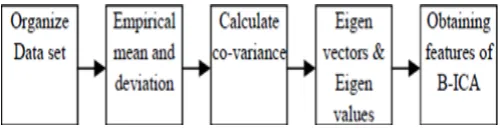
[image:3.595.305.553.263.307.2]Independent Component Analysis represents a set of random variables using basic functions which are statistically as independent as possible [5]. First a whitening matrix is computed following which the whitened data is used to compute the demixing matrix (W) using kurtosis. In Block-ICA implementation, the image is divided into blocks on each of which ICA is implemented. The stages involved in implementation of B-ICA are given in Fig. 2.
Fig. 2. Steps involved in B-ICA Algorithm
ii. DCT and FLD based feature extraction:
Fig. 3 presents the feature extraction scheme using DCT and FLD [11]. In DCT high-dimensional face images are converted into low-dimensional spaces with significant features such as outline of hair and face, position of eyes, nose and mouth, unaltered. DCT performs dimensionality reduction after which clustering is achieved using K means. To obtain the salient and invariant feature of human faces, FLD is applied in the truncated DCT domain after clustering such that the most discriminating facial feature can be effectively extracted.
Fig. 3. Steps involved in DCT and FLD based scheme
The discriminating feature vectors projected from the truncated DCT domain to the optimal subspace can be calculated as follows:
P
E
optT*
X
where X is the truncated DCT coefficient vectors and ET opt is
the FLD optimal projection matrix.
iii. Kalman Filtering:
Kalman filter [4], [1] identifies significant traits in the face. “Kalman faces” are compact visual model that represents the invariant proportions of the face classes. Each face class is represented in single feature vector. Those vectors are extracted by image normalization followed by feature extraction.
Image normalization converts the image into luminance metrics (gray scale) of the same size. Nearest Neighbor Classification is used to implement this and each pixel represents one face region. During feature extraction, Kalman averaging is computed from normalized faces using Kalman filter to obtain the Kalman face. Only those Kalman faces that are sufficiently invariant with respect to different poses are considered as a feature. Kalman average of the image is computed by the following equation:
X
t
X
t1
k X
t(
t1
L
t)
where,
X
t=
Pixel average with the time t,k
t=
Kalmanweighing factor,
L
t=
Luminance value.1
1
t t
t t
k
Here
t = Standard Deviation of luminance. Weightkt, is the [image:3.595.43.294.667.732.2]D. k-NN classifier
k- Nearest Neighbor (k-NN) classifier locates the k nearest samples to the query sample and determines its class by identifying the single most frequent class label. Instances or samples are points within an n-dimensional instance space where each of the dimensions corresponds to one of the n-features that are used to describe an instance. The relative distance between instances is determined by using a distance metric which minimizes the distance between two similarly classified instances, while maximizing the distance between instances of different classes.
The Euclidean distance between any two vectors X=(x1,x2,…,xn) and Y=(y1,y2,…,yn) is defined by d(x, y) as
2 2
1 1
( , )
(
)
... (
n n)
d x y
x
y
x
y
The percentage of match for each algorithm is determined using the formula:
min( ( , ))
1
*100
max( ( , ))
d x y
C
d x y
E. Quality Analysis
A good input always gives good recognition performance. A quantitative estimate of image quality can be effective in predicting the performance of the recognition unit and subsequently compensating for the degradation due to unavoidable noisy input. The quality estimates are fed to the decision logic to account for the noise in the input and consequently to improve recognition performance.
The paper implements a simple illumination estimate proposed by Mohamed Abdel-Mottaleb and Mohammad H. Mahoor [10]. The pseudo code is as follows:
Start {
Resize the image to pre-defined size;
Normalize the image to zero mean and unit variance; Partition the image into 16 regions;
for (each of the 16 regions) {
Calculate mean of a block and store in a matrix; }
Generate a Gaussian weight matrix of the same size as the mean matrix;
Calculate the weighted sum of the mean matrix (Wmi); Output the calculated value (Wmi);
} Stop 10 1
*
mi i i
i
W
w
I
where
,
1 1
1/ ( * )N M ( , )
i
x y I M N I x y
and Wi is the Gaussian weight factor, MxN is the size of the
image.
F. Score level fusion
As discussed already, various algorithms provide different performance in different conditions. An intelligent way of fusion i.e. a correct decision on weighing the obtained score of the different algorithms for real-time situations, will provide the necessitate results and making the system invariant to pose, illumination and occlusion.
A weighted average strategy of fusion can easily accommodate varying performance of different algorithms. A dynamically weight updating strategy matching any particular situation like illumination, pose variance or occlusion can be an added boon in terms of increase in system performance making the system automatic. Since the algorithms may give results in various ranges, the matches are normalized so that the percentage of match for algorithm x is
3
1
_ : _ 1
x
P x P x
where algorithm 1 stands for DCT, 2 stands for B-ICA and 3 stands for Kalman. The initial weights given to the respective algorithm is:
3 1
_ : _ 1
x
W x W x
The initial weights for the algorithms are assigned by evaluating the performance of the algorithm during training and testing [12].The final score for the person is determined using the formula:
1
_ * _
n
x
S W x P x
To make the system illumination invariant, illumination estimation (Wmi) is done and the result is shown in Fig. 5. The weights are updated for the corresponding algorithms, and score level fusion is performed. To make the system pose invariant, pose detection is performed. If the face is not a frontal face then Kalman algorithm is given a larger weight. To make the system invariant to occlusion, EMD fusion of visible and IR face images is performed and recognition is performed using the fused image. The algorithm for automatic score level fusion is given below.
If (daytime)
{ If (image not occluded) { If (frontal face)
{ If (bright image or dark image)
{ Assign appropriate weights, W_1, W_2 & W_3 Else
Assign appropriate weights, W_1, W_2 & W_3 }
} Else
Assign appropriate weights, W_1, W_2 & W_3 }
Else
Fuse IR and visible image and perform face recognition on fused image
} Else
Fig. 5. Face quality analyses of images captured in lab
III. IMPLEMENTATIONANDRESULTS
The programs are executed using the OpenCV image processing library. OpenCV [6] is an open source Intel’s computer vision library. False Acceptance Rate (FAR) and False Rejection Rate (FRR) are the two metrics that define a biometric system’s accuracy. FAR gives the percentage of unauthorized entities that were judged as authorized by any algorithm to the total number of entities in the database. FRR gives the ratio ofauthentic entities that were wrongly rejected as unauthorized by the algorithm to the total number of entities in the database.
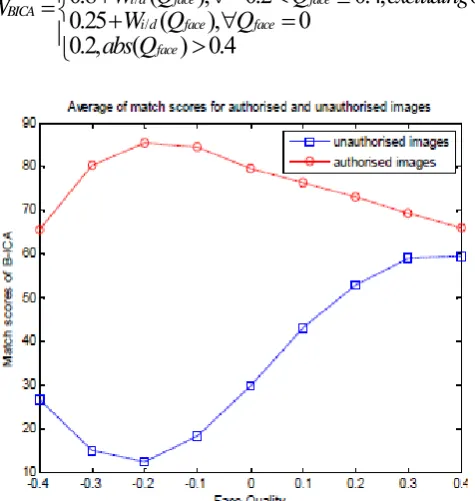
To make the fusion scheme dynamic, weights are computed during run-time depending on the input quality of the image. The performance of the three different face recognition schemes (B-ICA, Kalman and DCT) with respect to the face illumination quality is plotted in Fig. 6 to Fig. 8 respectively.
Thus the weights to the three algorithms can be dynamically formulated using the following equations:
/ / /
0.4
(
),
0.4
0.2
0.8
(
),
0.2
0.4,
0
0.25
(
),
0
0.2,
(
) 0.4
i d face face
i d face face
BICA
i d face face
face
W
Q
Q
W
Q
Q
excluding
W
W
Q
Q
abs Q
[image:5.595.43.291.104.194.2]
Fig.6. Average match scores obtained by running the B-ICA algorithm for images with varying brightness. Images of both trained (authorized) and untrained (unauthorized) images was taken for the analysis
/ / /
0.6
(
),
0.4
0.2
0.2
(
),
0.2
0.4,
0
0.25
(
),
0
0.2,
(
) 0.4
i d face face
i d face face
Kalman
i d face face
face
W
Q
Q
W
Q
Q
excluding
W
W
Q
Q
abs Q
0.5,
0
0,
faceDCT
Q
W
otherwise
/
( ) [ ]*[
x]
i d
W
Q
Q
[ ] [16244
2847
4040 843 231 61 3 1 0 0]
9 8 7 6 5 4 3 2 1 0
[ x] [ ]'
Q Q Q Q Q Q Q Q Q Q Q
[image:5.595.50.288.450.701.2]
where WBICA, WKalman, WDCT is the quality dependent weight assigned to B-ICA, Kalman and DCT algorithms for score level fusion, Wi/d is the quality dependent weight increment or decrement, [π] is the row vector containing the coefficients of the weight increment/decrement equation and [Qx] is the column vector containing the powers of the estimated quality. The selection of quality range from -0.4 to +0.4 in the weight determination equation is due to the fact that for absolute values of quality above 0.4 the percentage of match for authorized as well as unauthorized images starts to increase or decrease, in an undistinguishable way is described by the fig.9. When the face quality falls below +0.4 or -0.4, the IR image is captured and the recognition is done using the IR image.
[image:5.595.308.549.499.699.2]If the image is occluded, the IR image and visible face image of the person is fused using EMD. The fusion of the two images gives more detail on which face recognition can be applied using the feature extraction algorithms. The fused image can be recognized using the BICA algorithm.
Fig.8. Average match scores obtained by running the DCT & FLD algorithm for images with varying brightness. Images of both trained (authorized) and untrained (unauthorized) images was taken for the analysis
Fig. 9. Average match scores with respect to face illumination quality after performing score level fusion
IV. CONCLUSION
This paper performed an analysis into the need for multiple algorithms in the recognition of a face biometric and the approach makes the system adaptive to variations in the image capture or due to environmental conditions. The effect of surroundings is obvious in the results of the analysis which makes it necessary for implementing face detection before feature extraction. It is concluded that the proposed scheme outperforms other face recognition approaches. The proposed PAS is pose, illumination and orientation invariant. The system can be further enhanced to include much more biometrics in order to make it spoof-free.
REFERENCES
[1] H.Eidenberger, Kalman Filtering for Robust Identification of Face Images with Varying Expressions and Lighting Conditions, 18th
International Conference on Pattern Recognition (ICPR'06), pp.1073-1076.
[2] H.Hariharan, A.Gribok, M.Abidi, and A.Koschan, Image enhancement and fusion via empirical mode decomposition, Proc. IEEE International Conference on Image Processing ICIP2006, Atlanta, GA, pp. 2049-2052, October 2006.
[3] S. G. Kong, J. Heo, F. Boughorbel, Y. Zheng, B. R. Abidi, A. Koschan, M. Yi, and M. A. Abidi, Multiscale Fusion of Visible and Thermal IR Images for Illumination-Invariant Face Recognition, International Journal of Computer Vision, Vol. 71, No. 2, pp. 215-233, Feb. 2007.
[4] G. Welch and G. Bishop, An Introduction to the Kalman Filter, Technical Report, University of North Carolina at Chapel Hill. [5] Lei Zhang, Quanxue Gao and David Zhang, “Block Independent
Component Analysis for Face Recognition”, 14th International Conference on Image Analysis and Processing (ICIAP), 0-7695-2877-5/07(2007)
[6] Gary Bradski and Adrian Kaehler, Learning OpenCV, Published by O’Reilly Media, Inc., 1005 Gravenstein Highway North, Sebastopol, CA 95472.
[7] Ali J. Abboud, Harin Sellahewa and Sabah A. Jassim, Quality based approach for adaptive face recognition, Proceedings of Mobile Multimedia/Image Processing, Security, and Applications, Vol. 7351, 2009.
[8] Necmiye Ozayy, Yan Tong Frederick, W. Wheeler and Xiaoming Liu, Improving face recognition with a quality-based probabilistic framework, IEEE Computer Society Conference on Computer Vision and Pattern Recognition Workshops, pp. 134 – 141, 2009.
[9] Paul Viola and Michael J. Jones, Robust Real-Time Face Detection, International Journal of Computer Vision Vol. 57(2), pp. 137–154, 2004.
[10] Mohamed Abdel-Mottaleb and Mohammad H. Mahoor, Algorithms for Assessing the Quality of Facial Images, Application Notes, IEEE Computational Intelligence Magazine, May 2007.