A Generalized Difference-cum-Ratio Type
Estimator for the Population Variance in Double
Sampling
H. S. Jhajj and G.S. Walia
Abstract: For estimating the population variance of variable under study, a generalized difference-cum-ratio type estimator has been proposed. Expressions for bias and mean square error have been obtained using random sampling at both the phases. The expressions have also been derived using simple random sampling at both the phases as a special case. Then the comparison has been made with the regression-type estimator and sample variance. Results have also been illustrated numerically and graphically.
Keywords : Regression-type estimator, Sample variance, Mean square error, Auxiliary variable, Double Sampling, Efficiency.
I. INTRODUCTION
In survey sampling, the estimation of population variance of the variable under study has attracted the attention of large number of statisticians to know the variation in the population. It is well known that the use of the auxiliary information can increase the efficiency of the estimators of parameters of interest. Using the prior knowledge of population variance
S
x2 of auxiliary variable x, which is highly correlated with study variable y, several estimators have been defined by different authors such as Tripathi et al.(1978), Jhajj et al.(1980), Ahmed et al.(2003), Jhajj et al.(2005), Kadilar & Cingi (2006), Pradhan B.K.(2010) in the literature for estimating the unknown population variance of study variable y. In the situation when information on population varianceS
x2 is not known in advance then generally two phase (double) sampling design has been widely used. In the two-phase sampling design, a large preliminary random sample (called first phase sample) is drawn from the population and information on auxiliary variable is taken, which is used to estimate the value of unknown population varianceS
x2of auxiliary variable x. Then second phase sample is drawn either from the first phase sample or independently from the population and observations on study and auxiliary variable are taken.Manuscript received Nov. 30, 2010; revised April 18, 2011.
Harbans Singh Jhajj, Prof. & Head, Department of Statistics, Punjabi University, Patiala-147002, India Email : [email protected]
Gurjeet Singh Walia, Department of Statistics, Punjabi University, Patiala-147002, India. Email : [email protected]
In the present paper, we propose a generalized difference-cum-ratio type estimator for the population variance under double sampling design. The expressions for bias and mean square error of the proposed estimator have been obtained. The comparison of the proposed estimator has been made with the regression type and sample variance. Effort has also been made to illustrate the results numerically and graphically.
II. NOTATIONS AND RESULTS
A preliminary large random sample (first phase sample) of size
n
is drawn from a finite population of size N and both auxiliary variable x and study variable y are measured on it. The second phase random sample of sizen
n
is drawn from the first phase sample.Let
Y
i andX
idenote the respective values of variables y and x on thei
th
i
1, 2,...,
N
unit of the population and the corresponding small letters denote the values in the sample.Denoting
2 21
1
1
n
y i
i
s
y
y
n
,
2 2
1
1
1
n
y i
i
s
y
y
n
,
22
1 1
1
N
y i
i
S Y Y
N
,
2 2
1
1 1
n
x i
i
s x x
n
,
2 21 1
1
n
x i
i
s x x
n
,
2 2
1
1 1
N
x i
i
S X X
N
1
1
Nr s
rs i i
i
Y Y
X
X
N
2 2
20 02
,
rs
rs r s
0 4 2 2
4 0
1
1 1
v
where
s
x2,2
x
s
ands
2y,s
y2are the sample variances of variables x and y based on the sampling units of first and second phase samples of sizesn
andn
respectively.Defining
2
0 2
1
x
x
s
S
2
0 2
1
y
y
s
S
2
1 2
1
x
x
s
S
2
1 2
1
y
y
s
S
IAENG International Journal of Applied Mathematics, 41:4, IJAM_41_4_01
We assume that
0
1
0
10
E
E
E
E
2 2 2 20 4 1 4
2 2
2 2
0 4 1 4
2 2 2 2
0 1 4 0 1 4
2 2
0 0 2 2 0 1
, , , x x x x y y y y
y y x x
y x
x y x y
Var s Var s
E E
S S
Var s Var s
E E
S S
Cov s s Cov s s
E E
S S
Cov s s Cov s
E E S S
2 2 2 22 2 2 2
1 0 2 2 1 1 2 2
2.1 , , , x y x y
x y x y
x y x y
s S S
Cov s s Cov s s
E E
S S S S
III. THE PROPOSED ESTIMATOR AND ITS MEAN SQUARE ERROR
When information on population variance
S
x2 of theauxiliary variable x is not known, we propose an estimator of population variance
S
2y of study variable y under thedouble sampling design defined in section 2 as
2
2 2 2 2
2 2 2
x
hgd y y y
x x x
s
s s s s
s s s
(3.1) where
and
are unknown constants.To find the bias and mean square error of estimator
s
hgd2 , we expands
hgd2 in terms of
'
s
and
'
s
and retaining terms up to second degree of approximation
2 20 1 0 1 0 0 1 0
2 2
1 0 0 1 0 1 1 0
2 2
1 0 0 1 0
1 0 1 0
1 1 2 1 1 1 2 1 hgd y
s S
3.2
Taking expectation of (3.2), we obtain
2 2
2
2 2 2
4
2 2 2 2
2 2 1 1 2 , , 3.3 x x
hgd y y
x
y x y x
y x
V s V s
E s S S
S
C ov s s C ov s s
S S
Up to first order of approximation, mean square error (MSE) of the estimator
s
hgd2 is obtained by using (3.2) as
2 2 2
2hgd hgd y
MSE s
E s
S
24
0 1 0 1 1 0
y
S E
2 2 2 2
4 2
2 2 2
4
2
2 2 2 2 2
2 2 1
2 1 , , 3.4
y y y
y
x x
x y
y x y x
x
V s V s V s
S
V s V s S
S
Cov s s Cov s s S
Differentiating (3.4) w.r.t.
and equating to zero, we get
4
2 2 2
4
2
2 2 2 2 2
2
2 1
2 1 , , 0
y
x x
x y
y x y x
x
S
V s V s S
S
Cov s s Cov s s S
After solving, we get the optimum value of
as
2 2 2 2 2
2 2 2
,
,
x y x y x
opt
y x x
S
Cov s s
Cov s s
S V s
V s
(3.5)Substituting the optimum value of
from (3.5) in (3.4), we get minimum mean square errorMSE
min
s
hgd2 as
2 2 2 2 2
min
2
2 2 2 2
2
2 2
2
, ,
1 3.6
hgd y y y
y x y x
x x
MSE s V s V s V s
Cov s s Cov s s V s V s
Theorem 1: Up to first order of approximation, the bias of estimator
s
hgd2 is
2 2 2 2 2 42 2 2 2
2 2 1 1 2 , , x x hgd y x
y x y x
y x
V s V s Bias s S
S
Cov s s Cov s s S S
and its Mean Square Error is
2 2 2 2 2
4 2
2 2 2
4 2
2 2 2 2 2
2 2 1
2 1 , ,
hgd y y y
y
x x
x y
y x y x
x
MSE s V s V s V s
S
V s V s S
S
Cov s s Cov s s S
Theorem 2: Up to first order of approximation, the MSE of
2
hgd
s
is minimized for
2 2 2 2 2
2 2 2
,
,
x y x y x
opt
y x x
S
Cov s s
Cov s s
S
V s
V s
IAENG International Journal of Applied Mathematics, 41:4, IJAM_41_4_01
and its minimum value is given by
2 2 2 2 2
min
2
2 2 2 2
2
2 2
2
, ,
1
hgd y y y
y x y x
x x
MSE s V s V s V s
Cov s s Cov s s V s V s
Special Case : When simple random sampling is used for selection of samples in given double sampling design, then we have
2 4 2 4
40 40
2 4 2 4
04 04
2 2 2 2 2 2 2 2
22 22
1 1
1 1
1 1
1 1 3.7
1 1
, 1 , 1
y y y y
x x x x
x y x y x y x y
Var s S Var s S
n n
Var s S Var s S
n n
Cov s s S S Cov s s S S
n n
(3.8)
Substituting results of (3.7) in (3.3) and (3.4) respectively, we have
2 2
2
04 22
1
1 1
1
1
1
2
hgd y
Bias s
S
n n
(3.8)
2 4 4 2
40 40
2 2
2
04 22
1 1 1
1 2 1
1 1 2 1 1
hgd y y
MSE s S S
n n n
(3.9) For minimizing
MSE s
hgd2 , we differentiate (3.9) w.r.t.
and equating to zero and after some simplification, we get
22
041
1
opt
(3.10) Substituting the optimum value of
from (3.10) in (3.9), we obtain
2 4
4
2
2 2min 40 40
1 1 1
1 1 2 1
hgd y y v
MSE s S S
n n n
(3.11)
Cor 1.1: Up to first order of approximation
n
1 , underdouble sampling design in which simple random sampling is used at both phases, the bias of estimator
s
hgd2 is
2 2
2
04 22
1 1 1
1 1 1
2
hgd y
Bias s S
n n
and its MSE is
2 4 4 2
40 40
2 2
2
04 22
1 1 1
1 2 1
1 1 2 1 1
hgd y y
MSE s S S
n
n n
Cor2.1: Up to first order of approximation
n
1 , under double sampling design in which simple random sampling is used at both phases, the MSE ofs
hgd2 is minimized for
22
041
1
opt
and its minimum value is given by
IV. COMPARISON
For comparing the proposed estimator with the existing ones, we first write the expressions of their mean square errors. The MSE of the linear regression-type estimator
s
lrd2 under double sampling design is given by
2 4
4
240 40
1
1
1
1
1
lrd y y v
MSE s
S
S
n
n
n
(4.1) and the MSE of the sample variance
s
2yis given by
2 4
40
1
1
y y
MSE s
S
n
(4.2)
Using (3.11) and (4.1), we obtain
2
2 4
2
2
min 40
1 1
1 2 1 0
lrd hgd y v
MSE s MSE s S
n n
2
2min hgd lrd
0
2
MSE
s
MSE s
if
(4.3) Using (3.11) and (4.2), we obtain
2
2 4
2
2
2
min 40
1 1
1 2 1 0
y hgd y v v
MSE s MSE s S
n n
2
2min 2 2
1 1
1 1
1 1
hgd y
v v
MSE s MSE s if
(4.4)
IAENG International Journal of Applied Mathematics, 41:4, IJAM_41_4_01
V. NUMERICAL ILLUSTRATION
[image:4.595.317.538.64.231.2]To have a rough idea about the gain in efficiency of the proposed estimator (
s
hgd2 ) over the Regression-type estimator
s
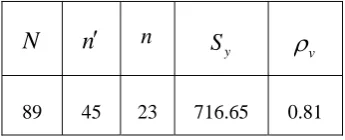
lrd2 in double sampling, we take the empirical population considered in the literature (Source: Sukhatme & Sukhatme, 1970, p-256). The values of the population parameters obtained are given in Table 1. The mean square error and relative efficiency of the proposed estimator (s
hgd2 ) w.r.t. Regression-type estimator
s
lrd2 and sample variance (s
2y) are given for some different values of
in the table 2. [image:4.595.64.237.288.358.2]Table 1: Value of Population Parameters
Table 2: Mean Square Errors and Relative Efficiency
Proposed Estimator Vs. Regression-type Estimator and
Sample variance
-2 -1 0 1 2 3
40 60 80 100 120 140 160 180 200
Ef
ficie
n
cy
Regression Estimator
Sample variance
Proposed Estimator
Figure 1: Comparison of Proposed estimator with Regression-type estimator and sample variance
VI. CONCLUSION
From table 2, we can see that there is a significant gain in efficiency of the proposed estimator (
s
hgd2 ) over the Regression-type estimator
s
lrd2 in double sampling for0
2
and sample variance (s
2y) for2 2
1
1
1
1
1
v1
v
. From the graph we alsosee that for
0
2
, the efficiency of proposed estimator is more than the regression-type estimator and it is also more efficient than sample variance for wider range of
at moderate value of correlation coefficient. Hence we conclude that proposed estimator will always be better than the existing regression-type estimator under double sampling for0
2
and sample variance for2 2
1
1
1
1
1
v1
v
.ACKNOWLEDGEMENT
Authors are thankful to the Referees for their valuable suggestions in improving the paper.
N
n
n
S
y
v89 45 23 716.65 0.81
2y
M S E s
2lrd
MSE s
2hgd
MSE s Efficiency
2
y
s
s
lrd2s
hgd20 83539.758 56329.12 56329.12 100 148.30 148.30 0.5 83539.758 56329.12 46105.85 100 148.30 181.19
1 83539.758 56329.12 42698.09 100 148.30 195.65 1.5 83539.758 56329.12 46105.85 100 148.30 181.19
2 83539.758 56329.12 56329.12 100 148.30 148.30
IAENG International Journal of Applied Mathematics, 41:4, IJAM_41_4_01
REFERENCES
[1] S.N. Nath, “On Product Moments from a Finite Universe”, Journal of
the American Statistical Association, 63(322), 535-541, 1968.
[2] S.N. Nath, “More Results on Product Moments from a Finite Universe”, Journal of the American Statistical Association, 64(327), 864-869, 1969.
[3] A.K. Das and B. Tripathi, “Use of auxiliary information in estimating the finite population variance”, Sankhya, C 40, 139–148, 1978. [4] H.S. Jhajj and S.K. Srivastava, “A class of estimators using auxiliary
information for estimating finite population variance”, Sankhya, C
42(1–2), 87–96, 1980.
[5] M.S. Ahmed, A.D. Walid and A.O.H. Ahmed, “Some estimators for finite population variance under two-phase sampling”, Statistics in
Transition, 6(1), 143–150, 2003.
[6] H.S. Jhajj, M.K. Sharma and L.K. Grover, “An Efficient class of chain estimators of population variance under sub-sampling scheme”, Jour
Japan Statistical Society, 35(2), 273–286, 2005.
[7] C. Kadilar and H. Cingi, “Ratio estimators for the population variance in simple and stratified random sampling”, Applied Mathematics and
Computation, 173, 1047–1059, 2006.
[8] R. Fernandez-Alcala, J. Navarro-Moreno, J. C. Ruiz-Molina and A. Oya, “LMMSE Estimation based on Counting Observations”, IAENG Int. J. Appl. Math, 37:2, 2007.
[9] B.K. Pradhan, “Regression Type Estimators of Finite Population Variance Under Multiphase Sampling”, Bull. Malays. Math. Sci. Soc.,
(2) 33(2), 345–353, 2010.
[10] S.A. Al-hadhrami, “Estimation of the population variance using Ranked set sampling with auxiliary variable”, Int. J. Contemp. Math.
Sciences, Vol. 5, no.52, 2567-2576, 2010.
[11] H.P. Singh, R. Tailor, S. Singh and Jong-Min Kim, “Estimation of
population variance in successive sampling”, Qual. Quant, 45:477–
494, 2011.
APPENDIX
Appendix: I. For getting the expected value of
1 1, weproceed as
2 2
1 1 2
1
21
y x
x y
s
s
E
E
S
S
2
1
2
x2 x2
y2 y2
x y
E
s
S
s
S
S S
2 2
2 2
,
x y
x y
Cov s
s
S S
(1)On the similar line, other results involved in (2.1) can be derived.
II. Under Simple Random Sampling, covariance between sample variance of
x
andy
can be obtained as
2 2 2 2 2 2
,
x y x x y y
Cov s s
E
s
S
s
S
E s s
2 2x y S Sx2 2y
2
2 2 21 1
1 1
1 1
n n
i i x y
i i
E x x y y S S
n n
2 2 2 2 2 2
2
1 1
1 1
n n
i i x y
i i
E x X n x X y Y n y Y S S
n
2 2 2 2
2
1 1 1
2 2 2 2 2 2 2
1 1
1
n n n
i i i
i i i
n
i x y
i
E x X y Y n x X y Y
n
n y Y x X n x X y Y S S
(2) The following results can be obtained by usual procedure
2 2
1 1
2 2 20 02
1
1 1
n n
i i
i i
E x X y Y
N n n n N n
N N
(3)
2 2
1
22 20 02
2 1
1 2 1 2
n
i i
E x X y Y
N n N n N N n n
N N n n N N
(4)
2 2
1
22 20 02
2 1
1 2 1 2
n i i
E y Y x X
N n N n N N n n
N N n
n N N
(5)
2 2
2 2
22 3
20 02 3
2 11 3
6 1 6
1 2 3
1 1
1 2 3
2 1 1
1 2 3
N n N n N n
E x X y Y
N N N n
N N n N n n
N N N n
N N n N n n
N N N n
(6) Using the results of (3), (4), (5) and (6) in (2), and retaining terms up to first order of approximation, we have
2 2 2 2
22
1
,
1
x y x y
Cov s s
S S
n
On the similar line, other results involved in (3.8) can be derived.
IAENG International Journal of Applied Mathematics, 41:4, IJAM_41_4_01