http://www.scirp.org/journal/am
ISSN Online: 2152-7393 ISSN Print: 2152-7385
DOI: 10.4236/am.2018.94033 Apr. 30, 2018 459 Applied Mathematics
Operator Product Formula for a Special
Macdonald Function
Lifang Wang
2, Ke Wu
1, Jie Yang
11School of Mathematical Sciences, Capital Normal University, Beijing, China 2School of Mathematics and Statistics, Henan University, Kaifeng, China
Abstract
In this paper, we construct two sets of vertex operators S+ and S− from a
direct sum of two sets of Heisenberg algebras. Then by calculating the vacuum expectation value of some products of vertex operators, we get Macdonald function in special variables i1
i
x =t− (i=0,1, 2,). Hence we obtain the op-erator product formula for a special Macdonald function
(
1)
1, , , n ; , Pλ t t − q t when n is finite as well as when n goes to infinity.
Keywords
Macdonald Function, Vertex Operator, Heisenberg Algebra
1. Introduction
The study of topological string on Calabi-Yau manifolds is interested in mathematical physics for many years. It was found that gauge theories with certain gauge groups can be geometrically engineered from some Calabi-Yau threefolds, and the topological string partition functions on such spaces are related to instanton sums in gauge theories [1].
The topological vertex formalism provides a powerful method to calculate the topological string partition function for non-compact toric Calabi-Yau 3-fold. By transfer matrix approach, A. Okounkov, N. Reshetikhin and C. Vafa proposed the topological vertex Cλµν using Schur and skew Schur functions
[2]:
( )
( )2( )
(
)
( )
/ /
t
t t
C q q s q s q s q
κ µ
ρ ν ρ ν ρ
λµν ν λ η µ η
η
− − − − −
=
∑
where λ µ ν, , are Young diagrams, λt denotes the transpose of λ, and How to cite this paper: Wang, L.F., Wu,
K. and Yang, J. (2018) Operator Product Formula for a Special Macdonald Function. Applied Mathematics, 9, 459-471.
https://doi.org/10.4236/am.2018.94033
Received: April 4, 2018 Accepted: April 27, 2018 Published: April 30, 2018
Copyright © 2018 by authors and Scientific Research Publishing Inc. This work is licensed under the Creative Commons Attribution International License (CC BY 4.0).
http://creativecommons.org/licenses/by/4.0/
DOI: 10.4236/am.2018.94033 460 Applied Mathematics
(
1 2 , 3 2 , 5 2 ,)
ρ= − − − . The topological vertex Cλµν has a nice interpretation by statistical mechanics of the melting crystal model [2] [3]. In this paper two sets of vertex operators constructed specifically by the annihilation and creation generators of Heisenberg algebra play important roles in realizing Schur and skew Schur functions.
On the other hand, gauge theory partition function is a function with two equivariant parameters. In 2007, based on the arguments of geometric engineering, concerning the K-theoretic lift of the Nekrasov partition functions, A. Iqbal, C. Kozçaz and C. Vafa introduced a refined version of topological vertex [4]. In this refinement, one more parameter t comes in and the theory seems to be deeply related to a Macdonald function with special variables, or what we call a special Macdonald function, P tλ
(
−ρ; ,q t)
:( )
( )(
)
(
)
(
)
2 22 2
2
/ /
, t ; ,
t t
q
C t q t P t q t
t q
s t q s t q
t
µ ν
κ µ ρ
λµν ν
η λ µ
ρ ν ν ρ
µ η λ η
η +
−
+ −
− − − −
=
×
∑
where 2 2
i i
λ =
∑
λ . Moreover H. Awata and H. Kanno proposed another formula [5] which is expressed entirely in terms of the special (skew) Macdonald functions:( )
(
)
( )
(
)
(
)(
)
1
1 2 1 2 /
/
, ; , ,
; , ; , ,
t t t C q t P t q t f q t
P t q t q P q t q t q t
ν ρ
µλ λ ν
σ ν
λ ρ λ ρ
ν σ µ σ
σ
ι
−
−
=
×
∑
−where
( ) ( )
( )
2 ( ) 2, 1
t
n n
fλ q t = − λ q λ +λ t− λ λ− and ι is the involution on the algebra of symmetric functions defined by ι
( )
pn = −pn, here( )
1n n i i p x =
∑
∞=x . Although Cλµν( )
t q, and Cνµλ( )
q t, have different expressions, they are supposed to give the same result.Therefore it seems that the key problem is to change Schur function for the unrefined case to Macdonald function for the refined one. Hence to find a vertex operator formalism for the refined topological vertex will be interesting. The essential step is to realize the special Macdonald function P tλ
(
−ρ; ,q t)
. However a vertex operator formalism for P tλ(
−ρ; ,q t)
does not exist so far.In this paper, we get the operator product formula for the special Macdonald
function
(
1)
1, , , n ; ,
Pλ t t − q t . We also extend this formula to the case when n goes to infinity.
2. Preliminaries
2.1. Notations
• : the set of rational numbers;
•
( )
q t, : the field of rational functions of q, t over ;• The q infinite product:
( )
(
)
0; : 1 n
n
x q ∞ xq
≥
DOI: 10.4236/am.2018.94033 461 Applied Mathematics
2.2. Partitions
A partition is any (finite or infinite) sequence λ=
(
λ λ1, 2,,λr,)
ofnon-negative in decreasing order: λ λ1≥ 2≥≥λr≥ and containing only finitely many non-zero terms. We denote by λ the size of the partition, i.e.
i i
λ =
∑
λ and by l( )
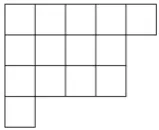
λ the number of non-zero λi. The set of all partitions is denoted by .A pictorial representation of a partition λ is called 2D Young diagram , it can be obtained by placing λi boxes at the i-th row. For example, Figure 1 represents a partition λ=
(
5, 4, 4,1)
.The transpose of λ is denoted by λt,
(
)
1, 2,
t t t
λ = λ λ , here
{
}
Card | t
j i i j
λ
=λ
≥ . For example, the transpose of λ=(
5, 4, 4,1)
is(
4, 3, 3, 3,1)
t
λ
= .We denote by
( )
2,
s= i j ∈ for each square of a partitionλ, here 1≤ ≤j λi. For each square s=
( )
i j, ∈λ, let( )
,( )
t ,( )
( ) ( )
1,i j
a s = −
λ
j l s =λ
−i h s =a s +l s +( )
1,( )
1.a s′ = −j l s′ = −i
The numbers a s
( )
and a s′( )
may be called respectively the arm-length and the arm-colength of s, and l s( )
, l s′( )
the leg-length and the leg-colength.2.3. Macdonald Function
We define a scalar product
( )
,
1
1
, ,
1 i
i
l
q t
i
q
p p z
t
λ λ
λ µ δλµ λ λ
= − =
−
∏
(1)here
=
!
1
i i m
i
m
i
z
∏
≥
λ , where mi =mi
( )
λ is the number of parts of λ equal to i;1 2
pλ =p pλ λ for each partition λ=
(
λ λ1, 2,)
and r ir i p =∑
x .Macdonald function P x q tλ
(
; ,)
depends rationally on two parameters q t, , i.e. P x q tλ(
; ,)
∈ Λ ⊗( )
q t, , here[
1, , ,]
n S n
x x
Λ = and ⊗ means
tensor product over
. They are characterized by the following two properties[6]:1) P x q tλ
(
; ,)
is of the form: Pλ =mλ+∑
µ λ< u mλµ µ, where uλµ∈( )
q t, ;2) , , 0
q t
P Pλ µ = , if λ µ≠ .
When q=t, P x q tλ
(
; ,)
reduce to the schur function sλ. [image:3.595.333.413.636.701.2]In particular,
DOI: 10.4236/am.2018.94033 462 Applied Mathematics
(
)
( ) ( ) ( )( ) ( )
1
1
1
1, , , ; , ,
1
a s n l s n
n
a s l s s
q t
P t t q t t
q t
λ λ
λ
′ −′ −
+ ∈
− =
−
∏
(2)
here l
( )
λ ≤n and( )
(
)
1
= 1 i
i
n λ
∑
≥ i− λ . Let n→ ∞,(
)
( )( ) ( )1
1
1, , , , ; , .
1
n n
a s l s s
P t t q t t
q t
λ λ
λ +
∈ =
−
∏
(3)
3. Operator Product Formula for
(
n)
P
λ1, ,
t
,
t
−1; ,
q t
.
3.1. Algebra
B
a b,We introduce an algebra Ba b, generated by bosons
{ }
an n∈\ 0{ } and{ }
bn n∈\ 0{ },they satisfy the following relations:
[
am,an]
=mδm n+,0[
b bm, n]
=mδm n+,0and[
a bm, n]
=0, for∀m n, ∈\ 0 .{ }
Let 0 be the vacuum state which satisfies the conditions an 0 =0
(
n>0)
and bn 0 =0(
n>0)
. For a partition λ=(
λ λ1, 2,)
, we use a short notation1 2
0 0
aλ =a aλ λ .
The bosonic Fock space is generated from the vacuum state:
{
}
: span= a b−λ −µ 0 : ,λ µ∈ .
The dual vacuum state 0 is defined by the conditions 0an=0 0
(
n<)
and 0 bn =0 0(
n<)
. The dual boson Fock space * is generated by the dual vacuum state:{
}
*
: span 0= a bλ µ: ,λ µ∈ .
There is a paring *× →
denoted by
(
u ,v)
u v between two spaces, defined by the following properties:(
)
(
)
, 0 0 =1, u a v = u a v for alla∈Ba b.3.2. The Vertex Operators
To construct the vertex realization for
(
1)
1, , , n ; ,
Pλ t t − q t , we propose two sets of vertex operators depending on q and t.
We define
( )
(
)
121 1
exp 1 i ,
n n i
i n
n
A t q t a
n
λ
λ ∞ −
+
=
= −
∑
(4)( )
121
1 1
exp .
1
i n i
i n n
n
A q t a
n q
λ
λ ∞ − −
− −
=
= −
−
∑
(5)Since
(
)
1 12 2
1 1
1 1 1
1 ,
1
i j
n m
n i j
n m m
n m
t q t a q t a
n m q
λ λ
∞ − ∞ −
− −
= =
− −
−
DOI: 10.4236/am.2018.94033 463 Applied Mathematics
[
]
1 1
2 2
1 1
1 0
1 1 1
, 1
1
ln ,
1
i j
j i
j i
n m
n
i j
n m m
n m
m i j m i j m
t
q t q t a a
n m q
q t
q t
λ λ
λ λ
λ λ
∞ ∞ − −
−
−
= =
− + −
∞
− + − +
=
−
= −
−
−
=
−
∑∑
∏
we can obtain
( )
( )
( )
( )
(
)
(
)
( )
( )
1 0
1 1 1
;
. ;
j i
j i
j i
j i
m i j
i j m i j j i m
i j
j i i j
q t
A A A A
q t
q t q
A A
q t q
λ λ
λ λ
λ λ
λ λ
λ λ λ λ
λ λ
− + −
∞
+ − − + − + − +
=
− −
∞
− +
− − +
∞
− =
−
=
∏
(6)
We define another set of vertex operators
( )
(
)
1
1
exp 1 n n ,
n n
B x t x b
n
∞ +
=
= −
∑
(7)( )
1
1 1
exp .
1
n n n n
B x x b
n q
∞
− −
=
= −
∑
(8)Since
(
)
[
]
1 1
1 1
0
1 1 1
1 ,
1 1 1 1
, 1
1
ln ,
1
n n m
n m m
n m
n n m
n m m
n m
m m m
t x b y b
n m q
t
x y b b n m q
q txy q xy
∞ ∞
−
= =
∞ ∞
−
= =
∞
=
−
−
− =
−
−
= −
∑
∑
∑∑
∏
likewise we obtain
( ) ( )
( ) ( )
(
)
(
)
( ) ( )
0 1 1
;
. ;
m m m
q txy
B x B y B y B x
q xy txy q
B y B x xy q
∞
+ − − +
=
∞
− +
∞
− =
−
=
∏
(9)
3.3. Operator Product Formula for
(
n)
P
λ1, ,
t
,
t
−1; ,
q t
With the help of the vertex operator A+
( )
λi ,A−( )
λi ,B+( )
x ,B−( )
x , we define vertex operators S+( )
i and S−( )
i as follows:( )
(
)
12 121 1
exp 1 i ,
n n
n i i
n n
n
S i t q t a q t b
n
λ
∞ −
+
=
= − +
∑
(10)
and
( )
12 121
1 1
exp .
1
i
n n
i i
n n
n n
S i q t a q t b
n q
λ
∞ − −
− −
− − −
=
= − − −
∑
(11)
DOI: 10.4236/am.2018.94033 464 Applied Mathematics
( ) ( ) (
1) (
1)
( ) ( ) ( ) ( )
2 2 1 1 .S− n S+ n S− n− S+ n− S− S+ S− S+ (12) After some careful computation via the commutative relation (6) and (9), the Formula (12) is equal to
(
)
(
)
(
)
(
)
( ) (
)
( ) ( ) ( ) (
)
( ) ( )
1
1 1
; ;
; ;
1 2 1 1 2 1
j i
j i
i j i j i j i j j i n
q t q t q
q t q t q
S n S n S S S n S n S S
λ λ
λ λ
− − − +
∞ ∞
− − + −
≤ < ≤
∞ ∞
− − − − + + + +
× − −
∏
Using the identity (we will prove it in the appendix)
(
)
(
)
(
)
(
)
( ) ( ) ( ) ( )
1
1 1
1
; ; 1
1
; ;
j i
j i
i j i j
a s n l s
a s l s
i j i j
j i n s
q t q t q q t
q t
q t q t q
λ λ
λ λ
λ
− − − + ′ −′
∞ ∞
+
− − + −
≤ < ≤ ∈
∞ ∞
− =
−
∏
∏
(13)we get the vacuum expectation value of this operator product formula
( ) ( ) (
) (
)
( ) ( ) ( ) ( )
( ) ( ) ( ) ( )1
0 1 1 2 2 1 1 0
1
. 1
a s n l s a s l s s
S n S n S n S n S S S S
q t q t
λ
− + − + − + − +
′ −′
+ ∈
− −
− =
−
∏
(14)
In other words,
( ) ( ) (
) (
)
( ) ( ) ( ) ( )
( )
(
1)
0 1 1 2 2 1 1 0
1, , , ; , .
n n
S n S n S n S n S S S S
t λ Pλ t t q t
− + − + − + − +
− −
− −
=
(15)
Therefore we get the operator product formula for
(
1)
1, , , n ; , Pλ t t − q t . Similarly, by using the identity(
)
(
)
(
)
(
)
( ) ( )1
1 1
1
; ; 1
1
; ;
j i
j i
i j i j
a s l s
i j i j
j i s
q t q t q
q t
q t q t q
λ λ
λ λ
λ
− − − +
∞ ∞
+
− − + −
≤ < <∞ ∈
∞ ∞
= −
∏
∏
(16)we get
( ) ( ) (
) (
)
( ) ( ) ( ) ( )
( ) ( )1 ( )
(
)
0 1 1 2 2 1 1 0
1
1, , , , ; , . 1
n n
a s l s s
S n S n S n S n S S S S
t P t t q t
q t
λ λ λ
− + − + − + − +
− + ∈
− −
= =
−
∏
(17)
Hence we get the operator product formula for
(
1, , , ,n ; ,)
Pλ t t q t .4. Conclusion
The operator product formula for a special Macdonald function
(
1)
1, , , n ; ,Pλ t t − q t when n is finite as well as when n goes to infinity are given in this paper. A further investigation is to find a possible relation with the refined topological vertex.
The Proof of Identity (13) and (16)
Firstly, we will proof the identity (13).
DOI: 10.4236/am.2018.94033 465 Applied Mathematics For the first part
(
)
(
)
(
(
)(
)(
)
)
1
1
1 1 1
1 1
; 1 1
; 1 1
j i j i j i
j i j i j i
i j i j i j
i j i j i j
j i r n j i r n
q t q q t q t
q t q q t q t
λ λ λ λ λ λ
λ λ λ λ λ λ
− − − − − + −
∞
− − + − − + − + − +
≤ < ≤ ≤ ≤ < ≤ ≤
∞
− −
=
− −
∏
∏
(18)
(
)
(
)
(
(
)(
)(
)(
)(
)
)
1 1 1 2 1
2
1 1
; 1 1 1
; 1 1 1
i j i j i j i j i j i j i j i j j i r n j i r n
t q t qt q t
t q t qt q t
− + − + − + − +
∞
− − − −
≤ < ≤ ≤ ≤ < ≤ ≤
∞
− − −
=
− − −
∏
∏
(19)
For the second part i>r,λi=0
(
)
(
)
(
(
)(
)(
)(
)(
)
)
1 2
1 2
1 1 1 1
1 1
; 1 1 1
; 1 1 1
j j j j
j j j j
i j i j i j i j i j i j i j i j j r i n j r i n
q t q q t q t q t
q t q q t q t q t
λ λ λ λ
λ λ λ λ
+ +
− − − −
∞
+ +
− + − + − + − +
≤ ≤ < ≤ ≤ ≤ < ≤
∞
− − −
=
− − −
∏
∏
(20)
(
)
(
)
(
(
)(
)(
)(
)(
)
)
1 1 1 2 1
2
1 1
; 1 1 1
; 1 1 1
i j i j i j i j i j i j i j i j j r i n j r i n
t q t qt q t
t q t qt q t
− + − + − + − +
∞
− − − −
≤ ≤ < ≤ ≤ ≤ < ≤
∞
− − −
=
− − −
∏
∏
(21)
For the third part r< <j i,
λ λ
i = j =0, the numerator and denominator cancel out each other.Next, we will simplify the left hand side of the (13).
( )
(
(
)(
)(
)
)
(
(
)(
)(
)
)
(
(
)(
)(
)
)
( ) ( ) (
) ( )
( )
1 2
2 2 3 3
2 2 1 1
1
2 3 1
1 1 1 1 1 1
19
1 1 1 1 1 1
; ; ; ; ; r r r r r r r r r
t qt t qt t qt
t qt t qt t qt
t q t q t q t q t q
− − − − − − ∞ ∞ ∞ ∞ ∞ − − − − − − = − − − − − − =
( )
( )(
)
(
)(
)
(
(
) (
)(
)(
)
)
(
)(
)
(
)(
)
(
) (
) ( )
( )
( ) (
)
1 11 1 2 2 2 2
1 1
1 2
2
1 1 1 1
21
1 1 1 ) 1 1
1 1
1 1
; ; ;
; ; ;
i i i i
i i i i i
r i n
i r i r
i r i r
r r n
n r
t qt t qt
t qt t qt q t
t qt
t qt
t q t q t q
t q t q t q
− − − − − − − < ≤ − + − + − − + + ∞ ∞ ∞ − ∞ ∞ ∞ − − − − = − − − − − − − × × − − =
∏
( ) ( )
(
) (
) ( )
( )
1; 2; ;
19 21
;
n r n r n
r
t q t q t q
t q − + − + ∞ ∞ ∞ ∞ × =
( )
(
)(
)
(
)(
)
(
(
)(
)(
)
)
(
)(
)
(
)(
)
(
)(
)
(
)(
)
(
(
)(
)(
)
)
1 1 1 1
1 1 1 1
1 1
1 1
2 2 2 2
2 2 2 2
1 1 1 1
1 1
1 1 2 2
1
1 1
1
1 1
1 1
1 1 1 1
1 1 1 1
20
1 1 1 1
1 1
1 1
1 1 1 1
1 1 1 1
r r r r
r r r r
n n
n n
r r r r
r r r r
q t q t q t q t
q t q t q t q t
q t q t
q t q t
q t q t q t q t
q t q t q t q t
λ λ λ λ
λ λ λ λ
λ λ
λ λ
λ λ λ λ
λ λ λ λ
+ + + + + + + + + + + − − + + + − − + + + + − − − − = − − − − − − × × − − − − − − × − − − −
(
)(
)
(
)(
)
2 2 2 2 1 2 2 1 1 1 1 1 1 1 n n n nq t q t
q t q t
DOI: 10.4236/am.2018.94033 466 Applied Mathematics
(
)(
)
(
)(
)
(
(
)(
)(
)
)
(
)(
)
(
)(
)
(
)
(
)
1 2 12
1 1
2 2 3 3
1 1 1 1 1 1 1
1 1 1 1
1 1 1 1
1 1
1 1
;
;
r r r r
r r r r
r r
r r
i
i
n r n r n r n r r i
r n i i
q t q t q t q t
q t q t q t q t
q t q t
q t q t
q t q q t q
λ λ λ λ
λ λ λ λ
λ λ λ λ λ λ + + + + + − − + − + − + − + ∞ − + = ∞ − − − − × − − − − − − × × − − =
∏
Since λ λi− i+1≤ −λ λi i+2≤≤ −λ λi r≤λi, we can get
( )
(
)
(
)
(
(
)
)
(
(
)
)
(
(
)
)
(
)
(
)
(
(
)
)
(
(
)
)
(
)
1 31 2 1 1 1
1 3
1 2 1 1 1
2 3 2 4 2 1 2
2 3 2 4 2 1 2
2 2 1
2 3 1
2 3 2
3 2 1
2 ; ; ; ; 18 ; ; ; ; ; ; ; ; ; ; ; ; r r r r r r r r r r r r r r r r
q t q
q t q q t q q t q
q t q q t q q t q q t q
q t q q t q q t q q t q
q t q q t q q t
q t q
λ λ
λ λ λ λ λ λ
λ λ
λ λ λ λ λ λ
λ λ λ λ λ λ λ λ
λ λ λ λ λ λ λ λ
− − − − − − − − − − ∞ ∞ ∞ ∞ − − − − − ∞ ∞ ∞ ∞ − − − − − − ∞ ∞ ∞ ∞ − − − − − − ∞ ∞ ∞ = ×
(
)
(
)
(
)
(
(
)
)
(
(
)
)
2 1 2 1
2 1 2 1
2
2 3 2
; ; ;
; ; ;
r r r r r r
r r r r r r
q
q t q q t q q t q
q t q q t q q t q
λ λ λ λ λ λ
λ λ λ λ λ λ
− − − − − − − − ∞ − − − ∞ ∞ ∞ − − − ∞ ∞ ∞ × × ×
(
)
(
)(
)
(
)
(
)(
) (
)
(
)(
) (
)
(
)(
) (
) (
)
1 2 1 3 1 2 1 21 3 1 3 1 4
1 1 1 1 1
1 1 1 1
1 1
2 2 2
1 1
3 3 3
1 1
1 1 1
1 1
;
1 1 1
1
1 1 1
1
1 1 1
1 1
1 1 1 ;
r r r
r r
r r r
r r r r
q t q
q t q t q t
q t q t q t
q t q t q t
q t q t q t q t q
λ λ
λ λ
λ λ λ λ
λ λ λ λ λ λ
λ λ λ λ λ λ
λ λ λ λ λ λ
− − − ∞ − − − − + − − + − − − − − + − − − − − − + − ∞ = − − − − − − − − − − − −
(
)
(
)(
) (
)
(
)(
)
(
)
(
)(
) (
)
(
)(
) (
) (
)
2 32 3 2 3 2 4
2 5 2 4 2 4
2 1 2 1 2
2 2 2 2
1 1
2 2 2
1 1
3 3 3
1 1
2 2 2
1 1
1 1 1 1
;
1 1 1
1
1 1 1
1
1 1 1
1 1
1 1 1 ;
r r r
r r
r r r
r r r r
q t q
q t q t q t
q t q t q t
q t q t q t
q t q t q t q t q
λ λ
λ λ λ λ λ λ
λ λ
λ λ λ λ
λ λ λ λ λ λ
λ λ λ λ λ λ
− − − ∞ − − + − − − − − − + − − − + − − − − − − − + − − − − ∞ × − − − − − − − − − × − − −
(
)
(
)(
) (
)
(
)(
) (
) (
)
(
)
(
)(
) (
) (
)
2 12 1 2 1 2
2 2 2 2
1
1 1 1 1
1 1
2 2 2
1 1
3 3 3 3
1 1
2 2 2 2
;
1 1 1
1 1
1 1 1 ;
; 1
1 1 1 ;
r r
r r r r r r
r r r r r r
r r
r r r r r r
q t q
q t q t q t
q t q t q t q t q
q t q
q t q t q t q t q
λ λ
λ λ λ λ λ λ
λ λ λ λ λ λ
λ λ
λ λ λ λ λ λ
DOI: 10.4236/am.2018.94033 467 Applied Mathematics
( ) ( )
(
)
(
)(
)
(
)
(
)(
) (
)
(
)(
) (
)
(
)(
) (
)
1 21 3 1 2 1 2
1 3 1 3 1 4
1 1 1 1 1
1 1 1
1 1
2 2 2
1 1
3 3 3
1 1
1 1 1
1 1
20 18
;
1 1 1
1
1 1 1
1
1 1 1
1
1 1 1
r r r
r r
r r r
r r r
q t q
q t q t q t
q t q t q t
q t q t q t
q t q t q t
λ λ
λ λ
λ λ λ λ
λ λ λ λ λ λ
λ λ λ λ λ λ
λ λ λ λ λ
− −
− ∞
− −
− − +
− − + − −
− − − + − − − −
− − + −
×
=
− − −
− − −
− − −
− − −
(
)
(
)(
) (
)
(
)(
)
(
)
(
)(
) (
)
(
)(
) (
)
2 3
2 3 2 3 2 4
2 5 2 4 2 4
2 1 2 1 2
2 2 2
1 1
2 2 2
1 1
3 3 3
1 1
2 2 2
1 1
1 1 1
;
1 1 1
1
1 1 1
1
1 1 1
1
1 1 1
r r r
r r
r r r
r r r
q t q
q t q t q t
q t q t q t
q t q t q t
q t q t q t
λ λ
λ λ λ λ λ λ
λ λ
λ λ λ λ
λ λ λ λ λ λ
λ λ λ λ λ
− −
− ∞
− − + − −
− −
− − +
− − − + − − − −
− − − + − − −
×
− − −
×
− − −
− − −
− − −
×
(
)
(
)(
) (
)
(
)(
) (
)
(
)
(
)(
) (
)
(
)
(
)
2 12 1 2 1 2
2 2 2
1
1 1 1
1 1
2 2 2
1 1
3 3 3
1 1
2 2 2
1 1
;
1 1 1
1
1 1 1
;
1 1 1
; 1
1 ;
r r
r r r r r r
r r r r r
r r
r r r r r
r
i r
n i i
q t q
q t q t q t
q t q t q t
q t q
q t q t q t
q t q
q t q
λ λ
λ λ λ λ λ λ
λ λ λ λ λ
λ λ
λ λ λ λ λ
λ
λ
− −
− − − − −
− − −
−
− − −
− ∞
− − + − −
− − + −
− ∞
− − + −
∞
− + =
∞
×
− − −
− − −
×
− − −
× ×
∏
Before combing them all, we can check
(
)
( )
(
( )
)
(
( )
)
(
( )
)
(
)(
)
(
)
(
)(
)
(
)
(
)(
)
(
)
(
)(
)
(
)
2 3
1 2 1
1 2
2 3
1
1
1
1
1
;
; ; ;
; ; ; ;
1
1 1 1
1
1 1 1
1
1 1 1
1
1 1 1
r r r
r r
r
q t q
q t q q t q q t q
t q t q t q t q
t qt q t
t qt q t
t qt q t
t qt q t
λ λ
λ λ λ λ λ
λ λ
λ λ
λ λ
λ
−
−
−
− −
∞ ∞ ∞ ∞
∞ ∞ ∞ ∞
− −
− −
− −
− =
− − −
− − −
− − −
− − −
DOI: 10.4236/am.2018.94033 468 Applied Mathematics
(
) (
) (
) ( )
(
) (
) (
) (
)
(
)(
)
(
)
(
)(
)
(
)
(
)(
)
(
)
(
)(
)
(
)
1 2 1
1
2
1
1 2 1
1 2 1
1
1
1 1 1
1
2 2 2
1
1 1 1
; ; ; ;
; ; ; ;
1 1 1
1 1 1
1 1 1
1 1 1
r r
r
r
n r n r n n
n n n r n r
n n n
n n n
n r n r n r
n r n r n r
t q t q t q t q
q t q q t q q t q q t q
t qt q t
t qt q t
t qt q t
t qt q t
λ λ λ λ
λ
λ
λ
λ
−
−
− + − + −
∞ ∞ ∞ ∞
− − + − +
∞ ∞ ∞ ∞
−
−
− − −
−
− + − + − +
−
− + − + − +
= − − −
− − −
− − −
− − −
(23)
In conclusion,
( ) ( ) ( ) ( )
(
)(
)
(
)
(
)(
)
(
)
(
)(
)
(
)
(
)(
)
(
)
(
)(
)
(
)
(
)(
) (
)
1 2 2 3
1
1 3 1 2 1 2
2 3 2 3 2 4
1 1
1 1
1 1
2 2 2
1 1
2 2 2
18 19 20 21
1 1
1 1 1 1 1 1
1 1
1 1 1 1 1 1
1
1 1 1
1
1 1 1
r r r
t qt q t t qt q t
t qt q t t qt q t
q t q t q t
q t q t q t
λ λ λ λ
λ λ λ
λ λ
λ λ λ λ
λ λ λ λ λ λ
−
− − − −
− − −
− −
− − +
− − + − −
× × ×
=
− − − − − −
− − − − − −
×
− − −
− − −
(
)(
) (
)
(
)(
) (
)
(
)(
) (
)
(
)(
) (
)
2 1 2 1 2
1 1 1
1 1 1 1 1
2 2 2
1 1
2 2 2
1 1
2 2 2
1 1
1 1 1
1 1
1 1 1
1
1 1 1
1
1 1 1
1
1 1 1
1
1 1 1
r r r r r r
r r r r r
r r r
r r
r r r
r r r
q t q t q t
q t q t q t
q t q t q t
q t q t q t
λ λ λ λ λ λ
λ λ λ λ λ
λ λ λ λ λ λ
λ λ λ λ λ
− − − − −
− − −
− −
− − + − −
− − + −
− − − + − − − −
− − − + − − −
×
− − −
− − −
×
×
− − −
− − −
(
)(
) (
)
(
)(
)
(
)
(
)(
)
(
)
(
)(
)
(
)
(
)(
)
(
)
1 1 1
1
2
1
1 1
1
1
1 1 1
1
2 2 2
1
1 1 1
1
1 1 1
1 1 1
1 1 1
1 1 1
1 1 1
r r
r
r
r r r
n n n
n n n
n r n r n r n r n r n r
q t q t q t
t qt q t
t qt q t
t qt q t
t qt q t
λ λ λ λ λ
λ
λ
λ
λ
−
− − + −
−
−
− − −
−
− + − + − +
−
− + − + − +
×
− − −
× − − −
− − −
− − −
− − −
(24)
To show the identity (13), we need to use some properties of Young diagram λ, namely we need to interpret those powers of q in terms of arm lengths, leg lengths, arm co-lengths and leg co-lengths of those squares of Young diagram λ.
DOI: 10.4236/am.2018.94033 469 Applied Mathematics whose leg length l s
( )
=0, there must be λ λi− i+1 squares counting from the end of row i. Likewise for leg length l s( )
=1, there must be(
)
2 1 1 2
i i i i i i
λ λ− + − λ λ− + =λ+ −λ+ squares (See Figure 2). For l s
( )
=2, theremust be λ λi− i+3−
(
λ λi− i+2)
=λi+2−λi+3 squares etc. The leg length for i-th rowmust satisfy l s
( )
≤ −r i where r is the number of rows of λ. For l s( )
= − −r i 1 there must be λ λi− r −(
λ λi− r−1)
=λr−1−λr squares. For l s( )
= −r i theremust be λr squares.
For those squares which have leg length l s
( )
=0, their arm lengths are ranged from 0 to λ λi− i+1−1. For l s( )
=1, those squares have arm lengths ranged from λ λi− i+1 to λ λi− i+2−1. Similarly for l s( )
= −j i, those squares have arm lengths ranged fromλ λ
i− j toλ λ
i− j+1−1. Therefore the set( )
{ }
a s q on the i-th row with leg length j−i becomes{
qλ λi− j,qλ λi− +j 1,,qλ λi− j+1−1}
(where j=i i, +1,,r).
Similarly for leg co-length l s′
( )
=0, these squares have arm co-lengths ranged from 0 to λ −1 1. For l s′( )
=i, these squares have arm co-lengths ranged from 0 to λi+1−1. At most l s′( )
= −r 1.Now from previous computation of
( ) ( ) ( ) ( )
18 × 19 × 20 × 21 and the analysis about the properties of Young diagram, we can deduce the identity (13).Next we will prove the identity (16). we notice that if n goes to infinity
( )
( )(
)(
)
(
)(
)(
)
(
)(
)(
)
(
)(
)(
)
(
)(
)(
)
(
)(
)(
)
( )
(
)
2
1 1 2 1
1 1 2 1
2 2 2 2
1 1 2 1
2
1
1 1 1
21
1 1 1
1 1 1
1 1 1
1 1 1
1 1 1
;
;
i i i
i i i
r i
i i i
i i i
i r i r i r
i r i r i r
i
i r i r
t qt q t
t qt q t
t qt q t
t qt q t
t qt q t
t qt q t
t q
t q
− − −
< <∞
− − −
− − −
− + − + − +
− − −
∞
∞ − = +
∞
− − −
=
− − −
− − −
× ×
− − −
− − −
×
− − −
=
∏
∏
[image:11.595.249.509.372.702.2]
DOI: 10.4236/am.2018.94033 470 Applied Mathematics
( ) ( )
( )
1
19 21
; r t q ∞
× =
( )
(
)(
)
(
)(
)
(
(
)(
)(
)
)
(
)(
)
(
)(
)
(
(
)(
)(
)
)
(
)(
)
(
)(
)
1 1 1 1
1 1 1 1
2 2 2 2
2 2 2 2
1 1 1 1
1 1
1 1 2 2
1 1
1 1
1 1 1 1
1
1
2 2
1 1 1 1
20
1 1 1 1
1 1 1 1
1 1 1 1
1 1 1
1 1
r r
r r
r r r r
r r r r
r r r r
r r r r
q t q t q t q t
q t q t q t q t
q t q t q t q t
q t q t q t q t
q t q t q
q t q t
λ λ λ λ
λ λ λ λ
λ λ λ λ
λ λ λ λ
λ λ
λ λ
+ + + +
+ +
+ + + +
+ +
− −
+ + + +
+
+
− − − −
=
− − − −
− − − −
×
− − − −
×
− − −
×
− −
(
)(
)
(
)(
)
(
)
1
2 2
1
3 3
1
1
1
1 1
;
r r
r r
i
r r i
i
t q t
q t q t
q t q
λ λ
λ λ
λ
+
+
− + ∞ =
−
− −
=
∏
So when n goes to infinity,
( ) ( ) ( ) ( )
(
)(
)
(
)
(
)(
)
(
)
(
)(
)
(
)
(
)(
)
(
)
1 2 2 3
1
1 1
1 1
18 19 20 21
1 1
1 1 1 1 1 1
1 1
1 1 1 r r 1 1 1 r
t qt q t t qt q t
t qt q t t qt q t
λ λ λ λ
λ− λ λ
− − − −
− − −
× × ×
=
− − − − − −
− − − − − −
(
)(
)
(
)
(
)(
) (
)
(
)(
) (
)
(
)(
) (
)
1 3 1 2 1 2
2 3 2 3 2 4
2 1 2 1 2
1 1 1
1 1
2 2 2
1 1
2 2 2
1 1
2 2 2
1 1
2 2 2
1
1 1 1
1
1 1 1
1
1 1 1
1
1 1 1
r r r r r r
r r r r r
q t q t q t
q t q t q t
q t q t q t
q t q t q t
λ λ
λ λ λ λ
λ λ λ λ λ λ
λ λ λ λ λ λ
λ λ λ λ λ
− − − − −
− − −
− −
− − +
− − + − −
− − + − −
− − + −
×
− − −
− − −
− − −
− − −
×
(
)(
) (
)
(
)(
) (
)
(
)(
) (
)
1 1 1 1 1
2 2 2
1 1 1
1 1
1 1 1
1 1
1 1 1
1 1
1
1 1 1
1
1 1 1
1
1 1 1
r r r
r r
r r
r r r
r r r
r r r
q t q t q t
q t q t q t
q t q t q t
λ λ λ λ λ λ
λ λ λ λ λ
λ λ λ λ λ
− −
− − − + − − − −
− − − + − − −
− − + −
×
− − −
− − −
×
− − −
From previous analysis about the properties of Young diagram, we can deduce the identity (16).
Acknowledgements
DOI: 10.4236/am.2018.94033 471 Applied Mathematics
References
[1] Nekrasov, N.A. (2003) Seiberg-Witten Prepotential from Instanton Counting. Ad-vances in Theoretical and Mathematical Physics, 7, 831-864.
https://doi.org/10.4310/ATMP.2003.v7.n5.a4
[2] Okounkov, A. and Reshetikhin, N. and Vafa, C. (2006) Quantum Calabi-Yau and Classical Crystals. Progress in Mathematics, 244, 597-618.
https://doi.org/10.1007/0-8176-4467-9_16
[3] Nakatsu, T. and Takasaki, K. (2010) Integrable Structure of Melting Crystal Model with External Potentials. Advanced Studies in Pure Mathematics, 59, 201-223. [4] Iqbal, A. and Kozçaz, C. and Vafa, C. (2009) The Refined Topological Vertex.
Jour-nal of High Energy Physics, 10, 069.
http://dx.doi.org/10.1088/1126-6708/2009/10/069
[5] Awata, H. and Kanno, H. (2009) Refined BPS State Counting from Nekrasov’s Formula and Macdonald Function. International Journal of Modern Physics A, 24, 2253-2306. https://doi.org/10.1142/S0217751X09043006