GRPW-MuS-s: A Secure Enhanced Trust Aware
Routing against Wormhole Attacks in Wireless Sensor
Networks
Yassine Sabri
STIC Laboratory
Higher Institute of Business and Engineering (ISGA) El Jadida MOROCCO
Najib El Kamoun
STIC Laboratory
Chouaib Doukkali University, B.P: 20 El Jadida MOROCCO
ABSTRACT
GRPW-MuS (Geographic Routing to Multiple Sinks in con-nected wireless sensor networks based on Multiple Sinks) is one of the basic routing protocols used for Supporting Mobile Sinks in Wireless Sensor Networks . GRPW-MuS, a geographical rout-ing protocol for wireless sensor networks , is based on an archi-tecture partitioned by logical levels, on the other hand based on a multipoint relaying flooding technique to reduce the number of topology broadcast. GRPW-MuS uses periodic HELLO pack-ets to neighbor detection. As introduced in Reference [9, 17], the wormhole attack can form a serious threat in wireless sen-sor networks, especially against many wireless sensen-sor networks routing protocols and location-based wireless security systems. Here, a trust model to handle this attack in GRPW-MuS is pro-vided called GRPW-MuS-s . Using OMNET++ simulation and the MiXiM framework, results show that GRPW-MuS-s proto-col only has very small false positives for wormhole detection during the neighbor discovery process (less than GRPW-MuS). The average energy usage at each node for GRPW-MuS-s pro-tocol during the neighbor discovery and route discovery is very low than GRPW-MuS, which is much lower than the available energy at each node. The cost analysis shows that GRPW-MuS-s protocol only needs small memory usage at each node , which is suitable for the sensor network.
General Terms
Wireless Sensor Network (WSN), Routing, Security, Wormhole attack
Keywords
Wireless Sensor Network (WSN), Routing, Multiple Sink, Lo-calization, Geographic Routing
1. INTRODUCTION
Wireless sensor network (WSN) is a self-organized, low cost and composed with tiny communication and computing devices net-work used to monitor different environments. Typically sensor nodes deployment is very effective in harsh and hostile environ-ment for cooperatively monitor and reports to sink node or base station for further processing and analysis. The nature of wireless sensor network is liable to attack internally and externally. Ma-licious nodes launch security attacks in the network and lead to damage the different network functions such as routing, energy, data aggregation, etc. [2, 18, 8] . The attacks such as blackhole, wormhole, misdirection, and replay [3, 24] can cause an existing route to be broken or a new route to be prevented from being es-tablished [7, 21]. There are several examples of attacks against routing in sensor networks; a routing packet could be captured and the information in the packet could be tampered with, or the adversary might insert a spurious message in the sensor
net-work. Traditional security protocols are designed for resource rich machines to support large computation and are not applica-ble to sensor networks due to resource limitations, ad hoc na-ture, and intermittent connectivity. Many sensor network routing protocols have been proposed, but very few of them have been designed with secure routing as a goal. Secure routing protocols in sensor networks present challenges, which do not exist in tra-ditional networks, such as no centrally administered routers, low power, and small memory nodes.
the Network, tunnels them to another location, and relays them there. Due to the nature of wireless transmission, the attacker can create a wormhole even for packets not addressed to itself, since it can overhear them in wireless transmission and tunnel them to the colluding attacker at the opposite end of the wormhole. The GRPW-MuS’s neighbor discovery mechanisms rely heav-ily on the reception of HELLO packets to neighbor detection, so it is extremely vulnerable to this attack. When an attacker tunnels through a wormhole to a colluding attacker near node
Ball HELLO packets transmitted by nodeA, and likewise tun-nels back to the first attacker all HELLO packets transmitted by
B, thenA andB will believe that they are neighbors, which would cause the routing protocol to fail to find routes when they are not actually neighbors. Furthermore, the attacker is invisible at higher layers, unlike a malicious node in a routing protocol, which can often easily be named, the presence of the wormhole and the two colluding attackers at either endpoint of the worm-hole are not visible in the route.
The rest of the paper is organized as follows: Section 2 discusses related work. Section 3 describes the problem statement. Sec-tion 4 provides an overview of GRPW-MuS approach. SecSec-tion 5 gives a detailed description of GRPW-MuS-S approach. Section 6 gives cost analysis. Section 7 gives performance evaluations, and Section 8 concludes the paper.
2. RELATED WORK AND BACKGROUND
The important approach for preventing wormhole attacks is pre-sented in References [27]. The main idea is that by authenticating either an extremely precise timestamp or location information combined with a loose timestamp, a receiver can determine if the packet has traversed an unrealistic distance for the specific net-work technology used. Temporal leashes rely on extremely pre-cise time synchronization and timestamps in each packet. But to construct a temporal leash, all nodes must have tightly synchro-nized clocks, which in fact are not easy to achieve in MANET. Geographical leashes rely on all nodes knowing its own location and having loosely synchronized clock. In that paper, the authors also point out that in some circumstances, bounding the distance between the sender and receiver, cannot prevent wormhole at-tacks. Another method of preventing wormhole tacks is known as RF watermarking- -, which authenticates a wireless transmis-sion by modulating the RF waveform in a way known only to authorize node. But if the radio band in which communications are taking place is known, then an attacker can attempt to tun-nel the entire signal from one location to another. Some authors also propose using intrusion detection to handle the wormhole attack, but intrusion detection is difficult to isolate the attacker in a software-only approach.
In [28] presented a general mechanism, called packet leashes, for detecting and thus defending against wormhole attacks in wire-less networks. They presented two types of packet leashes: geo-graphic leashes and temporal leashes. A geogeo-graphical leash en-sures that the recipient of the packet is within a certain distance from the sender. To construct a geographical leash, each node must know its own location, and all nodes must have loosely synchronized clocks. A temporal leash ensures that the packet has an upper bound on its lifetime, which restricts the maximum travel distance since the packet can travel as fast as the speed of light. To construct a temporal leash, all nodes must have tightly synchronized clocks. The disadvantage of using packet leashes is that they require either location information for each node or need tight clock synchronization between the nodes.
In [4] have presented a solution that uses directional antennas by mobile nodes to defend against wormholes. Their assumption is that if there is no wormhole attack and if one node sends pack-ets in a given direction, then its neighbor will get that packet from the opposite direction. The neighboring nodes examine the directions of the received signals from each other with a shared
witness. Only when the directions of both pairs match, the neigh-boring relation is confirmed. The disadvantage is that each node is to be equipped with the special hardware called directional antenna, which is not always possible.
In [20] proposed a graph theoretic model for characterizing a wormhole attack and derived the necessary and sufficient con-ditions for any candidate solution to prevent wormholes. In this approach, a small fraction of the nodes needs to be equipped with a GPS receiver. In [26] proposed a mechanism, MDSVOW, to detect wormholes in a sensor network. MDS-VOW detects a wormhole by visualizing the anomalies introduced by an at-tack. The anomalies, which are caused by the fake connections through the wormhole, bend the reconstructed surface to pull the sensors that are far away to each other. By detecting this bend-ing feature, the wormhole is located and fake connections are identified. The disadvantage is that the message overhead is high because all of the sensors need to send their neighbor lists to the base station. In [1], the authors proposed two mechanisms based on hypothesis testing for detecting wormholes in wireless sensor networks. The first mechanism, called the neighbor number test (NNT), detects increases in the number of neighbors of the sen-sors due to new links created by the wormhole in the network. The second mechanism, called the all distances test (ADT), de-tects decreases in the lengths of the shortest paths between all pairs of sensors, which are due to the shortcut links created by a wormhole in the network. Both mechanisms assume that the sensors send their neighbor lists to the base station and the base station runs the algorithms on the network topology. The disad-vantages are (1) the message overhead is high because all of the sensors need to send their neighbor lists to the base station and (2) the mechanisms can only detect the presence of a wormhole, but they do not pinpoint its exact location.
3. PROBLEM STATEMENT
Recall, in a wormhole attack, an attacker receives packets at one location in the network, tunnels them to another location, and re-transmits them there into the network. In the basic route discov-ery process, the base station starts the route discovdiscov-ery by broad-casting a routing beacon. Each node which receives the routing beacon records the base station’s identity as its parent. Then, it rebroadcasts the routing beacon. The algorithm continues recur-sively with each node marking the first node from whom it hears a route beacon to be its parent. The basic route discovery pro-cess fails if an attacker receives the routing beacon at one point in the network, tunnels it to another point in the network, and then replays it into the network from that point. Since the routing beacon tunneled by the wormhole reaches the targeted area con-siderably faster than it normally would have through the multi-hop routing, the nodes near the endpoint of the wormhole will create a large routing sub-tree in the targeted area with them-selves as the root. For exemple, the attacker tunnels the rout-ing beacon fromM1 toM2. The nodes in the target area build
the route through the wormhole located betweenM1 andM2.
com-pletely [6]. The sensor nodes communicate using RF (radio fre-quency), so broadcast is the fundamental communication primi-tive [15]. Two nodes within each other’s transmission range are called one-hop neighbors. We assume that communication chan-nels are bidirectional [15], i.e. if a nodeycan receive a message fromz, then it can also send a message toz. We assume that the channel, based on MAC protocols [12], between the sensor nodes is reliable. That is, the signals sent from different sensor nodes across the same channel do not collide.
4. SECURITY SCHEME
We use an adaptation of the trust model [14] configured by Marsh for use in pure ad hoe Networks. Marsh’s model com-putes situational trust in agents based upon the general trust in the trustor and in the importance and utility of the situation in which an agent finds itself. General trust is basically the trust that one entity assigns another entity based upon all previous transactions in all situations. In our model each node have a trust evaluator which gathers data from the neighbor’s events in all states, filters it, assigns weights to each event and computes dif-ferent trust levels based upon them. The trust evaluator has three functions: trust derivation, quantification, and computation. At first, in GRPW-Mus the trust can come from the information about the successful transmission of any packet that is relayed by the neighboring node, such as some acknowledgments. Second, the neighboring node’s HELLO packet received on schedule can also conduce to the trust. These events can be categorized into data and control packet types, and in each event there are two states: success and fail, which record the number of successful events and failed events respectively. In trust quantification pro-cess, we represent trust from−1to1signifying a continuous range from complete distrust to complete trust. Trust computa-tion involves an assignment of weights to the event that were monitored and quantified. We use the continuous range from0to
1for representing the significance of a certain event from unim-portant to most imunim-portant. The higher weights represent the event more important. We define the trustTto the neighboring nodey
by the nodex, and it is given by the following equation:
Tx(y) = n
X
i=1
[Wx(i)×Tx(i)] (1)
whereWx(i)is the weight of theith trust category toxandTx(i) is the situational trust ofxin theith trust category. Then repre-sents the number of category. From above equation, we can get the following equations :
Ch=
HS−HF
HS+HF
f orHS+HF 6= 0else Ch= 0 (2) Negative values represent that more failed events occur than suc-cesses. Hence, a value of−1represents complete distrust, a value of0implies a non-contributing event and a value of+1means absolute trust in a particular event. Now the nodexcan get the whole trustTto the neighboring nodey.
Tx(y) =Wx(Ch)×Tx(Ch) +Wx(Cd)×Tx(Cd) (3)
5. GRPW-MUS REVIEW
In this section we will focus on introducing the GRPW-MuS Routing approach as this is the foundation for our work. For a more elaborate description to GRPW-Mus please refer to [19]. GRPW-Mus Is a geographic routing protocol for wireless sen-sor networks for multiple sink, Based on a partitioned topology in circular logic levels ,each node can get its own location in-formation either by GPS or other location services. The routing of data is inspired by the principle of water flow in a washbasin by creating the virtual logic levels as described in the figure 1
and 2 . After this logical network reconstruction ,each sink es-tablishes its area based on the sinkDSposition. The routing of captured data be performed within each zone belonging to each node using the GRPW-Mus method for each Area Sink .
Level0
Level1
Level2
Level3
Level4
SB ( sink )
η
Fig. 1. Illustration of GRPW-MuS routing network levels
Level0
Level1
Level2
Level3
Level4
Source
Designated Sink (DS) SIN Ksecondary
SIN Ksecondary internal node
Backbone area sink
Area border noeud
Area border noeud
Fig. 2. Illustration of GRPW-MuS routing network levels
The procedure of GRPW-MuS is as follows. Every node broad-casts HELLO messages that contain one-hop neighbor informa-tion periodically. The TTL of HELLO messages is1, so they should not forwarded by its neighbors. With the aid of HELLO messages, every node obtains local topology information. A node (also calledDS) chooses a subset of its neighbors to act as multi-point relaying nodes for it is based on the local Level topol-ogy information, which Level specified in the periodic HELLO messages later.DSnodes perform two tasks:
(1) when the Sink sends or forwards a broadcast packet, only its
DSnodes among all its neighbors forward the packet (2) theDSnodes periodically broadcast its selector list . Thus
every node in the each level knows through whichDSnodes every other node could be reached.
Fig. 3. Framework of extension to GRPW-MuS
6. EXTENSION TO GRPW-MUS
The framework of extension to GRPW-Mus is shown in Fig.3 When the node receives a new sender’s HELLO message, it will make two new records ¡node, positive, negative, event¿ , to record separately the event of this sender’s HELLO message’s coming in time or not, and the event of data forwarding suc-cessfully or not. Then in information collection there are two ta-bles to record every possible neighbor’s events. These tata-bles are the inputs of trust calculation. By trust calculation, every pos-sible neighbor will get a value which represents the probability of the neighbor relationship. The tuples neighbor, probability ¿ will be recorded in Neighbor Set. Some GRPW-MuS informa-tion repositories and packets’ format should be modified. When the node broadcasts the HELLO message, it contains its neigh-bor information including the recommendation about the proba-bility of neighbor relationships. From receiving others HELLO messages, every node obtains local topology information. When choosing MPR nodes, the node will take the nodCs recommen-dation as an important factor. When nodes exchange the Hello messages which contain the information about the neighbor re-lationship’ s probability, every node would get global topology information which can construct a weighted directed graph. The weight on the edge represents the evaluation of edge start point on the link existence between itself and the end point.Then from the weighted directed graph of the global topology, we can use Dijkstra algorithm to calculate the routing table. In this process, the probability of the ”being a neighbor” is considered as the weight.
7. PERFORMANCE EVALUATIONS
For performance analysis, we have simulated GRPW-MS-S pro-tocol using OMNET++ discrete event simulator [25]. As OM-NET++ is not developed for the sensor network, a sensor net-work environment is created in OMNET++ with the installation of a MiXiM framework patch [11]. In this simulation, we simu-late1600sensor nodes. The transmission range for each sensor node is40m. Transmit PowerPt is the power with which the signal is transmitted. The Transmit PowerPtdecides the trans-mission range for the sensor node. Transmit Power (txPower) is the power consumed by the transceiver to transmit a data packet. Receive Power (rxPower) is the power consumed to receive a data packet.
we can see that there are some false positives, which means that some nodes are mistakenly detected to be connected by the wormhole since they are actually close nodes. In this section, we simulate the false positives under different deployments and dif-ferent thresholds used . The purpose of this simulation is to
con-trol the false positives to the minimum. We design four different types of sensor deployment:
(1) Random deployment within the grid (RandomGrid): The whole sensor deployment area is divided into grids with only one sensor node for each grid. The position of the sensor node in the grid is random.
(2) Random deployment in the whole area (RandomArea): All sensor nodes are randomly deployed in the whole deploy-ment area.
(3) Normal distribution within the grid (NormalGrid): The whole sensor deployment area is divided into subareas, where each sub-area holds an equal number of sensor nodes. More specifically, let the total number of sensor nodes be N, the total number of divided grids beNgrid, then each grid contains (N/Ngrid) sensor nodes. Within each grid, the sen-sor nodes are deployed using the normal distribution. (4) Normal distribution in the whole area (NormalArea): All
sensor nodes are deployed in the whole deployment area fol-lowing the normal distribution.
10 20 30 40
2 4 6 8 10
Density10−3/m2
F
alse
Positi
v
e
%
RandomGrid RandomArea NormalArea NormalGrid
Fig. 4. False positive vs. density (T h= 4).
10 20 30 40
5 10 15 20
Density10−3/m2
F
alse
Positi
v
e
%
RandomGrid RandomArea NormalArea NormalGrid
Figs. 5 and 4 describe the relationship between the false pos-itives and the density of the sensor network with the different types of sensor deployment under a specific thresholdT h. We find that when the thresholdT his equal to or less than6, all of the four deployments have false positives that are less than10%. From Fig 4, we find that the NormalGrid has higher false pos-itives than other deployments. Moreover, the false pospos-itives for NormalGrid deployment increases when the density of the sen-sor nodes increases. This is because in NormalGrid, when the density increases, each grid covers more nodes. Since nodes in each grid are deployed with the normal distribution, the nodes have more chance to become close nodes in each grid. This causes more false positives. We cannot see much difference in the false positives for the other deployments, which are Random-Grid, RandomArea, and NormalArea. Their false positives are low (less than10%) if the threshold Th is below12. Moreover, we find that the false positives are roughly the same when the density of the sensor network increases. This is because in Ran-domGrid/RandomArea, the nodes are randomly deployed. The nodes could be closer but they are still not close enough accord-ing to so called close nodes. So we cannot see the false posi-tive growing with increasing density. In NormalArea, the nodes are deployed with the normal distribution in the area. When the density increases, most the nodes originally close are still close. Therefore, the false positives do not grow with increasing den-sity. From the above analysis, to minimize the false positives, a good distribution and a good threshold Th must be selected. To keep the false positives below10%, the ideal distribution can be RandomGrid, RandomArea, and NormalArea with a maximum threshold Th value of12.
50 100 150
2 4 6 8 10 12 14
Simulation Time (s)
transmission
speed
(
K
b.s
−
1)
GRPW-MS GRPW-MS-s
Fig. 6. Wormhole attack analysis
In the network there are a set of attacking nodes which repre-sents20%of the network nodes , which areA1andAzin the figure. For exemple ,A1 and A2, which are the tunnel’s two
ends, will execute the wormhole attack.A1 will tunnel all i t’s
hearing HELLO packets toA2,A2will also tunnel all the
hear-ing HELLO packets toA1 , then both of them will replay the
HELLO packets. We simulate the originate GRPW-MS protocol and the revised protocol GRPW-MS-S under the same condition. The results are shown in Fig. 6. From the figure, we can see that the lower line is a zero line which simulate the originate GRPW-MS protocol. The zero means that No can not find a right route to send the packet , so Nu receives nothing . All these happened cases are caused by wormhole attackers making misbelieving be-ing its neighbor. The upper line is the result of simulatbe-ing the revised GRPW-MS-S protocol, we can found at first node also
can not find the right route , but after evaluating some neighbor’s trustiness, eache node start to choose another route to send the packet, after many times trying and evaluating, No finally find a stable route to Nal, so in the figure it shows that the transmit-ting rate is going to keep stable with time, and after20s, it keeps about10.0kb/s.
50 100 150 200
20 40 60 80 100 120
Simulation Time (s)
The
number
of
pack
ets
on
the
w
ormhole
link Wormhole attackDefend attack
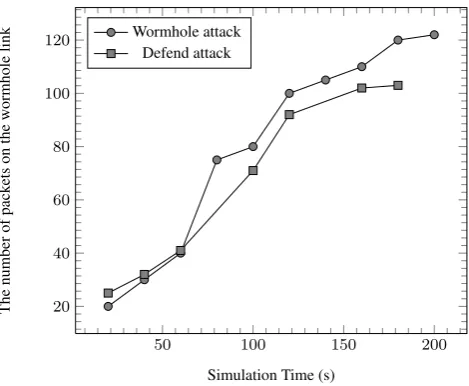
Fig. 7. The number of packets on the wormhole link against time for GPRW-MS-S
Finally, we evaluate the defending effectiveness after detecting the wormhole attack. When the wormhole attack is initiated, the surrounding packets would transfer from the original route to this highquality wormhole link. As shown in the Fig.7, the dot curve indicates that the number of packets on the wormhole link dramatically increases after the wormhole attack; when the defending nodes begin to take defensive measures, the square curve reveals that the number of packets on the wormhole link grows exponentially. Gradually, the wormhole link becomes con-gested and the metric of link decreases, which indicates that our algorithm’s defense against wormhole is effective. Therefore, when the nodes conduct the neighbor discovery, they will remove the malicious nodes from their respective neighbor lists and the wormhole link gets eliminated.
10 20 30 40
92 94 96 98
Density10−3/m2
W
ormhole
detection
rate
GRPW-MS GRPW-MS-s
we evaluate the algorithm’s performance on detecting wormhole by varying the length of wormhole link. Fig.8 reveals the re-lationship between wormhole detection rate and the density. In Fig.8, we can find that two algorithms both have a high detection rate. In GRPW-MS algorithm, when density varies from5to20, the detection rate has a slight downward trend. When density continues to increase, the detection rate levels off, maintaining at about0.955. By contrast, in our proposal, the detection rate shows an upward trend with the increase of density. Moreover, when density is greater than10, the detection rate of our algo-rithm GRPW-MS-S is higher than that of GRPW-MS. The reason is that the longer the wormhole link is, the more hops the packets have to pass from source to destination if packets are transmit-ted through the normal link. But if there exists a wormhole link, the hops between source and destination would dramatically de-crease and thus make the wormhole attack effect much more sig-nificant. So, according to our algorithm, we can easily detect the wormhole attack and thus get a high detection rate.
8. CONCLUSIONS
Because of the wireless medium’s openness, every node can hear the neighbor’s radio without being detected. When two or more malicious nodes construct one or more wormholes, they can de-stroy the entire Network by disrupting the routing protocol, es-pecially to GRPW-Mus protocols. In this paper we introduced a trust model to evaluate the trustiness of ”a node is the neigh-bor” in GRPW-Mus protocol. From the trustiness calculating, the node can get the right route instead of choosing the route caused by wormhole attack. This scheme can run with no need for net-work synchronization and GPS devices. But the scheme is based on trust evaluation, which predicts the future events by collecting the past events, so the trust evaluated by the node lags behind the attacks. In future work, we will work on how to secure the trusti-ness message transmission and how to get the recommended path in trust graph. We also take the node’s mobility into considera-tion, because when the network topology changing fast, the route will change fast, which means the trust model should keep track with it.
9. REFERENCES
[1] Tarik Arici, Toygar Akgun, and Yucel Altunbasak. A pre-diction error-based hypothesis testing method for sensor data acquisition. ACM Trans. Sen. Netw., 2(4):529–556, November 2006.
[2] Marcello Cinque, Antonio Coronato, Alessandro Testa, and Catello Di Martino. A survey on resiliency assessment techniques for wireless sensor networks. InProceedings of the 11th ACM International Symposium on Mobility Man-agement and Wireless Access, MobiWac ’13, pages 73–80, New York, NY, USA, 2013. ACM.
[3] Gabriel Martins Dias, Boris Bellalta, and Simon Oechsner. A survey about prediction-based data reduction in wireless sensor networks. ACM Comput. Surv., 49(3):58:1–58:35, November 2016.
[4] Tassos Dimitriou and Athanassios Giannetsos. Wormholes no more? localized wormhole detection and prevention in wireless networks. InProceedings of the 6th IEEE Inter-national Conference on Distributed Computing in Sensor Systems, DCOSS’10, pages 334–347, Berlin, Heidelberg, 2010. Springer-Verlag.
[5] Tassos Dimitriou and Athanassios Giannetsos. Wormholes no more? localized wormhole detection and prevention in wireless networks. InProceedings of the 6th IEEE Inter-national Conference on Distributed Computing in Sensor Systems, DCOSS’10, pages 334–347, Berlin, Heidelberg, 2010. Springer-Verlag.
[6] Dezun Dong, Mo Li, Yunhao Liu, Xiang-Yang Li, and Xi-angke Liao. Topological detection on wormholes in wire-less ad hoc and sensor networks.IEEE/ACM Trans. Netw., 19(6):1787–1796, December 2011.
[7] Mohammad Hammoudeh. Applying wireless sensor net-works to solve real-world problems. InProceedings of the International Conference on Intelligent Information Pro-cessing, Security and Advanced Communication, IPAC ’15, pages 1:1–1:1, New York, NY, USA, 2015. ACM. [8] Kamal S. Hamza and Fathy Amir. Centralized clustering
evolutionary algorithms for wireless sensor networks. In Proceedings of the 10th International Conference on In-formatics and Systems, INFOS ’16, pages 273–277, New York, NY, USA, 2016. ACM.
[9] Sunil Kumar Jangir and Naveen Hemrajani. Evaluation of black hole, wormhole and sybil attacks in mobile ad-hoc networks. InProceedings of the Second International Con-ference on Information and Communication Technology for Competitive Strategies, ICTCS ’16, pages 74:1–74:6, New York, NY, USA, 2016. ACM.
[10] Marek Klonowski and MichaB Koza. Countermeasures against sybil attacks in wsn based on proofs-of-work. In Proceedings of the Sixth ACM Conference on Security and Privacy in Wireless and Mobile Networks, WiSec ’13, pages 179–184, New York, NY, USA, 2013. ACM. [11] A. K¨opke, M. Swigulski, K. Wessel, D. Willkomm,
P. T. Klein Haneveld, T. E. V. Parker, O. W. Visser, H. S. Lichte, and S. Valentin. Simulating wireless and mobile networks in omnet++ the mixim vision. InProceedings of the 1st International Conference on Simulation Tools and Techniques for Communications, Networks and Systems & Workshops, Simutools ’08, pages 71:1–71:8, ICST, Brus-sels, Belgium, Belgium, 2008. ICST (Institute for Com-puter Sciences, Social-Informatics and Telecommunica-tions Engineering).
[12] Konrad-Felix Krentz and Gerhard Wunder. 6lowpan secu-rity: Avoiding hidden wormholes using channel reciprocity. InProceedings of the 4th International Workshop on Trust-worthy Embedded Devices, TrustED ’14, pages 13–22, New York, NY, USA, 2014. ACM.
[13] Abdelkader Laouid, Mohamed-Lamine Messai, Ahc`ene Bounceur, Reinhardt Euler, Abdelnasser Dahmani, and Ab-delkamel Tari. A dynamic and distributed key manage-ment scheme for wireless sensor networks. InProceedings of the International Conference on Internet of Things and Cloud Computing, ICC ’16, pages 70:1–70:6, New York, NY, USA, 2016. ACM.
[14] Stephen Paul Marsh. Formalising trust as a computational concept. Technical report, 1994.
[15] Takashi Minohara and Kyosuke Nishiyama. Poster: Detec-tion of wormhole attack on wireless sensor networks in duty-cycling operation. InProceedings of the 2016 Inter-national Conference on Embedded Wireless Systems and Networks, EWSN ’16, pages 281–282, USA, 2016. Junc-tion Publishing.
[16] Fihri Mohammed, El Fatimi Youssef, Hnini Abedehalim, and Ezzati Abdellah. Investigating the impact of black-hole attack on hierarchical protocols and direct transmission in wsn. In Proceedings of the International Conference on Internet of Things and Cloud Computing, ICC ’16, pages 78:1–78:4, New York, NY, USA, 2016. ACM.
[18] Ibrihich Ouafaa, Laassiri Jalal, Krit Salah-ddine, and El Hajji Said. The comparison study of hierarchical routing protocols for ad-hoc and wireless sensor networks: A liter-ature survey. InProceedings of the The International Con-ference on Engineering & MIS 2015, ICEMIS ’15, pages 32:1–32:8, New York, NY, USA, 2015. ACM.
[19] Yassine Sabri and Najib El Kamoun. Geographic routing in wireless sensor networks based on a partitioned archi-tecture.International Journal of Computer Applications, 153(5):1–8, Nov 2016.
[20] H. Sarbazi-Azad and M. Ould-Khaoua. A simple mathe-matical model of adaptive routing in wormhole k-ary n-cubes. InProceedings of the 2002 ACM Symposium on Ap-plied Computing, SAC ’02, pages 835–839, New York, NY, USA, 2002. ACM.
[21] Marcelo P. Sousa, Ajey Kumar, Marcelo S. Alencar, and Waslon T.A. Lopes. Performance evaluation of a selec-tive cooperaselec-tive scheme for wireless sensor networks. In Proceedings of the 6th ACM Symposium on Performance Evaluation of Wireless Ad Hoc, Sensor, and Ubiquitous Networks, PE-WASUN ’09, pages 85–92, New York, NY, USA, 2009. ACM.
[22] Yanqiang Sun, Xiaodong Wang, and Xingming Zhou. Jam-ming attack in wsn: A spatial perspective. InProceedings of the 13th International Conference on Ubiquitous Comput-ing, UbiComp ’11, pages 563–564, New York, NY, USA, 2011. ACM.
[23] Kun-Lin Tsai, MengYuan Ye, and Fang-Yie Leu. Secure power management scheme for wsn. InProceedings of the 7th ACM CCS International Workshop on Managing In-sider Security Threats, MIST ’15, pages 63–66, New York, NY, USA, 2015. ACM.
[24] R. Annie Uthra and S. V. Kasmir Raja. Qos routing in wireless sensor networks—a survey.ACM Comput. Surv., 45(1):9:1–9:12, December 2012.
[25] Andr´as Varga and Rudolf Hornig. An overview of the om-net++ simulation environment. InProceedings of the 1st International Conference on Simulation Tools and Tech-niques for Communications, Networks and Systems & Workshops, Simutools ’08, pages 60:1–60:10, ICST, Brus-sels, Belgium, Belgium, 2008. ICST (Institute for Com-puter Sciences, Social-Informatics and Telecommunica-tions Engineering).
[26] Weichao Wang and Bharat Bhargava. Visualization of wormholes in sensor networks. InProceedings of the 3rd ACM Workshop on Wireless Security, WiSe ’04, pages 51– 60, New York, NY, USA, 2004. ACM.
[27] Yurong Xu, Yi Ouyang, Zhengyi Le, James Ford, and Fillia Makedon. Analysis of range-free anchor-free localization in a wsn under wormhole attack. InProceedings of the 10th ACM Symposium on Modeling, Analysis, and Simulation of Wireless and Mobile Systems, MSWiM ’07, pages 344– 351, New York, NY, USA, 2007. ACM.