MECHANICAL ENGINEERING MODELLING - A SUCCESSFUL MSC-DEGREE PROGRAM OF EXCELLENCE
Ádám Kovács
Budapest University of Technology and Economics, Department of Applied Mechanics 1111 Budapest, Muegyetem rkp. 3, Hungary
Abstract
The first master programs in engineering (MSc) based on the Bologna System have started in Hungary in 2009, among them a fully English-taught program called Mechanical Engineering Modelling (MEM) in the Faculty of Mechanical Engineering Budapest University of Technology and Economics (BME) for talented students. In contrast of other engineering programs running parallely, which are focusing on one specialization, this program consists of two (a major and a minor) obligatory disciplines ("modules") giving two solid legs for students' competence. Students can choose these two modules in any combination from Solid Mechanics, Fluid Mechanics, Thermal Engineering and Design and Technology. Five years have past since the start of the program and we have already enough experience to judge its success. The program became the best one among all in demand, serving as a virtual center of excellence, and also a natural forum of international students participating in regular or exchange programs.
Key words: Mechanical engineering, master program, Bologna System
1. INTRODUCTION
The traditional mechanical engineering graduate program was running from 1871 (year of establishment of the Faculty of Mechanical Engineering) until 2008. During these almost 140 years a stable 5-year long mechanical engineering course program has crystallized containing a 3-year long deep and wide undergraduate program, followed by a 1.5-year long specialization and ended by the last – final project – semester.
Main merits of this tradition were the solid knowledge of fundamental (e.g. mathematics, physics) and mechanical disciplines (fluid and solid mechanics, thermodynamics), as well as expertise in one applied field (e.g. machine design, manufacturing, energetics, etc.) In the last decade this system was improved by introducing the compulsory choice of two different specializations („modules”) of equal weight. It was argued by the necessity of a broader knowledge of disciplines – „standing on two legs” was the slogan those times. Disciplines were classified in four groups by their topics and the main principle of selection was that both modules may not be in the same group.
The introduction of the Bologna System equally in all technical universities of Hungary extensively perturbed this system. We should rearrange the whole course by not only splitting it into two parts – BSc and Msc – but also to discover the appropriate frame for saving the merits of the previous system. There was no doubt, we could not map the old courses directly onto the new system.
Specialization have been needed to move at an earlier stage, since we should give a BSc-diploma after the 7th semester, and therefore master programs must fit to the undergraduate programs and at the same time to give deeper general knowledge of basic disciplines for the understanding of higher-level applications. Parallely to the effort of the faculty departments to create their own bachelor- and master-programs, a new idea has come true: to create a brand new, fully English-spoken master course, which is one side traditional, i.e. it is built on „two legs”, and on the other side modern, by containing new areas (e.g. coupled field problems, sophisticated measurement techniques, many computational issues). The result was called Mechanical Engineering Modelling.
2. MECHANICAL ENGINEERING PROGRAMS IN ENGLISH
The number of mechanical engineering master programs in English – not counting the British and Irish universities – is not high in Europe. An estimated number can be given, if one is searching in public databases or internet portals. MastersPortal.eu1 has the most comprehensive database on degree courses at 950 universities and schools in United Kingdom, Germany, The Netherlands, Belgium, Sweden, Finland, Poland, Spain, France, Italy and 29 other European Countries, including the European Union. Focusing on fully English mechanical engineering courses one finds 33 European universities in 18 countries (see Table 1) apart from the United Kingdom and Ireland.
Austria (2) Hungary (1) Russia (1)
Czech Republic (1) Italy (1) Slovakia (1)
Denmark (2) Lithuania (1) Spain (1)
Finnland (1) Netherlands (3) Sweden (6)
France (3) Poland (1) Switzerland (2)
Germany (5) Portugal (1) Turkey (1)
Table 1. Fully English mechanical engineering master courses in Europe
(Number of universities)
The offers are very different, what is justified by analyzing the content and structure of the courses. Three examples are given only, focusing on solid mechanics programs:
- Technical University of Munich, Germany – Computational Mechanics;
- Eindhoven University of Technology, Netherlands – Fluid and Solid Mechanics; - Aarhus University, Denmark.
In all three universities a 2-year long (4 semesters, 120 credits) course is offered. In Munich the program starts always in fall, the subjects are of 3 or 6 credits (their sum is 90) and the diploma work (master thesis) has 30 credits and must be accomplished within maximum 6 months. The course contains compulsory subjects (36 credits), compulsory elective subjects (24 credits) and freely elective subjects (30 credits). In the 1st semester subjects are prescribed, later there is a proportionally greater freedom for choices. The whole course is tuition-free.
In Eindhoven the program can be begun either in fall or in spring and almost all subjects are of 3 credits. The course consists of a large number of elective subjects (45 credits), there is a team-project (15 credits), and a so called ’Individual space’ (15 credits). The final project (45 credits) requires 1.5 semesters EU-citizens should pay 1.770 EUR/year, the others 12,650 EUR/year.
In Aarhus the year is split into 4 terms (each is 7 weeks long), followed by 2-4 weeks examination period. Freshmen can enter two times a year: in summer or in winter. The subjects are of 5 credits each, there are several ’semester projects’ (10 credits each) and the final project is of 30 credits. EU-citizens pay nothing, the tuition-fee is 15.300 EUR/year for others.
The motivation of launching such courses is probably similar in all institutions: first of all to offer an internationalized study-program, second to promote the high-level education of the host university and third – with exceptions – to increase the income.
1http://www.mastersportal.eu
3. OVERVIEW OF MEM
MEM is a fully English-speaking MSc-program for both Hungarian and foreigner students. The past 5 years from the beginning showed, that it attracts principally the talented Hungarian students, who intend to obtain a grade, which can be easily accepted by international industrial firms.
The compilation of teaching program targeted a balance between the traditional merits (e.g. stable fundaments) and up-to-date trends (e.g. numerical methods) built in the new frame established by the Bologna System.
3.1 Curriculum
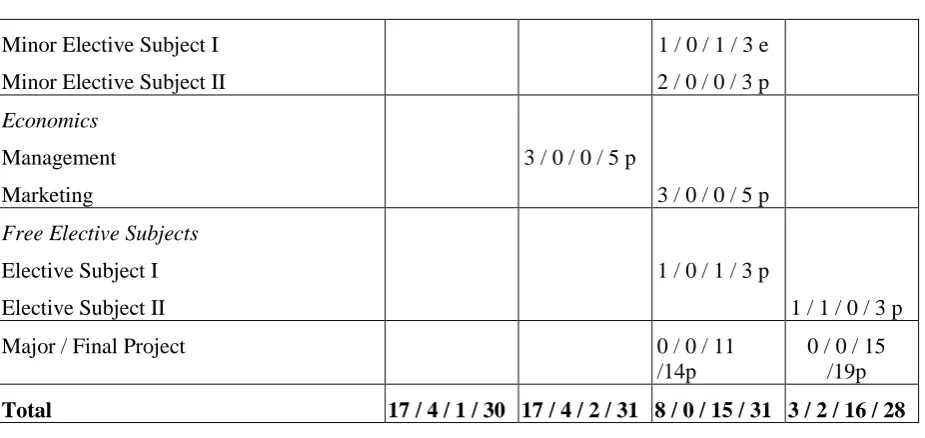
The curriculum of the program – starting with spring semester – is shown in Table 2. It contains the following subject blocks:
- Basic Subjects, which are compulsory for everybody, independently of the chosen modules; - Specific Compulsory Subjects, which are prescribed in the modules;
- Specific Elective Subjects, which can be chosen from a list given by the responsible department; - Economics, which are also compulsory for everybody;
- Free Elective Subjects, which can be chosen freely from all master subjects of the university;
- Major / Final Project. These serve for the preparation if the MSc-Thesis, which should be defended at the end of the 4th semester.
Subject 1. 2. 3. 4.
Basic subjects
Diff. Equations and Numerical Methods Laser Physics
Analytical Mechanics Advanced Fluid Mechanics Advanced Thermodynamics Electronics
Advance Control and Informatics
4 / 2 / 0 / 8 e
3 / 0 / 0 / 4 e 3 / 0 / 0 / 4 e 2 / 1 / 0 / 4 e
3 / 1 / 0 / 4 e
2 / 0 / 1 / 4 e 2 / 1 / 0 / 4 e
Specific Compulsory Subjects
Machine Design and Production Technology
Major Compulsory Subject I Major Compulsory Subject II Minor Compulsory Subject I Minor Compulsory Subject II
2 / 1 / 0 / 5 p 3 / 1 / 0 / 5 p
2 / 1 / 0 / 4 e 3 / 0 / 1 / 5 p
2 / 1 / 0 / 5 p
Specific Elective Subjects
Major Elective Subject I Major Elective Subject II Major Elective Subject III
1 / 0 / 2 / 3 e
1 / 0 / 1 / 3 e 1 / 1 / 0 / 3 e
Minor Elective Subject I Minor Elective Subject II
1 / 0 / 1 / 3 e 2 / 0 / 0 / 3 p
Economics
Management Marketing
3 / 0 / 0 / 5 p
3 / 0 / 0 / 5 p Free Elective Subjects
Elective Subject I Elective Subject II
1 / 0 / 1 / 3 p
1 / 1 / 0 / 3 p
Major / Final Project 0 / 0 / 11
/14p
0 / 0 / 15 /19p
Total 17 / 4 / 1 / 30 17 / 4 / 2 / 31 8 / 0 / 15 / 31 3 / 2 / 16 / 28 Table 2. Curriculum of MEM
(contact hours of lecture / seminar / labs / number of credits)
Students can enter in spring or in fall, but the subjects are offered once, therefore the order of the subjects and the total hours and credits are somehow different if the 1st semester is fall.
3.2 Modules
Students should choose one major and one minor module from the following disciplines:
- Design and Technology, - Fluid Mechanics, - Solid Mechanics, - Thermal Engineering.
9/10 departments of the Faculty are involved in the program with 1…10 subjects, among them several elective ones, of course. None of the other five master programs contains such a wide offer and participation!
The name of modules reflects the fundamental basements of mechanical engineering activities, however, they contain not only the traditional subjects. The curriculum showed in Table 3.1 gives the frame for all modules, however, the details show a large variety among them.
In Design and Technology the following subjects are offered: Specific Compulsory Subjects
F1.Advanced Manufacturing
F2.Machine Design and Production Technology F3.Product Modelling
Specific Elective Subjects
DT4. CAD Technology DT5. Fatigue and Fracture DT6. Materials Science
DT7. NC Machine Tools DT8. Process Planning DT9. Structural Analysis
The subjects can be clearly separated to design (subjects DT2, DT3, DT4, DT9) and manufacturing (DT1, DT7, DT8), the two relevant applied sciences in mechanical engineering. Two materials subjects (DT5, DT6) completes them, consisting of key issues for the practice. This module combines both and gives the students a deep understanding of these very important fields.
In Fluid Mechanics the offer is somehow different: Basic Subject
F0. Advanced Fluid Mechanics Specific Compulsory Subjects
F4.Computational Fluid Dynamics F2.Flow Measurements
Specific Elective Subjects
F3.Advanced Technical Acoustics
F4.Aerodynamics and its Applications for Vehicles F5.Building Aerodynamics
F6.Flow Stability
F7.Fluid Technical Processes Modelling F8.Hemodynamics
F9.Large-Eddy Simulation in Mechanical Engineering F10.Measurement Techniques and Signal Processing F11.Multiphase and Reactive Flow Modelling F12.Theoretical Acoustics
F13.Unsteady Flows in Pipe Networks
It is seen that besides theoretical foundation (subjects F0, F5, F8, F11, F12), emphasis is made on computational methods (subjects F1, F3, F6, F7, F9), measurement techniques (subjects F2, F4, F10, F13).
The module Solid Mechanics is one that contains only specified subjects of the field:
Basic Subject
S0. Analytical Mechanics
Specific Compulsory Subjects
S1.Continuum Mechanics S2.Finite Element Analysis Specific Elective Subjects
S3.Beam Structures
S4.Coupled Problems in Mechanics S5.Elasticity and Plasticity
S6.Experimental Methods in Solid Mechanics S7.Mechanisms
S8.Nonlinear Vibrations
In contrast of other mechanical engineering, or especially applied or computational mechanics courses in other universities this module focuses equally on equilibrium solid mechanics (subjects S1, S3, S4, S5) and dynamics (S0, S7, S8). Finite Element Analysis (on an advanced level, since this subject is compulsory already for all BSc-students in mechanical engineering) and Experimental Methods in Solid Mechanics give the necessary computational and measurement technique support for the everyday applications of the subjects.
The module Thermal Engineering contains the following subjects: Basic Subject
T0. Advanced Thermodynamics Specific Compulsory Subjects
T1.Combustion Technology
T2.Measurements in Thermal Engineering Specific Elective Subjects
T3.Energy Conversion Processes and its Equipment T4.Simulation of Energy Engineering Systems T5.Steam and Gas Turbines
T6.Thermo-Hydraulics T7.Thermo-Mechanics T8.Thermal Physics
This module combines four disciplines: classical thermodynamics (subjects T0, T2, T3, T4), heat engines (T1, T5), physics (T7, T8) and thermohydraulics (T6) and therefore gives a knowledge very well applicable in all mechanical engineering fields, where temperature raise appears.
In all four modules there is a great emphasis on both modelling issues (whether it means geometrical, physical or numerical one) and measurement techniques. This gives a unique character for MEM and makes it competitive among other similar courses.
4. ACTUAL STATE
Actually there are 6 master courses in the Faculty of Mechanical Engineering:
- Building Service and Process Engineering (BSPE) - Energy Engineering (EE)
- Industrial Design Engineering (IDE) - Mechanical Engineering (ME)
- Mechanical Engineering Modelling (MEM) - Mechatronics Engineering (MSE)
4.2 Statistics
Our courses are supervised regularly, typically every 5 years. One important part of this supervision consists of a collection of actual statistical data (number of students, admission rates, diploma notes, necessary time of studies, etc.) They reflect the effectiveness of courses in numbers. When we want to evaluate MEM, we should compare it with the other five master-courses of the Faculty.
MSc-courses are started in the 2nd (spring) semester of the academic year 2008/2009. The number of admitted students in MEM lies between 6-15% of the total number of new MSc-students in the Faculty (Table 3).
Academic year 2008/2009 2009/2010 2010/2011 2011/2012 2012/2013 Number of admitted
MEM students 8 22 38 28 40
Total number of admitted
MSc-students 55 219 312 430 452
Percentage 14.5% 10.0% 12.2% 6.5% 8.8%
Table 3. Number of admitted students (Bihari 2013)
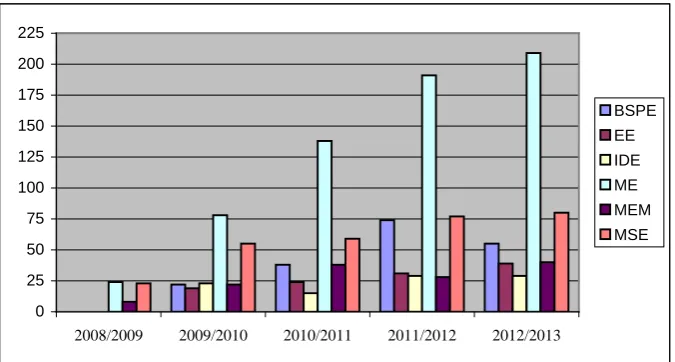
The permanent interest for the course can be proved by comparing the data given in Table 4.1.with those of the other master-courses of the Faculty (Fig. 1).
0 25 50 75 100 125 150 175 200 225
2008/2009 2009/2010 2010/2011 2011/2012 2012/2013
BSPE
EE
IDE ME
MEM MSE
Fig. 1. Number of admitted students
Parallely to the massive growth of the total number of admitted MSc-students the number of MEM-students is fluctuating, but the estimated average is slightly fewer than 10%. Taking into account the excellence-characteristic of this course this value is more than acceptable.
Average points of admitted students in the entrance examination are shown in Fig. 2.
80 81 82 83 84 85 86 87 88 89 90
2008/2009 2009/2010 2010/2011 2011/2012 2012/2013
BSPE
EE IDE
ME
MEM MSE
Fig. 2. Average points of admitted students in the entrance examination (max = 100)
In the last three years MEM-students achieved the best results, which show their very high level of knowledge – this course is kept as a center of excellence.
The average time between the beginning and the end of the course is 5 semesters (longest among all MSc-courses), which is one semester longer, than the normal time (4 semesters). This slip is mainly caused by the participation of many students in typically one-semester long exchange programs (e.g. Erasmus). The average value of the final diploma is 4.39 (1…5 scale, 5 is the best), which is the second best in the Faculty.
At the moment dominantly (~83%) our own BSc-students – who completed their studies in BME – apply for MEM-course, which is almost equal to the average value (in the Faculty (Table 4).
BSPE EE IDE ME MEM MSE
Internal
(from BME) 85.1% 81.1% 94.0% 84.8% 83.3% 73.8%
External
(others) 14.9% 18.9% 6.0% 15.2% 16.7% 26.2%
Table 4. Rate of internal and external admitted students in MSc-courses
These rates do not include exchange and other foreign students. Since MEM is the only English-speaking master-course in the Faculty, they are all admitted in this course. Their number is about 10%.
4.2 Reflections
Szipka (2013) reported about students’ reflections. The success of the program can only be well judged, if we consider these opinions. A detailed survey containing 100 questions have been sent to students. 26 students of MEM answered, which is about one-third of the total number of course students. This is not too much, however, enough to obtain an overview.
The overall satisfaction of the students with the course is 68.7%, which is a strong satisfactory in our evaluation system. At the same time the satisfaction with the quality of the education obtained an average note of 7.2/10, which is the best in the Faculty. Critical remarks were given corresponding to the lack of labs and practices in the course and too many overlaid chapters in BSc- and MSc-courses. Besides students, teachers were also asked by questionnaires. Relevant opinion was given concerning the introduction of team-projects (73%), 92% of teachers said, that the repetition of former stuff is negligible, which is somehow in contrast with students’ opinion. 50% of teachers also agree, that subjects are dominantly theoretical and more practical issue should be taught.
4.3 Ways of improvement
The aims of all master programs are to provide highly-qualified mechanical engineers for the industry and for the academics and they are especially true for MEM. Based on the demand of students a new timetable is being organized in block-system, which enables students to work in order to complete their knowledge or simply to earn money. In this system subjects of modules are organized in parallel blocks on given weekdays, so that compulsory subjects do not coincide and leaving at least one free weekday for the student.
Further improvement could be made by the elongation of internship time. Many firms require longer practice-time, than is usual now (4 weeks during the whole study). It is more important, if we take into account, that the 6-week long internship during the BSc-studies can be accepted, provided it was organized by the Faculty. The question arises more problems, e.g. shortening of the vacancy or the class-period, employment regulations in the industry, etc.
The invitation of more foreign lecturers would also improve the course. Erasmus and other exchange programs make possible to professors to give some lectures, however, it would be better to increase the number.
5. SUMMARY
MEM is one of the six master programs of the BME Faculty of Mechanical Engineering, however, the only one running fully in English. It serves as a virtual center of excellence for the best Hungarian, and also as an offer for regular and exchange foreign students. It saves the traditionally wide expertise by its two modules, gives the teachers an opportunity to exercise the English language and makes possible the encounter of students from different countries.
References
Bihari P 2013, Mesterképzések felülvizsgálata (Supervision of Master-courses), Summary report, BME Faculty of Mechanical Engineering, Budapest
Mechanical Engineering Master Programs in Europe <http://www.mastersportal.eu/search/?q=di-39|lv-master||f7643c70>
Szipka K 2013, Mesterképzések felülvizsgálata – hallgatói felmérések eredménye (Supervision of Master-courses – results of students survey), Vol. II/W, Report, BME Faculty of Mechanical Engineering, Budapest