R E S E A R C H A R T I C L E
Open Access
Single screening versus conventional
double screening for study selection in
systematic reviews: a methodological
systematic review
Siw Waffenschmidt
1*, Marco Knelangen
1, Wiebke Sieben
1, Stefanie Bühn
2and Dawid Pieper
2Abstract
Background:Stringent requirements exist regarding the transparency of the study selection process and the reliability of results. A 2-step selection process is generally recommended; this is conducted by 2 reviewers independently of each other (conventional double-screening). However, the approach is resource intensive, which can be a problem, as systematic reviews generally need to be completed within a defined period with a limited budget. The aim of the following methodological systematic review was to analyse the evidence available on whether single screening is equivalent to double screening in the screening process conducted in systematic reviews.
Methods:We searched Medline, PubMed and the Cochrane Methodology Register (last search 10/2018). We also used supplementary search techniques and sources (“similar articles”function in PubMed, conference abstracts and
reference lists). We included all evaluations comparing single with double screening. Data were summarized in a structured, narrative way.
Results:The 4 evaluations included investigated a total of 23 single screenings (12 sets for screening involving 9 reviewers). The median proportion of missed studies was 5% (range 0 to 58%). The median proportion of missed studies was 3% for the 6 experienced reviewers (range: 0 to 21%) and 13% for the 3 reviewers with less experience (range: 0 to 58%).
The impact of missing studies on the findings of meta-analyses had been reported in 2 evaluations for 7 single screenings including a total of 18,148 references. In 3 of these 7 single screenings–all conducted by the same
reviewer (with less experience)–the findings would have changed substantially. The remaining 4 of these 7 screenings were conducted by experienced reviewers and the missing studies had no impact or a negligible on the findings of the meta-analyses.
Conclusions:Single screening of the titles and abstracts of studies retrieved in bibliographic searches is not equivalent to double screening, as substantially more studies are missed. However, in our opinion such an approach could still represent an appropriate methodological shortcut in rapid reviews, as long as it is conducted by an experienced reviewer. Further research on single screening is required, for instance, regarding factors influencing the number of studies missed.
Keywords:Systematic reviews, Study selection, Methodology
© The Author(s). 2019Open AccessThis article is distributed under the terms of the Creative Commons Attribution 4.0 International License (http://creativecommons.org/licenses/by/4.0/), which permits unrestricted use, distribution, and reproduction in any medium, provided you give appropriate credit to the original author(s) and the source, provide a link to the Creative Commons license, and indicate if changes were made. The Creative Commons Public Domain Dedication waiver (http://creativecommons.org/publicdomain/zero/1.0/) applies to the data made available in this article, unless otherwise stated.
* Correspondence:[email protected]
1Institute for Quality and Efficiency in Health Care, Cologne, Germany
Background
A systematic, reproducible and transparent methodo-logical approach is a key component in systematic re-views. The systematic review process consists of several steps: after a systematic search for the relevant literature, the publications retrieved are screened and the relevant ones selected. This is followed by data extraction and analysis as well as an appraisal of the review’s results.
Stringent requirements exist with regard to the trans-parency of the study selection process (hereinafter re-ferred to as “screening”) and the reliability of the corresponding results. These requirements aim to avoid the non-detection of relevant evidence with a subse-quent risk of bias that endangers the validity of conclu-sions drawn from the evidence available [1,2].
The relevant publications are selected in several steps [3]:
– Exclusion of irrelevant references (i.e. references not fulfilling the eligibility criteria) through perusal of the titles, and, if available, the abstracts. If doubts exist as to the relevance of a study, the
corresponding full text is obtained.
– The full texts of the potentially relevant publications are obtained. The decision on the inclusion of the study is then made on the basis of these full texts.
All selection steps are performed by 2 persons inde-pendently of each other. Discrepancies are resolved by discussion.
The double screening approach is an international standard and recommended by well-established hand-books, which mostly refer only to the study by Edwards 2002 as the evidence base for this recommendation [4].
The double-screening approach offers the following advantages: firstly, it ensures that the study inclusion cri-teria are applied consistently, thus avoiding systematic errors, and secondly, random errors such as careless mistakes can be identified and corrected [5]. However, it is resource intensive, which can be a problem, as system-atic reviews generally need to be completed within a de-fined period with a limited budget [1,2].
In recent years, the focus of methodological research has shifted more to the analysis of efficiency resources, as there is a growing need to provide evidence products faster [6–9], for instance, as rapid reviews. This means that there is an increasing demand for research on methodological shortcuts. Its aim is to evaluate what impact these shortcuts have on the validity of the re-sults and conclusions of systematic reviews [6, 8, 9]. Single screening, which requires far fewer resources than double screening, also represents a potential shortcut [7, 10, 11]. It is therefore of interest whether, and under what conditions and with what impact, a sin-gle screening approach could be applied.
The aim of the following methodological systematic review was to analyse the evidence available on whether single screening is equivalent to double screening in the screening process conducted in systematic reviews.
Methods
Information sources and literature search
The electronic search strategy was developed by an expe-rienced information specialist (SW). We searched Medline (Ovid), all PubMed databases, and the Cochrane Method-ology Register (see Additional file1: Appendix A); the last bibliographic search was conducted in October 2018. We also applied the“similar articles”function in PubMed with 4 known key publications to identify additional relevant articles (applied for the first 20 entries). Furthermore, in June 2018 we searched all Cochrane Colloquium abstracts (since 2009) as well as the Cochrane database of oral, pos-ter and workshop presentations (since 1994). We also cross-checked reference lists of all articles included. In addition, we screened guidelines known to us on the con-duct of systematic reviews.
Eligibility criteria and selection of evaluations
We included all evaluations comparing single with double screening (i.e. including at least 2 reviewers screening independently of one another). We did not limit the evaluations to a certain number of screening steps, i.e. evaluations dealing only with one screening step (e.g. title/abstract screening) were eligible for inclu-sion. Evaluations involving students or persons without screening experience were excluded.. The rationale be-hind this decision was that we were only interested in testing standards for a highly professional environment (e.g. an HTA agency) and not in whether or how inex-perienced researchers could be involved in the screening process. No text mining or automation tools were allowed. No restrictions to the type of studies to be screened in the evaluations (e.g. therapeutic) were ap-plied. Only evaluations published in English and German were included.
As a minimum requirement, each evaluation had to report at least one quantitative measure for missing studies. No data on the agreement between reviewers (e.g. calculation of Cohen’s kappa) were considered, as they were not the focus of our study.
Table
1
Characteristics
of
the
4
evaluations
(Co
ntinued)
Ed
wards
2002
Do
ust
20
05
Pham
2016
She
milt
2016
exper
ience:
classif
ication
Re
viewer
2:
less
exp
erience
d
Re
viewer
3:
exper
ienced
Re
viewer
4:
exper
ienced
Re
viewer
2:
less
exp
erience
d
Reviewe
r
2:
le
ss
exper
ienced
Re-analysis meta
-analysis
No
No
Yes
Ye
s
Numb
er
of
missed
records
prese
nted
Ye
s
Ye
s
Yes
Ye
s
*Each
reviewer
was
assigned
to
3
sets
to
screen
(2
reviewers
for
each
set):
Reviewer
1:
sets
A,B,C;
Reviewer
2:
sets
A,D,E;
Reviewer
3:
sets
B,
D,
F;
Revie
wer
4:
sets
C,
E,
We used an online screening tool for the screening process (an internal tool called web Trial Selection Data-base, webTSDB). All titles/abstracts identified in the electronic databases were screened by 2 authors (DP, SB) independently of one another. Discrepancies were re-solved by discussion. Cochrane Colloquium abstracts and the database of oral poster and workshop presenta-tions were screened by one author (SB), which is in line with recommendations for the screening of supplemen-tary information sources [3]. All potentially relevant full texts were screened by 2 authors (DP, SB) independently of one another. Discrepancies were resolved by discus-sion. In the case of discrepant judgements, a third au-thor (SW) was involved.
Data extraction and synthesis
Data extraction was conducted by one author (SW) and checked by another (DP). Data were summarized in a structured narrative way. The narrative synthesis included information on the sample (evaluations, sets for screening, and studies included), reviewers, screening methods, the gold standard as well as results. In addition, we performed a post-hoc subgroup analysis to investigate the impact of reviewer experience. No assessment of risk of bias or methodological quality was performed due to the nature of our review and the wide range of study designs in-cluded in the evaluations analysed.
We calculated the median proportion of missed stud-ies with respect to all screenings. As there were great variations in the number of missed studies between re-viewers, we conducted post-hoc subgroup analyses based on reviewer experience.
We did not register our review in the International Prospective Register of Systematic Reviews (PROS-PERO), as it did not meet the eligibility criteria (inclu-sion of at least one outcome of direct patient or clinical relevance). The current systematic review was conducted in accordance with the Preferred Reporting Items for Systematic Reviews and Meta-Analyses (PRISMA) state-ment (Additional file3: Appendix C).
Results
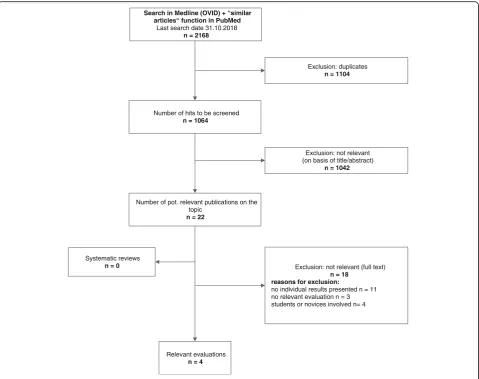
The bibliographic search yielded 2168 hits; 1064 hits without duplicates were screened; 22 were potentially relevant and obtained in full text (Fig. 1). Subsequent full paper-based screening excluded an additional 18 references, as no relevant evaluation was reported (n= 3) or potentially relevant evaluations involved stu-dents or persons without screening experience (n= 4) or quantified measures were either not reported or could not be calculated with the results reported (n= 11); see Additional file 4: Appendix D. We identified one poten-tially eligible evaluation reported in a conference abstract, with no full-text publication available. We contacted one
of the authors who responded that he had no access to any data. No additional evaluations were identified through handsearching or any other sources.
We ultimately included 4 evaluations (Edwards 2002 [12], Doust 2005 [13], Pham 2016 [11], Shemilt 2016 [10]).
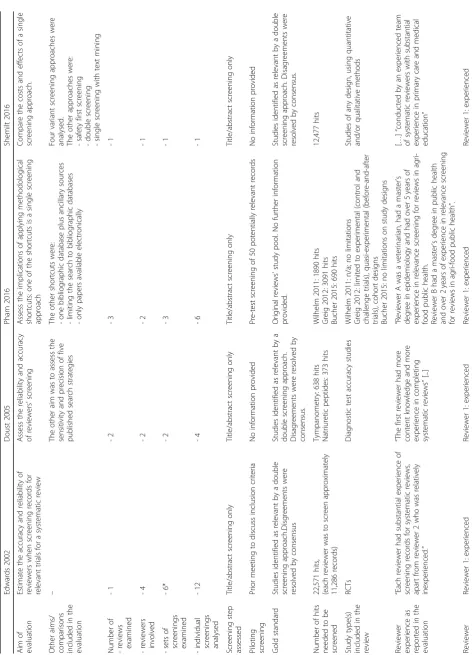
The characteristics of the 4 evaluations included are presented in Table 1. The 4 evaluations investigated a total of 23 single screenings (12 sets for screening con-ducted by 9 reviewers). The number of hits needed to be screened varied between 373 and 12,477 hits for each re-viewer per set. All evaluations only examined title and abstract screening.
The 4 evaluations considered different study types: randomized controlled trials (RCTs) (Edwards 2002), diagnostic test accuracy studies (Doust 2005), as well as all study types (Pham 2016 and Shemilt 2016). No pat-terns or associations were noticeable between study types screened in the evaluations and the number of studies missed.
The reviewers’level of experience in the 4 evaluations varied. Six of the 9 reviewers were described as being ex-perienced and 3 had a lower level of experience than the other reviewer(s) involved (see Table 1). All evaluations reported the number of studies missed by the reviewers. Two re-ran the meta-analysis without the missed studies (Pham 2016, Shemilt 2016).
Table 2summarizes the overall results and the results of the individual evaluations. Edwards 2002 is the only evaluation with a comparable research question and their results are similar to ours. That was to be expected, as Edwards 2002 contributed more than half (12 of 23) of the individual screenings to our overall result.
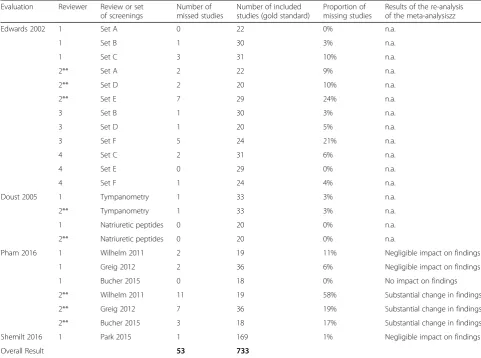
The number of missed studies in each set for screen-ing is displayed in Table 3 (summarized in Table 2). In 23 screenings conducted by 9 reviewers, 41,730 refer-ences were screened; the median proportion of missed studies was 5% (range 0 to 58%).
The post-hoc subgroup analyses based on reviewer ex-perience showed that 15 of the 23 screenings were con-ducted by 6 experienced reviewers and 8 by the 3 reviewers with less experience. The median proportion of missed studies for the experienced reviewers was 3% (range: 0 to 21%) and 13% for the 3 other reviewers (range: 0 to 58%).
Discussion
Our methodological systematic review of evaluations of single versus double screening showed that single screening of the titles and abstracts of studies re-trieved in bibliographic searches is not equivalent to double screening, as substantially more studies are missed. However, our findings indicate that this ap-proach could still represent a potential apap-proach for study selection, as long as it is conducted by an expe-rienced reviewer.
Reviewer experience
Only 2 of the 4 evaluations included re-analysed data without the missing studies. In 3 of the 7 single screen-ings, the studies missed would have led to a substantial change in the findings of the meta-analyses. Even though the reviewer responsible was less experienced than the other reviewer involved, the number of studies missed was surprising. For example, he or she missed 11 of 19 studies in the Wilhelm 2011 review ([14] in Pham 2016). In comparison with the results of the other evaluations,
Search in Medline (OVID) + “similar articles“ function in PubMed
Last search date 31.10.2018 n = 2168
Exclusion: duplicates n = 1104
Number of hits to be screened n = 1064
Number of pot. relevant publications on the topic
n = 22
Systematic reviews n = 0
Relevant evaluations n = 4
Exclusion: not relevant (full text) n = 18
reasons for exclusion:
no individual results presented n = 11 no relevant evaluation n = 3 students or novices involved n= 4
Exclusion: not relevant (on basis of title/abstract)
n = 1042
Fig. 1Flowchart for selection of evaluations of screening approaches
Table 2Median proportion of missed studies
Median proportion missed Sets of screenings Min. in % Max. in %
Overall result 5% 23 0% 57.8%
Edwards 2002 5.7% 12 0% 24.1%
Doust 2005 1.5% 4 0% 3.0%
Pham 2016 16.6% 6 0% 57.8%
this is a major outlier (the results for the other inexperi-enced reviewer ranged from 3 to 24% missed studies).
Pham did not provide an explanation for this, but even if study inclusion criteria had been applied inconsistently or random errors had occurred, this high number of studies missed is unusual. As this evaluation was the only one with pre-test screening, any topic-related sys-tematic error should have been eliminated.
It has also been shown that reviewer experience has an impact on other tasks in systematic reviews, such as asses-sing their methodological quality or extracting data [15].
Research question too vague
One explanation why studies were missed might be that the research question was too vague and largely depended on the reviewer’s interpretation. Pham stated “the specificity of the review question may have made identification of relevant studies more straight-forward for reviewers” [11]. This is supported by the fact that the Bucher 2015 review, which yielded the
best results for single screening, had the most nar-rowly defined research question of all 3 reviews in-cluded by Pham, with just one population group, one intervention and one pathogen. Patients, interven-tions, comparisons and outcomes (PICO) should therefore be defined as exactly as possible in order to avoid dependence on the reviewer’s interpretation of exactly what study types, interventions or, in this ex-ample, pathogens might be eligible.
Single screening approach as a methodological shortcut
The question remains as to whether it is an appropriate decision to apply single screening of titles and abstracts as a methodological shortcut for rapid reviews. As She-milt 2016 concluded, such a decision depends on “the willingness of review teams and funders to sacrifice re-call in order to substantively reduce the overall workload and total costs of systematic review production”. In our opinion, the reduction in recall is marginal and the re-sults are robust enough to establish this approach as a
Table 3Individual results of the evaluations
Evaluation Reviewer Review or set of screenings
Number of missed studies
Number of included studies (gold standard)
Proportion of missing studies
Results of the re-analysis of the meta-analysiszz
Edwards 2002 1 Set A 0 22 0% n.a.
1 Set B 1 30 3% n.a.
1 Set C 3 31 10% n.a.
2** Set A 2 22 9% n.a.
2** Set D 2 20 10% n.a.
2** Set E 7 29 24% n.a.
3 Set B 1 30 3% n.a.
3 Set D 1 20 5% n.a.
3 Set F 5 24 21% n.a.
4 Set C 2 31 6% n.a.
4 Set E 0 29 0% n.a.
4 Set F 1 24 4% n.a.
Doust 2005 1 Tympanometry 1 33 3% n.a.
2** Tympanometry 1 33 3% n.a.
1 Natriuretic peptides 0 20 0% n.a.
2** Natriuretic peptides 0 20 0% n.a.
Pham 2016 1 Wilhelm 2011 2 19 11% Negligible impact on findings
1 Greig 2012 2 36 6% Negligible impact on findings
1 Bucher 2015 0 18 0% No impact on findings
2** Wilhelm 2011 11 19 58% Substantial change in findings
2** Greig 2012 7 36 19% Substantial change in findings
2** Bucher 2015 3 18 17% Substantial change in findings
Shemilt 2016 1 Park 2015 1 169 1% Negligible impact on findings
Overall Result 53 733
methodological shortcut, as long as it is applied by an experienced reviewer.
Importance of bibliographic searches
A further aspect should also be considered in future re-search: all results of the 4 evaluations included refer to the screening of citations retrieved from bibliographic databases as the only information source. However, sys-tematic reviews generally consider several other sources (e.g. clinical study reports provided by regulatory agen-cies or manufacturers, study registries, scanning refer-ence lists etc.), so that the identification of the relevant study pool does not rely solely on the screening ap-proach for the results of the bibliographic search. The impact of these additional searches on the number of missing studies is not mentioned in the evaluations ana-lysed. However, there is evidence that these different search approaches (e.g. citation searching) could repre-sent useful supplementary alternatives [16]. It should also be noted that in the assessment of drugs, biblio-graphic databases provide insufficient information to en-able the assessment of a primary study and should therefore not be the main information source [17]. None of the 4 evaluations we included mentions this aspect, even though other information sources had also been considered (e.g. Pham 2016 evaluated the screening in Greig 2012, in which reference lists and conference pro-ceedings had also been screened). The impact of studies missed in the screening of results of bibliographic searches may thus be lower than expected when other information sources, which may contain the missing studies, are considered.
Available evidence
We could compare our results only with one other sys-tematic review. Recently, Robson 2018 summarized eval-uations of methods for systematic reviews, including study selection. According to their results on screening, the evidence supported the involvement of 2 independ-ent experienced reviewers. Robson 2018 included 4 studies to investigate the question as to whether 2 inde-pendent reviewers are required for study selection. They included Yip 2013 [25], which we excluded due to the lack of a quantitative measure for missing studies. In addition, we included one further evaluation (Pham 2016) not included in Robson. Robson summarized the conclusions of the evaluations included, whereas we ex-tracted and analysed the actual data. Our findings may thus potentially provide a more accurate picture of the current evidence. However, we emphasize that our find-ings can only indicate certain tendencies or be used to help create hypotheses for future research to test when a single screening approach might be applicable.
Research gaps
Evidence is still lacking on the issue as to whether the number of missed studies would change if full-text screening were also performed by a single reviewer.
A further important issue is the technical aspect of screening. Except for Shemilt 2016, none of the evalua-tions reported whether they had used a screening tool, ref-erence management software, or hardcopies for screening. It can be assumed that 15 to 20 years ago (applies to Edwards 2002 and Doust 2005) screening was conducted using hardcopies, an approach that might be more error prone than the use of a screening tool. Edwards 2002 noted that aspects of electronic records could influence their ease of identification for systematic reviews.
Future research
There is still a need for further validation of the single screening approach under consideration of the following factors:
– the impact of reviewer experience and poorly described PICO on the number of missed studies, – the impact of missed studies on results of meta-analyses, – the impact of non-bibliographic information sources on
the relevance of studies missed in bibliographic searches, – the impact of single full-text screening on sensitivity
(vs. double screening)
– the impact of training or piloting before starting screening
– the impact of screening tools
– the impact of the prioritization of references in combination with single or double screening (as analysed in Shemilt 2016).
We are therefore currently conducting further re-search on screening approaches, including single screen-ing, to address these open questions [18].
Limitations
Conclusions
Single screening of the titles and abstracts of studies re-trieved in bibliographic searches is not equivalent to double screening, as substantially more studies are missed. However, in our opinion such an approach could still represent an appropriate methodological shortcut in rapid reviews, as long as it is conducted by an experi-enced reviewer. The current evidence base on the im-pact of studies missed in screening is insufficient and further research is required to confirm our preliminary findings. There is also a need for further validation of the single screening approach, for example, by investi-gating factors that influence the number of studies missed in screening.
Additional files
Additional files 1:Appendix A: Search strategy (DOCX 22 kb)
Additional files 2:Appendix B: Detailed eligibility criteria (DOCX 14 kb)
Additional files 3:Appendix C: Completed PRISMA 2009 Checklist (DOC 67 kb)
Additional files 4:Appendix D: List of excluded references (full text) sorted by reasons (DOCX 21 kb)
Abbreviations
PICO:patient, intervention, comparison and outcome; RCT: randomized controlled trials
Acknowledgements
The authors thank Natalie McGauran for editorial support.
Authors’contributions
SW and DP contributed to the review’s design and drafted the initial manuscript. SB, MK and WS provided input into the review’s design and provided input. All authors contributed to the manuscript and revisions and approved the final manuscript.
Funding
No funding was received.
Availability of data and materials
All data generated or analysed during this systematic review are included in this published article.
Ethics approval and consent to participate
Not applicable.
Consent for publication
Not applicable.
Competing interests
The authors declare that they have no competing interests.
Author details
1Institute for Quality and Efficiency in Health Care, Cologne, Germany. 2Institute for Research in Operative Medicine Witten/Herdecke University,
Cologne, Germany.
Received: 24 January 2019 Accepted: 20 June 2019
References
1. O'Mara-Eves A, Thomas J, McNaught J, Miwa M, Ananiadou S. Using text mining for study identification in systematic reviews: a systematic review of current approaches. Syst Rev. 2015;4(1):5.
2. Olofsson H, Brolund A, Hellberg C, Silverstein R, Stenström K, Österberg M, et al. Can abstract screening workload be reduced using text mining? User experiences of the tool Rayyan. Res Syn Meth. 2017;8(3):275–80. 3. Institut für Qualität und Wirtschaftlichkeit im Gesundheitswesen. General
methods: version 5.0. 2018; https://www.iqwig.de/download/General-Methods_Version-5-0.pdf. Accessed 06.06.2018.
4. Edwards P, Clarke M, DiGuiseppi C, Pratap S, Roberts I, Wentz R.
Identification of randomized controlled trials in systematic reviews: accuracy and reliability of screening records. Stat Med. 2002;21(11):1635–40. 5. McDonagh M, Peterson K, Raina P, Chang S, Shekelle P. Avoiding bias in
selecting studies. Rockville, MD: Agency for Healthcare Research and Quality; 2013.https://effectivehealthcare.ahrq.gov/sites/default/files/pdf/ methods-guidance-bias_methods.pdf.
6. Garritty C, Stevens A, Gartlehner G, King V, Kamel C. Cochrane rapid reviews methods group to play a leading role in guiding the production of informed high-quality, timely research evidence syntheses. Syst Rev. 2016; 5(1):184.
7. Haby MM, Chapman E, Clark R, Barreto J, Reveiz L, Lavis JN. What are the best methodologies for rapid reviews of the research evidence for evidence-informed decision making in health policy and practice: a rapid review. Health Res Policy Syst. 2016;14(1):83.
8. Kaltenthaler E, Cooper K, Pandor A, Martyn-St James M, Chatters R, Wong R. The use of rapid review methods in health technology assessments: 3 case studies. BMC Med Res Methodol. 2016;16(1):108.
9. Patnode CD, Eder ML, Walsh ES, Viswanathan M, Lin JS. The use of rapid review methods for the U.S. preventive services task force. Am J Prev Med. 2018;54(1 Suppl 1):S19–25.
10. Shemilt I, Khan N, Park S, Thomas J. Use of cost-effectiveness analysis to compare the efficiency of study identification methods in systematic reviews. Syst Rev. 2016;5(1):140.
11. Pham MT, Waddell L, Rajic A, Sargeant JM, Papadopoulos A, McEwen SA. Implications of applying methodological shortcuts to expedite systematic reviews: three case studies using systematic reviews from Agri-food public health. Res Syn Meth. 2016;7(4):433–46.
12. Eden J, Levit L, Berg A, Morton S, editors. Finding what works in health care: standards for systematic reviews. Washington, DC: National Academies Press; 2011.https://doi.org/10.17226/13059.
13. Doust JA, Pietrzak E, Sanders S, Glasziou PP. Identifying studies for systematic reviews of diagnostic tests was difficult due to the poor sensitivity and precision of methodologic filters and the lack of information in the abstract. J Clin Epidemiol. 2005;58(5):444–9.
14. Wilhelm BJ, Rajic A, Greig J, Waddell L, Trottier G, Houde A, et al. A systematic review/meta-analysis of primary research investigating swine, pork or pork products as a source of zoonotic hepatitis E virus. Epidemiol Infect. 2011;139(8):1127–44.
15. Mathes T, Klassen P, Pieper D. Frequency of data extraction errors and methods to increase data extraction quality: a methodological review. BMC Med Res Methodol. 2017;17(1):152.
16. Dorée C, Hausner E, Mathisen M, Waffenschmidt S. Value of using different search approaches.http://vortal.htai.org/?q=node/993. Accessed 16.03.2016. 17. Köhler M, Haag S, Biester K, Brockhaus AC, McGauran N, Grouven U, et al.
Information on new drugs at market entry: retrospective analysis of health technology assessment reports versus regulatory reports, journal publications, and registry reports. BMJ. 2015;350:h796.
18. Waffenschmidt S, Hausner E, Sieben W, Jaschinski T, Knelangen M, Overesch I. Effective study selection using text mining or a single-screening approach: a study protocol. Syst Rev. 2018;7(1):166.
Publisher’s Note